Self-medication in student
         population
   Presentation of 2008 survey results


Žiga Hladnik and Janko Kersnik   Bled 20.9. 2008
Method
• Cross-sectional type of survey in a form of web based
  questionnaire
• Self developed questions consisted of several parts:
∀ •     demographical data
∀ •     relationship toward health as a value and trust to different
  sources of health information
∀ •     health status
∀ •     self-medication and other self-treatment practices
• Sampling procedure with emphasis on direct contact
  trough internal mailing lists
• Data statistically analysed with SPSS 16.0
Results: Demography
•     Total number of participants: 1294
•     Mean age: 22.4 (SD=3.24)
•     Gender:
                                                Men                             Women
      No.                                       303                              991
      %                                         23.4                             76.6

•     School:
                Med.       Pharm.      Engin,          Health     Biotec        Educ          Arts      Oth.
                                       geode           Care
No.              300        194         129             125        114            110         87         235
%               23.2        15.0        10.0            9.7         8.8           8.5         6.7       18.2

•     Study year:
      Year             1           2           3              4            5            6            Cand.
                                                                                                     grad.
    No.             278        312         243             152            47            35           195

    %               21.5       24.1        18.8            11.7           3.6           2.7          15.1
Results: Attitude to self-medication
• Students were asked to choose one of four statements that most closely
  describe their attitude towards self-medication practice.
     
                                                       N (1294=100%)

    Self-medication is the method of choice             755 (58.3%)
    for treating some symptoms

    Self-medication is the method of choice for all     332 (25.7%)
    symptoms. If my condition does not improve I
    can still visit a doctor.
    Self-medication is the right method but only if     173 (13.4%)
    I get this advice from a doctor or a
    pharmacist
    Self-medication is not the right method              34 (2.6%)
    because I can miss a serious disease if I do not
    visit a doctor
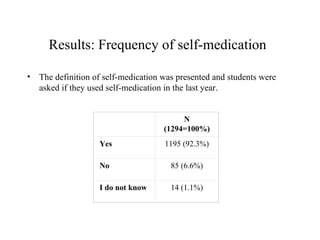
Results: Frequency of self-medication

• The definition of self-medication was presented and students were
  asked if they used self-medication in the last year.


                                         N
                                    (1294=100%)
                   Yes               1195 (92.3%)

                   No                 85 (6.6%)

                   I do not know      14 (1.1%)
Results: Length of self-medication
• The question was to determine the length of self-medication believed
  to be the appropriate one without an improvement of the symptoms.
  Six time periods were presented and the students were asked to choose
  one.

                               N (1294=100%)
        ≤1 day                    50 (3.9%)
        ≤1 week                  810 (62.6%)
        ≤2 weeks                 216 (16.7%)
        ≤1 month                  78 (6.0%)
        ≤½ year                   24 (1.9%)
        >½ year                   25 (1.9%)
        I do not know             91 (7.0%)
Results: Reasons for self-medication
• Seven potentially important reasons were presented and participants
  were asked to rate them on a Likert scale from 1-7. (1 – not important;
  7 – very important).
                                                                Mean
     I have mild problems and I think it is not necessary to    5.76
     visit a doctor
     I was informed by a doctor or a pharmacist that my         4.31
     symptoms are suitable for self-medication
     I want to have a more active role considering my health    3.76
     I was informed by relatives, friends, media, … that my     3.19
     symptoms are suitable for self-medication
     I do not want to visit a doctor due to long waiting time   2.90
     The doctor did not treat my problems successfully          2.40
     I do not trust my doctor                                   1.84
Results: The use of drugs and other
         procedures for self-medication
• The number of participants that reported the use of the drug or a
  procedure without consulting a doctor.
                                        N (1294=100%)

         Herbal tea                     903 (69.8%)
         Herbs                          822 (63.5%)
         Vitamins and minerals          809 (62.5%)
         Non prescription or OTC        655 (50.6%)
         drugs
         Diet                           584 (45.1%)
         Prescription medicines         272 (21.0%)
         Drugs from the healer           90 (7.0%)
         Homeopathic drugs               80 (6.2%)
         Mass gain supplements           38 (2.9%)
Results: Symptoms and signs that are
           frequently self-medicated
• We presented 29 common health problems and asked students to
  select how they cope with them. Ten symptoms and signs that were
  most frequently self-treated or left untreated are presented.
                                           N (1294=100%)

        Headache                            1186 (91.7%)
        Nasal discharge                     1137 (87.9%)
        Fatigue/tiredness                   1115 (86.2%)
        Cough                               1085 (83.8%)
        Diarrhoea                           1048 (81.0%)
        Raised body temperature             1014 (78.4%)
        Common cold and flu                 1003 (77.5%)
        Mild to moderate pain in muscles    978 (75.6%)
        and joints
        Sore throat                         873 (67.5%)
        Vomiting                            861(66.5%)
Conclusion
• Self-medication is widely used among student population
• Herbal tea, vitamins and minerals, herbs and non-
  prescription drugs are most commonly used without
  consultation of a doctor
• The health related problems that students reported they
  treated by themselves are all a part of the group of most
  frequently encountered self limiting problems
• Students have fairly good knowledge when and how long
  self-medication is appropriate but the fact that more than
  25% of participants would self-treat all symptoms or signs
  is a reason for concern
Limitations
• The interpretation of the results should be
  careful due to:
     -Unknown response rate
     -Unknown number of students without access to the
      computer
• But a large number of participating students
  from specific schools gives validity and
  reliability of the results and allows us to
  draw generalizing conclusions.
Acknowledgement
• We are thankful to all the participating
  students.
• We acknowledge great support of GFK
  Slovenija tržne raziskave d.o.o. by
  providing us a platform free of charge.

Self Medication In Students’ Population

  • 1.
    Self-medication in student population Presentation of 2008 survey results Žiga Hladnik and Janko Kersnik Bled 20.9. 2008
  • 2.
    Method • Cross-sectional typeof survey in a form of web based questionnaire • Self developed questions consisted of several parts: ∀ • demographical data ∀ • relationship toward health as a value and trust to different sources of health information ∀ • health status ∀ • self-medication and other self-treatment practices • Sampling procedure with emphasis on direct contact trough internal mailing lists • Data statistically analysed with SPSS 16.0
  • 3.
    Results: Demography • Total number of participants: 1294 • Mean age: 22.4 (SD=3.24) • Gender: Men Women No. 303 991 % 23.4 76.6 • School: Med. Pharm. Engin, Health Biotec Educ Arts Oth. geode Care No. 300 194 129 125 114 110 87 235 % 23.2 15.0 10.0 9.7 8.8 8.5 6.7 18.2 • Study year: Year 1 2 3 4 5 6 Cand. grad. No. 278 312 243 152 47 35 195 % 21.5 24.1 18.8 11.7 3.6 2.7 15.1
  • 4.
    Results: Attitude toself-medication • Students were asked to choose one of four statements that most closely describe their attitude towards self-medication practice.   N (1294=100%) Self-medication is the method of choice 755 (58.3%) for treating some symptoms Self-medication is the method of choice for all 332 (25.7%) symptoms. If my condition does not improve I can still visit a doctor. Self-medication is the right method but only if 173 (13.4%) I get this advice from a doctor or a pharmacist Self-medication is not the right method 34 (2.6%) because I can miss a serious disease if I do not visit a doctor
  • 5.
    Results: Frequency ofself-medication • The definition of self-medication was presented and students were asked if they used self-medication in the last year. N (1294=100%) Yes 1195 (92.3%) No 85 (6.6%) I do not know 14 (1.1%)
  • 6.
    Results: Length ofself-medication • The question was to determine the length of self-medication believed to be the appropriate one without an improvement of the symptoms. Six time periods were presented and the students were asked to choose one. N (1294=100%) ≤1 day 50 (3.9%) ≤1 week 810 (62.6%) ≤2 weeks 216 (16.7%) ≤1 month 78 (6.0%) ≤½ year 24 (1.9%) >½ year 25 (1.9%) I do not know 91 (7.0%)
  • 7.
    Results: Reasons forself-medication • Seven potentially important reasons were presented and participants were asked to rate them on a Likert scale from 1-7. (1 – not important; 7 – very important). Mean I have mild problems and I think it is not necessary to 5.76 visit a doctor I was informed by a doctor or a pharmacist that my 4.31 symptoms are suitable for self-medication I want to have a more active role considering my health 3.76 I was informed by relatives, friends, media, … that my 3.19 symptoms are suitable for self-medication I do not want to visit a doctor due to long waiting time 2.90 The doctor did not treat my problems successfully 2.40 I do not trust my doctor 1.84
  • 8.
    Results: The useof drugs and other procedures for self-medication • The number of participants that reported the use of the drug or a procedure without consulting a doctor. N (1294=100%) Herbal tea 903 (69.8%) Herbs 822 (63.5%) Vitamins and minerals 809 (62.5%) Non prescription or OTC 655 (50.6%) drugs Diet 584 (45.1%) Prescription medicines 272 (21.0%) Drugs from the healer 90 (7.0%) Homeopathic drugs 80 (6.2%) Mass gain supplements 38 (2.9%)
  • 9.
    Results: Symptoms andsigns that are frequently self-medicated • We presented 29 common health problems and asked students to select how they cope with them. Ten symptoms and signs that were most frequently self-treated or left untreated are presented. N (1294=100%) Headache 1186 (91.7%) Nasal discharge 1137 (87.9%) Fatigue/tiredness 1115 (86.2%) Cough 1085 (83.8%) Diarrhoea 1048 (81.0%) Raised body temperature 1014 (78.4%) Common cold and flu 1003 (77.5%) Mild to moderate pain in muscles 978 (75.6%) and joints Sore throat 873 (67.5%) Vomiting 861(66.5%)
  • 10.
    Conclusion • Self-medication iswidely used among student population • Herbal tea, vitamins and minerals, herbs and non- prescription drugs are most commonly used without consultation of a doctor • The health related problems that students reported they treated by themselves are all a part of the group of most frequently encountered self limiting problems • Students have fairly good knowledge when and how long self-medication is appropriate but the fact that more than 25% of participants would self-treat all symptoms or signs is a reason for concern
  • 11.
    Limitations • The interpretationof the results should be careful due to: -Unknown response rate -Unknown number of students without access to the computer • But a large number of participating students from specific schools gives validity and reliability of the results and allows us to draw generalizing conclusions.
  • 12.
    Acknowledgement • We arethankful to all the participating students. • We acknowledge great support of GFK Slovenija tržne raziskave d.o.o. by providing us a platform free of charge.