Direct Care Workers’ Experiences with
Patient Death: Training and Support Needs
Kathrin Boerner
Jewish Home Lifecare/Icahn School of Medicine at Mount Sinai

The research presented herein was supported by a grant from the National
Institute on Aging (1 R03 AG034076), as well as by several private donors.
Background
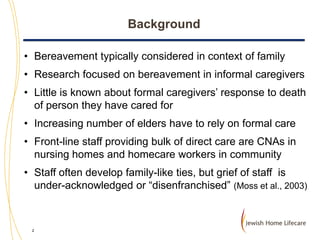
• Bereavement typically considered in context of family
• Research focused on bereavement in informal caregivers
• Little is known about formal caregivers’ response to death
of person they have cared for
• Increasing number of elders have to rely on formal care
• Front-line staff providing bulk of direct care are CNAs in
nursing homes and homecare workers in community
• Staff often develop family-like ties, but grief of staff is
under-acknowledged or “disenfranchised” (Moss et al., 2003)

2
Study Objectives

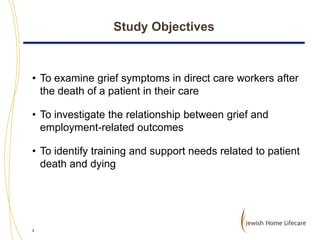
• To examine grief symptoms in direct care workers after
the death of a patient in their care
• To investigate the relationship between grief and
employment-related outcomes
• To identify training and support needs related to patient
death and dying

3
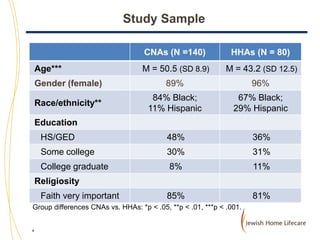
Study Sample
CNAs (N =140)

HHAs (N = 80)

M = 50.5 (SD 8.9)

M = 43.2 (SD 12.5)

Gender (female)

89%

96%

Race/ethnicity**

84% Black;
11% Hispanic

67% Black;
29% Hispanic

HS/GED

48%

36%

Some college

30%

31%

College graduate

8%

11%

85%

81%

Age***

Education

Religiosity
Faith very important

Group differences CNAs vs. HHAs: *p < .05, **p < .01, ***p < .001.

4
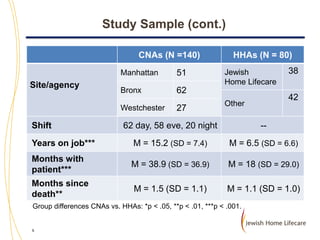
Study Sample (cont.)
CNAs (N =140)
Manhattan

Site/agency

51

Bronx

Jewish
Home Lifecare

62

Westchester

Shift

HHAs (N = 80)

27

38
42

Other

62 day, 58 eve, 20 night

--

Years on job***

M = 15.2 (SD = 7.4)

M = 6.5 (SD = 6.6)

Months with
patient***

M = 38.9 (SD = 36.9)

M = 18 (SD = 29.0)

Months since
death**

M = 1.5 (SD = 1.1)

M = 1.1 (SD = 1.0)

Group differences CNAs vs. HHAs: *p < .05, **p < .01, ***p < .001.

5
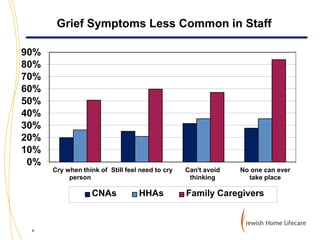
Grief Symptoms Less Common in Staff
90%
80%
70%
60%
50%
40%
30%
20%
10%
0%
Cry when think of Still feel need to cry
person

CNAs

6

HHAs

Can't avoid
thinking

No one can ever
take place

Family Caregivers
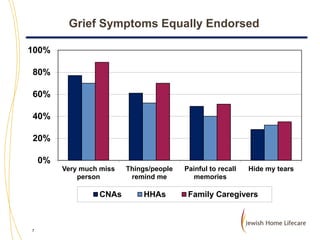
Grief Symptoms Equally Endorsed
100%
80%

60%
40%
20%
0%
Very much miss
person

CNAs

7

Things/people
remind me

HHAs

Painful to recall
memories

Hide my tears

Family Caregivers
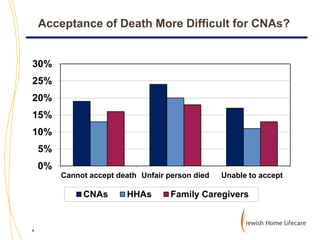
Acceptance of Death More Difficult for CNAs?

30%
25%
20%
15%
10%
5%
0%
Cannot accept death Unfair person died

CNAs

8

HHAs

Unable to accept

Family Caregivers
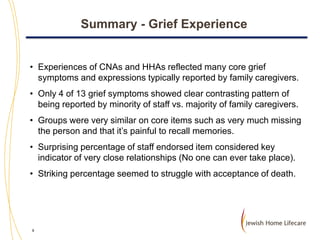
Summary - Grief Experience

• Experiences of CNAs and HHAs reflected many core grief
symptoms and expressions typically reported by family caregivers.
• Only 4 of 13 grief symptoms showed clear contrasting pattern of
being reported by minority of staff vs. majority of family caregivers.
• Groups were very similar on core items such as very much missing
the person and that it’s painful to recall memories.
• Surprising percentage of staff endorsed item considered key
indicator of very close relationships (No one can ever take place).

• Striking percentage seemed to struggle with acceptance of death.

9
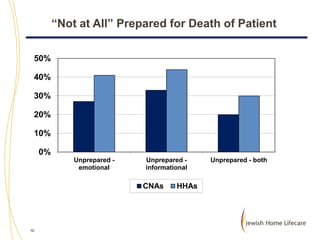
“Not at All” Prepared for Death of Patient
50%

40%
30%
20%

10%
0%
Unprepared emotional

Unprepared informational

CNAs

10

HHAs

Unprepared - both
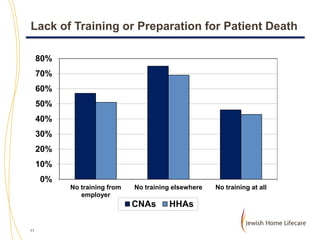
Lack of Training or Preparation for Patient Death
80%

70%
60%
50%
40%
30%
20%
10%

0%
No training from
employer

No training elsewhere

CNAs
11

HHAs

No training at all
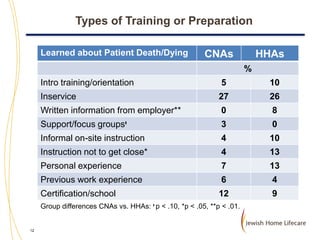
Types of Training or Preparation
Learned about Patient Death/Dying

CNAs

HHAs
%

Intro training/orientation

5

10

Inservice

27

26

Written information from employer**

0

8

Support/focus groupsᵻ

3

0

Informal on-site instruction

4

10

Instruction not to get close*

4

13

Personal experience

7

13

Previous work experience

6

4

Certification/school

12

9

Group differences CNAs vs. HHAs: ᵻ p < .10, *p < .05, **p < .01.

12
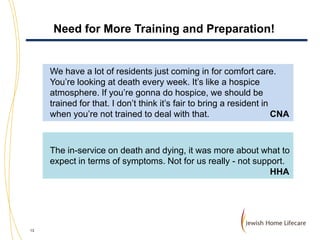
Need for More Training and Preparation!

We have a lot of residents just coming in for comfort care.
You’re looking at death every week. It’s like a hospice
atmosphere. If you’re gonna do hospice, we should be
trained for that. I don’t think it’s fair to bring a resident in
when you’re not trained to deal with that.
CNA

The in-service on death and dying, it was more about what to
expect in terms of symptoms. Not for us really - not support.
HHA

13
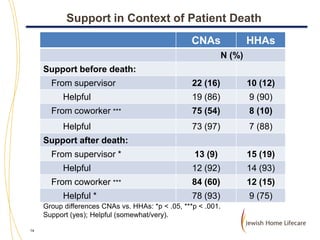
Support in Context of Patient Death
CNAs

HHAs

N (%)

Support before death:
From supervisor
Helpful

From coworker ***
Helpful

22 (16)

10 (12)

19 (86)

9 (90)

75 (54)

8 (10)

73 (97)

7 (88)

13 (9)

15 (19)

12 (92)

14 (93)

84 (60)

12 (15)

78 (93)

9 (75)

Support after death:
From supervisor *

Helpful
From coworker ***
Helpful *

Group differences CNAs vs. HHAs: *p < .05, ***p < .001.
Support (yes); Helpful (somewhat/very).
14
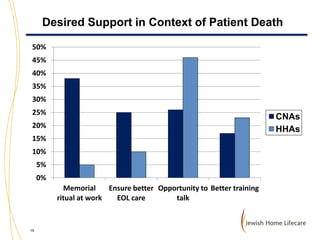
Desired Support in Context of Patient Death
50%
45%
40%
35%

30%
25%

CNAs
HHAs

20%
15%
10%
5%
0%
Memorial
Ensure better Opportunity to Better training
ritual at work
EOL care
talk

15
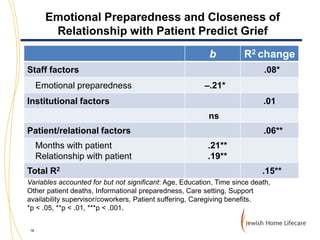
Emotional Preparedness and Closeness of
Relationship with Patient Predict Grief
b
Staff factors
Emotional preparedness

R2 change
.08*

–.21*

Institutional factors

.01
ns

Patient/relational factors
Months with patient
Relationship with patient
Total R2

.06**
.21**
.19**
.15**

Variables accounted for but not significant: Age, Education, Time since death,
Other patient deaths, Informational preparedness, Care setting, Support
availability supervisor/coworkers, Patient suffering, Caregiving benefits.
*p < .05, **p < .01, ***p < .001.
16
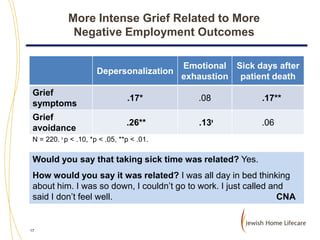
More Intense Grief Related to More
Negative Employment Outcomes

Depersonalization

Emotional Sick days after
exhaustion patient death

Grief
symptoms

.17*

.08

.17**

Grief
avoidance

.26**

.13ᵻ

.06

N = 220. ᵻ p < .10, *p < .05, **p < .01.

Would you say that taking sick time was related? Yes.
How would you say it was related? I was all day in bed thinking
about him. I was so down, I couldn’t go to work. I just called and
said I don’t feel well.
CNA

17
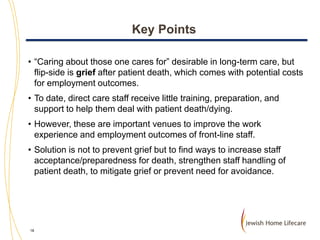
Key Points
• “Caring about those one cares for” desirable in long-term care, but
flip-side is grief after patient death, which comes with potential costs
for employment outcomes.
• To date, direct care staff receive little training, preparation, and
support to help them deal with patient death/dying.
• However, these are important venues to improve the work
experience and employment outcomes of front-line staff.

• Solution is not to prevent grief but to find ways to increase staff
acceptance/preparedness for death, strengthen staff handling of
patient death, to mitigate grief or prevent need for avoidance.

18
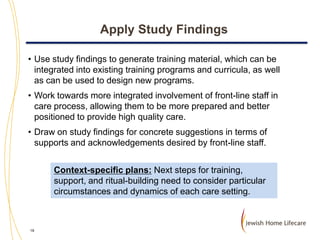
Apply Study Findings
• Use study findings to generate training material, which can be
integrated into existing training programs and curricula, as well
as can be used to design new programs.
• Work towards more integrated involvement of front-line staff in
care process, allowing them to be more prepared and better
positioned to provide high quality care.
• Draw on study findings for concrete suggestions in terms of
supports and acknowledgements desired by front-line staff.
Context-specific plans: Next steps for training,
support, and ritual-building need to consider particular
circumstances and dynamics of each care setting.

19
Staff Appreciative of Opportunity to
Talk about Patient Death
This [study] is a good thing. Like now: it makes me feel like I’m kind of
getting real closure with [resident]. I got to say what I wanted to say.
Even if I’m not getting answers back, I’m letting out all I had here. If we
had this a long time ago, maybe new CNAs would act different with it.
CNA
For me, I’m grateful you did come. I wanted to tell someone [about
client]. You did inquire about her, and I was able to tell you. That’s the
part I’m gonna hold.
HHA
This interview makes me happy. It makes me happy that [JHL] wants to
know what is my emotional state, how the employee felt or how it
affected him/her. Truth is I did not do it for the money. This interview
has a value and I feel happy that [JHL] is concerned about me.
HHA

20

Kathrin Boerner-Direct Care Worker's Experiences with Patient Death: Training and Support

  • 1.
    Direct Care Workers’Experiences with Patient Death: Training and Support Needs Kathrin Boerner Jewish Home Lifecare/Icahn School of Medicine at Mount Sinai The research presented herein was supported by a grant from the National Institute on Aging (1 R03 AG034076), as well as by several private donors.
  • 2.
    Background • Bereavement typicallyconsidered in context of family • Research focused on bereavement in informal caregivers • Little is known about formal caregivers’ response to death of person they have cared for • Increasing number of elders have to rely on formal care • Front-line staff providing bulk of direct care are CNAs in nursing homes and homecare workers in community • Staff often develop family-like ties, but grief of staff is under-acknowledged or “disenfranchised” (Moss et al., 2003) 2
  • 3.
    Study Objectives • Toexamine grief symptoms in direct care workers after the death of a patient in their care • To investigate the relationship between grief and employment-related outcomes • To identify training and support needs related to patient death and dying 3
  • 4.
    Study Sample CNAs (N=140) HHAs (N = 80) M = 50.5 (SD 8.9) M = 43.2 (SD 12.5) Gender (female) 89% 96% Race/ethnicity** 84% Black; 11% Hispanic 67% Black; 29% Hispanic HS/GED 48% 36% Some college 30% 31% College graduate 8% 11% 85% 81% Age*** Education Religiosity Faith very important Group differences CNAs vs. HHAs: *p < .05, **p < .01, ***p < .001. 4
  • 5.
    Study Sample (cont.) CNAs(N =140) Manhattan Site/agency 51 Bronx Jewish Home Lifecare 62 Westchester Shift HHAs (N = 80) 27 38 42 Other 62 day, 58 eve, 20 night -- Years on job*** M = 15.2 (SD = 7.4) M = 6.5 (SD = 6.6) Months with patient*** M = 38.9 (SD = 36.9) M = 18 (SD = 29.0) Months since death** M = 1.5 (SD = 1.1) M = 1.1 (SD = 1.0) Group differences CNAs vs. HHAs: *p < .05, **p < .01, ***p < .001. 5
  • 6.
    Grief Symptoms LessCommon in Staff 90% 80% 70% 60% 50% 40% 30% 20% 10% 0% Cry when think of Still feel need to cry person CNAs 6 HHAs Can't avoid thinking No one can ever take place Family Caregivers
  • 7.
    Grief Symptoms EquallyEndorsed 100% 80% 60% 40% 20% 0% Very much miss person CNAs 7 Things/people remind me HHAs Painful to recall memories Hide my tears Family Caregivers
  • 8.
    Acceptance of DeathMore Difficult for CNAs? 30% 25% 20% 15% 10% 5% 0% Cannot accept death Unfair person died CNAs 8 HHAs Unable to accept Family Caregivers
  • 9.
    Summary - GriefExperience • Experiences of CNAs and HHAs reflected many core grief symptoms and expressions typically reported by family caregivers. • Only 4 of 13 grief symptoms showed clear contrasting pattern of being reported by minority of staff vs. majority of family caregivers. • Groups were very similar on core items such as very much missing the person and that it’s painful to recall memories. • Surprising percentage of staff endorsed item considered key indicator of very close relationships (No one can ever take place). • Striking percentage seemed to struggle with acceptance of death. 9
  • 10.
    “Not at All”Prepared for Death of Patient 50% 40% 30% 20% 10% 0% Unprepared emotional Unprepared informational CNAs 10 HHAs Unprepared - both
  • 11.
    Lack of Trainingor Preparation for Patient Death 80% 70% 60% 50% 40% 30% 20% 10% 0% No training from employer No training elsewhere CNAs 11 HHAs No training at all
  • 12.
    Types of Trainingor Preparation Learned about Patient Death/Dying CNAs HHAs % Intro training/orientation 5 10 Inservice 27 26 Written information from employer** 0 8 Support/focus groupsᵻ 3 0 Informal on-site instruction 4 10 Instruction not to get close* 4 13 Personal experience 7 13 Previous work experience 6 4 Certification/school 12 9 Group differences CNAs vs. HHAs: ᵻ p < .10, *p < .05, **p < .01. 12
  • 13.
    Need for MoreTraining and Preparation! We have a lot of residents just coming in for comfort care. You’re looking at death every week. It’s like a hospice atmosphere. If you’re gonna do hospice, we should be trained for that. I don’t think it’s fair to bring a resident in when you’re not trained to deal with that. CNA The in-service on death and dying, it was more about what to expect in terms of symptoms. Not for us really - not support. HHA 13
  • 14.
    Support in Contextof Patient Death CNAs HHAs N (%) Support before death: From supervisor Helpful From coworker *** Helpful 22 (16) 10 (12) 19 (86) 9 (90) 75 (54) 8 (10) 73 (97) 7 (88) 13 (9) 15 (19) 12 (92) 14 (93) 84 (60) 12 (15) 78 (93) 9 (75) Support after death: From supervisor * Helpful From coworker *** Helpful * Group differences CNAs vs. HHAs: *p < .05, ***p < .001. Support (yes); Helpful (somewhat/very). 14
  • 15.
    Desired Support inContext of Patient Death 50% 45% 40% 35% 30% 25% CNAs HHAs 20% 15% 10% 5% 0% Memorial Ensure better Opportunity to Better training ritual at work EOL care talk 15
  • 16.
    Emotional Preparedness andCloseness of Relationship with Patient Predict Grief b Staff factors Emotional preparedness R2 change .08* –.21* Institutional factors .01 ns Patient/relational factors Months with patient Relationship with patient Total R2 .06** .21** .19** .15** Variables accounted for but not significant: Age, Education, Time since death, Other patient deaths, Informational preparedness, Care setting, Support availability supervisor/coworkers, Patient suffering, Caregiving benefits. *p < .05, **p < .01, ***p < .001. 16
  • 17.
    More Intense GriefRelated to More Negative Employment Outcomes Depersonalization Emotional Sick days after exhaustion patient death Grief symptoms .17* .08 .17** Grief avoidance .26** .13ᵻ .06 N = 220. ᵻ p < .10, *p < .05, **p < .01. Would you say that taking sick time was related? Yes. How would you say it was related? I was all day in bed thinking about him. I was so down, I couldn’t go to work. I just called and said I don’t feel well. CNA 17
  • 18.
    Key Points • “Caringabout those one cares for” desirable in long-term care, but flip-side is grief after patient death, which comes with potential costs for employment outcomes. • To date, direct care staff receive little training, preparation, and support to help them deal with patient death/dying. • However, these are important venues to improve the work experience and employment outcomes of front-line staff. • Solution is not to prevent grief but to find ways to increase staff acceptance/preparedness for death, strengthen staff handling of patient death, to mitigate grief or prevent need for avoidance. 18
  • 19.
    Apply Study Findings •Use study findings to generate training material, which can be integrated into existing training programs and curricula, as well as can be used to design new programs. • Work towards more integrated involvement of front-line staff in care process, allowing them to be more prepared and better positioned to provide high quality care. • Draw on study findings for concrete suggestions in terms of supports and acknowledgements desired by front-line staff. Context-specific plans: Next steps for training, support, and ritual-building need to consider particular circumstances and dynamics of each care setting. 19
  • 20.
    Staff Appreciative ofOpportunity to Talk about Patient Death This [study] is a good thing. Like now: it makes me feel like I’m kind of getting real closure with [resident]. I got to say what I wanted to say. Even if I’m not getting answers back, I’m letting out all I had here. If we had this a long time ago, maybe new CNAs would act different with it. CNA For me, I’m grateful you did come. I wanted to tell someone [about client]. You did inquire about her, and I was able to tell you. That’s the part I’m gonna hold. HHA This interview makes me happy. It makes me happy that [JHL] wants to know what is my emotional state, how the employee felt or how it affected him/her. Truth is I did not do it for the money. This interview has a value and I feel happy that [JHL] is concerned about me. HHA 20