Composition and chemistry, distribution of water in
the body, functions and requirements
• Next to air (oxygen), water is the most essential element to human life.
• The human body needs water in order to survive.
• Water is essential to the functioning of every single cell and organ
system in the human body.
• Water makes up greater than 2/3 of the weight of the human body; the
brain is 75% water, blood is 83% water, bones are 22% water, muscles
are 75% water, and the lungs are 90% water.
• True health cannot occur without proper hydration of the body.
• It is a universal solvent.
• Body's temperature regulation.
• It flushes out toxins and wastes.
• It is a major component of blood which
carries nutrients and oxygen to and from
all cells.
• Provides a moist environment for all body
tissues.
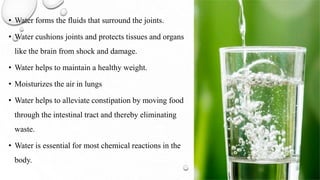
• Water forms the fluids that surround the joints.
• Water cushions joints and protects tissues and organs
like the brain from shock and damage.
• Water helps to maintain a healthy weight.
• Moisturizes the air in lungs
• Water helps to alleviate constipation by moving food
through the intestinal tract and thereby eliminating
waste.
• Water is essential for most chemical reactions in the
body.
• Human beings are mostly water, ranging from about 75 % of body mass in infants
to about 50–60 % in adult men and women, to as low as 45 % in old age.
• The percent of body water changes with development, because the proportions of
the body given over to each organ and to muscles, fat, bone, and other tissues
change from infancy to adulthood.
• Brain and kidneys have the highest proportions of water, which composes 80–85
% of their masses.
• In contrast, teeth have the lowest proportion of water at 8–10 %.
WATER AS SUCH
WATER THROUGH FOODS
WATER FORMED BY OXIDATION
OF FOOD STUFF
TYPE OF FOOD WATER CONTENT IN
PERCENTAGE
MILK 87
EGGS 75
MEAT 40-75
FRUITS AND VEGETABLES 70-90
CEREALS 8-20
BREAD 35
KIDNEYS
SKIN
LUNGS
GI TRACT
 Normal kidney rate of filtration is 125ml/min ~ 180lit/day.
 99% of water filtered is reabsorbed into blood.
 500 – 2000ml excreted as urine.
 Volume of urine excretion reflects the body fluid intake and rate of
perspiration.
 Water loss from skin is not noticeable.
 Helps in maintenance of body temperature.
 Loss of water is proportionate to body surface area, weather and
physical activity.
 300ml/day at normal conditions
 Increase in activity increases water loss.
 Loss is small (100ml/day)
 Water in gastric secretions (saliva, gastric juice, bile,
pancreatic juice & intestinal juices) is 7000-8000ml.
 Helps in digestion in alimentary canal and reabsorbed.
Available water equals to water excreted.
AVAILABLE
WATER
QUANTITY
(ml)
EXCRETED
WATER
QUANTITY
(ml)
WATER IN
TAKE AS
SUCH
1100 URINE 1000
WATER IN
DIET
900 STOOL 200
WATER OF
OXIDATION
200 VAPOUR(SKIN
AND LUNGS)
1000
TOTAL 2200 TOTAL 2200
 Thirst
 Interaction of the pituitary gland and kidneys
 Osmoregulation
 The kidneys can control the volume of urine produced depending on the
volume of water taken into the body. The kidneys are controlled by a
substance called ADH (which is anti-diuretic hormone, but the initials are
enough).
 This process of water balance is called osmoregulation.
 ADH is produced by the pituitary gland in the brain.
 This is controlled by the part of the brain called the hypothalamus which
contains osmoreceptors, which are nerve cells that check the water
concentration of the blood.
 Plants use stomata on the lower side of their leaves
to regulate water loss.
 Plants growing in hydrated soils compensate water
loss by transpiration by absorbing more water
from the soil.
 The plants that grow in semi-arid areas store water
in the vacuoles and have thick and fleshy cuticles
to prevent water loss.
 It is a deficiency of water in the body.
 Dehydration occurs when the body loses more water than it takes in.
 Vomiting, diarrhea, the use of drugs that increase urine excretion
(diuretics), profuse sweating and decreased water intake can lead to
dehydration.
Symptoms of mild to moderate
dehydration include:
• Thirst
• Reduced sweating
• Reduced skin elasticity
• Reduced urine production
• Dry mouth
 In severe dehydration, the sensation of thirst may actually decrease and blood
pressure can fall, causing light-headedness or fainting, particularly upon
standing (a condition called orthostatic hypotension).
 If dehydration continues, shock and severe damage to internal organs, such as
the kidneys, liver, and brain, occur.
 Brain cells are particularly susceptible to more severe levels of dehydration.
 Consequently, confusion is one of the best indicators that dehydration has
become severe.
 Very severe dehydration can lead to coma.
 It is the excess amount of water in the body.
 People, particularly athletes, who drink excessive water to avoid dehydration, can
develop over hydration.
 People may also drink excessive water because of a psychiatric disorder called
psychogenic polydipsia.
 The result is too much water and not enough sodium.
 Thus, over hydration generally results in low sodium levels in the blood
(hyponatremia) which can be dangerous.
 To exceed the body’s ability to excrete water, a young adult with normal
kidney function would have to drink more than 6 gallons of water a day on a
regular basis.
 Over hydration is much more common among people whose kidneys do not
excrete urine normally.
 Over hydration may also result from the syndrome of inappropriate anti-
diuretic hormone secretion.
 In this syndrome, the pituitary gland secretes too much vasopressin (also
called anti-diuretic hormone), stimulating the kidneys to conserve water
when that is not needed.
 Add a squeeze or slice of lemon or lime, or some strawberries or mint
leaves to plain water to add variety.
 Keep a bottle or glass of water handy on your desk or in your bag.
 Drink some water with each meal and snack.
 Add ice cubes made from fresh fruit to a glass of water.
Fdsn @ lec 3

Fdsn @ lec 3

  • 2.
    Composition and chemistry,distribution of water in the body, functions and requirements
  • 3.
    • Next toair (oxygen), water is the most essential element to human life. • The human body needs water in order to survive. • Water is essential to the functioning of every single cell and organ system in the human body. • Water makes up greater than 2/3 of the weight of the human body; the brain is 75% water, blood is 83% water, bones are 22% water, muscles are 75% water, and the lungs are 90% water. • True health cannot occur without proper hydration of the body.
  • 4.
    • It isa universal solvent. • Body's temperature regulation. • It flushes out toxins and wastes. • It is a major component of blood which carries nutrients and oxygen to and from all cells. • Provides a moist environment for all body tissues.
  • 5.
    • Water formsthe fluids that surround the joints. • Water cushions joints and protects tissues and organs like the brain from shock and damage. • Water helps to maintain a healthy weight. • Moisturizes the air in lungs • Water helps to alleviate constipation by moving food through the intestinal tract and thereby eliminating waste. • Water is essential for most chemical reactions in the body.
  • 6.
    • Human beingsare mostly water, ranging from about 75 % of body mass in infants to about 50–60 % in adult men and women, to as low as 45 % in old age. • The percent of body water changes with development, because the proportions of the body given over to each organ and to muscles, fat, bone, and other tissues change from infancy to adulthood. • Brain and kidneys have the highest proportions of water, which composes 80–85 % of their masses. • In contrast, teeth have the lowest proportion of water at 8–10 %.
  • 7.
    WATER AS SUCH WATERTHROUGH FOODS WATER FORMED BY OXIDATION OF FOOD STUFF
  • 8.
    TYPE OF FOODWATER CONTENT IN PERCENTAGE MILK 87 EGGS 75 MEAT 40-75 FRUITS AND VEGETABLES 70-90 CEREALS 8-20 BREAD 35
  • 10.
  • 11.
     Normal kidneyrate of filtration is 125ml/min ~ 180lit/day.  99% of water filtered is reabsorbed into blood.  500 – 2000ml excreted as urine.  Volume of urine excretion reflects the body fluid intake and rate of perspiration.
  • 12.
     Water lossfrom skin is not noticeable.  Helps in maintenance of body temperature.  Loss of water is proportionate to body surface area, weather and physical activity.
  • 13.
     300ml/day atnormal conditions  Increase in activity increases water loss.
  • 14.
     Loss issmall (100ml/day)  Water in gastric secretions (saliva, gastric juice, bile, pancreatic juice & intestinal juices) is 7000-8000ml.  Helps in digestion in alimentary canal and reabsorbed.
  • 15.
    Available water equalsto water excreted. AVAILABLE WATER QUANTITY (ml) EXCRETED WATER QUANTITY (ml) WATER IN TAKE AS SUCH 1100 URINE 1000 WATER IN DIET 900 STOOL 200 WATER OF OXIDATION 200 VAPOUR(SKIN AND LUNGS) 1000 TOTAL 2200 TOTAL 2200
  • 17.
     Thirst  Interactionof the pituitary gland and kidneys  Osmoregulation
  • 18.
     The kidneyscan control the volume of urine produced depending on the volume of water taken into the body. The kidneys are controlled by a substance called ADH (which is anti-diuretic hormone, but the initials are enough).  This process of water balance is called osmoregulation.  ADH is produced by the pituitary gland in the brain.  This is controlled by the part of the brain called the hypothalamus which contains osmoreceptors, which are nerve cells that check the water concentration of the blood.
  • 20.
     Plants usestomata on the lower side of their leaves to regulate water loss.  Plants growing in hydrated soils compensate water loss by transpiration by absorbing more water from the soil.  The plants that grow in semi-arid areas store water in the vacuoles and have thick and fleshy cuticles to prevent water loss.
  • 21.
     It isa deficiency of water in the body.  Dehydration occurs when the body loses more water than it takes in.  Vomiting, diarrhea, the use of drugs that increase urine excretion (diuretics), profuse sweating and decreased water intake can lead to dehydration.
  • 22.
    Symptoms of mildto moderate dehydration include: • Thirst • Reduced sweating • Reduced skin elasticity • Reduced urine production • Dry mouth
  • 23.
     In severedehydration, the sensation of thirst may actually decrease and blood pressure can fall, causing light-headedness or fainting, particularly upon standing (a condition called orthostatic hypotension).  If dehydration continues, shock and severe damage to internal organs, such as the kidneys, liver, and brain, occur.  Brain cells are particularly susceptible to more severe levels of dehydration.  Consequently, confusion is one of the best indicators that dehydration has become severe.  Very severe dehydration can lead to coma.
  • 25.
     It isthe excess amount of water in the body.  People, particularly athletes, who drink excessive water to avoid dehydration, can develop over hydration.  People may also drink excessive water because of a psychiatric disorder called psychogenic polydipsia.  The result is too much water and not enough sodium.  Thus, over hydration generally results in low sodium levels in the blood (hyponatremia) which can be dangerous.
  • 26.
     To exceedthe body’s ability to excrete water, a young adult with normal kidney function would have to drink more than 6 gallons of water a day on a regular basis.  Over hydration is much more common among people whose kidneys do not excrete urine normally.  Over hydration may also result from the syndrome of inappropriate anti- diuretic hormone secretion.  In this syndrome, the pituitary gland secretes too much vasopressin (also called anti-diuretic hormone), stimulating the kidneys to conserve water when that is not needed.
  • 27.
     Add asqueeze or slice of lemon or lime, or some strawberries or mint leaves to plain water to add variety.  Keep a bottle or glass of water handy on your desk or in your bag.  Drink some water with each meal and snack.  Add ice cubes made from fresh fruit to a glass of water.