Ch 4. The Evolution of Analytic Scalability
Taming The Big Data Tidal Wave
Outline
 Introduction
 The Convergence of the Analytic and Data Environment
 Massively Parallel Processing System (MPP)
 Cloud Computing
 Grid Computing
 MapReduce
 Conclusion
2
Introduction
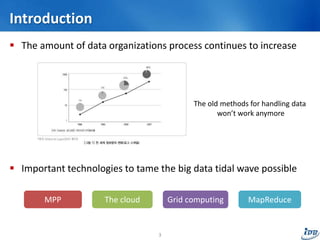
 The amount of data organizations process continues to increase
 Important technologies to tame the big data tidal wave possible
3
The old methods for handling data
won’t work anymore
MPP The cloud Grid computing MapReduce
Outline
 Introduction
 The Convergence of the Analytic and Data Environment
 Massively Parallel Processing System (MPP)
 Cloud Computing
 Grid Computing
 MapReduce
 Conclusion
4
The Convergence of the Analytic and Data Environment (1/2)
Traditional Analytic Architecture
 We had to pull all data together into a separate analytics
environment to do analysis
5
Database 1 Database 4
Database 2
Database 3
Analytic Server
Or PC
The heavy processing occurs
in the analytic environment
 The processing stays in the database where the data has been
consolidated
6
The Convergence of the Analytic and Data Environment (2/2)
Modern In-Database Architecture
Database 1 Database 4
Database 2
Database 3
Consolidate
Enterprise Data Warehouse
Analytic Server Or PC
Submit Request
The user’s machine
just submits the request
Outline
 Introduction
 The Convergence of the Analytic and Data Environment
 Massively Parallel Processing System (MPP)
 Cloud Computing
 Grid Computing
 MapReduce
 Conclusion
7
Massively Parallel Processing (1/3)
What is an MPP Database?
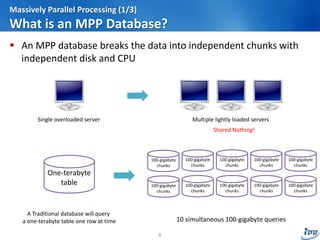
 An MPP database breaks the data into independent chunks with
independent disk and CPU
8
Single overloaded server Multiple lightly loaded servers
Shared Nothing!
A Traditional database will query
a one-terabyte table one row at time
One-terabyte
table
100-gigabyte
chunks
100-gigabyte
chunks
100-gigabyte
chunks
100-gigabyte
chunks
100-gigabyte
chunks
100-gigabyte
chunks
100-gigabyte
chunks
100-gigabyte
chunks
100-gigabyte
chunks
100-gigabyte
chunks
10 simultaneous 100-gigabyte queries
 An MPP system allows the different sets of CPU and disk to run the
process concurrently
9
Massively Parallel Processing (2/3)
Concurrent Processing
★
★
Single Threaded
Process Parallel Process
An MPP system
breaks the job into pieces
 MPP systems build in redundancy to make recovery easy
 MPP systems have resource management tools
– Manage the CPU and disk space
– Query optimizer
Massively Parallel Processing (3/3)
Others
Outline
 Introduction
 The Convergence of the Analytic and Data Environment
 Massively Parallel Processing System (MPP)
 Cloud Computing
 Grid Computing
 MapReduce
 Conclusion
11
Cloud Computing (1/2)
What is Cloud Computing?
 McKinsey and Company paper from 2009¹
– Mask the underlying infrastructure from the user
– Be elastic to scale on demand
– On a pay-per-use basis
 National Institute of Standards and Technology (NIST)
– On-demand self-service
– Broad network access
– Resource pooling
– Rapid elasticity
– Measured service
12
[1] McKinsey and Company, ‘Clearing the Air on Cloud Computing,” March 2009.
1. Public Cloud
– The services and infrastructure are provided off-site over the internet
– Greatest level of efficiency in shared resources
– Less secured and more vulnerable than private clouds
2. Private Cloud
– Infrastructure operated solely for a single organization
– The same features of a public cloud
– Offer the greatest level of security and control
– Necessary to purchase and own the entire cloud infrastructure
13
Cloud Computing (2/2)
Two Types of Cloud Environment
Outline
 Introduction
 The Convergence of the Analytic and Data Environment
 Massively Parallel Processing System (MPP)
 Cloud Computing
 Grid Computing
 MapReduce
 Conclusion
14
Grid Computing
 The federation of computer resources to reach a common goal
– E.g., SETI@Home (Search for Extraterrestrial Intelligence)
 An Internet-based public volunteer computing project
15
Outline
 Introduction
 The Convergence of the Analytic and Data Environment
 Massively Parallel Processing System (MPP)
 Cloud Computing
 Grid Computing
 MapReduce
 Conclusion
16
 A Parallel programming framework¹
– Map function
 Processing a key/value pairs to generate a set of intermediate key/value pairs
– Reduce function
 Merging all intermediate values associated with the same intermediate key
17
MapReduce (1/3)
What is MapReduce?
Parallelization
Fault-tolerance
Data distribution
Load balancing
……
Library
map reduce
[1] MapReduce: Simplified Data Processing on Large Clusters – OSDI 2004
 Let’s assume there are 20 terabytes of data and 20 MapReduce
server nodes for a project
18
MapReduce (2/3)
How MapReduce Works
Map Function
Scheduler
Results
Map
Shuffle
Reduce
1. Distribute a terabyte to each of the 20
nodes using a simple file copy process
2. Submit two programs(Map, Reduce) to
the scheduler
3. The map program finds the data on disk
and executes the logic it contains
4. The results of the map step are then
passed to the reduce process to
summarize and aggregate the final
answers
MapReduce (3/3)
Strengths and Weaknesses
 Good for
– Lots of input, intermediate, and output data
– Batch oriented datasets (ETL: Extract, Load, Transform)
– Cheap to get up and running because of running on commodity hardware
 Bad for
– Fast response time
– Large amounts of shared data
– CPU intensive operations (as opposed to data intensive)
– NOT a database!
 No built-in security
 No indexing, No query or process optimizer
 No knowledge of other data that exists
19
Outline
 Introduction
 The Convergence of the Analytic and Data Environment
 Massively Parallel Processing System (MPP)
 Cloud Computing
 Grid Computing
 MapReduce
 Conclusion
20
Conclusion
 These technologies can integrate and work together
– Databases running in the cloud
– Databases including MapReduce functionality
– MapReduce can be run against data sourced from a database
– MapReduce can also run against data in the cloud
21
[Cloud Database] [SQL-MapReduce] [In-Database MapReduce]¹
[1] https://blogs.oracle.com/datawarehousing/entry/in-database_map-reduce
[2] http://code.google.com/p/cloudmapreduce/
Cloud mapreduce: a mapreduce implementation on top of a cloud operating system – CCGRID 2011, IEEE Computer Society
[Running MapReduce in Database] [Running MapReduce in Cloud]²

notes on Evolution Of Analytic Scalability.ppt

  • 1.
    Ch 4. TheEvolution of Analytic Scalability Taming The Big Data Tidal Wave
  • 2.
    Outline  Introduction  TheConvergence of the Analytic and Data Environment  Massively Parallel Processing System (MPP)  Cloud Computing  Grid Computing  MapReduce  Conclusion 2
  • 3.
    Introduction  The amountof data organizations process continues to increase  Important technologies to tame the big data tidal wave possible 3 The old methods for handling data won’t work anymore MPP The cloud Grid computing MapReduce
  • 4.
    Outline  Introduction  TheConvergence of the Analytic and Data Environment  Massively Parallel Processing System (MPP)  Cloud Computing  Grid Computing  MapReduce  Conclusion 4
  • 5.
    The Convergence ofthe Analytic and Data Environment (1/2) Traditional Analytic Architecture  We had to pull all data together into a separate analytics environment to do analysis 5 Database 1 Database 4 Database 2 Database 3 Analytic Server Or PC The heavy processing occurs in the analytic environment
  • 6.
     The processingstays in the database where the data has been consolidated 6 The Convergence of the Analytic and Data Environment (2/2) Modern In-Database Architecture Database 1 Database 4 Database 2 Database 3 Consolidate Enterprise Data Warehouse Analytic Server Or PC Submit Request The user’s machine just submits the request
  • 7.
    Outline  Introduction  TheConvergence of the Analytic and Data Environment  Massively Parallel Processing System (MPP)  Cloud Computing  Grid Computing  MapReduce  Conclusion 7
  • 8.
    Massively Parallel Processing(1/3) What is an MPP Database?  An MPP database breaks the data into independent chunks with independent disk and CPU 8 Single overloaded server Multiple lightly loaded servers Shared Nothing! A Traditional database will query a one-terabyte table one row at time One-terabyte table 100-gigabyte chunks 100-gigabyte chunks 100-gigabyte chunks 100-gigabyte chunks 100-gigabyte chunks 100-gigabyte chunks 100-gigabyte chunks 100-gigabyte chunks 100-gigabyte chunks 100-gigabyte chunks 10 simultaneous 100-gigabyte queries
  • 9.
     An MPPsystem allows the different sets of CPU and disk to run the process concurrently 9 Massively Parallel Processing (2/3) Concurrent Processing ★ ★ Single Threaded Process Parallel Process An MPP system breaks the job into pieces
  • 10.
     MPP systemsbuild in redundancy to make recovery easy  MPP systems have resource management tools – Manage the CPU and disk space – Query optimizer Massively Parallel Processing (3/3) Others
  • 11.
    Outline  Introduction  TheConvergence of the Analytic and Data Environment  Massively Parallel Processing System (MPP)  Cloud Computing  Grid Computing  MapReduce  Conclusion 11
  • 12.
    Cloud Computing (1/2) Whatis Cloud Computing?  McKinsey and Company paper from 2009¹ – Mask the underlying infrastructure from the user – Be elastic to scale on demand – On a pay-per-use basis  National Institute of Standards and Technology (NIST) – On-demand self-service – Broad network access – Resource pooling – Rapid elasticity – Measured service 12 [1] McKinsey and Company, ‘Clearing the Air on Cloud Computing,” March 2009.
  • 13.
    1. Public Cloud –The services and infrastructure are provided off-site over the internet – Greatest level of efficiency in shared resources – Less secured and more vulnerable than private clouds 2. Private Cloud – Infrastructure operated solely for a single organization – The same features of a public cloud – Offer the greatest level of security and control – Necessary to purchase and own the entire cloud infrastructure 13 Cloud Computing (2/2) Two Types of Cloud Environment
  • 14.
    Outline  Introduction  TheConvergence of the Analytic and Data Environment  Massively Parallel Processing System (MPP)  Cloud Computing  Grid Computing  MapReduce  Conclusion 14
  • 15.
    Grid Computing  Thefederation of computer resources to reach a common goal – E.g., SETI@Home (Search for Extraterrestrial Intelligence)  An Internet-based public volunteer computing project 15
  • 16.
    Outline  Introduction  TheConvergence of the Analytic and Data Environment  Massively Parallel Processing System (MPP)  Cloud Computing  Grid Computing  MapReduce  Conclusion 16
  • 17.
     A Parallelprogramming framework¹ – Map function  Processing a key/value pairs to generate a set of intermediate key/value pairs – Reduce function  Merging all intermediate values associated with the same intermediate key 17 MapReduce (1/3) What is MapReduce? Parallelization Fault-tolerance Data distribution Load balancing …… Library map reduce [1] MapReduce: Simplified Data Processing on Large Clusters – OSDI 2004
  • 18.
     Let’s assumethere are 20 terabytes of data and 20 MapReduce server nodes for a project 18 MapReduce (2/3) How MapReduce Works Map Function Scheduler Results Map Shuffle Reduce 1. Distribute a terabyte to each of the 20 nodes using a simple file copy process 2. Submit two programs(Map, Reduce) to the scheduler 3. The map program finds the data on disk and executes the logic it contains 4. The results of the map step are then passed to the reduce process to summarize and aggregate the final answers
  • 19.
    MapReduce (3/3) Strengths andWeaknesses  Good for – Lots of input, intermediate, and output data – Batch oriented datasets (ETL: Extract, Load, Transform) – Cheap to get up and running because of running on commodity hardware  Bad for – Fast response time – Large amounts of shared data – CPU intensive operations (as opposed to data intensive) – NOT a database!  No built-in security  No indexing, No query or process optimizer  No knowledge of other data that exists 19
  • 20.
    Outline  Introduction  TheConvergence of the Analytic and Data Environment  Massively Parallel Processing System (MPP)  Cloud Computing  Grid Computing  MapReduce  Conclusion 20
  • 21.
    Conclusion  These technologiescan integrate and work together – Databases running in the cloud – Databases including MapReduce functionality – MapReduce can be run against data sourced from a database – MapReduce can also run against data in the cloud 21 [Cloud Database] [SQL-MapReduce] [In-Database MapReduce]¹ [1] https://blogs.oracle.com/datawarehousing/entry/in-database_map-reduce [2] http://code.google.com/p/cloudmapreduce/ Cloud mapreduce: a mapreduce implementation on top of a cloud operating system – CCGRID 2011, IEEE Computer Society [Running MapReduce in Database] [Running MapReduce in Cloud]²