A MONTHLY
DOSE OF EDUCATION
Brian Pelletier, PharmD, BCGP, FASCP
CEO, A Dose of Education, LLC
December 2017
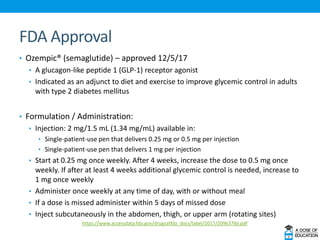
FDA Approval
• Ozempic® (semaglutide) – approved 12/5/17
• A glucagon-like peptide 1 (GLP-1) receptor agonist
• Indicated as an adjunct to diet and exercise to improve glycemic control in adults
with type 2 diabetes mellitus
• Formulation / Administration:
• Injection: 2 mg/1.5 mL (1.34 mg/mL) available in:
• Single-patient-use pen that delivers 0.25 mg or 0.5 mg per injection
• Single-patient-use pen that delivers 1 mg per injection
• Start at 0.25 mg once weekly. After 4 weeks, increase the dose to 0.5 mg once
weekly. If after at least 4 weeks additional glycemic control is needed, increase to
1 mg once weekly
• Administer once weekly at any time of day, with or without meal
• If a dose is missed administer within 5 days of missed dose
• Inject subcutaneously in the abdomen, thigh, or upper arm (rotating sites)
https://www.accessdata.fda.gov/drugsatfda_docs/label/2017/209637lbl.pdf
Ozempic® (semaglutide)
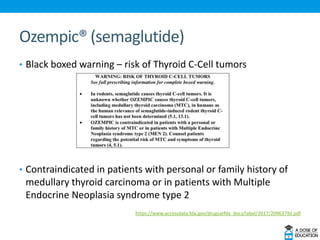
• Black boxed warning – risk of Thyroid C-Cell tumors
• Contraindicated in patients with personal or family history of
medullary thyroid carcinoma or in patients with Multiple
Endocrine Neoplasia syndrome type 2
https://www.accessdata.fda.gov/drugsatfda_docs/label/2017/209637lbl.pdf
Ozempic® (semaglutide)
• Adverse Reactions:
• Most common ADRs are nausea, vomiting, diarrhea, abdominal pain and
constipation (>5%)
• Drug Interactions:
• Delays gastric emptying. May impact absorption of concomitantly
administered oral medications
• Renal/Hepatic Impairment:
• No dose adjustments recommended
https://www.accessdata.fda.gov/drugsatfda_docs/label/2017/209637lbl.pdf
Ozempic® (semaglutide)
• Warnings and Precautions:
• Pancreatitis: Has been reported in clinical trials. Discontinue promptly if
pancreatitis is suspected. Do not restart if pancreatitis is confirmed
• Diabetic Retinopathy Complications: Has been reported in a clinical trial. Patients
with a history of diabetic retinopathy should be monitored
• Never share an pen between patients, even if the needle is changed
• Hypoglycemia: When used with an insulin secretagogue or insulin, consider
lowering the dose of the secretagogue or insulin to reduce the risk of
hypoglycemia
• Acute Kidney Injury: Monitor renal function in patients with renal impairment
reporting severe adverse gastrointestinal reactions
• Hypersensitivity Reactions: Discontinue if suspected and promptly seek medical
advice
• Macrovascular outcomes: There have been no clinical studies establishing
conclusive evidence of macrovascular risk reduction with semaglutide
https://www.accessdata.fda.gov/drugsatfda_docs/label/2017/209637lbl.pdf
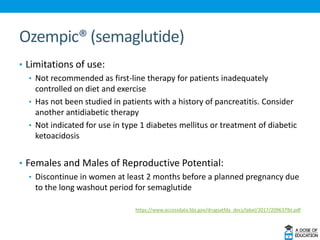
Ozempic® (semaglutide)
• Limitations of use:
• Not recommended as first-line therapy for patients inadequately
controlled on diet and exercise
• Has not been studied in patients with a history of pancreatitis. Consider
another antidiabetic therapy
• Not indicated for use in type 1 diabetes mellitus or treatment of diabetic
ketoacidosis
• Females and Males of Reproductive Potential:
• Discontinue in women at least 2 months before a planned pregnancy due
to the long washout period for semaglutide
https://www.accessdata.fda.gov/drugsatfda_docs/label/2017/209637lbl.pdf
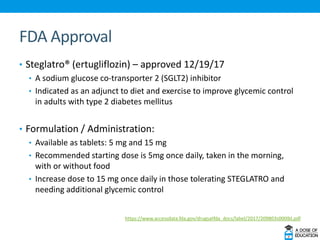
FDA Approval
• Steglatro® (ertugliflozin) – approved 12/19/17
• A sodium glucose co-transporter 2 (SGLT2) inhibitor
• Indicated as an adjunct to diet and exercise to improve glycemic control
in adults with type 2 diabetes mellitus
• Formulation / Administration:
• Available as tablets: 5 mg and 15 mg
• Recommended starting dose is 5mg once daily, taken in the morning,
with or without food
• Increase dose to 15 mg once daily in those tolerating STEGLATRO and
needing additional glycemic control
https://www.accessdata.fda.gov/drugsatfda_docs/label/2017/209803s000lbl.pdf
Steglatro® (ertugliflozin)
• Dose adjustments:
• Assess renal function before initiating and periodically thereafter:
• Do not use in patients with an estimated glomerular filtration rate (eGFR)
below 30 mL/minute/1.73 m22.
• Initiation is not recommended in patients with an eGFR of 30 to less than 60
mL/minute/1.73 m22.
• Continued use is not recommended in patients with an eGFR persistently
between 30 and less than 60 mL/min/1.73 m22.
• Contraindications:
• Severe renal impairment, end-stage renal disease, or dialysis
• History of serious hypersensitivity reaction to ertugliflozin
https://www.accessdata.fda.gov/drugsatfda_docs/label/2017/209803s000lbl.pdf
Steglatro® (ertugliflozin)
• Limitations of use:
• Not for the treatment of type 1 diabetes mellitus or diabetic ketoacidosis
• Adverse Reactions:
• The most common adverse reactions (incidence ≥ 5%) were female
genital mycotic infections
• Geriatric Use
• No dosage adjustment is recommended based on age. However, patients
65 years and older had a higher incidence of adverse reactions related to
volume depletion compared to younger patients
https://www.accessdata.fda.gov/drugsatfda_docs/label/2017/209803s000lbl.pdf
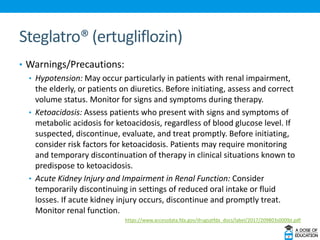
Steglatro® (ertugliflozin)
• Warnings/Precautions:
• Hypotension: May occur particularly in patients with renal impairment,
the elderly, or patients on diuretics. Before initiating, assess and correct
volume status. Monitor for signs and symptoms during therapy.
• Ketoacidosis: Assess patients who present with signs and symptoms of
metabolic acidosis for ketoacidosis, regardless of blood glucose level. If
suspected, discontinue, evaluate, and treat promptly. Before initiating,
consider risk factors for ketoacidosis. Patients may require monitoring
and temporary discontinuation of therapy in clinical situations known to
predispose to ketoacidosis.
• Acute Kidney Injury and Impairment in Renal Function: Consider
temporarily discontinuing in settings of reduced oral intake or fluid
losses. If acute kidney injury occurs, discontinue and promptly treat.
Monitor renal function.
https://www.accessdata.fda.gov/drugsatfda_docs/label/2017/209803s000lbl.pdf
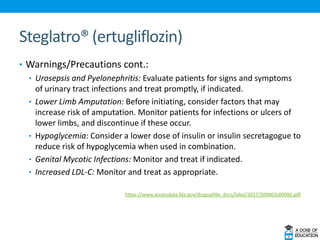
Steglatro® (ertugliflozin)
• Warnings/Precautions cont.:
• Urosepsis and Pyelonephritis: Evaluate patients for signs and symptoms
of urinary tract infections and treat promptly, if indicated.
• Lower Limb Amputation: Before initiating, consider factors that may
increase risk of amputation. Monitor patients for infections or ulcers of
lower limbs, and discontinue if these occur.
• Hypoglycemia: Consider a lower dose of insulin or insulin secretagogue to
reduce risk of hypoglycemia when used in combination.
• Genital Mycotic Infections: Monitor and treat if indicated.
• Increased LDL-C: Monitor and treat as appropriate.
https://www.accessdata.fda.gov/drugsatfda_docs/label/2017/209803s000lbl.pdf
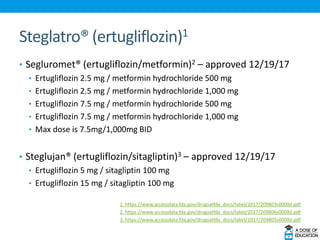
Steglatro® (ertugliflozin)1
• Segluromet® (ertugliflozin/metformin)2 – approved 12/19/17
• Ertugliflozin 2.5 mg / metformin hydrochloride 500 mg
• Ertugliflozin 2.5 mg / metformin hydrochloride 1,000 mg
• Ertugliflozin 7.5 mg / metformin hydrochloride 500 mg
• Ertugliflozin 7.5 mg / metformin hydrochloride 1,000 mg
• Max dose is 7.5mg/1,000mg BID
• Steglujan® (ertugliflozin/sitagliptin)3 – approved 12/19/17
• Ertugliflozin 5 mg / sitagliptin 100 mg
• Ertugliflozin 15 mg / sitagliptin 100 mg
1. https://www.accessdata.fda.gov/drugsatfda_docs/label/2017/209803s000lbl.pdf
2. https://www.accessdata.fda.gov/drugsatfda_docs/label/2017/209806s000lbl.pdf
3. https://www.accessdata.fda.gov/drugsatfda_docs/label/2017/209805s000lbl.pdf
FDA Approval
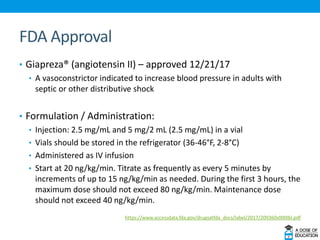
• Giapreza® (angiotensin II) – approved 12/21/17
• A vasoconstrictor indicated to increase blood pressure in adults with
septic or other distributive shock
• Formulation / Administration:
• Injection: 2.5 mg/mL and 5 mg/2 mL (2.5 mg/mL) in a vial
• Vials should be stored in the refrigerator (36-46°F, 2-8°C)
• Administered as IV infusion
• Start at 20 ng/kg/min. Titrate as frequently as every 5 minutes by
increments of up to 15 ng/kg/min as needed. During the first 3 hours, the
maximum dose should not exceed 80 ng/kg/min. Maintenance dose
should not exceed 40 ng/kg/min.
https://www.accessdata.fda.gov/drugsatfda_docs/label/2017/209360s000lbl.pdf
Giapreza® (angiotensin II)
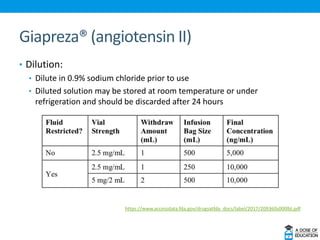
• Dilution:
• Dilute in 0.9% sodium chloride prior to use
• Diluted solution may be stored at room temperature or under
refrigeration and should be discarded after 24 hours
https://www.accessdata.fda.gov/drugsatfda_docs/label/2017/209360s000lbl.pdf
Giapreza® (angiotensin II)
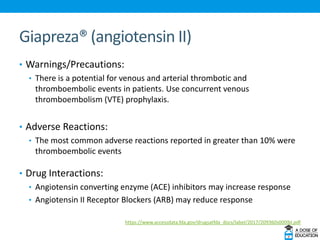
• Warnings/Precautions:
• There is a potential for venous and arterial thrombotic and
thromboembolic events in patients. Use concurrent venous
thromboembolism (VTE) prophylaxis.
• Adverse Reactions:
• The most common adverse reactions reported in greater than 10% were
thromboembolic events
• Drug Interactions:
• Angiotensin converting enzyme (ACE) inhibitors may increase response
• Angiotensin II Receptor Blockers (ARB) may reduce response
https://www.accessdata.fda.gov/drugsatfda_docs/label/2017/209360s000lbl.pdf
FDA Approval
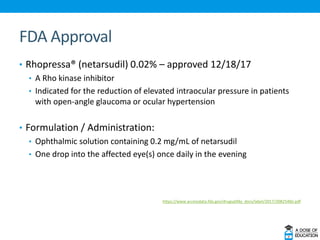
• Rhopressa® (netarsudil) 0.02% – approved 12/18/17
• A Rho kinase inhibitor
• Indicated for the reduction of elevated intraocular pressure in patients
with open-angle glaucoma or ocular hypertension
• Formulation / Administration:
• Ophthalmic solution containing 0.2 mg/mL of netarsudil
• One drop into the affected eye(s) once daily in the evening
https://www.accessdata.fda.gov/drugsatfda_docs/label/2017/208254lbl.pdf
Rhopressa® (netarsudil)
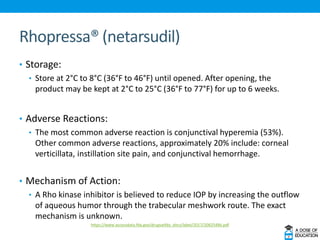
• Storage:
• Store at 2°C to 8°C (36°F to 46°F) until opened. After opening, the
product may be kept at 2°C to 25°C (36°F to 77°F) for up to 6 weeks.
• Adverse Reactions:
• The most common adverse reaction is conjunctival hyperemia (53%).
Other common adverse reactions, approximately 20% include: corneal
verticillata, instillation site pain, and conjunctival hemorrhage.
• Mechanism of Action:
• A Rho kinase inhibitor is believed to reduce IOP by increasing the outflow
of aqueous humor through the trabecular meshwork route. The exact
mechanism is unknown.
https://www.accessdata.fda.gov/drugsatfda_docs/label/2017/208254lbl.pdf
Other December FDA Approvals
• Xepi® (ozenoxacin)1 – approved 12/11/17
• To treat Impetigo
• Topical Cream (1%); new molecular entity
• Macrilen® (macimorelin)2 – approved 12/20/17
• For the diagnosis of adult growth hormone deficiency
• Oral solution: 40mg; new molecular entity
1. https://www.accessdata.fda.gov/drugsatfda_docs/label/2017/208945lbl.pdf
2. https://www.accessdata.fda.gov/drugsatfda_docs/label/2017/205598s000lbl.pdf
Other December FDA Approvals
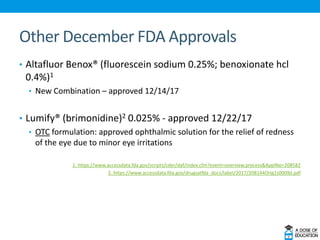
• Altafluor Benox® (fluorescein sodium 0.25%; benoxionate hcl
0.4%)1
• New Combination – approved 12/14/17
• Lumify® (brimonidine)2 0.025% - approved 12/22/17
• OTC formulation: approved ophthalmic solution for the relief of redness
of the eye due to minor eye irritations
1. https://www.accessdata.fda.gov/scripts/cder/daf/index.cfm?event=overview.process&ApplNo=208582
2. https://www.accessdata.fda.gov/drugsatfda_docs/label/2017/208144Orig1s000lbl.pdf
New Formulations
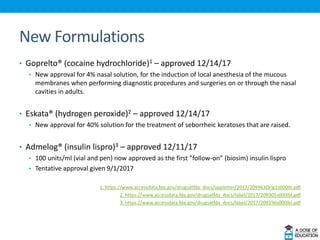
• Goprelto® (cocaine hydrochloride)1 – approved 12/14/17
• New approval for 4% nasal solution, for the induction of local anesthesia of the mucous
membranes when performing diagnostic procedures and surgeries on or through the nasal
cavities in adults.
• Eskata® (hydrogen peroxide)2 – approved 12/14/17
• New approval for 40% solution for the treatment of seborrheic keratoses that are raised.
• Admelog® (insulin lispro)3 – approved 12/11/17
• 100 units/ml (vial and pen) now approved as the first ”follow-on” (biosim) insulin lispro
• Tentative approval given 9/1/2017
1. https://www.accessdata.fda.gov/drugsatfda_docs/appletter/2017/209963Orig1s000ltr.pdf
2. https://www.accessdata.fda.gov/drugsatfda_docs/label/2017/209305s000lbl.pdf
3. https://www.accessdata.fda.gov/drugsatfda_docs/label/2017/209196s000lbl.pdf
New Dosage Forms
• Prexxartan® (valsartan)1 – approved 12/19/17
• New Dosage Form: Oral solution – 4mg/ml
• Tentative approval given October 2017
• Lonhala Magnair® (glycopyrrolate)2 – approved 12/5/17
• New Dosage Form: Inhalation solution
• Each 1mL vial contains 25 mcg of glycopyrrolate
1. https://www.accessdata.fda.gov/drugsatfda_docs/label/2017/209139s000lbl.pdf
2. https://www.accessdata.fda.gov/drugsatfda_docs/label/2017/208437lbl.pdf
New Dosage Forms
• Siklos® (hydroxyurea)1 – approved 12/21/17
• New Dosage Form: 100 mg and 1,000 mg tablets
• Indicated to reduce the frequency of painful crises and to reduce the
need for blood transfusions in pediatric patients, 2 years of age and older,
with sickle cell anemia with recurrent moderate to severe painful crises.
• Sinuva® (mometasone furoate)2 – approved 12/8/17
• New Dosage Form: Sinus implant; 1,350 mcg
• Indicated for the treatment of nasal polyps in patients 18 years of age or
older who have had ethmoid sinus surgery
1. https://www.accessdata.fda.gov/drugsatfda_docs/label/2017/208843s000lbl.pdf
2. https://www.accessdata.fda.gov/drugsatfda_docs/label/2017/209310lbl.pdf
Thank you!

FDA Approvals - December 2017

  • 1.
    A MONTHLY DOSE OFEDUCATION Brian Pelletier, PharmD, BCGP, FASCP CEO, A Dose of Education, LLC December 2017
  • 2.
    FDA Approval • Ozempic®(semaglutide) – approved 12/5/17 • A glucagon-like peptide 1 (GLP-1) receptor agonist • Indicated as an adjunct to diet and exercise to improve glycemic control in adults with type 2 diabetes mellitus • Formulation / Administration: • Injection: 2 mg/1.5 mL (1.34 mg/mL) available in: • Single-patient-use pen that delivers 0.25 mg or 0.5 mg per injection • Single-patient-use pen that delivers 1 mg per injection • Start at 0.25 mg once weekly. After 4 weeks, increase the dose to 0.5 mg once weekly. If after at least 4 weeks additional glycemic control is needed, increase to 1 mg once weekly • Administer once weekly at any time of day, with or without meal • If a dose is missed administer within 5 days of missed dose • Inject subcutaneously in the abdomen, thigh, or upper arm (rotating sites) https://www.accessdata.fda.gov/drugsatfda_docs/label/2017/209637lbl.pdf
  • 3.
    Ozempic® (semaglutide) • Blackboxed warning – risk of Thyroid C-Cell tumors • Contraindicated in patients with personal or family history of medullary thyroid carcinoma or in patients with Multiple Endocrine Neoplasia syndrome type 2 https://www.accessdata.fda.gov/drugsatfda_docs/label/2017/209637lbl.pdf
  • 4.
    Ozempic® (semaglutide) • AdverseReactions: • Most common ADRs are nausea, vomiting, diarrhea, abdominal pain and constipation (>5%) • Drug Interactions: • Delays gastric emptying. May impact absorption of concomitantly administered oral medications • Renal/Hepatic Impairment: • No dose adjustments recommended https://www.accessdata.fda.gov/drugsatfda_docs/label/2017/209637lbl.pdf
  • 5.
    Ozempic® (semaglutide) • Warningsand Precautions: • Pancreatitis: Has been reported in clinical trials. Discontinue promptly if pancreatitis is suspected. Do not restart if pancreatitis is confirmed • Diabetic Retinopathy Complications: Has been reported in a clinical trial. Patients with a history of diabetic retinopathy should be monitored • Never share an pen between patients, even if the needle is changed • Hypoglycemia: When used with an insulin secretagogue or insulin, consider lowering the dose of the secretagogue or insulin to reduce the risk of hypoglycemia • Acute Kidney Injury: Monitor renal function in patients with renal impairment reporting severe adverse gastrointestinal reactions • Hypersensitivity Reactions: Discontinue if suspected and promptly seek medical advice • Macrovascular outcomes: There have been no clinical studies establishing conclusive evidence of macrovascular risk reduction with semaglutide https://www.accessdata.fda.gov/drugsatfda_docs/label/2017/209637lbl.pdf
  • 6.
    Ozempic® (semaglutide) • Limitationsof use: • Not recommended as first-line therapy for patients inadequately controlled on diet and exercise • Has not been studied in patients with a history of pancreatitis. Consider another antidiabetic therapy • Not indicated for use in type 1 diabetes mellitus or treatment of diabetic ketoacidosis • Females and Males of Reproductive Potential: • Discontinue in women at least 2 months before a planned pregnancy due to the long washout period for semaglutide https://www.accessdata.fda.gov/drugsatfda_docs/label/2017/209637lbl.pdf
  • 7.
    FDA Approval • Steglatro®(ertugliflozin) – approved 12/19/17 • A sodium glucose co-transporter 2 (SGLT2) inhibitor • Indicated as an adjunct to diet and exercise to improve glycemic control in adults with type 2 diabetes mellitus • Formulation / Administration: • Available as tablets: 5 mg and 15 mg • Recommended starting dose is 5mg once daily, taken in the morning, with or without food • Increase dose to 15 mg once daily in those tolerating STEGLATRO and needing additional glycemic control https://www.accessdata.fda.gov/drugsatfda_docs/label/2017/209803s000lbl.pdf
  • 8.
    Steglatro® (ertugliflozin) • Doseadjustments: • Assess renal function before initiating and periodically thereafter: • Do not use in patients with an estimated glomerular filtration rate (eGFR) below 30 mL/minute/1.73 m22. • Initiation is not recommended in patients with an eGFR of 30 to less than 60 mL/minute/1.73 m22. • Continued use is not recommended in patients with an eGFR persistently between 30 and less than 60 mL/min/1.73 m22. • Contraindications: • Severe renal impairment, end-stage renal disease, or dialysis • History of serious hypersensitivity reaction to ertugliflozin https://www.accessdata.fda.gov/drugsatfda_docs/label/2017/209803s000lbl.pdf
  • 9.
    Steglatro® (ertugliflozin) • Limitationsof use: • Not for the treatment of type 1 diabetes mellitus or diabetic ketoacidosis • Adverse Reactions: • The most common adverse reactions (incidence ≥ 5%) were female genital mycotic infections • Geriatric Use • No dosage adjustment is recommended based on age. However, patients 65 years and older had a higher incidence of adverse reactions related to volume depletion compared to younger patients https://www.accessdata.fda.gov/drugsatfda_docs/label/2017/209803s000lbl.pdf
  • 10.
    Steglatro® (ertugliflozin) • Warnings/Precautions: •Hypotension: May occur particularly in patients with renal impairment, the elderly, or patients on diuretics. Before initiating, assess and correct volume status. Monitor for signs and symptoms during therapy. • Ketoacidosis: Assess patients who present with signs and symptoms of metabolic acidosis for ketoacidosis, regardless of blood glucose level. If suspected, discontinue, evaluate, and treat promptly. Before initiating, consider risk factors for ketoacidosis. Patients may require monitoring and temporary discontinuation of therapy in clinical situations known to predispose to ketoacidosis. • Acute Kidney Injury and Impairment in Renal Function: Consider temporarily discontinuing in settings of reduced oral intake or fluid losses. If acute kidney injury occurs, discontinue and promptly treat. Monitor renal function. https://www.accessdata.fda.gov/drugsatfda_docs/label/2017/209803s000lbl.pdf
  • 11.
    Steglatro® (ertugliflozin) • Warnings/Precautionscont.: • Urosepsis and Pyelonephritis: Evaluate patients for signs and symptoms of urinary tract infections and treat promptly, if indicated. • Lower Limb Amputation: Before initiating, consider factors that may increase risk of amputation. Monitor patients for infections or ulcers of lower limbs, and discontinue if these occur. • Hypoglycemia: Consider a lower dose of insulin or insulin secretagogue to reduce risk of hypoglycemia when used in combination. • Genital Mycotic Infections: Monitor and treat if indicated. • Increased LDL-C: Monitor and treat as appropriate. https://www.accessdata.fda.gov/drugsatfda_docs/label/2017/209803s000lbl.pdf
  • 12.
    Steglatro® (ertugliflozin)1 • Segluromet®(ertugliflozin/metformin)2 – approved 12/19/17 • Ertugliflozin 2.5 mg / metformin hydrochloride 500 mg • Ertugliflozin 2.5 mg / metformin hydrochloride 1,000 mg • Ertugliflozin 7.5 mg / metformin hydrochloride 500 mg • Ertugliflozin 7.5 mg / metformin hydrochloride 1,000 mg • Max dose is 7.5mg/1,000mg BID • Steglujan® (ertugliflozin/sitagliptin)3 – approved 12/19/17 • Ertugliflozin 5 mg / sitagliptin 100 mg • Ertugliflozin 15 mg / sitagliptin 100 mg 1. https://www.accessdata.fda.gov/drugsatfda_docs/label/2017/209803s000lbl.pdf 2. https://www.accessdata.fda.gov/drugsatfda_docs/label/2017/209806s000lbl.pdf 3. https://www.accessdata.fda.gov/drugsatfda_docs/label/2017/209805s000lbl.pdf
  • 13.
    FDA Approval • Giapreza®(angiotensin II) – approved 12/21/17 • A vasoconstrictor indicated to increase blood pressure in adults with septic or other distributive shock • Formulation / Administration: • Injection: 2.5 mg/mL and 5 mg/2 mL (2.5 mg/mL) in a vial • Vials should be stored in the refrigerator (36-46°F, 2-8°C) • Administered as IV infusion • Start at 20 ng/kg/min. Titrate as frequently as every 5 minutes by increments of up to 15 ng/kg/min as needed. During the first 3 hours, the maximum dose should not exceed 80 ng/kg/min. Maintenance dose should not exceed 40 ng/kg/min. https://www.accessdata.fda.gov/drugsatfda_docs/label/2017/209360s000lbl.pdf
  • 14.
    Giapreza® (angiotensin II) •Dilution: • Dilute in 0.9% sodium chloride prior to use • Diluted solution may be stored at room temperature or under refrigeration and should be discarded after 24 hours https://www.accessdata.fda.gov/drugsatfda_docs/label/2017/209360s000lbl.pdf
  • 15.
    Giapreza® (angiotensin II) •Warnings/Precautions: • There is a potential for venous and arterial thrombotic and thromboembolic events in patients. Use concurrent venous thromboembolism (VTE) prophylaxis. • Adverse Reactions: • The most common adverse reactions reported in greater than 10% were thromboembolic events • Drug Interactions: • Angiotensin converting enzyme (ACE) inhibitors may increase response • Angiotensin II Receptor Blockers (ARB) may reduce response https://www.accessdata.fda.gov/drugsatfda_docs/label/2017/209360s000lbl.pdf
  • 16.
    FDA Approval • Rhopressa®(netarsudil) 0.02% – approved 12/18/17 • A Rho kinase inhibitor • Indicated for the reduction of elevated intraocular pressure in patients with open-angle glaucoma or ocular hypertension • Formulation / Administration: • Ophthalmic solution containing 0.2 mg/mL of netarsudil • One drop into the affected eye(s) once daily in the evening https://www.accessdata.fda.gov/drugsatfda_docs/label/2017/208254lbl.pdf
  • 17.
    Rhopressa® (netarsudil) • Storage: •Store at 2°C to 8°C (36°F to 46°F) until opened. After opening, the product may be kept at 2°C to 25°C (36°F to 77°F) for up to 6 weeks. • Adverse Reactions: • The most common adverse reaction is conjunctival hyperemia (53%). Other common adverse reactions, approximately 20% include: corneal verticillata, instillation site pain, and conjunctival hemorrhage. • Mechanism of Action: • A Rho kinase inhibitor is believed to reduce IOP by increasing the outflow of aqueous humor through the trabecular meshwork route. The exact mechanism is unknown. https://www.accessdata.fda.gov/drugsatfda_docs/label/2017/208254lbl.pdf
  • 18.
    Other December FDAApprovals • Xepi® (ozenoxacin)1 – approved 12/11/17 • To treat Impetigo • Topical Cream (1%); new molecular entity • Macrilen® (macimorelin)2 – approved 12/20/17 • For the diagnosis of adult growth hormone deficiency • Oral solution: 40mg; new molecular entity 1. https://www.accessdata.fda.gov/drugsatfda_docs/label/2017/208945lbl.pdf 2. https://www.accessdata.fda.gov/drugsatfda_docs/label/2017/205598s000lbl.pdf
  • 19.
    Other December FDAApprovals • Altafluor Benox® (fluorescein sodium 0.25%; benoxionate hcl 0.4%)1 • New Combination – approved 12/14/17 • Lumify® (brimonidine)2 0.025% - approved 12/22/17 • OTC formulation: approved ophthalmic solution for the relief of redness of the eye due to minor eye irritations 1. https://www.accessdata.fda.gov/scripts/cder/daf/index.cfm?event=overview.process&ApplNo=208582 2. https://www.accessdata.fda.gov/drugsatfda_docs/label/2017/208144Orig1s000lbl.pdf
  • 20.
    New Formulations • Goprelto®(cocaine hydrochloride)1 – approved 12/14/17 • New approval for 4% nasal solution, for the induction of local anesthesia of the mucous membranes when performing diagnostic procedures and surgeries on or through the nasal cavities in adults. • Eskata® (hydrogen peroxide)2 – approved 12/14/17 • New approval for 40% solution for the treatment of seborrheic keratoses that are raised. • Admelog® (insulin lispro)3 – approved 12/11/17 • 100 units/ml (vial and pen) now approved as the first ”follow-on” (biosim) insulin lispro • Tentative approval given 9/1/2017 1. https://www.accessdata.fda.gov/drugsatfda_docs/appletter/2017/209963Orig1s000ltr.pdf 2. https://www.accessdata.fda.gov/drugsatfda_docs/label/2017/209305s000lbl.pdf 3. https://www.accessdata.fda.gov/drugsatfda_docs/label/2017/209196s000lbl.pdf
  • 21.
    New Dosage Forms •Prexxartan® (valsartan)1 – approved 12/19/17 • New Dosage Form: Oral solution – 4mg/ml • Tentative approval given October 2017 • Lonhala Magnair® (glycopyrrolate)2 – approved 12/5/17 • New Dosage Form: Inhalation solution • Each 1mL vial contains 25 mcg of glycopyrrolate 1. https://www.accessdata.fda.gov/drugsatfda_docs/label/2017/209139s000lbl.pdf 2. https://www.accessdata.fda.gov/drugsatfda_docs/label/2017/208437lbl.pdf
  • 22.
    New Dosage Forms •Siklos® (hydroxyurea)1 – approved 12/21/17 • New Dosage Form: 100 mg and 1,000 mg tablets • Indicated to reduce the frequency of painful crises and to reduce the need for blood transfusions in pediatric patients, 2 years of age and older, with sickle cell anemia with recurrent moderate to severe painful crises. • Sinuva® (mometasone furoate)2 – approved 12/8/17 • New Dosage Form: Sinus implant; 1,350 mcg • Indicated for the treatment of nasal polyps in patients 18 years of age or older who have had ethmoid sinus surgery 1. https://www.accessdata.fda.gov/drugsatfda_docs/label/2017/208843s000lbl.pdf 2. https://www.accessdata.fda.gov/drugsatfda_docs/label/2017/209310lbl.pdf
  • 23.