GLYXAMBI®
linagliptin/empagliflozin
Simplifying the treatment paradigm
in Type 2 Diabetes
Alex Aizikovich MD PgP MBA
SGLT2 Inhibitors- A Therapeutic
Option Across the Continuum of
T2DM
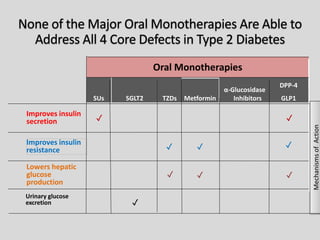
None of the Major Oral Monotherapies Are Able to
Address All 4 Core Defects in Type 2 Diabetes
Oral Monotherapies
α-Glucosidase
Inhibitors
✓✓✓
Lowers hepatic
glucose
production
✓
SUs
✓
SGLT2
✓
TZDs
✓
Improves insulin
resistance
✓
Improves insulin
secretion
DPP-4
GLP1Metformin
MechanismsofAction
✓
Urinary glucose
excretion
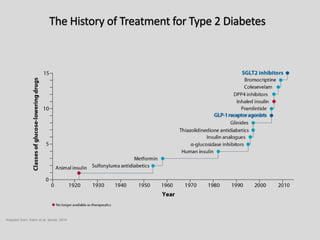
The History of Treatment for Type 2 Diabetes
Adapted from: Kahn et al. lancet, 2014
SGLT2 ingibitors
Jardiance
SGLT2
Inhibitors
TZDs
Metformin
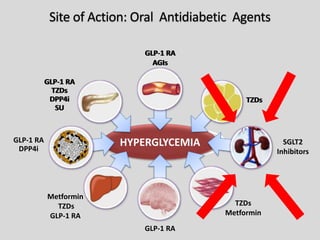
Site of Action: Oral Antidiabetic Agents
Increased
HGP
Hyperglycemia
ETIOLOGY OF T2DM
DEFN75-3/99
Decreased Glucose
Uptake
Impaired Insulin
Secretion
Increased Lipolysis
HYPERGLYCEMIA
Metformin
TZDs
GLP-1 RA
GLP-1 RA
TZDs
DPP4i
SU
GLP-1 RA
GLP-1 RA
DPP4i
GLP-1 RA
AGIs
TZDs
GLP-1 RA
TZDs
DPP4i
SU
GLP-1 RA
AGIs
TZDs
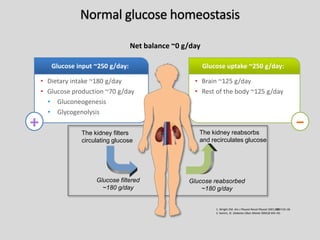
Normal glucose homeostasis
1. Wright EM. Am J Physiol Renal Physiol 2001;280:F10–18.
2. Gerich, JE. Diabetes Obes Metab 2000;2:345–50.
• Brain ~125 g/day
• Rest of the body ~125 g/day
Glucose uptake ~250 g/day:
• Dietary intake ~180 g/day
• Glucose production ~70 g/day
• Gluconeogenesis
• Glycogenolysis
+ −
Net balance ~0 g/day
Glucose input ~250 g/day:
The kidney reabsorbs
and recirculates glucose
Glucose reabsorbed
~180 g/day
Glucose filtered
~180 g/day
The kidney filters
circulating glucose
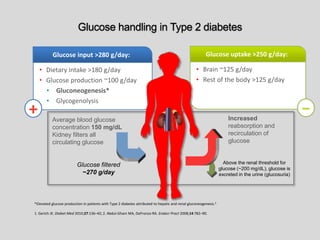
Glucose handling in Type 2 diabetes
*Elevated glucose production in patients with Type 2 diabetes attributed to hepatic and renal gluconeogenesis.2
1. Gerich JE. Diabet Med 2010;27:136–42; 2. Abdul-Ghani MA, DeFronzo RA. Endocr Pract 2008;14:782–90.
• Dietary intake >180 g/day
• Glucose production ~100 g/day
• Gluconeogenesis*
• Glycogenolysis
Glucose input >280 g/day:
• Brain ~125 g/day
• Rest of the body >125 g/day
Glucose uptake >250 g/day:
−Increased
reabsorption and
recirculation of
glucose
Average blood glucose
concentration 150 mg/dL
Kidney filters all
circulating glucose
Above the renal threshold for
glucose (~200 mg/dL), glucose is
excreted in the urine (glucosuria)
+
Glucose filtered
~270 g/day
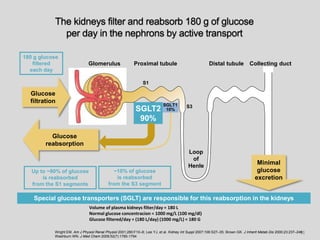
The kidneys filter and reabsorb 180 g of glucose
per day in the nephrons by active transport
11Wright EM. Am J Physiol Renal Physiol 2001;280:F10–8; Lee YJ, et al. Kidney Int Suppl 2007;106:S27–35; Brown GK. J Inherit Metab Dis 2000;23:237–246;
Washburn WN. J Med Chem 2009;52(7):1785‐1794
Special glucose transporters (SGLT) are responsible for this reabsorption in the kidneys
SGLT1
10%
Proximal tubule
S1
Glomerulus Distal tubule
Loop
of
Henle
Collecting duct
Glucose
filtration
Glucose
reabsorption
S3
~10% of glucose
is reabsorbed
from the S3 segment
180 g glucose
filtered
each day
Up to ~90% of glucose
is reabsorbed
from the S1 segments
Minimal
glucose
excretion
SGLT2
90%
Volume of plasma kidneys filter/day = 180 L
Normal glucose concentracion = 1000 mg/L (100 mg/dl)
Glucose filtered/day = (180 L/day) (1000 mg/L) = 180 G
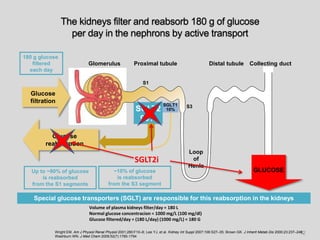
The kidneys filter and reabsorb 180 g of glucose
per day in the nephrons by active transport
12Wright EM. Am J Physiol Renal Physiol 2001;280:F10–8; Lee YJ, et al. Kidney Int Suppl 2007;106:S27–35; Brown GK. J Inherit Metab Dis 2000;23:237–246;
Washburn WN. J Med Chem 2009;52(7):1785‐1794
Special glucose transporters (SGLT) are responsible for this reabsorption in the kidneys
SGLT1
10%
Proximal tubule
S1
Glomerulus Distal tubule
Loop
of
Henle
Collecting duct
Glucose
filtration
Glucose
reabsorption
S3
~10% of glucose
is reabsorbed
from the S3 segment
180 g glucose
filtered
each day
Up to ~90% of glucose
is reabsorbed
from the S1 segments
GLUCOSE
SGLT2
90%
Volume of plasma kidneys filter/day = 180 L
Normal glucose concentracion = 1000 mg/L (100 mg/dl)
Glucose filtered/day = (180 L/day) (1000 mg/L) = 180 G
SGLT2i
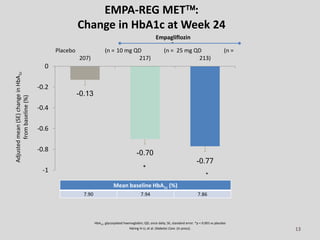
-0.13
-0.70
-0.77
-1
-0.8
-0.6
-0.4
-0.2
0
Placebo (n =
207)
10 mg QD (n =
217)
25 mg QD (n =
213)
Adjustedmean(SE)changeinHbA1c
frombaseline(%)
*
*
HbA1C, glycosylated haemoglobin; QD, once daily; SE, standard error. *p < 0.001 vs placebo
Häring H-U, et al. Diabetes Care. (in press).
EMPA-REG MET:
Change in HbA1c at Week 24
13
Mean baseline HbA1c (%)
7.90 7.94 7.86
Empagliflozin
®
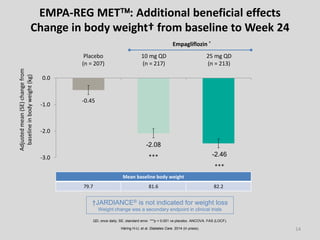
-0.45
-2.08
*** -2.46
***
-3.0
-2.0
-1.0
0.0
Adjustedmean(SE)changefrom
baselineinbodyweight(kg)
EMPA-REG MET: Additional beneficial effects
Change in body weight† from baseline to Week 24
14
QD, once daily; SE, standard error. ***p < 0.001 vs placebo. ANCOVA. FAS (LOCF).
Häring H-U, et al. Diabetes Care. 2014 (in press).
Mean baseline body weight
79.7 81.6 82.2
Empagliflozin ®
Placebo
(n = 207)
10 mg QD
(n = 217)
25 mg QD
(n = 213)
†JARDIANCE® is not indicated for weight loss
Weight change was a secondary endpoint in clinical trials
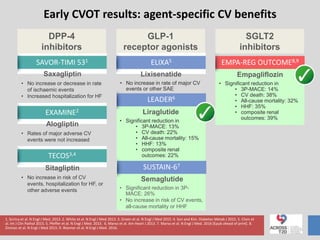
Early CVOT results: agent-specific CV benefits
1. Scirica et al. N Engl J Med. 2013. 2. White et al. N Engl J Med 2013. 3. Green et al. N Engl J Med 2015. 4. Son and Kim. Diabetes Metab J 2015. 5. Chen et
al. Int J Clin Pathol 2015. 5. Pfeffer et al. N Engl J Med. 2015. 6. Marso et al. Am Heart J 2013. 7. Marso et al. N Engl J Med. 2016 [Epub ahead of print]. 8.
Zinman et al. N Engl J Med 2015. 9. Wanner et al. N Engl J Med. 2016.
SGLT2
inhibitors
GLP-1
receptor agonists
EXAMINE2
ELIXA5SAVOR-TIMI 531
TECOS3,4
DPP-4
inhibitors
Sitagliptin
• No increase in risk of CV
events, hospitalization for HF, or
other adverse events
Saxagliptin
• No increase or decrease in rate
of ischaemic events
• Increased hospitalization for HF
Alogliptin
• Rates of major adverse CV
events were not increased
Lixisenatide
• No increase in rate of major CV
events or other SAE
Liraglutide
• Significant reduction in
• 3P-MACE: 13%
• CV death: 22%
• All-cause mortality: 15%
• HHF: 13%
• composite renal
outcomes: 22%
Semaglutide
• Significant reduction in 3P-
MACE: 26%
• No increase in risk of CV events,
all-cause mortality or HHF
LEADER6
SUSTAIN-67
Empagliflozin
• Significant reduction in
• 3P-MACE: 14%
• CV death: 38%
• All-cause mortality: 32%
• HHF: 35%
• composite renal
outcomes: 39%
EMPA-REG OUTCOME8,9
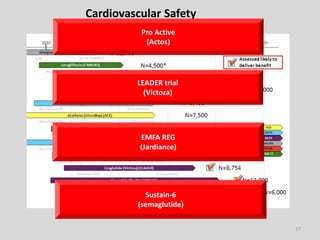
Cardiovascular Safety
17
Pro Active
(Actos)
EMFA REG
(Jardiance)
LEADER trial
(Victoza)
Sustain-6
(semaglutide)
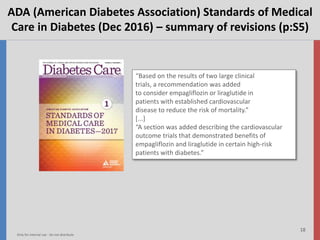
ADA (American Diabetes Association) Standards of Medical
Care in Diabetes (Dec 2016) – summary of revisions (p:S5)
18
Only for internal use - Do not distribute
“Based on the results of two large clinical
trials, a recommendation was added
to consider empagliflozin or liraglutide in
patients with established cardiovascular
disease to reduce the risk of mortality.”
[...]
“A section was added describing the cardiovascular
outcome trials that demonstrated benefits of
empagliflozin and liraglutide in certain high-risk
patients with diabetes.”
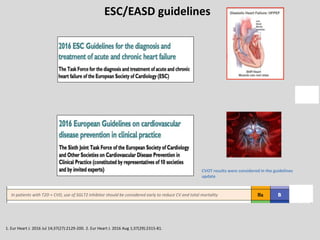
ESC/EASD guidelines
1. Eur Heart J. 2016 Jul 14;37(27):2129-200. 2. Eur Heart J. 2016 Aug 1;37(29):2315-81.
CVOT results were considered in the guidelines
update
In patients with T2D + CVD, use of SGLT2 inhibitor should be considered early to reduce CV and total mortality
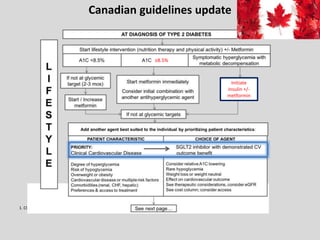
Canadian guidelines update
1. Clinical practice guideline. Canadian diabetes association. 2016 update. http://guidelines.diabetes.ca/slides-and-videos
≥8.5%
Initiate
insulin +/-
metformin
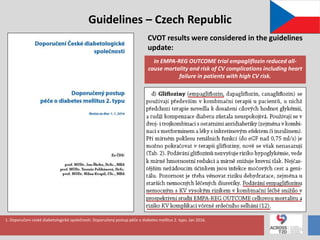
In EMPA-REG OUTCOME trial empagliflozin reduced all-
cause mortality and risk of CV complications including heart
failure in patients with high CV risk.
06/05/2017
Guidelines – Czech Republic
1. Doporučení ceské diabetologické společnosti. Doporučený postup péče o diabetes mellitus 2. typu. Jan 2016.
CVOT results were considered in the guidelines
update:
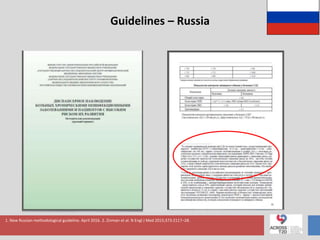
Guidelines – Russia
1. New Russian methodological guideline. April 2016. 2. Zinman et al. N Engl J Med 2015;373:2117–28.
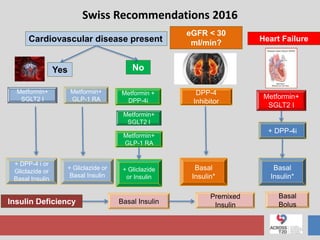
Swiss Recommendations 2016
eGFR < 30
ml/min?
DPP-4
Inhibitor
Basal
Insulin*
Cardiovascular disease present
Yes No
Metformin+
SGLT2 I
Metformin+
GLP-1 RA
Metformin +
DPP-4i
Metformin+
SGLT2 I
Metformin+
GLP-1 RA
+ DPP-4 i or
Gliclazide or
Basal Insulin
+ Gliclazide or
Basal Insulin
+ Gliclazide
or Insulin
Heart Failure
Metformin+
SGLT2 I
+ DPP-4i
Basal
Insulin*
Insulin Deficiency Basal Insulin
Premixed
Insulin
Basal
Bolus
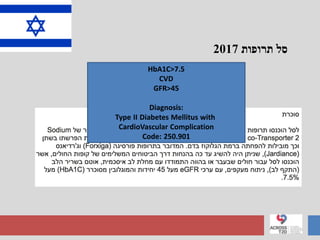
‫סל‬‫תרופות‬2017
HbA1C>7.5
CVD
GFR>45
Diagnosis:
Type II Diabetes Mellitus with
CardioVascular Complication
Code: 250.901
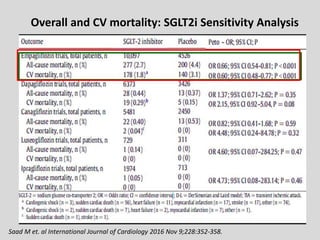
Overall and CV mortality: SGLT2i Sensitivity Analysis
Saad M et. al International Journal of Cardiology 2016 Nov 9;228:352-358.
DPP4 ingibitors
Linagliptin
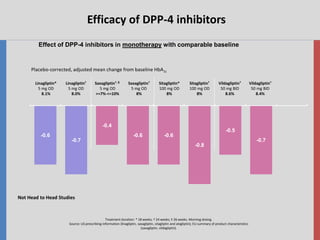
Efficacy of DPP-4 inhibitors
Effect of DPP-4 inhibitors in monotherapy with comparable baseline
Treatment duration: * 18 weeks; † 24 weeks; ‡ 26 weeks. Morning dosing.
Source: US prescribing information (linagliptin, saxagliptin, sitagliptin and alogliptin); EU summary of product characteristics
(saxagliptin, vildagliptin).
Vildagliptin†
50 mg BID
8.6%
Saxagliptin†,§
5 mg OD
>=7%-<=10%
Linagliptin*
5 mg OD
8.1%
Vildagliptin†
50 mg BID
8.4%
Sitagliptin*
100 mg OD
8%
Sitagliptin†
100 mg OD
8%
Saxagliptin†
5 mg OD
8%
Linagliptin†
5 mg OD
8.0%
-0.6
-0.7
-0.4
-0.6 -0.6
-0.8
-0.5
-0.7
Placebo-corrected, adjusted mean change from baseline HbA1c
Not Head to Head Studies
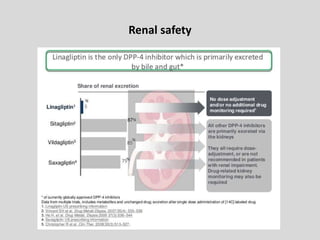
Renal safety
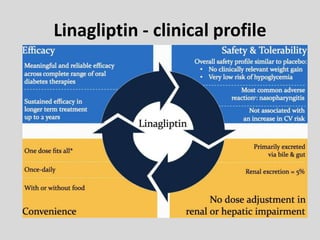
Linagliptin - clinical profile
Jardiance+Trajenta
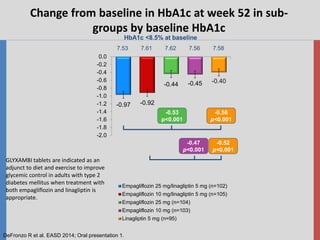
Change from baseline in HbA1c at week 52 in sub-
groups by baseline HbA1c
-0.97 -0.92
-0.44 -0.45 -0.40
-2.0
-1.8
-1.6
-1.4
-1.2
-1.0
-0.8
-0.6
-0.4
-0.2
0.0
Empagliflozin 25 mg/linagliptin 5 mg (n=102)
Empagliflozin 10 mg/linagliptin 5 mg (n=105)
Empagliflozin 25 mg (n=104)
Empagliflozin 10 mg (n=103)
Linagliptin 5 mg (n=95)
7.53 7.61 7.62 7.56 7.58
-0.58
p<0.001
-0.53
p<0.001
-0.52
p<0.001
-0.47
p<0.001
HbA1c <8.5% at baseline
DeFronzo R et al. EASD 2014; Oral presentation 1.
GLYXAMBI tablets are indicated as an
adjunct to diet and exercise to improve
glycemic control in adults with type 2
diabetes mellitus when treatment with
both empagliflozin and linagliptin is
appropriate.
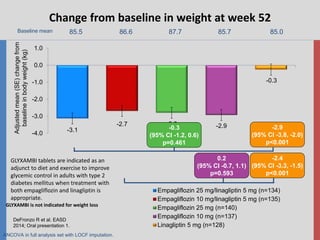
-3.1
-2.7 -2.8 -2.9
-0.3
-4.0
-3.0
-2.0
-1.0
0.0
1.0
Empagliflozin 25 mg/linagliptin 5 mg (n=134)
Empagliflozin 10 mg/linagliptin 5 mg (n=135)
Empagliflozin 25 mg (n=140)
Empagliflozin 10 mg (n=137)
Linagliptin 5 mg (n=128)
Adjustedmean(SE)changefrom
baselineinbodyweight(kg)
Baseline mean 85.5 86.6 87.7 85.7 85.0
-2.9
(95% CI -3.8, -2.0)
p<0.001
-2.4
(95% CI -3.3, -1.5)
p<0.001
0.2
(95% CI -0.7, 1.1)
p=0.593
-0.3
(95% CI -1.2, 0.6)
p=0.461
ANCOVA in full analysis set with LOCF imputation.
Change from baseline in weight at week 52
DeFronzo R et al. EASD
2014; Oral presentation 1.
GLYXAMBI is not indicated for weight loss
GLYXAMBI tablets are indicated as an
adjunct to diet and exercise to improve
glycemic control in adults with type 2
diabetes mellitus when treatment with
both empagliflozin and linagliptin is
appropriate.
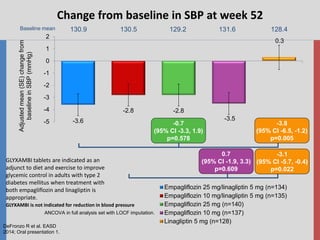
-3.6
-2.8 -2.8
-3.5
0.3
-5
-4
-3
-2
-1
0
1
2
Empagliflozin 25 mg/linagliptin 5 mg (n=134)
Empagliflozin 10 mg/linagliptin 5 mg (n=135)
Empagliflozin 25 mg (n=140)
Empagliflozin 10 mg (n=137)
Linagliptin 5 mg (n=128)
-3.8
(95% CI -6.5, -1.2)
p=0.005
-3.1
(95% CI -5.7, -0.4)
p=0.022
0.7
(95% CI -1.9, 3.3)
p=0.609
-0.7
(95% CI -3.3, 1.9)
p=0.578
Change from baseline in SBP at week 52
ANCOVA in full analysis set with LOCF imputation.
Adjustedmean(SE)changefrom
baselineinSBP(mmHg)Baseline mean 130.9 130.5 129.2 131.6 128.4
DeFronzo R et al. EASD
2014; Oral presentation 1.
GLYXAMBI is not indicated for reduction in blood pressure
GLYXAMBI tablets are indicated as an
adjunct to diet and exercise to improve
glycemic control in adults with type 2
diabetes mellitus when treatment with
both empagliflozin and linagliptin is
appropriate.
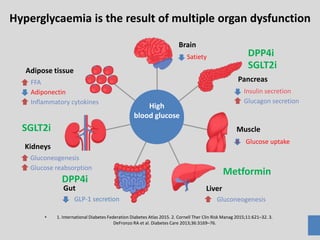
Hyperglycaemia is the result of multiple organ dysfunction
High
blood glucose
Pancreas
Insulin secretion
Glucagon secretion
Muscle
Glucose uptakev
Adipose tissue
FFA
Adiponectin
Inflammatory cytokines
Kidneys
Gluconeogenesis
Glucose reabsorption
Liver
Gluconeogenesis
Gut
GLP-1 secretion
Brain
Satiety
• 1. International Diabetes Federation Diabetes Atlas 2015. 2. Cornell Ther Clin Risk Manag 2015;11:621–32. 3.
DeFronzo RA et al. Diabetes Care 2013;36:3169–76.
SGLT2i
SGLT2i
Metformin
DPP4i
DPP4i
Questions?