DRUG STUDY
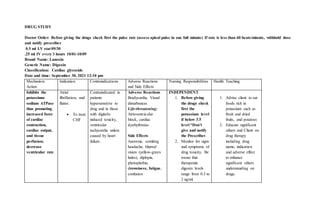
Doctor Order: Before giving the drugs check first the pulse rate (assess apical pulse in one full minute) If rate is less than 60 beats/minute, withhold dose
and notify prescriber
0.5 ml I.V stat 09/30
.25 ml IV every 3 hours 10/01-10/09
Brand Name: Lanoxin
Generic Name: Digoxin
Classification: Cardiac glycoside
Date and time: September 30, 2021 12:10 pm
Mechanism
Action
Indication Contraindications Adverse Reactions
and Side Effects
Nursing Responsibilities Health Teaching
Inhibits the
potassium-
sodium ATPase
thus promoting
increased force
of cardiac
contraction,
cardiac output,
and tissue
perfusion;
decrease
ventricular rate
Atrial
fibrillation, and
flutter.
 To treat
CHF
Contraindicated in
patients
hypersensitive to
drug and in those
with digitalis
induced toxicity,
ventricular
tachycardia unless
caused by heart
failure.
Adverse Reactions
Bradycardia, Visual
disturbances
Life-threatening:
Atrioventricular
block, cardiac
dysrhythmias
Side Effects
Anorexia, vomiting
headache, blurred
vision (yellow-green
halos), diplopia,
photophobia,
drowsiness, fatigue,
confusion
INDEPENDENT
1. Before giving
the drugs check
first the
potassium level
if below 3.5
level *Don’t
give and notify
the Prescriber.
2. Monitor for signs
and symptoms of
drug toxicity. Be
aware that
therapeutic
digoxin levels
range from 0.5 to
2 ng/ml.
1. Advise client to eat
foods rich in
potassium such as
fresh and dried
fruits, and potatoes
2. Educate significant
others and Client on
drug therapy
including drug
name, indication
and adverse effect
to enhance
significant others
understanding on
drugs.
*Sign and symptoms
of toxicity
such as Blurring of
vision, Anorexia,
Nausea and vomiting
and Diarrhea).
DEPENDENT
3. Monitor ECG
and blood levels
of digoxin,
electrolytes,
creatinine and
renal function
test By Doctors
order
*Stay alert for
hypocalcemia.
Know that this
condition may
predispose
patient to
digoxin toxicity
and may
decrease digoxin
efficacy.
*Watch closely
for hypokalemia
and
hypomagnesemia
Doctor Order:
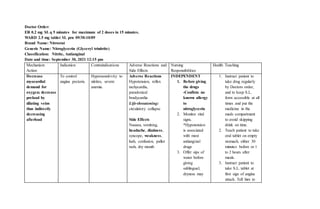
ER 0.2 mg SLq 5 minutes for maximum of 2 doses in 15 minutes.
WARD 2.5 mg tablet SL prn 09/30-10/09
Brand Name: Nitrostat
Generic Name: Nitroglycerin (Glyceryl trinitrite)
Classification: Nitrite, Antianginal
Date and time: September 30, 2021 12:15 pm
Mechanism
Action
Indication Contraindications Adverse Reactions and
Side Effects
Nursing
Responsibilities
Health Teaching
Decrease
myocardial
demand for
oxygen; decrease
preload by
dilating veins
thus indirectly
decreasing
afterload
To control
angina pectoris.
Hypersensitivity to
nitrites, severe
anemia.
Adverse Reactions
Hypotension, reflex
tachycardia,
paradoxical
bradycardia
Life-threatening:
circulatory collapse
Side Effects
Nausea, vomiting,
headache, dizziness,
syncope, weakness,
lush, confusion, pallor
rash, dry mouth
INDEPENDENT
1. Before giving
the drugs
-Confirm no
known allergy
to
nitroglycerin
2. Monitor vital
signs.
*Hypotension
is associated
with most
antianginal
drugs
3. Offer sips of
water before
giving
sublingual;
dryness may
1. Instruct patient to
take drug regularly
by Doctors order,
and to keep S.L.
form accessible at all
times and put the
medicine in the
meds compartment
to avoid skipping
drink on time.
2. Teach patient to take
oral tablet on empty
stomach, either 30
minutes before or 1
to 2 hours after
meals.
3. Instruct patient to
take S.L. tablet at
first sign of angina
attack. Tell him to
inhibit drug
absorption
4. Store S.L.
tablets in
original
container or
other container.
wet tablet with
saliva, place it under
the tongue until
completely
absorbed, and sit
down and rest.
Doctor Order:
1.25 mg IV q 6 hours infuse in 5 mins 09/30-10/02
0.625 mg IV prn 10/03-10/09
Brand Name: vasotec
Generic Name: Enalapril Maleate
Classification: Angiotensin-converting enzyme (ACE) inhibitor
Date and time: September 30, 2021 12:20 pm
Mechanism
Action
Indication Contraindications Adverse Reactions and
Side Effects
Nursing
Responsibilities
Health Teaching
May inhibit
ACE, preventing
conversion of
angiotensin I to
angiotensin II, a
potent
vasoconstrictor.
Less angiotensin
II decreases
peripheral
arterial
resistance,
To treat
hypertension
and also
effective in
treating heart
failure
-Hypersensitivity to
drug or other ACE
inhibitors
-Angioedema
Adverse Reactions
Loss of appetite, Dry
Cough
Side Effects
Dizziness Weakness
headache, Diarrhea,
skin rash, Nausea and
vomiting,
INDEPENDENT
1. Assess for
rapid blood
pressure drop
leading to
cardiovascular
collapse,
especially
when giving
with diuretics.
2. Monitor vital
signs, fluid
1. Inform patient and
significant others
that drug’s full effect
may not occur for
several weeks.
2. Advise patient and
significant others to
report persistent dry
cough with nasal
congestion.
3. Tell patient and
significant others to
decreasing
aldosterone
secretion,
reducing sodium
and water
retention and
lowering blood
pressure
intake and
output, and
daily weight.
of drug are
known.
DEPENDENT
3. Monitor CBC
with
differential
counts before
and during
therapy
4. Monitor
potassium
intake and
potassium level
5. Monitor liver
function tests,
BUN, and
creatinine and
electrolyte
levels.
immediately report
swelling of face, eye
area, tongue, lips,
hands, or feet; rash,
hives, or severe
itching; unexplained
fever; unusual
tiredness; yellowing
of skin or eyes;
abdominal pain; or
easy bruising.
4. Instruct patient to
move slowly when
sitting up to avoid
dizziness or light-
headedness from
sudden blood
pressure decrease.
Doctor Order: 40 mg PO day 09/30-10/09
Brand Name: Lipitor
Generic Name: Atorvastatin
Classification: HMG-CoA reductase inhibitors, statin, lipid-lowering agents
September 30, 2021 12:30 pm
Mechanism Action Indication Contraindications Adverse Reactions
and Side Effects
Nursing
Responsibilities
Health Teaching
HMG-CoA reductase
inhibitor; inhibits
rate- limiting step in
cholesterol
biosynthesis by
completely inhibiting
HMG-CoA reductase.
-To decrease cholesterol
levels and to decrease serum
lipids especially LDL and
tryglycerines
Hypersensitivity, active
liver disease or
unexplained persistent
elevations of serum
transaminase, porphyria
Adverse
Reactions
Rhabdomyolysis,
myalgia,
photosensitivity
and cataracts
Side Effects
Rare headache,
rush/ pruritus,
constipation/
diarrhea, sinusitis,
pharynitis
INDEPENDENT
1. Tell patient to
take drug at the
same time each
day to maintain
its effect.
2. Observe for
signs and
symptoms of
GI upset.
Taking the
drug with
sufficient water
or with meals
may alleviate
some of the GI
discomfort
DEPENDENT
3. Monitor blood
lipid levels
every 6 to 8
1.Teach patient about
proper dietary
management and maintain
a low fat diet by eating
food that low in animal
fat, cholesterol and
complex sugar.
2. Advise patients that
drug can be taken at any
time of day but taking at
night is good because our
body makes most
cholesterol at night.
3. Encourage client to
report promptly any
unexplained muscle
tenderness or weakness
that may be caused by
rhabdomyolysis
4. Tell patient to inform
prescriber for any side
effects.
weeks for the
first months
after the
therapy and
then after 3 to
6 months as
doctors order
4. Monitor
Laboratory for
liver function
test in every
follow up
check up or as
Doctors order
Doctor Order: 10 ml OD at night 09/30-10/09
Brand Name: Duphalac
Generic Name: Lactulose
Classification: Pharmacologic class: disaccharide, Therapeutic class: laxative
Date and time: September 30, 2021 1:00 pm
Mechanism Action Indication Contraindications Adverse
Reactions and
Side Effects
Nursing
Responsibilities
Health Teaching
Increases water content
and softens the stool.
Lower PH of the colon,
which inhibits the diffusion
of ammonia from the colon
into the blood thereby
reducing blood .
-To facilitate the
easy passage of
stool and to avoid
exerts force
(Valsalva
maneuver)
-contraindicated in
patients on low-galactose
diet.
GI: Abdominal
cramps,
belching,
diarrhea,
distention,
Flatulence.
1. Assess patients
condition
before starting
therapy, and
regularly there
after to monitor
the drugs
effectiveness.
2. Be alert for
adverse
reactions and
drug
interactions
3. Assess patients
and family’s
knowledge of
drug therapy.
1. Advice minimize sweet
taste, dilute with water or
fruit juice or give with
food.
2. Effects are seen 24 to 48
hrs.
3. Explain to Patient and
family the state of
understanding about drug
therapy.
Doctor Order:
20 mg slowly IV push over 2 minutes q 2 hrs. for 24 hours 10/01-10/02
20 mg PO bid 10/03-10/09
Brand Name: Lasix
Generic Name: Furosemide
Classification: Loop Diuretics
Date and time: October 1, 2021 8:00 am
Mechanism
Action
Indication Contraindications Adverse Reactions
and Side Effects
Nursing
Responsibilities
Health Teaching
Inhibit sodium
and chloride
reabsorption
mainly in the
ascending loop
of Henle;
potassium,
magnesium ,
and calcium also
may be excreted
To treat fluid
retention/fluid
overload caused
by CHF and
hypertension
-Contraindicated in
patients
hypersensitive to
drug or in those
with anuria.
Adverse Reactions
Severe dehydration;
marked hypotension
Life-threatening:
Renal failure,
thrombocytopenia,
and agranulocytosis
Side Effects
Nausea, diarrhea,
electrolytes
imbalances, vertigo,
cramping, rash,
headache, weakness,
ECG changes, blurred
vision,
photosensitivity
INDEPENDENT
1. Prior to
administration
check for signs
and symptoms
of volume
depletion, such
as postural
hypotension,
lightheadedness,
and dizziness
2. Monitor urine
output during
hours during
after
administration.
Analyze intake,
output and daily
1. Instruct patient and
significant others to
move slowly when
sitting up or
standing, to avoid
dizziness or light-
headedness from
sudden blood
pressure drop.
2. Advise patient to eat
foods high in
potassium. Provide
other dietary
counseling as
appropriate to help
prevent or minimize
electrolyte
imbalances.
weights to
assess response.
3. Monitor blood
pressure
regularly. Be
alert for marked
decrease in
blood pressure
DEPENDENT
1. Monitor serum
electrolyte, uric
acid, glucose,
and BUN levels
as Doctors order
3. Instruct patient and
significant others to
immediately report
ringing in ears,
severe abdominal
pain, or sore throat
and fever (these
symptoms may
indicate toxicity)
.
Doctors order: 25 mg P.O OD
Brand Name: Aldactone
Generic Name: Potassium-sparring diuretics
Classification: Potassium sparring
Date and Time: October 01, 2021- 8:03 am.
Mechanism Of
Action
Indication Contraindication Adverse Reactions
and Side Effects
Nursing Responsibilities Health Teaching
Potassium-sparring
diuretics:
antagonizes
aldosterone in the
distal tubules,
increasing sodium
and water
excretion.
Treatment for
hypokalemia or
prevention of
hypokalemia in
patients who would
be at risk if
hypokalemia
occurred;
Digitalized patients,
patients with
cardiac arrhythmias
 To treat
CHF
Contraindicated in patient with
allergy to spironolactone,
hyperkalemia, renal disease,
anuria.
Adverse Reactions
Hyperkalemia,
Agranulocytosis,
hyponatremia
Side Effects
Drowsiness,
dizziness, Nausea,
vomiting, diarrhea,
abdominal cramps,
irritability
INDEPENDENT
1. To enhance
absorption, give
drug with meals
2. Protect drug from
light.
DEPENDENT
3. Monitor electrolyte
levels, fluid intake
and output, weight,
and and blood
pressure.
4. Inform laboratory
that patients is
taking
spironolactone
because drug may
interfere with test
that measure
digoxin level.
1. Instruct patient to
take drugs in
morning to prevent
need to urinate at
night.
2. To prevent serious
hyperkalemia warn
patent to avoid
excessive ingestion
of potassium-rich
foods (such as
citrus fruits,
tomatoes, bananas,
dates and apricots),
potassium
containing salt
substitutes, and
potassium
supplements.
Doctor Order: 1mg/tab OD
Brand Name: Coumadin
Generic Name: Warfarin Sodium
Classification: Anticoagulant
Date and time: October 01, 2021 8:00pm
Mechanism
Action
Indication Contraindications Adverse Reactions and
Side Effects
Nursing
Responsibilities
Health Teaching
Inhibit hepatic
synthesis of
vitamin k- which
decrease
prothrombin
and clotting
factors
dependent
activation of
clotting factors
VII,IX and X.
Prevent blood
clotting due to
arterial
fibrillation
because of heart
failure.
Peptic bleeding
ulcer, blood
dyscrasias,
Adverse Reactions
Stomatitis
Life-threatening:
hemorrhage
Side Effects
Anorexia, nausea,
vomiting, diarrhea,
abdominal cramps,
rash, fever
INDEPENDENT
1. Watch for
signs and
symptoms of
bleeding and
hepatitis.
2. Give drug at
the same time
daily.
3. Avoid all IM
injections.
4. Regularly
inspect patient
for bleeding
gums, bruises
on arms or
legs, petechiae,
nosebleeds,
melena, tarry
stools,
hematuria
4. Explain therapy to
patient. Stress
importance of
adhering to schedule
for laboratory tests.
5. Instruct patient and
family to promptly
report unusual
bleeding or bruising.
6. Caution patient to
consult prescriber
before taking herbs.
7. Tell patient not to
vary his intake of
foods high in
vitamin K (such as
leafy green
vegetables, fish,
pork, green tea, and
tomatoes), to avoid
alterations in drug’s
anticoagulant effect.
5. Withhold drug
and call
prescriber at
once in the
event of fever
or rash.
DEPENDENT
2. Draw blood to
establish
baseline
coagulation as
doctors order
3. parameters
before
therapy. PT
and INR as
doctors order
Doctor Order: 3.125 mg/ tab b.i.d
Brand Name: Coreg
Generic Name: Carvedilol
Classification: Beta-adrenergic blocking Agents
Date and time: October 1, 2021 9:00 am
Mechanism
Action
Indication Contraindications Adverse Reactions and
Side Effects
Nursing
Responsibilities
Health Teaching
Carvedilol
causes
vasodilation by
blocking the
activity of α-
blockers, mainly
at alpha-1
receptors. It
exerts
antihypertensive
effect partly by
reducing total
peripheral
resistance and
vasodilation. It
is used in
patients with
renal
impairment,
NIDDM or
IDDM
-For treatment
of hypertension
and with heart
failure
Hypersensitivity;
severe chronic heart
failure, bronchial
asthma or related
bronchospastic
conditions.
CNS: pain dizziness,
fever
CV: hypotension,
edema, bradycardia
EENT: sinusitis,
blurred vision
GI: Diarrhea, Nausea
and vomiting
GU: UTI, Hematuria
Hematologic: anemia.
Thrombocytopenia
Metabolic: weight
gain, hyperglycemia
Musculoskeletal: Back
pain, muscle cramps
Respirarotry:
bronchitis, rales,
dyspnea
1. Monitor for
orthostatic
hypotension
and adverse
effects
2. Monitor patient
for any sign of
liver function
test
3. Monitor for
fluid retention
4. Assess patient
for dizziness or
light
headedness for
1 hour after
giving each
new dose
1. Instruct to take drug
with meals.
2. Instruct to do not
stop taking drug
unless instructed to
do so by a health
care provider.
3. Advised to report
difficulty breathing,
swelling of
extremities, changes
in color of stool or
urine, very slow
heart rate, continued
dizziness.
4. Check the BP of the
patient.
5. Inform patient that
improvement of
heart failure
symptoms might
take several weeks
of drug therapy

DRUG-STUDY-for-Case-presentation-finale.docx

  • 1.
    DRUG STUDY Doctor Order:Before giving the drugs check first the pulse rate (assess apical pulse in one full minute) If rate is less than 60 beats/minute, withhold dose and notify prescriber 0.5 ml I.V stat 09/30 .25 ml IV every 3 hours 10/01-10/09 Brand Name: Lanoxin Generic Name: Digoxin Classification: Cardiac glycoside Date and time: September 30, 2021 12:10 pm Mechanism Action Indication Contraindications Adverse Reactions and Side Effects Nursing Responsibilities Health Teaching Inhibits the potassium- sodium ATPase thus promoting increased force of cardiac contraction, cardiac output, and tissue perfusion; decrease ventricular rate Atrial fibrillation, and flutter.  To treat CHF Contraindicated in patients hypersensitive to drug and in those with digitalis induced toxicity, ventricular tachycardia unless caused by heart failure. Adverse Reactions Bradycardia, Visual disturbances Life-threatening: Atrioventricular block, cardiac dysrhythmias Side Effects Anorexia, vomiting headache, blurred vision (yellow-green halos), diplopia, photophobia, drowsiness, fatigue, confusion INDEPENDENT 1. Before giving the drugs check first the potassium level if below 3.5 level *Don’t give and notify the Prescriber. 2. Monitor for signs and symptoms of drug toxicity. Be aware that therapeutic digoxin levels range from 0.5 to 2 ng/ml. 1. Advise client to eat foods rich in potassium such as fresh and dried fruits, and potatoes 2. Educate significant others and Client on drug therapy including drug name, indication and adverse effect to enhance significant others understanding on drugs.
  • 2.
    *Sign and symptoms oftoxicity such as Blurring of vision, Anorexia, Nausea and vomiting and Diarrhea). DEPENDENT 3. Monitor ECG and blood levels of digoxin, electrolytes, creatinine and renal function test By Doctors order *Stay alert for hypocalcemia. Know that this condition may predispose patient to digoxin toxicity and may decrease digoxin efficacy. *Watch closely for hypokalemia and hypomagnesemia
  • 3.
    Doctor Order: ER 0.2mg SLq 5 minutes for maximum of 2 doses in 15 minutes. WARD 2.5 mg tablet SL prn 09/30-10/09 Brand Name: Nitrostat Generic Name: Nitroglycerin (Glyceryl trinitrite) Classification: Nitrite, Antianginal Date and time: September 30, 2021 12:15 pm Mechanism Action Indication Contraindications Adverse Reactions and Side Effects Nursing Responsibilities Health Teaching Decrease myocardial demand for oxygen; decrease preload by dilating veins thus indirectly decreasing afterload To control angina pectoris. Hypersensitivity to nitrites, severe anemia. Adverse Reactions Hypotension, reflex tachycardia, paradoxical bradycardia Life-threatening: circulatory collapse Side Effects Nausea, vomiting, headache, dizziness, syncope, weakness, lush, confusion, pallor rash, dry mouth INDEPENDENT 1. Before giving the drugs -Confirm no known allergy to nitroglycerin 2. Monitor vital signs. *Hypotension is associated with most antianginal drugs 3. Offer sips of water before giving sublingual; dryness may 1. Instruct patient to take drug regularly by Doctors order, and to keep S.L. form accessible at all times and put the medicine in the meds compartment to avoid skipping drink on time. 2. Teach patient to take oral tablet on empty stomach, either 30 minutes before or 1 to 2 hours after meals. 3. Instruct patient to take S.L. tablet at first sign of angina attack. Tell him to
  • 4.
    inhibit drug absorption 4. StoreS.L. tablets in original container or other container. wet tablet with saliva, place it under the tongue until completely absorbed, and sit down and rest. Doctor Order: 1.25 mg IV q 6 hours infuse in 5 mins 09/30-10/02 0.625 mg IV prn 10/03-10/09 Brand Name: vasotec Generic Name: Enalapril Maleate Classification: Angiotensin-converting enzyme (ACE) inhibitor Date and time: September 30, 2021 12:20 pm Mechanism Action Indication Contraindications Adverse Reactions and Side Effects Nursing Responsibilities Health Teaching May inhibit ACE, preventing conversion of angiotensin I to angiotensin II, a potent vasoconstrictor. Less angiotensin II decreases peripheral arterial resistance, To treat hypertension and also effective in treating heart failure -Hypersensitivity to drug or other ACE inhibitors -Angioedema Adverse Reactions Loss of appetite, Dry Cough Side Effects Dizziness Weakness headache, Diarrhea, skin rash, Nausea and vomiting, INDEPENDENT 1. Assess for rapid blood pressure drop leading to cardiovascular collapse, especially when giving with diuretics. 2. Monitor vital signs, fluid 1. Inform patient and significant others that drug’s full effect may not occur for several weeks. 2. Advise patient and significant others to report persistent dry cough with nasal congestion. 3. Tell patient and significant others to
  • 5.
    decreasing aldosterone secretion, reducing sodium and water retentionand lowering blood pressure intake and output, and daily weight. of drug are known. DEPENDENT 3. Monitor CBC with differential counts before and during therapy 4. Monitor potassium intake and potassium level 5. Monitor liver function tests, BUN, and creatinine and electrolyte levels. immediately report swelling of face, eye area, tongue, lips, hands, or feet; rash, hives, or severe itching; unexplained fever; unusual tiredness; yellowing of skin or eyes; abdominal pain; or easy bruising. 4. Instruct patient to move slowly when sitting up to avoid dizziness or light- headedness from sudden blood pressure decrease.
  • 6.
    Doctor Order: 40mg PO day 09/30-10/09 Brand Name: Lipitor Generic Name: Atorvastatin Classification: HMG-CoA reductase inhibitors, statin, lipid-lowering agents September 30, 2021 12:30 pm Mechanism Action Indication Contraindications Adverse Reactions and Side Effects Nursing Responsibilities Health Teaching HMG-CoA reductase inhibitor; inhibits rate- limiting step in cholesterol biosynthesis by completely inhibiting HMG-CoA reductase. -To decrease cholesterol levels and to decrease serum lipids especially LDL and tryglycerines Hypersensitivity, active liver disease or unexplained persistent elevations of serum transaminase, porphyria Adverse Reactions Rhabdomyolysis, myalgia, photosensitivity and cataracts Side Effects Rare headache, rush/ pruritus, constipation/ diarrhea, sinusitis, pharynitis INDEPENDENT 1. Tell patient to take drug at the same time each day to maintain its effect. 2. Observe for signs and symptoms of GI upset. Taking the drug with sufficient water or with meals may alleviate some of the GI discomfort DEPENDENT 3. Monitor blood lipid levels every 6 to 8 1.Teach patient about proper dietary management and maintain a low fat diet by eating food that low in animal fat, cholesterol and complex sugar. 2. Advise patients that drug can be taken at any time of day but taking at night is good because our body makes most cholesterol at night. 3. Encourage client to report promptly any unexplained muscle tenderness or weakness that may be caused by rhabdomyolysis 4. Tell patient to inform prescriber for any side effects.
  • 7.
    weeks for the firstmonths after the therapy and then after 3 to 6 months as doctors order 4. Monitor Laboratory for liver function test in every follow up check up or as Doctors order
  • 8.
    Doctor Order: 10ml OD at night 09/30-10/09 Brand Name: Duphalac Generic Name: Lactulose Classification: Pharmacologic class: disaccharide, Therapeutic class: laxative Date and time: September 30, 2021 1:00 pm Mechanism Action Indication Contraindications Adverse Reactions and Side Effects Nursing Responsibilities Health Teaching Increases water content and softens the stool. Lower PH of the colon, which inhibits the diffusion of ammonia from the colon into the blood thereby reducing blood . -To facilitate the easy passage of stool and to avoid exerts force (Valsalva maneuver) -contraindicated in patients on low-galactose diet. GI: Abdominal cramps, belching, diarrhea, distention, Flatulence. 1. Assess patients condition before starting therapy, and regularly there after to monitor the drugs effectiveness. 2. Be alert for adverse reactions and drug interactions 3. Assess patients and family’s knowledge of drug therapy. 1. Advice minimize sweet taste, dilute with water or fruit juice or give with food. 2. Effects are seen 24 to 48 hrs. 3. Explain to Patient and family the state of understanding about drug therapy.
  • 9.
    Doctor Order: 20 mgslowly IV push over 2 minutes q 2 hrs. for 24 hours 10/01-10/02 20 mg PO bid 10/03-10/09 Brand Name: Lasix Generic Name: Furosemide Classification: Loop Diuretics Date and time: October 1, 2021 8:00 am Mechanism Action Indication Contraindications Adverse Reactions and Side Effects Nursing Responsibilities Health Teaching Inhibit sodium and chloride reabsorption mainly in the ascending loop of Henle; potassium, magnesium , and calcium also may be excreted To treat fluid retention/fluid overload caused by CHF and hypertension -Contraindicated in patients hypersensitive to drug or in those with anuria. Adverse Reactions Severe dehydration; marked hypotension Life-threatening: Renal failure, thrombocytopenia, and agranulocytosis Side Effects Nausea, diarrhea, electrolytes imbalances, vertigo, cramping, rash, headache, weakness, ECG changes, blurred vision, photosensitivity INDEPENDENT 1. Prior to administration check for signs and symptoms of volume depletion, such as postural hypotension, lightheadedness, and dizziness 2. Monitor urine output during hours during after administration. Analyze intake, output and daily 1. Instruct patient and significant others to move slowly when sitting up or standing, to avoid dizziness or light- headedness from sudden blood pressure drop. 2. Advise patient to eat foods high in potassium. Provide other dietary counseling as appropriate to help prevent or minimize electrolyte imbalances.
  • 10.
    weights to assess response. 3.Monitor blood pressure regularly. Be alert for marked decrease in blood pressure DEPENDENT 1. Monitor serum electrolyte, uric acid, glucose, and BUN levels as Doctors order 3. Instruct patient and significant others to immediately report ringing in ears, severe abdominal pain, or sore throat and fever (these symptoms may indicate toxicity) .
  • 11.
    Doctors order: 25mg P.O OD Brand Name: Aldactone Generic Name: Potassium-sparring diuretics Classification: Potassium sparring Date and Time: October 01, 2021- 8:03 am. Mechanism Of Action Indication Contraindication Adverse Reactions and Side Effects Nursing Responsibilities Health Teaching Potassium-sparring diuretics: antagonizes aldosterone in the distal tubules, increasing sodium and water excretion. Treatment for hypokalemia or prevention of hypokalemia in patients who would be at risk if hypokalemia occurred; Digitalized patients, patients with cardiac arrhythmias  To treat CHF Contraindicated in patient with allergy to spironolactone, hyperkalemia, renal disease, anuria. Adverse Reactions Hyperkalemia, Agranulocytosis, hyponatremia Side Effects Drowsiness, dizziness, Nausea, vomiting, diarrhea, abdominal cramps, irritability INDEPENDENT 1. To enhance absorption, give drug with meals 2. Protect drug from light. DEPENDENT 3. Monitor electrolyte levels, fluid intake and output, weight, and and blood pressure. 4. Inform laboratory that patients is taking spironolactone because drug may interfere with test that measure digoxin level. 1. Instruct patient to take drugs in morning to prevent need to urinate at night. 2. To prevent serious hyperkalemia warn patent to avoid excessive ingestion of potassium-rich foods (such as citrus fruits, tomatoes, bananas, dates and apricots), potassium containing salt substitutes, and potassium supplements.
  • 12.
    Doctor Order: 1mg/tabOD Brand Name: Coumadin Generic Name: Warfarin Sodium Classification: Anticoagulant Date and time: October 01, 2021 8:00pm Mechanism Action Indication Contraindications Adverse Reactions and Side Effects Nursing Responsibilities Health Teaching Inhibit hepatic synthesis of vitamin k- which decrease prothrombin and clotting factors dependent activation of clotting factors VII,IX and X. Prevent blood clotting due to arterial fibrillation because of heart failure. Peptic bleeding ulcer, blood dyscrasias, Adverse Reactions Stomatitis Life-threatening: hemorrhage Side Effects Anorexia, nausea, vomiting, diarrhea, abdominal cramps, rash, fever INDEPENDENT 1. Watch for signs and symptoms of bleeding and hepatitis. 2. Give drug at the same time daily. 3. Avoid all IM injections. 4. Regularly inspect patient for bleeding gums, bruises on arms or legs, petechiae, nosebleeds, melena, tarry stools, hematuria 4. Explain therapy to patient. Stress importance of adhering to schedule for laboratory tests. 5. Instruct patient and family to promptly report unusual bleeding or bruising. 6. Caution patient to consult prescriber before taking herbs. 7. Tell patient not to vary his intake of foods high in vitamin K (such as leafy green vegetables, fish, pork, green tea, and tomatoes), to avoid alterations in drug’s anticoagulant effect.
  • 13.
    5. Withhold drug andcall prescriber at once in the event of fever or rash. DEPENDENT 2. Draw blood to establish baseline coagulation as doctors order 3. parameters before therapy. PT and INR as doctors order
  • 14.
    Doctor Order: 3.125mg/ tab b.i.d Brand Name: Coreg Generic Name: Carvedilol Classification: Beta-adrenergic blocking Agents Date and time: October 1, 2021 9:00 am Mechanism Action Indication Contraindications Adverse Reactions and Side Effects Nursing Responsibilities Health Teaching Carvedilol causes vasodilation by blocking the activity of α- blockers, mainly at alpha-1 receptors. It exerts antihypertensive effect partly by reducing total peripheral resistance and vasodilation. It is used in patients with renal impairment, NIDDM or IDDM -For treatment of hypertension and with heart failure Hypersensitivity; severe chronic heart failure, bronchial asthma or related bronchospastic conditions. CNS: pain dizziness, fever CV: hypotension, edema, bradycardia EENT: sinusitis, blurred vision GI: Diarrhea, Nausea and vomiting GU: UTI, Hematuria Hematologic: anemia. Thrombocytopenia Metabolic: weight gain, hyperglycemia Musculoskeletal: Back pain, muscle cramps Respirarotry: bronchitis, rales, dyspnea 1. Monitor for orthostatic hypotension and adverse effects 2. Monitor patient for any sign of liver function test 3. Monitor for fluid retention 4. Assess patient for dizziness or light headedness for 1 hour after giving each new dose 1. Instruct to take drug with meals. 2. Instruct to do not stop taking drug unless instructed to do so by a health care provider. 3. Advised to report difficulty breathing, swelling of extremities, changes in color of stool or urine, very slow heart rate, continued dizziness. 4. Check the BP of the patient. 5. Inform patient that improvement of heart failure symptoms might
  • 15.