Presented by
Sushil Kumar Ranjan
M.Sc. (1st Sem. (Roll No-11)
Under the guidance of
Dr. N.P. Singh
Associate professor
Department of chemistry,
DDU Gorakhpur University, Gorakhpur
Silicones and their Applications
– Introduction
– Nomenclature
– Manufacturing of silicones
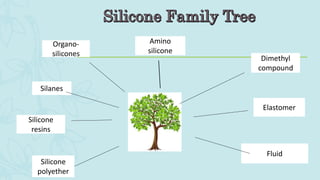
– Types of silicones
– Properties of silicones
– Applications
Silicones, also known as polysiloxanes
It is made up by repeating unit of
siloxanes, which is chain of alternating
silicone atoms and oxygen atoms,
combined with carbon, hydrogen or
other
Silicone fluid, silicone elastomer and
silicone resin
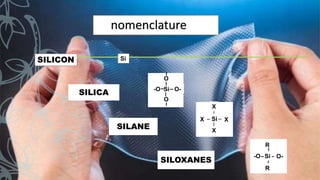
nomenclature
SILICON Si
SILICA
SILANE
SILOXANES
X
X X
X
Si
-O
R
R
Si O-
-O Si O-
O
O
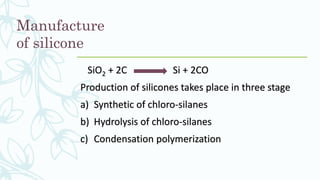
Manufacture
of silicone
SiO2 + 2C Si + 2CO
Production of silicones takes place in three stage
a) Synthetic of chloro-silanes
b) Hydrolysis of chloro-silanes
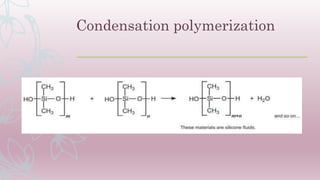
c) Condensation polymerization
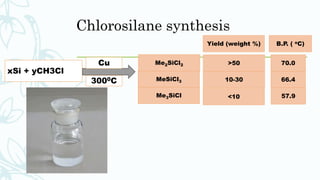
Chlorosilane synthesis
xSi + yCH3Cl
Cu
3000C MeSiCl3
Me3SiCl
Me2SiCl2
Yield (weight %) B.P. ( oC)
>50
10-30
<10
70.0
66.4
57.9
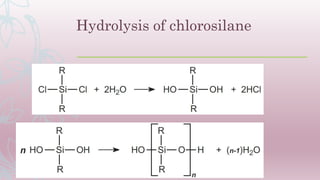
Hydrolysis of chlorosilane
Condensation polymerization
Elastomer
Silicone
polyether
Organo-
silicones
Silanes
Dimethyl
compound
Fluid
Silicone
resins
Amino
silicone
Silicone
fluid
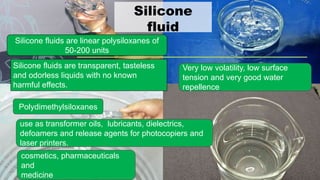
Silicone fluids are linear polysiloxanes of
50-200 units
Very low volatility, low surface
tension and very good water
repellence
Silicone fluids are transparent, tasteless
and odorless liquids with no known
harmful effects.
use as transformer oils, lubricants, dielectrics,
defoamers and release agents for photocopiers and
laser printers.
cosmetics, pharmaceuticals
and
medicine
Polydimethylsiloxanes
Silicone
elastomers
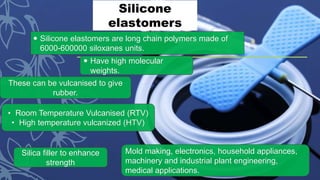
 Silicone elastomers are long chain polymers made of
6000-600000 siloxanes units.
 Have high molecular
weights.
These can be vulcanised to give
rubber.
• Room Temperature Vulcanised (RTV)
• High temperature vulcanized (HTV)
Mold making, electronics, household appliances,
machinery and industrial plant engineering,
medical applications.
Silica filler to enhance
strength
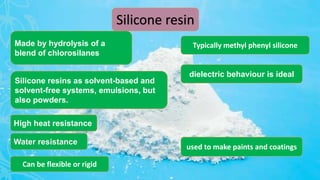
Silicone resin
Water resistance
Made by hydrolysis of a
blend of chlorosilanes
High heat resistance
dielectric behaviour is ideal
Silicone resins as solvent-based and
solvent-free systems, emulsions, but
also powders.
Typically methyl phenyl silicone
Can be flexible or rigid
used to make paints and coatings
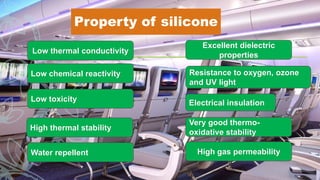
Property of silicone
Water repellent
Very good thermo-
oxidative stability
Excellent dielectric
properties
Low chemical reactivity
Low toxicity
High thermal stability
High gas permeability
Low thermal conductivity
Resistance to oxygen, ozone
and UV light
Electrical insulation
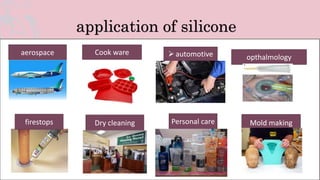
application of silicone
aerospace Cook ware
firestops Dry cleaning
automotive opthalmology
Mold makingPersonal care
lubricant
plumbing
Coating
Building
construction
toyselectronics medicine
As modern means of transport become faster, more
reliable
and more efficient, demands on materials to perform
become
tougher. As such, smaller parts must resist exposure
to
extreme heat, moisture, salt and fuels. Most
materials
deteriorate in these conditions, but not silicones.
Silicones retain their properties and –
most important –
ensure that cars, ships, airplanes and
trains operate safely
for the long haul.
References
• Industrial chemistry including chemical engineering by BK Sharma,
IO-1040 (1991) (book.google.co.in)
• Hans-Heinrich Moretto, Manfred Schulze, Gebhard Wagner (2005) "Silicones"
in Ullmann's Encyclopedia of Industrial Chemistry, Wiley-VCH,
Weinheim. (books.google.co.in)
• https://en.wikipedia.org/wiki/Silicone
• http://www.essentialchemicalindustry.org/polymers/silicones.html
Acknowledgement
– I would like to express my special thanks of gratitude to my teacher Dr. N.P. Singh sir
– I am also very thankful to the head, Department Of Chemistry D.D.U. Gorakhpur
University, Gorakhpur Prof. O.P. Pandey Sir.
– Secondly, I would also like to thank my parents and friends who helped me a lot in
finalizing this presentation within the time frame.
– Thanks again to all who helped me
 silicone and their application

silicone and their application

  • 1.
    Presented by Sushil KumarRanjan M.Sc. (1st Sem. (Roll No-11) Under the guidance of Dr. N.P. Singh Associate professor Department of chemistry, DDU Gorakhpur University, Gorakhpur Silicones and their Applications
  • 2.
    – Introduction – Nomenclature –Manufacturing of silicones – Types of silicones – Properties of silicones – Applications
  • 3.
    Silicones, also knownas polysiloxanes It is made up by repeating unit of siloxanes, which is chain of alternating silicone atoms and oxygen atoms, combined with carbon, hydrogen or other Silicone fluid, silicone elastomer and silicone resin
  • 4.
  • 5.
    Manufacture of silicone SiO2 +2C Si + 2CO Production of silicones takes place in three stage a) Synthetic of chloro-silanes b) Hydrolysis of chloro-silanes c) Condensation polymerization
  • 6.
    Chlorosilane synthesis xSi +yCH3Cl Cu 3000C MeSiCl3 Me3SiCl Me2SiCl2 Yield (weight %) B.P. ( oC) >50 10-30 <10 70.0 66.4 57.9
  • 7.
  • 8.
  • 9.
  • 10.
    Silicone fluid Silicone fluids arelinear polysiloxanes of 50-200 units Very low volatility, low surface tension and very good water repellence Silicone fluids are transparent, tasteless and odorless liquids with no known harmful effects. use as transformer oils, lubricants, dielectrics, defoamers and release agents for photocopiers and laser printers. cosmetics, pharmaceuticals and medicine Polydimethylsiloxanes
  • 11.
    Silicone elastomers  Silicone elastomersare long chain polymers made of 6000-600000 siloxanes units.  Have high molecular weights. These can be vulcanised to give rubber. • Room Temperature Vulcanised (RTV) • High temperature vulcanized (HTV) Mold making, electronics, household appliances, machinery and industrial plant engineering, medical applications. Silica filler to enhance strength
  • 12.
    Silicone resin Water resistance Madeby hydrolysis of a blend of chlorosilanes High heat resistance dielectric behaviour is ideal Silicone resins as solvent-based and solvent-free systems, emulsions, but also powders. Typically methyl phenyl silicone Can be flexible or rigid used to make paints and coatings
  • 13.
    Property of silicone Waterrepellent Very good thermo- oxidative stability Excellent dielectric properties Low chemical reactivity Low toxicity High thermal stability High gas permeability Low thermal conductivity Resistance to oxygen, ozone and UV light Electrical insulation
  • 14.
    application of silicone aerospaceCook ware firestops Dry cleaning automotive opthalmology Mold makingPersonal care
  • 15.
  • 16.
    As modern meansof transport become faster, more reliable and more efficient, demands on materials to perform become tougher. As such, smaller parts must resist exposure to extreme heat, moisture, salt and fuels. Most materials deteriorate in these conditions, but not silicones. Silicones retain their properties and – most important – ensure that cars, ships, airplanes and trains operate safely for the long haul.
  • 17.
    References • Industrial chemistryincluding chemical engineering by BK Sharma, IO-1040 (1991) (book.google.co.in) • Hans-Heinrich Moretto, Manfred Schulze, Gebhard Wagner (2005) "Silicones" in Ullmann's Encyclopedia of Industrial Chemistry, Wiley-VCH, Weinheim. (books.google.co.in) • https://en.wikipedia.org/wiki/Silicone • http://www.essentialchemicalindustry.org/polymers/silicones.html
  • 18.
    Acknowledgement – I wouldlike to express my special thanks of gratitude to my teacher Dr. N.P. Singh sir – I am also very thankful to the head, Department Of Chemistry D.D.U. Gorakhpur University, Gorakhpur Prof. O.P. Pandey Sir. – Secondly, I would also like to thank my parents and friends who helped me a lot in finalizing this presentation within the time frame. – Thanks again to all who helped me