FATS AND OILS
Presented by: Group 2
FATS SIMILARITIES OILS
Liquid at room
temperature
Unsaturated fats
belong in oils
Unsaturated fats
can improve
cholesterol levels
Solid at room
temperature
Saturated Fats are
solid fat
Saturated Fat can
increase
cholesterol levels
Both are glycerol
esters
Have glycerol
backbone and
fatty acid chains
Both are called
lipids
CLASSIFICATION
OF FATS AND
OILS
According to Appearance
Visible Fat- visually distinctive such as beef tallow, butter, coconut oil, etc
Invisible Fat- indistinguishable unless separated by chemical means.
Examples are fats in avocado, egg yolk, and lean meats.
Plant vs Animal
Plant fats have generally more
unsaturated fatty acids.
Plant oils have no cholesterol but
may be converted to cholesterol
inside the body.
Monounsaturated fatty acids- canola,
olive and peanut
Polyunsaturated fatty acids- corn,
canola, cottonseed, sunflower,
soybean, and safflower.
Animal fat has predominantly
saturated fatty acids.
Only animal fats have cholesterol.
Saturated fatty acids, those with no
double bonds in the carbon chain are
butter, lard, beef tallow, coconut oil
and palm kernel oil
ACCORDING TO SOURCE
Plant vs Animal
ACCORDING TO SOURCE
Butter- Milk
Lard- Fatty tissues of pork
Beef Tallow (Suet)- Fatty tissues of beef
Fish Oils- Fatty tissues of fish
Fish Liver Oils- Fish Liver
Chicken Fat- Chicken
Coconut Oils
Palm Kernel Oil
Palm Oil
Soybean Oil
Rice Bran Oil
Cottonseed Oil
Olive Oil
Peanut Oil
Safflower Oil
Sesame Oil
Rapeseed Oil
Canola Oil
Cocoa Butter
Combination Oils
Specialty Oils
(Avocado Oil,
Aryan Oil, etc.)
Frying Oils
Shortening
Spread
Salad Dressing
Topping
Flavoring
Nutritional Supplement
1.
2.
3.
4.
5.
6.
7.
According to Culinary Use
9 calories per gram
Calories from fat should not exceed 30% of total caloric requirement
Excess fats become fat deposits which is responsible for obesity
Filipino's consumption of fats and oil is low at 15g/day
Bicol Region has highest intake of fats and oils (23g/day) because
Central Visayas has lowest consumption at
of gata.
8 grams per day.
Nutritional Importance
Carry fat soluble vitamins A,D,E and K
Insulates body organs from extreme temperatures
Necessary to maintain cell structures
Sources of essential fatty acids EFA (Linoleic and Linolenic)
EFA are converted to prostaglandins necessary for immune system.
Linoleic Acid (LA)- parent molecule of omega-6 fatty acids including
arachidonic acid (ARA)
Alpha-Linolenic Acid (ALA)- parent molecule of omega-3 fatty acids
including docosahexaenoic acid (DHA).
ARA and DHA are critical for brain development of infants.
Nutritional Importance
CHEMICAL COMPOSITION
OF
FATS AND OILS
CHEMICAL COMPOSITION OF FATS AND OILS
Triglycerides
-glycerol esters of free fatty acids wherein all 3 carbons in the glycerol backbone
are attached to the fatty acid.
-Most naturally occurring fatty acids have straight even number chains with only
hydrogen attached.
-Fatty acids may be saturated or not.
-Degree of unsaturation has other nutritional and culinary implications.
-It affects physical properties, especially melting point
-Fats and oil may differ from one another with respect to the position of the
fatty acid, the glycerol backbone, and other factors.
CHEMICAL COMPOSITION OF FATS AND OILS
Diglycerides and Monoglycerides
Monoglyceride- when only one of the 3 carbons of the glycerol is esterified with
a fatty acid
Diglyceride- When 2 of the 3 carbons are esterified
Mono and Diglycerides functions as emulsifiers due to the hydrophilic and
hydrophobic ends of their molecules. The free hydroxyl interacts with water and
the hydrocarbon chain interacts with the oil.
CHEMICAL COMPOSITION OF FATS AND OILS
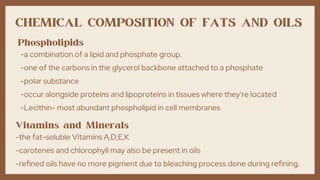
Phospholipids
-a combination of a lipid and phosphate group.
-one of the carbons in the glycerol backbone attached to a phosphate
-polar substance
-occur alongside proteins and lipoproteins in tissues where they're located
-Lecithin- most abundant phospholipid in cell membranes
Vitamins and Minerals
-the fat-soluble Vitamins A,D,E,K
-carotenes and chlorophyll may also be present in oils
-refined oils have no more pigment due to bleaching process done during refining.
PHYSICAL PROPERTIES OF
FATS AND OILS
PHYSICAL PROPERTIES OF FATS AND OILS
physical and chemical configuration of fats and oil determine its properties
and reaction
Solid fat is composed of crystal structures of straight chain fatty acids
suspended in oil
Physical Structure
the proportion of fat in crystalline form to suspending oil is expressed as
solid fat index (SFI).
Solid Fat Index
PHYSICAL PROPERTIES OF FATS AND OILS
if there are fewer molecular species, the crystals will be unstable and larger
crystals will form whereas if there are more molecular species, the resulting
crystals will be smaller.
Polymorphism
the property of fat that allows it to be molded or pressed into various shapes
without breaking.
Plasticity
PHYSICAL PROPERTIES OF FATS AND OILS
the temperature at which a solid fat is changed into liquid.
melting point range depends on the SFI
factors determining the SFI are chain length, degree of saturation,
configuration at double bonds of unsaturated fatty acids, and the number of
molecular species.
melting point increases as the number of carbons in its hydrocarbon chain
increases and as the number of double bond decreases.
the greater the degree of unsaturation, the lower the melting point.
Melting Point
PHYSICAL PROPERTIES OF FATS AND OILS
the temperature at which a liquid fat is changed to solid.
always lower than the melting point
Solidification Temperature
natural fats are insoluble in water, slightly soluble in lower alcohols and readily
soluble in non-polar solvent
Solubility
PHYSICAL PROPERTIES OF FATS AND OILS
Oil is lighter than water.
Oil's density- 0.90 to 0.92 grams per cubic meter
Specific gravity is defined as the ratio between the density of a substance
and that of water.
The density of water is 1.0 so that gravity and density has the same value
Density and Gravity
PHYSICAL PROPERTIES OF FATS AND OILS
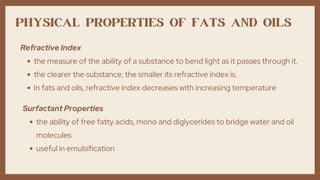
the measure of the ability of a substance to bend light as it passes through it.
the clearer the substance, the smaller its refractive index is.
In fats and oils, refractive index decreases with increasing temperature
Refractive Index
the ability of free fatty acids, mono and diglycerides to bridge water and oil
molecules
useful in emulsification
Surfactant Properties
PHYSICAL PROPERTIES OF FATS AND OILS
the ability of the fat/oil to withstand heat without undergoing deterioration. .
Thermal Stability
the temperature at which fat deterioration is sufficient to produce bluish
smoke.
much higher than the boiling point of water.
Frying temperatures- 170° to 195° C. Smoke points of fats and oils are
beyond the temperature used in frying.
Smoke Point
PHYSICAL PROPERTIES OF FATS AND OILS
Pyrolysis- heating oil causes molecular breakdown with or without contact
with food
Oxidation- combination of heat and oxygen at the surface causes molecular
breakdown at the point of unsaturation and ultimately development of
rancidity
Hydrolysis- water reacts with oil and splits ester bridge between fatty acid
and glycerol
Reaction with Food Residue- residue from the food being fried reacts with
fat and contributes to deterioration.
4 WAYS BY WHICH OILS DECOMPOSE DURING HEATING.
1.
2.
3.
4.
CHEMICAL PROPERTIES
AND REACTION OF
FATS AND OILS
CHEMICAL PROPERTIES AND REACTIONS
the breaking of the ester linkage between glycerol molecules and the fatty
acids resulting in the release of free fatty acids.
water is needed
is catalyzed by lipases, enzymes naturally present in some fats, and acids with
heat
Hydrolysis
Ester Linkage Reactions
CHEMICAL PROPERTIES AND REACTIONS
the formation of soap with the free fatty acid.
saponification number is defined as the grams of potassium hydroxide
(KOH) required to saponify 1 gram of oil at specified conditions.
Saponification
Ester Linkage Reactions
the transfer of fatty acid from the glycerol to another alcohol
.involved in the production of mono and diglycerides.
Interesterification
CHEMICAL PROPERTIES AND REACTIONS
the reaction is used in commercial preparation of shortening where a variety
of fatty acid molecules is desired to increase plasticity
Rearrangement
Ester Linkage Reactions
another industrial reaction that involves the replacement of fatty acid by
acetate
.production of emulsifiers and food colors
Acetylation
CHEMICAL PROPERTIES AND REACTIONS
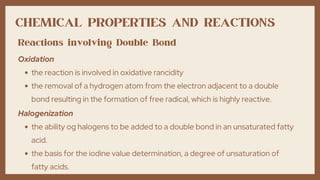
the reaction is involved in oxidative rancidity
the removal of a hydrogen atom from the electron adjacent to a double
bond resulting in the formation of free radical, which is highly reactive.
Oxidation
Reactions involving Double Bond
the ability og halogens to be added to a double bond in an unsaturated fatty
acid.
the basis for the iodine value determination, a degree of unsaturation of
fatty acids.
Halogenization
CHEMICAL PROPERTIES AND REACTIONS
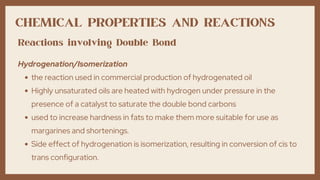
the reaction used in commercial production of hydrogenated oil
Highly unsaturated oils are heated with hydrogen under pressure in the
presence of a catalyst to saturate the double bond carbons
used to increase hardness in fats to make them more suitable for use as
margarines and shortenings.
Side effect of hydrogenation is isomerization, resulting in conversion of cis to
trans configuration.
Hydrogenation/Isomerization
Reactions involving Double Bond
RANCIDITY OF
FATS AND OILS
RANCIDITY OF FATS AND OIL
results in the formation of free fatty acids and soaps
cause by either reaction of lipid and water in the presence of a catalyst or by
the action of lipase enzymes
Hydrolytic Rancidity
results from a more complex liquid oxidation process
Initiation or Induction Phase
Propagation Phase
Termination Phase
Oxidative Rancidity
RANCIDITY OF FATS AND OIL
the initial quality of fat or used for manufacturing the product
conditions used to manufacture the product
storage conditions
surface area exposed to atmospheric oxygen
presence of transition metals
concentration of active lipoxidase
application of appropriate of synthetic or natural preservatives
presence of chemical oxidizers
Factors Affecting Oxidation of Fats and Oils
RANCIDITY OF FATS AND OIL
peroxides and hydroperoxides are the predominant reaction products.
Increased peroxide and hydroperoxide concentrations will lead to increasing
concentrations in aldehydes, ketones, hydrocarbons, and other termination
phase products.
The rate of decrease varies with storage conditions, packaging, and original
fat content.
It is best to rely on sense of smell to determine if rancidity has set in. Tasting
can determine early rancidity.
Reaction Products of Oxidation
MEASUREMENT OF RANCIDITY
2 types: predictive test and oxidation indicator tests
Predictive testing- ex: deterioration of iodine value
Oxidation Indicator Tests- peroxide value, TBA, anisidine, and free fatty acids
Chemical Methods
detect typical smells such as
acetaldehyde and phenolic substances
Sensory Methods
Saturated aldehydes, 2-enals, and 2-dienals produced in the termination
phase of lipid oxidation can be detected by reaction with 2-thiobarbituric
acid.
produces red color which can be measured using spectrophotometer
TBA Tests
MEASUREMENT OF RANCIDITY
measure of the concentration of peroxides and hydroperoxides formed in
the initial stages of lipid oxidation.
Peroxide Value
can be determined by titration
this is an indication of hydrolytic rancidity
Free Fatty Acids (FFA)
MEASUREMENT OF RANCIDITY
when hydroperoxidase break down, they produce volatile aldehydes leaving
behind a non-volatile reaction product that can be measured by reaction
with anisidine.
Anisidine Value
effective scavenger of peroxyl radicals
Vitamin E
PREVENTING RANCIDITY
compounds that delay rancidity and flavor deterioration associated with
oxidation.
either from natural or synthesized products
useful only for oxidative rancidity
radical scavengers
Antioxidants
propyl gallate, butylated hydroxyanisole (BHA), butylated hyroxytoluene
(BHT), and tertiary butyl hydroquinone (TBHQ).
Phenolic Antioxidant
PREVENTING RANCIDITY
donates hydrogen
returns hydrogen atom removed from initial process to form unreactive
ascorbic radical.
Vitamin C
*Antioxidants do not stop the development of oxidative rancidity but can delay it.
any form of altering the gaseous composition inside a food package
Modified Atmosphere Packaging
PREVENTING RANCIDITY
substance that helps antioxidants but in themselves are not antioxidants
Chelating Agents
lowering storage temperature can delay rancidity development
Storage Temperature Control
FAT AND OIL
PRODUCTS
ANIMAL; FAT PRODUCTS
fat or cream that is separated from other milk constituents by agitation or
churning.
18% water dispersed in 80% fat with small amounts of proteins as emulsifiers
Butter
fatty tissues of hog are chopped into small pieces and heated with or without
water. Wet rendering is more common
In the Philippines, Lard is a by-product of chicharron making.
Utilized mostly as flavoring ingredients or flavor carriers.
Lard
ANIMAL; FAT PRODUCTS
beef tallow is dry rendered form
fatty tissues of beef
Tallow
of interest due to omega fatty acids
Fish Oils
PLANT FAT PRODUCTS
oil obtained by pressing the ripened olives
graded according to acidity
Olive Oil
usually winterized
Winterization- a process which subjects the oil to a low temperature where
higher melting point glycerides are crystallized then filtered off.
Cottonseed Oil
remove from oil containing seed fruits or nuts by various processes, by
solvent extraction and by combination of these.
Vegetable Oil
PLANT FAT PRODUCTS
major edible oil in the U.S.A.
Soybean Oil
oil obtained from the germ of the corn endosperm
linoleic (55%) and oleic (29%) polyunsaturated fat.
used as frying oil and salad oil
Corn Oil
obtained from genetically modified rapeseed.
modification reduced erucic acid from 20-40% to less than 2%
used for frying, salad dressing, and shortening
Canola Oil
PLANT FAT PRODUCTS
shortening is made by hydrogenation of refined oil
Vegetable Shortening
substitute for more expensive butter
prepared from a mixture of vegetable oil that is hydrogenated
pasteurized then churned
Margarine
extracted from dried coconut meat called copra
composed mostly of saturated medium chain fatty acids. About 50% lauric
acid and 20% myristic
Coconut Oil
PLANT FAT PRODUCTS
50% lauric acid
Destroys lipid membranes in
a variety of microorganisms
and viruses
Human breast milk
protects infants from
illnesses.
Benefits of Coconut Oil
urged to avoid due to its
saturated fatty acid content
which was linked in the
production of low density
lipoprotein (LDL) or bad
cholesterol.
Negatives of Coconut Oil
PLANT FAT PRODUCTS
produced without the use of chemicals
derived directly from coconut milk
oil is extracted by natural fermentation and separated by centrifuge and
filtration
Virgin Coconut Oil
palm kernel oil- seed oil, has fatty acid composition similar to coconut
palm oil- rich in vitamin E, is extracted from the fruit and constitutes equal
amounts of saturated and unsaturated fatty acids.
Indonesia and Malaysia are the largest palm oil producers.
Palm Oil and Palm Kernel Oil
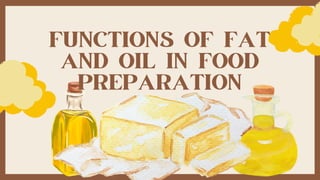
FUNCTIONS OF FAT
AND OIL IN FOOD
PREPARATION
FUNCTIONS OF FATS AND OILS
snack food and fast food industries are the major industrial users of frying
oils.
Snack Food Industry
Oil blanching is an industrial process and is better known as first fry.
This is also a drying process
Blanching Medium
A variation of frying which is done at very low (below 100%) temperatures is
also known as oil poaching.
Low Temperature Frying
FUNCTIONS OF FATS AND OILS
one of the most important functions of fat is to tenderize baked products
that otherwise would be a tough mass firmly held by gluten.
Shortening
Oil can either be the dispersing medium or the dispersed phase.
Emulsion Structure
Fat affect smoothness of crystalline candies and frozen desserts by
retarding crystallization
Fat affect gelatinization process and contributes to juiciness in meat and
foam structure of whipped cream.
Texture Effect
FUNCTIONS OF FATS AND OILS
Fats and oils are used to prevent food from sticking to the pan.
Spray or Greasing
Fat is an efficient flavor carrier
Flavor Effect
Butter and yellow margarines are used for a more appetizing
color/appearance.
Color Effect
Fat is a raw material for emulsifiers and is also a source of fatty acids for food
supplements
Fat as Sources of Ingredient/Supplement
FAT
SUBSTITUTES
FATS SUBSTITUTES
mixture of compounds called esters made by combining sucrose esters and
fatty acids. EX: Olestra
Olestra is currently used as frying medium for savory snacks and shortening
Sucrose fatty acid polyesters (SPE's)
similar to SPE's but their molecular size is smaller.
they are partially or fully absorbed providing up to 9 cal/gram to diet
used as emulsifiers and stabilizers
Sucrose fatty acid esters (SFE's)
Fat-Based Substitutes
FATS SUBSTITUTES
derived from a variety of protein sources such as eggs, milk, whey, soy, and
wheat gluten.
these proteins undergo microparticulation
Protein-Based Fat Replacers
Carbohydrate-Based Fat Replacers
carbohydrates including gum, starches, pectins, and cellulose have been
used as thickening agents to add bulk, moisture and textural stability to
variety of foods.
STORAGE OF
FATS AND OILS
STORAGE OF FATS AND OILS
Avoid exposure to oxygen, light, and heat. Refrigeration is a good option.
Always cover oil container.
Used oil should be strained to remove food particles that have been broken
off during frying
General Rules to Maximize the Shelf Life of Fats and Oils
Oil is subject to 2 kinds of deterioration: hydrolytic rancidity and oxidative
rancidity. Avoid water and oxygen to prevent these reactions from happening.
STORAGE OF FATS AND OILS
Do not overheat oil. Watch out for the smoke point. When oil starts to smoke,
lower the heat.
Never leave heating oil unattended. Do not allow children and pets to go
near fryers while in use.
Cool heated oil before transferring to any container. Do not transfer hot oil
to plastic containers
Clean spilled oil immediately
Have fire extinguisher in the kitchen. Never use water to put out fire. Use
baking soda.
Safety Precautions:
STORAGE OF FATS AND OILS
Do not throw oil in the drain.
Dispose it as solid waste in a tightly sealed container
Use absorbent material such as soil or sand if there are spills
Large quantities of used oil are best taken to gasoline station that has proper
disposal procedure.
Disposal of Used Oils
THANK YOU FOR
LISTENING!
Abedejos, Jhonacel Gail
Bravo, Ma. Jacinta
Bucong, Andrelle Jan
Butcon, Czaira
De Los Santos, Andrea
Martinez, Ronna Alieza Mae
Najera, Elyssa
Tan, John Carl
Taray, Gizelle Kate
Ybiosa, Yuljix
GROUP 2

Group-2-Fats-and-Oils-1.pdf

  • 1.
  • 2.
    FATS SIMILARITIES OILS Liquidat room temperature Unsaturated fats belong in oils Unsaturated fats can improve cholesterol levels Solid at room temperature Saturated Fats are solid fat Saturated Fat can increase cholesterol levels Both are glycerol esters Have glycerol backbone and fatty acid chains Both are called lipids
  • 3.
  • 4.
    According to Appearance VisibleFat- visually distinctive such as beef tallow, butter, coconut oil, etc Invisible Fat- indistinguishable unless separated by chemical means. Examples are fats in avocado, egg yolk, and lean meats.
  • 5.
    Plant vs Animal Plantfats have generally more unsaturated fatty acids. Plant oils have no cholesterol but may be converted to cholesterol inside the body. Monounsaturated fatty acids- canola, olive and peanut Polyunsaturated fatty acids- corn, canola, cottonseed, sunflower, soybean, and safflower. Animal fat has predominantly saturated fatty acids. Only animal fats have cholesterol. Saturated fatty acids, those with no double bonds in the carbon chain are butter, lard, beef tallow, coconut oil and palm kernel oil ACCORDING TO SOURCE
  • 6.
    Plant vs Animal ACCORDINGTO SOURCE Butter- Milk Lard- Fatty tissues of pork Beef Tallow (Suet)- Fatty tissues of beef Fish Oils- Fatty tissues of fish Fish Liver Oils- Fish Liver Chicken Fat- Chicken Coconut Oils Palm Kernel Oil Palm Oil Soybean Oil Rice Bran Oil Cottonseed Oil Olive Oil Peanut Oil Safflower Oil Sesame Oil Rapeseed Oil Canola Oil Cocoa Butter Combination Oils Specialty Oils (Avocado Oil, Aryan Oil, etc.)
  • 7.
    Frying Oils Shortening Spread Salad Dressing Topping Flavoring NutritionalSupplement 1. 2. 3. 4. 5. 6. 7. According to Culinary Use
  • 8.
    9 calories pergram Calories from fat should not exceed 30% of total caloric requirement Excess fats become fat deposits which is responsible for obesity Filipino's consumption of fats and oil is low at 15g/day Bicol Region has highest intake of fats and oils (23g/day) because Central Visayas has lowest consumption at of gata. 8 grams per day. Nutritional Importance
  • 9.
    Carry fat solublevitamins A,D,E and K Insulates body organs from extreme temperatures Necessary to maintain cell structures Sources of essential fatty acids EFA (Linoleic and Linolenic) EFA are converted to prostaglandins necessary for immune system. Linoleic Acid (LA)- parent molecule of omega-6 fatty acids including arachidonic acid (ARA) Alpha-Linolenic Acid (ALA)- parent molecule of omega-3 fatty acids including docosahexaenoic acid (DHA). ARA and DHA are critical for brain development of infants. Nutritional Importance
  • 10.
  • 11.
    CHEMICAL COMPOSITION OFFATS AND OILS Triglycerides -glycerol esters of free fatty acids wherein all 3 carbons in the glycerol backbone are attached to the fatty acid. -Most naturally occurring fatty acids have straight even number chains with only hydrogen attached. -Fatty acids may be saturated or not. -Degree of unsaturation has other nutritional and culinary implications. -It affects physical properties, especially melting point -Fats and oil may differ from one another with respect to the position of the fatty acid, the glycerol backbone, and other factors.
  • 12.
    CHEMICAL COMPOSITION OFFATS AND OILS Diglycerides and Monoglycerides Monoglyceride- when only one of the 3 carbons of the glycerol is esterified with a fatty acid Diglyceride- When 2 of the 3 carbons are esterified Mono and Diglycerides functions as emulsifiers due to the hydrophilic and hydrophobic ends of their molecules. The free hydroxyl interacts with water and the hydrocarbon chain interacts with the oil.
  • 13.
    CHEMICAL COMPOSITION OFFATS AND OILS Phospholipids -a combination of a lipid and phosphate group. -one of the carbons in the glycerol backbone attached to a phosphate -polar substance -occur alongside proteins and lipoproteins in tissues where they're located -Lecithin- most abundant phospholipid in cell membranes Vitamins and Minerals -the fat-soluble Vitamins A,D,E,K -carotenes and chlorophyll may also be present in oils -refined oils have no more pigment due to bleaching process done during refining.
  • 14.
  • 15.
    PHYSICAL PROPERTIES OFFATS AND OILS physical and chemical configuration of fats and oil determine its properties and reaction Solid fat is composed of crystal structures of straight chain fatty acids suspended in oil Physical Structure the proportion of fat in crystalline form to suspending oil is expressed as solid fat index (SFI). Solid Fat Index
  • 16.
    PHYSICAL PROPERTIES OFFATS AND OILS if there are fewer molecular species, the crystals will be unstable and larger crystals will form whereas if there are more molecular species, the resulting crystals will be smaller. Polymorphism the property of fat that allows it to be molded or pressed into various shapes without breaking. Plasticity
  • 17.
    PHYSICAL PROPERTIES OFFATS AND OILS the temperature at which a solid fat is changed into liquid. melting point range depends on the SFI factors determining the SFI are chain length, degree of saturation, configuration at double bonds of unsaturated fatty acids, and the number of molecular species. melting point increases as the number of carbons in its hydrocarbon chain increases and as the number of double bond decreases. the greater the degree of unsaturation, the lower the melting point. Melting Point
  • 18.
    PHYSICAL PROPERTIES OFFATS AND OILS the temperature at which a liquid fat is changed to solid. always lower than the melting point Solidification Temperature natural fats are insoluble in water, slightly soluble in lower alcohols and readily soluble in non-polar solvent Solubility
  • 19.
    PHYSICAL PROPERTIES OFFATS AND OILS Oil is lighter than water. Oil's density- 0.90 to 0.92 grams per cubic meter Specific gravity is defined as the ratio between the density of a substance and that of water. The density of water is 1.0 so that gravity and density has the same value Density and Gravity
  • 20.
    PHYSICAL PROPERTIES OFFATS AND OILS the measure of the ability of a substance to bend light as it passes through it. the clearer the substance, the smaller its refractive index is. In fats and oils, refractive index decreases with increasing temperature Refractive Index the ability of free fatty acids, mono and diglycerides to bridge water and oil molecules useful in emulsification Surfactant Properties
  • 21.
    PHYSICAL PROPERTIES OFFATS AND OILS the ability of the fat/oil to withstand heat without undergoing deterioration. . Thermal Stability the temperature at which fat deterioration is sufficient to produce bluish smoke. much higher than the boiling point of water. Frying temperatures- 170° to 195° C. Smoke points of fats and oils are beyond the temperature used in frying. Smoke Point
  • 22.
    PHYSICAL PROPERTIES OFFATS AND OILS Pyrolysis- heating oil causes molecular breakdown with or without contact with food Oxidation- combination of heat and oxygen at the surface causes molecular breakdown at the point of unsaturation and ultimately development of rancidity Hydrolysis- water reacts with oil and splits ester bridge between fatty acid and glycerol Reaction with Food Residue- residue from the food being fried reacts with fat and contributes to deterioration. 4 WAYS BY WHICH OILS DECOMPOSE DURING HEATING. 1. 2. 3. 4.
  • 23.
  • 24.
    CHEMICAL PROPERTIES ANDREACTIONS the breaking of the ester linkage between glycerol molecules and the fatty acids resulting in the release of free fatty acids. water is needed is catalyzed by lipases, enzymes naturally present in some fats, and acids with heat Hydrolysis Ester Linkage Reactions
  • 25.
    CHEMICAL PROPERTIES ANDREACTIONS the formation of soap with the free fatty acid. saponification number is defined as the grams of potassium hydroxide (KOH) required to saponify 1 gram of oil at specified conditions. Saponification Ester Linkage Reactions the transfer of fatty acid from the glycerol to another alcohol .involved in the production of mono and diglycerides. Interesterification
  • 26.
    CHEMICAL PROPERTIES ANDREACTIONS the reaction is used in commercial preparation of shortening where a variety of fatty acid molecules is desired to increase plasticity Rearrangement Ester Linkage Reactions another industrial reaction that involves the replacement of fatty acid by acetate .production of emulsifiers and food colors Acetylation
  • 27.
    CHEMICAL PROPERTIES ANDREACTIONS the reaction is involved in oxidative rancidity the removal of a hydrogen atom from the electron adjacent to a double bond resulting in the formation of free radical, which is highly reactive. Oxidation Reactions involving Double Bond the ability og halogens to be added to a double bond in an unsaturated fatty acid. the basis for the iodine value determination, a degree of unsaturation of fatty acids. Halogenization
  • 28.
    CHEMICAL PROPERTIES ANDREACTIONS the reaction used in commercial production of hydrogenated oil Highly unsaturated oils are heated with hydrogen under pressure in the presence of a catalyst to saturate the double bond carbons used to increase hardness in fats to make them more suitable for use as margarines and shortenings. Side effect of hydrogenation is isomerization, resulting in conversion of cis to trans configuration. Hydrogenation/Isomerization Reactions involving Double Bond
  • 29.
  • 30.
    RANCIDITY OF FATSAND OIL results in the formation of free fatty acids and soaps cause by either reaction of lipid and water in the presence of a catalyst or by the action of lipase enzymes Hydrolytic Rancidity results from a more complex liquid oxidation process Initiation or Induction Phase Propagation Phase Termination Phase Oxidative Rancidity
  • 31.
    RANCIDITY OF FATSAND OIL the initial quality of fat or used for manufacturing the product conditions used to manufacture the product storage conditions surface area exposed to atmospheric oxygen presence of transition metals concentration of active lipoxidase application of appropriate of synthetic or natural preservatives presence of chemical oxidizers Factors Affecting Oxidation of Fats and Oils
  • 32.
    RANCIDITY OF FATSAND OIL peroxides and hydroperoxides are the predominant reaction products. Increased peroxide and hydroperoxide concentrations will lead to increasing concentrations in aldehydes, ketones, hydrocarbons, and other termination phase products. The rate of decrease varies with storage conditions, packaging, and original fat content. It is best to rely on sense of smell to determine if rancidity has set in. Tasting can determine early rancidity. Reaction Products of Oxidation
  • 33.
    MEASUREMENT OF RANCIDITY 2types: predictive test and oxidation indicator tests Predictive testing- ex: deterioration of iodine value Oxidation Indicator Tests- peroxide value, TBA, anisidine, and free fatty acids Chemical Methods detect typical smells such as acetaldehyde and phenolic substances Sensory Methods
  • 34.
    Saturated aldehydes, 2-enals,and 2-dienals produced in the termination phase of lipid oxidation can be detected by reaction with 2-thiobarbituric acid. produces red color which can be measured using spectrophotometer TBA Tests MEASUREMENT OF RANCIDITY measure of the concentration of peroxides and hydroperoxides formed in the initial stages of lipid oxidation. Peroxide Value
  • 35.
    can be determinedby titration this is an indication of hydrolytic rancidity Free Fatty Acids (FFA) MEASUREMENT OF RANCIDITY when hydroperoxidase break down, they produce volatile aldehydes leaving behind a non-volatile reaction product that can be measured by reaction with anisidine. Anisidine Value
  • 36.
    effective scavenger ofperoxyl radicals Vitamin E PREVENTING RANCIDITY compounds that delay rancidity and flavor deterioration associated with oxidation. either from natural or synthesized products useful only for oxidative rancidity radical scavengers Antioxidants
  • 37.
    propyl gallate, butylatedhydroxyanisole (BHA), butylated hyroxytoluene (BHT), and tertiary butyl hydroquinone (TBHQ). Phenolic Antioxidant PREVENTING RANCIDITY donates hydrogen returns hydrogen atom removed from initial process to form unreactive ascorbic radical. Vitamin C *Antioxidants do not stop the development of oxidative rancidity but can delay it.
  • 38.
    any form ofaltering the gaseous composition inside a food package Modified Atmosphere Packaging PREVENTING RANCIDITY substance that helps antioxidants but in themselves are not antioxidants Chelating Agents lowering storage temperature can delay rancidity development Storage Temperature Control
  • 39.
  • 40.
    ANIMAL; FAT PRODUCTS fator cream that is separated from other milk constituents by agitation or churning. 18% water dispersed in 80% fat with small amounts of proteins as emulsifiers Butter fatty tissues of hog are chopped into small pieces and heated with or without water. Wet rendering is more common In the Philippines, Lard is a by-product of chicharron making. Utilized mostly as flavoring ingredients or flavor carriers. Lard
  • 41.
    ANIMAL; FAT PRODUCTS beeftallow is dry rendered form fatty tissues of beef Tallow of interest due to omega fatty acids Fish Oils
  • 42.
    PLANT FAT PRODUCTS oilobtained by pressing the ripened olives graded according to acidity Olive Oil usually winterized Winterization- a process which subjects the oil to a low temperature where higher melting point glycerides are crystallized then filtered off. Cottonseed Oil remove from oil containing seed fruits or nuts by various processes, by solvent extraction and by combination of these. Vegetable Oil
  • 43.
    PLANT FAT PRODUCTS majoredible oil in the U.S.A. Soybean Oil oil obtained from the germ of the corn endosperm linoleic (55%) and oleic (29%) polyunsaturated fat. used as frying oil and salad oil Corn Oil obtained from genetically modified rapeseed. modification reduced erucic acid from 20-40% to less than 2% used for frying, salad dressing, and shortening Canola Oil
  • 44.
    PLANT FAT PRODUCTS shorteningis made by hydrogenation of refined oil Vegetable Shortening substitute for more expensive butter prepared from a mixture of vegetable oil that is hydrogenated pasteurized then churned Margarine extracted from dried coconut meat called copra composed mostly of saturated medium chain fatty acids. About 50% lauric acid and 20% myristic Coconut Oil
  • 45.
    PLANT FAT PRODUCTS 50%lauric acid Destroys lipid membranes in a variety of microorganisms and viruses Human breast milk protects infants from illnesses. Benefits of Coconut Oil urged to avoid due to its saturated fatty acid content which was linked in the production of low density lipoprotein (LDL) or bad cholesterol. Negatives of Coconut Oil
  • 46.
    PLANT FAT PRODUCTS producedwithout the use of chemicals derived directly from coconut milk oil is extracted by natural fermentation and separated by centrifuge and filtration Virgin Coconut Oil palm kernel oil- seed oil, has fatty acid composition similar to coconut palm oil- rich in vitamin E, is extracted from the fruit and constitutes equal amounts of saturated and unsaturated fatty acids. Indonesia and Malaysia are the largest palm oil producers. Palm Oil and Palm Kernel Oil
  • 47.
    FUNCTIONS OF FAT ANDOIL IN FOOD PREPARATION
  • 48.
    FUNCTIONS OF FATSAND OILS snack food and fast food industries are the major industrial users of frying oils. Snack Food Industry Oil blanching is an industrial process and is better known as first fry. This is also a drying process Blanching Medium A variation of frying which is done at very low (below 100%) temperatures is also known as oil poaching. Low Temperature Frying
  • 49.
    FUNCTIONS OF FATSAND OILS one of the most important functions of fat is to tenderize baked products that otherwise would be a tough mass firmly held by gluten. Shortening Oil can either be the dispersing medium or the dispersed phase. Emulsion Structure Fat affect smoothness of crystalline candies and frozen desserts by retarding crystallization Fat affect gelatinization process and contributes to juiciness in meat and foam structure of whipped cream. Texture Effect
  • 50.
    FUNCTIONS OF FATSAND OILS Fats and oils are used to prevent food from sticking to the pan. Spray or Greasing Fat is an efficient flavor carrier Flavor Effect Butter and yellow margarines are used for a more appetizing color/appearance. Color Effect Fat is a raw material for emulsifiers and is also a source of fatty acids for food supplements Fat as Sources of Ingredient/Supplement
  • 51.
  • 52.
    FATS SUBSTITUTES mixture ofcompounds called esters made by combining sucrose esters and fatty acids. EX: Olestra Olestra is currently used as frying medium for savory snacks and shortening Sucrose fatty acid polyesters (SPE's) similar to SPE's but their molecular size is smaller. they are partially or fully absorbed providing up to 9 cal/gram to diet used as emulsifiers and stabilizers Sucrose fatty acid esters (SFE's) Fat-Based Substitutes
  • 53.
    FATS SUBSTITUTES derived froma variety of protein sources such as eggs, milk, whey, soy, and wheat gluten. these proteins undergo microparticulation Protein-Based Fat Replacers Carbohydrate-Based Fat Replacers carbohydrates including gum, starches, pectins, and cellulose have been used as thickening agents to add bulk, moisture and textural stability to variety of foods.
  • 54.
  • 55.
    STORAGE OF FATSAND OILS Avoid exposure to oxygen, light, and heat. Refrigeration is a good option. Always cover oil container. Used oil should be strained to remove food particles that have been broken off during frying General Rules to Maximize the Shelf Life of Fats and Oils Oil is subject to 2 kinds of deterioration: hydrolytic rancidity and oxidative rancidity. Avoid water and oxygen to prevent these reactions from happening.
  • 56.
    STORAGE OF FATSAND OILS Do not overheat oil. Watch out for the smoke point. When oil starts to smoke, lower the heat. Never leave heating oil unattended. Do not allow children and pets to go near fryers while in use. Cool heated oil before transferring to any container. Do not transfer hot oil to plastic containers Clean spilled oil immediately Have fire extinguisher in the kitchen. Never use water to put out fire. Use baking soda. Safety Precautions:
  • 57.
    STORAGE OF FATSAND OILS Do not throw oil in the drain. Dispose it as solid waste in a tightly sealed container Use absorbent material such as soil or sand if there are spills Large quantities of used oil are best taken to gasoline station that has proper disposal procedure. Disposal of Used Oils
  • 58.
  • 59.
    Abedejos, Jhonacel Gail Bravo,Ma. Jacinta Bucong, Andrelle Jan Butcon, Czaira De Los Santos, Andrea Martinez, Ronna Alieza Mae Najera, Elyssa Tan, John Carl Taray, Gizelle Kate Ybiosa, Yuljix GROUP 2