A report on
Fast Breeder Test Reactor
By-
Shreenath Modi
M.Tech. Nuclear Science & technology
UPES, Dehradun
Contents
Introduction ............................................................................................................................................3
Reactor core............................................................................................................................................3
Core configuration ..............................................................................................................................4
Reactor Assembly................................................................................................................................4
Sodium Loops..........................................................................................................................................5
Types of primary loops........................................................................................................................5
Primary Loops .....................................................................................................................................5
Secondary loops..................................................................................................................................6
Steam & Power Generation....................................................................................................................6
Safety and control Mechanisms..............................................................................................................7
Sodium Leaks ......................................................................................................................................7
Water leaks .........................................................................................................................................8
Fuel Handling ..........................................................................................................................................8
Electrical Power Supply...........................................................................................................................8
Auxiliary Systems ....................................................................................................................................8
Introduction
Fast breeder reactors are the second stage of three-stage power program of India formulated by
Homi Bhabha in 1950s. He summarised this program by this way
“The total reserves of thorium in India amount to over 500,000 tons in readily extractable form,
while the known reserves of Uranium are less than tenth of this. The aim of long range atomic power
programme in India must therefore be to base the nuclear power generation as soon as possible on
Thorium rather than Uranium….. The first generation of atomic power programme… The Plutonium
produced by the first generation power stations can be used in a second generation of power
stations designed to produce electric power and convert Thorium into U-233 or depleted Uranium
into more Plutonium with breeding gain… The second generation of power stations may be regarded
as an intermediate step for the breeder power stations of the third generation all of which would
produce more U-233 than they burn in the course of producing power.”
IGCAR is working with the mission of development of the technology of Sodium cooled fast reactors.
Fast Breeder Test Reactor (FBTR) is a 40MW thermal, loop type, sodium cooled fast reactor. Heat
generated in the reactor is removed by two primary sodium loops, and transferred to secondary
sodium loops. Each secondary sodium loop is provided with two once-through steam generator
modules. Steam from the four modules is fed to a common steam–water circuit comprising a turbine
generator and a 100% dump condenser. Stainless steel (SS 316) is the principal material of
construction for the reactor and coolant circuits.
Reactor core
Core configuration
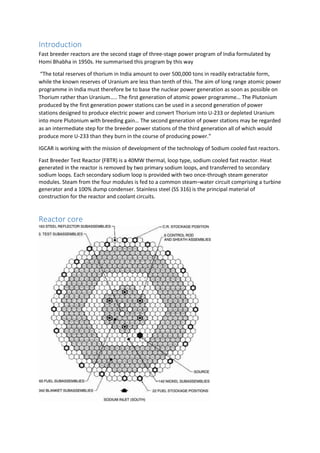
 The core consists of 745 closely packed locations, with fuel at the centre, surrounded
by Ni reflectors, ThO2 blankets and steel reflectors.
 The core is vertical and freestanding, with the subassemblies supported at the
bottom by the Grid Plate and held on to the latter by collapsible hold-down springs.
The subassemblies are hexagonally shaped.
 As per the initial design, the core was rated for 40 MW t and had 65 fuel sub-
assemblies, three test steel subassemblies, six control rods, 143 nickel reflectors, 342
ThO2 blankets and 163 steel reflectors sub-assemblies. In addition, there are 23
storage locations in the outermost steel reflector row.
 The fuel subassembly is 1661.5 mm long, with a width across flats of 49.8 mm and
houses 61 fuel pins of MOX composition (30% PuO2 + 70% UO2 with 85%
enrichment).
 The fuel pins are 531.5 mm long, with fuel stack length of 320 mm. Axial blankets of
263mm length are provided on either side of the fuel pins.
Reactor Assembly
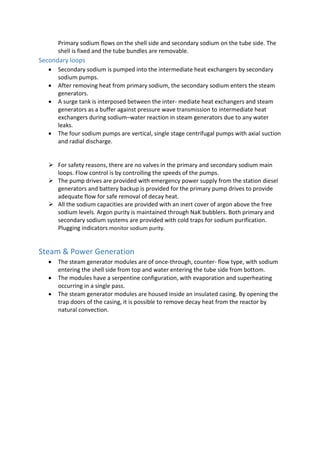
 The Reactor Vessel houses the core and serves as a conduit for the primary sodium
coolant flow through the core.
 Charging and discharging of subassemblies are done from the reactor top with the
reactor in shutdown state.
 The sodium inlet pipe joins the Reactor Vessel at the bottom and two sodium outlet
pipes radially branch out of the vessel above the core.
 The reactor is closed at the top by Large and Small Rotatable Plugs, which serve as
top shields and also enable access to the core locations for fuel handling. The
Rotatable Plugs are cooled by nitrogen.
 Liquid Metal Seals of Tin–Bismuth alloy, backed with Inflatable Seals, isolate the
reactor cover gas from the Reactor Containment Building atmosphere. The Liquid
Metal Seals are frozen during reactor operation and melted during rotation of the
plugs. The space between the Liquid Metal Seals and the Inflatable Seals, called the
Inter-seal Space, is maintained in argon at a pressure higher than the reactor cover
gas to prevent the leakage of active cover gas into the reactor building.
 The Small Rotatable Plug houses the Control Plug which carries six Control Rod Drive
Mechanisms and Core Cover Plate with thermocouples for monitoring the outlet
temperatures of the fuel subassemblies.
 Ten neutron shields, each 25 mm thick, surround the core and minimize the incident
flux on the Reactor Vessel. Thermal shields are provided inside the Reactor Vessel to
minimize the thermal stresses due to cold and hot shocks.
 The radial and axial shifts of the Grid Plate are monitored by two displacement
measuring devices.
 A steel vessel with thermal insulation surrounds the Reactor Vessel. Radial shielding
is provided by borated concrete and structural concrete. The borated concrete is
cooled by water pipes embedded close to its inner periphery. The entire Reactor
Assembly is suspended from the top, with the load taken by structural concrete. The
reactor is closed at the top by the Anti-Explosion Floor, which is bolted to tie-rods
anchored on the structural concrete.
Sodium Loops
Types of primary loops
Primary Loops
 Primary sodium is pumped into the reactor by primary sodium pumps and flows by
gravity to the intermediate heat exchangers and then back to the pump suction.
 The intermediate heat exchangers are vertical, counter-flow heat exchangers and
transfer heat from the active primary sodium to the inactive secondary sodium.
Primary sodium flows on the shell side and secondary sodium on the tube side. The
shell is fixed and the tube bundles are removable.
Secondary loops
 Secondary sodium is pumped into the intermediate heat exchangers by secondary
sodium pumps.
 After removing heat from primary sodium, the secondary sodium enters the steam
generators.
 A surge tank is interposed between the inter- mediate heat exchangers and steam
generators as a buffer against pressure wave transmission to intermediate heat
exchangers during sodium–water reaction in steam generators due to any water
leaks.
 The four sodium pumps are vertical, single stage centrifugal pumps with axial suction
and radial discharge.
 For safety reasons, there are no valves in the primary and secondary sodium main
loops. Flow control is by controlling the speeds of the pumps.
 The pump drives are provided with emergency power supply from the station diesel
generators and battery backup is provided for the primary pump drives to provide
adequate flow for safe removal of decay heat.
 All the sodium capacities are provided with an inert cover of argon above the free
sodium levels. Argon purity is maintained through NaK bubblers. Both primary and
secondary sodium systems are provided with cold traps for sodium purification.
Plugging indicators monitor sodium purity.
Steam & Power Generation
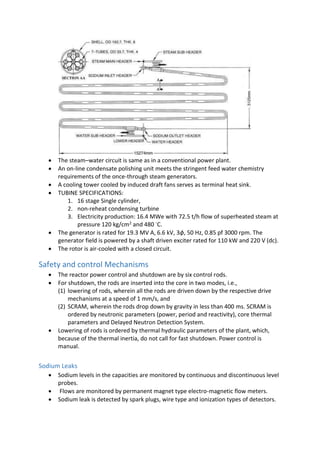
 The steam generator modules are of once-through, counter- flow type, with sodium
entering the shell side from top and water entering the tube side from bottom.
 The modules have a serpentine configuration, with evaporation and superheating
occurring in a single pass.
 The steam generator modules are housed inside an insulated casing. By opening the
trap doors of the casing, it is possible to remove decay heat from the reactor by
natural convection.
 The steam–water circuit is same as in a conventional power plant.
 An on-line condensate polishing unit meets the stringent feed water chemistry
requirements of the once-through steam generators.
 A cooling tower cooled by induced draft fans serves as terminal heat sink.
 TUBINE SPECIFICATIONS:
1. 16 stage Single cylinder,
2. non-reheat condensing turbine
3. Electricity production: 16.4 MWe with 72.5 t/h flow of superheated steam at
pressure 120 kg/cm2 and 480 ◦C.
 The generator is rated for 19.3 MV A, 6.6 kV, 3ϕ, 50 Hz, 0.85 pf 3000 rpm. The
generator field is powered by a shaft driven exciter rated for 110 kW and 220 V (dc).
 The rotor is air-cooled with a closed circuit.
Safety and control Mechanisms
 The reactor power control and shutdown are by six control rods.
 For shutdown, the rods are inserted into the core in two modes, i.e.,
(1) lowering of rods, wherein all the rods are driven down by the respective drive
mechanisms at a speed of 1 mm/s, and
(2) SCRAM, wherein the rods drop down by gravity in less than 400 ms. SCRAM is
ordered by neutronic parameters (power, period and reactivity), core thermal
parameters and Delayed Neutron Detection System.
 Lowering of rods is ordered by thermal hydraulic parameters of the plant, which,
because of the thermal inertia, do not call for fast shutdown. Power control is
manual.
Sodium Leaks
 Sodium levels in the capacities are monitored by continuous and discontinuous level
probes.
 Flows are monitored by permanent magnet type electro-magnetic flow meters.
 Sodium leak is detected by spark plugs, wire type and ionization types of detectors.
Water leaks
 Water leak into sodium in the steam generator at the incipient stage (50 mg to 10
g/s) is detected by a very sensitive Mass Spectrometer based Steam Generator Leak
Detection System to measure hydrogen in sodium in ppb (Parts Per Billion) levels.
 At lower sodium temperatures, as during valving in water into the steam generators
during power raising, leak is detected by monitoring the hydrogen in the cover gas of
expansion tanks. Medium leaks (0.01–0.5 kg/s) are detected by monitoring the
expansion tank cover gas pressure.
 Quick closing valves isolate the steam generators on the sodium and water sides in
the event of large leaks (>0.5 kg/s) and rupture discs provided in the sodium headers
relieve pressure build up.
Fuel Handling
 Fuel handling is done off-line using Charging and Discharging Flasks.
 There are special flasks for handling of control rod drives, irradiation devices, pumps
and intermediate heat exchangers.
 For moving the active components between Reactor Containment Building and the
adjacent Active Building, there is a Secondary Flask, which moves on rail carriages.
Spent fuel is stored in air-cooled cast iron blocks.
Electrical Power Supply
 Offsite power is received from the grid through two 33 kV feeders from the adjoining
Madras Atomic Power Station (MAPS) and stepped down to 6.6 kV by two 10 MV A
transformers.
 The 6.6 kV buses are interconnected, so that the tripping of any single offsite feeder
does not affect station power supply. The turbine-generator can be synchronized to
the 6.6 kV bus Station power is distributed at 415 V through two emergency buses
and two nonemergency buses. Two 1000 kV A, quick-starting emergency diesel
generators provide emergency power at 415 V in the event of offsite power failure.
220 V, single phase Uninterruptible Power Supply system, comprising rectifier
charger, batteries and invertors, feeds the critical instrumentation loads including
the Central Data Processing System.
 In addition, there are 48 and 24 V dc power supplies with battery back-up for
control and instrumentation and 220 V dc supplying control power supply for circuit
breakers, emergency lighting and DC flushing oil pump of turbine-generator.
Auxiliary Systems
 Station auxiliaries comprise
(1) The Service and Circulating Water System for heat removal from main
and dump condensers and other heat exchangers.
(2) Fire water system
(3) chilled water system
(4) compressed air system to provide service
(5) Instrument and mask air
(6) Service argon system
(7) Service nitrogen system with a Pressure Swing Adsorption (PSA) Nitrogen
plant and Horton sphere
(8) Air-conditioning and Ventilation System
(9) Make-up Demineralised water plant and auxiliary boiler.

Fast Breeder Test Reactor

  • 1.
    A report on FastBreeder Test Reactor By- Shreenath Modi M.Tech. Nuclear Science & technology UPES, Dehradun
  • 2.
    Contents Introduction ............................................................................................................................................3 Reactor core............................................................................................................................................3 Coreconfiguration ..............................................................................................................................4 Reactor Assembly................................................................................................................................4 Sodium Loops..........................................................................................................................................5 Types of primary loops........................................................................................................................5 Primary Loops .....................................................................................................................................5 Secondary loops..................................................................................................................................6 Steam & Power Generation....................................................................................................................6 Safety and control Mechanisms..............................................................................................................7 Sodium Leaks ......................................................................................................................................7 Water leaks .........................................................................................................................................8 Fuel Handling ..........................................................................................................................................8 Electrical Power Supply...........................................................................................................................8 Auxiliary Systems ....................................................................................................................................8
  • 3.
    Introduction Fast breeder reactorsare the second stage of three-stage power program of India formulated by Homi Bhabha in 1950s. He summarised this program by this way “The total reserves of thorium in India amount to over 500,000 tons in readily extractable form, while the known reserves of Uranium are less than tenth of this. The aim of long range atomic power programme in India must therefore be to base the nuclear power generation as soon as possible on Thorium rather than Uranium….. The first generation of atomic power programme… The Plutonium produced by the first generation power stations can be used in a second generation of power stations designed to produce electric power and convert Thorium into U-233 or depleted Uranium into more Plutonium with breeding gain… The second generation of power stations may be regarded as an intermediate step for the breeder power stations of the third generation all of which would produce more U-233 than they burn in the course of producing power.” IGCAR is working with the mission of development of the technology of Sodium cooled fast reactors. Fast Breeder Test Reactor (FBTR) is a 40MW thermal, loop type, sodium cooled fast reactor. Heat generated in the reactor is removed by two primary sodium loops, and transferred to secondary sodium loops. Each secondary sodium loop is provided with two once-through steam generator modules. Steam from the four modules is fed to a common steam–water circuit comprising a turbine generator and a 100% dump condenser. Stainless steel (SS 316) is the principal material of construction for the reactor and coolant circuits. Reactor core
  • 4.
    Core configuration  Thecore consists of 745 closely packed locations, with fuel at the centre, surrounded by Ni reflectors, ThO2 blankets and steel reflectors.  The core is vertical and freestanding, with the subassemblies supported at the bottom by the Grid Plate and held on to the latter by collapsible hold-down springs. The subassemblies are hexagonally shaped.  As per the initial design, the core was rated for 40 MW t and had 65 fuel sub- assemblies, three test steel subassemblies, six control rods, 143 nickel reflectors, 342 ThO2 blankets and 163 steel reflectors sub-assemblies. In addition, there are 23 storage locations in the outermost steel reflector row.  The fuel subassembly is 1661.5 mm long, with a width across flats of 49.8 mm and houses 61 fuel pins of MOX composition (30% PuO2 + 70% UO2 with 85% enrichment).  The fuel pins are 531.5 mm long, with fuel stack length of 320 mm. Axial blankets of 263mm length are provided on either side of the fuel pins. Reactor Assembly  The Reactor Vessel houses the core and serves as a conduit for the primary sodium coolant flow through the core.  Charging and discharging of subassemblies are done from the reactor top with the reactor in shutdown state.  The sodium inlet pipe joins the Reactor Vessel at the bottom and two sodium outlet pipes radially branch out of the vessel above the core.  The reactor is closed at the top by Large and Small Rotatable Plugs, which serve as top shields and also enable access to the core locations for fuel handling. The Rotatable Plugs are cooled by nitrogen.  Liquid Metal Seals of Tin–Bismuth alloy, backed with Inflatable Seals, isolate the reactor cover gas from the Reactor Containment Building atmosphere. The Liquid Metal Seals are frozen during reactor operation and melted during rotation of the plugs. The space between the Liquid Metal Seals and the Inflatable Seals, called the Inter-seal Space, is maintained in argon at a pressure higher than the reactor cover gas to prevent the leakage of active cover gas into the reactor building.  The Small Rotatable Plug houses the Control Plug which carries six Control Rod Drive Mechanisms and Core Cover Plate with thermocouples for monitoring the outlet temperatures of the fuel subassemblies.  Ten neutron shields, each 25 mm thick, surround the core and minimize the incident flux on the Reactor Vessel. Thermal shields are provided inside the Reactor Vessel to minimize the thermal stresses due to cold and hot shocks.  The radial and axial shifts of the Grid Plate are monitored by two displacement measuring devices.  A steel vessel with thermal insulation surrounds the Reactor Vessel. Radial shielding is provided by borated concrete and structural concrete. The borated concrete is cooled by water pipes embedded close to its inner periphery. The entire Reactor Assembly is suspended from the top, with the load taken by structural concrete. The reactor is closed at the top by the Anti-Explosion Floor, which is bolted to tie-rods anchored on the structural concrete.
  • 5.
    Sodium Loops Types ofprimary loops Primary Loops  Primary sodium is pumped into the reactor by primary sodium pumps and flows by gravity to the intermediate heat exchangers and then back to the pump suction.  The intermediate heat exchangers are vertical, counter-flow heat exchangers and transfer heat from the active primary sodium to the inactive secondary sodium.
  • 6.
    Primary sodium flowson the shell side and secondary sodium on the tube side. The shell is fixed and the tube bundles are removable. Secondary loops  Secondary sodium is pumped into the intermediate heat exchangers by secondary sodium pumps.  After removing heat from primary sodium, the secondary sodium enters the steam generators.  A surge tank is interposed between the inter- mediate heat exchangers and steam generators as a buffer against pressure wave transmission to intermediate heat exchangers during sodium–water reaction in steam generators due to any water leaks.  The four sodium pumps are vertical, single stage centrifugal pumps with axial suction and radial discharge.  For safety reasons, there are no valves in the primary and secondary sodium main loops. Flow control is by controlling the speeds of the pumps.  The pump drives are provided with emergency power supply from the station diesel generators and battery backup is provided for the primary pump drives to provide adequate flow for safe removal of decay heat.  All the sodium capacities are provided with an inert cover of argon above the free sodium levels. Argon purity is maintained through NaK bubblers. Both primary and secondary sodium systems are provided with cold traps for sodium purification. Plugging indicators monitor sodium purity. Steam & Power Generation  The steam generator modules are of once-through, counter- flow type, with sodium entering the shell side from top and water entering the tube side from bottom.  The modules have a serpentine configuration, with evaporation and superheating occurring in a single pass.  The steam generator modules are housed inside an insulated casing. By opening the trap doors of the casing, it is possible to remove decay heat from the reactor by natural convection.
  • 7.
     The steam–watercircuit is same as in a conventional power plant.  An on-line condensate polishing unit meets the stringent feed water chemistry requirements of the once-through steam generators.  A cooling tower cooled by induced draft fans serves as terminal heat sink.  TUBINE SPECIFICATIONS: 1. 16 stage Single cylinder, 2. non-reheat condensing turbine 3. Electricity production: 16.4 MWe with 72.5 t/h flow of superheated steam at pressure 120 kg/cm2 and 480 ◦C.  The generator is rated for 19.3 MV A, 6.6 kV, 3ϕ, 50 Hz, 0.85 pf 3000 rpm. The generator field is powered by a shaft driven exciter rated for 110 kW and 220 V (dc).  The rotor is air-cooled with a closed circuit. Safety and control Mechanisms  The reactor power control and shutdown are by six control rods.  For shutdown, the rods are inserted into the core in two modes, i.e., (1) lowering of rods, wherein all the rods are driven down by the respective drive mechanisms at a speed of 1 mm/s, and (2) SCRAM, wherein the rods drop down by gravity in less than 400 ms. SCRAM is ordered by neutronic parameters (power, period and reactivity), core thermal parameters and Delayed Neutron Detection System.  Lowering of rods is ordered by thermal hydraulic parameters of the plant, which, because of the thermal inertia, do not call for fast shutdown. Power control is manual. Sodium Leaks  Sodium levels in the capacities are monitored by continuous and discontinuous level probes.  Flows are monitored by permanent magnet type electro-magnetic flow meters.  Sodium leak is detected by spark plugs, wire type and ionization types of detectors.
  • 8.
    Water leaks  Waterleak into sodium in the steam generator at the incipient stage (50 mg to 10 g/s) is detected by a very sensitive Mass Spectrometer based Steam Generator Leak Detection System to measure hydrogen in sodium in ppb (Parts Per Billion) levels.  At lower sodium temperatures, as during valving in water into the steam generators during power raising, leak is detected by monitoring the hydrogen in the cover gas of expansion tanks. Medium leaks (0.01–0.5 kg/s) are detected by monitoring the expansion tank cover gas pressure.  Quick closing valves isolate the steam generators on the sodium and water sides in the event of large leaks (>0.5 kg/s) and rupture discs provided in the sodium headers relieve pressure build up. Fuel Handling  Fuel handling is done off-line using Charging and Discharging Flasks.  There are special flasks for handling of control rod drives, irradiation devices, pumps and intermediate heat exchangers.  For moving the active components between Reactor Containment Building and the adjacent Active Building, there is a Secondary Flask, which moves on rail carriages. Spent fuel is stored in air-cooled cast iron blocks. Electrical Power Supply  Offsite power is received from the grid through two 33 kV feeders from the adjoining Madras Atomic Power Station (MAPS) and stepped down to 6.6 kV by two 10 MV A transformers.  The 6.6 kV buses are interconnected, so that the tripping of any single offsite feeder does not affect station power supply. The turbine-generator can be synchronized to the 6.6 kV bus Station power is distributed at 415 V through two emergency buses and two nonemergency buses. Two 1000 kV A, quick-starting emergency diesel generators provide emergency power at 415 V in the event of offsite power failure. 220 V, single phase Uninterruptible Power Supply system, comprising rectifier charger, batteries and invertors, feeds the critical instrumentation loads including the Central Data Processing System.  In addition, there are 48 and 24 V dc power supplies with battery back-up for control and instrumentation and 220 V dc supplying control power supply for circuit breakers, emergency lighting and DC flushing oil pump of turbine-generator. Auxiliary Systems  Station auxiliaries comprise (1) The Service and Circulating Water System for heat removal from main and dump condensers and other heat exchangers. (2) Fire water system (3) chilled water system
  • 9.
    (4) compressed airsystem to provide service (5) Instrument and mask air (6) Service argon system (7) Service nitrogen system with a Pressure Swing Adsorption (PSA) Nitrogen plant and Horton sphere (8) Air-conditioning and Ventilation System (9) Make-up Demineralised water plant and auxiliary boiler.