ANTIMATTER ROCKET PROPULSION
PRESENTED BY


YASEEN


SIXTH SEMESTER


AERONAUTICAL DEPARTMENT
CONTENT
1.INTRODUCTION
2.ANTIMATTER
3.TYPES OF ANTIMATTER
4.MATTER-ANTIMATTER ROCKET ENGINE
• WORKING
• COMPONENTS
• TYPES OF ANTIMATTER ROCKET ENGINE
5. DIFFICULTIES
6. ADVANTAGES
7. CONCLUSION
8. BIBILOGRAPHY
INTRODUCTION
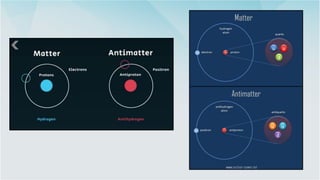
This isn't a trick question. Antimatter is exactly what you
might think it is -- the opposite of normal matter, of which
the majority of our universe is made.


Until just recently, the presence of antimatter in our
universe was considered to be only theoretical. In 1928,
British physicist Paul A.M. Dirac revised Einstein's famous
equation E=mc². Dirac said that Einstein didn't consider
that the "m" in the equation -- mass -- could have negative
properties as well as positive. Dirac's equation (E = + or -
mc2) allowed for the existence of anti-particles in our
universe. Scientists have since proven that several anti-
particles exist.


These anti-particles are, literally, mirror images of normal
matter. Each anti-particle has the same mass as its
corresponding particle, but the electrical charges are
reversed.
What is Antimatter ?
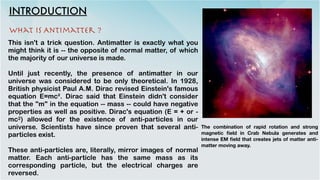
The combination of rapid rotation and strong
magnetic
fi
eld in Crab Nebula generates and
intense EM
fi
eld that creates jets of matter anti-
matter moving away.
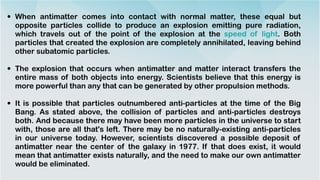
• When antimatter comes into contact with normal matter, these equal but
opposite particles collide to produce an explosion emitting pure radiation,
which travels out of the point of the explosion at the speed of light. Both
particles that created the explosion are completely annihilated, leaving behind
other subatomic particles.


• The explosion that occurs when antimatter and matter interact transfers the
entire mass of both objects into energy. Scientists believe that this energy is
more powerful than any that can be generated by other propulsion methods.


• It is possible that particles outnumbered anti-particles at the time of the Big
Bang. As stated above, the collision of particles and anti-particles destroys
both. And because there may have been more particles in the universe to start
with, those are all that's left. There may be no naturally-existing anti-particles
in our universe today. However, scientists discovered a possible deposit of
antimatter near the center of the galaxy in 1977. If that does exist, it would
mean that antimatter exists naturally, and the need to make our own antimatter
would be eliminated.
TYPES OF ANTIMATTER
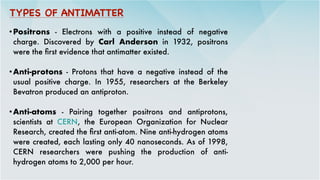
•Positrons - Electrons with a positive instead of negative
charge. Discovered by Carl Anderson in 1932, positrons
were the
fi
rst evidence that antimatter existed.


•Anti-protons - Protons that have a negative instead of the
usual positive charge. In 1955, researchers at the Berkeley
Bevatron produced an antiproton.


•Anti-atoms - Pairing together positrons and antiprotons,
scientists at CERN, the European Organization for Nuclear
Research, created the
fi
rst anti-atom. Nine anti-hydrogen atoms
were created, each lasting only 40 nanoseconds. As of 1998,
CERN researchers were pushing the production of anti-
hydrogen atoms to 2,000 per hour.
MATTER-ANTIMATTER ROCKET ENGINE
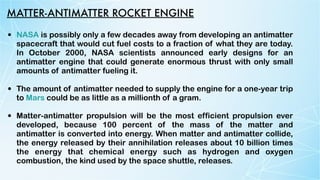
• NASA is possibly only a few decades away from developing an antimatter
spacecraft that would cut fuel costs to a fraction of what they are today.
In October 2000, NASA scientists announced early designs for an
antimatter engine that could generate enormous thrust with only small
amounts of antimatter fueling it.


• The amount of antimatter needed to supply the engine for a one-year trip
to Mars could be as little as a millionth of a gram.


• Matter-antimatter propulsion will be the most efficient propulsion ever
developed, because 100 percent of the mass of the matter and
antimatter is converted into energy. When matter and antimatter collide,
the energy released by their annihilation releases about 10 billion times
the energy that chemical energy such as hydrogen and oxygen
combustion, the kind used by the space shuttle, releases.
An artistic illustration of an
Antimatter Spacecraft that could
carry us beyond the Solar System
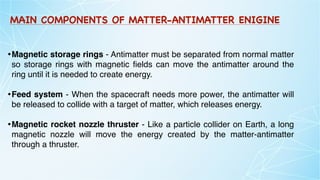
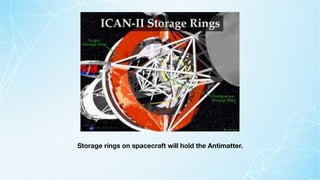
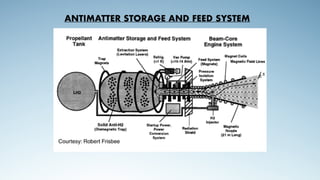
•Magnetic storage rings - Antimatter must be separated from normal matter
so storage rings with magnetic
fi
elds can move the antimatter around the
ring until it is needed to create energy.
•Feed system - When the spacecraft needs more power, the antimatter will
be released to collide with a target of matter, which releases energy.
•Magnetic rocket nozzle thruster - Like a particle collider on Earth, a long
magnetic nozzle will move the energy created by the matter-antimatter
through a thruster.
MAIN COMPONENTS OF MATTER-ANTIMATTER ENIGINE
Storage rings on spacecraft will hold the Antimatter.
HOW DOES AN ANTIMATTER PROPULSION ENGINE WORKS ?
• Ordinary matters and antimatter hate each others with passion.
When they meet each others, they will immediately clash and
annihilate each others - this process releases energy( PHOTON
DRIVE ).


• For example, if I let a Positron and an Electron meets each others,
they will annihilate each other as soon as they touch and release
5.46∗10 to the power -22 J of pure energy and that is technically
how an anti-matter drive works and produces acceleration .


• Due to the enormous energy only a few kilograms of antimatter can
produce, an antimatter drive becomes an astronomer’s dream. You
can realistically accelerate to near speed of light now if you have a
ton of antimatter and a ton of ordinary matter that you can allow to
react with each others.
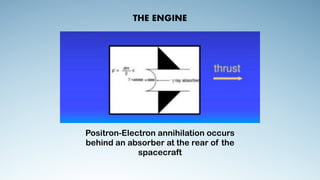
Positron-Electron annihilation occurs
behind an absorber at the rear of the
spacecraft
THE ENGINE
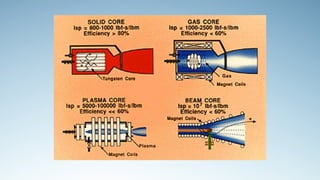
TYPES OF ANTIMATTER ROCKET ENGINE
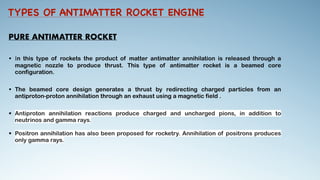
• In this type of rockets the product of matter antimatter annihilation is released through a
magnetic nozzle to produce thrust. This type of antimatter rocket is a beamed core
configuration.


• The beamed core design generates a thrust by redirecting charged particles from an
antiproton-proton annihilation through an exhaust using a magnetic field .


• Antiproton annihilation reactions produce charged and uncharged pions, in addition to
neutrinos and gamma rays.


• Positron annihilation has also been proposed for rocketry. Annihilation of positrons produces
only gamma rays.


PURE ANTIMATTER ROCKET
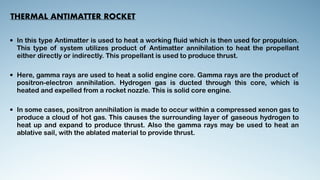
THERMAL ANTIMATTER ROCKET
• In this type Antimatter is used to heat a working fluid which is then used for propulsion.
This type of system utilizes product of Antimatter annihilation to heat the propellant
either directly or indirectly. This propellant is used to produce thrust.


• Here, gamma rays are used to heat a solid engine core. Gamma rays are the product of
positron-electron annihilation. Hydrogen gas is ducted through this core, which is
heated and expelled from a rocket nozzle. This is solid core engine.


• In some cases, positron annihilation is made to occur within a compressed xenon gas to
produce a cloud of hot gas. This causes the surrounding layer of gaseous hydrogen to
heat up and expand to produce thrust. Also the gamma rays may be used to heat an
ablative sail, with the ablated material to provide thrust.
ANTIMATTER STORAGE AND FEED SYSTEM
DIFFICULTIES
The production and storage of Antimatter are the major difficulties with systems
using Antimatter.


PRODUCTION
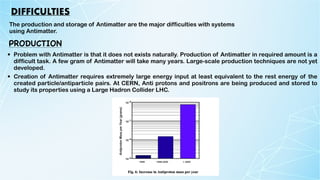
• Problem with Antimatter is that it does not exists naturally. Production of Antimatter in required amount is a
difficult task. A few gram of Antimatter will take many years. Large-scale production techniques are not yet
developed.


• Creation of Antimatter requires extremely large energy input at least equivalent to the rest energy of the
created particle/antiparticle pairs. At CERN, Anti protons and positrons are being produced and stored to
study its properties using a Large Hadron Collider LHC.
STORAGE
• Antimatter cannot be stored in a container made of ordinary matter because it reacts with
any matter, it touches, annihilating itself and releasing total amount of the energy
contained in both the particles.


• Storage of Antimatter is typically done by trapping electrically charged frozen anti-
hydrogen pellets in Penning traps . At CERN, they are successful n trapping antiprotons for
1000 seconds and are still giving their best to increase the storage time.


COST
Antimatter is the most expensive substance on Earth about $62.5 trillion per gram.
Production and storage involves a huge cost.
EXTRACTION OF ENERGY
• A secondary problem is the extraction of useful energy or momentum from the
products of antimatter annihilation, which are primarily in the form of extremely
energetic ionizing radiation. The antimatter mechanisms proposed to have for the
most part provided plausible mechanisms for harnessing energy from these
annihilation products.


• When Antimatter is compared with the conventional fuel used in the propulsion
systems then it is observed that the exhaust released from the antimatter propulsion
systems is highly radioactive and lethal to the biodiversity.


• According to CERN, the pace with which technology is developing and studies being
carried out, it is possible that this technology will be implemented in deep space
exploration in next decade or so. Efforts are being made to reduce the required mass
of antimatter for propulsion in order to reduce the overall cost of production and
storage.
ADVANTAGES
1. Antimatter is hundred percent efficient as its whole mass is converted into
Energy after annihilation with matter.


2. For propulsion of spacecraft the amount of Antimatter required will be very
less. A ten-gram of Antimatter would be enough to send manned spacecraft
to Mars. This mass is negligible as compared to Hydrogen or any
conventional fuel used.


3. Specific Impulse of Antimatter is very High . Specific Impulse could be
greater than 10,000,000 seconds.


4. Speed of antimatter is about 94% of speed of light which provides extremely
high thrust.This helps to cover large distances in short time .
CONCLUSION
It has always been the dream of man to reach the stars.  The ancient scholars sought the
knowledge to build wings, while the engineers of today seek a means to power them.  In the last
100 years the evolution of flight has enabled us to cross the oceans, and reach the moon.  Now
we stand on the brink of the future of flight.  Interstellar travel was once only a concept found in
the world of science fiction; today, it stands as the next step in mankind's venture into space. 
The limits set by our flight technology decrease each day with new discoveries in science and
the aerospace industry.  However, in order for progress and change to occur, funding and
testing must be made possible for those ideas that show the potential to revolutionize the field.   


Funding and testing are vital to the development of an antimatter propulsion system. 
Antimatter propulsion is a realistic and tangible means of powering the spacecrafts of today
and tomorrow.  Its energy, efficiency, and size make it the leading replacement for current solid
and liquid fuel systems. Antimatter is also safer than most of its leading competitors in its
production of waste and byproducts.  Though the cost of antimatter is significantly greater than
other alternatives, with an increase in demand the price per milligram of antimatter will decline. 
In conclusion, further research on this subject by an agency with the facilities and money, such
as the Air Force, is important to ensure the continuation of testing, and the production of a
working system.
BIBILOGRAPHY
1.www.quora.com
2.www.wikipedia.com/antimatterrocketengine
3.www.science.howstu
ff
sworks.com
THANK YOU

ANTIMATTER ROCKET PROPULSION

  • 1.
    ANTIMATTER ROCKET PROPULSION PRESENTEDBY YASEEN SIXTH SEMESTER AERONAUTICAL DEPARTMENT
  • 2.
    CONTENT 1.INTRODUCTION 2.ANTIMATTER 3.TYPES OF ANTIMATTER 4.MATTER-ANTIMATTERROCKET ENGINE • WORKING • COMPONENTS • TYPES OF ANTIMATTER ROCKET ENGINE 5. DIFFICULTIES 6. ADVANTAGES 7. CONCLUSION 8. BIBILOGRAPHY
  • 3.
    INTRODUCTION This isn't atrick question. Antimatter is exactly what you might think it is -- the opposite of normal matter, of which the majority of our universe is made. Until just recently, the presence of antimatter in our universe was considered to be only theoretical. In 1928, British physicist Paul A.M. Dirac revised Einstein's famous equation E=mc². Dirac said that Einstein didn't consider that the "m" in the equation -- mass -- could have negative properties as well as positive. Dirac's equation (E = + or - mc2) allowed for the existence of anti-particles in our universe. Scientists have since proven that several anti- particles exist. These anti-particles are, literally, mirror images of normal matter. Each anti-particle has the same mass as its corresponding particle, but the electrical charges are reversed. What is Antimatter ? The combination of rapid rotation and strong magnetic fi eld in Crab Nebula generates and intense EM fi eld that creates jets of matter anti- matter moving away.
  • 4.
    • When antimattercomes into contact with normal matter, these equal but opposite particles collide to produce an explosion emitting pure radiation, which travels out of the point of the explosion at the speed of light. Both particles that created the explosion are completely annihilated, leaving behind other subatomic particles. • The explosion that occurs when antimatter and matter interact transfers the entire mass of both objects into energy. Scientists believe that this energy is more powerful than any that can be generated by other propulsion methods. • It is possible that particles outnumbered anti-particles at the time of the Big Bang. As stated above, the collision of particles and anti-particles destroys both. And because there may have been more particles in the universe to start with, those are all that's left. There may be no naturally-existing anti-particles in our universe today. However, scientists discovered a possible deposit of antimatter near the center of the galaxy in 1977. If that does exist, it would mean that antimatter exists naturally, and the need to make our own antimatter would be eliminated.
  • 5.
    TYPES OF ANTIMATTER •Positrons- Electrons with a positive instead of negative charge. Discovered by Carl Anderson in 1932, positrons were the fi rst evidence that antimatter existed. •Anti-protons - Protons that have a negative instead of the usual positive charge. In 1955, researchers at the Berkeley Bevatron produced an antiproton. •Anti-atoms - Pairing together positrons and antiprotons, scientists at CERN, the European Organization for Nuclear Research, created the fi rst anti-atom. Nine anti-hydrogen atoms were created, each lasting only 40 nanoseconds. As of 1998, CERN researchers were pushing the production of anti- hydrogen atoms to 2,000 per hour.
  • 7.
    MATTER-ANTIMATTER ROCKET ENGINE •NASA is possibly only a few decades away from developing an antimatter spacecraft that would cut fuel costs to a fraction of what they are today. In October 2000, NASA scientists announced early designs for an antimatter engine that could generate enormous thrust with only small amounts of antimatter fueling it. • The amount of antimatter needed to supply the engine for a one-year trip to Mars could be as little as a millionth of a gram. • Matter-antimatter propulsion will be the most efficient propulsion ever developed, because 100 percent of the mass of the matter and antimatter is converted into energy. When matter and antimatter collide, the energy released by their annihilation releases about 10 billion times the energy that chemical energy such as hydrogen and oxygen combustion, the kind used by the space shuttle, releases.
  • 8.
    An artistic illustrationof an Antimatter Spacecraft that could carry us beyond the Solar System
  • 9.
    •Magnetic storage rings- Antimatter must be separated from normal matter so storage rings with magnetic fi elds can move the antimatter around the ring until it is needed to create energy. •Feed system - When the spacecraft needs more power, the antimatter will be released to collide with a target of matter, which releases energy. •Magnetic rocket nozzle thruster - Like a particle collider on Earth, a long magnetic nozzle will move the energy created by the matter-antimatter through a thruster. MAIN COMPONENTS OF MATTER-ANTIMATTER ENIGINE
  • 10.
    Storage rings onspacecraft will hold the Antimatter.
  • 11.
    HOW DOES ANANTIMATTER PROPULSION ENGINE WORKS ? • Ordinary matters and antimatter hate each others with passion. When they meet each others, they will immediately clash and annihilate each others - this process releases energy( PHOTON DRIVE ). • For example, if I let a Positron and an Electron meets each others, they will annihilate each other as soon as they touch and release 5.46∗10 to the power -22 J of pure energy and that is technically how an anti-matter drive works and produces acceleration . • Due to the enormous energy only a few kilograms of antimatter can produce, an antimatter drive becomes an astronomer’s dream. You can realistically accelerate to near speed of light now if you have a ton of antimatter and a ton of ordinary matter that you can allow to react with each others.
  • 12.
    Positron-Electron annihilation occurs behindan absorber at the rear of the spacecraft THE ENGINE
  • 13.
    TYPES OF ANTIMATTERROCKET ENGINE • In this type of rockets the product of matter antimatter annihilation is released through a magnetic nozzle to produce thrust. This type of antimatter rocket is a beamed core configuration. • The beamed core design generates a thrust by redirecting charged particles from an antiproton-proton annihilation through an exhaust using a magnetic field . • Antiproton annihilation reactions produce charged and uncharged pions, in addition to neutrinos and gamma rays. • Positron annihilation has also been proposed for rocketry. Annihilation of positrons produces only gamma rays. PURE ANTIMATTER ROCKET
  • 14.
    THERMAL ANTIMATTER ROCKET •In this type Antimatter is used to heat a working fluid which is then used for propulsion. This type of system utilizes product of Antimatter annihilation to heat the propellant either directly or indirectly. This propellant is used to produce thrust. • Here, gamma rays are used to heat a solid engine core. Gamma rays are the product of positron-electron annihilation. Hydrogen gas is ducted through this core, which is heated and expelled from a rocket nozzle. This is solid core engine. • In some cases, positron annihilation is made to occur within a compressed xenon gas to produce a cloud of hot gas. This causes the surrounding layer of gaseous hydrogen to heat up and expand to produce thrust. Also the gamma rays may be used to heat an ablative sail, with the ablated material to provide thrust.
  • 15.
  • 17.
    DIFFICULTIES The production andstorage of Antimatter are the major difficulties with systems using Antimatter. PRODUCTION • Problem with Antimatter is that it does not exists naturally. Production of Antimatter in required amount is a difficult task. A few gram of Antimatter will take many years. Large-scale production techniques are not yet developed. • Creation of Antimatter requires extremely large energy input at least equivalent to the rest energy of the created particle/antiparticle pairs. At CERN, Anti protons and positrons are being produced and stored to study its properties using a Large Hadron Collider LHC.
  • 18.
    STORAGE • Antimatter cannotbe stored in a container made of ordinary matter because it reacts with any matter, it touches, annihilating itself and releasing total amount of the energy contained in both the particles. • Storage of Antimatter is typically done by trapping electrically charged frozen anti- hydrogen pellets in Penning traps . At CERN, they are successful n trapping antiprotons for 1000 seconds and are still giving their best to increase the storage time. COST Antimatter is the most expensive substance on Earth about $62.5 trillion per gram. Production and storage involves a huge cost.
  • 19.
    EXTRACTION OF ENERGY •A secondary problem is the extraction of useful energy or momentum from the products of antimatter annihilation, which are primarily in the form of extremely energetic ionizing radiation. The antimatter mechanisms proposed to have for the most part provided plausible mechanisms for harnessing energy from these annihilation products. • When Antimatter is compared with the conventional fuel used in the propulsion systems then it is observed that the exhaust released from the antimatter propulsion systems is highly radioactive and lethal to the biodiversity. • According to CERN, the pace with which technology is developing and studies being carried out, it is possible that this technology will be implemented in deep space exploration in next decade or so. Efforts are being made to reduce the required mass of antimatter for propulsion in order to reduce the overall cost of production and storage.
  • 20.
    ADVANTAGES 1. Antimatter ishundred percent efficient as its whole mass is converted into Energy after annihilation with matter. 2. For propulsion of spacecraft the amount of Antimatter required will be very less. A ten-gram of Antimatter would be enough to send manned spacecraft to Mars. This mass is negligible as compared to Hydrogen or any conventional fuel used. 3. Specific Impulse of Antimatter is very High . Specific Impulse could be greater than 10,000,000 seconds. 4. Speed of antimatter is about 94% of speed of light which provides extremely high thrust.This helps to cover large distances in short time .
  • 21.
    CONCLUSION It has alwaysbeen the dream of man to reach the stars.  The ancient scholars sought the knowledge to build wings, while the engineers of today seek a means to power them.  In the last 100 years the evolution of flight has enabled us to cross the oceans, and reach the moon.  Now we stand on the brink of the future of flight.  Interstellar travel was once only a concept found in the world of science fiction; today, it stands as the next step in mankind's venture into space.  The limits set by our flight technology decrease each day with new discoveries in science and the aerospace industry.  However, in order for progress and change to occur, funding and testing must be made possible for those ideas that show the potential to revolutionize the field.    Funding and testing are vital to the development of an antimatter propulsion system.  Antimatter propulsion is a realistic and tangible means of powering the spacecrafts of today and tomorrow.  Its energy, efficiency, and size make it the leading replacement for current solid and liquid fuel systems. Antimatter is also safer than most of its leading competitors in its production of waste and byproducts.  Though the cost of antimatter is significantly greater than other alternatives, with an increase in demand the price per milligram of antimatter will decline.  In conclusion, further research on this subject by an agency with the facilities and money, such as the Air Force, is important to ensure the continuation of testing, and the production of a working system.
  • 22.
  • 23.