Fast and Reliable
Apache Spark SQL Engine
Cheng Lian @liancheng
Spark + AI Summit @ SF | April, 2019
1
2
About me
CHENG LIAN
• Software Engineer at Databricks
• PMC member and committer of Apache Spark
• Committer of Apache Parquet
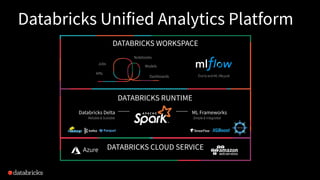
DATABRICKS WORKSPACE
Databricks Delta ML Frameworks
DATABRICKS CLOUD SERVICE
DATABRICKS RUNTIME
Reliable & Scalable Simple & Integrated
Databricks Unified Analytics Platform
APIs
Jobs
Models
Notebooks
Dashboards End to end ML lifecycle
Databricks Customers Across Industries
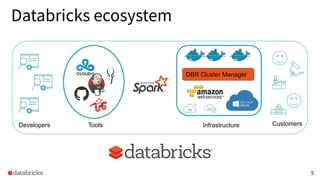
Databricks ecosystem
5
ToolsDevelopers
DBR Cluster Manager
Infrastructure Customers
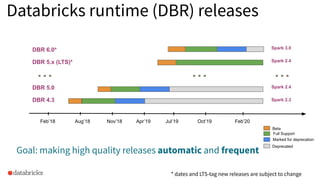
Beta
Full Support
Marked for deprecation
Deprecated
Databricks runtime (DBR) releases
Goal: making high quality releases automatic and frequent
Feb’18 Aug’18 Nov’18 Apr’19 Jul’19 Oct’19 Feb’20
* dates and LTS-tag new releases are subject to change
Spark 3.0
Spark 2.3
Spark 2.4
Spark 2.4
DBR 6.0*
DBR 4.3
DBR 5.0
DBR 5.x (LTS)*
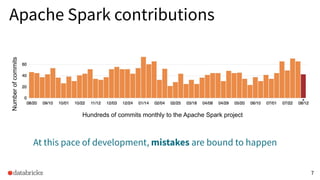
Apache Spark contributions
7
Hundreds of commits monthly to the Apache Spark project
Numberofcommits
At this pace of development, mistakes are bound to happen
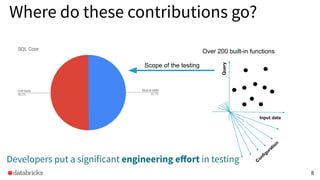
Where do these contributions go?
8
Scope of the testing
Developers put a significant engineering effort in testing
Query
Input data
Configuration
Over 200 built-in functions
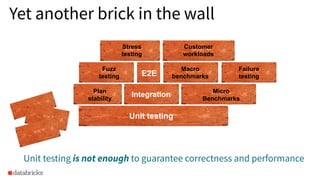
Yet another brick in the wall
Unit testing is not enough to guarantee correctness and performance
Unit testing
Integration
E2E
Micro
Benchmarks
Plan
stability
Fuzz
testing
Macro
benchmarks
Stress
testing
Customer
workloads
Failure
testing
10
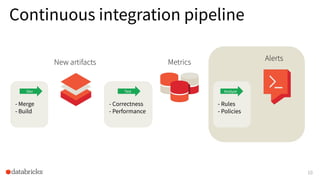
Continuous integration pipeline
New artifacts Metrics
- Correctness
- Performance
Test
Alerts
- Merge
- Build
Dev
- Rules
- Policies
Analyze
11
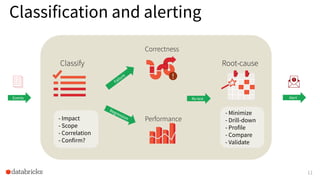
Classification and alerting
- Impact
- Scope
- Correlation
- Confirm?
Failure
Regression
- Minimize
- Drill-down
- Profile
- Compare
- Validate
Events Re-test Alert
Classify Root-cause
Correctness
Performance
12
Failure
Regression
Events
Re-test
Alert
Classify Root-cause
Correctness
Performance
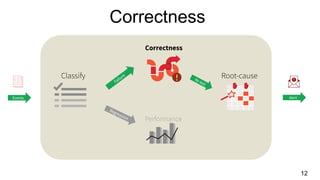
Correctness
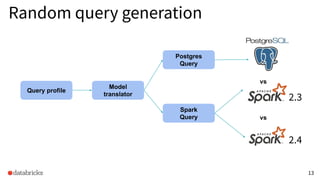
Random query generation
13
Query profile
Model
translator
Spark
Query
Postgres
Query
vs
vs
2.3
2.4
...
...
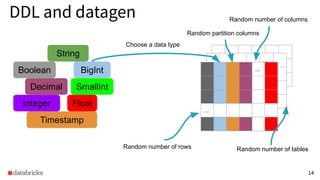
DDL and datagen
14
...
...
BigIntBoolean
Timestamp
Decimal
FloatInteger
SmallInt
String
Choose a data type
Random number of rows
Random number of columns
Random number of tables
Random partition columns
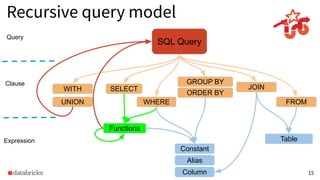
Recursive query model
15
SQL Query
WITH
FROMUNION
SELECT
Functions
Constant
GROUP BY
ORDER BY
Table
Column
Alias
Query
Clause
Expression
JOIN
WHERE
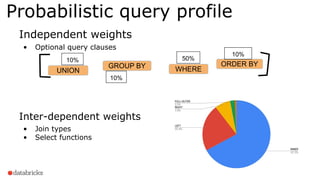
Probabilistic query profile
Independent weights
• Optional query clauses
Inter-dependent weights
• Join types
• Select functions
ORDER BY
UNION
GROUP BY WHERE
10%
10%
50%
10%
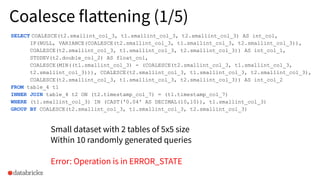
Coalesce flattening (1/5)
SELECT COALESCE(t2.smallint_col_3, t1.smallint_col_3, t2.smallint_col_3) AS int_col,
IF(NULL, VARIANCE(COALESCE(t2.smallint_col_3, t1.smallint_col_3, t2.smallint_col_3)),
COALESCE(t2.smallint_col_3, t1.smallint_col_3, t2.smallint_col_3)) AS int_col_1,
STDDEV(t2.double_col_2) AS float_col,
COALESCE(MIN((t1.smallint_col_3) - (COALESCE(t2.smallint_col_3, t1.smallint_col_3,
t2.smallint_col_3))), COALESCE(t2.smallint_col_3, t1.smallint_col_3, t2.smallint_col_3),
COALESCE(t2.smallint_col_3, t1.smallint_col_3, t2.smallint_col_3)) AS int_col_2
FROM table_4 t1
INNER JOIN table_4 t2 ON (t2.timestamp_col_7) = (t1.timestamp_col_7)
WHERE (t1.smallint_col_3) IN (CAST('0.04' AS DECIMAL(10,10)), t1.smallint_col_3)
GROUP BY COALESCE(t2.smallint_col_3, t1.smallint_col_3, t2.smallint_col_3)
Small dataset with 2 tables of 5x5 size
Within 10 randomly generated queries
Error: Operation is in ERROR_STATE
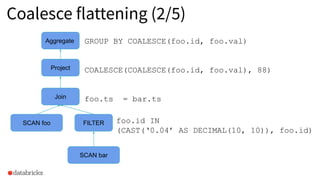
Coalesce flattening (2/5)
Aggregate
Project
Join
FILTERSCAN foo
SCAN bar
foo.id IN
(CAST(‘0.04’ AS DECIMAL(10, 10)), foo.id)
foo.ts = bar.ts
COALESCE(COALESCE(foo.id, foo.val), 88)
GROUP BY COALESCE(foo.id, foo.val)
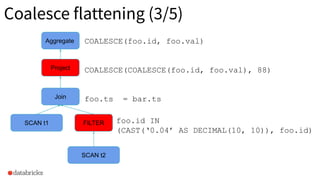
Coalesce flattening (3/5)
Aggregate
Project
Join
FILTERSCAN t1
SCAN t2
foo.id IN
(CAST(‘0.04’ AS DECIMAL(10, 10)), foo.id)
foo.ts = bar.ts
COALESCE(COALESCE(foo.id, foo.val), 88)
COALESCE(foo.id, foo.val)
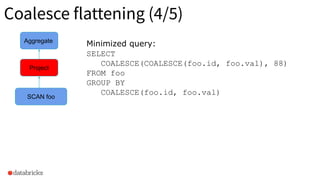
Coalesce flattening (4/5)
Aggregate
Project
SCAN foo
Minimized query:
SELECT
COALESCE(COALESCE(foo.id, foo.val), 88)
FROM foo
GROUP BY
COALESCE(foo.id, foo.val)
Coalesce flattening (5/5)
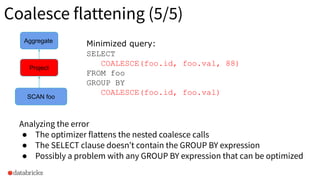
Aggregate
Project
SCAN foo
Minimized query:
SELECT
COALESCE(foo.id, foo.val, 88)
FROM foo
GROUP BY
COALESCE(foo.id, foo.val)
Analyzing the error
● The optimizer flattens the nested coalesce calls
● The SELECT clause doesn’t contain the GROUP BY expression
● Possibly a problem with any GROUP BY expression that can be optimized
Lead function (1/3)
SELECT (t1.decimal0803_col_3) / (t1.decimal0803_col_3) AS decimal_col,
CAST(696 AS STRING) AS char_col, t1.decimal0803_col_3,
(COALESCE(CAST('0.02' AS DECIMAL(10,10)),
CAST('0.47' AS DECIMAL(10,10)),
CAST('-0.53' AS DECIMAL(10,10)))) +
(LEAD(-65, 4) OVER (ORDER BY (t1.decimal0803_col_3) / (t1.decimal0803_col_3),
CAST(696 AS STRING))) AS decimal_col_1,
CAST(-349 AS STRING) AS char_col_1
FROM table_16 t1
WHERE (943) > (889)
Error: Column 4 in row 10 does not match:
[1.0, 696, -871.81, <<-64.98>>, -349] SPARK row
[1.0, 696, -871.81, <<None>>, -349] POSTGRESQL row
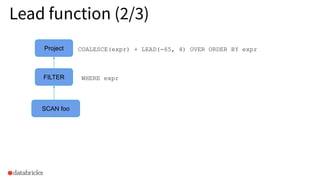
Lead function (2/3)
Project
FILTER
SCAN foo
WHERE expr
COALESCE(expr) + LEAD(-65, 4) OVER ORDER BY expr
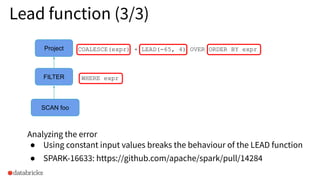
Lead function (3/3)
Project
FILTER WHERE expr
COALESCE(expr) + LEAD(-65, 4) OVER ORDER BY expr
Analyzing the error
● Using constant input values breaks the behaviour of the LEAD function
● SPARK-16633: https://github.com/apache/spark/pull/14284
SCAN foo
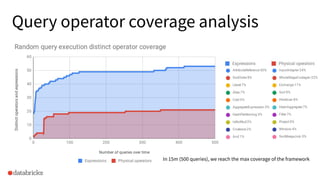
Query operator coverage analysis
In 15m (500 queries), we reach the max coverage of the framework
26
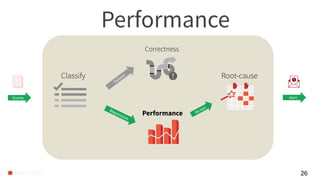
Performance
26
Failure
Regression
Events
Re-test
Alert
Classify Root-cause
Correctness
Performance
Benchmarking tools
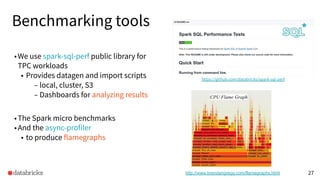
•We use spark-sql-perf public library for
TPC workloads
• Provides datagen and import scripts
– local, cluster, S3
– Dashboards for analyzing results
•The Spark micro benchmarks
•And the async-profiler
• to produce flamegraphs
27
https://github.com/databricks/spark-sql-perf
Source:
http://www.brendangregg.com/flamegraphs.html
CPU Flame Graph
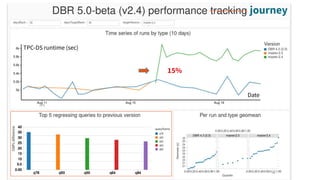
15%
----------- journey
TPC-DS runtime (sec)
Date
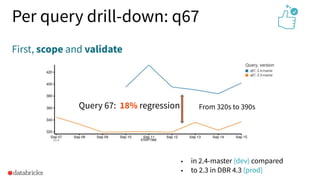
Per query drill-down: q67
First, scope and validate
• in 2.4-master (dev) compared
• to 2.3 in DBR 4.3 (prod)
Query 67: 18% regression From 320s to 390s
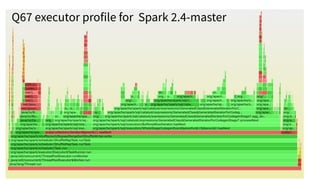
Q67 executor profile for Spark 2.4-master
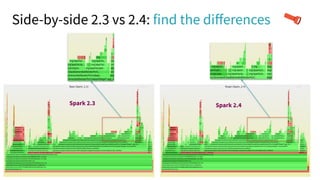
Side-by-side 2.3 vs 2.4: find the differences
Spark 2.3 Spark 2.4
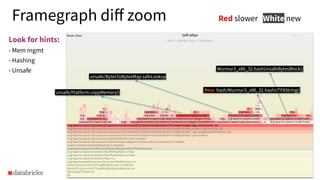
Framegraph diff zoom Red slower White new
unsafe/Platform.copyMemory()
unsafe/BytesToBytesMap.safeLookup
New: hash/Murmur3_x86_32.hashUTF8String()
Murmur3_x86_32.hashUnsafeBytesBlock()
Look for hints:
- Mem mgmt
- Hashing
- Unsafe
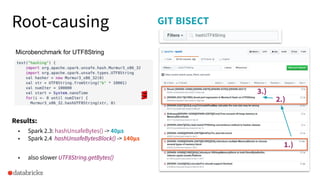
Root-causing
Results:
• Spark 2.3: hashUnsafeBytes() -> 40µs
• Spark 2.4 hashUnsafeBytesBlock() -> 140µs
• also slower UTF8String.getBytes()
Microbenchmark for UTF8String
GIT BISECT
1.)
2.)
3.)
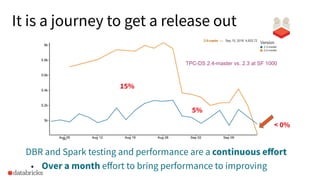
It is a journey to get a release out
DBR and Spark testing and performance are a continuous effort
• Over a month effort to bring performance to improving
TPC-DS 2.4-master vs. 2.3 at SF 1000
15%
5%
< 0%
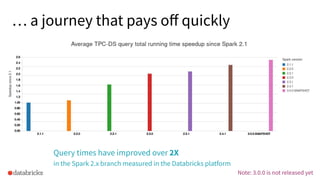
… a journey that pays off quickly
Query times have improved over 2X
in the Spark 2.x branch measured in the Databricks platform
Note: 3.0.0 is not released yet
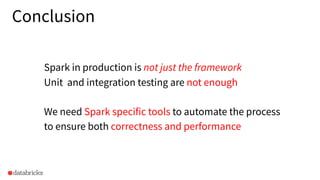
Conclusion
Spark in production is not just the framework
Unit and integration testing are not enough
We need Spark specific tools to automate the process
to ensure both correctness and performance
Thanks!
Fast and Reliable Apache Spark SQL Engine
April 2019
37
Test AnalyzeDev
Feedback: lian@databricks.com

Fast and Reliable Apache Spark SQL Engine

  • 1.
    Fast and Reliable ApacheSpark SQL Engine Cheng Lian @liancheng Spark + AI Summit @ SF | April, 2019 1
  • 2.
    2 About me CHENG LIAN •Software Engineer at Databricks • PMC member and committer of Apache Spark • Committer of Apache Parquet
  • 3.
    DATABRICKS WORKSPACE Databricks DeltaML Frameworks DATABRICKS CLOUD SERVICE DATABRICKS RUNTIME Reliable & Scalable Simple & Integrated Databricks Unified Analytics Platform APIs Jobs Models Notebooks Dashboards End to end ML lifecycle
  • 4.
  • 5.
  • 6.
    Beta Full Support Marked fordeprecation Deprecated Databricks runtime (DBR) releases Goal: making high quality releases automatic and frequent Feb’18 Aug’18 Nov’18 Apr’19 Jul’19 Oct’19 Feb’20 * dates and LTS-tag new releases are subject to change Spark 3.0 Spark 2.3 Spark 2.4 Spark 2.4 DBR 6.0* DBR 4.3 DBR 5.0 DBR 5.x (LTS)*
  • 7.
    Apache Spark contributions 7 Hundredsof commits monthly to the Apache Spark project Numberofcommits At this pace of development, mistakes are bound to happen
  • 8.
    Where do thesecontributions go? 8 Scope of the testing Developers put a significant engineering effort in testing Query Input data Configuration Over 200 built-in functions
  • 9.
    Yet another brickin the wall Unit testing is not enough to guarantee correctness and performance Unit testing Integration E2E Micro Benchmarks Plan stability Fuzz testing Macro benchmarks Stress testing Customer workloads Failure testing
  • 10.
    10 Continuous integration pipeline Newartifacts Metrics - Correctness - Performance Test Alerts - Merge - Build Dev - Rules - Policies Analyze
  • 11.
    11 Classification and alerting -Impact - Scope - Correlation - Confirm? Failure Regression - Minimize - Drill-down - Profile - Compare - Validate Events Re-test Alert Classify Root-cause Correctness Performance
  • 12.
  • 13.
    Random query generation 13 Queryprofile Model translator Spark Query Postgres Query vs vs 2.3 2.4
  • 14.
    ... ... DDL and datagen 14 ... ... BigIntBoolean Timestamp Decimal FloatInteger SmallInt String Choosea data type Random number of rows Random number of columns Random number of tables Random partition columns
  • 15.
    Recursive query model 15 SQLQuery WITH FROMUNION SELECT Functions Constant GROUP BY ORDER BY Table Column Alias Query Clause Expression JOIN WHERE
  • 16.
    Probabilistic query profile Independentweights • Optional query clauses Inter-dependent weights • Join types • Select functions ORDER BY UNION GROUP BY WHERE 10% 10% 50% 10%
  • 17.
    Coalesce flattening (1/5) SELECTCOALESCE(t2.smallint_col_3, t1.smallint_col_3, t2.smallint_col_3) AS int_col, IF(NULL, VARIANCE(COALESCE(t2.smallint_col_3, t1.smallint_col_3, t2.smallint_col_3)), COALESCE(t2.smallint_col_3, t1.smallint_col_3, t2.smallint_col_3)) AS int_col_1, STDDEV(t2.double_col_2) AS float_col, COALESCE(MIN((t1.smallint_col_3) - (COALESCE(t2.smallint_col_3, t1.smallint_col_3, t2.smallint_col_3))), COALESCE(t2.smallint_col_3, t1.smallint_col_3, t2.smallint_col_3), COALESCE(t2.smallint_col_3, t1.smallint_col_3, t2.smallint_col_3)) AS int_col_2 FROM table_4 t1 INNER JOIN table_4 t2 ON (t2.timestamp_col_7) = (t1.timestamp_col_7) WHERE (t1.smallint_col_3) IN (CAST('0.04' AS DECIMAL(10,10)), t1.smallint_col_3) GROUP BY COALESCE(t2.smallint_col_3, t1.smallint_col_3, t2.smallint_col_3) Small dataset with 2 tables of 5x5 size Within 10 randomly generated queries Error: Operation is in ERROR_STATE
  • 18.
    Coalesce flattening (2/5) Aggregate Project Join FILTERSCANfoo SCAN bar foo.id IN (CAST(‘0.04’ AS DECIMAL(10, 10)), foo.id) foo.ts = bar.ts COALESCE(COALESCE(foo.id, foo.val), 88) GROUP BY COALESCE(foo.id, foo.val)
  • 19.
    Coalesce flattening (3/5) Aggregate Project Join FILTERSCANt1 SCAN t2 foo.id IN (CAST(‘0.04’ AS DECIMAL(10, 10)), foo.id) foo.ts = bar.ts COALESCE(COALESCE(foo.id, foo.val), 88) COALESCE(foo.id, foo.val)
  • 20.
    Coalesce flattening (4/5) Aggregate Project SCANfoo Minimized query: SELECT COALESCE(COALESCE(foo.id, foo.val), 88) FROM foo GROUP BY COALESCE(foo.id, foo.val)
  • 21.
    Coalesce flattening (5/5) Aggregate Project SCANfoo Minimized query: SELECT COALESCE(foo.id, foo.val, 88) FROM foo GROUP BY COALESCE(foo.id, foo.val) Analyzing the error ● The optimizer flattens the nested coalesce calls ● The SELECT clause doesn’t contain the GROUP BY expression ● Possibly a problem with any GROUP BY expression that can be optimized
  • 22.
    Lead function (1/3) SELECT(t1.decimal0803_col_3) / (t1.decimal0803_col_3) AS decimal_col, CAST(696 AS STRING) AS char_col, t1.decimal0803_col_3, (COALESCE(CAST('0.02' AS DECIMAL(10,10)), CAST('0.47' AS DECIMAL(10,10)), CAST('-0.53' AS DECIMAL(10,10)))) + (LEAD(-65, 4) OVER (ORDER BY (t1.decimal0803_col_3) / (t1.decimal0803_col_3), CAST(696 AS STRING))) AS decimal_col_1, CAST(-349 AS STRING) AS char_col_1 FROM table_16 t1 WHERE (943) > (889) Error: Column 4 in row 10 does not match: [1.0, 696, -871.81, <<-64.98>>, -349] SPARK row [1.0, 696, -871.81, <<None>>, -349] POSTGRESQL row
  • 23.
    Lead function (2/3) Project FILTER SCANfoo WHERE expr COALESCE(expr) + LEAD(-65, 4) OVER ORDER BY expr
  • 24.
    Lead function (3/3) Project FILTERWHERE expr COALESCE(expr) + LEAD(-65, 4) OVER ORDER BY expr Analyzing the error ● Using constant input values breaks the behaviour of the LEAD function ● SPARK-16633: https://github.com/apache/spark/pull/14284 SCAN foo
  • 25.
    Query operator coverageanalysis In 15m (500 queries), we reach the max coverage of the framework
  • 26.
  • 27.
    Benchmarking tools •We usespark-sql-perf public library for TPC workloads • Provides datagen and import scripts – local, cluster, S3 – Dashboards for analyzing results •The Spark micro benchmarks •And the async-profiler • to produce flamegraphs 27 https://github.com/databricks/spark-sql-perf Source: http://www.brendangregg.com/flamegraphs.html CPU Flame Graph
  • 28.
  • 29.
    Per query drill-down:q67 First, scope and validate • in 2.4-master (dev) compared • to 2.3 in DBR 4.3 (prod) Query 67: 18% regression From 320s to 390s
  • 30.
    Q67 executor profilefor Spark 2.4-master
  • 31.
    Side-by-side 2.3 vs2.4: find the differences Spark 2.3 Spark 2.4
  • 32.
    Framegraph diff zoomRed slower White new unsafe/Platform.copyMemory() unsafe/BytesToBytesMap.safeLookup New: hash/Murmur3_x86_32.hashUTF8String() Murmur3_x86_32.hashUnsafeBytesBlock() Look for hints: - Mem mgmt - Hashing - Unsafe
  • 33.
    Root-causing Results: • Spark 2.3:hashUnsafeBytes() -> 40µs • Spark 2.4 hashUnsafeBytesBlock() -> 140µs • also slower UTF8String.getBytes() Microbenchmark for UTF8String GIT BISECT 1.) 2.) 3.)
  • 34.
    It is ajourney to get a release out DBR and Spark testing and performance are a continuous effort • Over a month effort to bring performance to improving TPC-DS 2.4-master vs. 2.3 at SF 1000 15% 5% < 0%
  • 35.
    … a journeythat pays off quickly Query times have improved over 2X in the Spark 2.x branch measured in the Databricks platform Note: 3.0.0 is not released yet
  • 36.
    Conclusion Spark in productionis not just the framework Unit and integration testing are not enough We need Spark specific tools to automate the process to ensure both correctness and performance
  • 37.
    Thanks! Fast and ReliableApache Spark SQL Engine April 2019 37 Test AnalyzeDev Feedback: lian@databricks.com