

Family-based Neonatal Care
STEFAN JOHANSSON, MD PhD
Sachs Children’s Hospital
Karolinska institutet
Stockholm, Sweden
Get in touch!
stefan.johansson@ki.se
linkedin.com/in/johansson247
slideshare.com/stefanjohansson
www.99nicu.org
www.ebneo.org
”Families are the most central and
enduring influence in children's lives”
Shor. AAP Task Force on the Family
Pediatrics 2003;111:1541
Framework
”…planning, delivery, and evaluation of
health care… grounded in mutually
beneficial partnerships…”
Institute for Patient- and Family-Centered Care
www.ipfcc.org
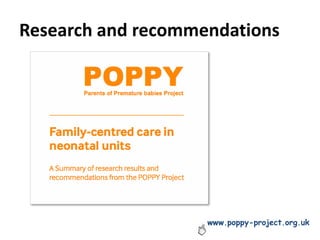
Research and recommendations
www.poppy-project.org.uk
Becoming a parent
• Life-changing event
• Preconceptions
• Expectations
• Demands
• Almost all parents are unaware that
~10% of newborns need neonatal care
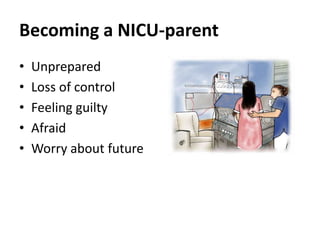
Becoming a NICU-parent
• Unprepared
• Loss of control
• Feeling guilty
• Afraid
• Worry about future
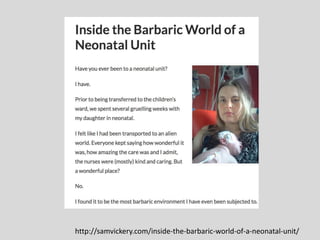
http://samvickery.com/inside-the-barbaric-world-of-a-neonatal-unit/
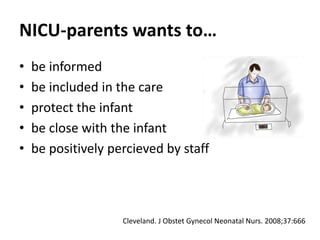
NICU-parents wants to…
• be informed
• be included in the care
• protect the infant
• be close with the infant
• be positively percieved by staff
Cleveland. J Obstet Gynecol Neonatal Nurs. 2008;37:666
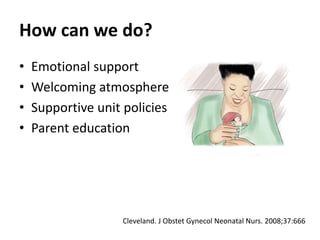
How can we do?
• Emotional support
• Welcoming atmosphere
• Supportive unit policies
• Parent education
Cleveland. J Obstet Gynecol Neonatal Nurs. 2008;37:666
”Family-based” practise
• Parents are a natural part of the team
• Parents are present as care-givers
• Parents participate in rounds
• Skin-to-skin
• Rooming in
NO SIZE FITS ALL
Your context matters
Do we need evidence for
family-based neonatal care
before we can adopt it?
”Sounds good but show some data”
• Creating Opportunities for Parent
Empowerment (COPE)
Melnyk. Pediatrics 2006;118:1414
• Stockholm Family-Centered Care Study
Örtenstrand. Pediatrics. 2010;125:e278
• Parental presence on NICU bedside rounds
Abdel-Latif. Arch Dis Child FN Ed 2015;100:F203
• Family Nurture Intervention in the NICU
Welsh. J Child Psychol Psychiatry. 2015;56:1202
• Parent-Administered Physical Therapy
Ustad. Pediatrics. 2016;138(2).pii: e20160271
Creating Opportunities for Parent
Empowerment (COPE)
• 260 families with preterm infants, they
either learned about:
– infant behaviour and how to parent it
– hospital services and organisation
• Families in the empowered group had
– lower depression and anxiety scores
– 4 days shorter hospital stay (35 vs 39 days)
Melnyk. Pediatrics 2006;118:1414
Stockholm Family-Centered Care Study
• 366 families with preterm infants randomized
to be roomed-in or staying at home
• Family-care families had
– less anxiety at discharge and after 3 months
– 5 days shorter hospital stay (27 vs 32 days)
Örtenstrand. Pediatrics. 2010;125:e278
Parental presence on NICU rounds
• 63 parents participating or non-participating
in bedside rounds (cross-over randomization)
• 95% of parents and 90% of staff:
”parents should be allowed to attend rounds”
• Focus group interviews revealed two themes
– communication
– philosophy
Abdel-Latif. Arch Dis Child FN Ed 2015;100:F203
Family Nurture Intervention in the NICU
• Parents were randomized to ”calming
interactions” with the preterm infant (scent
cloths, touch, vocal soothing, skin-to-skin)
• At 18 months, the ”nurtured” infants had
– higher Bayley scores
– fewer attention problems on CBCL
– higher scores on M-CHAT
Welsh. J Child Psychol Psychiatry. 2015;56:1202
Parent-Administered Physical Therapy
• 153 very preterm infants
• 74 parents trained by physiotherapist to give
10 minute sessions, twice a day, over 3 weeks
• Motor performance at 37 weeks were judged
higher in the intervention group
Ustad. Pediatrics. 2016;138(2).pii: e20160271
What does the data tell?
• Up-side
– No ”side-effects”
– Consistent associations
• Down-side
– Small studies
– Bias (non-blinding)
– Long-term results?
• But… is ”non-family-based” care acceptable?
The journey in Stockholm
• Staff engagement
• Ward organisation
• Strategies and guidelines
• Handling of breast milk
• Adopting a mindset of educating & coaching
• Implementation started 15 years ago and
is still a work-in-progress
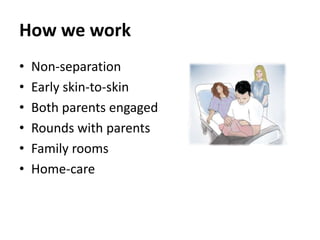
How we work
• Non-separation
• Early skin-to-skin
• Both parents engaged
• Rounds with parents
• Family rooms
• Home-care
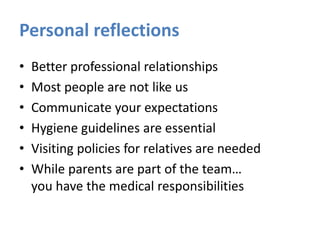
Personal reflections
• Better professional relationships
• Most people are not like us
• Communicate your expectations
• Hygiene guidelines are essential
• Visiting policies for relatives are needed
• While parents are part of the team…
you have the medical responsibilities
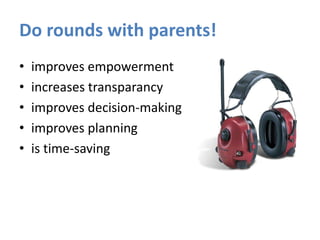
Do rounds with parents!
• improves empowerment
• increases transparancy
• improves decision-making
• improves planning
• is time-saving
Family-based neonatal care

Family-based neonatal care

  • 1.
    Family-based Neonatal Care STEFANJOHANSSON, MD PhD Sachs Children’s Hospital Karolinska institutet Stockholm, Sweden
  • 2.
  • 3.
  • 4.
  • 5.
    ”Families are themost central and enduring influence in children's lives” Shor. AAP Task Force on the Family Pediatrics 2003;111:1541
  • 6.
    Framework ”…planning, delivery, andevaluation of health care… grounded in mutually beneficial partnerships…” Institute for Patient- and Family-Centered Care www.ipfcc.org
  • 7.
  • 9.
    Becoming a parent •Life-changing event • Preconceptions • Expectations • Demands • Almost all parents are unaware that ~10% of newborns need neonatal care
  • 10.
    Becoming a NICU-parent •Unprepared • Loss of control • Feeling guilty • Afraid • Worry about future
  • 11.
  • 12.
    NICU-parents wants to… •be informed • be included in the care • protect the infant • be close with the infant • be positively percieved by staff Cleveland. J Obstet Gynecol Neonatal Nurs. 2008;37:666
  • 13.
    How can wedo? • Emotional support • Welcoming atmosphere • Supportive unit policies • Parent education Cleveland. J Obstet Gynecol Neonatal Nurs. 2008;37:666
  • 14.
    ”Family-based” practise • Parentsare a natural part of the team • Parents are present as care-givers • Parents participate in rounds • Skin-to-skin • Rooming in
  • 15.
    NO SIZE FITSALL Your context matters
  • 16.
    Do we needevidence for family-based neonatal care before we can adopt it?
  • 18.
    ”Sounds good butshow some data” • Creating Opportunities for Parent Empowerment (COPE) Melnyk. Pediatrics 2006;118:1414 • Stockholm Family-Centered Care Study Örtenstrand. Pediatrics. 2010;125:e278 • Parental presence on NICU bedside rounds Abdel-Latif. Arch Dis Child FN Ed 2015;100:F203 • Family Nurture Intervention in the NICU Welsh. J Child Psychol Psychiatry. 2015;56:1202 • Parent-Administered Physical Therapy Ustad. Pediatrics. 2016;138(2).pii: e20160271
  • 19.
    Creating Opportunities forParent Empowerment (COPE) • 260 families with preterm infants, they either learned about: – infant behaviour and how to parent it – hospital services and organisation • Families in the empowered group had – lower depression and anxiety scores – 4 days shorter hospital stay (35 vs 39 days) Melnyk. Pediatrics 2006;118:1414
  • 20.
    Stockholm Family-Centered CareStudy • 366 families with preterm infants randomized to be roomed-in or staying at home • Family-care families had – less anxiety at discharge and after 3 months – 5 days shorter hospital stay (27 vs 32 days) Örtenstrand. Pediatrics. 2010;125:e278
  • 21.
    Parental presence onNICU rounds • 63 parents participating or non-participating in bedside rounds (cross-over randomization) • 95% of parents and 90% of staff: ”parents should be allowed to attend rounds” • Focus group interviews revealed two themes – communication – philosophy Abdel-Latif. Arch Dis Child FN Ed 2015;100:F203
  • 22.
    Family Nurture Interventionin the NICU • Parents were randomized to ”calming interactions” with the preterm infant (scent cloths, touch, vocal soothing, skin-to-skin) • At 18 months, the ”nurtured” infants had – higher Bayley scores – fewer attention problems on CBCL – higher scores on M-CHAT Welsh. J Child Psychol Psychiatry. 2015;56:1202
  • 23.
    Parent-Administered Physical Therapy •153 very preterm infants • 74 parents trained by physiotherapist to give 10 minute sessions, twice a day, over 3 weeks • Motor performance at 37 weeks were judged higher in the intervention group Ustad. Pediatrics. 2016;138(2).pii: e20160271
  • 24.
    What does thedata tell? • Up-side – No ”side-effects” – Consistent associations • Down-side – Small studies – Bias (non-blinding) – Long-term results? • But… is ”non-family-based” care acceptable?
  • 25.
    The journey inStockholm • Staff engagement • Ward organisation • Strategies and guidelines • Handling of breast milk • Adopting a mindset of educating & coaching • Implementation started 15 years ago and is still a work-in-progress
  • 26.
    How we work •Non-separation • Early skin-to-skin • Both parents engaged • Rounds with parents • Family rooms • Home-care
  • 27.
    Personal reflections • Betterprofessional relationships • Most people are not like us • Communicate your expectations • Hygiene guidelines are essential • Visiting policies for relatives are needed • While parents are part of the team… you have the medical responsibilities
  • 28.
    Do rounds withparents! • improves empowerment • increases transparancy • improves decision-making • improves planning • is time-saving

Editor's Notes

  • #2 First of all I would like to thank the organising committee for inviting me here. It is an honor.
  • #3 If you have any questions or want to give feedback please get in touch. I promise to respond! I will also share the slides (without photos of parents) with you through the conference organisers and on slideshare.com
  • #4 I have no financial conflicts-of-interests, but I do want to high-light and promote the web site 99nicu.org, a community I started with colleagues in 2006. Prof Hesham Abdel Hady
  • #5 Further, I also want to promote something really great that I and professor Haresh Kirpalani and some other colleagues started last year, the International Society for Evidence-based Neonatology. You can join both 99nicu and EBNEO free of charge.
  • #6 Although it is rather obvious, the family perspective in pediatrics and neonatology needs to be lifted every now and then. The AAP even felt it necessary to start its own Task Force on the Family, despite the obvious fact that ”FAMILIES ARE THE MOST…”
  • #7 There are also more complex and theoretical frameworks about family-based care. This qoute from the Institute for Patient andFamily-centered care in the US, summarize into: READ.
  • #8 However, as clinicians we also want to get more hands-on information. I would really like to recommend for all to download this thorough document from the Poppy project in the UK. It is also about frameworks, but summarizes research, and gives recommendations how plan och deliver family-based neonatal care.
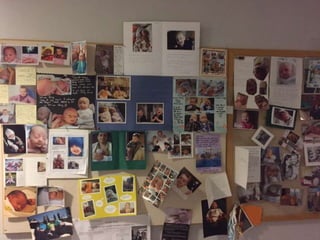
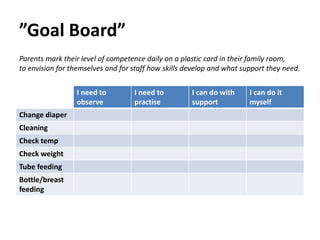
  • #9 But let’s take a more practical approach. I believe you also have similar boards in your wards, where you put letters and photos from discharged families. I like those very much, because we get a small glimpse from the worlds outside for our ”NICU-graduates”
  • #10 As you know, is a journey to make to become a parent. READ THE LIST Further, my experience is that no parents are aware that a large proportion of newborns need neonatal care.
  • #11 Becoming a NICU parent is even more challenging. You are unprepared, feel you loose control, may feel guilt (”did I do something wrong”), may be afraid what’s happening, worry about the future (”is the baby going to survive”)
  • #12 This blog post by a UK author Sam Vickery got quite a lot of attention in the social media channels I follow. Take 10 seconds to read. READ THE FINAL SENTENCE. This kind of public feedback – it feels quite strong.
  • #13 Actually, there are knowledge about what parental needs in the NICU: They want to be informed, included in the vare of their newborn, they want to feel that they can protect the infant, they want to be close to the infants and they want to be positively percieved by staff.
  • #14 A number of things we can do is also reported in the literature READ
  • #15 SO, what is family-based care in practise. These are the corners of our strategies and guidelines in Stockholm.
  • #16 Having said that – there is no version of family-based care that fits all. The context matters. Depending on social security systems, family traditions, and how premises are organised, you may need to realize your vision in different ways.
  • #17 And, do we need scientific evidence before we can adopt family-based care?
  • #18 This is my opinon. The family is the most important context for the newborn, so why would we not partner up with parents in the care of the parent’s baby.
  • #19 But there are scientific support for family-based neonatal care – and I briefly want to highlift five randomzied studies.
  • #20 This project on parent empowerment included 260 families, randomized to either learning about preterm infant behaviour and how to parent it, or hospital services and organisation. Families in the empowered group had lower depression and anxiety scores and the hospital stay was on average 4 days shorter.
  • #21 The Stockholm Family-Centered care study randomised 366 families with preterm infants to be roomed-in or to be staying at home. Results were similar to the previous study: less anxiety scores and 5 days shorter hospital stay
  • #22 This study from Australia investigated parental presence during rounds. The vast majority of all parents and staff responded that parents shoudl be allowed to attend rounds The researchers also performed focus group interviews with a subset of parents and staff and found two overarching themes why they believed parents should attend: exchange of information was improved there is a philosophical perspective – parents have a ”right” to attend
  • #23 This is a randomized trial in the US on nurturing interventions. Parents were randomized to calming interactions with their preterm infant At 18 months, nurtured infants had better on neurodevelopmental scores
  • #24 Finally, this example from Norway where parents were randomized to give physiotherapy. At 37 weeks, around discharge, the motor performance was judged more better in the intervention group.
  • #25 So, what does the data tell us? The upside is that there seems to be no side-effects and that positive associations are consistent. However, from a methodlogical point of view on should also be aware that studies are small, probably afflicted by bias due to the non-blinding nature of the interventions, and we don’t know much about long-term results of these interventions? The other side of the coin is… should non-family-based care be acceptable?
  • #26 The journey towards family-based care in Stockholm was not done without major efforts. Staff were committed and were engaged in working groups etc. We needed to re-think how we used rooms and premises. We incorporated a larger framework into strategies and guidelines. With more parents in the NICU, was also needed to ararnge for handling of breast milk. And most importantly, we needed to change our mindset, from being the care-givers to, also be educators and coaches. The implementation of family-based care in Stockholm started ~15 years ago and is still a work in progress.
  • #27 These principles are the core of our concept READ. TELL ABOUT ROUNDS WITH PARENTS
  • #28 My personal reflections on family-based care are: My experience is that a closer collaboration with parents deepen and improve our professional relationships with parents. Also – most people are not like us. Heath care staff is rather a subset of well-mannered, organized, kind and professionals. NICU-parents But, even if parents have a rough time and we aim to have a great degree of tolerance, we also need to communicate our expectations. Hygiene guidelines are essential, that family members apply the same strict hygiene as staff. Even though we have parents present 24/7 – I advice you to have a visiting policy for the larger family. Finally, parents are part of the team but you still have the medical responsibility.
  • #29 Finally, I would like to promote ward rounds with parents. It is simply great! In our larger NICU room with four beds, we have solved the secrecy / integrity issue with those hearing protectors. So, when we round with those parents, all other attending parents (sitting by their babies) wear those hearing protectors. Why do I like it so much: READ