A Public Health Approach to Improving Parenting Practices: An Overview of Principles and Practices for Meeting Diverse Family NeedsCarol W. Metzler, Oregon Research Institutecarolm@ori.orgORI Research To Practice Conference, December 2010
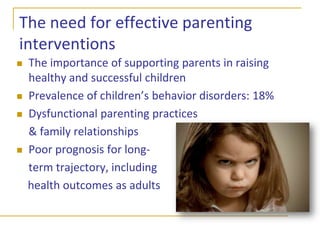
The need for effective parenting interventionsThe importance of supporting parents in raising healthy and successful childrenPrevalence of children’s behavior disorders: 18%Dysfunctional parenting practices 	& family relationships Poor prognosis for long- 	term trajectory, including     health outcomes as adults
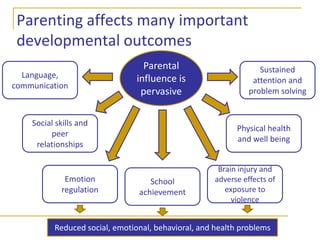
Parenting affects many important developmental outcomesParental influence is pervasiveLanguage, communicationSustained attention and problem solvingSocial skills and peer relationshipsPhysical health and well beingBrain injury and adverse effects of exposure to violenceEmotion regulationSchool achievement Reduced social, emotional, behavioral, and health problems
Problem behaviors develop over timeBy age 6: aggressive behavior, difficulty managing strong feelings, weak academic skillsElementary school years: academic difficulties, poor bonding to school, rejection by peersBy early adolescence: drift toward other troubled peers, experimentation with problem behaviorsThe earlier these problems begin, the more chronic and serious they become throughout adolescence
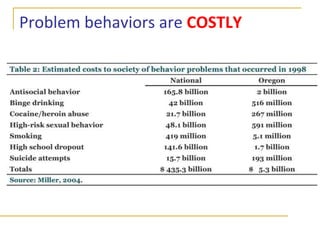
Problem behaviors are COSTLY
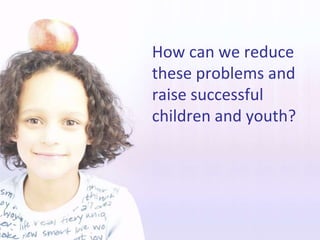
How can we reduce these problems and raise successful children and youth?
Promote positive parenting usingevidence-based prevention and treatment practices
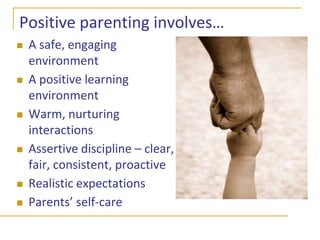
Positive parenting involves…A safe, engaging environment
A positive learning environment
Warm, nurturing interactions
Assertive discipline – clear, fair, consistent, proactive
Realistic expectations
Parents’ self-careWhy evidence-based practices?Our best bet is on programs that have shown positive benefits in experimental evaluations  Supported by data, not just based on theory Rigorously tested and shown to be more effective than “usual care” or an alternative practiceCan be reproduced in other settingsIncreases our confidence in the results
The need for effective parenting interventionsEvidence-based parenting programs make a differenceMore skillful parentsHealthier family relationshipsDecreased behavior problems in children and youthImproved  social skills and academic outcomesImproved health outcomes as adults
Evidence-based models of family interventions for childhood problemsParent education and trainingExamples:PMTO, Triple P, Incredible Years, Strengthening Families 10-14Skills focused, strengths basedWarm, positive parent-child interactions and relationshipEncourage and reinforce desirable behaviorMonitor children’s activitiesSet clear limits on problem behaviors, and consistently enforce them with fair, non-harsh consequencesEffective problem-solvingGeneralize skills to new situations
Evidence-based models of family interventions for childhood problemsHome visitingExamples:Nurse-Family Partnership, Healthy Families New York Skills focused, strengths basedWarm, positive parent-child interactions and relationshipParenting educationInformation on child developmentSocial supportLink family with community resources
Evidence-based models of family interventions for childhood problemsFamily therapyExamples:Functional Family Therapy, Multisystemic Therapy Skills focused, strengths basedPromote warm, positive family interactions and relationshipsPromote a relational understanding of problem behaviorImprove parenting skillsImprove family communication, problem solvingGeneralize skills to new situationsDiscourage contact with deviant peersLink family with community resources
The challenge of reaching parents with effective parenting interventionsMost parents struggle from time to time with difficult child behaviorsDespite effectiveness, few parents participate in evidence-based parenting programs (Sanders et al., 2007)Limited availability outside of major metropolitan areas (Connell et al., 1998)Poor participation – substantial challenges in recruiting and retaining parents (Spoth & Redmond, 2000)
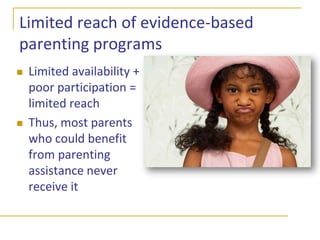
Limited reach of evidence-based parenting programsLimited availability + poor participation =  limited reachThus, most parents who could benefit from parenting assistance never receive it
The goal of a public health approach to improving parentingAchieve positive changes in parenting practices across a whole populationReduce the prevalence of socioemotional and behavioral problems in children
A public health approach to improving parentingTo significantly improve the health and well being of children at a population level, we must strengthen parents’ skills, knowledge, and confidence in the task of raising their childrenA public health approach requires us to think about how we can get effective parenting supports to the maximum number of people.
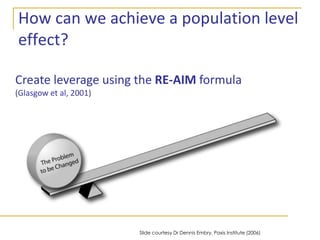
How can we achieve a population level effect?Create leverage using the RE-AIM formula (Glasgow et al, 2001)Slide courtesy Dr Dennis Embry, Paxis Institute (2006)
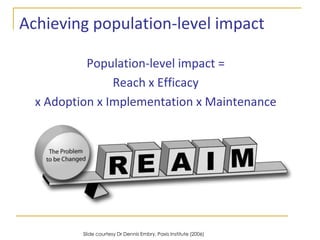
Achieving population-level impactPopulation-level impact =Reach x Efficacyx Adoption x Implementation x Maintenance Slide courtesy Dr Dennis Embry, Paxis Institute (2006)
Public health approach to improving parenting requires…Maximizing program reachVariety of delivery formatsEfficient deliveryProvide minimally sufficient supports, but not excessive dosage Improving program efficacyMeet the needs of diverse familiesMeet diverse levels of families’ needsEmpower parents to take charge of the supports of they receive
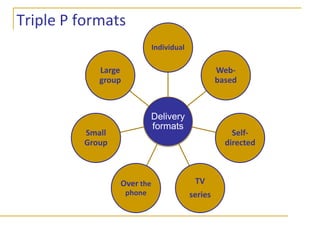
Formats for reaching parentsHome visitingFace-to-face office visitsParenting groupsBrief consultation on a specific problemWorkshops/seminarsSelf-administered workbooks, written materialsVideosOnline programsTV broadcasts
Meeting diverse levels of needIntensiveHome visitingFace-to-face office visitsParenting groupsMedium intensityBrief consultation on a specific problemWorkshops/seminarsLight-touchSelf-administered workbooks, written materialsOnline programsVideos, TV broadcasts
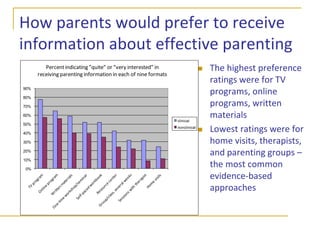
How parents would prefer to receive information about effective parentingThe highest preference ratings were for TV programs, online programs, written materialsLowest ratings were for home visits, therapists, and parenting groups – the most common evidence-based approaches
The efficacy of alternative formats and delivery mechanismsHome visits, office visits, and parenting groups are the most common evidence-based formatsBut self-administered and other no-clinician formats have shown substantial and sustained effects on parenting and child behavior outcomes, even for at-risk familiesOne-time workshop on specific topicSelf-administered workbookStructured online programTV series on parenting
A public health perspectiveIn a public health framework, lighter-touch interventionsare part of a larger system of supportsmay be sufficient level of dosage for some familiescomplement more intensive supportsextend the reach of parenting programs to those who might not otherwise be reachedare consistent with the principles of minimal sufficiency and self-regulationEven modest effects of lighter-touch interventions could translate into substantial benefits when multiplied across many parents reached
Principle of minimal sufficiencyThe principle of minimal sufficiency calls on us to provide interventions that are sufficient to meet the needbut not more than is neededThis makes efficient use of resourcesParents’ timeProfessionals’ timeProvider agency resourcesPublic or private funding
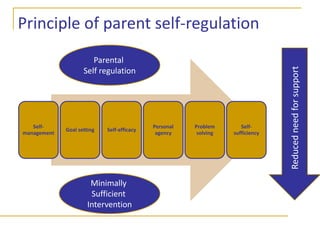
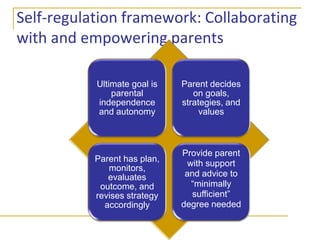
Principle of parent self-regulationParental Self regulationReduced need for supportMinimally Sufficient Intervention
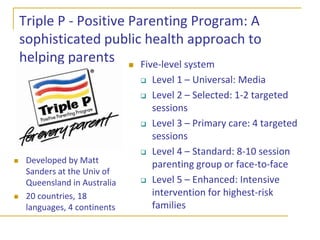
Triple P - Positive Parenting Program: A sophisticated public health approach to helping parentsFive-level system Level 1 – Universal: MediaLevel 2 – Selected: 1-2 targeted sessionsLevel 3 – Primary care: 4 targeted sessionsLevel 4 – Standard: 8-10 session parenting group or face-to-faceLevel 5 – Enhanced: Intensive intervention for highest-risk familiesDeveloped by Matt Sanders at the Univ of Queensland in Australia20 countries, 18 languages, 4 continents
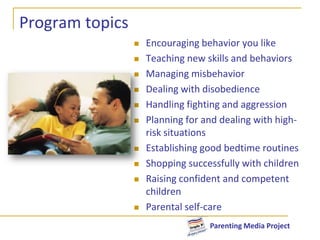
Program topics	Encouraging behavior you likeTeaching new skills and behaviorsManaging misbehaviorDealing with disobedienceHandling fighting and aggressionPlanning for and dealing with high-risk situationsEstablishing good bedtime routinesShopping successfully with childrenRaising confident and competent childrenParental self-careParenting Media Project
Triple P formats
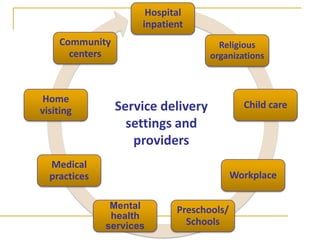
Service delivery settings and providers
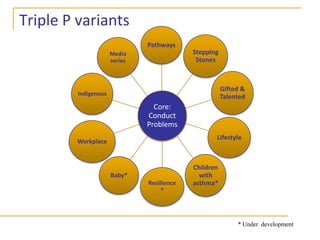
Triple P variants* Under  development
Self-regulation framework: Collaborating with and empowering parents
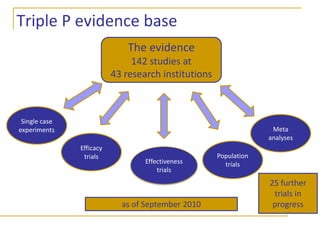
Triple P evidence baseThe evidence142 studies at43 research institutionsSingle case experimentsMeta analysesEfficacy trialsPopulation trialsEffectiveness trials25 further  trials in progressas of September 2010
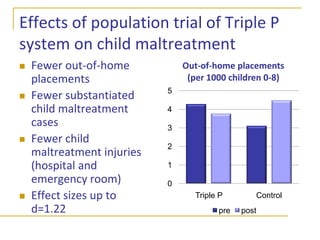
Effects of population trial of Triple P system on child maltreatmentFewer out-of-home placementsFewer substantiated child maltreatment casesFewer child maltreatment injuries (hospital and emergency room)Effect sizes up to d=1.22
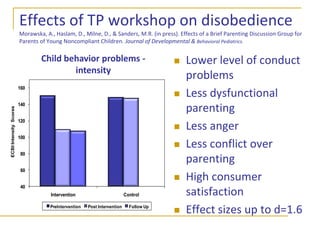
Effects of TP workshop on disobedience Morawska, A., Haslam, D., Milne, D., & Sanders, M.R. (in press). Effects of a Brief Parenting Discussion Group for Parents of Young Noncompliant Children. Journal of Developmental & BehavioralPediatrics.Lower level of conduct problemsLess dysfunctional parenting Less angerLess conflict over parentingHigh consumer satisfaction Effect sizes up to d=1.6Child behavior problems - intensity
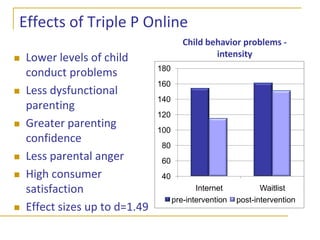
Effects of Triple P Online Child behavior problems - intensityLower levels of child conduct problemsLess dysfunctional parentingGreater parenting confidenceLess parental angerHigh consumer satisfactionEffect sizes up to d=1.49
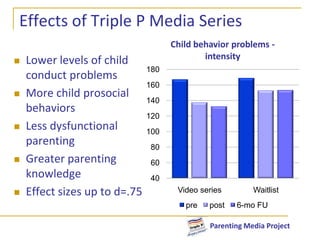
Effects of Triple P Media SeriesLower levels of child conduct problemsMore child prosocial behaviorsLess dysfunctional parenting Greater parenting knowledgeEffect sizes up to d=.75Parenting Media Project
The importance of appeal and engagement to achieving outcomesIf we can’t engage parents, they won’t benefitAcknowledging parents as consumers with preferencesFormats that fit ecologically into their livesMessages that engage and resonateStrategies that address their needs
Improving reach, appeal, and effectiveness for diverse populationsStill much to learn about how to maximize the reach, appeal, and effectiveness of family interventions for different…Income groupsRacial/ethnic groupsDegrees of family risk and difficultiesImproving  the reach, appeal and effectiveness of interventions to diverse populations increases overall public health impact, and helps us meet the needs of individual families before us.
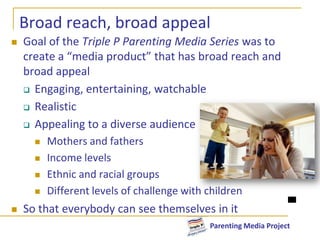
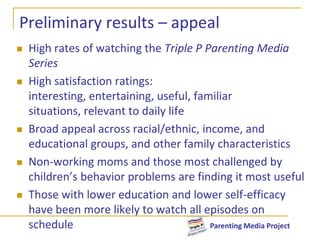
Broad reach, broad appealGoal of the Triple P Parenting Media Series was to create a “media product” that has broad reach and broad appealEngaging, entertaining, watchableRealisticAppealing to a diverse audienceMothers and fathersIncome levelsEthnic and racial groupsDifferent levels of challenge with childrenSo that everybody can see themselves in itParenting Media Project

Triple P Metzler 12-3-2010

  • 1.
    A Public HealthApproach to Improving Parenting Practices: An Overview of Principles and Practices for Meeting Diverse Family NeedsCarol W. Metzler, Oregon Research Institutecarolm@ori.orgORI Research To Practice Conference, December 2010
  • 2.
    The need foreffective parenting interventionsThe importance of supporting parents in raising healthy and successful childrenPrevalence of children’s behavior disorders: 18%Dysfunctional parenting practices & family relationships Poor prognosis for long- term trajectory, including health outcomes as adults
  • 3.
    Parenting affects manyimportant developmental outcomesParental influence is pervasiveLanguage, communicationSustained attention and problem solvingSocial skills and peer relationshipsPhysical health and well beingBrain injury and adverse effects of exposure to violenceEmotion regulationSchool achievement Reduced social, emotional, behavioral, and health problems
  • 4.
    Problem behaviors developover timeBy age 6: aggressive behavior, difficulty managing strong feelings, weak academic skillsElementary school years: academic difficulties, poor bonding to school, rejection by peersBy early adolescence: drift toward other troubled peers, experimentation with problem behaviorsThe earlier these problems begin, the more chronic and serious they become throughout adolescence
  • 5.
  • 6.
    How can wereduce these problems and raise successful children and youth?
  • 7.
    Promote positive parentingusingevidence-based prevention and treatment practices
  • 8.
    Positive parenting involves…Asafe, engaging environment
  • 9.
  • 10.
  • 11.
    Assertive discipline –clear, fair, consistent, proactive
  • 12.
  • 13.
    Parents’ self-careWhy evidence-basedpractices?Our best bet is on programs that have shown positive benefits in experimental evaluations Supported by data, not just based on theory Rigorously tested and shown to be more effective than “usual care” or an alternative practiceCan be reproduced in other settingsIncreases our confidence in the results
  • 14.
    The need foreffective parenting interventionsEvidence-based parenting programs make a differenceMore skillful parentsHealthier family relationshipsDecreased behavior problems in children and youthImproved social skills and academic outcomesImproved health outcomes as adults
  • 15.
    Evidence-based models offamily interventions for childhood problemsParent education and trainingExamples:PMTO, Triple P, Incredible Years, Strengthening Families 10-14Skills focused, strengths basedWarm, positive parent-child interactions and relationshipEncourage and reinforce desirable behaviorMonitor children’s activitiesSet clear limits on problem behaviors, and consistently enforce them with fair, non-harsh consequencesEffective problem-solvingGeneralize skills to new situations
  • 16.
    Evidence-based models offamily interventions for childhood problemsHome visitingExamples:Nurse-Family Partnership, Healthy Families New York Skills focused, strengths basedWarm, positive parent-child interactions and relationshipParenting educationInformation on child developmentSocial supportLink family with community resources
  • 17.
    Evidence-based models offamily interventions for childhood problemsFamily therapyExamples:Functional Family Therapy, Multisystemic Therapy Skills focused, strengths basedPromote warm, positive family interactions and relationshipsPromote a relational understanding of problem behaviorImprove parenting skillsImprove family communication, problem solvingGeneralize skills to new situationsDiscourage contact with deviant peersLink family with community resources
  • 18.
    The challenge ofreaching parents with effective parenting interventionsMost parents struggle from time to time with difficult child behaviorsDespite effectiveness, few parents participate in evidence-based parenting programs (Sanders et al., 2007)Limited availability outside of major metropolitan areas (Connell et al., 1998)Poor participation – substantial challenges in recruiting and retaining parents (Spoth & Redmond, 2000)
  • 19.
    Limited reach ofevidence-based parenting programsLimited availability + poor participation = limited reachThus, most parents who could benefit from parenting assistance never receive it
  • 20.
    The goal ofa public health approach to improving parentingAchieve positive changes in parenting practices across a whole populationReduce the prevalence of socioemotional and behavioral problems in children
  • 21.
    A public healthapproach to improving parentingTo significantly improve the health and well being of children at a population level, we must strengthen parents’ skills, knowledge, and confidence in the task of raising their childrenA public health approach requires us to think about how we can get effective parenting supports to the maximum number of people.
  • 22.
    How can weachieve a population level effect?Create leverage using the RE-AIM formula (Glasgow et al, 2001)Slide courtesy Dr Dennis Embry, Paxis Institute (2006)
  • 23.
    Achieving population-level impactPopulation-levelimpact =Reach x Efficacyx Adoption x Implementation x Maintenance Slide courtesy Dr Dennis Embry, Paxis Institute (2006)
  • 24.
    Public health approachto improving parenting requires…Maximizing program reachVariety of delivery formatsEfficient deliveryProvide minimally sufficient supports, but not excessive dosage Improving program efficacyMeet the needs of diverse familiesMeet diverse levels of families’ needsEmpower parents to take charge of the supports of they receive
  • 25.
    Formats for reachingparentsHome visitingFace-to-face office visitsParenting groupsBrief consultation on a specific problemWorkshops/seminarsSelf-administered workbooks, written materialsVideosOnline programsTV broadcasts
  • 26.
    Meeting diverse levelsof needIntensiveHome visitingFace-to-face office visitsParenting groupsMedium intensityBrief consultation on a specific problemWorkshops/seminarsLight-touchSelf-administered workbooks, written materialsOnline programsVideos, TV broadcasts
  • 27.
    How parents wouldprefer to receive information about effective parentingThe highest preference ratings were for TV programs, online programs, written materialsLowest ratings were for home visits, therapists, and parenting groups – the most common evidence-based approaches
  • 28.
    The efficacy ofalternative formats and delivery mechanismsHome visits, office visits, and parenting groups are the most common evidence-based formatsBut self-administered and other no-clinician formats have shown substantial and sustained effects on parenting and child behavior outcomes, even for at-risk familiesOne-time workshop on specific topicSelf-administered workbookStructured online programTV series on parenting
  • 29.
    A public healthperspectiveIn a public health framework, lighter-touch interventionsare part of a larger system of supportsmay be sufficient level of dosage for some familiescomplement more intensive supportsextend the reach of parenting programs to those who might not otherwise be reachedare consistent with the principles of minimal sufficiency and self-regulationEven modest effects of lighter-touch interventions could translate into substantial benefits when multiplied across many parents reached
  • 30.
    Principle of minimalsufficiencyThe principle of minimal sufficiency calls on us to provide interventions that are sufficient to meet the needbut not more than is neededThis makes efficient use of resourcesParents’ timeProfessionals’ timeProvider agency resourcesPublic or private funding
  • 31.
    Principle of parentself-regulationParental Self regulationReduced need for supportMinimally Sufficient Intervention
  • 32.
    Triple P -Positive Parenting Program: A sophisticated public health approach to helping parentsFive-level system Level 1 – Universal: MediaLevel 2 – Selected: 1-2 targeted sessionsLevel 3 – Primary care: 4 targeted sessionsLevel 4 – Standard: 8-10 session parenting group or face-to-faceLevel 5 – Enhanced: Intensive intervention for highest-risk familiesDeveloped by Matt Sanders at the Univ of Queensland in Australia20 countries, 18 languages, 4 continents
  • 33.
    Program topics Encouraging behavioryou likeTeaching new skills and behaviorsManaging misbehaviorDealing with disobedienceHandling fighting and aggressionPlanning for and dealing with high-risk situationsEstablishing good bedtime routinesShopping successfully with childrenRaising confident and competent childrenParental self-careParenting Media Project
  • 34.
  • 35.
  • 36.
    Triple P variants*Under development
  • 37.
    Self-regulation framework: Collaboratingwith and empowering parents
  • 38.
    Triple P evidencebaseThe evidence142 studies at43 research institutionsSingle case experimentsMeta analysesEfficacy trialsPopulation trialsEffectiveness trials25 further trials in progressas of September 2010
  • 39.
    Effects of populationtrial of Triple P system on child maltreatmentFewer out-of-home placementsFewer substantiated child maltreatment casesFewer child maltreatment injuries (hospital and emergency room)Effect sizes up to d=1.22
  • 40.
    Effects of TPworkshop on disobedience Morawska, A., Haslam, D., Milne, D., & Sanders, M.R. (in press). Effects of a Brief Parenting Discussion Group for Parents of Young Noncompliant Children. Journal of Developmental & BehavioralPediatrics.Lower level of conduct problemsLess dysfunctional parenting Less angerLess conflict over parentingHigh consumer satisfaction Effect sizes up to d=1.6Child behavior problems - intensity
  • 41.
    Effects of TripleP Online Child behavior problems - intensityLower levels of child conduct problemsLess dysfunctional parentingGreater parenting confidenceLess parental angerHigh consumer satisfactionEffect sizes up to d=1.49
  • 42.
    Effects of TripleP Media SeriesLower levels of child conduct problemsMore child prosocial behaviorsLess dysfunctional parenting Greater parenting knowledgeEffect sizes up to d=.75Parenting Media Project
  • 43.
    The importance ofappeal and engagement to achieving outcomesIf we can’t engage parents, they won’t benefitAcknowledging parents as consumers with preferencesFormats that fit ecologically into their livesMessages that engage and resonateStrategies that address their needs
  • 44.
    Improving reach, appeal,and effectiveness for diverse populationsStill much to learn about how to maximize the reach, appeal, and effectiveness of family interventions for different…Income groupsRacial/ethnic groupsDegrees of family risk and difficultiesImproving the reach, appeal and effectiveness of interventions to diverse populations increases overall public health impact, and helps us meet the needs of individual families before us.
  • 45.
    Broad reach, broadappealGoal of the Triple P Parenting Media Series was to create a “media product” that has broad reach and broad appealEngaging, entertaining, watchableRealisticAppealing to a diverse audienceMothers and fathersIncome levelsEthnic and racial groupsDifferent levels of challenge with childrenSo that everybody can see themselves in itParenting Media Project

Editor's Notes

  • #3 Parenting matters. So important to support parents in raising healthy children. The quality of the parenting that children receive really matters and it affects every aspect of their development.There is a reasonably high prevalence of children’s behavior disorders; it currently stands at about 18% of children.When children have difficulties with behavior problems when they are young, coupled with poor family relationships and dysfunctional parenting practices, the children are much more likely to grow up continuing to have problems with the law, substance use, and poor functioning and poor health as an adolescent and adult.
  • #4 Thanks to Matt Sanders of University of Queensland for this slide.
  • #11 We know that parenting programs that have undergone rigorous evaluation and are evidence-based can make a substantial difference in families’ lives.
  • #13 More intensive, in situ
  • #15 So, there are a number of evidence-based parenting interventions, and that’s great.Most parents struggle from time to time with difficult child behaviors and could use some help…Challenges re: recruitment and retention: Scheduling conflicts, logistical difficulties, fatigue, insufficient motivation to get out, not wanting to join a group.
  • #17 So we need to think about this in a whole new way.The goal of a public health approach to improving parenting is to achieve positive changes in parenting practices across a whole population, thereby reducing the prevalence of socioemotional and behavioral problems in children. (Prevalence means the percentage of a population with a particular problem or characteristic.)A public health framework gets us thinking bigger.
  • #20 Focus today on two aspects of the RE-AIM formula that undergird the public health approach: Reach and efficacy.
  • #21 Understand the principles of maximizing program reach through a using a variety of appealing delivery formats and agents, and increasingefficiency of delivery…and maximizing efficacy through adapting to different levels of families’ needs and promoting parental self-regulation.Public health perspective requires us to look for efficient ways to meet a diverse range of needs among a diverse range families through a variety of delivery formats.
  • #23 Can organize these formats into varying levels of intensity to meet varying levels of need.Not everyone needs a 12-session parenting group or a full course of meetings with a therapist. Some parents can benefit from a lighter dose – a brief consultation, a workshop, a self-administered course, an online program, etc.
  • #24 158 ethnically diverse parents of 3-6 year olds, half with clinical levels of behavior problems, and half within normal range.In this sample, the most common approaches that our field offers are least preferred by parents. Hmmm.Pattern is also consistent for mothers vs. fathers, and Caucasians vs. minorities. Consistent preference for self-administered approaches across subgroups.
  • #26 Not JUST about individual families one at a time, but ALSO about affecting the entire community
  • #29 20 countries, 18 languages, 4 continents: N. America, Australia, Europe, AsiaDifferent levels of intensity for different levels of need.
  • #30 17 core parenting strategies presented
  • #32 Natural touchpoints for parents
  • #33 Standard – core program – is designed for dealing with children’s conduct problems
  • #36 Entire counties in South Carolina
  • #37 Positive, substantial, sustained effects of non-traditional, non-clinical formatsClinical cut-off = 132
  • #38 Preliminary results of pilot studyECBI intensityN (Internet) = 24; N (Waitlist) = 32; intervention effect sig. p<.001, d=1.49
  • #39 The Triple P Parenting Media Study is testing the efficacy of a 10-episode video media series on parenting Content is derived from the Triple P Positive Parenting ProgramResearch sites: Eugene and Portland, OregonSample: 300 parents having difficulty handling their 3-6 year old children’s behavior problems and not otherwise receiving parenting support servicesPreliminary analyses on the first 209 participants also suggest that the Triple P Media Series actually helped parents. Significant Tx vs. WL at T2; ES = .53SignificantTx vs. WL at T3; ES = .62Scale range: 36 – 252 Clinical cutoff: 132Effects for both mothers and fathers on dysfunctional parenting practices and parenting knowledge
  • #41 Underscore the importance of meeting the needs of diverse families – --different income levels--different racial/ethnic groups--different degrees of family risk and difficultiesDennis Embry will help us think outside the box about how we can use a variety of resources and approaches to meet family needs.And Mark Eddy/Laura Rains will discuss methods for matching intensity of treatment to different levels of need.Betsy Davis will discuss issues related to meeting the needs of culturally diverse families.
  • #42 A few words about appeal and engagement from our Parenting Media study. Our goal was to create a program that is more entertaining than your standard instructional video, and more instructional than reality TV, such as Nanny 911 or Supernanny.Hosted format. We use footage of real families in real situations; compelling, dramatic, emotionally evocative and engaging footage; vox pops (that is, person on the street interviews); a parent group with Matt Sanders; and what we call “hero” families who we follow through an episode to see their struggles and successes.Families from the US, Australia, and United Kingdom. American host/narrator. Diversity of families, faces, and accents.
  • #43 These preliminary analyses suggest that the challenges of parenting are universal, across racial/ethnic, income, and educational groups– what is important is that we develop programs that are responsive to people’s felt need for help. The Triple P Media Series was most attractive and useful to those who needed it the most.