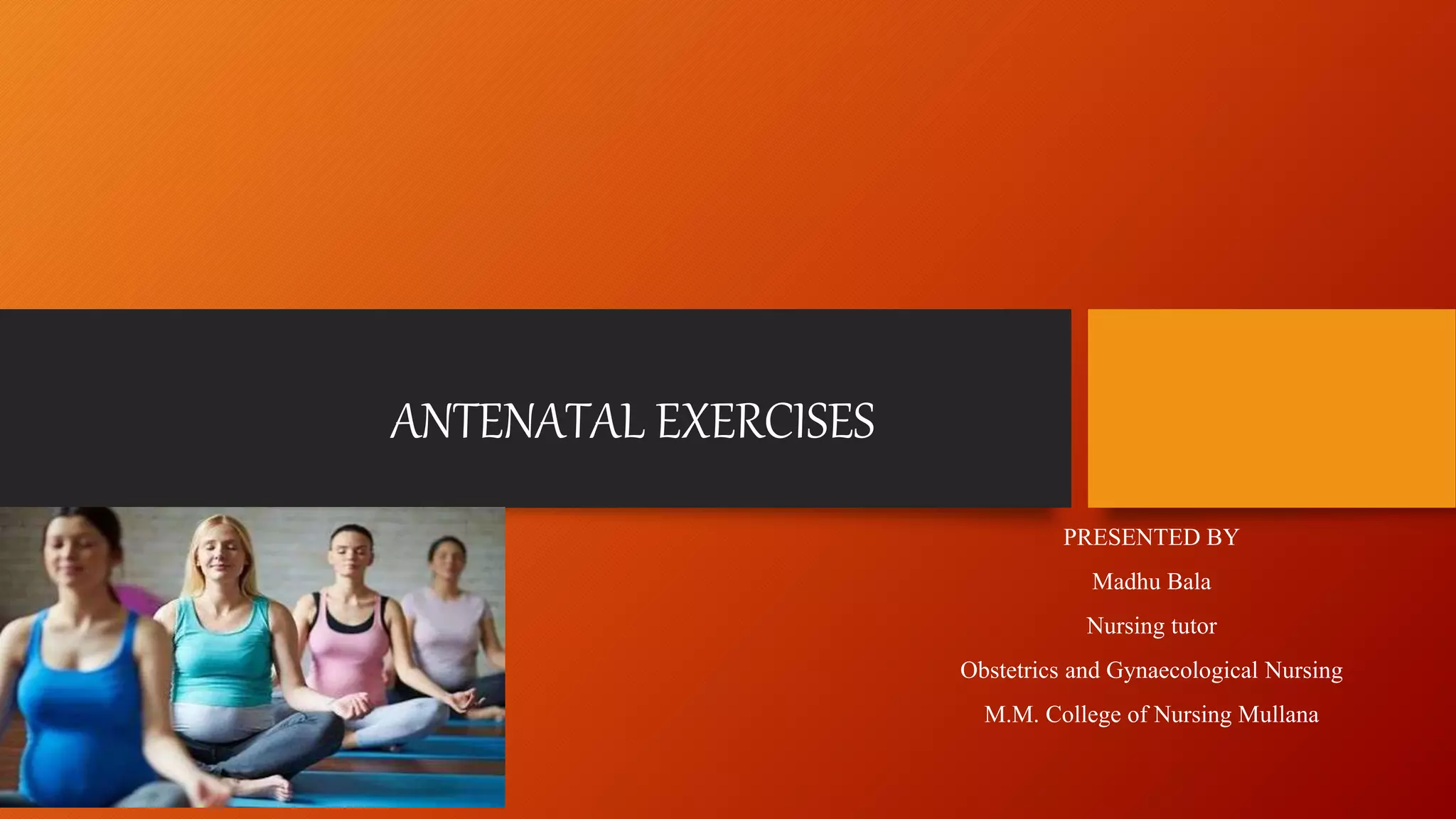
ANTENATAL EXERCISES
PRESENTED BY
Madhu Bala
Nursing tutor
Obstetrics and Gynaecological Nursing
M.M. College of Nursing Mullana
DEFINITION
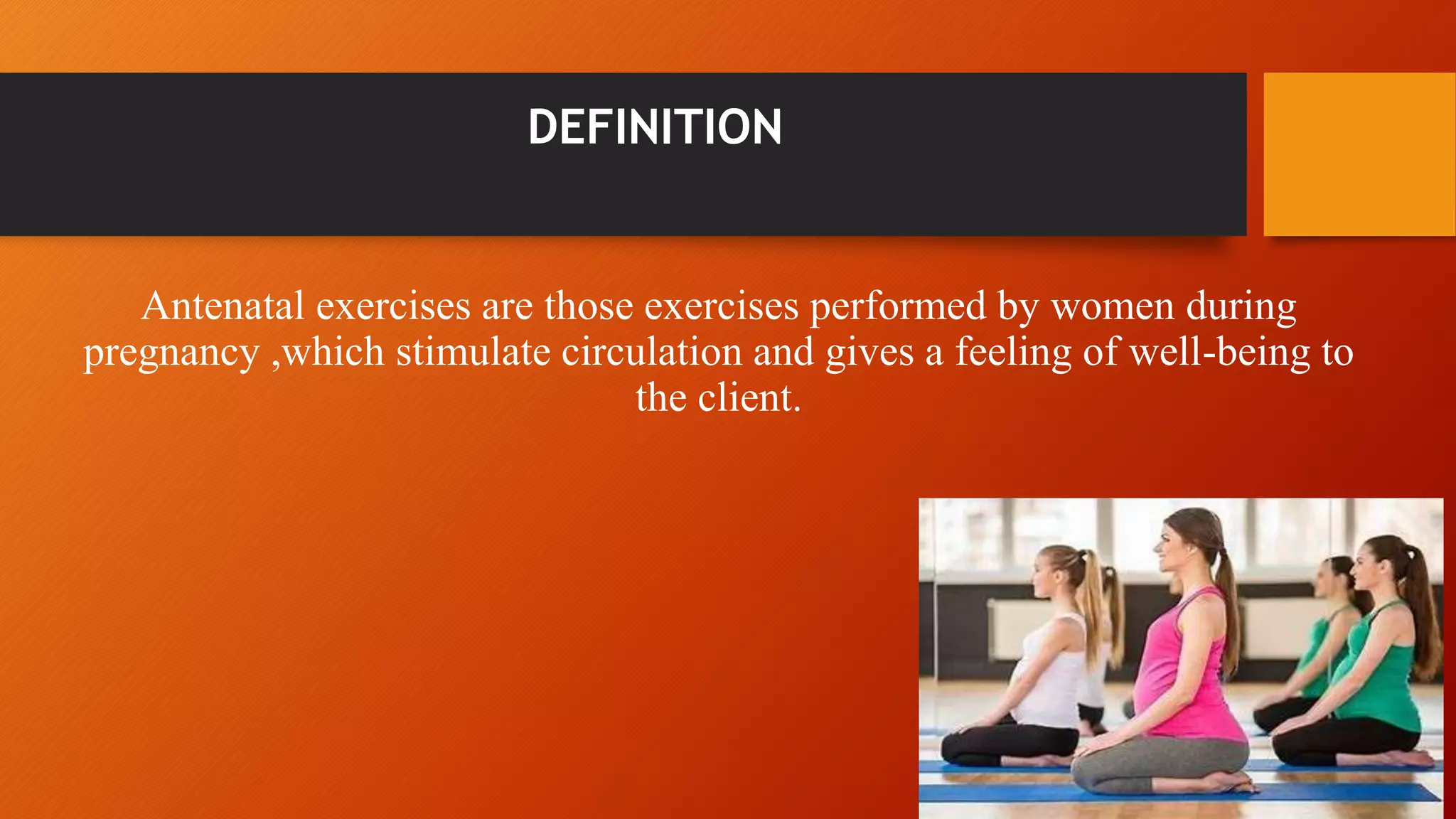
Antenatal exercises are those exercises performed by women during
pregnancy ,which stimulate circulation and gives a feeling of well-being to
the client.
ADVANTAGES
• Improves the circulation for the mother and baby.
• Reduction in aches and pains of pregnancy e.g. backache, cramps etc.
• Improves the stamina, gives the mother more energy to cope with the
growing demands of the pregnancy.
• Improves the posture and body awareness.
• More controlled weight gain.
Cont.
• Improves the sleeping patterns.
• Reduction in minor ailments of pregnancy such as stiffness, tension,
constipation, sleeplessness.
• Minimizes varicose veins and swelling due to improved circulation.
• Enhance the psychological well-being.
• Ensure an effective bearing down in labour and speedy return to
normal postnatal.
ADVICES
• Consult to doctor/midwife before beginning the exercise.
• Perform exercises regularly, plan a regular schedule that is at least
thrice a week.
• Dress comfortably (wear loose fitting clothes)
• Void before exercise.
• Use movements that are slow and deliberate: avoid jerking and
bouncing movements; jogging and running.
• Exercise on the firm surface.
Cont.
• Drink fluid whenever feel need during the exercise and after the
exercise. This prevents dehydration.
• Wear supportive shoes when needed.
• Limit activities to shorter interval. Exercise for 10-15min, rest for
2-3min, then exercise for another 10-15min.
• Decrease exercise level as pregnancy progresses.
• Take your pulse every 10-15 min. if it is more than 140 beats per
min ,slow down until it reaches to the maximum 90bpm.
• Rest in left lateral position for 10 min after the exercise.
Con.
• Take an increase in calories to replace those burned during exercises.
• Always rise slowly from lying to sitting position to prevent orthostatic
hypotension.
• Don’t risk activities such as surfing ,mountain climbing and sky diving.
• Don’t do activities that requires holding breath and bearing down.
• Do not continue the exercise if you experience shortness of breath.
pain, undue cramping, vaginal bleeding or nausea. report to the doctor
/midwife if it is happens.
• Don’t become over heated for extended period.
Cont.
• Avoid exercise by lying flat in the later 2nd and 3rd
trimester because of the danger of supine hypotension
and decreased placental/fetal circulation. Instead a half
lying position with back raised to an angle of
approximately 35◦ can be used.
• Never exercise to a point of fatigue.
PREPARATION OF THE ENVIRONMENTS
• Arrange the area i.e a hard, firm bed or mat spread on
the floor.
• Ensure privacy.
• Ensure that there is adequate light and ventilation.
TYPES OF EXERCISES
1. Breathing exercises
2. Circulatory exercises.
• Leg
• Shoulder
3. Stretching exercises
• Leg
• Arm
• Neck
Cont.
4.Abdominal exercise
5.Pelvic tilting and back stretching exercise.
6.Pelvis floor exercises (Kegal’s exercise)
7.Transverse exercise
8.Tailor sitting exercise
9.Hip hitching exercise
BREATHING EXERCISE:
PURPOSES:
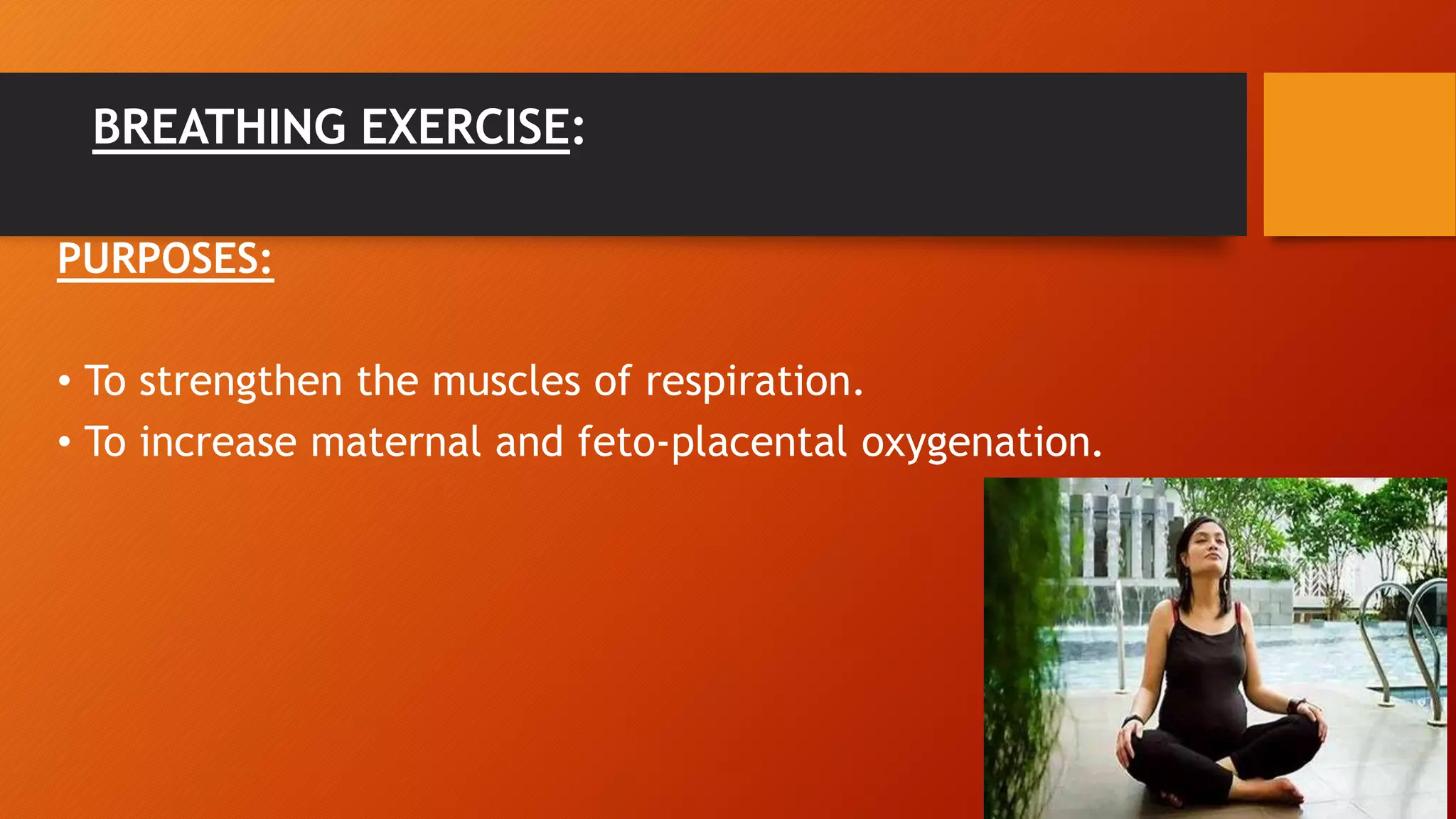
• To strengthen the muscles of respiration.
• To increase maternal and feto-placental oxygenation.
TECHNIQUE
• Sit comfortably with eyes closed and concentrate on
breathing.
• Breath in through the nose and out through the mouth,
repeat it five times.
CIRCULATORY EXERCISES:
PURPOSES:
• To improve circulation and venous return.
• To stretch and strengthen the calf muscles.
• To decrease calf muscles cramps.
LEG EXERCISE:
• Sit on a chair with back straight,move feet up and down. Repeat it 10
times.
• Sitting on a chair ,move feet inwards and outwards. Repeat it 10
times
• Sitting on a chair make a circle with both feet at anticlock wise
direction and vice vers. Repeat it 10 times.
SHOULDER CIRCLING EXERCISE:
• Shoulder rolls: The finger tips are placed on shoulder, then brought forward and
up during inhalation, back and down during exhaustion or rolling each shoulder
forward five times ,then back five time. Repeat it 10 times.
• Stand straight with legs apart and stretch arms out to the sides and rotate
arms(make a large circle)clockwise and anticlockwise. repeat it 10 times.
STRETCHING EXERCISES:
PURPOSES:
• Improve circulation of legs.
• Decrease swelling.
• Decrease calf muscle cramps.
TECHNIQUES:
LEG EXERCISES:
• Stand with feet apart, squat down hold for as you are comfortable and back to
standing position. Repeat it 5 times.
•
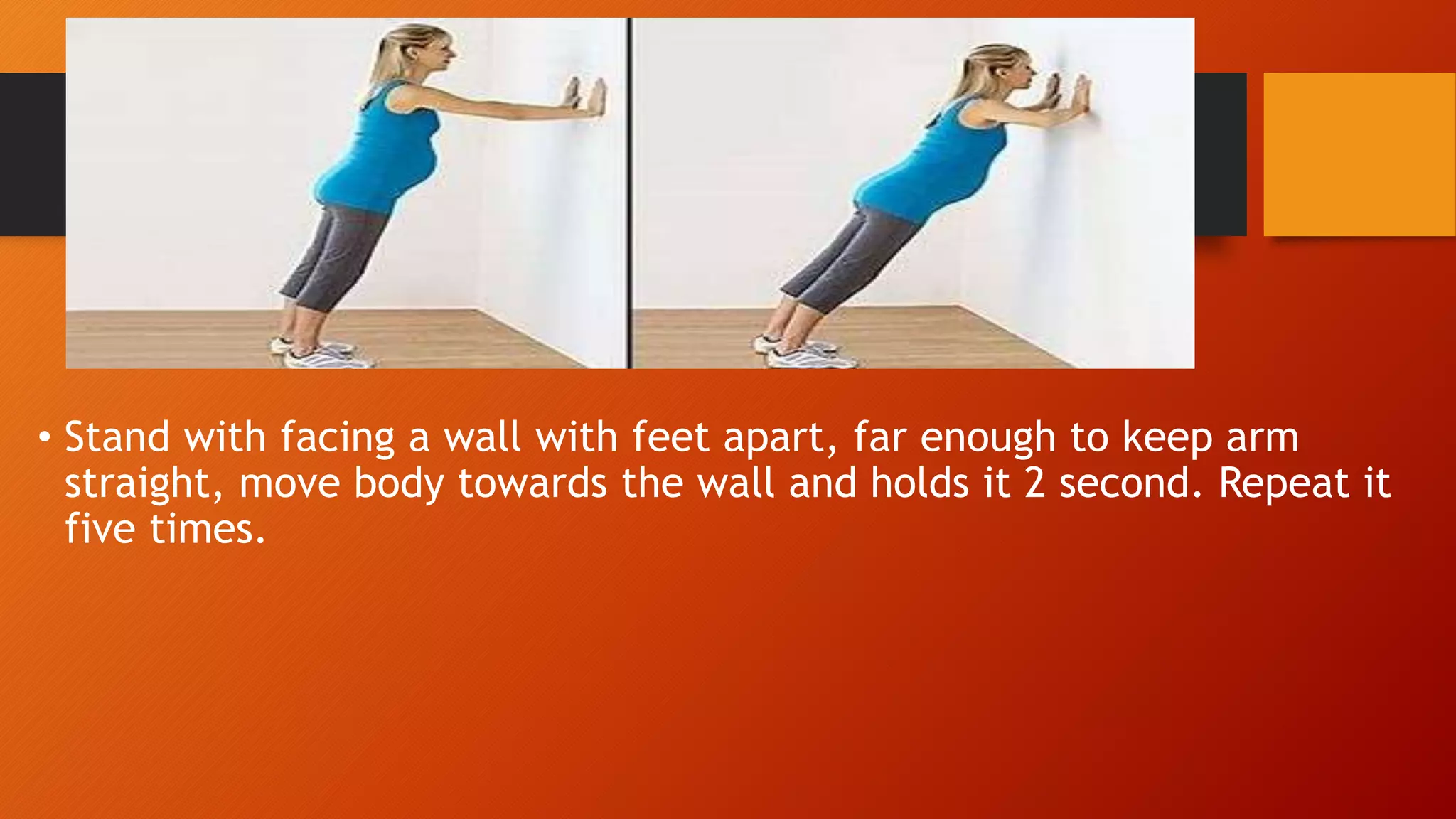
• Stand with facing a wall with feet apart, far enough to keep arm
straight, move body towards the wall and holds it 2 second. Repeat it
five times.
• Stand with facing a wall facing a wall with feet apart ,far enough to
keep arm straight, bend one leg forward, move body towards the wall
as you lean forward, keep spine straight and the other foot on the
floor throughout. Repeat it 5 times
• Lie in the supine position and bend one knee
alternatively, hold for5-6sec and then release it (do not
arch your back while lying).Repeat it 10 times.
ARM EXERCISE
• Sit up straight with head slightly raised ,shoulder back, stretch
arms out to the sides, keep the palms facing up make small
circles at anticlockwise and vice versa. Repeat it 10 times.
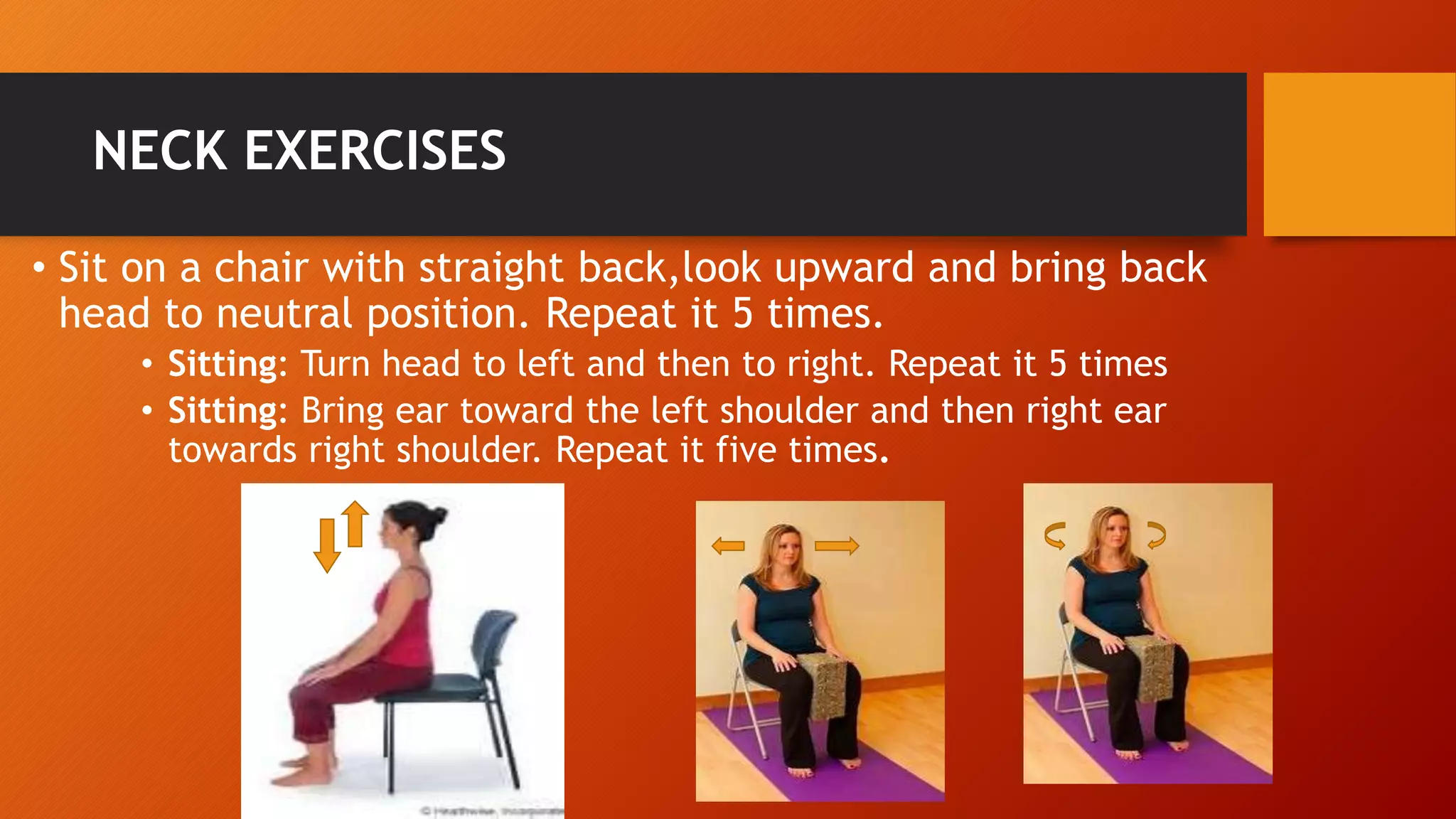
NECK EXERCISES
• Sit on a chair with straight back,look upward and bring back
head to neutral position. Repeat it 5 times.
• Sitting: Turn head to left and then to right. Repeat it 5 times
• Sitting: Bring ear toward the left shoulder and then right ear
towards right shoulder. Repeat it five times.
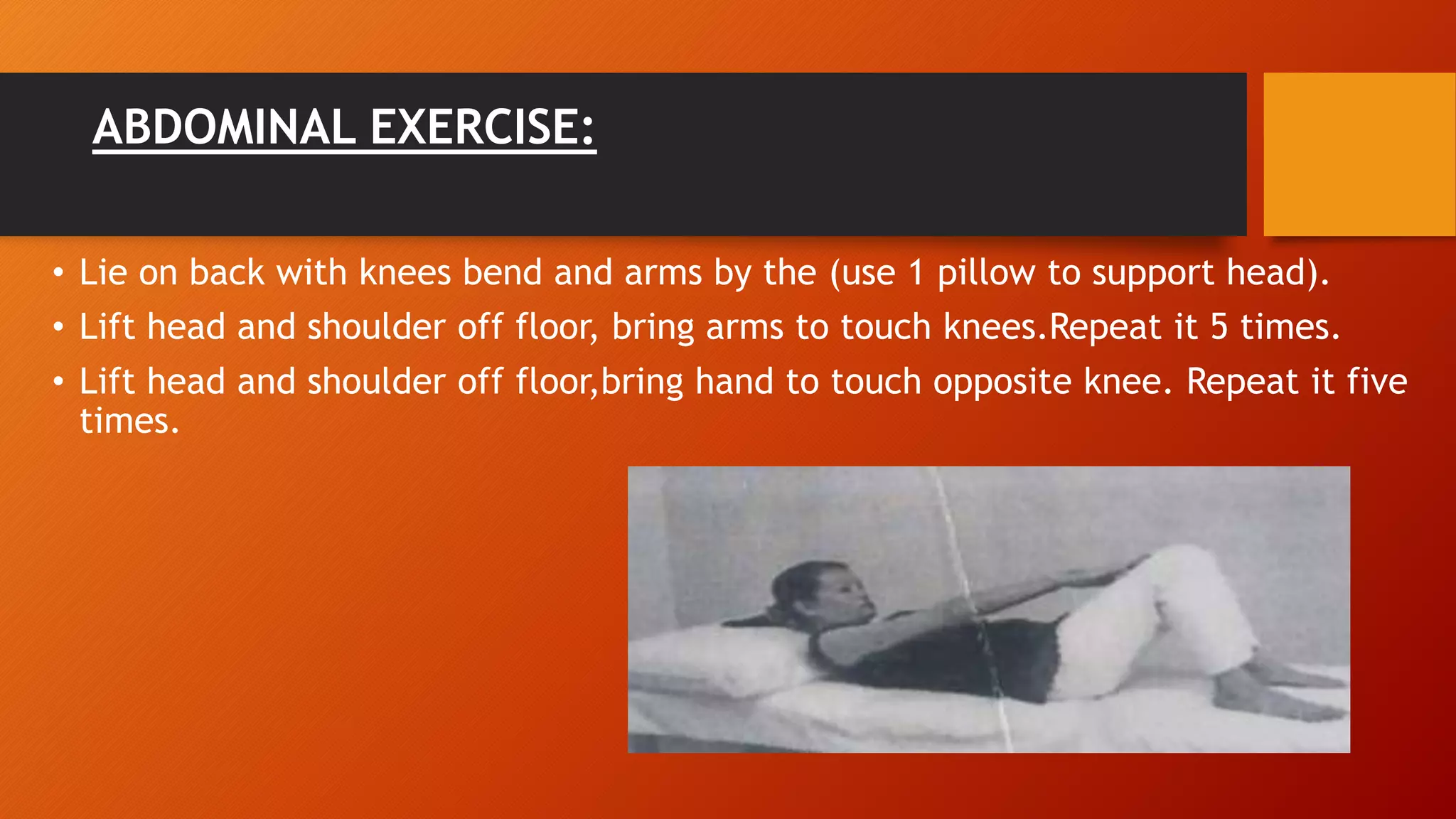
ABDOMINAL EXERCISE:
• Lie on back with knees bend and arms by the (use 1 pillow to support head).
• Lift head and shoulder off floor, bring arms to touch knees.Repeat it 5 times.
• Lift head and shoulder off floor,bring hand to touch opposite knee. Repeat it five
times.
PELVIC TILTING AND BACK STRETCHING:
PURPOSES:
• Helps to stretch muscles and ligament in the back preventing or
alleviating backache or strain.
• Improves posture.
• Make abdominal muscles firm.
TECHNIQUE:
PELVIC TILTING OR ROCKING:
• Lie well supported with pillows, knee bend and feet flat.
• Place one hand under the small of back and the other on the abdomen.
• Tighten the abdomen and buttocks and press the small of back down
onto underneath hand. Repeat 5 times.
• This exercise can be done in standing, supine and on all four position.
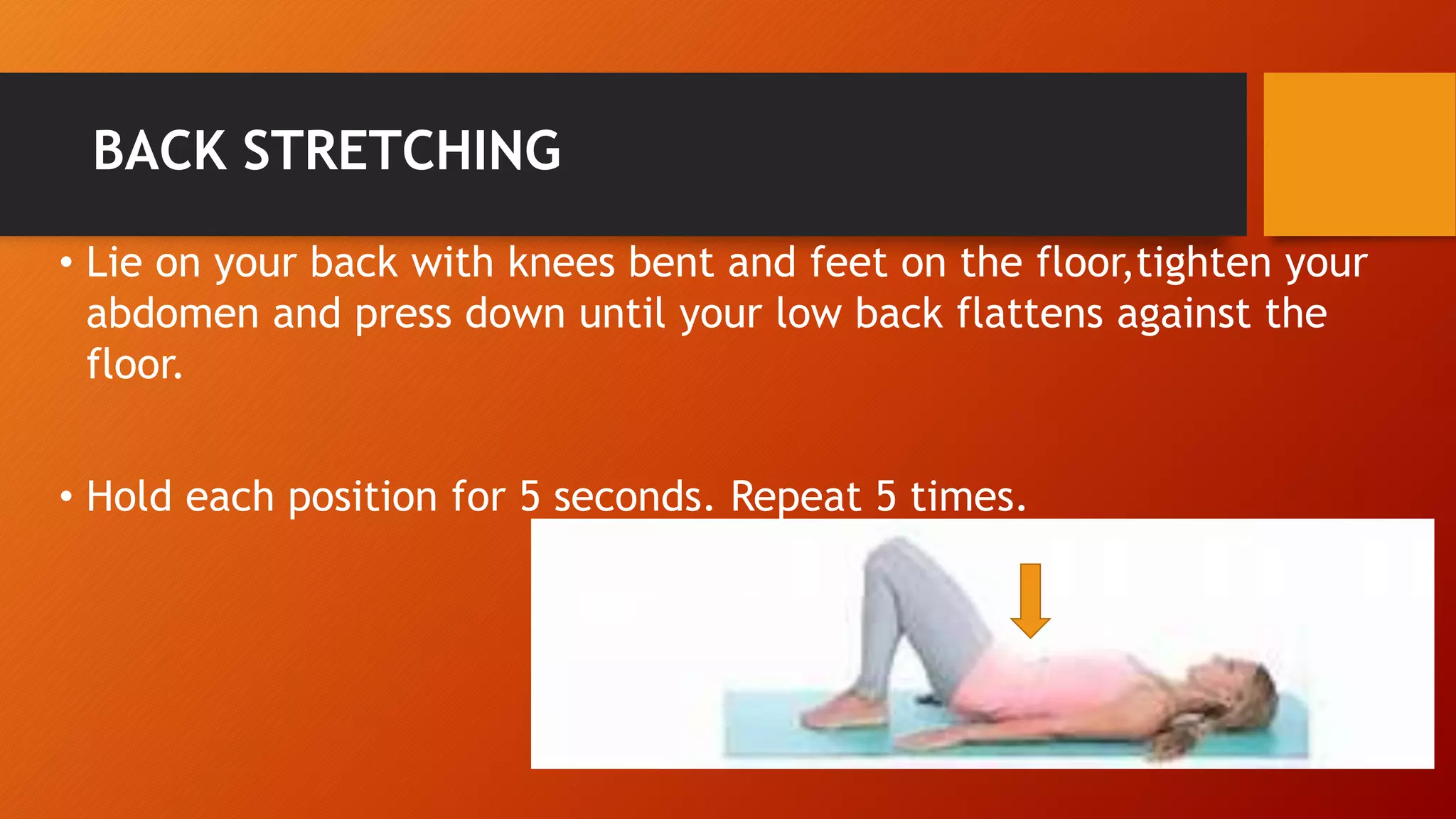
BACK STRETCHING
• Lie on your back with knees bent and feet on the floor,tighten your
abdomen and press down until your low back flattens against the
floor.
• Hold each position for 5 seconds. Repeat 5 times.
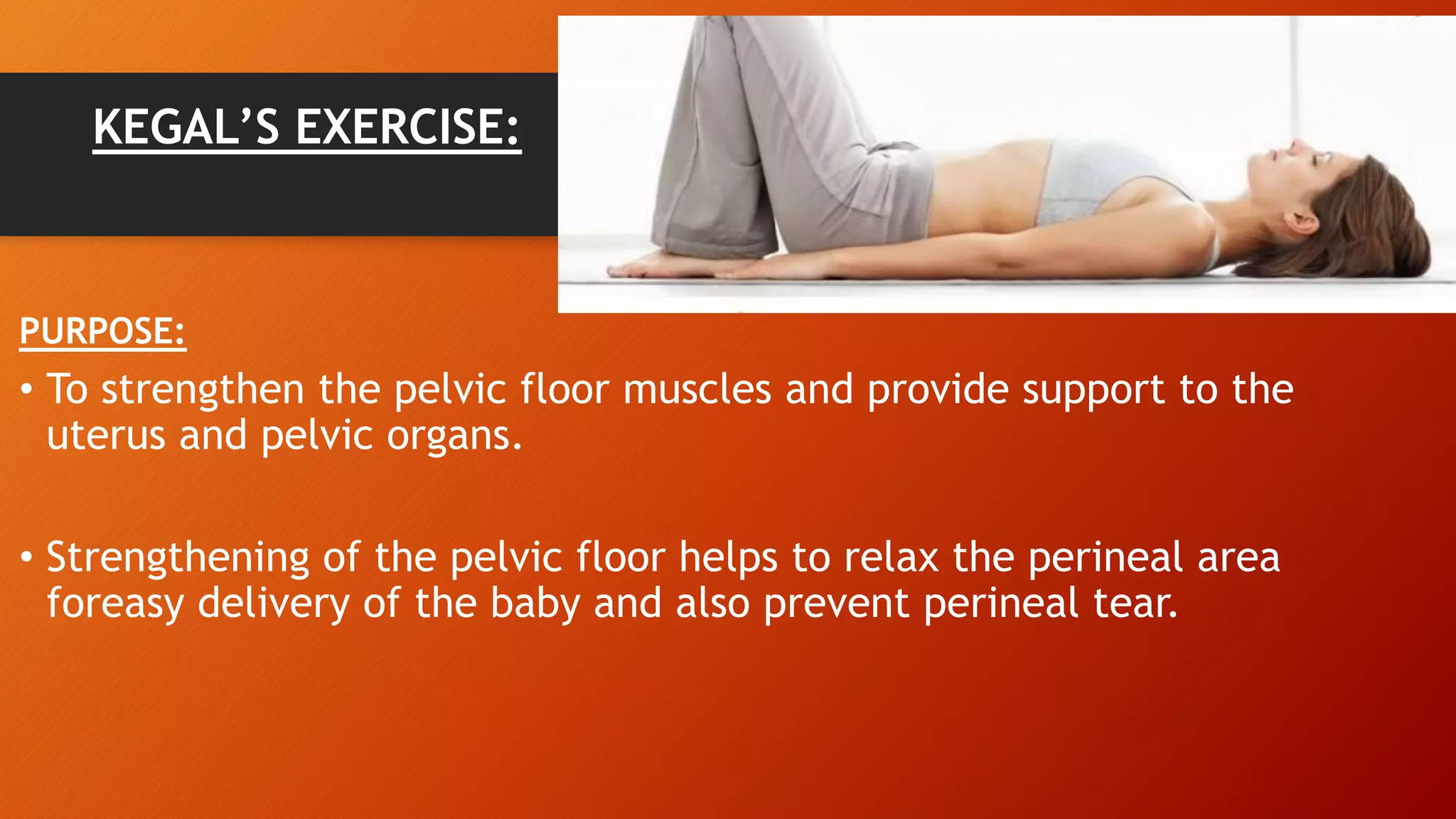
KEGAL’S EXERCISE:
PURPOSE:
• To strengthen the pelvic floor muscles and provide support to the
uterus and pelvic organs.
• Strengthening of the pelvic floor helps to relax the perineal area
foreasy delivery of the baby and also prevent perineal tear.
TECHNIQUE:
• Empty the bladder
• Adopt any comfortable position with legs slightly apart (lying ,
sitting, or standing).
• Squeeze pelvic floor muscle as through you are preventing the flow
of urine and bowel action, then feel it being lift up.
• Try to hold for 4 seconds and rest in between 10 sec.
• After a woman has located the correct muscles, kegal exercise can
be done in the following ways:
Cont.
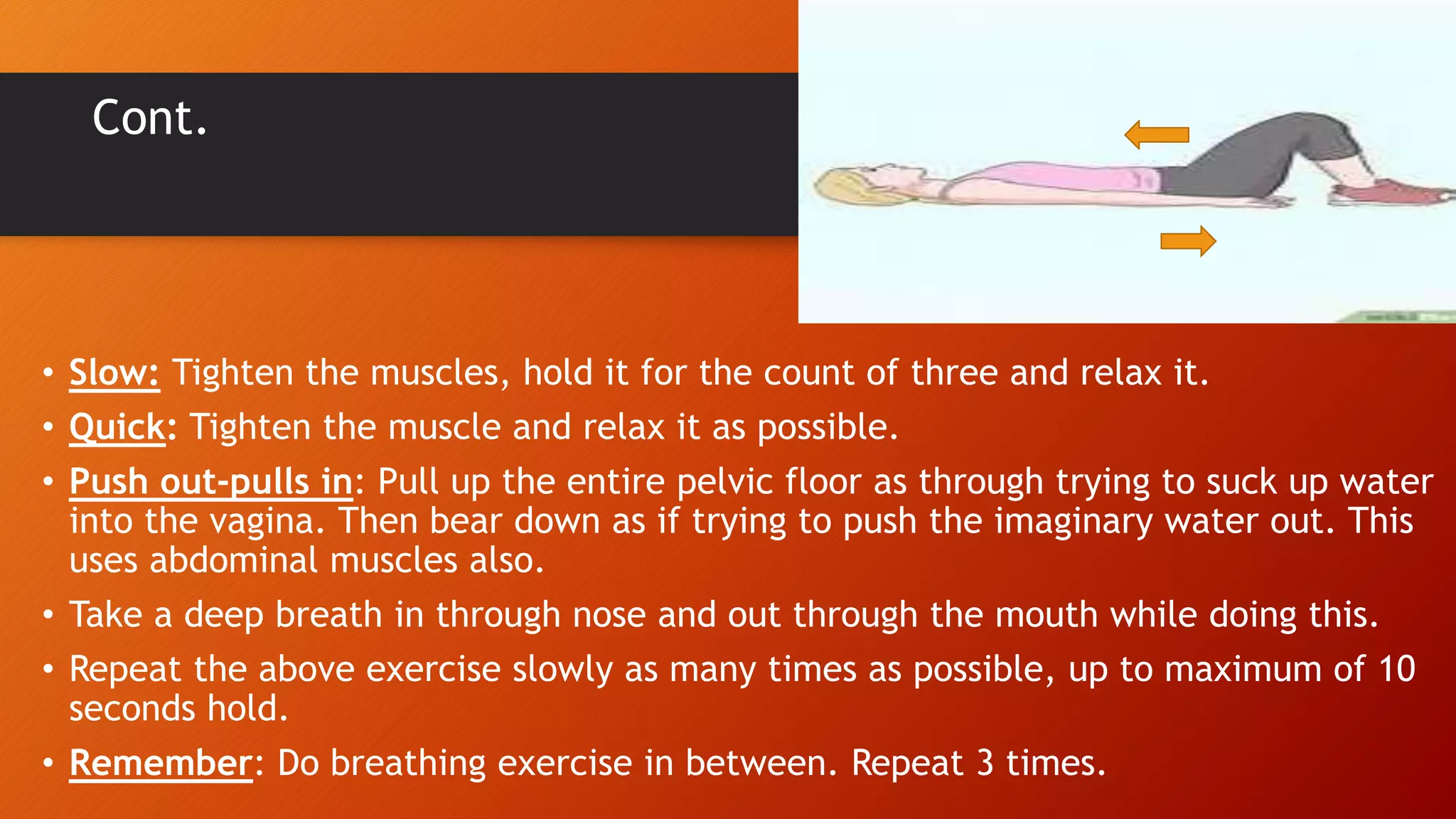
• Slow: Tighten the muscles, hold it for the count of three and relax it.
• Quick: Tighten the muscle and relax it as possible.
• Push out-pulls in: Pull up the entire pelvic floor as through trying to suck up water
into the vagina. Then bear down as if trying to push the imaginary water out. This
uses abdominal muscles also.
• Take a deep breath in through nose and out through the mouth while doing this.
• Repeat the above exercise slowly as many times as possible, up to maximum of 10
seconds hold.
• Remember: Do breathing exercise in between. Repeat 3 times.
TRANSVERSE EXERCISE:
PURPOSE:
• This is simple exercise to relieve backache during pregnancy.
TECHNIQUE:
• Kneel down on feet and arm with back straight.
• Imagine that you are balancing a tray on your back.
• Then tip the tray by abdominal muscle, tucking on your bottom and pushing the
small of back again upward.
• Flatten your back again repeat 6-8 times.
•
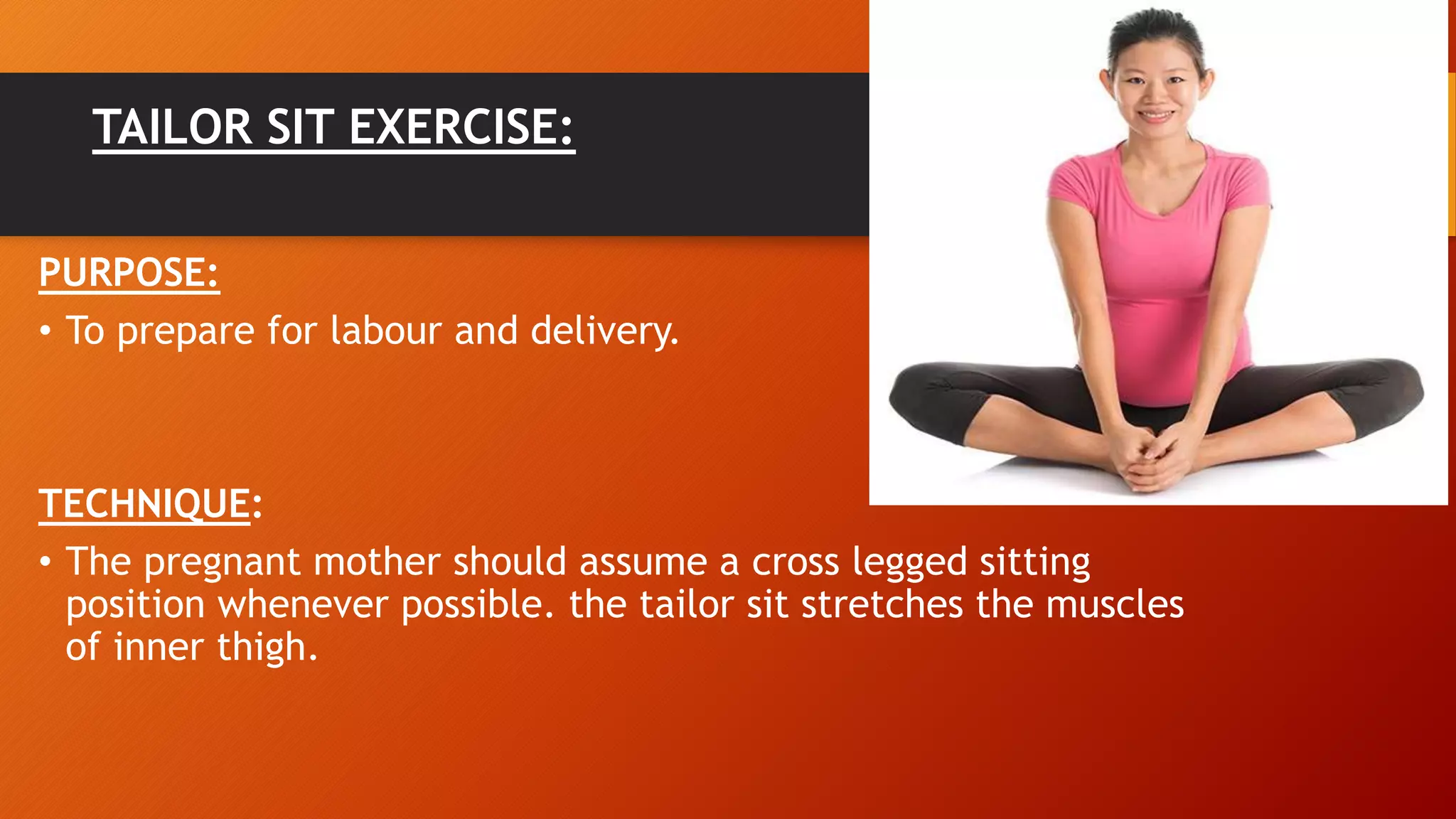
TAILOR SIT EXERCISE:
PURPOSE:
• To prepare for labour and delivery.
TECHNIQUE:
• The pregnant mother should assume a cross legged sitting
position whenever possible. the tailor sit stretches the muscles
of inner thigh.
KNEE ROLLING EXERCISE:
PURPOSES:
• To stretch and strengthen the muscles of back and thighs.
• To relieve back pain.
TECHNIQUE:
• Lie flat on the supine position, knees bend and feet flat.
• Roll both knees alternatively in opposite direction and try to touch the bed while
keeping back straight.
• Hold for 5 seconds and repeat 5 times.
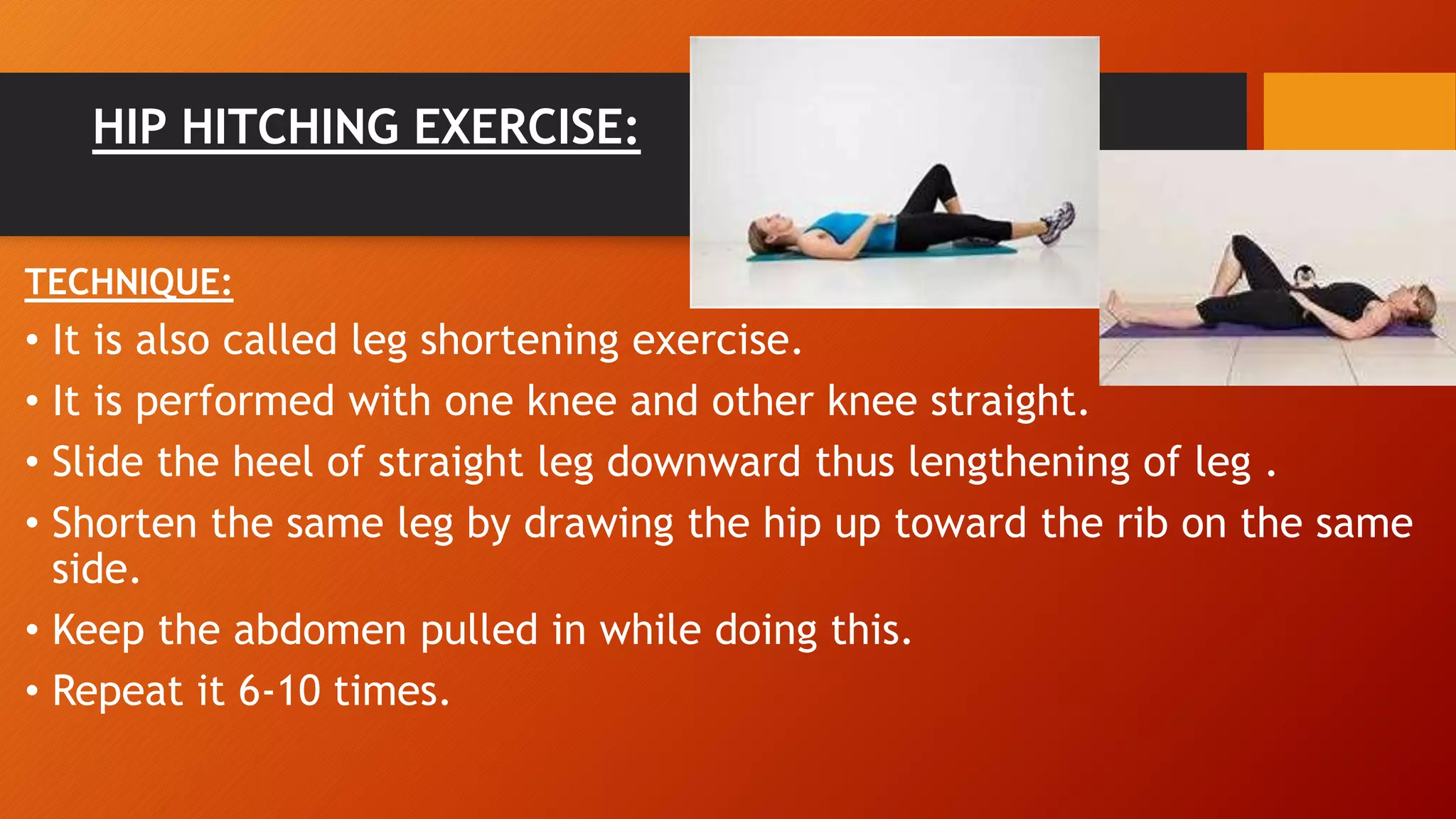
HIP HITCHING EXERCISE:
TECHNIQUE:
• It is also called leg shortening exercise.
• It is performed with one knee and other knee straight.
• Slide the heel of straight leg downward thus lengthening of leg .
• Shorten the same leg by drawing the hip up toward the rib on the same
side.
• Keep the abdomen pulled in while doing this.
• Repeat it 6-10 times.
LIFTING AND CARRYING
• Lifting heavy and awkward objects should be avoided during the
pregnancy. Twisting or bending while lifting is a particularly risky
activity.
• Toddler should not be carried on one hip. A rusksack carried on the
back is much better for the back than a heavy shopping bag.
EXERCISES TO AVOID :
Not everything is ideal for pregnancy and women is advised to avoid several forms of
exercises including the following:
• Diving
• Water skiing
• Gymnastics
• Netball
• Hockey
• Horse riding
• Cycling
• Rock climbing
• Scuba diving etc.
GUIDELINES FOR GOOD POSTURES:
Standing:
• Relax with upright posture.
• Strengthening your spine by tucking in your abdomen and
buttocks: relax your shoulders.
Sitting:
• Upright with spine well supported.
• Use a small pillow to tuck into small of your back.
• Sit in high backed chair that well support your back.
• Thighs should be supported by the chair, and the feet
resting flat on the floor.
• If sitting position is resumed for longer times, roll shoulder
in one way and then to the opposite to release tension.
Side lying:
• Side lying with a pillow under the head and one under
the knee and thigh prevents strains strain on the
sacroiliac joint. This is a good position for a women in
late pregnancy
CONCLUSION:
In pregnancy, exercise help strengthen muscles tone in preparation
for delivery and rapid restoration of muscle tone after delivery. The
goal of any exercise programme should be safety and improved
well-being of the mother and fetus. Promoting adequate
oxygenation, placental perfusion, venous return and positive
emotional state and important element of well-rounded exercise
programme.to gain all the advantages of exercises, mother should
perform these exercises daily.
Research abstract
The effect of antenatal exercise on delivery
outcomes: A systematic review and meta-analysis
of randomized controlled trials.
Cont.
BACKGROUND:
• Practicing different forms of exercises during pregnancy could
have beneficial effects on maternal outcomes during labor.
OBJECTIVE:
• To evaluate the effect of antenatal exercise on the duration of the
delivery.
Cont.
SELECTION CRITERIA:
• Randomized controlled trials (RCTs) that compared any type of
antenatal exercise versus no exercise in women who had vaginal
delivery.
DATA COLLECTION AND ANALYSIS:
• Data were extracted from eligible studies and pooled in a meta-analysis
model. Mean Difference (MD) was used in continuous outcomes, while
Risk Ratio (RR) was used to deal with dichotomous outcomes. The main
outcome was the duration of the first and second stages of labor while
the secondary outcomes included the rate of perineal lacerations and
analgesia request by women.
Cont.
RESULTS:
• Exercise significantly reduced the duration of second stage of labor
(SMD= -0.82, 95 % CI [-1.48, -0.16], p = 0.01). No significant difference
was noticed regarding the duration of the first stage of labor, perineal
lacerations and request for analgesia.
CONCLUSION:
• Antenatal exercise could reduce the duration of the second stage of
labor with racial differences.
Antenatal exercises.pptx

Antenatal exercises.pptx

  • 1.
    ANTENATAL EXERCISES PRESENTED BY MadhuBala Nursing tutor Obstetrics and Gynaecological Nursing M.M. College of Nursing Mullana
  • 3.
    DEFINITION Antenatal exercises arethose exercises performed by women during pregnancy ,which stimulate circulation and gives a feeling of well-being to the client.
  • 4.
    ADVANTAGES • Improves thecirculation for the mother and baby. • Reduction in aches and pains of pregnancy e.g. backache, cramps etc. • Improves the stamina, gives the mother more energy to cope with the growing demands of the pregnancy. • Improves the posture and body awareness. • More controlled weight gain.
  • 5.
    Cont. • Improves thesleeping patterns. • Reduction in minor ailments of pregnancy such as stiffness, tension, constipation, sleeplessness. • Minimizes varicose veins and swelling due to improved circulation. • Enhance the psychological well-being. • Ensure an effective bearing down in labour and speedy return to normal postnatal.
  • 6.
    ADVICES • Consult todoctor/midwife before beginning the exercise. • Perform exercises regularly, plan a regular schedule that is at least thrice a week. • Dress comfortably (wear loose fitting clothes) • Void before exercise. • Use movements that are slow and deliberate: avoid jerking and bouncing movements; jogging and running. • Exercise on the firm surface.
  • 7.
    Cont. • Drink fluidwhenever feel need during the exercise and after the exercise. This prevents dehydration. • Wear supportive shoes when needed. • Limit activities to shorter interval. Exercise for 10-15min, rest for 2-3min, then exercise for another 10-15min. • Decrease exercise level as pregnancy progresses. • Take your pulse every 10-15 min. if it is more than 140 beats per min ,slow down until it reaches to the maximum 90bpm. • Rest in left lateral position for 10 min after the exercise.
  • 8.
    Con. • Take anincrease in calories to replace those burned during exercises. • Always rise slowly from lying to sitting position to prevent orthostatic hypotension. • Don’t risk activities such as surfing ,mountain climbing and sky diving. • Don’t do activities that requires holding breath and bearing down. • Do not continue the exercise if you experience shortness of breath. pain, undue cramping, vaginal bleeding or nausea. report to the doctor /midwife if it is happens. • Don’t become over heated for extended period.
  • 9.
    Cont. • Avoid exerciseby lying flat in the later 2nd and 3rd trimester because of the danger of supine hypotension and decreased placental/fetal circulation. Instead a half lying position with back raised to an angle of approximately 35◦ can be used. • Never exercise to a point of fatigue.
  • 10.
    PREPARATION OF THEENVIRONMENTS • Arrange the area i.e a hard, firm bed or mat spread on the floor. • Ensure privacy. • Ensure that there is adequate light and ventilation.
  • 11.
    TYPES OF EXERCISES 1.Breathing exercises 2. Circulatory exercises. • Leg • Shoulder 3. Stretching exercises • Leg • Arm • Neck
  • 12.
    Cont. 4.Abdominal exercise 5.Pelvic tiltingand back stretching exercise. 6.Pelvis floor exercises (Kegal’s exercise) 7.Transverse exercise 8.Tailor sitting exercise 9.Hip hitching exercise
  • 13.
    BREATHING EXERCISE: PURPOSES: • Tostrengthen the muscles of respiration. • To increase maternal and feto-placental oxygenation.
  • 14.
    TECHNIQUE • Sit comfortablywith eyes closed and concentrate on breathing. • Breath in through the nose and out through the mouth, repeat it five times.
  • 15.
    CIRCULATORY EXERCISES: PURPOSES: • Toimprove circulation and venous return. • To stretch and strengthen the calf muscles. • To decrease calf muscles cramps.
  • 16.
    LEG EXERCISE: • Siton a chair with back straight,move feet up and down. Repeat it 10 times. • Sitting on a chair ,move feet inwards and outwards. Repeat it 10 times • Sitting on a chair make a circle with both feet at anticlock wise direction and vice vers. Repeat it 10 times.
  • 17.
    SHOULDER CIRCLING EXERCISE: •Shoulder rolls: The finger tips are placed on shoulder, then brought forward and up during inhalation, back and down during exhaustion or rolling each shoulder forward five times ,then back five time. Repeat it 10 times. • Stand straight with legs apart and stretch arms out to the sides and rotate arms(make a large circle)clockwise and anticlockwise. repeat it 10 times.
  • 18.
    STRETCHING EXERCISES: PURPOSES: • Improvecirculation of legs. • Decrease swelling. • Decrease calf muscle cramps.
  • 19.
    TECHNIQUES: LEG EXERCISES: • Standwith feet apart, squat down hold for as you are comfortable and back to standing position. Repeat it 5 times. •
  • 20.
    • Stand withfacing a wall with feet apart, far enough to keep arm straight, move body towards the wall and holds it 2 second. Repeat it five times.
  • 21.
    • Stand withfacing a wall facing a wall with feet apart ,far enough to keep arm straight, bend one leg forward, move body towards the wall as you lean forward, keep spine straight and the other foot on the floor throughout. Repeat it 5 times
  • 22.
    • Lie inthe supine position and bend one knee alternatively, hold for5-6sec and then release it (do not arch your back while lying).Repeat it 10 times.
  • 23.
    ARM EXERCISE • Situp straight with head slightly raised ,shoulder back, stretch arms out to the sides, keep the palms facing up make small circles at anticlockwise and vice versa. Repeat it 10 times.
  • 24.
    NECK EXERCISES • Siton a chair with straight back,look upward and bring back head to neutral position. Repeat it 5 times. • Sitting: Turn head to left and then to right. Repeat it 5 times • Sitting: Bring ear toward the left shoulder and then right ear towards right shoulder. Repeat it five times.
  • 25.
    ABDOMINAL EXERCISE: • Lieon back with knees bend and arms by the (use 1 pillow to support head). • Lift head and shoulder off floor, bring arms to touch knees.Repeat it 5 times. • Lift head and shoulder off floor,bring hand to touch opposite knee. Repeat it five times.
  • 26.
    PELVIC TILTING ANDBACK STRETCHING: PURPOSES: • Helps to stretch muscles and ligament in the back preventing or alleviating backache or strain. • Improves posture. • Make abdominal muscles firm.
  • 27.
    TECHNIQUE: PELVIC TILTING ORROCKING: • Lie well supported with pillows, knee bend and feet flat. • Place one hand under the small of back and the other on the abdomen. • Tighten the abdomen and buttocks and press the small of back down onto underneath hand. Repeat 5 times. • This exercise can be done in standing, supine and on all four position.
  • 28.
    BACK STRETCHING • Lieon your back with knees bent and feet on the floor,tighten your abdomen and press down until your low back flattens against the floor. • Hold each position for 5 seconds. Repeat 5 times.
  • 29.
    KEGAL’S EXERCISE: PURPOSE: • Tostrengthen the pelvic floor muscles and provide support to the uterus and pelvic organs. • Strengthening of the pelvic floor helps to relax the perineal area foreasy delivery of the baby and also prevent perineal tear.
  • 30.
    TECHNIQUE: • Empty thebladder • Adopt any comfortable position with legs slightly apart (lying , sitting, or standing). • Squeeze pelvic floor muscle as through you are preventing the flow of urine and bowel action, then feel it being lift up. • Try to hold for 4 seconds and rest in between 10 sec. • After a woman has located the correct muscles, kegal exercise can be done in the following ways:
  • 31.
    Cont. • Slow: Tightenthe muscles, hold it for the count of three and relax it. • Quick: Tighten the muscle and relax it as possible. • Push out-pulls in: Pull up the entire pelvic floor as through trying to suck up water into the vagina. Then bear down as if trying to push the imaginary water out. This uses abdominal muscles also. • Take a deep breath in through nose and out through the mouth while doing this. • Repeat the above exercise slowly as many times as possible, up to maximum of 10 seconds hold. • Remember: Do breathing exercise in between. Repeat 3 times.
  • 32.
    TRANSVERSE EXERCISE: PURPOSE: • Thisis simple exercise to relieve backache during pregnancy. TECHNIQUE: • Kneel down on feet and arm with back straight. • Imagine that you are balancing a tray on your back. • Then tip the tray by abdominal muscle, tucking on your bottom and pushing the small of back again upward. • Flatten your back again repeat 6-8 times. •
  • 33.
    TAILOR SIT EXERCISE: PURPOSE: •To prepare for labour and delivery. TECHNIQUE: • The pregnant mother should assume a cross legged sitting position whenever possible. the tailor sit stretches the muscles of inner thigh.
  • 34.
    KNEE ROLLING EXERCISE: PURPOSES: •To stretch and strengthen the muscles of back and thighs. • To relieve back pain. TECHNIQUE: • Lie flat on the supine position, knees bend and feet flat. • Roll both knees alternatively in opposite direction and try to touch the bed while keeping back straight. • Hold for 5 seconds and repeat 5 times.
  • 35.
    HIP HITCHING EXERCISE: TECHNIQUE: •It is also called leg shortening exercise. • It is performed with one knee and other knee straight. • Slide the heel of straight leg downward thus lengthening of leg . • Shorten the same leg by drawing the hip up toward the rib on the same side. • Keep the abdomen pulled in while doing this. • Repeat it 6-10 times.
  • 36.
    LIFTING AND CARRYING •Lifting heavy and awkward objects should be avoided during the pregnancy. Twisting or bending while lifting is a particularly risky activity. • Toddler should not be carried on one hip. A rusksack carried on the back is much better for the back than a heavy shopping bag.
  • 37.
    EXERCISES TO AVOID: Not everything is ideal for pregnancy and women is advised to avoid several forms of exercises including the following: • Diving • Water skiing • Gymnastics • Netball • Hockey • Horse riding • Cycling • Rock climbing • Scuba diving etc.
  • 38.
    GUIDELINES FOR GOODPOSTURES: Standing: • Relax with upright posture. • Strengthening your spine by tucking in your abdomen and buttocks: relax your shoulders.
  • 39.
    Sitting: • Upright withspine well supported. • Use a small pillow to tuck into small of your back. • Sit in high backed chair that well support your back. • Thighs should be supported by the chair, and the feet resting flat on the floor. • If sitting position is resumed for longer times, roll shoulder in one way and then to the opposite to release tension.
  • 40.
    Side lying: • Sidelying with a pillow under the head and one under the knee and thigh prevents strains strain on the sacroiliac joint. This is a good position for a women in late pregnancy
  • 41.
    CONCLUSION: In pregnancy, exercisehelp strengthen muscles tone in preparation for delivery and rapid restoration of muscle tone after delivery. The goal of any exercise programme should be safety and improved well-being of the mother and fetus. Promoting adequate oxygenation, placental perfusion, venous return and positive emotional state and important element of well-rounded exercise programme.to gain all the advantages of exercises, mother should perform these exercises daily.
  • 42.
    Research abstract The effectof antenatal exercise on delivery outcomes: A systematic review and meta-analysis of randomized controlled trials.
  • 43.
    Cont. BACKGROUND: • Practicing differentforms of exercises during pregnancy could have beneficial effects on maternal outcomes during labor. OBJECTIVE: • To evaluate the effect of antenatal exercise on the duration of the delivery.
  • 44.
    Cont. SELECTION CRITERIA: • Randomizedcontrolled trials (RCTs) that compared any type of antenatal exercise versus no exercise in women who had vaginal delivery. DATA COLLECTION AND ANALYSIS: • Data were extracted from eligible studies and pooled in a meta-analysis model. Mean Difference (MD) was used in continuous outcomes, while Risk Ratio (RR) was used to deal with dichotomous outcomes. The main outcome was the duration of the first and second stages of labor while the secondary outcomes included the rate of perineal lacerations and analgesia request by women.
  • 45.
    Cont. RESULTS: • Exercise significantlyreduced the duration of second stage of labor (SMD= -0.82, 95 % CI [-1.48, -0.16], p = 0.01). No significant difference was noticed regarding the duration of the first stage of labor, perineal lacerations and request for analgesia. CONCLUSION: • Antenatal exercise could reduce the duration of the second stage of labor with racial differences.