DEPARTMENT OF MICROBIOLOGY
FACTORS AFFECTING
THE BIOREMEDIATION PROCESS
Veerachipalayam - 637 303, Sankagiri, Salem Dt., Tamil Nadu India.
Affiliated to Periyar University, Salem ; Recognised Under Section 2(f) & 12(B) of the UGC Act, 1956 )
VIVEKANANDHA
ARTS AND SCIENCE COLLEGE FOR WOMEN
LEAD BY PRESENTED BY
Dr.R.DINESH KUMAR SONIYA SREE SAKTHIVEL
Assistant Professor / Microbiology
Vivekanandha
Art's and Science College For Women
Sankagiri, Salem.
I year - M.Sc., Microbiology
Vivekanandha
Art's and Science College For Women
Sankagiri, Salem.
FACTORS AFFECTING
THE BIOREMEDIATION
PROCESS
OUTLINE :
INTRODUCTION
FACTORS AFFECTING THE PROCESS
BIOTIC OR BIOLOGICAL FACTORS
ABIOTIC OR ENVIRONMENTAL FACTORS
CONCLUSION
INTRODUCTION :
Bioremediation process is degrading, removing, changing, immobilizing or
detoxifying various chemicals and physical pollutants from the environment
through the activity of bacteria, fungi algae and plants.
Enzymatic metabolic pathways of microorganisms facilitate the progress of
biochemical reactions that helps in degradation of pollutant.
Microorganisms are act on the pollutants only when they have contact to the
compounds which help them to generate energy and nutritions to multiply
cells.
Biotic or
Biological factor
FACTORS AFFECTING THE BIOREMEDIATION PROCESS
Abiotic or
Environmental factor
Enzyme activity
Mutation
Interaction
Gene Transfer
Biomass production
Population size
Major
Factors
pH
Temperature
O2 content
Redox potential
Osmotic pressure
Solubility
Toxicity
FACTORS AFFECTING THE BIOREMEDIATION PROCESS
The monitoring of soil physically and chemically is a time-
consuming process, in order to measure the pollution of soil after
contamination in a shorter period of time, microbial and biochemical
properties of the soil are to be determined.
The bioremediation process depends upon the different factors for
the removal of the contaminants, some of them are:
Concentration of the contaminant
1.
Nutrient Availability
2.
Surfactants, Enhancers of bioavailability
3.
Characteristics of the contaminated soil
4.
1.CONCENTRATION OF THE CONTAMINANT
The concentration of the contaminants directly affects
microbial activity.
Lower the concentration of the contaminants there will be
decreasing rate of degrading enzymes produced by
bacteria in the soil.
Toxic effects are observed in presence of higher
concentrations of contaminants.
The decomposition rate of catabolic enzymes can be
increased by the synergistic interactions between different
components of the contaminants.
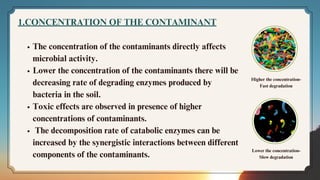
Higher the concentration-
Fast degradation
Lower the concentration-
Slow degradation
Carbon, nitrogen, phosphorus, potassium, and calcium are
the basic requirement for the growth of microorganisms, the
concentration of the nutrient availability directly affects the
degradation of the contaminants.
The excessive presence of nitrogen, potassium, and
phosphorus shows a negative impact on the degradation of
hydrocarbons.
The rate of bioremediation can also be determined by
knowing the accessibility of organic matters towards
microorganisms; which is known as bioavailability.
2. NUTRIENT AVAILABILITY
Nutrients
Uptake by the
microorganisms
Contaminants
Non toxic
end product
3. SURFACTANTS; ENHANCERS OF BIOAVAILABILITY
Mostly, Chemical and food-grade surfactants are used
to increase the hydrophobic organic contaminants.
Triton X 100, Tween 80, and SDS are the petroleum-
derived chemical surfactants and T-MAZ 28, T-MAZ
10 and T-MAZ 60 are food-graded surfactants used in
bioremediation.
Besides these surfactants produced by microbes are also
used for the reduction of environmental contaminants.
Surfactants Microbes
Degradation
process
4. CHARACTERISTICS OF THE CONTAMINATED SOIL
The bioremediation process is significantly affected by the different
parameters of the contaminated soil such as
pH
1.
Texture
2.
Permeability
3.
Water holding capacity
4.
Temperature
5.
Oxygen availability
6.
a. PH
Optimum pH is required for the bioremediation process which ranges from
6-8.
Neutral pH is suitable for the degradation of petroleum hydrocarbons
whereas some fungi and acidophilic microbes degrade contaminants in an
acidic environment.
Generally, alkaline or slightly acid soil pH enhances biodegradation, while
acidic environments pose limitations to biodegradation.
Usually, pH values between 6.5 and 8.0 are considered optimum for oil
degradation.
Within this range, specific enzymes function within a particular pH
spectrum.
b.TEXTURE
The texture of the soil plays a crucial role. The texture affects the movement
of water and air within the soil, which in turn affects the availability of
nutrients and the activity of microorganisms.
Fine-textured soils, like clay, have smaller particles that can hold more water
but may have limited oxygen availability.
On the other hand, coarse-textured soils, like sandy soil, have larger particles
that allow for better drainage but can lead to faster water movement and
nutrient leaching.So, the texture of the soil can impact the effectiveness and
efficiency of the bioremediation process.
The permeability of the soil is another important factor in the bioremediation
process.Permeabilityrefers to how easily water can flow through the soil.
It affects the movement of contaminants, nutrients, and oxygen within the soil, which in
turn impacts the activity of microorganisms involved in bioremediation. Soils with high
permeability, such as sandy soils, allow water to flow more freely.
This can be beneficial as it helps in distributing oxygen and nutrients to the
microorganisms, promoting their growth and activity. On the other hand, soils with low
permeability, like clay soils, can restrict the movement of water and may lead to poor
oxygen availability, which can hinder the bioremediation process.
c.PERMIABILITY
d.WATER HOLDING CAPACITY
Water holding capacity is important because it determines how much water
can be retained in the soil or substrate. This is crucial for the survival and
growth of microorganisms involved in bioremediation.
Adequate water holding capacity ensures that the soil remains moist,
providing a favorable environment for microbial activity. This allows the
microorganisms to break down and degrade contaminants effectively.
On the other hand, if the water holding capacity is too low, the soil may
become too dry, inhibiting microbial activity. This can slow down or even halt
the bioremediation process.
Conversely, if the water holding capacity is too high, excessive water can lead
to waterlogging, which can negatively impact microbial activity.
It can also cause the leaching of contaminants, spreading them to other areas.
Fnding the right balance in water holding capacity is crucial for successful
bioremediation.
It ensures that the soil provides optimal conditions for microbial growth and
activity, leading to effective contaminant degradation
e. TEMPERATURE
The degradation of the contaminants is also affected by temperature
especially in the case of hydrocarbons under both in situ and ex-situ
conditions.
It has been found that a higher temperature of 30°C-40°c increases the
bioremediation in the soil as well as in the marine environment
Temperature is definitely an important factor in the bioremediation
process.The activity and growth of microorganisms involved in
bioremediation are greatly influenced by temperature.
Warmer temperatures tend to enhance the metabolic activity of
microorganisms, leading to faster rates of biodegradation.
This is because higher temperatures provide more energy for the
microorganisms to carry out their biochemical reactions.
However, extremely high temperatures can also have negative effects, as
they can denature or kill the microorganisms.
On the other hand, colder temperatures can slow down the metabolic
activity of microorganisms, reducing the rate of biodegradation
f. OXYGEN AVAILABILITY
Oxygen is a very important factor to determine the extent and rate of
biodegradation of contaminants.
Aerobic biodegradation is much faster than anaerobic biodegradation.For
the aerobic respiratory breakdown of organic contaminants, oxygen
availability plays a significant role.
In the majority of cases, the addition of hydrogen peroxide is used to
introduce oxygen.Hydrogen peroxide is about seven times more soluble in
water than oxygen.
CONCLUSION:
Factors like temperature, pH, oxygen availability, and nutrient levels can greatly
influence the effectiveness of bioremediation. Optimal conditions must be maintained
for the growth and activity of microorganisms involved in the process
The type and concentration of contaminants play a significant role in bioremediation.
The presence of diverse microbial populations is beneficial for bioremediation.
Each contaminated site has unique characteristics that can impact bioremediation.
Factors such as soil type, moisture content, vegetation, and the presence of other
chemicals or pollutants can influence the effectiveness of the process.
Overall, understanding and addressing these factors is crucial for designing and
implementing effective bioremediation strategies to mitigate environmental
contamination.
https://microbenotes.com/bioremediation-types-factors/
https://www.sciencedirect.com/science/article/abs/pii/B9780128211991000055
https://www.frontiersin.org/articles/10.3389/fsoil.2022.937186
REFERENCE :
FACTORS AFFECTING THE BIOREMEDIATION PROCESS.pdf

FACTORS AFFECTING THE BIOREMEDIATION PROCESS.pdf

  • 1.
    DEPARTMENT OF MICROBIOLOGY FACTORSAFFECTING THE BIOREMEDIATION PROCESS Veerachipalayam - 637 303, Sankagiri, Salem Dt., Tamil Nadu India. Affiliated to Periyar University, Salem ; Recognised Under Section 2(f) & 12(B) of the UGC Act, 1956 ) VIVEKANANDHA ARTS AND SCIENCE COLLEGE FOR WOMEN LEAD BY PRESENTED BY Dr.R.DINESH KUMAR SONIYA SREE SAKTHIVEL Assistant Professor / Microbiology Vivekanandha Art's and Science College For Women Sankagiri, Salem. I year - M.Sc., Microbiology Vivekanandha Art's and Science College For Women Sankagiri, Salem.
  • 2.
  • 3.
    OUTLINE : INTRODUCTION FACTORS AFFECTINGTHE PROCESS BIOTIC OR BIOLOGICAL FACTORS ABIOTIC OR ENVIRONMENTAL FACTORS CONCLUSION
  • 4.
    INTRODUCTION : Bioremediation processis degrading, removing, changing, immobilizing or detoxifying various chemicals and physical pollutants from the environment through the activity of bacteria, fungi algae and plants. Enzymatic metabolic pathways of microorganisms facilitate the progress of biochemical reactions that helps in degradation of pollutant. Microorganisms are act on the pollutants only when they have contact to the compounds which help them to generate energy and nutritions to multiply cells.
  • 5.
    Biotic or Biological factor FACTORSAFFECTING THE BIOREMEDIATION PROCESS Abiotic or Environmental factor Enzyme activity Mutation Interaction Gene Transfer Biomass production Population size Major Factors pH Temperature O2 content Redox potential Osmotic pressure Solubility Toxicity
  • 6.
    FACTORS AFFECTING THEBIOREMEDIATION PROCESS The monitoring of soil physically and chemically is a time- consuming process, in order to measure the pollution of soil after contamination in a shorter period of time, microbial and biochemical properties of the soil are to be determined. The bioremediation process depends upon the different factors for the removal of the contaminants, some of them are: Concentration of the contaminant 1. Nutrient Availability 2. Surfactants, Enhancers of bioavailability 3. Characteristics of the contaminated soil 4.
  • 7.
    1.CONCENTRATION OF THECONTAMINANT The concentration of the contaminants directly affects microbial activity. Lower the concentration of the contaminants there will be decreasing rate of degrading enzymes produced by bacteria in the soil. Toxic effects are observed in presence of higher concentrations of contaminants. The decomposition rate of catabolic enzymes can be increased by the synergistic interactions between different components of the contaminants. Higher the concentration- Fast degradation Lower the concentration- Slow degradation
  • 8.
    Carbon, nitrogen, phosphorus,potassium, and calcium are the basic requirement for the growth of microorganisms, the concentration of the nutrient availability directly affects the degradation of the contaminants. The excessive presence of nitrogen, potassium, and phosphorus shows a negative impact on the degradation of hydrocarbons. The rate of bioremediation can also be determined by knowing the accessibility of organic matters towards microorganisms; which is known as bioavailability. 2. NUTRIENT AVAILABILITY Nutrients Uptake by the microorganisms Contaminants Non toxic end product
  • 9.
    3. SURFACTANTS; ENHANCERSOF BIOAVAILABILITY Mostly, Chemical and food-grade surfactants are used to increase the hydrophobic organic contaminants. Triton X 100, Tween 80, and SDS are the petroleum- derived chemical surfactants and T-MAZ 28, T-MAZ 10 and T-MAZ 60 are food-graded surfactants used in bioremediation. Besides these surfactants produced by microbes are also used for the reduction of environmental contaminants. Surfactants Microbes Degradation process
  • 10.
    4. CHARACTERISTICS OFTHE CONTAMINATED SOIL The bioremediation process is significantly affected by the different parameters of the contaminated soil such as pH 1. Texture 2. Permeability 3. Water holding capacity 4. Temperature 5. Oxygen availability 6.
  • 11.
    a. PH Optimum pHis required for the bioremediation process which ranges from 6-8. Neutral pH is suitable for the degradation of petroleum hydrocarbons whereas some fungi and acidophilic microbes degrade contaminants in an acidic environment. Generally, alkaline or slightly acid soil pH enhances biodegradation, while acidic environments pose limitations to biodegradation. Usually, pH values between 6.5 and 8.0 are considered optimum for oil degradation. Within this range, specific enzymes function within a particular pH spectrum.
  • 12.
    b.TEXTURE The texture ofthe soil plays a crucial role. The texture affects the movement of water and air within the soil, which in turn affects the availability of nutrients and the activity of microorganisms. Fine-textured soils, like clay, have smaller particles that can hold more water but may have limited oxygen availability. On the other hand, coarse-textured soils, like sandy soil, have larger particles that allow for better drainage but can lead to faster water movement and nutrient leaching.So, the texture of the soil can impact the effectiveness and efficiency of the bioremediation process.
  • 13.
    The permeability ofthe soil is another important factor in the bioremediation process.Permeabilityrefers to how easily water can flow through the soil. It affects the movement of contaminants, nutrients, and oxygen within the soil, which in turn impacts the activity of microorganisms involved in bioremediation. Soils with high permeability, such as sandy soils, allow water to flow more freely. This can be beneficial as it helps in distributing oxygen and nutrients to the microorganisms, promoting their growth and activity. On the other hand, soils with low permeability, like clay soils, can restrict the movement of water and may lead to poor oxygen availability, which can hinder the bioremediation process. c.PERMIABILITY
  • 14.
    d.WATER HOLDING CAPACITY Waterholding capacity is important because it determines how much water can be retained in the soil or substrate. This is crucial for the survival and growth of microorganisms involved in bioremediation. Adequate water holding capacity ensures that the soil remains moist, providing a favorable environment for microbial activity. This allows the microorganisms to break down and degrade contaminants effectively. On the other hand, if the water holding capacity is too low, the soil may become too dry, inhibiting microbial activity. This can slow down or even halt the bioremediation process.
  • 15.
    Conversely, if thewater holding capacity is too high, excessive water can lead to waterlogging, which can negatively impact microbial activity. It can also cause the leaching of contaminants, spreading them to other areas. Fnding the right balance in water holding capacity is crucial for successful bioremediation. It ensures that the soil provides optimal conditions for microbial growth and activity, leading to effective contaminant degradation
  • 16.
    e. TEMPERATURE The degradationof the contaminants is also affected by temperature especially in the case of hydrocarbons under both in situ and ex-situ conditions. It has been found that a higher temperature of 30°C-40°c increases the bioremediation in the soil as well as in the marine environment Temperature is definitely an important factor in the bioremediation process.The activity and growth of microorganisms involved in bioremediation are greatly influenced by temperature.
  • 17.
    Warmer temperatures tendto enhance the metabolic activity of microorganisms, leading to faster rates of biodegradation. This is because higher temperatures provide more energy for the microorganisms to carry out their biochemical reactions. However, extremely high temperatures can also have negative effects, as they can denature or kill the microorganisms. On the other hand, colder temperatures can slow down the metabolic activity of microorganisms, reducing the rate of biodegradation
  • 18.
    f. OXYGEN AVAILABILITY Oxygenis a very important factor to determine the extent and rate of biodegradation of contaminants. Aerobic biodegradation is much faster than anaerobic biodegradation.For the aerobic respiratory breakdown of organic contaminants, oxygen availability plays a significant role. In the majority of cases, the addition of hydrogen peroxide is used to introduce oxygen.Hydrogen peroxide is about seven times more soluble in water than oxygen.
  • 19.
    CONCLUSION: Factors like temperature,pH, oxygen availability, and nutrient levels can greatly influence the effectiveness of bioremediation. Optimal conditions must be maintained for the growth and activity of microorganisms involved in the process The type and concentration of contaminants play a significant role in bioremediation. The presence of diverse microbial populations is beneficial for bioremediation. Each contaminated site has unique characteristics that can impact bioremediation. Factors such as soil type, moisture content, vegetation, and the presence of other chemicals or pollutants can influence the effectiveness of the process. Overall, understanding and addressing these factors is crucial for designing and implementing effective bioremediation strategies to mitigate environmental contamination.
  • 20.