Factoring
Factoring
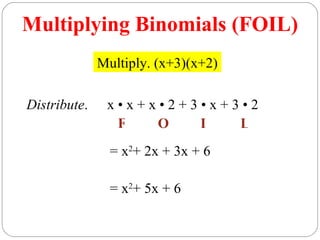
Multiplying Binomials (FOIL)
              Multiply. (x+3)(x+2)

Distribute.    x•x+x•2+3•x+3•2
                F   O   I   L
                = x2+ 2x + 3x + 6

                = x2+ 5x + 6
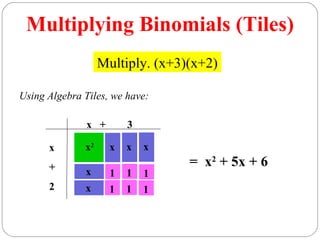
Multiplying Binomials (Tiles)
                   Multiply. (x+3)(x+2)

Using Algebra Tiles, we have:

               x +       3

      x       x2     x   x   x
      +                           = x2 + 5x + 6
              x      1   1   1
      2       x      1   1   1
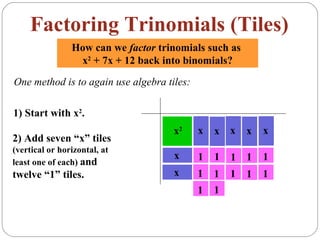
Factoring Trinomials (Tiles)
                How can we factor trinomials such as
                 x2 + 7x + 12 back into binomials?

One method is to again use algebra tiles:

1) Start with x2.
                                     x2     x   x x     x   x
2) Add seven “x” tiles
(vertical or horizontal, at
                                     x      1   1   1   1   1
least one of each) and
twelve “1” tiles.                    x      1   1   1   1   1
                                            1   1
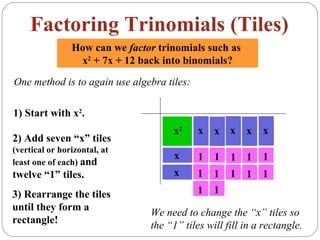
Factoring Trinomials (Tiles)
                How can we factor trinomials such as
                 x2 + 7x + 12 back into binomials?

One method is to again use algebra tiles:

1) Start with x2.
                                     x2     x   x x     x   x
2) Add seven “x” tiles
(vertical or horizontal, at
                                     x      1   1   1   1   1
least one of each) and
twelve “1” tiles.                    x      1   1   1   1   1
3) Rearrange the tiles                      1   1
until they form a
                                We need to change the “x” tiles so
rectangle!
                                the “1” tiles will fill in a rectangle.
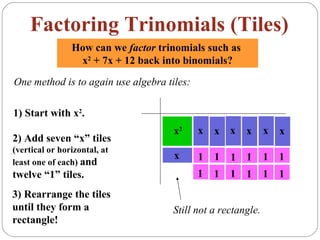
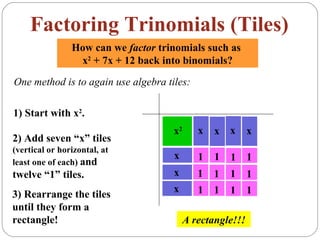
Factoring Trinomials (Tiles)
                How can we factor trinomials such as
                 x2 + 7x + 12 back into binomials?

One method is to again use algebra tiles:

1) Start with x2.
                                     x2     x   x x     x     x   x
2) Add seven “x” tiles
(vertical or horizontal, at
                                     x      1   1   1   1     1   1
least one of each) and
twelve “1” tiles.                           1   1   1   1     1   1
3) Rearrange the tiles
until they form a                    Still not a rectangle.
rectangle!
Factoring Trinomials (Tiles)
                How can we factor trinomials such as
                 x2 + 7x + 12 back into binomials?

One method is to again use algebra tiles:

1) Start with x2.
                                     x2      x   x x       x
2) Add seven “x” tiles
(vertical or horizontal, at
                                     x       1   1   1     1
least one of each) and
twelve “1” tiles.                    x       1   1   1     1
                                     x       1   1   1     1
3) Rearrange the tiles
until they form a
rectangle!                                A rectangle!!!
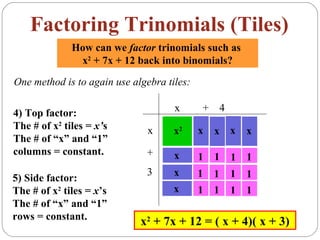
Factoring Trinomials (Tiles)
              How can we factor trinomials such as
               x2 + 7x + 12 back into binomials?

One method is to again use algebra tiles:

4) Top factor:                       x      +       4
The # of x2 tiles = x’s        x     x2     x   x x         x
The # of “x” and “1”
columns = constant.           +      x      1   1       1   1
                              3      x      1   1       1   1
5) Side factor:
The # of x2 tiles = x’s              x      1   1       1   1
The # of “x” and “1”
rows = constant.
                             x2 + 7x + 12 = ( x + 4)( x + 3)
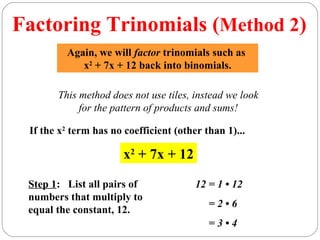
Factoring Trinomials (Method 2)
         Again, we will factor trinomials such as
            x2 + 7x + 12 back into binomials.

       This method does not use tiles, instead we look
            for the pattern of products and sums!

 If the x2 term has no coefficient (other than 1)...

                       x2 + 7x + 12

 Step 1: List all pairs of              12 = 1 • 12
 numbers that multiply to
                                           =2•6
 equal the constant, 12.
                                           =3•4
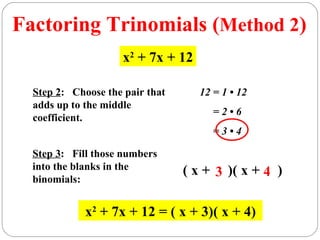
Factoring Trinomials (Method 2)
                     x2 + 7x + 12

  Step 2: Choose the pair that      12 = 1 • 12
  adds up to the middle
                                       =2•6
  coefficient.
                                       =3•4

  Step 3: Fill those numbers
  into the blanks in the         ( x + 3 )( x + 4 )
  binomials:


             x2 + 7x + 12 = ( x + 3)( x + 4)
Factoring Trinomials (Method 2)
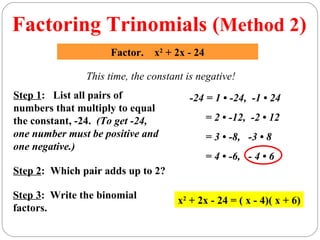
                    Factor.    x2 + 2x - 24

               This time, the constant is negative!
Step 1: List all pairs of              -24 = 1 • -24, -1 • 24
numbers that multiply to equal
the constant, -24. (To get -24,               = 2 • -12, -2 • 12
one number must be positive and               = 3 • -8, -3 • 8
one negative.)
                                              = 4 • -6, - 4 • 6
Step 2: Which pair adds up to 2?

Step 3: Write the binomial           x2 + 2x - 24 = ( x - 4)( x + 6)
factors.
Factoring Trinomials (Method 2*)
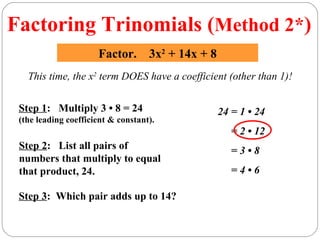
                      Factor. 3x2 + 14x + 8
   This time, the x2 term DOES have a coefficient (other than 1)!

 Step 1: Multiply 3 • 8 = 24                   24 = 1 • 24
 (the leading coefficient & constant).
                                                  = 2 • 12
 Step 2: List all pairs of                        =3•8
 numbers that multiply to equal
 that product, 24.                                =4•6

 Step 3: Which pair adds up to 14?
Factoring Trinomials (Method 2*)
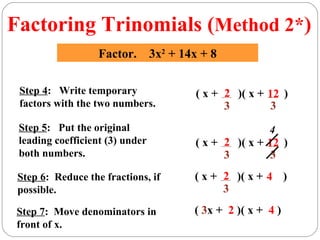
                   Factor. 3x2 + 14x + 8

 Step 4: Write temporary            ( x + 2 )( x + 12 )
 factors with the two numbers.            3        3
 Step 5: Put the original                           4
 leading coefficient (3) under      ( x + 2 )( x + 12 )
 both numbers.                            3        3
 Step 6: Reduce the fractions, if   ( x + 2 )( x + 4 )
 possible.                                3
 Step 7: Move denominators in       ( 3x + 2 )( x + 4 )
 front of x.
Factoring Trinomials (Method 2*)
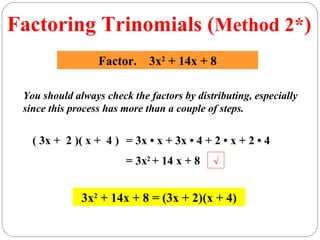
                  Factor. 3x2 + 14x + 8

 You should always check the factors by distributing, especially
 since this process has more than a couple of steps.


   ( 3x + 2 )( x + 4 ) = 3x • x + 3x • 4 + 2 • x + 2 • 4
                        = 3x2 + 14 x + 8    √


              3x2 + 14x + 8 = (3x + 2)(x + 4)
Factoring Trinomials (Method 2*)
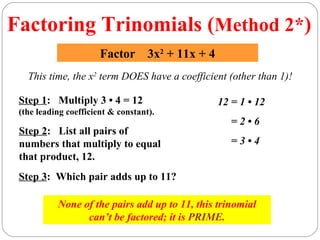
                       Factor 3x2 + 11x + 4
   This time, the x2 term DOES have a coefficient (other than 1)!

 Step 1: Multiply 3 • 4 = 12                    12 = 1 • 12
 (the leading coefficient & constant).
                                                   =2•6
 Step 2: List all pairs of
 numbers that multiply to equal                    =3•4
 that product, 12.
 Step 3: Which pair adds up to 11?

           None of the pairs add up to 11, this trinomial
                 can’t be factored; it is PRIME.
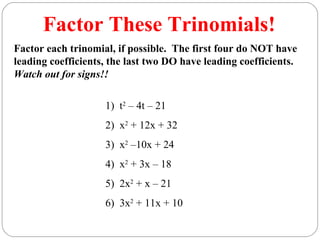
Factor These Trinomials!
Factor each trinomial, if possible. The first four do NOT have
leading coefficients, the last two DO have leading coefficients.
Watch out for signs!!

                    1) t2 – 4t – 21
                    2) x2 + 12x + 32
                    3) x2 –10x + 24
                    4) x2 + 3x – 18
                    5) 2x2 + x – 21
                    6) 3x2 + 11x + 10
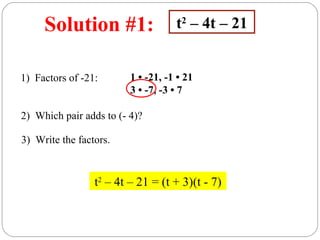
Solution #1:                   t2 – 4t – 21


1) Factors of -21:       1 • -21, -1 • 21
                         3 • -7, -3 • 7

2) Which pair adds to (- 4)?

3) Write the factors.


                 t2 – 4t – 21 = (t + 3)(t - 7)
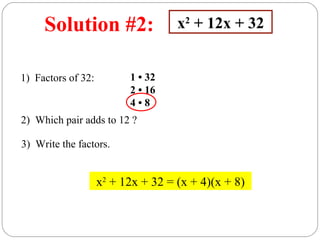
Solution #2:                   x2 + 12x + 32


1) Factors of 32:         1 • 32
                          2 • 16
                          4•8
2) Which pair adds to 12 ?

3) Write the factors.


                    x2 + 12x + 32 = (x + 4)(x + 8)
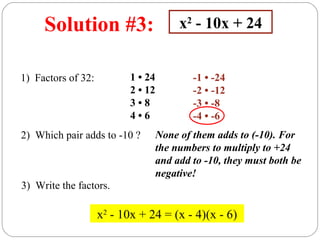
Solution #3:                        x2 - 10x + 24


1) Factors of 32:          1 • 24           -1 • -24
                           2 • 12           -2 • -12
                           3•8              -3 • -8
                           4•6              -4 • -6
2) Which pair adds to -10 ?         None of them adds to (-10). For
                                    the numbers to multiply to +24
                                    and add to -10, they must both be
                                    negative!
3) Write the factors.

                    x2 - 10x + 24 = (x - 4)(x - 6)
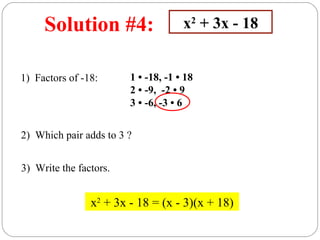
Solution #4:                    x2 + 3x - 18


1) Factors of -18:      1 • -18, -1 • 18
                        2 • -9, -2 • 9
                        3 • -6, -3 • 6


2) Which pair adds to 3 ?


3) Write the factors.


                x2 + 3x - 18 = (x - 3)(x + 18)
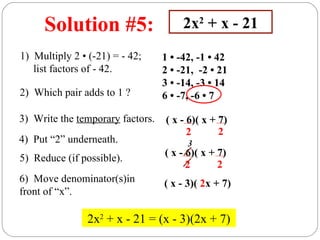
Solution #5:                      2x2 + x - 21
1) Multiply 2 • (-21) = - 42;     1 • -42, -1 • 42
   list factors of - 42.          2 • -21, -2 • 21
                                  3 • -14, -3 • 14
2) Which pair adds to 1 ?         6 • -7, -6 • 7

3) Write the temporary factors.   ( x - 6)( x + 7)
                                        2       2
4) Put “2” underneath.                  3
                                  ( x - 6)( x + 7)
5) Reduce (if possible).
                                        2       2
6) Move denominator(s)in          ( x - 3)( 2x + 7)
front of “x”.

                2x2 + x - 21 = (x - 3)(2x + 7)
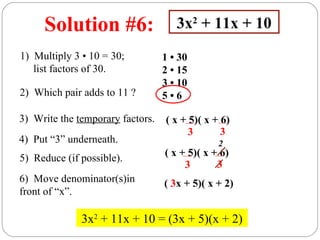
Solution #6:                    3x2 + 11x + 10
1) Multiply 3 • 10 = 30;          1 • 30
   list factors of 30.            2 • 15
                                  3 • 10
2) Which pair adds to 11 ?        5•6

3) Write the temporary factors.   ( x + 5)( x + 6)
                                        3       3
4) Put “3” underneath.                         2
                                  ( x + 5)( x + 6)
5) Reduce (if possible).
                                       3       3
6) Move denominator(s)in          ( 3x + 5)( x + 2)
front of “x”.

              3x2 + 11x + 10 = (3x + 5)(x + 2)

Factoring notes

  • 1.
  • 2.
  • 3.
    Multiplying Binomials (FOIL) Multiply. (x+3)(x+2) Distribute. x•x+x•2+3•x+3•2 F O I L = x2+ 2x + 3x + 6 = x2+ 5x + 6
  • 4.
    Multiplying Binomials (Tiles) Multiply. (x+3)(x+2) Using Algebra Tiles, we have: x + 3 x x2 x x x + = x2 + 5x + 6 x 1 1 1 2 x 1 1 1
  • 5.
    Factoring Trinomials (Tiles) How can we factor trinomials such as x2 + 7x + 12 back into binomials? One method is to again use algebra tiles: 1) Start with x2. x2 x x x x x 2) Add seven “x” tiles (vertical or horizontal, at x 1 1 1 1 1 least one of each) and twelve “1” tiles. x 1 1 1 1 1 1 1
  • 6.
    Factoring Trinomials (Tiles) How can we factor trinomials such as x2 + 7x + 12 back into binomials? One method is to again use algebra tiles: 1) Start with x2. x2 x x x x x 2) Add seven “x” tiles (vertical or horizontal, at x 1 1 1 1 1 least one of each) and twelve “1” tiles. x 1 1 1 1 1 3) Rearrange the tiles 1 1 until they form a We need to change the “x” tiles so rectangle! the “1” tiles will fill in a rectangle.
  • 7.
    Factoring Trinomials (Tiles) How can we factor trinomials such as x2 + 7x + 12 back into binomials? One method is to again use algebra tiles: 1) Start with x2. x2 x x x x x x 2) Add seven “x” tiles (vertical or horizontal, at x 1 1 1 1 1 1 least one of each) and twelve “1” tiles. 1 1 1 1 1 1 3) Rearrange the tiles until they form a Still not a rectangle. rectangle!
  • 8.
    Factoring Trinomials (Tiles) How can we factor trinomials such as x2 + 7x + 12 back into binomials? One method is to again use algebra tiles: 1) Start with x2. x2 x x x x 2) Add seven “x” tiles (vertical or horizontal, at x 1 1 1 1 least one of each) and twelve “1” tiles. x 1 1 1 1 x 1 1 1 1 3) Rearrange the tiles until they form a rectangle! A rectangle!!!
  • 9.
    Factoring Trinomials (Tiles) How can we factor trinomials such as x2 + 7x + 12 back into binomials? One method is to again use algebra tiles: 4) Top factor: x + 4 The # of x2 tiles = x’s x x2 x x x x The # of “x” and “1” columns = constant. + x 1 1 1 1 3 x 1 1 1 1 5) Side factor: The # of x2 tiles = x’s x 1 1 1 1 The # of “x” and “1” rows = constant. x2 + 7x + 12 = ( x + 4)( x + 3)
  • 10.
    Factoring Trinomials (Method2) Again, we will factor trinomials such as x2 + 7x + 12 back into binomials. This method does not use tiles, instead we look for the pattern of products and sums! If the x2 term has no coefficient (other than 1)... x2 + 7x + 12 Step 1: List all pairs of 12 = 1 • 12 numbers that multiply to =2•6 equal the constant, 12. =3•4
  • 11.
    Factoring Trinomials (Method2) x2 + 7x + 12 Step 2: Choose the pair that 12 = 1 • 12 adds up to the middle =2•6 coefficient. =3•4 Step 3: Fill those numbers into the blanks in the ( x + 3 )( x + 4 ) binomials: x2 + 7x + 12 = ( x + 3)( x + 4)
  • 12.
    Factoring Trinomials (Method2) Factor. x2 + 2x - 24 This time, the constant is negative! Step 1: List all pairs of -24 = 1 • -24, -1 • 24 numbers that multiply to equal the constant, -24. (To get -24, = 2 • -12, -2 • 12 one number must be positive and = 3 • -8, -3 • 8 one negative.) = 4 • -6, - 4 • 6 Step 2: Which pair adds up to 2? Step 3: Write the binomial x2 + 2x - 24 = ( x - 4)( x + 6) factors.
  • 13.
    Factoring Trinomials (Method2*) Factor. 3x2 + 14x + 8 This time, the x2 term DOES have a coefficient (other than 1)! Step 1: Multiply 3 • 8 = 24 24 = 1 • 24 (the leading coefficient & constant). = 2 • 12 Step 2: List all pairs of =3•8 numbers that multiply to equal that product, 24. =4•6 Step 3: Which pair adds up to 14?
  • 14.
    Factoring Trinomials (Method2*) Factor. 3x2 + 14x + 8 Step 4: Write temporary ( x + 2 )( x + 12 ) factors with the two numbers. 3 3 Step 5: Put the original 4 leading coefficient (3) under ( x + 2 )( x + 12 ) both numbers. 3 3 Step 6: Reduce the fractions, if ( x + 2 )( x + 4 ) possible. 3 Step 7: Move denominators in ( 3x + 2 )( x + 4 ) front of x.
  • 15.
    Factoring Trinomials (Method2*) Factor. 3x2 + 14x + 8 You should always check the factors by distributing, especially since this process has more than a couple of steps. ( 3x + 2 )( x + 4 ) = 3x • x + 3x • 4 + 2 • x + 2 • 4 = 3x2 + 14 x + 8 √ 3x2 + 14x + 8 = (3x + 2)(x + 4)
  • 16.
    Factoring Trinomials (Method2*) Factor 3x2 + 11x + 4 This time, the x2 term DOES have a coefficient (other than 1)! Step 1: Multiply 3 • 4 = 12 12 = 1 • 12 (the leading coefficient & constant). =2•6 Step 2: List all pairs of numbers that multiply to equal =3•4 that product, 12. Step 3: Which pair adds up to 11? None of the pairs add up to 11, this trinomial can’t be factored; it is PRIME.
  • 17.
    Factor These Trinomials! Factoreach trinomial, if possible. The first four do NOT have leading coefficients, the last two DO have leading coefficients. Watch out for signs!! 1) t2 – 4t – 21 2) x2 + 12x + 32 3) x2 –10x + 24 4) x2 + 3x – 18 5) 2x2 + x – 21 6) 3x2 + 11x + 10
  • 18.
    Solution #1: t2 – 4t – 21 1) Factors of -21: 1 • -21, -1 • 21 3 • -7, -3 • 7 2) Which pair adds to (- 4)? 3) Write the factors. t2 – 4t – 21 = (t + 3)(t - 7)
  • 19.
    Solution #2: x2 + 12x + 32 1) Factors of 32: 1 • 32 2 • 16 4•8 2) Which pair adds to 12 ? 3) Write the factors. x2 + 12x + 32 = (x + 4)(x + 8)
  • 20.
    Solution #3: x2 - 10x + 24 1) Factors of 32: 1 • 24 -1 • -24 2 • 12 -2 • -12 3•8 -3 • -8 4•6 -4 • -6 2) Which pair adds to -10 ? None of them adds to (-10). For the numbers to multiply to +24 and add to -10, they must both be negative! 3) Write the factors. x2 - 10x + 24 = (x - 4)(x - 6)
  • 21.
    Solution #4: x2 + 3x - 18 1) Factors of -18: 1 • -18, -1 • 18 2 • -9, -2 • 9 3 • -6, -3 • 6 2) Which pair adds to 3 ? 3) Write the factors. x2 + 3x - 18 = (x - 3)(x + 18)
  • 22.
    Solution #5: 2x2 + x - 21 1) Multiply 2 • (-21) = - 42; 1 • -42, -1 • 42 list factors of - 42. 2 • -21, -2 • 21 3 • -14, -3 • 14 2) Which pair adds to 1 ? 6 • -7, -6 • 7 3) Write the temporary factors. ( x - 6)( x + 7) 2 2 4) Put “2” underneath. 3 ( x - 6)( x + 7) 5) Reduce (if possible). 2 2 6) Move denominator(s)in ( x - 3)( 2x + 7) front of “x”. 2x2 + x - 21 = (x - 3)(2x + 7)
  • 23.
    Solution #6: 3x2 + 11x + 10 1) Multiply 3 • 10 = 30; 1 • 30 list factors of 30. 2 • 15 3 • 10 2) Which pair adds to 11 ? 5•6 3) Write the temporary factors. ( x + 5)( x + 6) 3 3 4) Put “3” underneath. 2 ( x + 5)( x + 6) 5) Reduce (if possible). 3 3 6) Move denominator(s)in ( 3x + 5)( x + 2) front of “x”. 3x2 + 11x + 10 = (3x + 5)(x + 2)