TEMPLATE DESIGN © 2008
www.PosterPresentations.com
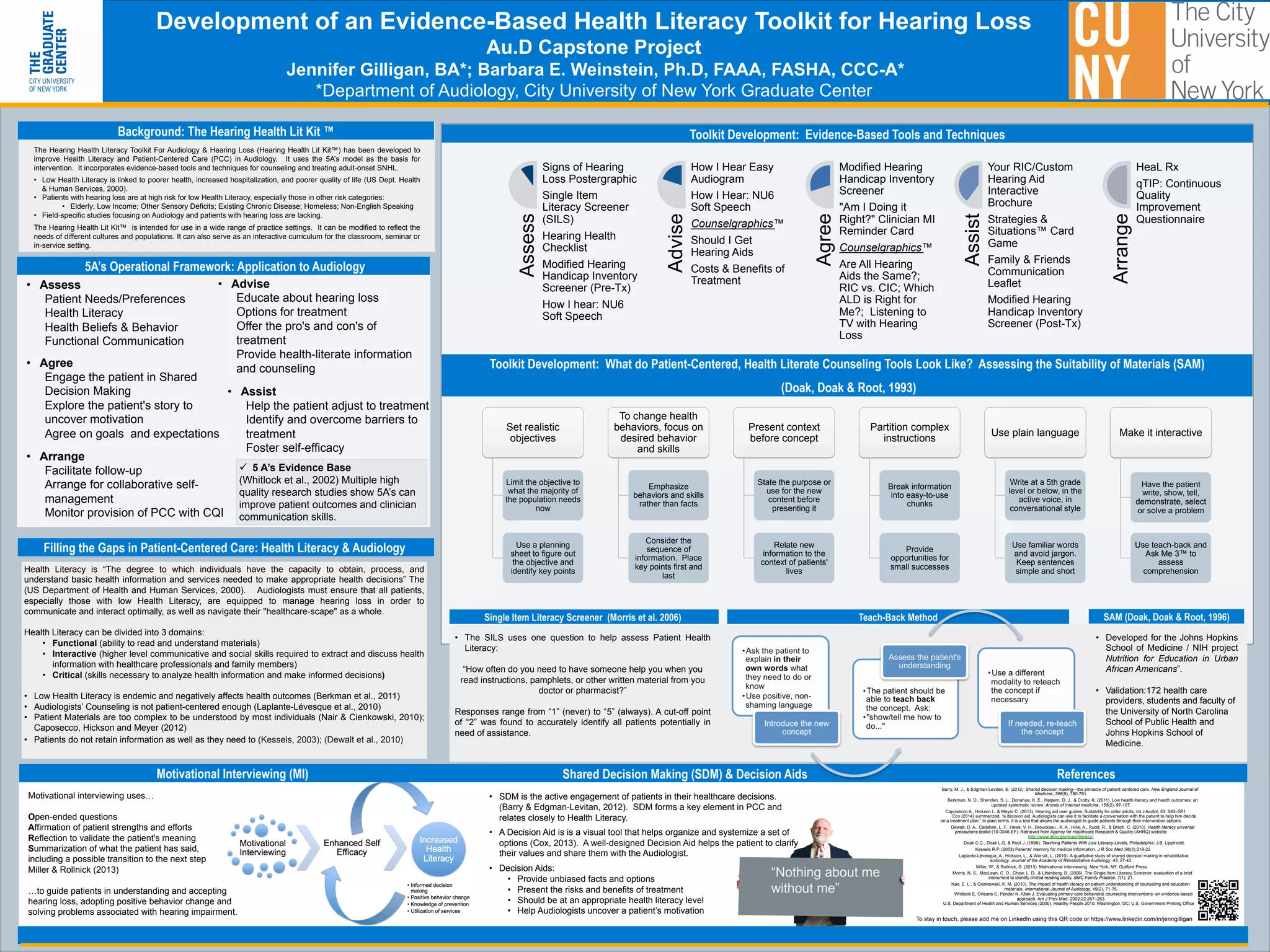
Development of an Evidence-Based Health Literacy Toolkit for Hearing Loss
Au.D Capstone Project
Jennifer Gilligan, BA*; Barbara E. Weinstein, Ph.D, FAAA, FASHA, CCC-A*
*Department of Audiology, City University of New York Graduate Center
Set realistic
objectives
Limit the objective to
what the majority of
the population needs
now
Use a planning
sheet to figure out
the objective and
identify key points
To change health
behaviors, focus on
desired behavior
and skills
Emphasize
behaviors and skills
rather than facts
Consider the
sequence of
information. Place
key points first and
last
Present context
before concept
State the purpose or
use for the new
content before
presenting it
Relate new
information to the
context of patients'
lives
Partition complex
instructions
Break information
into easy-to-use
chunks
Provide
opportunities for
small successes
Use plain language
Write at a 5th grade
level or below, in the
active voice, in
conversational style
Use familiar words
and avoid jargon.
Keep sentences
simple and short
Make it interactive
Have the patient
write, show, tell,
demonstrate, select
or solve a problem
Use teach-back and
Ask Me 3™ to
assess
comprehension
Assess
Signs of Hearing
Loss Postergraphic
Single Item
Literacy Screener
(SILS)
Hearing Health
Checklist
Modified Hearing
Handicap Inventory
Screener (Pre-Tx)
How I hear: NU6
Soft Speech
Advise
How I Hear Easy
Audiogram
How I Hear: NU6
Soft Speech
Counselgraphics™
Should I Get
Hearing Aids
Costs & Benefits of
Treatment
Agree
Modified Hearing
Handicap Inventory
Screener
"Am I Doing it
Right?" Clinician MI
Reminder Card
Counselgraphics™
Are All Hearing
Aids the Same?;
RIC vs. CIC; Which
ALD is Right for
Me?; Listening to
TV with Hearing
Loss
Assist
Your RIC/Custom
Hearing Aid
Interactive
Brochure
Strategies &
Situations™ Card
Game
Family & Friends
Communication
Leaflet
Modified Hearing
Handicap Inventory
Screener (Post-Tx)
Arrange
HeaL Rx
qTIP: Continuous
Quality
Improvement
Questionnaire
Toolkit Development: Evidence-Based Tools and Techniques
Toolkit Development: What do Patient-Centered, Health Literate Counseling Tools Look Like? Assessing the Suitability of Materials (SAM)
(Doak, Doak & Root, 1993)
”
Single Item Literacy Screener (Morris et al. 2006) SAM (Doak, Doak & Root, 1996)
“Nothing about me
without me”
Background
Health Literacy is “The degree to which individuals have the capacity to obtain, process, and
understand basic health information and services needed to make appropriate health decisions” The
(US Department of Health and Human Services, 2000). Audiologists must ensure that all patients,
especially those with low Health Literacy, are equipped to manage hearing loss in order to
communicate and interact optimally, as well as navigate their "healthcare-scape" as a whole.
Health Literacy can be divided into 3 domains:
•  Functional (ability to read and understand materials)
•  Interactive (higher level communicative and social skills required to extract and discuss health
information with healthcare professionals and family members)
•  Critical (skills necessary to analyze health information and make informed decisions)
•  Low Health Literacy is endemic and negatively affects health outcomes (Berkman et al., 2011)
•  Audiologists’ Counseling is not patient-centered enough (Laplante-Lévesque et al., 2010)
•  Patient Materials are too complex to be understood by most individuals (Nair & Cienkowski, 2010);
Caposecco, Hickson and Meyer (2012)
•  Patients do not retain information as well as they need to (Kessels, 2003); (Dewalt et al., 2010)
Filling the Gaps in Patient-Centered Care: Health Literacy & Audiology
References
Teach-Back Method
•  Developed for the Johns Hopkins
School of Medicine / NIH project
Nutrition for Education in Urban
African Americans”.
•  Validation:172 health care
providers, students and faculty of
the University of North Carolina
School of Public Health and
Johns Hopkins School of
Medicine.
•  Assess
Patient Needs/Preferences
Health Literacy
Health Beliefs & Behavior
Functional Communication
•  Advise
Educate about hearing loss
Options for treatment
Offer the pro's and con's of
treatment
Provide health-literate information
and counseling•  Agree
Engage the patient in Shared
Decision Making
Explore the patient's story to
uncover motivation
Agree on goals and expectations
•  Assist
Help the patient adjust to treatment
Identify and overcome barriers to
treatment
Foster self-efficacy
•  Arrange
Facilitate follow-up
Arrange for collaborative self-
management
Monitor provision of PCC with CQI
5A’s Operational Framework: Application to Audiology
ü  5 A’s Evidence Base
(Whitlock et al., 2002) Multiple high
quality research studies show 5A’s can
improve patient outcomes and clinician
communication skills.
The Hearing Health Literacy Toolkit For Audiology & Hearing Loss (Hearing Health Lit Kit™) has been developed to
improve Health Literacy and Patient-Centered Care (PCC) in Audiology. It uses the 5A’s model as the basis for
intervention. It incorporates evidence-based tools and techniques for counseling and treating adult-onset SNHL.
•  Low Health Literacy is linked to poorer health, increased hospitalization, and poorer quality of life (US Dept. Health
& Human Services, 2000).
•  Patients with hearing loss are at high risk for low Health Literacy, especially those in other risk categories:
•  Elderly; Low Income; Other Sensory Deficits; Existing Chronic Disease; Homeless; Non-English Speaking
•  Field-specific studies focusing on Audiology and patients with hearing loss are lacking.
The Hearing Health Lit Kit™ is intended for use in a wide range of practice settings. It can be modified to reflect the
needs of different cultures and populations. It can also serve as an interactive curriculum for the classroom, seminar or
in-service setting.
Background: The Hearing Health Lit Kit ™
Motivational interviewing uses…
Open-ended questions
Affirmation of patient strengths and efforts
Reflection to validate the patient's meaning
Summarization of what the patient has said,
including a possible transition to the next step
Miller & Rollnick (2013)
…to guide patients in understanding and accepting
hearing loss, adopting positive behavior change and
solving problems associated with hearing impairment.
•  The SILS uses one question to help assess Patient Health
Literacy:
“How often do you need to have someone help you when you
read instructions, pamphlets, or other written material from you
doctor or pharmacist?”
Responses range from “1” (never) to “5” (always). A cut-off point
of “2” was found to accurately identify all patients potentially in
need of assistance.
Shared Decision Making (SDM) & Decision AidsMotivational Interviewing (MI)
•  SDM is the active engagement of patients in their healthcare decisions.
(Barry & Edgman-Levitan, 2012). SDM forms a key element in PCC and
relates closely to Health Literacy.
•  A Decision Aid is is a visual tool that helps organize and systemize a set of
options (Cox, 2013). A well-designed Decision Aid helps the patient to clarify
their values and share them with the Audiologist.
•  Decision Aids:
•  Provide unbiased facts and options
•  Present the risks and benefits of treatment
•  Should be at an appropriate health literacy level
•  Help Audiologists uncover a patient’s motivation
Barry, M. J., & Edgman-Levitan, S. (2012). Shared decision making—the pinnacle of patient-centered care. New England Journal of
Medicine, 366(9), 780-781.
Berkman, N. D., Sheridan, S. L., Donahue, K. E., Halpern, D. J., & Crotty, K. (2011). Low health literacy and health outcomes: an
updated systematic review. Annals of internal medicine, 155(2), 97-107.
Caposecco A., Hickson L. & Meyer C. (2013). Hearing aid user guides: Suitability for older adults. Int J Audiol, 53: S43–S51.
Cox (2014) summarized, “a decision aid. Audiologists can use it to facilitate a conversation with the patient to help him decide
on a treatment plan.” In plain terms, it is a tool that allows the audiologist to guide patients through their intervention options.
Dewalt, D. A., Callahan, L. F., Hawk, V. H., Broucksou , K. A., Hink, A., Rudd, R., & Brach, C. (2010). Health literacy universal
precautions toolkit (10-0046-EF). Retrieved from Agency for Healthcare Research & Quality (AHRQ) website:
http://www.ahrq.gov/qual/literacy/.
Doak C.C., Doak L.G. & Root J. (1996). Teaching Patients With Low Literacy Levels, Philadelphia: J.B. Lippincott.
Kessels R.P. (2003) Patients' memory for medical information. J R Soc Med.;96(5):219-22
Laplante-Lévesque, A., Hickson, L., & Worrall, L. (2010). A qualitative study of shared decision making in rehabilitative
audiology. Journal of the Academy of Rehabilitative Audiology, 43, 27-43.
Miller, W., & Rollnick, S. (2013). Motivational interviewing. New York, NY: Guilford Press.
Morris, N. S., MacLean, C. D., Chew, L. D., & Littenberg, B. (2006). The Single Item Literacy Screener: evaluation of a brief
instrument to identify limited reading ability. BMC Family Practice, 7(1), 21.
Nair, E. L., & Cienkowski, K. M. (2010). The impact of health literacy on patient understanding of counseling and education
materials. International Journal of Audiology, 49(2), 71-75.
Whitlock E, Orleans C, Pender N, Allan J. Evaluating primary care behavioral counseling interventions: an evidence-based
approach. Am J Prev Med. 2002;22:267–283.
U.S. Department of Health and Human Services (2000). Healthy People 2010. Washington, DC: U.S. Government Printing Office
To stay in touch, please add me on LinkedIn using this QR code or https://www.linkedin.com/in/jenngilligan

AAA 2016 Poster2

  • 1.
    TEMPLATE DESIGN ©2008 www.PosterPresentations.com Development of an Evidence-Based Health Literacy Toolkit for Hearing Loss Au.D Capstone Project Jennifer Gilligan, BA*; Barbara E. Weinstein, Ph.D, FAAA, FASHA, CCC-A* *Department of Audiology, City University of New York Graduate Center Set realistic objectives Limit the objective to what the majority of the population needs now Use a planning sheet to figure out the objective and identify key points To change health behaviors, focus on desired behavior and skills Emphasize behaviors and skills rather than facts Consider the sequence of information. Place key points first and last Present context before concept State the purpose or use for the new content before presenting it Relate new information to the context of patients' lives Partition complex instructions Break information into easy-to-use chunks Provide opportunities for small successes Use plain language Write at a 5th grade level or below, in the active voice, in conversational style Use familiar words and avoid jargon. Keep sentences simple and short Make it interactive Have the patient write, show, tell, demonstrate, select or solve a problem Use teach-back and Ask Me 3™ to assess comprehension Assess Signs of Hearing Loss Postergraphic Single Item Literacy Screener (SILS) Hearing Health Checklist Modified Hearing Handicap Inventory Screener (Pre-Tx) How I hear: NU6 Soft Speech Advise How I Hear Easy Audiogram How I Hear: NU6 Soft Speech Counselgraphics™ Should I Get Hearing Aids Costs & Benefits of Treatment Agree Modified Hearing Handicap Inventory Screener "Am I Doing it Right?" Clinician MI Reminder Card Counselgraphics™ Are All Hearing Aids the Same?; RIC vs. CIC; Which ALD is Right for Me?; Listening to TV with Hearing Loss Assist Your RIC/Custom Hearing Aid Interactive Brochure Strategies & Situations™ Card Game Family & Friends Communication Leaflet Modified Hearing Handicap Inventory Screener (Post-Tx) Arrange HeaL Rx qTIP: Continuous Quality Improvement Questionnaire Toolkit Development: Evidence-Based Tools and Techniques Toolkit Development: What do Patient-Centered, Health Literate Counseling Tools Look Like? Assessing the Suitability of Materials (SAM) (Doak, Doak & Root, 1993) ” Single Item Literacy Screener (Morris et al. 2006) SAM (Doak, Doak & Root, 1996) “Nothing about me without me” Background Health Literacy is “The degree to which individuals have the capacity to obtain, process, and understand basic health information and services needed to make appropriate health decisions” The (US Department of Health and Human Services, 2000). Audiologists must ensure that all patients, especially those with low Health Literacy, are equipped to manage hearing loss in order to communicate and interact optimally, as well as navigate their "healthcare-scape" as a whole. Health Literacy can be divided into 3 domains: •  Functional (ability to read and understand materials) •  Interactive (higher level communicative and social skills required to extract and discuss health information with healthcare professionals and family members) •  Critical (skills necessary to analyze health information and make informed decisions) •  Low Health Literacy is endemic and negatively affects health outcomes (Berkman et al., 2011) •  Audiologists’ Counseling is not patient-centered enough (Laplante-Lévesque et al., 2010) •  Patient Materials are too complex to be understood by most individuals (Nair & Cienkowski, 2010); Caposecco, Hickson and Meyer (2012) •  Patients do not retain information as well as they need to (Kessels, 2003); (Dewalt et al., 2010) Filling the Gaps in Patient-Centered Care: Health Literacy & Audiology References Teach-Back Method •  Developed for the Johns Hopkins School of Medicine / NIH project Nutrition for Education in Urban African Americans”. •  Validation:172 health care providers, students and faculty of the University of North Carolina School of Public Health and Johns Hopkins School of Medicine. •  Assess Patient Needs/Preferences Health Literacy Health Beliefs & Behavior Functional Communication •  Advise Educate about hearing loss Options for treatment Offer the pro's and con's of treatment Provide health-literate information and counseling•  Agree Engage the patient in Shared Decision Making Explore the patient's story to uncover motivation Agree on goals and expectations •  Assist Help the patient adjust to treatment Identify and overcome barriers to treatment Foster self-efficacy •  Arrange Facilitate follow-up Arrange for collaborative self- management Monitor provision of PCC with CQI 5A’s Operational Framework: Application to Audiology ü  5 A’s Evidence Base (Whitlock et al., 2002) Multiple high quality research studies show 5A’s can improve patient outcomes and clinician communication skills. The Hearing Health Literacy Toolkit For Audiology & Hearing Loss (Hearing Health Lit Kit™) has been developed to improve Health Literacy and Patient-Centered Care (PCC) in Audiology. It uses the 5A’s model as the basis for intervention. It incorporates evidence-based tools and techniques for counseling and treating adult-onset SNHL. •  Low Health Literacy is linked to poorer health, increased hospitalization, and poorer quality of life (US Dept. Health & Human Services, 2000). •  Patients with hearing loss are at high risk for low Health Literacy, especially those in other risk categories: •  Elderly; Low Income; Other Sensory Deficits; Existing Chronic Disease; Homeless; Non-English Speaking •  Field-specific studies focusing on Audiology and patients with hearing loss are lacking. The Hearing Health Lit Kit™ is intended for use in a wide range of practice settings. It can be modified to reflect the needs of different cultures and populations. It can also serve as an interactive curriculum for the classroom, seminar or in-service setting. Background: The Hearing Health Lit Kit ™ Motivational interviewing uses… Open-ended questions Affirmation of patient strengths and efforts Reflection to validate the patient's meaning Summarization of what the patient has said, including a possible transition to the next step Miller & Rollnick (2013) …to guide patients in understanding and accepting hearing loss, adopting positive behavior change and solving problems associated with hearing impairment. •  The SILS uses one question to help assess Patient Health Literacy: “How often do you need to have someone help you when you read instructions, pamphlets, or other written material from you doctor or pharmacist?” Responses range from “1” (never) to “5” (always). A cut-off point of “2” was found to accurately identify all patients potentially in need of assistance. Shared Decision Making (SDM) & Decision AidsMotivational Interviewing (MI) •  SDM is the active engagement of patients in their healthcare decisions. (Barry & Edgman-Levitan, 2012). SDM forms a key element in PCC and relates closely to Health Literacy. •  A Decision Aid is is a visual tool that helps organize and systemize a set of options (Cox, 2013). A well-designed Decision Aid helps the patient to clarify their values and share them with the Audiologist. •  Decision Aids: •  Provide unbiased facts and options •  Present the risks and benefits of treatment •  Should be at an appropriate health literacy level •  Help Audiologists uncover a patient’s motivation Barry, M. J., & Edgman-Levitan, S. (2012). Shared decision making—the pinnacle of patient-centered care. New England Journal of Medicine, 366(9), 780-781. Berkman, N. D., Sheridan, S. L., Donahue, K. E., Halpern, D. J., & Crotty, K. (2011). Low health literacy and health outcomes: an updated systematic review. Annals of internal medicine, 155(2), 97-107. Caposecco A., Hickson L. & Meyer C. (2013). Hearing aid user guides: Suitability for older adults. Int J Audiol, 53: S43–S51. Cox (2014) summarized, “a decision aid. Audiologists can use it to facilitate a conversation with the patient to help him decide on a treatment plan.” In plain terms, it is a tool that allows the audiologist to guide patients through their intervention options. Dewalt, D. A., Callahan, L. F., Hawk, V. H., Broucksou , K. A., Hink, A., Rudd, R., & Brach, C. (2010). Health literacy universal precautions toolkit (10-0046-EF). Retrieved from Agency for Healthcare Research & Quality (AHRQ) website: http://www.ahrq.gov/qual/literacy/. Doak C.C., Doak L.G. & Root J. (1996). Teaching Patients With Low Literacy Levels, Philadelphia: J.B. Lippincott. Kessels R.P. (2003) Patients' memory for medical information. J R Soc Med.;96(5):219-22 Laplante-Lévesque, A., Hickson, L., & Worrall, L. (2010). A qualitative study of shared decision making in rehabilitative audiology. Journal of the Academy of Rehabilitative Audiology, 43, 27-43. Miller, W., & Rollnick, S. (2013). Motivational interviewing. New York, NY: Guilford Press. Morris, N. S., MacLean, C. D., Chew, L. D., & Littenberg, B. (2006). The Single Item Literacy Screener: evaluation of a brief instrument to identify limited reading ability. BMC Family Practice, 7(1), 21. Nair, E. L., & Cienkowski, K. M. (2010). The impact of health literacy on patient understanding of counseling and education materials. International Journal of Audiology, 49(2), 71-75. Whitlock E, Orleans C, Pender N, Allan J. Evaluating primary care behavioral counseling interventions: an evidence-based approach. Am J Prev Med. 2002;22:267–283. U.S. Department of Health and Human Services (2000). Healthy People 2010. Washington, DC: U.S. Government Printing Office To stay in touch, please add me on LinkedIn using this QR code or https://www.linkedin.com/in/jenngilligan