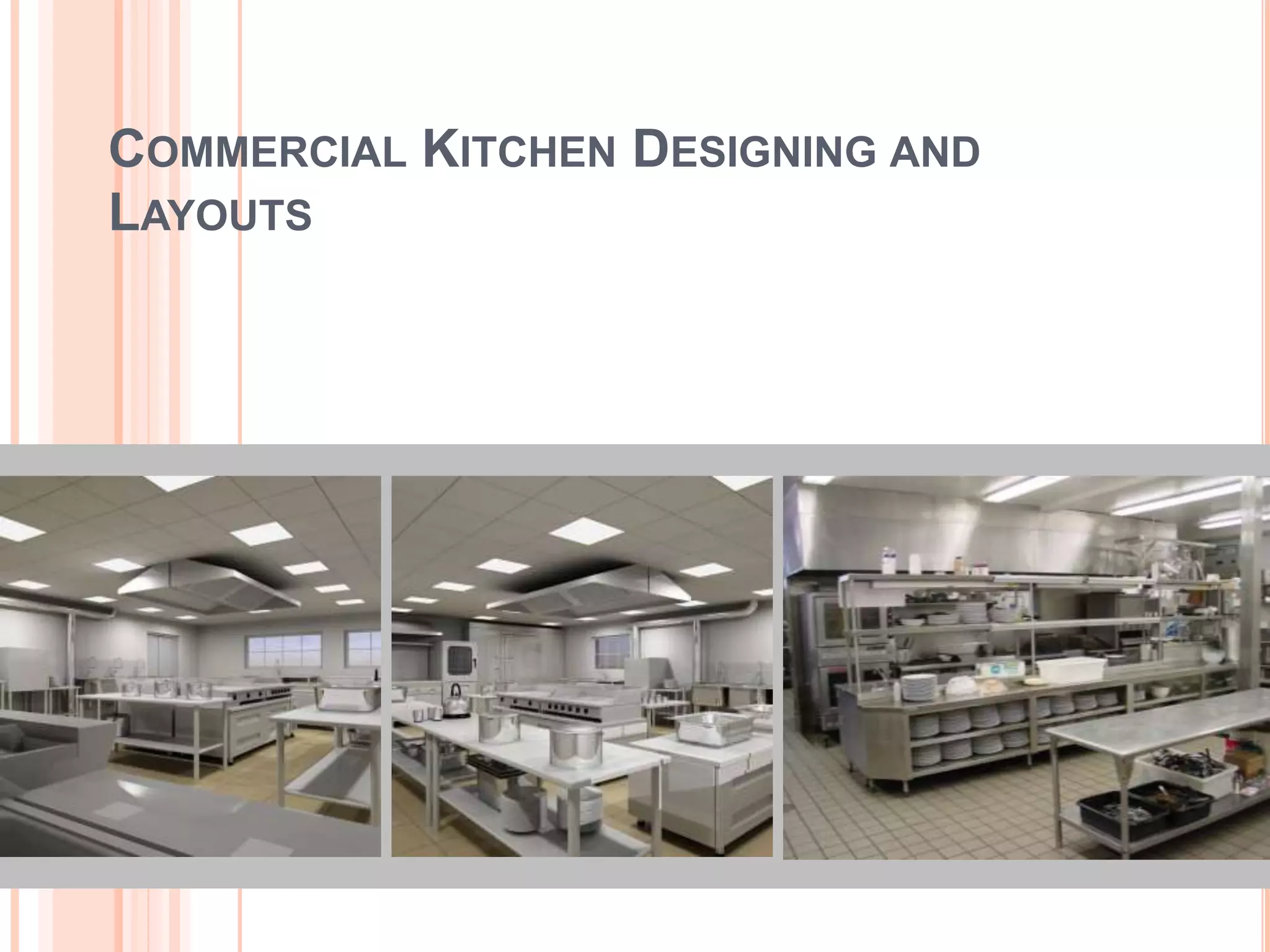
COMMERCIAL KITCHEN DESIGNING AND
LAYOUTS
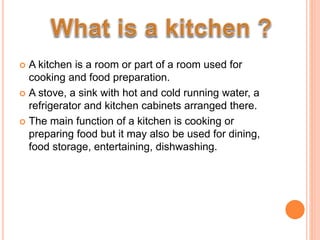
 A kitchen is a room or part of a room used for
cooking and food preparation.
 A stove, a sink with hot and cold running water, a
refrigerator and kitchen cabinets arranged there.
 The main function of a kitchen is cooking or
preparing food but it may also be used for dining,
food storage, entertaining, dishwashing.
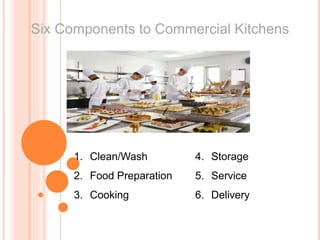
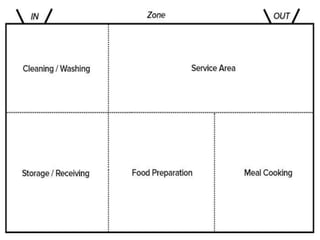
Six Components to Commercial Kitchens
1. Clean/Wash
2. Food Preparation
3. Cooking
4. Storage
5. Service
6. Delivery
SIX COMPONENTS TO COMMERCIAL
KITCHENS
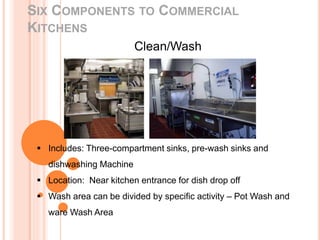
Clean/Wash
 Includes: Three-compartment sinks, pre-wash sinks and
dishwashing Machine
 Location: Near kitchen entrance for dish drop off
 Wash area can be divided by specific activity – Pot Wash and
ware Wash Area
SIX COMPONENTS TO COMMERCIAL
KITCHENS
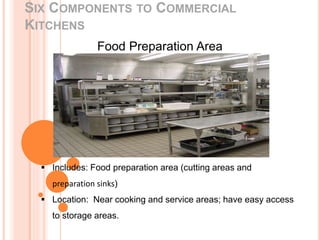
Food Preparation Area
 Includes: Food preparation area (cutting areas and
preparation sinks)
 Location: Near cooking and service areas; have easy access
to storage areas.
SIX COMPONENTS TO COMMERCIAL
KITCHENS
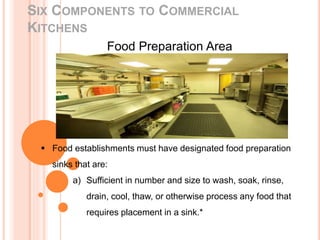
Food Preparation Area
 Food establishments must have designated food preparation
sinks that are:
a) Sufficient in number and size to wash, soak, rinse,
drain, cool, thaw, or otherwise process any food that
requires placement in a sink.*
SIX COMPONENTS TO COMMERCIAL
KITCHENS
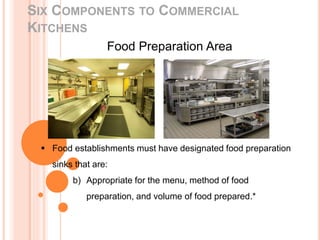
Food Preparation Area
 Food establishments must have designated food preparation
sinks that are:
b) Appropriate for the menu, method of food
preparation, and volume of food prepared.*
SIX COMPONENTS TO COMMERCIAL
KITCHENS
Food Preparation Area
 Food establishments must have designated food preparation
sinks that are:
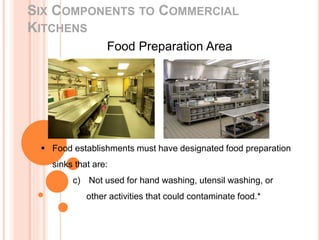
c) Not used for hand washing, utensil washing, or
other activities that could contaminate food.*
SIX COMPONENTS TO COMMERCIAL
KITCHENS
Cooking
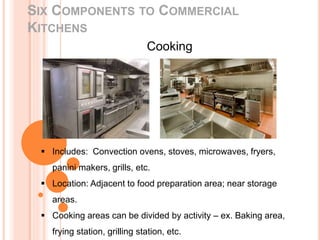
 Includes: Convection ovens, stoves, microwaves, fryers,
panini makers, grills, etc.
 Location: Adjacent to food preparation area; near storage
areas.
 Cooking areas can be divided by activity – ex. Baking area,
frying station, grilling station, etc.
SIX COMPONENTS TO COMMERCIAL
KITCHENS
Cooking
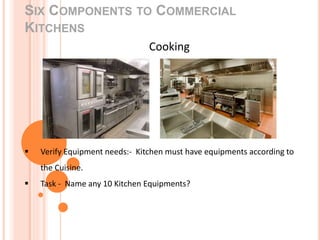
 Verify Equipment needs:- Kitchen must have equipments according to
the Cuisine.
 Task - Name any 10 Kitchen Equipments?
SIX COMPONENTS TO COMMERCIAL
KITCHENS
Storage
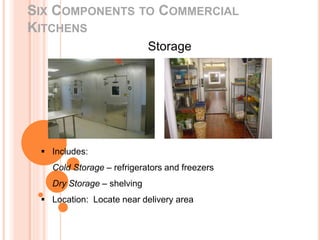
 Includes:
Cold Storage – refrigerators and freezers
Dry Storage – shelving
 Location: Locate near delivery area
SIX COMPONENTS TO COMMERCIAL
KITCHENS
Storage
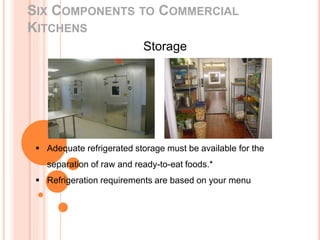
 Adequate refrigerated storage must be available for the
separation of raw and ready-to-eat foods.*
 Refrigeration requirements are based on your menu
SIX COMPONENTS TO COMMERCIAL
KITCHENS
Service
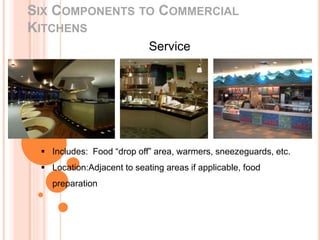
 Includes: Food “drop off” area, warmers, sneezeguards, etc.
 Location:Adjacent to seating areas if applicable, food
preparation
SIX COMPONENTS TO COMMERCIAL
KITCHENS
Service
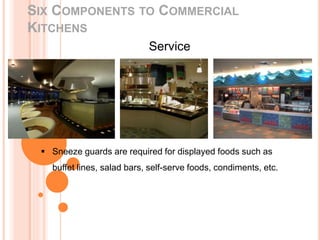
 Sneeze guards are required for displayed foods such as
buffet lines, salad bars, self-serve foods, condiments, etc.
SIX COMPONENTS TO COMMERCIAL
KITCHENS
Support Spaces
Toilet Rooms
 The food establishment permit holder must ensure that toilet
rooms are conveniently located within two hundred feet of the
food establishment and accessible to employees during all
hours of operation.
 May be used jointly by patrons and employees, provided
patrons accessing the toilet rooms are excluded from food
preparation areas and unpackaged food storage areas.
SIX COMPONENTS TO COMMERCIAL
KITCHENS
Support Spaces
Janitor Room
 A mop/utility sink is required and must be located so foods
are not contaminated.
 May include washer/dryer for linen laundering, mop sink, hot
water heater, cleaser/chemical storage, etc.
Other
 Provide storage area for employee’s personal items
 Provide area for disposal of garbage, recycling, etc.
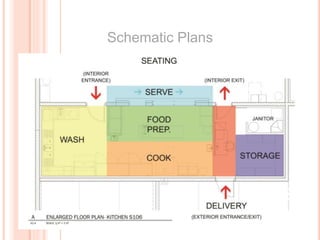
Schematic Plans
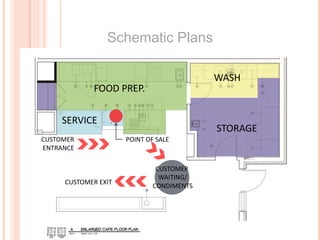
Schematic Plans
STORAGE
WASH
FOOD PREP.
SERVICE
POINT OF SALECUSTOMER
ENTRANCE
CUSTOMER EXIT
CUSTOMER
WAITING/
CONDIMENTS
MATERIALS Walls
 Easy to clean
 Provide stainless steel finish behind ovens, grills, fryers and
any other equipment that emits high levels of heat.
 Provide ceramic tile/stainless steel/frp (fiberglass reinforced
panels – most cost effective) throughout kitchen if budget
allows.
 If budget is a consideration, provide frp in wet areas and
semi-gloss paint
 Use semi-gloss paint throughout
MATERIALS Flooring
 Non-slip
 Cove base
 Smooth, easily cleanable, non-absorbent, and durable
 Examples: Quarry tile, non-slip sheet vinyl
MATERIALS Ceilings
 Easy to clean
 Gwb w/ semi-gloss paint or mylar suspended ceiling
Countertops
 Smooth, easy to clean, anti-microbial
 Free of breaks, open seams, cracks, chips, inclusions, pits,
and similar imperfections
 Free of sharp internal angles, corners, and crevices
 Finished to have smooth welds and joints
 Example: stainless steel
 Not to be used: Copper, galvanized metal, wood
LIGHTING
 Light Fixtures in food preparation areas to have protective
covering over lamp.
 If menu boards are used and are not electronic, provide
adequate light to illuminate boards.
 Provide adequate light levels for the activities of the space.
 Illumination for the Areas
Coffee shop – 150 Flux
Dinning Room – 100 flux
Food preparation – 500 Flux
Before Construction:
 Submit proposed menu: include all foods and beverages that
will be prepared and served.
 Submit food preparation sheets: include a description of all
food preparation steps and an estimate of the maximum
number of meals served per day.
Before Construction:
 Submit plans – include the following:
1) Site plan
2) Building layout including food prep, dining, serving and
storage areas, and restrooms
3) Equipment layout including make and model numbers
4) Electrical, plumbing and ventilation system layout
5) Garbage storage and cleaning facilities
6) Storage area for employees’ personal items
7) Number of seats for patrons (if applicable)
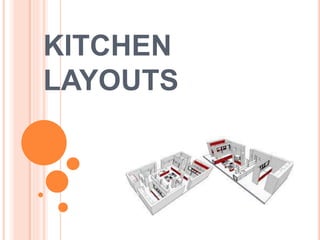
KITCHEN
LAYOUTS
ERGONOMICS
 The study of efficiency in workplace concerning the
arrangement of equipment in the most efficient way
so that time and energy are saved.
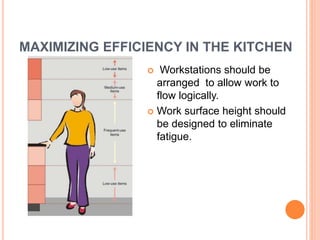
MAXIMIZING EFFICIENCY IN THE KITCHEN
 Workstations should be
arranged to allow work to
flow logically.
 Work surface height should
be designed to eliminate
fatigue.
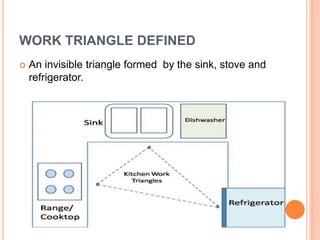
WORK TRIANGLE DEFINED
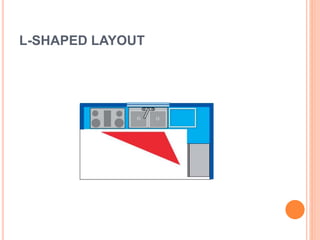
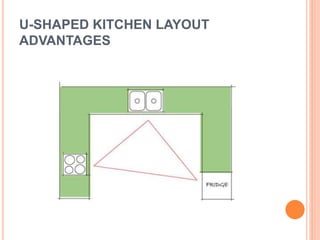
 An invisible triangle formed by the sink, stove and
refrigerator.
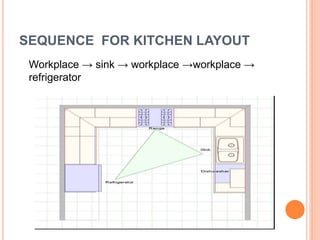
SEQUENCE FOR KITCHEN LAYOUT
Workplace → sink → workplace →workplace →
refrigerator
RECOMMENDED DISTANCE IN A WORK
TRIANGLE
 Refrigerator to sink 1.2 -2.1 m (4”-7”)
 Sink to stove 1.2- 1.82 m (4”-6”)
 Stove to refrigerator 1.2 -2.74m (4”-9”)
 Sum of total triangle should not exceed 6.6m (22”)
POORLY CONSTRUCTED WORK
TRIANGLE
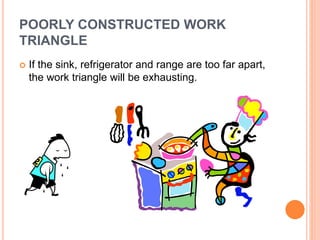
 If the sink, refrigerator and range are too far apart,
the work triangle will be exhausting.
MAIN KITCHEN LAYOUT TYPES
 Single wall/ corridor layout
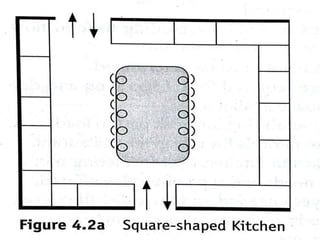
 Square shape
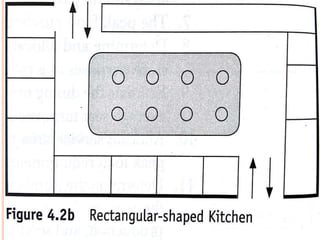
 Rectangle Shape
 U shaped
 L shaped
 Parallel wall
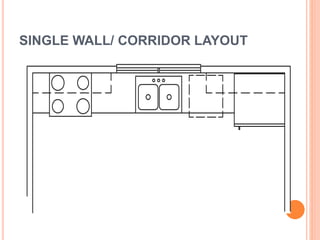
SINGLE WALL/ CORRIDOR LAYOUT
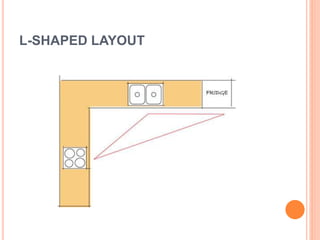
L-SHAPED LAYOUT
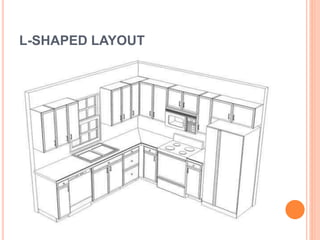
L-SHAPED LAYOUT
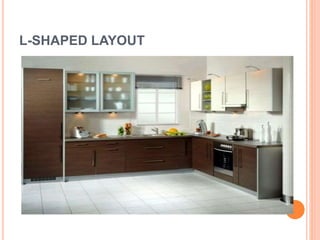
L-SHAPED LAYOUT
L-SHAPED LAYOUT
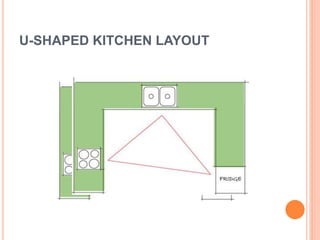
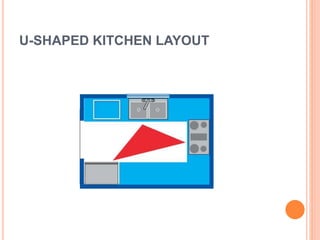
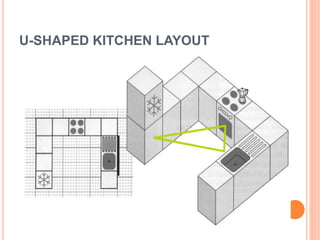
U-SHAPED KITCHEN LAYOUT
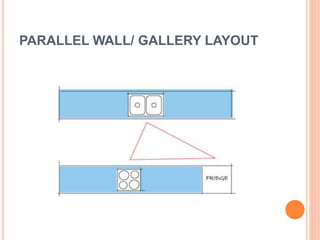
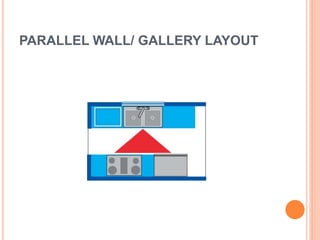
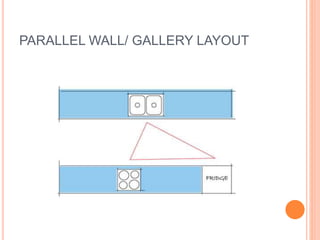
PARALLEL WALL/ GALLERY LAYOUT
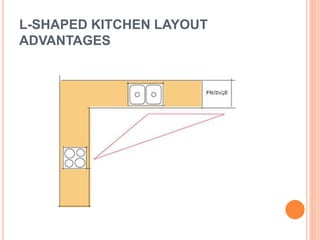
L-SHAPED KITCHEN LAYOUT
ADVANTAGES
ADVANTAGES OF THE L-SHAPED
KITCHEN
 Great for corner space
 Efficient for a small and medium kitchen space
 Can adjust to any length
 Can easily divide the kitchen into multiple work
sites
 No through traffic to disrupt work zones
 Can use one side of the kitchen as a wall divide
DISADVANTAGES OF THE L-SHAPED
LAYOUT
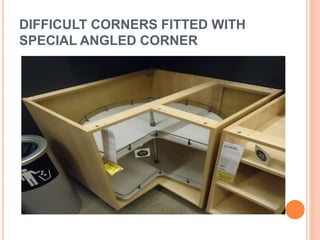
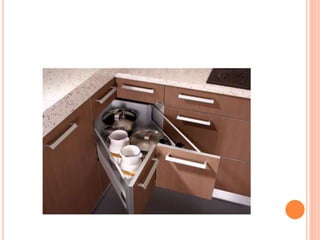
 The corner of the L can be problematic if the corner
is taken up by a cupboard because unless fitted by
a special angled corner cupboard, the corner
spaces will be inaccessible and wasted.
 Not efficient for large kitchens.
 Not good for multiple cooks .
DIFFICULT CORNERS FITTED WITH
SPECIAL ANGLED CORNER
U-SHAPED KITCHEN LAYOUT
ADVANTAGES
U-SHAPED KITCHEN LAYOUT
ADVANTAGES
 Efficient for a small, medium or large kitchen space
 No through traffic to disrupt work zones
 Wide "U" can support a kitchen island
 Lots of cupboard space.
U-SHAPED KITCHEN LAYOUT
DISADVANTAGES
 Not efficient for large kitchens without an island
 Bottom corner cabinets are difficult to access
 Unsuitable for narrow kitchens i.e. below 10” wide.
PARALLEL WALL/ GALLERY LAYOUT
PARALLEL WALL/ GALLERY
ADVANTAGES
 Excellent use of the kitchen triangle
 Lots of workspace and cabinets on either side
 Great for small apartments with limited space
 Great for small kitchens
 Great for one cook to move around
PARALLEL WALL/ GALLERY
DISADVANTAGES
 Can be difficult for through traffic
 Needs good lighting as can be dark- lights may
need to be added under overhead cabinets
FACTORS TO CONSIDER WHEN PLANNING
THE LAYOUT OF KITCHEN
 Organization of cooking areas
 Layout of equipment
 Size of the kitchen
 Location of the kitchen (close to the dining areas
and easy access to the outdoors.
 Floor Plan
 Type of services
 Type of Business
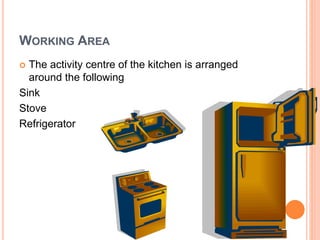
WORKING AREA
 The activity centre of the kitchen is arranged
around the following
Sink
Stove
Refrigerator
RELATIONSHIP BETWEEN SEQUENCE AND
ACTIVITY CENTRES
 Workplace → sink → workplace →workplace
→refrigerator
 Mixing and preparation centre
 Washing and cleanup centre
 Cooking and serving centre
MIXING & PREPARATION CENTRE
 Near fridge, near sink (may have its own sink
separate from the main cleanup sink)’
 Near trash and compost containers
 Needs counter space
 knife storage, cutting boards, measuring and mixing
utensils, small appliances such as food processor
or blender, casseroles and baking dishes,
flavorings, cookbook storage, graters
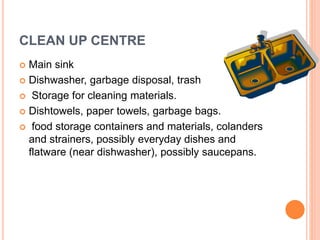
CLEAN UP CENTRE
 Main sink
 Dishwasher, garbage disposal, trash
 Storage for cleaning materials.
 Dishtowels, paper towels, garbage bags.
 food storage containers and materials, colanders
and strainers, possibly everyday dishes and
flatware (near dishwasher), possibly saucepans.
COOKING AND SERVING CENTRE
 Main item in this area is the stove.
 Stoves especially gas should not placed near
draughts (breeze).
 Cupboards and drawers in this area should contain
equipment relation to cooking and serving.
 What are some items related to:
a. Cooking? b. Serving?
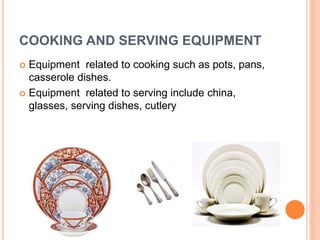
COOKING AND SERVING EQUIPMENT
 Equipment related to cooking such as pots, pans,
casserole dishes.
 Equipment related to serving include china,
glasses, serving dishes, cutlery
Facility planning   kitchen layout and planning

Facility planning kitchen layout and planning

  • 1.
  • 2.
     A kitchenis a room or part of a room used for cooking and food preparation.  A stove, a sink with hot and cold running water, a refrigerator and kitchen cabinets arranged there.  The main function of a kitchen is cooking or preparing food but it may also be used for dining, food storage, entertaining, dishwashing.
  • 3.
    Six Components toCommercial Kitchens 1. Clean/Wash 2. Food Preparation 3. Cooking 4. Storage 5. Service 6. Delivery
  • 4.
    SIX COMPONENTS TOCOMMERCIAL KITCHENS Clean/Wash  Includes: Three-compartment sinks, pre-wash sinks and dishwashing Machine  Location: Near kitchen entrance for dish drop off  Wash area can be divided by specific activity – Pot Wash and ware Wash Area
  • 5.
    SIX COMPONENTS TOCOMMERCIAL KITCHENS Food Preparation Area  Includes: Food preparation area (cutting areas and preparation sinks)  Location: Near cooking and service areas; have easy access to storage areas.
  • 6.
    SIX COMPONENTS TOCOMMERCIAL KITCHENS Food Preparation Area  Food establishments must have designated food preparation sinks that are: a) Sufficient in number and size to wash, soak, rinse, drain, cool, thaw, or otherwise process any food that requires placement in a sink.*
  • 7.
    SIX COMPONENTS TOCOMMERCIAL KITCHENS Food Preparation Area  Food establishments must have designated food preparation sinks that are: b) Appropriate for the menu, method of food preparation, and volume of food prepared.*
  • 8.
    SIX COMPONENTS TOCOMMERCIAL KITCHENS Food Preparation Area  Food establishments must have designated food preparation sinks that are: c) Not used for hand washing, utensil washing, or other activities that could contaminate food.*
  • 9.
    SIX COMPONENTS TOCOMMERCIAL KITCHENS Cooking  Includes: Convection ovens, stoves, microwaves, fryers, panini makers, grills, etc.  Location: Adjacent to food preparation area; near storage areas.  Cooking areas can be divided by activity – ex. Baking area, frying station, grilling station, etc.
  • 10.
    SIX COMPONENTS TOCOMMERCIAL KITCHENS Cooking  Verify Equipment needs:- Kitchen must have equipments according to the Cuisine.  Task - Name any 10 Kitchen Equipments?
  • 11.
    SIX COMPONENTS TOCOMMERCIAL KITCHENS Storage  Includes: Cold Storage – refrigerators and freezers Dry Storage – shelving  Location: Locate near delivery area
  • 12.
    SIX COMPONENTS TOCOMMERCIAL KITCHENS Storage  Adequate refrigerated storage must be available for the separation of raw and ready-to-eat foods.*  Refrigeration requirements are based on your menu
  • 13.
    SIX COMPONENTS TOCOMMERCIAL KITCHENS Service  Includes: Food “drop off” area, warmers, sneezeguards, etc.  Location:Adjacent to seating areas if applicable, food preparation
  • 14.
    SIX COMPONENTS TOCOMMERCIAL KITCHENS Service  Sneeze guards are required for displayed foods such as buffet lines, salad bars, self-serve foods, condiments, etc.
  • 15.
    SIX COMPONENTS TOCOMMERCIAL KITCHENS Support Spaces Toilet Rooms  The food establishment permit holder must ensure that toilet rooms are conveniently located within two hundred feet of the food establishment and accessible to employees during all hours of operation.  May be used jointly by patrons and employees, provided patrons accessing the toilet rooms are excluded from food preparation areas and unpackaged food storage areas.
  • 16.
    SIX COMPONENTS TOCOMMERCIAL KITCHENS Support Spaces Janitor Room  A mop/utility sink is required and must be located so foods are not contaminated.  May include washer/dryer for linen laundering, mop sink, hot water heater, cleaser/chemical storage, etc. Other  Provide storage area for employee’s personal items  Provide area for disposal of garbage, recycling, etc.
  • 17.
  • 18.
    Schematic Plans STORAGE WASH FOOD PREP. SERVICE POINTOF SALECUSTOMER ENTRANCE CUSTOMER EXIT CUSTOMER WAITING/ CONDIMENTS
  • 21.
    MATERIALS Walls  Easyto clean  Provide stainless steel finish behind ovens, grills, fryers and any other equipment that emits high levels of heat.  Provide ceramic tile/stainless steel/frp (fiberglass reinforced panels – most cost effective) throughout kitchen if budget allows.  If budget is a consideration, provide frp in wet areas and semi-gloss paint  Use semi-gloss paint throughout
  • 22.
    MATERIALS Flooring  Non-slip Cove base  Smooth, easily cleanable, non-absorbent, and durable  Examples: Quarry tile, non-slip sheet vinyl
  • 23.
    MATERIALS Ceilings  Easyto clean  Gwb w/ semi-gloss paint or mylar suspended ceiling Countertops  Smooth, easy to clean, anti-microbial  Free of breaks, open seams, cracks, chips, inclusions, pits, and similar imperfections  Free of sharp internal angles, corners, and crevices  Finished to have smooth welds and joints  Example: stainless steel  Not to be used: Copper, galvanized metal, wood
  • 24.
    LIGHTING  Light Fixturesin food preparation areas to have protective covering over lamp.  If menu boards are used and are not electronic, provide adequate light to illuminate boards.  Provide adequate light levels for the activities of the space.  Illumination for the Areas Coffee shop – 150 Flux Dinning Room – 100 flux Food preparation – 500 Flux
  • 25.
    Before Construction:  Submitproposed menu: include all foods and beverages that will be prepared and served.  Submit food preparation sheets: include a description of all food preparation steps and an estimate of the maximum number of meals served per day.
  • 26.
    Before Construction:  Submitplans – include the following: 1) Site plan 2) Building layout including food prep, dining, serving and storage areas, and restrooms 3) Equipment layout including make and model numbers 4) Electrical, plumbing and ventilation system layout 5) Garbage storage and cleaning facilities 6) Storage area for employees’ personal items 7) Number of seats for patrons (if applicable)
  • 27.
  • 28.
    ERGONOMICS  The studyof efficiency in workplace concerning the arrangement of equipment in the most efficient way so that time and energy are saved.
  • 29.
    MAXIMIZING EFFICIENCY INTHE KITCHEN  Workstations should be arranged to allow work to flow logically.  Work surface height should be designed to eliminate fatigue.
  • 30.
    WORK TRIANGLE DEFINED An invisible triangle formed by the sink, stove and refrigerator.
  • 31.
    SEQUENCE FOR KITCHENLAYOUT Workplace → sink → workplace →workplace → refrigerator
  • 32.
    RECOMMENDED DISTANCE INA WORK TRIANGLE  Refrigerator to sink 1.2 -2.1 m (4”-7”)  Sink to stove 1.2- 1.82 m (4”-6”)  Stove to refrigerator 1.2 -2.74m (4”-9”)  Sum of total triangle should not exceed 6.6m (22”)
  • 33.
    POORLY CONSTRUCTED WORK TRIANGLE If the sink, refrigerator and range are too far apart, the work triangle will be exhausting.
  • 34.
    MAIN KITCHEN LAYOUTTYPES  Single wall/ corridor layout  Square shape  Rectangle Shape  U shaped  L shaped  Parallel wall
  • 35.
  • 38.
  • 39.
  • 40.
  • 41.
  • 42.
  • 43.
  • 44.
  • 45.
  • 46.
  • 47.
  • 48.
    ADVANTAGES OF THEL-SHAPED KITCHEN  Great for corner space  Efficient for a small and medium kitchen space  Can adjust to any length  Can easily divide the kitchen into multiple work sites  No through traffic to disrupt work zones  Can use one side of the kitchen as a wall divide
  • 49.
    DISADVANTAGES OF THEL-SHAPED LAYOUT  The corner of the L can be problematic if the corner is taken up by a cupboard because unless fitted by a special angled corner cupboard, the corner spaces will be inaccessible and wasted.  Not efficient for large kitchens.  Not good for multiple cooks .
  • 50.
    DIFFICULT CORNERS FITTEDWITH SPECIAL ANGLED CORNER
  • 52.
  • 53.
    U-SHAPED KITCHEN LAYOUT ADVANTAGES Efficient for a small, medium or large kitchen space  No through traffic to disrupt work zones  Wide "U" can support a kitchen island  Lots of cupboard space.
  • 54.
    U-SHAPED KITCHEN LAYOUT DISADVANTAGES Not efficient for large kitchens without an island  Bottom corner cabinets are difficult to access  Unsuitable for narrow kitchens i.e. below 10” wide.
  • 55.
  • 56.
    PARALLEL WALL/ GALLERY ADVANTAGES Excellent use of the kitchen triangle  Lots of workspace and cabinets on either side  Great for small apartments with limited space  Great for small kitchens  Great for one cook to move around
  • 57.
    PARALLEL WALL/ GALLERY DISADVANTAGES Can be difficult for through traffic  Needs good lighting as can be dark- lights may need to be added under overhead cabinets
  • 58.
    FACTORS TO CONSIDERWHEN PLANNING THE LAYOUT OF KITCHEN  Organization of cooking areas  Layout of equipment  Size of the kitchen  Location of the kitchen (close to the dining areas and easy access to the outdoors.  Floor Plan  Type of services  Type of Business
  • 59.
    WORKING AREA  Theactivity centre of the kitchen is arranged around the following Sink Stove Refrigerator
  • 60.
    RELATIONSHIP BETWEEN SEQUENCEAND ACTIVITY CENTRES  Workplace → sink → workplace →workplace →refrigerator  Mixing and preparation centre  Washing and cleanup centre  Cooking and serving centre
  • 61.
    MIXING & PREPARATIONCENTRE  Near fridge, near sink (may have its own sink separate from the main cleanup sink)’  Near trash and compost containers  Needs counter space  knife storage, cutting boards, measuring and mixing utensils, small appliances such as food processor or blender, casseroles and baking dishes, flavorings, cookbook storage, graters
  • 62.
    CLEAN UP CENTRE Main sink  Dishwasher, garbage disposal, trash  Storage for cleaning materials.  Dishtowels, paper towels, garbage bags.  food storage containers and materials, colanders and strainers, possibly everyday dishes and flatware (near dishwasher), possibly saucepans.
  • 63.
    COOKING AND SERVINGCENTRE  Main item in this area is the stove.  Stoves especially gas should not placed near draughts (breeze).  Cupboards and drawers in this area should contain equipment relation to cooking and serving.  What are some items related to: a. Cooking? b. Serving?
  • 64.
    COOKING AND SERVINGEQUIPMENT  Equipment related to cooking such as pots, pans, casserole dishes.  Equipment related to serving include china, glasses, serving dishes, cutlery