Quantity Kitchen
Equipments
Cooking Equipment for the Kitchen to Prepare Quantity
Recipes for Crowds
The Junior Culinarian's Code
I pledge to advance the profession and to pass it on.
I shall foster a spirit of cooperation.
I shall be honorable.
I shall not use unfair means.
I shall be fair, courteous and considerate.
I shall refrain from (non-constructive) criticism.
I shall subject no one to risks (I would not be willing to assume).
I shall help to protect all members.
I shall be enthusiastic (about others success and my own)
I shall be too big for worry, too noble for anger, too strong for fear and too happy to hurt
anyone.
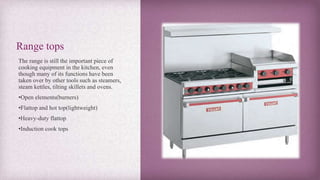
Range tops
The range is still the important piece of
cooking equipment in the kitchen, even
though many of its functions have been
taken over by other tools such as steamers,
steam kettles, tilting skillets and ovens.
•Open elements(burners)
•Flattop and hot top(lightweight)
•Heavy-duty flattop
•Induction cook tops
DO’S AND DON’TS
• Make sure gas pilots are lit before turning on burners. If burners do not light, turn off
• gas and allow the gas to ventilate before trying again to light pilots or burners.
• For maximum heat, adjust air intake so gas flames are blue with a white tip.
• Do not keep flattop ranges on high heat unless items are being cooked over them.
• Damage to tops could result.
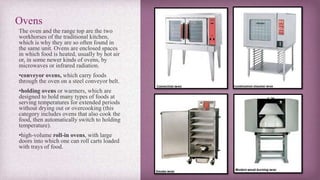
Ovens
The oven and the range top are the two
workhorses of the traditional kitchen,
which is why they are so often found in
the same unit. Ovens are enclosed spaces
in which food is heated, usually by hot air
or, in some newer kinds of ovens, by
microwaves or infrared radiation.
•conveyor ovens, which carry foods
through the oven on a steel conveyor belt.
•holding ovens or warmers, which are
designed to hold many types of foods at
serving temperatures for extended periods
without drying out or overcooking (this
category includes ovens that also cook the
food, then automatically switch to holding
temperature).
•high-volume roll-in ovens, with large
doors into which one can roll carts loaded
with trays of food.
CONVENTIONAL OVENS
Conventional ovens operate simply by
heating air in an enclosed space.
• Preheat ovens thoroughly, but no longer than
necessary, to avoid excess energy use.
• To avoid high energy loss and interruption of
cooking, do not open the door more often
than necessary.
• Space items well to allow for heat
circulation.
• Be sure the pilot light is on before turning on
gas ovens.
CONVECTION OVENS
Convection ovens contain fans that
circulate the air and distribute the heat
rapidly throughout the interior.
• For most products, set the temperature 25°–
50°F (15°–30°C) lower than you would a
conventional oven. Check the manufacturer’s
recommendations.
• Watch cooking times closely. The forced
heat cooks foods more quickly and tends to
dry out some foods if they are overcooked.
Roasts shrink more than they do in
conventional ovens.
• Many convection oven models should not be
operated with the blower switch off, as the
motor may burn out.
• The forced air of a convection oven may
deform soft items. Cake
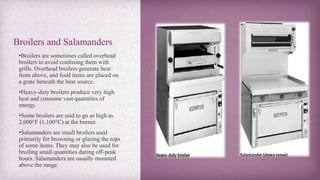
Broilers and Salamanders
•Broilers are sometimes called overhead
broilers to avoid confusing them with
grills. Overhead broilers generate heat
from above, and food items are placed on
a grate beneath the heat source.
•Heavy-duty broilers produce very high
heat and consume vast quantities of
energy.
•Some broilers are said to go as high as
2,000°F (1,100°C) at the burner.
•Salamanders are small broilers used
primarily for browning or glazing the tops
of some items. They may also be used for
broiling small quantities during off-peak
hours. Salamanders are usually mounted
above the range.
Grills
Grills are used for the same cooking
operations as broilers, except the heat
source is below
the grid that holds the food rather than
above it.
TYPES
•Many grill models are in use. The major
differences in operation among them are
due to the difference in heat source—gas,
electricity, or charcoal.
•To operate, set areas of the grill to
different temperatures and place foods in
the areas with the appropriate cooking
temperature.
•Keep grills clean, as the high
temperatures can easily start grease fires.
Deep Fryers
A deep fryer has only one use: to cook
foods in hot fat. Yet because of the
popularity of fried foods, this function is
an important one.
•Standard deep fryers are powered by
either gas or electricity and have
thermostatic controls that maintain fat at
preset temperatures.
•Automatic fryers remove food from the
fat automatically after a preset time.
•Pressure fryers are covered fry kettles
that fry foods under pressure. Foods cook
faster, even at a lower fat temperature.
DO’S AND DON’TS
• When filling kettles with solid fats, set the thermostat at 250°F (120°C) until the fat has
melted enough to cover the heating elements.
• Keep the kettles filled to the fill line.
• Make sure the drain valve is shut before adding fat to the empty kettle.
• Check the accuracy of the thermostat regularly by reading the fat temperature with a
thermometer.
Tilting Skillet
•The tilting skillet, also known as the
tilting brazier and tilting fry pan, is a
versatile and efficient piece of
equipment.
•It can be used as a griddle, fry pan,
brazier, stewpot, stockpot, steamer, and
bain-marie or steam table.
•The tilting skillet is a large, shallow, flat-
bottomed pot. To look at it another way, it
is a griddle with sides 6 inches (24 cm)
high, plus a cover. It has a tilting
mechanism that enables liquids to be
poured out of it.
•Power may be gas or electric.
•Clean the skillet immediately after each
use, before food has time to dry on. Add
water, turn on the skillet to heat it, and
scrub thoroughly.
Steam-Jacketed Kettles
•Steam-jacketed kettles, or steam kettles,
are sometimes thought of as stockpots
heated not just on the bottom but on the
sides as well. This comparison is only
partly accurate.
•Steam kettles heat much more quickly
and have more uniform and controllable
heat than pots on the range.
Types
• Steam kettles range in capacity from 2 gallons(7.5 L) to over 100 gallons (378.5 L).
• Some large institutional kettles hold 4,000 gallons (15,142 L). Tilt or trunnion kettles can be tilted
for emptying, either by turning a wheel or by pulling a lever. Nontilt kettles are emptied by a spigot
and drain on the bottom. Heat is controlled by regulating the steam flow or by adjusting the
thermostat. Steam may be from an outside source or self-generated.
• Exercise caution when operating all steam equipment. Steam can cause serious burns.
• Clean immediately after use to avoid food drying on surfaces. Disassemble the spigot and drain, and
clean with a bottle brush.
Steam Cooker
• Steam cookers are ideal for cooking vegetables and many other foods rapidly and with minimum
loss of nutrients and flavor. For this reason, they are becoming more common in both large and
small kitchens.
Types
• Pressure steamers cook foods under a pressure of
15 pounds per square inch (1.05 kg/cm) in high-
pressure steamers or 4–6 pounds per square inch
(0.28–0.42 kg/cm) in lowpressure steamers. They are
operated by a timer, which shuts the equipment off
after a preset time. The door cannot be opened until
the pressure returns to zero.
• Pressureless or convection steamers do not operate
under pressure. Jets of steam are directed at the
food to speed the heat transfer, just as the fan in a
convection oven speeds cooking. The door can be
opened any time during cooking.
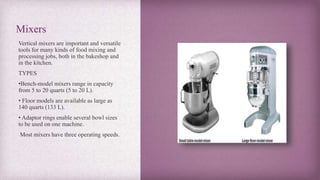
Mixers
Vertical mixers are important and versatile
tools for many kinds of food mixing and
processing jobs, both in the bakeshop and
in the kitchen.
TYPES
•Bench-model mixers range in capacity
from 5 to 20 quarts (5 to 20 L).
• Floor models are available as large as
140 quarts (133 L).
• Adaptor rings enable several bowl sizes
to be used on one machine.
Most mixers have three operating speeds.
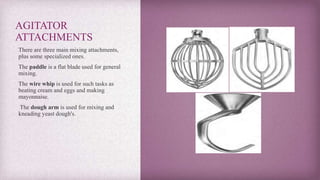
AGITATOR
ATTACHMENTS
There are three main mixing attachments,
plus some specialized ones.
The paddle is a flat blade used for general
mixing.
The wire whip is used for such tasks as
beating cream and eggs and making
mayonnaise.
The dough arm is used for mixing and
kneading yeast dough's.
DO’S AND DON’TS
• Make sure the bowl and the mixing attachment are firmly in place before turning on the machine.
• Make sure you are using the right size attachment for the bowl. Using a 40-quart paddle with a 30-
quart bowl, for example, could cause serious damage. Sizes in quarts are marked on the sides of
large bowls and on the tops of attachments.
• Turn off the machine before scraping down the bowl or inserting a spoon, scraper, or hand into the
bowl. Mixer motors are powerful and can cause serious injury.
• Turn off the machine before changing speeds.
Food Cutter
The food cutter or rotation chopper,
familiarly known as the buffalo chopper,
is a common
piece of equipment used for general food
chopping.
DO’S AND DON’TS
• Always make sure the machine is completely assembled before use.
• Close the cover lock knob, or the machine will not turn on.
• Never reach under the bowl cover while the machine is running.
• For uniform chopping, place the food in the bowl all at one time.
• Keep the knives sharp. Dull knives bruise food rather than cut it cleanly.
Slicer
The slicer is a valuable machine because it
slices foods more evenly and uniformly
than can be done by hand. This makes it
valuable for portion control and for
reducing cutting loss.
DO’S AND DON’TS
• Be sure the machine is properly assembled before using.
• Always use the end weight to press the food against the blade. This protects the hand from serious
cuts and provides a more even pressure on the food, resulting in more uniform slices.
• Set the thickness control knob to zero when the machine is not in use or is being cleaned.
• Always unplug the machine before dismantling and cleaning.
• Keep the blade sharp with the sharpening stones provided with the slicer.
Food Processors
Food processors were used in commercial
kitchens long before home models were
introduced.
They consist of a motor in a heavy base
topped by a cylindrical work bowl
containing an S-shaped blade.
Processors are used to chop or purée
foods, including raw or cooked meats, and
to mix or emulsify such items as sauces
and flavored butters. With special disk
attachments in place of the standard blade,
they can also slice, shred, and julienne
solid foods such as vegetables.
Blender
•A blender consists of a motor in a base,
topped by a container with a spinning
blade.
•Because the blender’s container is tall
and narrow, it is more suited for mixing
and puréeing liquids than for chopping
solid foods.
•In the commercial kitchen, the blender is
used to mix, purée, and emulsify liquids
such as soups, sauces, and batters.
• It is also used in bars and coffeehouses to
prepare certain drinks.
•Blender motors may have from 2 to 10
speeds, or even more.
• The containers are made of stainless
steel, glass, or plastic. The blade assembly
at the base of the container can be
disassembled for thorough cleaning.
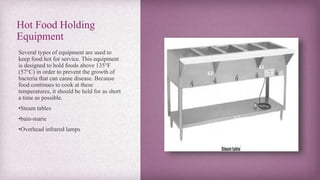
Hot Food Holding
Equipment
Several types of equipment are used to
keep food hot for service. This equipment
is designed to hold foods above 135°F
(57°C) in order to prevent the growth of
bacteria that can cause disease. Because
food continues to cook at these
temperatures, it should be held for as short
a time as possible.
•Steam tables
•bain-marie
•Overhead infrared lamps
Cold Food Storage
Equipment
•The quality of the food you serve
depends to a great degree on refrigeration
equipment. By keeping foods cold, usually
below 41°F (5°C), the refrigerator.
•The walk-in is a room-size refrigerator
with built-in shelves on the walls. Walk-
ins can be customized to fit nearly any
available space.
•The reach-in is a standard upright
refrigerator similar in shape to a large
home refrigerator, but without the freezer
unit.
•Freezers are used to hold foods for longer
times, or to store foods purchased in
frozen form.

Quantity kitchen equipments

  • 1.
    Quantity Kitchen Equipments Cooking Equipmentfor the Kitchen to Prepare Quantity Recipes for Crowds
  • 2.
    The Junior Culinarian'sCode I pledge to advance the profession and to pass it on. I shall foster a spirit of cooperation. I shall be honorable. I shall not use unfair means. I shall be fair, courteous and considerate. I shall refrain from (non-constructive) criticism. I shall subject no one to risks (I would not be willing to assume). I shall help to protect all members. I shall be enthusiastic (about others success and my own) I shall be too big for worry, too noble for anger, too strong for fear and too happy to hurt anyone.
  • 3.
    Range tops The rangeis still the important piece of cooking equipment in the kitchen, even though many of its functions have been taken over by other tools such as steamers, steam kettles, tilting skillets and ovens. •Open elements(burners) •Flattop and hot top(lightweight) •Heavy-duty flattop •Induction cook tops
  • 4.
    DO’S AND DON’TS •Make sure gas pilots are lit before turning on burners. If burners do not light, turn off • gas and allow the gas to ventilate before trying again to light pilots or burners. • For maximum heat, adjust air intake so gas flames are blue with a white tip. • Do not keep flattop ranges on high heat unless items are being cooked over them. • Damage to tops could result.
  • 5.
    Ovens The oven andthe range top are the two workhorses of the traditional kitchen, which is why they are so often found in the same unit. Ovens are enclosed spaces in which food is heated, usually by hot air or, in some newer kinds of ovens, by microwaves or infrared radiation. •conveyor ovens, which carry foods through the oven on a steel conveyor belt. •holding ovens or warmers, which are designed to hold many types of foods at serving temperatures for extended periods without drying out or overcooking (this category includes ovens that also cook the food, then automatically switch to holding temperature). •high-volume roll-in ovens, with large doors into which one can roll carts loaded with trays of food.
  • 6.
    CONVENTIONAL OVENS Conventional ovensoperate simply by heating air in an enclosed space. • Preheat ovens thoroughly, but no longer than necessary, to avoid excess energy use. • To avoid high energy loss and interruption of cooking, do not open the door more often than necessary. • Space items well to allow for heat circulation. • Be sure the pilot light is on before turning on gas ovens. CONVECTION OVENS Convection ovens contain fans that circulate the air and distribute the heat rapidly throughout the interior. • For most products, set the temperature 25°– 50°F (15°–30°C) lower than you would a conventional oven. Check the manufacturer’s recommendations. • Watch cooking times closely. The forced heat cooks foods more quickly and tends to dry out some foods if they are overcooked. Roasts shrink more than they do in conventional ovens. • Many convection oven models should not be operated with the blower switch off, as the motor may burn out. • The forced air of a convection oven may deform soft items. Cake
  • 7.
    Broilers and Salamanders •Broilersare sometimes called overhead broilers to avoid confusing them with grills. Overhead broilers generate heat from above, and food items are placed on a grate beneath the heat source. •Heavy-duty broilers produce very high heat and consume vast quantities of energy. •Some broilers are said to go as high as 2,000°F (1,100°C) at the burner. •Salamanders are small broilers used primarily for browning or glazing the tops of some items. They may also be used for broiling small quantities during off-peak hours. Salamanders are usually mounted above the range.
  • 8.
    Grills Grills are usedfor the same cooking operations as broilers, except the heat source is below the grid that holds the food rather than above it. TYPES •Many grill models are in use. The major differences in operation among them are due to the difference in heat source—gas, electricity, or charcoal. •To operate, set areas of the grill to different temperatures and place foods in the areas with the appropriate cooking temperature. •Keep grills clean, as the high temperatures can easily start grease fires.
  • 9.
    Deep Fryers A deepfryer has only one use: to cook foods in hot fat. Yet because of the popularity of fried foods, this function is an important one. •Standard deep fryers are powered by either gas or electricity and have thermostatic controls that maintain fat at preset temperatures. •Automatic fryers remove food from the fat automatically after a preset time. •Pressure fryers are covered fry kettles that fry foods under pressure. Foods cook faster, even at a lower fat temperature.
  • 10.
    DO’S AND DON’TS •When filling kettles with solid fats, set the thermostat at 250°F (120°C) until the fat has melted enough to cover the heating elements. • Keep the kettles filled to the fill line. • Make sure the drain valve is shut before adding fat to the empty kettle. • Check the accuracy of the thermostat regularly by reading the fat temperature with a thermometer.
  • 11.
    Tilting Skillet •The tiltingskillet, also known as the tilting brazier and tilting fry pan, is a versatile and efficient piece of equipment. •It can be used as a griddle, fry pan, brazier, stewpot, stockpot, steamer, and bain-marie or steam table. •The tilting skillet is a large, shallow, flat- bottomed pot. To look at it another way, it is a griddle with sides 6 inches (24 cm) high, plus a cover. It has a tilting mechanism that enables liquids to be poured out of it. •Power may be gas or electric. •Clean the skillet immediately after each use, before food has time to dry on. Add water, turn on the skillet to heat it, and scrub thoroughly.
  • 12.
    Steam-Jacketed Kettles •Steam-jacketed kettles,or steam kettles, are sometimes thought of as stockpots heated not just on the bottom but on the sides as well. This comparison is only partly accurate. •Steam kettles heat much more quickly and have more uniform and controllable heat than pots on the range.
  • 13.
    Types • Steam kettlesrange in capacity from 2 gallons(7.5 L) to over 100 gallons (378.5 L). • Some large institutional kettles hold 4,000 gallons (15,142 L). Tilt or trunnion kettles can be tilted for emptying, either by turning a wheel or by pulling a lever. Nontilt kettles are emptied by a spigot and drain on the bottom. Heat is controlled by regulating the steam flow or by adjusting the thermostat. Steam may be from an outside source or self-generated. • Exercise caution when operating all steam equipment. Steam can cause serious burns. • Clean immediately after use to avoid food drying on surfaces. Disassemble the spigot and drain, and clean with a bottle brush.
  • 14.
    Steam Cooker • Steamcookers are ideal for cooking vegetables and many other foods rapidly and with minimum loss of nutrients and flavor. For this reason, they are becoming more common in both large and small kitchens.
  • 15.
    Types • Pressure steamerscook foods under a pressure of 15 pounds per square inch (1.05 kg/cm) in high- pressure steamers or 4–6 pounds per square inch (0.28–0.42 kg/cm) in lowpressure steamers. They are operated by a timer, which shuts the equipment off after a preset time. The door cannot be opened until the pressure returns to zero. • Pressureless or convection steamers do not operate under pressure. Jets of steam are directed at the food to speed the heat transfer, just as the fan in a convection oven speeds cooking. The door can be opened any time during cooking.
  • 16.
    Mixers Vertical mixers areimportant and versatile tools for many kinds of food mixing and processing jobs, both in the bakeshop and in the kitchen. TYPES •Bench-model mixers range in capacity from 5 to 20 quarts (5 to 20 L). • Floor models are available as large as 140 quarts (133 L). • Adaptor rings enable several bowl sizes to be used on one machine. Most mixers have three operating speeds.
  • 17.
    AGITATOR ATTACHMENTS There are threemain mixing attachments, plus some specialized ones. The paddle is a flat blade used for general mixing. The wire whip is used for such tasks as beating cream and eggs and making mayonnaise. The dough arm is used for mixing and kneading yeast dough's.
  • 18.
    DO’S AND DON’TS •Make sure the bowl and the mixing attachment are firmly in place before turning on the machine. • Make sure you are using the right size attachment for the bowl. Using a 40-quart paddle with a 30- quart bowl, for example, could cause serious damage. Sizes in quarts are marked on the sides of large bowls and on the tops of attachments. • Turn off the machine before scraping down the bowl or inserting a spoon, scraper, or hand into the bowl. Mixer motors are powerful and can cause serious injury. • Turn off the machine before changing speeds.
  • 19.
    Food Cutter The foodcutter or rotation chopper, familiarly known as the buffalo chopper, is a common piece of equipment used for general food chopping.
  • 20.
    DO’S AND DON’TS •Always make sure the machine is completely assembled before use. • Close the cover lock knob, or the machine will not turn on. • Never reach under the bowl cover while the machine is running. • For uniform chopping, place the food in the bowl all at one time. • Keep the knives sharp. Dull knives bruise food rather than cut it cleanly.
  • 21.
    Slicer The slicer isa valuable machine because it slices foods more evenly and uniformly than can be done by hand. This makes it valuable for portion control and for reducing cutting loss.
  • 22.
    DO’S AND DON’TS •Be sure the machine is properly assembled before using. • Always use the end weight to press the food against the blade. This protects the hand from serious cuts and provides a more even pressure on the food, resulting in more uniform slices. • Set the thickness control knob to zero when the machine is not in use or is being cleaned. • Always unplug the machine before dismantling and cleaning. • Keep the blade sharp with the sharpening stones provided with the slicer.
  • 23.
    Food Processors Food processorswere used in commercial kitchens long before home models were introduced. They consist of a motor in a heavy base topped by a cylindrical work bowl containing an S-shaped blade. Processors are used to chop or purée foods, including raw or cooked meats, and to mix or emulsify such items as sauces and flavored butters. With special disk attachments in place of the standard blade, they can also slice, shred, and julienne solid foods such as vegetables.
  • 24.
    Blender •A blender consistsof a motor in a base, topped by a container with a spinning blade. •Because the blender’s container is tall and narrow, it is more suited for mixing and puréeing liquids than for chopping solid foods. •In the commercial kitchen, the blender is used to mix, purée, and emulsify liquids such as soups, sauces, and batters. • It is also used in bars and coffeehouses to prepare certain drinks. •Blender motors may have from 2 to 10 speeds, or even more. • The containers are made of stainless steel, glass, or plastic. The blade assembly at the base of the container can be disassembled for thorough cleaning.
  • 25.
    Hot Food Holding Equipment Severaltypes of equipment are used to keep food hot for service. This equipment is designed to hold foods above 135°F (57°C) in order to prevent the growth of bacteria that can cause disease. Because food continues to cook at these temperatures, it should be held for as short a time as possible. •Steam tables •bain-marie •Overhead infrared lamps
  • 26.
    Cold Food Storage Equipment •Thequality of the food you serve depends to a great degree on refrigeration equipment. By keeping foods cold, usually below 41°F (5°C), the refrigerator. •The walk-in is a room-size refrigerator with built-in shelves on the walls. Walk- ins can be customized to fit nearly any available space. •The reach-in is a standard upright refrigerator similar in shape to a large home refrigerator, but without the freezer unit. •Freezers are used to hold foods for longer times, or to store foods purchased in frozen form.