KITCHEN LAYOUT
KITCHEN LAYOUT
 The layout process may be described as two
separate stages that occur at the same time.
 One stage deals with arrangements of individual
pieces of equipment, work tables, and sinks with a
unit which comprise a functional area or a
functional department.
 That is one particular area may be developed
for the function of Indian and Tandoor preparations,
(or) salad and sandwich preparation, as a single
unit.
 The second stage of layout process involves
arranging the functional areas into a total facility.
 For e.g. the receiving, storing, pre-
preparation, production, pot washing areas, and
non-production areas such a rest rooms, offices are
brought together to form the basic floor plan for the
facility.
CONCEPTS OF LAYOUT:
 There are 4 concepts of layout for a kitchen plan,
they are
1. Materials or products
2. Machines and equipment
3. Workers
4. Movement.
MATERIALS OR PRODUCTS
 The products should be designed for ease of
production.
 Raw materials used should require minimum
number of processing steps.
 The layout should protect the material from
detrimental factors such as moisture, dust, vibration
and temperature changes.
 To provide flexible layout to handle change with
product
 Material storage area should facilitate taking
inventory.
 Provide facilities for storing waste and scrap
materials.
MACHINES AND EQUIPMENT'S
 The equipment provided in the layout should be united
to the required processes.
 Maximum use of the equipment should be planned.
 Layout should provide for each operations of the
equipment.
 Layout should facilitate movement of mobile equipment.
 Sufficient access space for equipment maintenance
should be provided.
 Proper ventilation and exhausting of equipment to be
provided.
WORKERS
 Layout should safeguard the workers by eliminating
hazards.
 Adequate light should be provided.
 Proper exhaust system for fresh air should be
provided.
 Layout should be free of distracting activities.
 Design of work place should correspond to the
height of the workers.
 Layout should provide adequate work space.
MOVEMENT
 Layout should provide for easy movement of
material and workers.
 Provide for smooth flow into and out of work place
 Layout should prevent back tracking
 Delays in movement of material should
be minimized.
LAYOUT CONFIGURATION
 The arrangement of equipment and work places
for functional areas is usually is the form of a
straight line or in combination and modifications of
straight line configurations. The basic patterns
that may be used include;
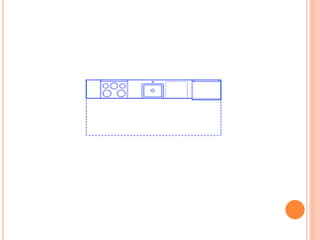
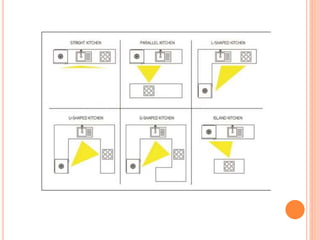
SINGLE LINE OR PULLMAN KITCHEN
 This is the simplest of designs, but it is limited in the
number of pieces of equipment or work places that
can be arranged. The straight line arrangement
may be placed along a wall or take the form of an
island.
 Ideal for apartments and smaller homes
 Works well with the open designs found in many
contemporary homes
 Small moveable table can provide eating space
 Can be enhanced with the addition of an island
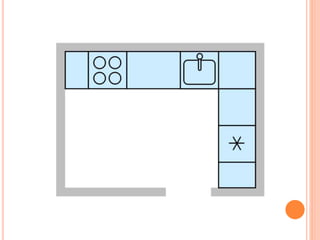
L’ SHAPED KITCHEN
 This is a modification of the straight
line arrangement to accommodate more
equipments and work places, it is sometimes used
where linear space is limited. The ‘L’ shaped
configuration is suitable for separating two major
groups of equipment. One group of equipment
would be placed on one leg of the ‘L’, the other
group forming the second leg.
 Very flexible layout design
 Major appliances can be placed in a variety of areas
 Work areas are close to each other
 Can easily convert to a U-Shape with a cabinet leg
addition
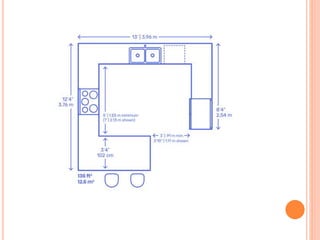
‘U’ SHAPED KITCHEN
 ‘U’ shaped configuration is ideal for small
areas where only one or two employees are
working. One disadvantage of this configuration is
that straight line flow through the area is not
possible.
 Perfect for families who use their kitchens a great
deal
 Provides plenty of counter space
 Efficient work triangle
 Can convert one cabinet leg into a breakfast bar
PARALLEL OR GALLY KITCHEN
 This configuration is an arrangement of two parallel
lines where the backs of the equipment and/or work
places on each line are adjacent to each other. This
arrangement centralizes the utility lines required for
the equipment. Some time a short wall
is constructed between the two rows of equipment,
in which case provision for cleaning and
maintenance should be provided.
 Great for smaller kitchens
 Appliances are close to one another
 Easy for one cook to maneuver
 Can easily convert to a U-Shape by closing off one
end
ISLAND KITCHEN
 A very popular choice in open plan homes, the
island kitchen provides a large work surface or
storage area in the middle of the kitchen. The island
can incorporate a cooking surface, prep bowl and
bar or wine fridge. It can also be used simply as a
preparation area or for enjoying family meals.
G SHAPED KITCHEN
 Built very much like the U-Shaped with the addition
of an elongated partial wall, the G-Shaped kitchen
offers a great deal of space.
 Ideal for larger families needing extra storage
space
 Plenty of counter and cabinet space
 Multiple cooks can function well in this layout
 Can convert one cabinet leg into a breakfast bar or
entertaining area
WORK TRIANGLE
 The work triangle is a logical arrangement of the
stove, refrigerator, and sink that reduces wasted
steps in the kitchen when you have precisely the
appropriate amount of space between them. This
guarantees that you make the most of your
available space.
The three primary kitchen work stations which create
the work triangle are:
 Food storage - Your refrigerator and pantry are the
major items here. Other Options like wine racks,
spice racks, and roll-out trays help to organize your
groceries.
 The preparation/cooking station - Your range,
oven, microwave, and smaller appliances are found
in this area. Counter space is important in this
section. Conserve space by moving appliances off
the counter with appliance garage cabinets and
space saving ideas like towel rods and pot lid racks.
 The clean-up station - Everyone's least favourite
activity is one of the kitchen's most important -
clean-up. This area is home to the sink, waste
disposal, and dishwasher. Cabinetry for this station
is designed to organize with the trash bin cabinet
and roll-out tray baskets for storage convenience.
Kitchen layout.pptx
Kitchen layout.pptx

Kitchen layout.pptx

  • 1.
  • 2.
    KITCHEN LAYOUT  Thelayout process may be described as two separate stages that occur at the same time.  One stage deals with arrangements of individual pieces of equipment, work tables, and sinks with a unit which comprise a functional area or a functional department.  That is one particular area may be developed for the function of Indian and Tandoor preparations, (or) salad and sandwich preparation, as a single unit.
  • 3.
     The secondstage of layout process involves arranging the functional areas into a total facility.  For e.g. the receiving, storing, pre- preparation, production, pot washing areas, and non-production areas such a rest rooms, offices are brought together to form the basic floor plan for the facility.
  • 4.
    CONCEPTS OF LAYOUT: There are 4 concepts of layout for a kitchen plan, they are 1. Materials or products 2. Machines and equipment 3. Workers 4. Movement.
  • 5.
    MATERIALS OR PRODUCTS The products should be designed for ease of production.  Raw materials used should require minimum number of processing steps.  The layout should protect the material from detrimental factors such as moisture, dust, vibration and temperature changes.  To provide flexible layout to handle change with product  Material storage area should facilitate taking inventory.  Provide facilities for storing waste and scrap materials.
  • 6.
    MACHINES AND EQUIPMENT'S The equipment provided in the layout should be united to the required processes.  Maximum use of the equipment should be planned.  Layout should provide for each operations of the equipment.  Layout should facilitate movement of mobile equipment.  Sufficient access space for equipment maintenance should be provided.  Proper ventilation and exhausting of equipment to be provided.
  • 7.
    WORKERS  Layout shouldsafeguard the workers by eliminating hazards.  Adequate light should be provided.  Proper exhaust system for fresh air should be provided.  Layout should be free of distracting activities.  Design of work place should correspond to the height of the workers.  Layout should provide adequate work space.
  • 8.
    MOVEMENT  Layout shouldprovide for easy movement of material and workers.  Provide for smooth flow into and out of work place  Layout should prevent back tracking  Delays in movement of material should be minimized.
  • 9.
    LAYOUT CONFIGURATION  Thearrangement of equipment and work places for functional areas is usually is the form of a straight line or in combination and modifications of straight line configurations. The basic patterns that may be used include;
  • 10.
    SINGLE LINE ORPULLMAN KITCHEN  This is the simplest of designs, but it is limited in the number of pieces of equipment or work places that can be arranged. The straight line arrangement may be placed along a wall or take the form of an island.  Ideal for apartments and smaller homes  Works well with the open designs found in many contemporary homes  Small moveable table can provide eating space  Can be enhanced with the addition of an island
  • 12.
    L’ SHAPED KITCHEN This is a modification of the straight line arrangement to accommodate more equipments and work places, it is sometimes used where linear space is limited. The ‘L’ shaped configuration is suitable for separating two major groups of equipment. One group of equipment would be placed on one leg of the ‘L’, the other group forming the second leg.
  • 13.
     Very flexiblelayout design  Major appliances can be placed in a variety of areas  Work areas are close to each other  Can easily convert to a U-Shape with a cabinet leg addition
  • 15.
    ‘U’ SHAPED KITCHEN ‘U’ shaped configuration is ideal for small areas where only one or two employees are working. One disadvantage of this configuration is that straight line flow through the area is not possible.  Perfect for families who use their kitchens a great deal  Provides plenty of counter space  Efficient work triangle  Can convert one cabinet leg into a breakfast bar
  • 17.
    PARALLEL OR GALLYKITCHEN  This configuration is an arrangement of two parallel lines where the backs of the equipment and/or work places on each line are adjacent to each other. This arrangement centralizes the utility lines required for the equipment. Some time a short wall is constructed between the two rows of equipment, in which case provision for cleaning and maintenance should be provided.
  • 18.
     Great forsmaller kitchens  Appliances are close to one another  Easy for one cook to maneuver  Can easily convert to a U-Shape by closing off one end
  • 20.
    ISLAND KITCHEN  Avery popular choice in open plan homes, the island kitchen provides a large work surface or storage area in the middle of the kitchen. The island can incorporate a cooking surface, prep bowl and bar or wine fridge. It can also be used simply as a preparation area or for enjoying family meals.
  • 23.
    G SHAPED KITCHEN Built very much like the U-Shaped with the addition of an elongated partial wall, the G-Shaped kitchen offers a great deal of space.  Ideal for larger families needing extra storage space  Plenty of counter and cabinet space  Multiple cooks can function well in this layout  Can convert one cabinet leg into a breakfast bar or entertaining area
  • 25.
    WORK TRIANGLE  Thework triangle is a logical arrangement of the stove, refrigerator, and sink that reduces wasted steps in the kitchen when you have precisely the appropriate amount of space between them. This guarantees that you make the most of your available space.
  • 26.
    The three primarykitchen work stations which create the work triangle are:  Food storage - Your refrigerator and pantry are the major items here. Other Options like wine racks, spice racks, and roll-out trays help to organize your groceries.  The preparation/cooking station - Your range, oven, microwave, and smaller appliances are found in this area. Counter space is important in this section. Conserve space by moving appliances off the counter with appliance garage cabinets and space saving ideas like towel rods and pot lid racks.
  • 27.
     The clean-upstation - Everyone's least favourite activity is one of the kitchen's most important - clean-up. This area is home to the sink, waste disposal, and dishwasher. Cabinetry for this station is designed to organize with the trash bin cabinet and roll-out tray baskets for storage convenience.