“Facilitation Skills for Prevention Professionals”	


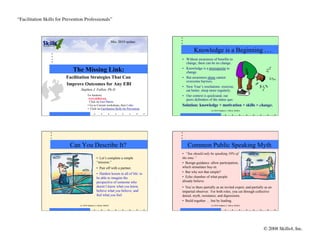
                                                                        May 2010 update

                                                                                                    Knowledge is a Beginning . . .
                                                                                            •  Without awareness of benefits to
                                                                                               change, there can be no change.

                              The Missing Link:                                             •  Knowledge is a prerequisite to
                                                                                               change.
                          Facilitation Strategies That Can                                  •  But awareness alone cannot
                                                                                               overcome barriers.
                          Improve Outcomes for Any EBI
                                                                                            •  New Year’s resolutions: exercise,
                                   Stephen J. Fallon, Ph.D.                                    eat better, sleep more regularly.
                                          For handouts:                                     •  Our context is quicksand, our
                                          www.skills4.org
                                                                                               peers defenders of the status quo.
                                            Click on Fact Sheets
                                          •  Go to Current workshops, then Links            Solution: knowledge + motivation + skills = change.
                                          •  Click on Facilitation Skills for Prevention
                                  (c) 2010 Stephen J. Fallon, Skills4                                            (c) 2010 Stephen J. Fallon, Skills4


                            Can You Describe It?                                               Common Public Speaking Myth
                                                                                            •  “You should only be speaking 10% of
                                                     •  Let’s complete a simple             the time.”
                                                     “mission.”                             •  Benign guidance: allow participation,
                                                     •  Pair off with a partner.            which stimulates buy-in.
                                                     •  Hardest lesson in all of life: to   •  But why not that simple?
                                                     be able to imagine the                 •  Echo chamber of what people
                                                     perspective of someone who             already believe.
                                                     doesn’t know what you know,            •  You’re there partially as an invited expert, and partially as an
                                                     believe what you believe, and          impartial observer. For both roles, you cut through collective
                                                     feel what you feel.                    denial, myth, resistance, and digressions.
                                                                                            •  Build together … but by leading.
                                  (c) 2010 Stephen J. Fallon, Skills4                                            (c) 2010 Stephen J. Fallon, Skills4


                                                                                                                                                         © 2008 Skills4, Inc.
“Facilitation Skills for Prevention Professionals”	


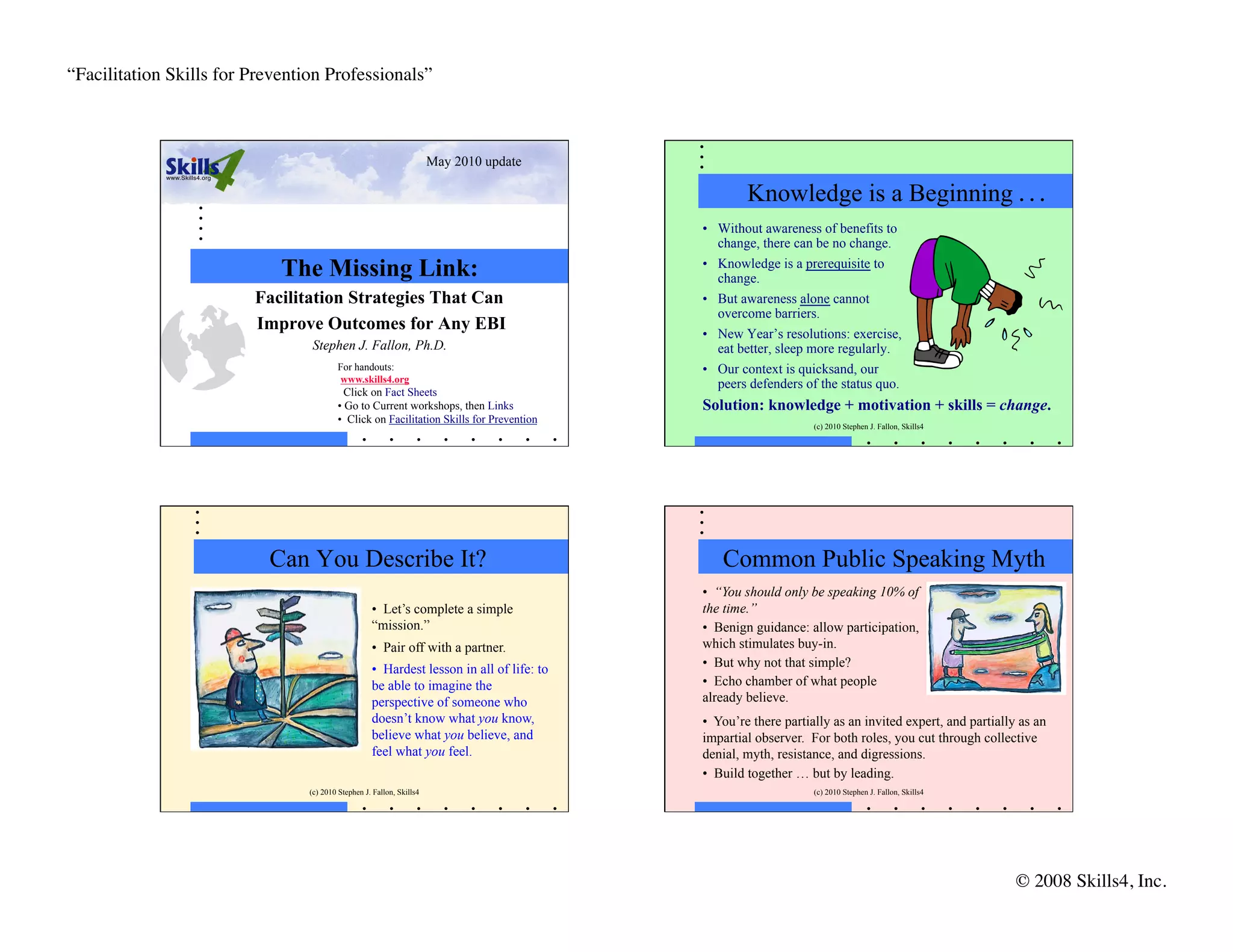
                           Facilitation Myths and Truths                                                                                  Our Feeling Brains
                   •  Fear is the best motivator.•  Too much fear paralyzes. But                                         Evolution of human brain structure … and how presenters use it
                                                 healthy respect for consequences                                        Reptilian (survival instinct)                   •  Fear-based presentations.
                                                 helps.
                   •  Any risk is too much risk. •  People should be able to weigh                                       Limbic (feeling and caring centers) •  Populist presentations.
                                                 risks objectively to choose.                                            Neocortal (logic)                               •  Scientific or evidence based
                   •  A good measure of their    •  Factoids do not change                                                                                               presentations.
                   change is whether they know behavior. Only knowledge that
                   what H.I.V. and A.I.D.S.      directly relates to actions truly
                   stand for.                    motivates.

                     Proof that they “get it”? Have them
                   repeat the message back in their own words.
                                                  (c) 2010 Stephen J. Fallon, Skills4                                                            (c) 2010 Stephen J. Fallon, Skills4


                               Facilitation Best Practices                                                                       Facilitation Best Practices (cont’d)
                                                                                                                          •   Know what you want to say (General
                                              •  While making messages culturally                                             goal-- “keep people safe from STDs"--
                                              competent, remember also to access                                              isn't enough. Exactly which risks and
                                              universal human traits.                                                         solutions will you focus on?)
                                              People in all cultures                                                      •  Know what your population relates to
                                                 •  smile when happy                                                          (both PIR and shared human traits).
                                                 •  raise eyebrows in recognition                                         •  Humor can be a useful "emotional
                                                 •  curl lips when disgusted                                                  can opener" (remember: laugh with,
                                                 •  detach when depressed, etc.                                               not at).
                   •  Making certain facial expressions triggers the emotions they                                         •  Sympathy isn’t empathy. (Affective isn’t always effective.)
                   typically represent. Can trigger them in other people, too.                                             •  Appeal to all seven types of intelligence:
                   Ehrlich P. Human Natures: Genes, Cultures, and the Human Prospect. Shearwater Books, Washington DC,
                   2000.                                                                                                   Verbal, Mathematical, Spatial, Bodily, Musical, Introspective, and
                                                  (c) 2010 Stephen J. Fallon, Skills4
                                                                                                                               Interpersonal. (c) 2010 Stephen J. Fallon, Skills4


                                                                                                                                                                                                © 2008 Skills4, Inc.
“Facilitation Skills for Prevention Professionals”	


                       Facilitation Best Practices (cont’d)                              Facilitation Exercise
                  •  Eye contact. (Groups are made up of individuals.)                                 •   Introduce yourself and your
                                                                                                           training topic. Participants look
                  •  Vocal modulation. (People respond                                                     for strengths in terms of
                  to emphasis that’s well placed.)                                                     1.  Language and logic -- does it
                  •  Room management. (Lighting and noise                                                  flow and fit together?
                  matter.)                                                                             2.  Posture and position -- does it
                  •  Peer but professional style. (Different                                               seem to come from confidence
                  enough to deserve attention, but not                                                     yet also openness?
                  resentment or derision.)                                                             3.  Likeability -- would you want to
                   •  Goodwill. (It shows through, as does                                                 follow the guidance based on this
                   burnout, judgment, or “needy helperism.”)                                               brief introduction?
                                       (c) 2010 Stephen J. Fallon, Skills4                      (c) 2010 Stephen J. Fallon, Skills4


                            How to Build Credibility                                Inductive vs. Deductive
                  •  Anticipate your target population’s                     •  Deductive format is standard law
                  questions.                                                 school model for trials.
                  •  Do your homework: know the
                                                                             •  “Tell them what you’re going to tell
                  specifics of the answer to their
                                                                             them, then tell it to them, then tell them
                  question (“tip of the iceberg” should
                                                                             what you just told them.”
                  show in response).
                  •  Repackage your answer in                                •  Very effective if you’re seeking a
                  accessible language. “Word                                 purely logical (neocortal) response.
                  pictures” and analogies are usually
                  the best approach.

                                       (c) 2010 Stephen J. Fallon, Skills4                      (c) 2010 Stephen J. Fallon, Skills4


                                                                                                                                      © 2008 Skills4, Inc.
“Facilitation Skills for Prevention Professionals”	


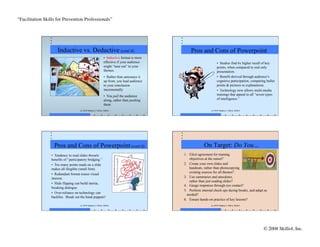
                      Inductive vs. Deductive (cont’d)                                             Pros and Cons of Powerpoint
                                                                 •  Inductive format is more
                                                                 effective if your audience                            •  Studies find 6x higher recall of key
                                                                 might “tune out” to your                              points, when compared to oral only
                                                                 themes.                                               presentation.
                                                                 •  Rather than announce it                            •  Benefit derived through audience’s
                                                                 up front, you lead audience                           cognitive participation, comparing bullet
                                                                 to your conclusion                                    points & pictures to explanations.
                                                                 incrementally                                         •  Technology now allows multi-media
                                                                 •  You pull the audience                              trainings that appeal to all “seven types
                                                                 along, rather than pushing                            of intelligence.”
                                                                 them.
                                     (c) 2010 Stephen J. Fallon, Skills4                                         (c) 2010 Stephen J. Fallon, Skills4


                    Pros and Cons of Powerpoint (cont’d)                                                    On Target: Do You…
                  •  Tendency to read slides thwarts                                           1.  Elicit agreement for training
                  benefits of “participatory bridging.”                                            objectives at the outset?
                  •  Too many points made on a slide                                           2.  Create your own slides and
                  makes all illegible (small font).                                                handouts, rather than photocopying
                                                                                                   existing sources for all themes?
                  •  Redundant format erases visual
                  interest.                                                                    3.  Use summaries and anecdotes,
                                                                                                   rather than just reading slides?
                  •  Slide flipping can build inertia,
                                                                                               4. Gauge responses through eye contact?
                  breaking dialogue.
                                                                                               5. Perform internal check ups during breaks, and adapt as
                  •  Over-reliance on technology can
                                                                                                 needed?
                  backfire. Break out the hand puppets!
                                                                                               6. Ensure hands-on practice of key lessons?
                                     (c) 2010 Stephen J. Fallon, Skills4                                         (c) 2010 Stephen J. Fallon, Skills4


                                                                                                                                                        © 2008 Skills4, Inc.
“Facilitation Skills for Prevention Professionals”	


                              Putting it All Together                         Thank You for Making a Difference!
                  •  When planning trainings, outline
                  themes, then highlight key points.
                  •  Build inductive activities.
                  •  First, memorize, then
                  “extemporaneousize.”
                  •  Check the pulse throughout.
                  •  Always strive to make the next
                  facilitation even better!
                                                                            Stephen J. Fallon, Ph.D.
                                                                            1712 N. Victoria Park Road
                                                                            Ft. Lauderdale, FL 33305
                                      (c) 2010 Stephen J. Fallon, Skills4
                                                                                Sfallon@skills4.org


                                                                                                           © 2008 Skills4, Inc.

Facilitation skills HIV STD prevention

  • 1.
    “Facilitation Skills forPrevention Professionals” May 2010 update Knowledge is a Beginning . . . •  Without awareness of benefits to change, there can be no change. The Missing Link: •  Knowledge is a prerequisite to change. Facilitation Strategies That Can •  But awareness alone cannot overcome barriers. Improve Outcomes for Any EBI •  New Year’s resolutions: exercise, Stephen J. Fallon, Ph.D. eat better, sleep more regularly. For handouts: •  Our context is quicksand, our www.skills4.org peers defenders of the status quo. Click on Fact Sheets •  Go to Current workshops, then Links Solution: knowledge + motivation + skills = change. •  Click on Facilitation Skills for Prevention (c) 2010 Stephen J. Fallon, Skills4 (c) 2010 Stephen J. Fallon, Skills4 Can You Describe It? Common Public Speaking Myth •  “You should only be speaking 10% of •  Let’s complete a simple the time.” “mission.” •  Benign guidance: allow participation, •  Pair off with a partner. which stimulates buy-in. •  Hardest lesson in all of life: to •  But why not that simple? be able to imagine the •  Echo chamber of what people perspective of someone who already believe. doesn’t know what you know, •  You’re there partially as an invited expert, and partially as an believe what you believe, and impartial observer. For both roles, you cut through collective feel what you feel. denial, myth, resistance, and digressions. •  Build together … but by leading. (c) 2010 Stephen J. Fallon, Skills4 (c) 2010 Stephen J. Fallon, Skills4 © 2008 Skills4, Inc.
  • 2.
    “Facilitation Skills forPrevention Professionals” Facilitation Myths and Truths Our Feeling Brains •  Fear is the best motivator.•  Too much fear paralyzes. But Evolution of human brain structure … and how presenters use it healthy respect for consequences Reptilian (survival instinct) •  Fear-based presentations. helps. •  Any risk is too much risk. •  People should be able to weigh Limbic (feeling and caring centers) •  Populist presentations. risks objectively to choose. Neocortal (logic) •  Scientific or evidence based •  A good measure of their •  Factoids do not change presentations. change is whether they know behavior. Only knowledge that what H.I.V. and A.I.D.S. directly relates to actions truly stand for. motivates.   Proof that they “get it”? Have them repeat the message back in their own words. (c) 2010 Stephen J. Fallon, Skills4 (c) 2010 Stephen J. Fallon, Skills4 Facilitation Best Practices Facilitation Best Practices (cont’d) •  Know what you want to say (General •  While making messages culturally goal-- “keep people safe from STDs"-- competent, remember also to access isn't enough. Exactly which risks and universal human traits. solutions will you focus on?) People in all cultures •  Know what your population relates to •  smile when happy (both PIR and shared human traits). •  raise eyebrows in recognition •  Humor can be a useful "emotional •  curl lips when disgusted can opener" (remember: laugh with, •  detach when depressed, etc. not at). •  Making certain facial expressions triggers the emotions they •  Sympathy isn’t empathy. (Affective isn’t always effective.) typically represent. Can trigger them in other people, too. •  Appeal to all seven types of intelligence: Ehrlich P. Human Natures: Genes, Cultures, and the Human Prospect. Shearwater Books, Washington DC, 2000. Verbal, Mathematical, Spatial, Bodily, Musical, Introspective, and (c) 2010 Stephen J. Fallon, Skills4 Interpersonal. (c) 2010 Stephen J. Fallon, Skills4 © 2008 Skills4, Inc.
  • 3.
    “Facilitation Skills forPrevention Professionals” Facilitation Best Practices (cont’d) Facilitation Exercise •  Eye contact. (Groups are made up of individuals.) •  Introduce yourself and your training topic. Participants look •  Vocal modulation. (People respond for strengths in terms of to emphasis that’s well placed.) 1.  Language and logic -- does it •  Room management. (Lighting and noise flow and fit together? matter.) 2.  Posture and position -- does it •  Peer but professional style. (Different seem to come from confidence enough to deserve attention, but not yet also openness? resentment or derision.) 3.  Likeability -- would you want to •  Goodwill. (It shows through, as does follow the guidance based on this burnout, judgment, or “needy helperism.”) brief introduction? (c) 2010 Stephen J. Fallon, Skills4 (c) 2010 Stephen J. Fallon, Skills4 How to Build Credibility Inductive vs. Deductive •  Anticipate your target population’s •  Deductive format is standard law questions. school model for trials. •  Do your homework: know the •  “Tell them what you’re going to tell specifics of the answer to their them, then tell it to them, then tell them question (“tip of the iceberg” should what you just told them.” show in response). •  Repackage your answer in •  Very effective if you’re seeking a accessible language. “Word purely logical (neocortal) response. pictures” and analogies are usually the best approach. (c) 2010 Stephen J. Fallon, Skills4 (c) 2010 Stephen J. Fallon, Skills4 © 2008 Skills4, Inc.
  • 4.
    “Facilitation Skills forPrevention Professionals” Inductive vs. Deductive (cont’d) Pros and Cons of Powerpoint •  Inductive format is more effective if your audience •  Studies find 6x higher recall of key might “tune out” to your points, when compared to oral only themes. presentation. •  Rather than announce it •  Benefit derived through audience’s up front, you lead audience cognitive participation, comparing bullet to your conclusion points & pictures to explanations. incrementally •  Technology now allows multi-media •  You pull the audience trainings that appeal to all “seven types along, rather than pushing of intelligence.” them. (c) 2010 Stephen J. Fallon, Skills4 (c) 2010 Stephen J. Fallon, Skills4 Pros and Cons of Powerpoint (cont’d) On Target: Do You… •  Tendency to read slides thwarts 1.  Elicit agreement for training benefits of “participatory bridging.” objectives at the outset? •  Too many points made on a slide 2.  Create your own slides and makes all illegible (small font). handouts, rather than photocopying existing sources for all themes? •  Redundant format erases visual interest. 3.  Use summaries and anecdotes, rather than just reading slides? •  Slide flipping can build inertia, 4. Gauge responses through eye contact? breaking dialogue. 5. Perform internal check ups during breaks, and adapt as •  Over-reliance on technology can needed? backfire. Break out the hand puppets! 6. Ensure hands-on practice of key lessons? (c) 2010 Stephen J. Fallon, Skills4 (c) 2010 Stephen J. Fallon, Skills4 © 2008 Skills4, Inc.
  • 5.
    “Facilitation Skills forPrevention Professionals” Putting it All Together Thank You for Making a Difference! •  When planning trainings, outline themes, then highlight key points. •  Build inductive activities. •  First, memorize, then “extemporaneousize.” •  Check the pulse throughout. •  Always strive to make the next facilitation even better! Stephen J. Fallon, Ph.D. 1712 N. Victoria Park Road Ft. Lauderdale, FL 33305 (c) 2010 Stephen J. Fallon, Skills4 Sfallon@skills4.org © 2008 Skills4, Inc.