FACIAL
NERVE & ITS
DISORDERS
Dr.Ashish K.Gupta
SMS Medical
college,Jaipur
INTRODUCTION
Facial nerve (CN VII), is the nerve of facial expression.
It is the nerve of second branchial arch.
 It contains motor and somatosensory components.
The somatosensory component of the facial nerve is
described under the name of the nervus intermedius or pars
intermedia of Wrisberg.
Development of Facial nerve
Motor root of the facial nerve is independent of the
development of the sensory root and the geniculate
ganglion.
In the 5th week, the facial motor nucleus & chorda
tympani
At this time, the chorda tympani nerve and the facial nerve
trunk are of approx. equal size
By the 7th week- nervus intermedius & greater petrosal
nerve
SURGICAL PEARL:
• At birth, facial nerve exits the stylomastoid foramen on the lateral aspect of
the skull, - this may cause facial nerve injury during difficult delivery.
• At 2 yrs , mastoid process pushes the stylomastoid foramen medially and
covers the facial nerve exit.
• Before the age of 2 years, a retroauricular incision should not be extended
inferiorly as facial nerve could be injured at its exit from the stylomastoid
foramen.
ANATOMY
Segment Location
Length
(mm)
Supranuclear Cerebral Cortex NA
Brainstem Motor nucleus, sup salivatory nucleus NA
Intracranial Brainstem to entry of IAC 13-15
Meatal segment Within Interanal Auditory Canal (IAC) 5-12
Labrynthine segment Fundus of IAC to Geniculate ganglion 3-4
Tympanic segment Geniculate gang to pyramidal eminence 8-11
Mastoid segment Pyramidal Process to stylomastoid foramen 10-14
Extratemporal segment Stylomastoid foramen to pes anserinus 15-20
SUPRANUCLEAR PATHWAY
FACIAL NERVE NUCLEI
1) Motor nucleus or Branchiomotor (MOTOR) –
lower pons below 4th ventricle
2) Superior salivatory nucleus (PARASYMP) –
dorsal to motor Nucleus
3) Lacrimatory Nucleus (PARASYMP)- in lower
pons
4) Nucleus of tractus solitarius (GUSTATORY)–
medulla oblongata
INFRANUCLEAR PATHWAY
They emerge from the lower border of the pons as a motor facial nerve root
and a sensory root (nerve of Wrisberg) and it is from here that the
infranuclear pathway starts.
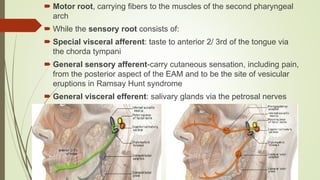
 Motor root, carrying fibers to the muscles of the second pharyngeal
arch
 While the sensory root consists of:
 Special visceral afferent: taste to anterior 2/ 3rd of the tongue via
the chorda tympani
 General sensory afferent-carry cutaneous sensation, including pain,
from the posterior aspect of the EAM and to be the site of vesicular
eruptions in Ramsay Hunt syndrome
 General visceral efferent: salivary glands via the petrosal nerves
 Lower half of the face has contralateral
supranuclear control.
 Upper half has bilateral control.
 Facial motor nucleus also has innervation
from thalamus for involuntary emotional
expression eg; happy or sad
So this explains why frontalis muscle and
emotional facial expression remains intact
in supranuclear lesions.
1. INTRACRANIAL PART
From pons to point of entry into IAC
Motor is more Medial.
Thin layer of pia mater
SURGICAL IMPORTANCE
1. Iatrogenic trauma in CerebelloPontine angle tumour surgery due to
lack of perineurium.
2. Difficult to identify during dissection of schwannoma (no
connective tissue)
2. Meatal Segement
FN run through IAC from its porus to its
fundus
 Facial nerve occupies the anterosuperior
quadrant of the IAC
It lies superior to the cochlear nerve and it
passes above the crista falciformis.
A crest of bone, the “Bill’s bar” hangs in the
vertical plane of the IAC between the
superior vestibular nerve and the facial nerve,
3. Labyrinthine segement
Shortest and the narrowest segment of the FN.
Here, facial nerve fibres are loosely arranged, without an epineural
covering,so it is common site of entrapment during inflammatory
disorders of facial nerve.
Only segement that laks anastomosing arteries,so is vunrable to embolic
phenomenon and vascular compression:most likely affected by ischemia
in odema following trauma and inflammation.
 Cochlea is anteroinferior to the labyrinthine segment
 Both the facial nerve and the nervus intermedius remain distinct entities, and
they meet each other just before joining the geniculate ganglion
Geniculate Ganglion:
At the distal end of the labyrinthine segment, the geniculate ganglion
forms part of a sharp ‘hairpin’ turn, the geniculum or first genu of the
facial nerve
Dehiscent in 25 % of temporal bones, vulnerable to injury during middle
cranial fossa surgery.
4. Tympanic Segement
Nerve takes a sharp turn posteriorly at 700-800 to form geniculate
ganglion then runs on medial wall of middle ear, above & medial to
processus cochleariformis.
Clinical Application-
• Processus cochleariformis (constant landmark)
• Most frequest site of dehiscene 91%.
• MC Site for iatrogenic injury
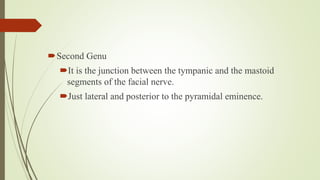
Second Genu
It is the junction between the tympanic and the mastoid
segments of the facial nerve.
Just lateral and posterior to the pyramidal eminence.
5. Mastoid Segement
From 2nd genu(PM) to SMF(AL)
 Landmark are the horizontal semicircular canal, the short process
of the incus, and the digastric ridge
Clinical Impact
• During canalplasty, the facial
nerve may pass lateral to the
annulus.
• In such cases, drilling in the
posteroinferior quadrant of the
external auditory canal, even
lateral to the annulus, may lead to
a facial nerve injury.
Branches of facial nerve
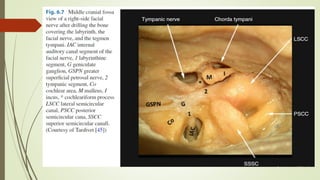
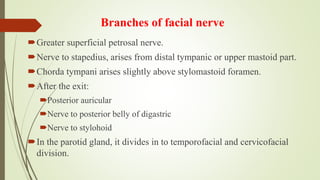
Greater superficial petrosal nerve.
Nerve to stapedius, arises from distal tympanic or upper mastoid part.
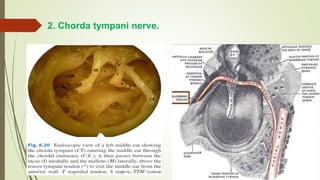
Chorda tympani arises slightly above stylomastoid foramen.
After the exit:
Posterior auricular
Nerve to posterior belly of digastric
Nerve to stylohoid
In the parotid gland, it divides in to temporofacial and cervicofacial
division.
1. GSPN
Runs in facial hiatus
in superior surface of
temporal bone.
Carries secretomotor
fibers to the lacrimal
gland, palate and
nasal cavity.
Clinical Application-
The perigeniculate area is
the weakest zone of the
Fallopian canal; it is the
most common localization
of traumatic facial nerve
injury in temporal bone
fracture
Clinical Implications
GSPN represents an important landmark for facial nerve
identification during middle cranial fossa approach.
The section of the GSPN or the section of vidian nerve has been
proposed in the past to treat intractable vasomotor rhinitis; this
surgery was abandoned because of its troublesome side effects of
such reduction of the lacrimal secretions (dry eyes).
2. Chorda tympani nerve.
3. Extra temporal Part
 Stylomastoid foramen to
terminal branches.
 Liesin relation posteriorly
with styloid process,
laterally with posterior belly
of digastric muscle, and
anteriorly with parotid
gland.
KATZ & CATALANO
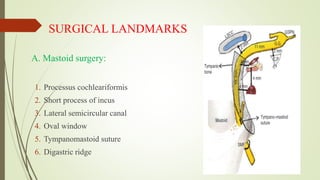
SURGICAL LANDMARKS
1. Processus cochleariformis
2. Short process of incus
3. Lateral semicircular canal
4. Oval window
5. Tympanomastoid suture
6. Digastric ridge
A. Mastoid surgery:
B. Parotid Surgery:
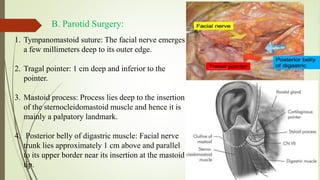
1. Tympanomastoid suture: The facial nerve emerges
a few millimeters deep to its outer edge.
2. Tragal pointer: 1 cm deep and inferior to the
pointer.
3. Mastoid process: Process lies deep to the insertion
of the sternocleidomastoid muscle and hence it is
mainly a palpatory landmark.
4. Posterior belly of digastric muscle: Facial nerve
trunk lies approximately 1 cm above and parallel
to its upper border near its insertion at the mastoid
tip.
OCNA 2018
FACIAL NERVE INJURY
1. Pathophysiology:
• Endonerium
– Surrounds each nerve fiber.
– Provides endoneural tube for regeneration.
– Much poorer prognosis if disrupted.
• Perinerium
– Surrounds a group of nerve fibers.
– Provides tensile strength.
– Protects nerve from infection.
• Epinerium
– Surrounds the entire nerve.
– Provides nutrition to nerve.
SEDDON CLASSIFICATION
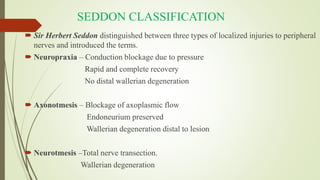
 Sir Herbert Seddon distinguished between three types of localized injuries to peripheral
nerves and introduced the terms.
 Neuropraxia – Conduction blockage due to pressure
Rapid and complete recovery
No distal wallerian degeneration
 Axonotmesis – Blockage of axoplasmic flow
Endoneurium preserved
Wallerian degeneration distal to lesion
 Neurotmesis –Total nerve transection.
Wallerian degeneration
‘Wallerian degeneration’ refers
specifically to the process of
degeneration that takes place
along a nerve distal to an injury
Improper axon healing can
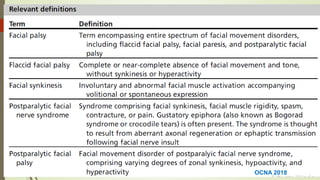
cause facial synkinesis
SUNDERLAND CLASSIFICATION
2. Clinical evaluation:
 History-
 Mechanism – recent surgery, facial/head
trauma
 Timing – progressive loss of function or
sudden loss
 Transected nerve -> sudden loss
 Intraneural hematoma or impengiment
-> progressive loss (better prognosis)
 Associated symptoms – hearing loss
,vertigo
 Complete or incomplete
Physical Examination
• Full head and neck examination
• Facial asymmetry
• Signs of facial injury: lacerations,
hematomas, bruising
• Exam head/scalp for signs of injury to
help guide you to vector of force if head
trauma is involved.
• Otoscopic examination is a must
• Canal lacerations
• Hemotympanum, TM perforation,
drainage of blood or clear fluid from
middle ear
• Tuning fork tests help to determine any
hearing loss
OCNA 2018
House–Brackmann staging system
It is not a perfect Garding system because of::-
1>the problems of inter & intraobserver variations
2>applicable only to disorders of nerve proximal to pesanserinus
3>not appropriate for single branch injuries.
4>The HB scale is not useful in assessing transected or repaired nerves for
three reasons:
a. all repairs cause mass movement;
b. most patients can eventually close their eyes and have good oral
sphincter function;
c. almost no patients arc able to raise their eyebrow or forehead.
3.TESTS FOR EVALUATION
TOPODIAGNOSTIC
TESTS
Lacrimal
Function
Stapedius
Reflex
Taste
Salivary Flow
test
ELECTRODIAGNOSTIC
Nerve excitability test
Maximal
Stimulation Test
Electroneurography
Electromyography
Imaging CT &
MRI
Intraoperative
monitoring
A. Topodiagnostic Tests
 These tests can be used to localize the site of injury to the facial nerve and
therefore assist in diagnosis and management.
 If the lesion is distal to a particular branch of the nerve, the function of that
branch will be spared.
 These tests are of limited value as they provide limited correlation with the
site of nerve damage and have no prognostic value.
 Assesment of GSPN
 Filter paper is placed in the lower conjunctival fornix
bilaterally.
 3- 5 minutes.
 Schirmer’s test is +ve when:
>75% unilateral decrease in lacrimation, or a
bilateral decrease in lacrimation (less than 10 mm
for both sides at five minutes).
Schirmer test positive  lesion at or proximal to
geniculate ganglion
1. Schirmer’s Test
2. Stapedial reflex
 Stapedius branch of the facial nerve.
 Most objective and reproducible.
 It is based on the fact that a loud sound, 70-100 dB
above the threshold of hearing of a particular ear causes
b/l contraction of the stapedial muscles.
 Tone can be delivered to one ear & the reflex picked
from the same ear or the contralateral ear.
 If intact stapedial reflex, complete recovery can be
expected to begin within six weeks.
3. Taste
 To test Chorda tympani nerve
 Natural stimuli, such as filter-paper disks impregnated with aqueous
solutions of
sodium chloride (salty taste),
saccharose (sweet taste),
citrate or hydrochloric acid (sour taste),
quinine (bitter taste)
or by electrical stimulation (EGM) of the tongue
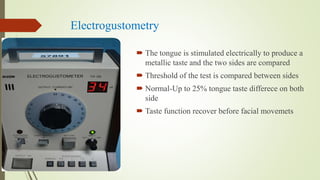
Electrogustometry
 The tongue is stimulated electrically to produce a
metallic taste and the two sides are compared
 Threshold of the test is compared between sides
 Normal-Up to 25% tongue taste differece on both
side
 Taste function recover before facial movemets
4. Salivary flow rates
Cannulation of Wharton's ducts bilaterally
5 minute measurement of output
 Salivary flow is measured over time following a gustatory
stimulus (6% citric acid on anterior part of tongue)
Significant if 25% reduction in flow of the involved side
as compared to the normal side-Indicative for surgery
B. ELECTRODIAGNOSTIC TESTING
 Tests based on these two principles
1. Electrical stimulation
2. Recording of the electromyographic response,
 Useful in determining the prognosis and sometimes in stratifying patients
for nonsurgical versus surgical management
 Repair is contraindicated when motor end plate muscle unit is no longer
functional.
1. Minimal Nerve Excitability Test
 Test for facial nerve degeneration (excitation is lost over 3-4 days pd)
 The stimulating electrode is placed on the skin over the stylomastoid foramen or
over one of the peripheral branches of the nerve, and a return electrode is taped
to the forearm.
 Start from healthy side- 0.3msec in duration and increse till facial twitch occur
 Then on opposite side and compare
 Result- difference of 3.5 ma or greater between the two sides is considered
significant
 Useful only in complete paralysis
2. Maximal Stimulation Test
 MST uses a level of current {maximal stimulus)at which the greatest
amplitude of facial movement is observed
 Stimulates all intact axons
 Proportion of fibers that have degenerated can be estimated
 Comparison rated as equal, slightly decreased, markedly decreased, or absent
– Equal or slightly decreased response = favorable for complete recovery
– Markedly decreased or absent response (with in 10 days)
= Advanced degeneration with a poor prognosis
3. Electroneurography
 most valuable prognostic indicator in electrodiagnostic tests.
 Supramaximal stimulus is delivered to trunk @ SMF
Evoked biphasic compound muscle action potential (CAMP)
 Response in 2 sides is compared and % of degenerated fiber is calculated
 If CAMP amplitute of affected side is 10% of normal side
90%axonal loss is sustained
Not useful until 4th day of palsy as wallerian degeneration takes 3 days for
completion
Less value after 3 weeks due to nerve fibre desynchronization
Main indication-Acute onset complete FN paralysis
Both % of amplitude reduction and rate of degeneration are used as
prognostic indicator
In bells palsy degeneration of >90% with in 14 days of complete
paralysis
Poor recovery
Not useful in Ramsay hunt syndrome due to multiple site involvement
4. Electromyography
 Record active motor unit potential of orbicularis oculi and oris during rest and
voluntary contraction
 Used to determine: - Continuity of nerve
- evidence of wallerian degeneration
-Sign of reinnervation
 Fibrillation potential arise 2-3 weeks following injury
 So EMG has no value till 2 weeks
 More useful are the polyphasic reinnervation potentials that may be seen as early as
4 to 6 weeks after the onset of paralysis.
 EMG has role in decision making in Sx intervention in long standing paralysis
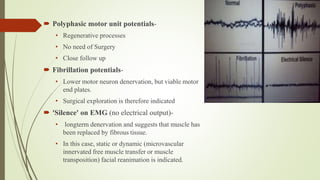
 Polyphasic motor unit potentials-
• Regenerative processes
• No need of Surgery
• Close follow up
 Fibrillation potentials-
• Lower motor neuron denervation, but viable motor
end plates.
• Surgical exploration is therefore indicated
 'Silence' on EMG (no electrical output)-
• longterm denervation and suggests that muscle has
been replaced by fibrous tissue.
• In this case, static or dynamic (microvascular
innervated free muscle transfer or muscle
transposition) facial reanimation is indicated.
Limitations:
 Impulse can stimulate only normal or neuropraxic fibers and can’t
distinguish whether remaining fibers are in a state of axono or
neurotomesis.
 No information on incomplete paralysis
 No information on immediate post paralysis(First-72hrs)
Intraoperative Nerve Monitoring
It includes continuous EMG measurement from peripheral
facial muscle groups and electrical stimulation of facial
nerve itself or its ranches to obtain CAMP
Uses- 1. CPA tumor sx
2. Rev. Mastoid sx
3. Rev. Parotid sx
4. Sx of congenital ear abnormalities
Antidromic potential:
 If a motor nerve is electrically or mechanically stimulated at some point
between its cell body and its synapse on a muscle fiber, action potentials will
be propagated in two directions:
 An orthodromic or antegrade impulse will travel distally toward the muscle.
 An antidromic or retrograde impulse will travel proximally toward the cell
body.
 The orthodromic impulse will cross the neuromuscular junction, resulting in an
observable muscle contraction and a recordable compound muscle action
potential. This M-wave is the same potential recorded in ENoG.
 The antidromic impulse will not cross a synapse, it can be recorded by electrodes on
the proximal nerve (near field) or at a distance (far field).
 The antidromic impulse will not travel farther “upstream” than the facial nucleus
motor neuron, but it can be reflected back along that neuron’s axon in an
orthodromic direction.
 eventually reaching the muscle and stimulating a muscle action potential— the
F-wave—that is delayed relative to the initial M-wave.
 F-waves are easily disrupted by even the mildest degree of facial paresis.
 They often are abnormal with delayed latency or decreased amplitude or are absent
in patients with acoustic tumors, even when clinical examination of facial nerve
function yields normal findings.
C. Imaging strategies in facial nerve palsy
The imaging strategy is largely determined by the suspected nature of
the lesion.
HRCT enables superior visualization of the intratemporal segment of
the facial nerve and is particularly useful in cases of temporal bone
trauma, Fallopian canal involvement in chronic suppurative otitis
media (CSOM) or temporal bone malignancies.
 MRI using paramagnetic contrast agents such as gadolinium is known
to provide better visualization of soft tissues and is particularly useful
in neoplastic or inflammatory lesions.
It should be remembered that both imaging techniques are
complementary and may be used in combination.
Causes of facial
nerve palsy:
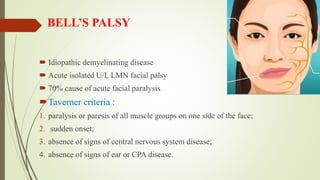
BELL’S PALSY
 Idiopathic demyelinating disease
 Acute isolated U/L LMN facial palsy
 70% cause of acute facial paralysis
Taverner criteria :
1. paralysis or paresis of all muscle groups on one side of the face;
2. sudden onset;
3. absence of signs of central nervous system disease;
4. absence of signs of ear or CPA disease.
 Predominance in women younger than 20 years and a slight predominance
in men older than 40 years,
 Peak between the ages of 15 and 45 years
 Recurrence rates of 4.5–15%
 familial incidence of 4.1%
 More common in pregnancy with the majority in the 3rd trimester
Etiology:
• Remains unclear.
• Although microcirculatory failure of
the vasa nervorum,
• Ischaemic neuropathy,
• Infectious-hsv-1& 2,VZV,
• Inf-b,adenovirus,EBV
• Genetic and immunologic causes
D/D
Cholesteatoma- Polyposis or granulations in EAC
Ramsay hunt syndrome- Vesicles
Preceding h/o trauma
Poor Prognosis
1. Complete paralysis @ onset
2. Incomplete paralysis with late onset of recovery
3. Old age
4. Dry eye
5. Abolished taste
6. Absent stapedial reflex
7. Post auricular pain
Normal function is usually regained within 3 months in about two-thirds of all
patients.
No further recovery is expected after a period of 6 months has elapsed.
Treatment:
General measurers-Eye care: lubricants, shield
-Physical therapy: eyelid stretch
Corticosteroids- Prednisolone 1mg/kg/day for 5days
F/b 10 day taper
Antiviral agents-acyclovir 200-400mg 5 times a day for 10
days
 (1.6 to 3.0 g acyclovir per day for 5 to 7 days, or 1.0 to 3.2 g
valacyclovir per day for 5 to 7 days)
Surgical decompression
OCNA 2018
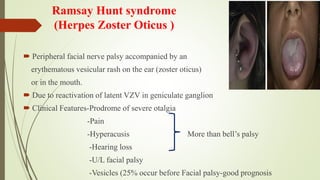
Ramsay Hunt syndrome
(Herpes Zoster Oticus )
 Peripheral facial nerve palsy accompanied by an
erythematous vesicular rash on the ear (zoster oticus)
or in the mouth.
 Due to reactivation of latent VZV in geniculate ganglion
 Clinical Features-Prodrome of severe otalgia
-Pain
-Hyperacusis More than bell’s palsy
-Hearing loss
-U/L facial palsy
-Vesicles (25% occur before Facial palsy-good prognosis
 Diagnosis-
• Titre of ab to VZV
• PCR to detect VZV in ear exudates
 May be missed due to Ramsay hunt sine herpete
( Four fold rise in ab to vzv and no vesicles)
 Prognosis poor than bells’s palsy
 Treatment- Prednisolone 1mg/kg/day for 5 days then 10 days taper
-IV acyclovir 250 mg TDS
-Oral acyclovir 800 mg 5times a day
 Without treatment, only 21% will fully recover
Trauma
Blunt
 Displaced fractures
May result in bony impingement
of the nerve
 Nondisplaced fractures
May result in perineural
inflammation and subsequent
neural ischemia
Penetrating
The soft tissues of the
head and neck with
acute fp
Immediate surgical
exploration and
debridement are
warranted
Birth trauma
Can affect 1 or more
branches of the facial nerve
Evident with the first cry
Risks-forceps delivery,
birthweight More than 3.5
kg, and primiparity
Itrogenic trauma
Features Longitudinal Transverse
Frequency More common (80%) Less common (20%)
Site of blow Parietal Occipital
Otic capsule Sparing Involving
Fracture line Squamous part of TB to foramen lacerum,
parallel to long axis of petrous
Foramen magnum to spinosum through
jugular foramen across the petrous
Injury to external and middle ear Common Absent
Ear bleeding Common Absent as TM is intact
Haemotympanum Common Absent
CSF Otorrhea Present Absent
Labyrinth or CN VIII injury Uncommon Common
Hearing loss Usually Conductive Usually Sensorineural
Vertigo Uncommon Generally severe
Facial paralysis Uncommon (20%) Common (50%)
Onset of Palsy Usually delayed Usually immediate
Site of facial nerve injury Horizontal tympanic segment Meatal or labyrinthine segment,
Axial HRCT image of the temporal bone shows
an otic capsule–sparing fracture (arrows).
Axial HRCT image of the temporal bone shows an otic
capsule–violating fracture (arrows).
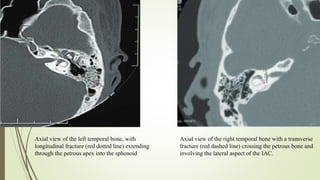
Axial view of the left temporal bone, with
longitudinal fracture (red dotted line) extending
through the petrous apex into the sphenoid
Axial view of the right temporal bone with a transverse
fracture (red dashed line) crossing the petrous bone and
involving the lateral aspect of the IAC.
Penetrating injuries
 such as gunshot wounds
 often accompanied by severe injuries that include dural tears, CSF
liquorrhea, damage to the otic capsule, and vascular injury.
 Evaluation includes high-resolution CT, carotid arteriography, and facial
nerve electrical testing.
 extratemporal facial nerve blast-type injuries may not cause transection of
the facial nerve;
 recommend continued conservative management, even if the nerve is
severely hemorrhagic and contused.
Management of iatrogenic facial nerve injury
Management
1. Surgery (Decompression)
2. Nerve Repair
3. Nerve graft(Cable Graft)
Acute
( <3 weeks )
FN decompression:
• Transmastoid
• MCF
• Translabyrinthine
FN repair:
• Primary
• Cablegraft
Intermediate
( 3 weeks – 2 years )
Cross face nerve graft
Nerve transfer
• Hypoglossal
• Massetric
• Spinal accessory
Chronic
( > 2 years )
Regional muscle transfer
• Temporalis
• Masseter
• Digastric
Free muscle transfer
• Gracilis
• Serratus anterior
• Lattisimus dorsi
• Pectoralis minor
Facial Nerve Decompression
 Site to be explored-
 Based on causes of facial paralysis and suspected site of
injury
 Bells palsy : the labyrinthine segment and perigeniculate
region are decompressed via a middle fossa approach.
 Acute or chronic otitis media : the mastoid and tympanic
segments are explored
 Canal wall down mastoidectomy :cholesteatoma involving
facial nerve
 Intraoperative injury :directed to the site of injury
1. Retrolabyrinthine Approach-
 Expose FN from brain stem to IAC
2. Retrosigmoid Approach
 Exposure FN from brain stem to IAC
 Adv-Expose FN without Sacrificing inner ear function
-Minimal/No cerebelllar compression
-Tumor removal near brainstem
 Limitations-Limited view of FN due to 8th CN
(if we separate 8th nerve then chance of HL)
-CSF leak
SURGERY
3. Middle Cranial Fossa Approach
 Expose FN: IAC to Tympanic segment
 Advantages-Hearing preservation
-With RL & TM approach
(can see entire FN)
-Mainly used for decompression
 Limitations -Anatomy of floor of MCF is variable
-CHL or SNHL
-CSF leak
-Injury to AICA(most severe bleed)
4. Transmastoid Approach
 Expose FN: GG to SMF
 Advantages-Used in # of mastoid part
of fallopian canal
-Infection
 Limitations-Limited exposure of GG
-Sometimes: CHL/SNHL
5. Translabyrinthine approach
 Total nerve exposure
 Advantages-Used in Transtemporal Bone #
-Large congenital cholesteatoma
-Interposition graft
 Limitations-Hearing and balance function sacrifice
-CSF leak
Nerve Repair
 Made to restore its continuity.
 Injured ends of the nerve should be freshened at a
45-degree angle
 Milesi-advocates removing a portion of the
epineurium before suturing to prevent connective
tissue growth at the anastomotic site
 The main factors that influence the results
following(downgrade)-
– Lack of suitable nerve ends
– Tension at the suture line
– Infection
Repaired Facial Nerve Recovery Scale
Nerve Grafting
 When tension-free apposition cannot be achieved using existing nerve ends,
cable grafts are used
 If grafting is not undertaken at the time of nerve sacrifice, it should be
completed within 72 hours
 GAN
• Its size and fascicular pattern are similar to FN
• Easily harvested
• Limitation-Max length 10cm
• Graft placed in “Lazy S” configuration so minimal
tension
(8-10mm extra length for each anastomosis)
Rehabilitation of Facial nerve Palsy
“Once damaged, the facial nerve rarely regains complete function”
1. Cross Face Nerve Grafting
2. Nerve Transposition
3. Muscle Transfer
 Cross Face Nerve Grafting
By Scaramella and Smith
Limitations -lack of sufficient axon population and neural excitatory vitality
-It is of marginal value when used alone, but when combined with
microvascular transfer of muscle it can provide suitable innervation
Buccal branch, on the nonparalyzed side through a nasolabial fold incision
One to three sural nerve grafts are approximated to these normal contralateral branches.
The nerve grafts are then passed through subcutaneous tunnels, usually in the upper lip
Nerve Transposition
 When a proximal facial nerve stump is not viable or available
Hypoglossal nerve transfer
It has anatomical and functional relation with VII nerve
Results in a lack of voluntary emotional control
Tongue atrophy(70-80%)
Partial transection of the hypoglossal nerve with use of a jump
graft from the partially transected nerve to the distal facial
nerve(GAN use as jump graft)
XII CN is incised in beveled fashion to expose approximately
30% of the nerve fibers
largest series to date, which involved 137 patients, approximately
95% regained satisfactory tone in repose and regained some mass
facial movement.
 Of these patients, 15% demonstrated hypertonia and excessive
movement in the middle third of the face.
OTHER NERVE TRANSFERS-
 The spinal accessory nerve & phrenic nerve was used before the hypoglossal
nerve in nerve transposition techniques
 Limitations: Paralysis of the diaphragm and induces undesirable involuntary
inspiratory movements in the facial muscles
MUSCLE TRANSFERS
 Masseter and temporalis muscle
 They should be used only if ipsilateral cable nerve grafting is not possible
 Complete paralysis has lasted 2 years or more.
 The masseter transfer procedure generally is performed for rehabilitation of the
sagging paralyzed oral commissure and the buccal-smile complex of muscles.
 The entire muscle, rather than only anterior elements, is transposed so that the masseteric nerve
supply is transferred intact with the muscle belly.
Temporalis muscle
CONCLUSION
Temporal bone dissection to learn the course of facial
nerve.
Facial palsy (FP) is a devastating condition resulting in
profound quality-of-life (QOL) impairment.
Therefore, Management of FP requires establishing a
diagnosis and formulating a therapeutic plan according to
the timing of presentation.
THANK YOU
Facial nerve
Facial nerve

Facial nerve

  • 1.
    FACIAL NERVE & ITS DISORDERS Dr.AshishK.Gupta SMS Medical college,Jaipur
  • 2.
    INTRODUCTION Facial nerve (CNVII), is the nerve of facial expression. It is the nerve of second branchial arch.  It contains motor and somatosensory components. The somatosensory component of the facial nerve is described under the name of the nervus intermedius or pars intermedia of Wrisberg.
  • 3.
    Development of Facialnerve Motor root of the facial nerve is independent of the development of the sensory root and the geniculate ganglion. In the 5th week, the facial motor nucleus & chorda tympani At this time, the chorda tympani nerve and the facial nerve trunk are of approx. equal size By the 7th week- nervus intermedius & greater petrosal nerve
  • 4.
    SURGICAL PEARL: • Atbirth, facial nerve exits the stylomastoid foramen on the lateral aspect of the skull, - this may cause facial nerve injury during difficult delivery. • At 2 yrs , mastoid process pushes the stylomastoid foramen medially and covers the facial nerve exit. • Before the age of 2 years, a retroauricular incision should not be extended inferiorly as facial nerve could be injured at its exit from the stylomastoid foramen.
  • 5.
    ANATOMY Segment Location Length (mm) Supranuclear CerebralCortex NA Brainstem Motor nucleus, sup salivatory nucleus NA Intracranial Brainstem to entry of IAC 13-15 Meatal segment Within Interanal Auditory Canal (IAC) 5-12 Labrynthine segment Fundus of IAC to Geniculate ganglion 3-4 Tympanic segment Geniculate gang to pyramidal eminence 8-11 Mastoid segment Pyramidal Process to stylomastoid foramen 10-14 Extratemporal segment Stylomastoid foramen to pes anserinus 15-20
  • 6.
  • 7.
    FACIAL NERVE NUCLEI 1)Motor nucleus or Branchiomotor (MOTOR) – lower pons below 4th ventricle 2) Superior salivatory nucleus (PARASYMP) – dorsal to motor Nucleus 3) Lacrimatory Nucleus (PARASYMP)- in lower pons 4) Nucleus of tractus solitarius (GUSTATORY)– medulla oblongata
  • 8.
    INFRANUCLEAR PATHWAY They emergefrom the lower border of the pons as a motor facial nerve root and a sensory root (nerve of Wrisberg) and it is from here that the infranuclear pathway starts.
  • 9.
     Motor root,carrying fibers to the muscles of the second pharyngeal arch  While the sensory root consists of:  Special visceral afferent: taste to anterior 2/ 3rd of the tongue via the chorda tympani  General sensory afferent-carry cutaneous sensation, including pain, from the posterior aspect of the EAM and to be the site of vesicular eruptions in Ramsay Hunt syndrome  General visceral efferent: salivary glands via the petrosal nerves
  • 10.
     Lower halfof the face has contralateral supranuclear control.  Upper half has bilateral control.  Facial motor nucleus also has innervation from thalamus for involuntary emotional expression eg; happy or sad So this explains why frontalis muscle and emotional facial expression remains intact in supranuclear lesions.
  • 11.
    1. INTRACRANIAL PART Frompons to point of entry into IAC Motor is more Medial. Thin layer of pia mater SURGICAL IMPORTANCE 1. Iatrogenic trauma in CerebelloPontine angle tumour surgery due to lack of perineurium. 2. Difficult to identify during dissection of schwannoma (no connective tissue)
  • 12.
    2. Meatal Segement FNrun through IAC from its porus to its fundus  Facial nerve occupies the anterosuperior quadrant of the IAC It lies superior to the cochlear nerve and it passes above the crista falciformis. A crest of bone, the “Bill’s bar” hangs in the vertical plane of the IAC between the superior vestibular nerve and the facial nerve,
  • 13.
    3. Labyrinthine segement Shortestand the narrowest segment of the FN. Here, facial nerve fibres are loosely arranged, without an epineural covering,so it is common site of entrapment during inflammatory disorders of facial nerve. Only segement that laks anastomosing arteries,so is vunrable to embolic phenomenon and vascular compression:most likely affected by ischemia in odema following trauma and inflammation.
  • 14.
     Cochlea isanteroinferior to the labyrinthine segment  Both the facial nerve and the nervus intermedius remain distinct entities, and they meet each other just before joining the geniculate ganglion
  • 15.
    Geniculate Ganglion: At thedistal end of the labyrinthine segment, the geniculate ganglion forms part of a sharp ‘hairpin’ turn, the geniculum or first genu of the facial nerve Dehiscent in 25 % of temporal bones, vulnerable to injury during middle cranial fossa surgery.
  • 16.
    4. Tympanic Segement Nervetakes a sharp turn posteriorly at 700-800 to form geniculate ganglion then runs on medial wall of middle ear, above & medial to processus cochleariformis. Clinical Application- • Processus cochleariformis (constant landmark) • Most frequest site of dehiscene 91%. • MC Site for iatrogenic injury
  • 19.
    Second Genu It isthe junction between the tympanic and the mastoid segments of the facial nerve. Just lateral and posterior to the pyramidal eminence.
  • 20.
    5. Mastoid Segement From2nd genu(PM) to SMF(AL)  Landmark are the horizontal semicircular canal, the short process of the incus, and the digastric ridge Clinical Impact • During canalplasty, the facial nerve may pass lateral to the annulus. • In such cases, drilling in the posteroinferior quadrant of the external auditory canal, even lateral to the annulus, may lead to a facial nerve injury.
  • 21.
    Branches of facialnerve Greater superficial petrosal nerve. Nerve to stapedius, arises from distal tympanic or upper mastoid part. Chorda tympani arises slightly above stylomastoid foramen. After the exit: Posterior auricular Nerve to posterior belly of digastric Nerve to stylohoid In the parotid gland, it divides in to temporofacial and cervicofacial division.
  • 22.
    1. GSPN Runs infacial hiatus in superior surface of temporal bone. Carries secretomotor fibers to the lacrimal gland, palate and nasal cavity.
  • 24.
    Clinical Application- The perigeniculatearea is the weakest zone of the Fallopian canal; it is the most common localization of traumatic facial nerve injury in temporal bone fracture
  • 25.
    Clinical Implications GSPN representsan important landmark for facial nerve identification during middle cranial fossa approach. The section of the GSPN or the section of vidian nerve has been proposed in the past to treat intractable vasomotor rhinitis; this surgery was abandoned because of its troublesome side effects of such reduction of the lacrimal secretions (dry eyes).
  • 26.
  • 28.
    3. Extra temporalPart  Stylomastoid foramen to terminal branches.  Liesin relation posteriorly with styloid process, laterally with posterior belly of digastric muscle, and anteriorly with parotid gland.
  • 30.
  • 31.
    SURGICAL LANDMARKS 1. Processuscochleariformis 2. Short process of incus 3. Lateral semicircular canal 4. Oval window 5. Tympanomastoid suture 6. Digastric ridge A. Mastoid surgery:
  • 32.
    B. Parotid Surgery: 1.Tympanomastoid suture: The facial nerve emerges a few millimeters deep to its outer edge. 2. Tragal pointer: 1 cm deep and inferior to the pointer. 3. Mastoid process: Process lies deep to the insertion of the sternocleidomastoid muscle and hence it is mainly a palpatory landmark. 4. Posterior belly of digastric muscle: Facial nerve trunk lies approximately 1 cm above and parallel to its upper border near its insertion at the mastoid tip.
  • 33.
  • 34.
    FACIAL NERVE INJURY 1.Pathophysiology: • Endonerium – Surrounds each nerve fiber. – Provides endoneural tube for regeneration. – Much poorer prognosis if disrupted. • Perinerium – Surrounds a group of nerve fibers. – Provides tensile strength. – Protects nerve from infection. • Epinerium – Surrounds the entire nerve. – Provides nutrition to nerve.
  • 35.
    SEDDON CLASSIFICATION  SirHerbert Seddon distinguished between three types of localized injuries to peripheral nerves and introduced the terms.  Neuropraxia – Conduction blockage due to pressure Rapid and complete recovery No distal wallerian degeneration  Axonotmesis – Blockage of axoplasmic flow Endoneurium preserved Wallerian degeneration distal to lesion  Neurotmesis –Total nerve transection. Wallerian degeneration
  • 36.
    ‘Wallerian degeneration’ refers specificallyto the process of degeneration that takes place along a nerve distal to an injury Improper axon healing can cause facial synkinesis
  • 37.
  • 38.
    2. Clinical evaluation: History-  Mechanism – recent surgery, facial/head trauma  Timing – progressive loss of function or sudden loss  Transected nerve -> sudden loss  Intraneural hematoma or impengiment -> progressive loss (better prognosis)  Associated symptoms – hearing loss ,vertigo  Complete or incomplete Physical Examination • Full head and neck examination • Facial asymmetry • Signs of facial injury: lacerations, hematomas, bruising • Exam head/scalp for signs of injury to help guide you to vector of force if head trauma is involved. • Otoscopic examination is a must • Canal lacerations • Hemotympanum, TM perforation, drainage of blood or clear fluid from middle ear • Tuning fork tests help to determine any hearing loss
  • 39.
  • 40.
  • 41.
    It is nota perfect Garding system because of::- 1>the problems of inter & intraobserver variations 2>applicable only to disorders of nerve proximal to pesanserinus 3>not appropriate for single branch injuries. 4>The HB scale is not useful in assessing transected or repaired nerves for three reasons: a. all repairs cause mass movement; b. most patients can eventually close their eyes and have good oral sphincter function; c. almost no patients arc able to raise their eyebrow or forehead.
  • 43.
    3.TESTS FOR EVALUATION TOPODIAGNOSTIC TESTS Lacrimal Function Stapedius Reflex Taste SalivaryFlow test ELECTRODIAGNOSTIC Nerve excitability test Maximal Stimulation Test Electroneurography Electromyography Imaging CT & MRI Intraoperative monitoring
  • 44.
    A. Topodiagnostic Tests These tests can be used to localize the site of injury to the facial nerve and therefore assist in diagnosis and management.  If the lesion is distal to a particular branch of the nerve, the function of that branch will be spared.  These tests are of limited value as they provide limited correlation with the site of nerve damage and have no prognostic value.
  • 45.
     Assesment ofGSPN  Filter paper is placed in the lower conjunctival fornix bilaterally.  3- 5 minutes.  Schirmer’s test is +ve when: >75% unilateral decrease in lacrimation, or a bilateral decrease in lacrimation (less than 10 mm for both sides at five minutes). Schirmer test positive  lesion at or proximal to geniculate ganglion 1. Schirmer’s Test
  • 46.
    2. Stapedial reflex Stapedius branch of the facial nerve.  Most objective and reproducible.  It is based on the fact that a loud sound, 70-100 dB above the threshold of hearing of a particular ear causes b/l contraction of the stapedial muscles.  Tone can be delivered to one ear & the reflex picked from the same ear or the contralateral ear.  If intact stapedial reflex, complete recovery can be expected to begin within six weeks.
  • 47.
    3. Taste  Totest Chorda tympani nerve  Natural stimuli, such as filter-paper disks impregnated with aqueous solutions of sodium chloride (salty taste), saccharose (sweet taste), citrate or hydrochloric acid (sour taste), quinine (bitter taste) or by electrical stimulation (EGM) of the tongue
  • 48.
    Electrogustometry  The tongueis stimulated electrically to produce a metallic taste and the two sides are compared  Threshold of the test is compared between sides  Normal-Up to 25% tongue taste differece on both side  Taste function recover before facial movemets
  • 49.
    4. Salivary flowrates Cannulation of Wharton's ducts bilaterally 5 minute measurement of output  Salivary flow is measured over time following a gustatory stimulus (6% citric acid on anterior part of tongue) Significant if 25% reduction in flow of the involved side as compared to the normal side-Indicative for surgery
  • 50.
    B. ELECTRODIAGNOSTIC TESTING Tests based on these two principles 1. Electrical stimulation 2. Recording of the electromyographic response,  Useful in determining the prognosis and sometimes in stratifying patients for nonsurgical versus surgical management  Repair is contraindicated when motor end plate muscle unit is no longer functional.
  • 51.
    1. Minimal NerveExcitability Test  Test for facial nerve degeneration (excitation is lost over 3-4 days pd)  The stimulating electrode is placed on the skin over the stylomastoid foramen or over one of the peripheral branches of the nerve, and a return electrode is taped to the forearm.  Start from healthy side- 0.3msec in duration and increse till facial twitch occur  Then on opposite side and compare  Result- difference of 3.5 ma or greater between the two sides is considered significant  Useful only in complete paralysis
  • 52.
    2. Maximal StimulationTest  MST uses a level of current {maximal stimulus)at which the greatest amplitude of facial movement is observed  Stimulates all intact axons  Proportion of fibers that have degenerated can be estimated  Comparison rated as equal, slightly decreased, markedly decreased, or absent – Equal or slightly decreased response = favorable for complete recovery – Markedly decreased or absent response (with in 10 days) = Advanced degeneration with a poor prognosis
  • 53.
    3. Electroneurography  mostvaluable prognostic indicator in electrodiagnostic tests.  Supramaximal stimulus is delivered to trunk @ SMF Evoked biphasic compound muscle action potential (CAMP)  Response in 2 sides is compared and % of degenerated fiber is calculated  If CAMP amplitute of affected side is 10% of normal side 90%axonal loss is sustained Not useful until 4th day of palsy as wallerian degeneration takes 3 days for completion Less value after 3 weeks due to nerve fibre desynchronization
  • 54.
    Main indication-Acute onsetcomplete FN paralysis Both % of amplitude reduction and rate of degeneration are used as prognostic indicator In bells palsy degeneration of >90% with in 14 days of complete paralysis Poor recovery Not useful in Ramsay hunt syndrome due to multiple site involvement
  • 55.
    4. Electromyography  Recordactive motor unit potential of orbicularis oculi and oris during rest and voluntary contraction  Used to determine: - Continuity of nerve - evidence of wallerian degeneration -Sign of reinnervation  Fibrillation potential arise 2-3 weeks following injury  So EMG has no value till 2 weeks  More useful are the polyphasic reinnervation potentials that may be seen as early as 4 to 6 weeks after the onset of paralysis.  EMG has role in decision making in Sx intervention in long standing paralysis
  • 56.
     Polyphasic motorunit potentials- • Regenerative processes • No need of Surgery • Close follow up  Fibrillation potentials- • Lower motor neuron denervation, but viable motor end plates. • Surgical exploration is therefore indicated  'Silence' on EMG (no electrical output)- • longterm denervation and suggests that muscle has been replaced by fibrous tissue. • In this case, static or dynamic (microvascular innervated free muscle transfer or muscle transposition) facial reanimation is indicated.
  • 57.
    Limitations:  Impulse canstimulate only normal or neuropraxic fibers and can’t distinguish whether remaining fibers are in a state of axono or neurotomesis.  No information on incomplete paralysis  No information on immediate post paralysis(First-72hrs)
  • 59.
    Intraoperative Nerve Monitoring Itincludes continuous EMG measurement from peripheral facial muscle groups and electrical stimulation of facial nerve itself or its ranches to obtain CAMP Uses- 1. CPA tumor sx 2. Rev. Mastoid sx 3. Rev. Parotid sx 4. Sx of congenital ear abnormalities
  • 61.
    Antidromic potential:  Ifa motor nerve is electrically or mechanically stimulated at some point between its cell body and its synapse on a muscle fiber, action potentials will be propagated in two directions:  An orthodromic or antegrade impulse will travel distally toward the muscle.  An antidromic or retrograde impulse will travel proximally toward the cell body.  The orthodromic impulse will cross the neuromuscular junction, resulting in an observable muscle contraction and a recordable compound muscle action potential. This M-wave is the same potential recorded in ENoG.
  • 62.
     The antidromicimpulse will not cross a synapse, it can be recorded by electrodes on the proximal nerve (near field) or at a distance (far field).  The antidromic impulse will not travel farther “upstream” than the facial nucleus motor neuron, but it can be reflected back along that neuron’s axon in an orthodromic direction.  eventually reaching the muscle and stimulating a muscle action potential— the F-wave—that is delayed relative to the initial M-wave.  F-waves are easily disrupted by even the mildest degree of facial paresis.  They often are abnormal with delayed latency or decreased amplitude or are absent in patients with acoustic tumors, even when clinical examination of facial nerve function yields normal findings.
  • 63.
    C. Imaging strategiesin facial nerve palsy The imaging strategy is largely determined by the suspected nature of the lesion. HRCT enables superior visualization of the intratemporal segment of the facial nerve and is particularly useful in cases of temporal bone trauma, Fallopian canal involvement in chronic suppurative otitis media (CSOM) or temporal bone malignancies.  MRI using paramagnetic contrast agents such as gadolinium is known to provide better visualization of soft tissues and is particularly useful in neoplastic or inflammatory lesions.
  • 64.
    It should beremembered that both imaging techniques are complementary and may be used in combination.
  • 65.
  • 66.
    BELL’S PALSY  Idiopathicdemyelinating disease  Acute isolated U/L LMN facial palsy  70% cause of acute facial paralysis Taverner criteria : 1. paralysis or paresis of all muscle groups on one side of the face; 2. sudden onset; 3. absence of signs of central nervous system disease; 4. absence of signs of ear or CPA disease.
  • 67.
     Predominance inwomen younger than 20 years and a slight predominance in men older than 40 years,  Peak between the ages of 15 and 45 years  Recurrence rates of 4.5–15%  familial incidence of 4.1%  More common in pregnancy with the majority in the 3rd trimester
  • 68.
    Etiology: • Remains unclear. •Although microcirculatory failure of the vasa nervorum, • Ischaemic neuropathy, • Infectious-hsv-1& 2,VZV, • Inf-b,adenovirus,EBV • Genetic and immunologic causes
  • 69.
    D/D Cholesteatoma- Polyposis orgranulations in EAC Ramsay hunt syndrome- Vesicles Preceding h/o trauma
  • 70.
    Poor Prognosis 1. Completeparalysis @ onset 2. Incomplete paralysis with late onset of recovery 3. Old age 4. Dry eye 5. Abolished taste 6. Absent stapedial reflex 7. Post auricular pain Normal function is usually regained within 3 months in about two-thirds of all patients. No further recovery is expected after a period of 6 months has elapsed.
  • 71.
    Treatment: General measurers-Eye care:lubricants, shield -Physical therapy: eyelid stretch Corticosteroids- Prednisolone 1mg/kg/day for 5days F/b 10 day taper Antiviral agents-acyclovir 200-400mg 5 times a day for 10 days  (1.6 to 3.0 g acyclovir per day for 5 to 7 days, or 1.0 to 3.2 g valacyclovir per day for 5 to 7 days) Surgical decompression
  • 72.
  • 73.
    Ramsay Hunt syndrome (HerpesZoster Oticus )  Peripheral facial nerve palsy accompanied by an erythematous vesicular rash on the ear (zoster oticus) or in the mouth.  Due to reactivation of latent VZV in geniculate ganglion  Clinical Features-Prodrome of severe otalgia -Pain -Hyperacusis More than bell’s palsy -Hearing loss -U/L facial palsy -Vesicles (25% occur before Facial palsy-good prognosis
  • 74.
     Diagnosis- • Titreof ab to VZV • PCR to detect VZV in ear exudates  May be missed due to Ramsay hunt sine herpete ( Four fold rise in ab to vzv and no vesicles)  Prognosis poor than bells’s palsy  Treatment- Prednisolone 1mg/kg/day for 5 days then 10 days taper -IV acyclovir 250 mg TDS -Oral acyclovir 800 mg 5times a day  Without treatment, only 21% will fully recover
  • 75.
    Trauma Blunt  Displaced fractures Mayresult in bony impingement of the nerve  Nondisplaced fractures May result in perineural inflammation and subsequent neural ischemia Penetrating The soft tissues of the head and neck with acute fp Immediate surgical exploration and debridement are warranted Birth trauma Can affect 1 or more branches of the facial nerve Evident with the first cry Risks-forceps delivery, birthweight More than 3.5 kg, and primiparity Itrogenic trauma
  • 76.
    Features Longitudinal Transverse FrequencyMore common (80%) Less common (20%) Site of blow Parietal Occipital Otic capsule Sparing Involving Fracture line Squamous part of TB to foramen lacerum, parallel to long axis of petrous Foramen magnum to spinosum through jugular foramen across the petrous Injury to external and middle ear Common Absent Ear bleeding Common Absent as TM is intact Haemotympanum Common Absent CSF Otorrhea Present Absent Labyrinth or CN VIII injury Uncommon Common Hearing loss Usually Conductive Usually Sensorineural Vertigo Uncommon Generally severe Facial paralysis Uncommon (20%) Common (50%) Onset of Palsy Usually delayed Usually immediate Site of facial nerve injury Horizontal tympanic segment Meatal or labyrinthine segment,
  • 77.
    Axial HRCT imageof the temporal bone shows an otic capsule–sparing fracture (arrows). Axial HRCT image of the temporal bone shows an otic capsule–violating fracture (arrows).
  • 78.
    Axial view ofthe left temporal bone, with longitudinal fracture (red dotted line) extending through the petrous apex into the sphenoid Axial view of the right temporal bone with a transverse fracture (red dashed line) crossing the petrous bone and involving the lateral aspect of the IAC.
  • 79.
    Penetrating injuries  suchas gunshot wounds  often accompanied by severe injuries that include dural tears, CSF liquorrhea, damage to the otic capsule, and vascular injury.  Evaluation includes high-resolution CT, carotid arteriography, and facial nerve electrical testing.  extratemporal facial nerve blast-type injuries may not cause transection of the facial nerve;  recommend continued conservative management, even if the nerve is severely hemorrhagic and contused.
  • 80.
    Management of iatrogenicfacial nerve injury
  • 81.
    Management 1. Surgery (Decompression) 2.Nerve Repair 3. Nerve graft(Cable Graft)
  • 83.
    Acute ( <3 weeks) FN decompression: • Transmastoid • MCF • Translabyrinthine FN repair: • Primary • Cablegraft Intermediate ( 3 weeks – 2 years ) Cross face nerve graft Nerve transfer • Hypoglossal • Massetric • Spinal accessory Chronic ( > 2 years ) Regional muscle transfer • Temporalis • Masseter • Digastric Free muscle transfer • Gracilis • Serratus anterior • Lattisimus dorsi • Pectoralis minor
  • 84.
    Facial Nerve Decompression Site to be explored-  Based on causes of facial paralysis and suspected site of injury  Bells palsy : the labyrinthine segment and perigeniculate region are decompressed via a middle fossa approach.  Acute or chronic otitis media : the mastoid and tympanic segments are explored  Canal wall down mastoidectomy :cholesteatoma involving facial nerve  Intraoperative injury :directed to the site of injury
  • 85.
    1. Retrolabyrinthine Approach- Expose FN from brain stem to IAC 2. Retrosigmoid Approach  Exposure FN from brain stem to IAC  Adv-Expose FN without Sacrificing inner ear function -Minimal/No cerebelllar compression -Tumor removal near brainstem  Limitations-Limited view of FN due to 8th CN (if we separate 8th nerve then chance of HL) -CSF leak SURGERY
  • 87.
    3. Middle CranialFossa Approach  Expose FN: IAC to Tympanic segment  Advantages-Hearing preservation -With RL & TM approach (can see entire FN) -Mainly used for decompression  Limitations -Anatomy of floor of MCF is variable -CHL or SNHL -CSF leak -Injury to AICA(most severe bleed)
  • 89.
    4. Transmastoid Approach Expose FN: GG to SMF  Advantages-Used in # of mastoid part of fallopian canal -Infection  Limitations-Limited exposure of GG -Sometimes: CHL/SNHL
  • 90.
    5. Translabyrinthine approach Total nerve exposure  Advantages-Used in Transtemporal Bone # -Large congenital cholesteatoma -Interposition graft  Limitations-Hearing and balance function sacrifice -CSF leak
  • 91.
    Nerve Repair  Madeto restore its continuity.  Injured ends of the nerve should be freshened at a 45-degree angle  Milesi-advocates removing a portion of the epineurium before suturing to prevent connective tissue growth at the anastomotic site  The main factors that influence the results following(downgrade)- – Lack of suitable nerve ends – Tension at the suture line – Infection
  • 92.
    Repaired Facial NerveRecovery Scale
  • 93.
    Nerve Grafting  Whentension-free apposition cannot be achieved using existing nerve ends, cable grafts are used  If grafting is not undertaken at the time of nerve sacrifice, it should be completed within 72 hours
  • 94.
     GAN • Itssize and fascicular pattern are similar to FN • Easily harvested • Limitation-Max length 10cm • Graft placed in “Lazy S” configuration so minimal tension (8-10mm extra length for each anastomosis)
  • 95.
    Rehabilitation of Facialnerve Palsy “Once damaged, the facial nerve rarely regains complete function” 1. Cross Face Nerve Grafting 2. Nerve Transposition 3. Muscle Transfer
  • 96.
     Cross FaceNerve Grafting By Scaramella and Smith Limitations -lack of sufficient axon population and neural excitatory vitality -It is of marginal value when used alone, but when combined with microvascular transfer of muscle it can provide suitable innervation Buccal branch, on the nonparalyzed side through a nasolabial fold incision One to three sural nerve grafts are approximated to these normal contralateral branches. The nerve grafts are then passed through subcutaneous tunnels, usually in the upper lip
  • 97.
    Nerve Transposition  Whena proximal facial nerve stump is not viable or available Hypoglossal nerve transfer It has anatomical and functional relation with VII nerve Results in a lack of voluntary emotional control Tongue atrophy(70-80%) Partial transection of the hypoglossal nerve with use of a jump graft from the partially transected nerve to the distal facial nerve(GAN use as jump graft) XII CN is incised in beveled fashion to expose approximately 30% of the nerve fibers
  • 98.
    largest series todate, which involved 137 patients, approximately 95% regained satisfactory tone in repose and regained some mass facial movement.  Of these patients, 15% demonstrated hypertonia and excessive movement in the middle third of the face.
  • 99.
    OTHER NERVE TRANSFERS- The spinal accessory nerve & phrenic nerve was used before the hypoglossal nerve in nerve transposition techniques  Limitations: Paralysis of the diaphragm and induces undesirable involuntary inspiratory movements in the facial muscles
  • 100.
    MUSCLE TRANSFERS  Masseterand temporalis muscle  They should be used only if ipsilateral cable nerve grafting is not possible  Complete paralysis has lasted 2 years or more.  The masseter transfer procedure generally is performed for rehabilitation of the sagging paralyzed oral commissure and the buccal-smile complex of muscles.
  • 101.
     The entiremuscle, rather than only anterior elements, is transposed so that the masseteric nerve supply is transferred intact with the muscle belly.
  • 102.
  • 103.
    CONCLUSION Temporal bone dissectionto learn the course of facial nerve. Facial palsy (FP) is a devastating condition resulting in profound quality-of-life (QOL) impairment. Therefore, Management of FP requires establishing a diagnosis and formulating a therapeutic plan according to the timing of presentation.
  • 104.

Editor's Notes

  • #4 Major atresia The facial nerve primordium is first recognized at the 4th week of gestation
  • #7 The fibers of the facial nerve emerging from the facial nucleus curve around the abducens nucleus ( neurobiotaxis) and later pass ventrolaterally and downwards to lie between the facial nucleus and the spinal nucleus of the trigeminal nerve.
  • #9 (muscles of facial expression, scalp, auricle, stylohyoid, stapedieus and the posterior belly of the digastric).
  • #14  It lies immediately above the anterior part of the vestibule.
  • #16 15%
  • #17 Imp landmark for 2nd genu -LSCC -Pyramidal eminence
  • #25 The greater superficial petrosal nerve represents an important landmark for facial nerve identification during middle cranial fossa approach.
  • #41 Nottingham and Sunnybrook scales
  • #46 Whatmann 41
  • #49 4µa to 4ma (6-34db)
  • #50 Cups-lashley cup or carlson crittenden collector
  • #68 latter stages of pregnancy relates to changes in fluid balance with increased extracellular fluid leading to oedema of the nerve and subsequent compression within the Fallopian canal.
  • #69 Paralysis of the orbicularis oculi muscle leads to unopposed retraction of the levator palpebrae superioris (LPS), which is innervated by the oculomotor nerve
  • #73 Paresis vs paralysis The typical prednisolone dosing in most studies was 60 mg per day for 5 days followed by a 5-day taper.69,70 In children, weight-based dosing, such as prednisone 1 to 2 mg/kg per day for 10 days with a 3-day to 5-day taper is used71 or prednisolone 0.5 to 1.0 mg/kg per day.72 Although intravenous delivery is an option, this is not common.73 Recent American Academy of Otolaryngology–Head and Neck Surgery (AAO-HNS) clinical practice guidelines for BP recommend a 10-day course of oral corticosteroids with at least 5 days at a high dose (prednisolone 50 mg for 10 days or prednisone 60 mg for 5 days with a 5-day taper). Steroids should be started within 72 hours of the onset of symptoms. Although
  • #88 Chl-ossicular disruption
  • #92 cutting the nerve at this angle exposes more neural tubules, placed with jeweler’s forceps or longer instruments (
  • #98 both arise from a similar collection of neurons in the brainstem, and they also share similar reflex responses to trigeminal nerve stimulation