PRESENTED
BY
NEETU.P.S
PGDBM
‘B’ SEC
WHAT IS GAAP?

• International convention of
good accounting practices.
• The rules that govern
accounting are called ‘GAAP’.
DEFINITION: The common set of accounting principles,
standards and procedures that companies use
to compile their financial statements. GAAP
are a combination of authorities standards
[set by policy boards] and simply the
commonly accepted ways of recording and
reporting accounting information.
IN GENERAL…….
 GAAP is a term that applies to the broad
concepts or guidelines and detailed practices
in accounting including all the conventions,
rules and procedures that make up accepted
accounting practice at a given time.
GAAP WAS ESTABLISHED BY Securities

and exchange
commission [SEC]
 Financial accounting standards
board [FASB]
 Governmental accounting
standards board [GASB]
GAAP PROVIDES…
 A fair financial image of the company
 With different information
-Revenue recognition
-Balance sheet item classification
-o/s share measurements
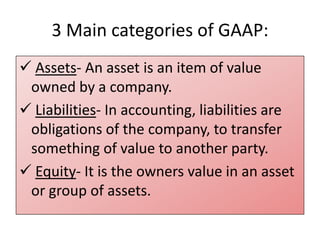
3 Main categories of GAAP:
 Assets- An asset is an item of value
owned by a company.
 Liabilities- In accounting, liabilities are
obligations of the company, to transfer
something of value to another party.
 Equity- It is the owners value in an asset
or group of assets.
DIFFERENCE BETWEEN INDIANGAAP
AND US GAAP
What is underlying assumption?
• Underlying assumptions are the basic
foundation that underlies generally accepted
accounting principles
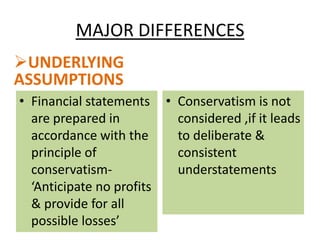
MAJOR DIFFERENCES
UNDERLYING
ASSUMPTIONS
• Financial statements
are prepared in
accordance with the
principle of
conservatism‘Anticipate no profits
& provide for all
possible losses’

• Conservatism is not
considered ,if it leads
to deliberate &
consistent
understatements
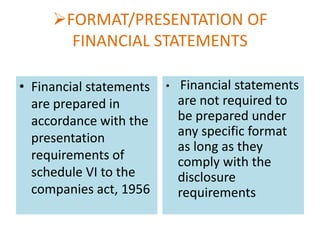
FORMAT/PRESENTATION OF
FINANCIAL STATEMENTS
• Financial statements
are prepared in
accordance with the
presentation
requirements of
schedule VI to the
companies act, 1956

•

Financial statements
are not required to
be prepared under
any specific format
as long as they
comply with the
disclosure
requirements
CASH FLOW STATEMENT
• Cash flow statement in
financial statements is
mandatory only for
listed companies[AS-3]

• Cash flow statement is
mandatory for 3yearscurrent year & 2
immediate preceding
years irrespective of
whether the company is
listed/not[AS-95]
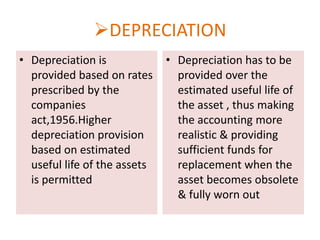
DEPRECIATION
• Depreciation is
provided based on rates
prescribed by the
companies
act,1956.Higher
depreciation provision
based on estimated
useful life of the assets
is permitted

• Depreciation has to be
provided over the
estimated useful life of
the asset , thus making
the accounting more
realistic & providing
sufficient funds for
replacement when the
asset becomes obsolete
& fully worn out
What is long term debt?
• Long term debt are loans & financial
obligations lasting over one year. Such
obligations would include company’s bond
issues or long term leases that have been
capitalized on a firm’s balance sheet.
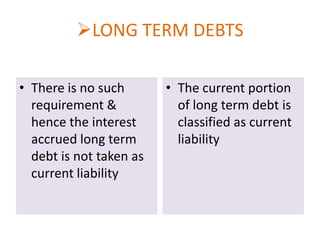
LONG TERM DEBTS
• There is no such
requirement &
hence the interest
accrued long term
debt is not taken as
current liability

• The current portion
of long term debt is
classified as current
liability
 Subsidiary company- A company controlled
by holding company i:e the company holding
more than 51% of shares.
Consolidation- It refers to the
aggregation[collection] of financial statements
of a group company as consolidated financial
statements.
CONSOLIDATION OF SUBSIDIARY
ACCOUNTS
• Consolidation of
accounts of subsidiary
companies is not
mandatory[AS-21]

• Consolidation of results
of subsidiary companies
is mandatory, hence
eliminating material,
inter company
transactions & giving a
true picture of the
operations &
profitability [AS-94]
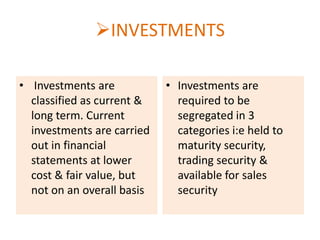
INVESTMENTS
• Investments are
classified as current &
long term. Current
investments are carried
out in financial
statements at lower
cost & fair value, but
not on an overall basis

• Investments are
required to be
segregated in 3
categories i:e held to
maturity security,
trading security &
available for sales
security
What is prudence?
• It is a good judgement or wisdom gained by
experience & knowledge, expressed in a
realistic & frugal attitude. It is not the same as
grave caution or wariness concerned only with
preserving status quo[existing state of affairs].
If there is no real cause for fear, prudence lies
in avoiding excessive deliberations & in the
readiness to sacrifice today’s gain for
tomorrow’s greater gain.
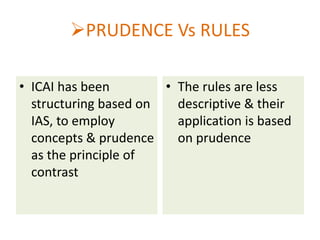
PRUDENCE Vs RULES
• ICAI has been
• The rules are less
structuring based on
descriptive & their
IAS, to employ
application is based
concepts & prudence
on prudence
as the principle of
contrast
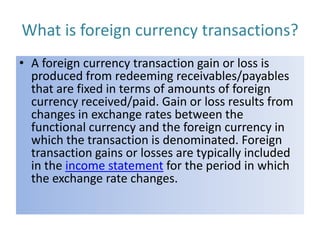
What is foreign currency transactions?
• A foreign currency transaction gain or loss is
produced from redeeming receivables/payables
that are fixed in terms of amounts of foreign
currency received/paid. Gain or loss results from
changes in exchange rates between the
functional currency and the foreign currency in
which the transaction is denominated. Foreign
transaction gains or losses are typically included
in the income statement for the period in which
the exchange rate changes.
FOREIGN CURRENCY TRANSACTIONS
• Exchange
• Capitalization of
fluctuations on
exchange fluctuation
liabilities incurred for
arising from
fixed assets can be
liabilities incurred for
capitalized[AS-11]
acquiring fixed
assets does not
exist[AS-52]
EXPENDITURE DURING
CONSTRUCTION PERIOD
• All incidental
expenditure on
construction of assets
during project stage are
accumulated &
allocated to the cost of
asset

• Such expenses are
divided into 2 heads
direct & indirect. While
direct expense is
accumulated &
allocated to the cost of
asset, indirect are
charged to revenue[AS7]
RESEARCH & DEVELOPMENT
EXPENDITURE
• R&D to be charged to
P/L, except equipment
& machinery which are
capitalized &
depreciated[AS-8]

• All R&D costs are
expenses except
intangible assets
purchased from others
& tangible assets that
have alternative future
uses which are
capitalized &
depreciated[AS-2]
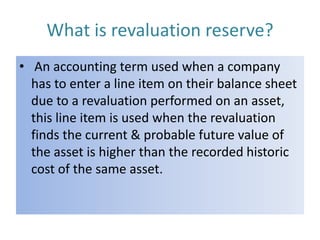
What is revaluation reserve?
• An accounting term used when a company
has to enter a line item on their balance sheet
due to a revaluation performed on an asset,
this line item is used when the revaluation
finds the current & probable future value of
the asset is higher than the recorded historic
cost of the same asset.
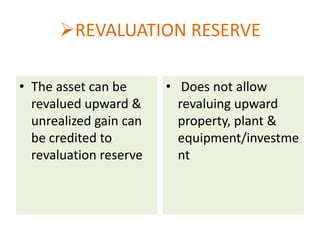
REVALUATION RESERVE
• The asset can be
revalued upward &
unrealized gain can
be credited to
revaluation reserve

• Does not allow
revaluing upward
property, plant &
equipment/investme
nt
 Extraordinary items- The gain or loss resulting
from a transactions or event that is both
unusual in nature & infrequent in occurrence.
Prior period items- It refer to the effects of
errors & omissions in the preparation of
financial statements of one or more prior
years whether it includes all failure of
accounting in prior years.
EXTRAORDINARY ITEMS & PRIOR
PERIOD ITEMS
• Extraordinary &
prior period items
are disclosed
without netting off
for tax effects[AS-5]

• Adjustments for tax
effects are required
to be made while
reporting the prior
period items[AS-16
GOODWILL
• Goodwill is
capitalized &
charged to earnings
over 5-10yrs period

• Goodwill &
intangible assets are
amortized, but they
are tested at least
annually for
impairment[AS-142]
What is capital expense?
• Capital expenses are payments by a business
for fixed assets, like buildings & equipments.
Capital expenses are not used for ordinary day
to day operating expenses of a business, like
rent, utilities & insurance.
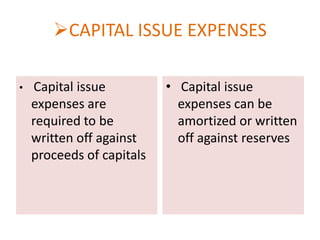
CAPITAL ISSUE EXPENSES
•

Capital issue
expenses are
required to be
written off against
proceeds of capitals

• Capital issue
expenses can be
amortized or written
off against reserves
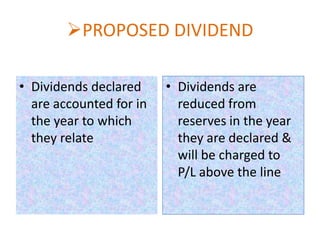
PROPOSED DIVIDEND
• Dividends declared
are accounted for in
the year to which
they relate

• Dividends are
reduced from
reserves in the year
they are declared &
will be charged to
P/L above the line
INVESTMENTS IN ASSOCIATED
COMPANIES
• Investments in
associate companies is
initially recorded at
cost, identifying
goodwill/capital reserve
arising at the time of
acquisition[AS-23]

• Investments in
associates are
accounted under equity
method in group
accounts but would be
held at cost in the
investor’s own A/c[AS115]
PREOPERATIVE EXPENSES
• Direct revenue
expenses like
preliminary &
indirect like
incidental, are
allowed to be
capitalized

• Expenses have to be
charged to revenue
& assets are
capitalized as a
normal
organization[AS-7]
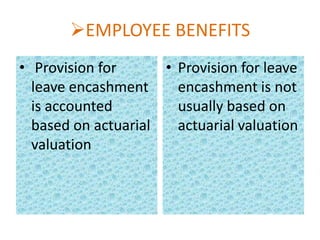
EMPLOYEE BENEFITS
• Provision for
• Provision for leave
leave encashment
encashment is not
is accounted
usually based on
based on actuarial
actuarial valuation
valuation
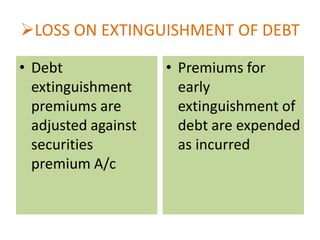
LOSS ON EXTINGUISHMENT OF DEBT
• Debt
extinguishment
premiums are
adjusted against
securities
premium A/c

• Premiums for
early
extinguishment of
debt are expended
as incurred
THANK YOU

Fa gaap

  • 1.
  • 2.
    WHAT IS GAAP? •International convention of good accounting practices. • The rules that govern accounting are called ‘GAAP’.
  • 3.
    DEFINITION: The commonset of accounting principles, standards and procedures that companies use to compile their financial statements. GAAP are a combination of authorities standards [set by policy boards] and simply the commonly accepted ways of recording and reporting accounting information.
  • 4.
    IN GENERAL…….  GAAPis a term that applies to the broad concepts or guidelines and detailed practices in accounting including all the conventions, rules and procedures that make up accepted accounting practice at a given time.
  • 5.
    GAAP WAS ESTABLISHEDBY Securities and exchange commission [SEC]  Financial accounting standards board [FASB]  Governmental accounting standards board [GASB]
  • 6.
    GAAP PROVIDES…  Afair financial image of the company  With different information -Revenue recognition -Balance sheet item classification -o/s share measurements
  • 7.
    3 Main categoriesof GAAP:  Assets- An asset is an item of value owned by a company.  Liabilities- In accounting, liabilities are obligations of the company, to transfer something of value to another party.  Equity- It is the owners value in an asset or group of assets.
  • 8.
  • 9.
    What is underlyingassumption? • Underlying assumptions are the basic foundation that underlies generally accepted accounting principles
  • 10.
    MAJOR DIFFERENCES UNDERLYING ASSUMPTIONS • Financialstatements are prepared in accordance with the principle of conservatism‘Anticipate no profits & provide for all possible losses’ • Conservatism is not considered ,if it leads to deliberate & consistent understatements
  • 11.
    FORMAT/PRESENTATION OF FINANCIAL STATEMENTS •Financial statements are prepared in accordance with the presentation requirements of schedule VI to the companies act, 1956 • Financial statements are not required to be prepared under any specific format as long as they comply with the disclosure requirements
  • 12.
    CASH FLOW STATEMENT •Cash flow statement in financial statements is mandatory only for listed companies[AS-3] • Cash flow statement is mandatory for 3yearscurrent year & 2 immediate preceding years irrespective of whether the company is listed/not[AS-95]
  • 13.
    DEPRECIATION • Depreciation is providedbased on rates prescribed by the companies act,1956.Higher depreciation provision based on estimated useful life of the assets is permitted • Depreciation has to be provided over the estimated useful life of the asset , thus making the accounting more realistic & providing sufficient funds for replacement when the asset becomes obsolete & fully worn out
  • 14.
    What is longterm debt? • Long term debt are loans & financial obligations lasting over one year. Such obligations would include company’s bond issues or long term leases that have been capitalized on a firm’s balance sheet.
  • 15.
    LONG TERM DEBTS •There is no such requirement & hence the interest accrued long term debt is not taken as current liability • The current portion of long term debt is classified as current liability
  • 16.
     Subsidiary company-A company controlled by holding company i:e the company holding more than 51% of shares. Consolidation- It refers to the aggregation[collection] of financial statements of a group company as consolidated financial statements.
  • 17.
    CONSOLIDATION OF SUBSIDIARY ACCOUNTS •Consolidation of accounts of subsidiary companies is not mandatory[AS-21] • Consolidation of results of subsidiary companies is mandatory, hence eliminating material, inter company transactions & giving a true picture of the operations & profitability [AS-94]
  • 18.
    INVESTMENTS • Investments are classifiedas current & long term. Current investments are carried out in financial statements at lower cost & fair value, but not on an overall basis • Investments are required to be segregated in 3 categories i:e held to maturity security, trading security & available for sales security
  • 19.
    What is prudence? •It is a good judgement or wisdom gained by experience & knowledge, expressed in a realistic & frugal attitude. It is not the same as grave caution or wariness concerned only with preserving status quo[existing state of affairs]. If there is no real cause for fear, prudence lies in avoiding excessive deliberations & in the readiness to sacrifice today’s gain for tomorrow’s greater gain.
  • 20.
    PRUDENCE Vs RULES •ICAI has been • The rules are less structuring based on descriptive & their IAS, to employ application is based concepts & prudence on prudence as the principle of contrast
  • 21.
    What is foreigncurrency transactions? • A foreign currency transaction gain or loss is produced from redeeming receivables/payables that are fixed in terms of amounts of foreign currency received/paid. Gain or loss results from changes in exchange rates between the functional currency and the foreign currency in which the transaction is denominated. Foreign transaction gains or losses are typically included in the income statement for the period in which the exchange rate changes.
  • 22.
    FOREIGN CURRENCY TRANSACTIONS •Exchange • Capitalization of fluctuations on exchange fluctuation liabilities incurred for arising from fixed assets can be liabilities incurred for capitalized[AS-11] acquiring fixed assets does not exist[AS-52]
  • 23.
    EXPENDITURE DURING CONSTRUCTION PERIOD •All incidental expenditure on construction of assets during project stage are accumulated & allocated to the cost of asset • Such expenses are divided into 2 heads direct & indirect. While direct expense is accumulated & allocated to the cost of asset, indirect are charged to revenue[AS7]
  • 24.
    RESEARCH & DEVELOPMENT EXPENDITURE •R&D to be charged to P/L, except equipment & machinery which are capitalized & depreciated[AS-8] • All R&D costs are expenses except intangible assets purchased from others & tangible assets that have alternative future uses which are capitalized & depreciated[AS-2]
  • 25.
    What is revaluationreserve? • An accounting term used when a company has to enter a line item on their balance sheet due to a revaluation performed on an asset, this line item is used when the revaluation finds the current & probable future value of the asset is higher than the recorded historic cost of the same asset.
  • 26.
    REVALUATION RESERVE • Theasset can be revalued upward & unrealized gain can be credited to revaluation reserve • Does not allow revaluing upward property, plant & equipment/investme nt
  • 27.
     Extraordinary items-The gain or loss resulting from a transactions or event that is both unusual in nature & infrequent in occurrence. Prior period items- It refer to the effects of errors & omissions in the preparation of financial statements of one or more prior years whether it includes all failure of accounting in prior years.
  • 28.
    EXTRAORDINARY ITEMS &PRIOR PERIOD ITEMS • Extraordinary & prior period items are disclosed without netting off for tax effects[AS-5] • Adjustments for tax effects are required to be made while reporting the prior period items[AS-16
  • 29.
    GOODWILL • Goodwill is capitalized& charged to earnings over 5-10yrs period • Goodwill & intangible assets are amortized, but they are tested at least annually for impairment[AS-142]
  • 30.
    What is capitalexpense? • Capital expenses are payments by a business for fixed assets, like buildings & equipments. Capital expenses are not used for ordinary day to day operating expenses of a business, like rent, utilities & insurance.
  • 31.
    CAPITAL ISSUE EXPENSES • Capitalissue expenses are required to be written off against proceeds of capitals • Capital issue expenses can be amortized or written off against reserves
  • 32.
    PROPOSED DIVIDEND • Dividendsdeclared are accounted for in the year to which they relate • Dividends are reduced from reserves in the year they are declared & will be charged to P/L above the line
  • 33.
    INVESTMENTS IN ASSOCIATED COMPANIES •Investments in associate companies is initially recorded at cost, identifying goodwill/capital reserve arising at the time of acquisition[AS-23] • Investments in associates are accounted under equity method in group accounts but would be held at cost in the investor’s own A/c[AS115]
  • 34.
    PREOPERATIVE EXPENSES • Directrevenue expenses like preliminary & indirect like incidental, are allowed to be capitalized • Expenses have to be charged to revenue & assets are capitalized as a normal organization[AS-7]
  • 35.
    EMPLOYEE BENEFITS • Provisionfor • Provision for leave leave encashment encashment is not is accounted usually based on based on actuarial actuarial valuation valuation
  • 36.
    LOSS ON EXTINGUISHMENTOF DEBT • Debt extinguishment premiums are adjusted against securities premium A/c • Premiums for early extinguishment of debt are expended as incurred
  • 37.