ASU 2016-02
• ASU 2016-02, Leases
• Creates Topic 842, Leases, in the FASB Codification
• Supersedes FASB ASC 840, Leases
• Applies only to leasing of property, plant,
and equipment
• Entities that hold numerous equipment and real estate
leases, in particular those with numerous operating
leases, will be most affected by this
new guidance
HIGHLIGHTS
• Operating leases will now be recorded in the
statement of financial position as assets and
liabilities
• Retains a distinction between finance leases and
operating leases
HIGHLIGHTS
• No more “bright-line”
thresholds as under current
U.S. GAAP
 75% life
 90% fair value
 Bargain purchase option
 Title transferred at the end of the
lease term
 FASB ASC 842-10-66-2 notes that
numerical thresholds above are
“one reasonable approach” to
assessing lease classification
criteria
DEFINITION OF A LEASE
 What is a lease?
• Understanding the definition and determining whether a contract is
or contains a lease will be crucial
• Much more extensive than previous U.S GAAP
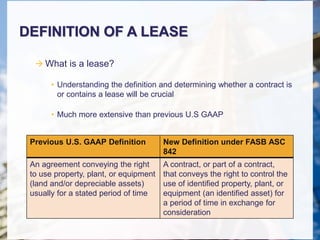
Previous U.S. GAAP Definition New Definition under FASB ASC
842
An agreement conveying the right
to use property, plant, or equipment
(land and/or depreciable assets)
usually for a stated period of time
A contract, or part of a contract,
that conveys the right to control the
use of identified property, plant, or
equipment (an identified asset) for
a period of time in exchange for
consideration
DEFINITION OF A LEASE
• Key differences in the 2 definitions:
 New definition refers specifically to a contract and includes mention
that a lease can be viewed as only being part of a contract
 New definition specifically includes the term “control” within the
context of the lease
 New definition includes mention of the fact that the lease requires
an "exchange of consideration”
• This definition was changed from the original ED issued in
2010 (which retained the original definition currently in U.S.
GAAP), as respondents noted that the 2010 definition would
result in a significant increase
RIGHT TO CONTROL USE OF ASSET
• An entity has the right to direct the use of the asset
throughout the period of use in ether of the following
situations:
• The entity has the right to direct how and for what purpose the asset is
used throughout the period of use
• The decisions about how and for what purpose the asset will be used
are predetermined and at least one of the following conditions exist--
– The entity has the right to operate the asset (or direct others
to operate) throughout the period of use without the supplier
having the right to change those operating instructions
– The customer designed the asset (or specific aspects of it)
in a way that predetermines how and for what
COMMENCEMENT DATE
• The date on which a lessor makes an underlying asset
available for use by the lessee
• Date on which the lessee is required to measure and
record both:
 The lease liability at the present value of the lease payments
not yet paid, using the discount rate for the lease
 The right-of-use asset
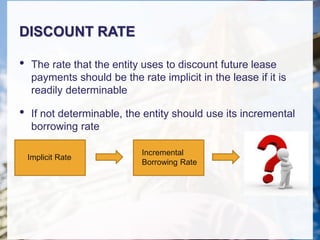
DISCOUNT RATE
• The rate that the entity uses to discount future lease
payments should be the rate implicit in the lease if it is
readily determinable
• If not determinable, the entity should use its incremental
borrowing rate
Implicit Rate
Incremental
Borrowing Rate
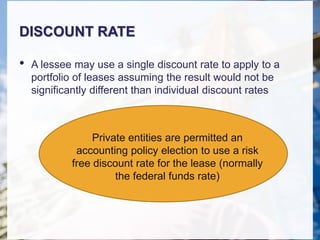
DISCOUNT RATE
• A lessee may use a single discount rate to apply to a
portfolio of leases assuming the result would not be
significantly different than individual discount rates
Private entities are permitted an
accounting policy election to use a risk
free discount rate for the lease (normally
the federal funds rate)
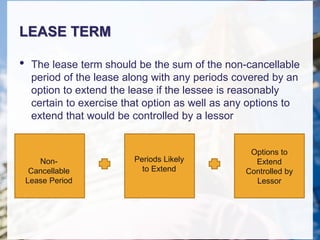
LEASE TERM
• The lease term should be the sum of the non-cancellable
period of the lease along with any periods covered by an
option to extend the lease if the lessee is reasonably
certain to exercise that option as well as any options to
extend that would be controlled by a lessor
Non-
Cancellable
Lease Period
Periods Likely
to Extend
Options to
Extend
Controlled by
Lessor
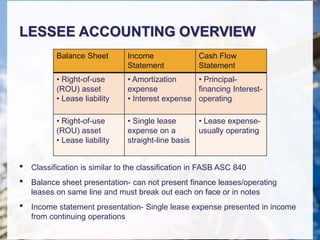
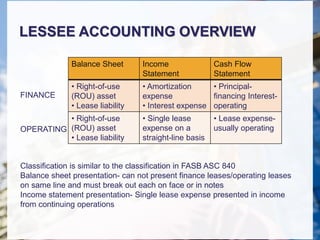
LESSEE ACCOUNTING OVERVIEW
• Classification is similar to the classification in FASB ASC 840
• Balance sheet presentation- can not present finance leases/operating
leases on same line and must break out each on face or in notes
• Income statement presentation- Single lease expense presented in income
from continuing operations
Balance Sheet Income
Statement
Cash Flow
Statement
• Right-of-use
(ROU) asset
• Lease liability
• Amortization
expense
• Interest expense
• Principal-
financing Interest-
operating
• Right-of-use
(ROU) asset
• Lease liability
• Single lease
expense on a
straight-line basis
• Lease expense-
usually operating
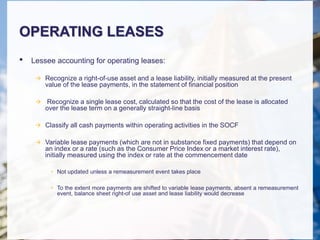
OPERATING LEASES
• Lessee accounting for operating leases:
 Recognize a right-of-use asset and a lease liability, initially measured at the present
value of the lease payments, in the statement of financial position
 Recognize a single lease cost, calculated so that the cost of the lease is allocated
over the lease term on a generally straight-line basis
 Classify all cash payments within operating activities in the SOCF
 Variable lease payments (which are not in substance fixed payments) that depend on
an index or a rate (such as the Consumer Price Index or a market interest rate),
initially measured using the index or rate at the commencement date
• Not updated unless a remeasurement event takes place
• To the extent more payments are shifted to variable lease payments, absent a remeasurement
event, balance sheet right-of use asset and lease liability would decrease
OPERATING LEASE EXAMPLE
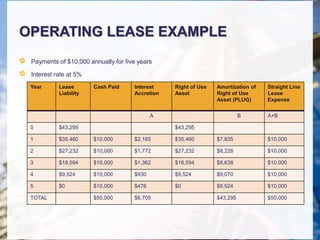
Payments of $10,000 annually for five years
Interest rate at 5%
Year Lease
Liability
Cash Paid Interest
Accretion
Right of Use
Asset
Amortization of
Right of Use
Asset (PLUG)
Straight Line
Lease
Expense
A B A+B
0 $43,295 $43,295
1 $35,460 $10,000 $2,165 $35,460 $7,835 $10,000
2 $27,232 $10,000 $1,772 $27,232 $8,228 $10,000
3 $18,594 $10,000 $1,362 $18,594 $8,638 $10,000
4 $9,524 $10,000 $930 $9,524 $9,070 $10,000
5 $0 $10,000 $476 $0 $9,524 $10,000
TOTAL $50,000 $6,705 $43,295 $50,000
OPERATING LEASE EXAMPLE
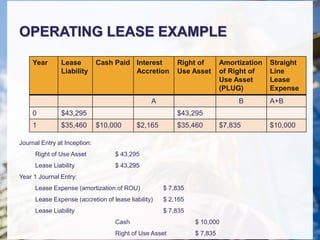
Journal Entry at Inception:
Right of Use Asset $ 43,295
Lease Liability $ 43,295
Year 1 Journal Entry:
Lease Expense (amortization of ROU) $ 7,835
Lease Expense (accretion of lease liability) $ 2,165
Lease Liability $ 7,835
Cash $ 10,000
Right of Use Asset $ 7,835
Year Lease
Liability
Cash Paid Interest
Accretion
Right of
Use Asset
Amortization
of Right of
Use Asset
(PLUG)
Straight
Line
Lease
Expense
A B A+B
0 $43,295 $43,295
1 $35,460 $10,000 $2,165 $35,460 $7,835 $10,000
FINANCE LEASES
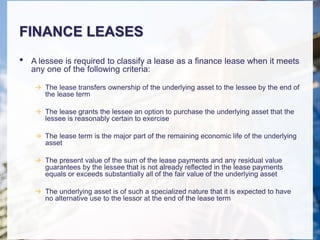
• A lessee is required to classify a lease as a finance lease when it meets
any one of the following criteria:
 The lease transfers ownership of the underlying asset to the lessee by the end of
the lease term
 The lease grants the lessee an option to purchase the underlying asset that the
lessee is reasonably certain to exercise
 The lease term is the major part of the remaining economic life of the underlying
asset
 The present value of the sum of the lease payments and any residual value
guarantees by the lessee that is not already reflected in the lease payments
equals or exceeds substantially all of the fair value of the underlying asset
 The underlying asset is of such a specialized nature that it is expected to have
no alternative use to the lessor at the end of the lease term
FINANCE LEASES
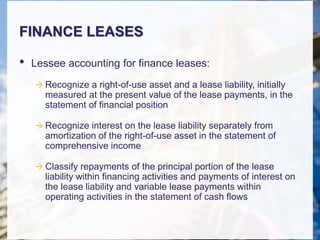
• Lessee accounting for finance leases:
 Recognize a right-of-use asset and a lease liability, initially
measured at the present value of the lease payments, in the
statement of financial position
 Recognize interest on the lease liability separately from
amortization of the right-of-use asset in the statement of
comprehensive income
 Classify repayments of the principal portion of the lease
liability within financing activities and payments of interest on
the lease liability and variable lease payments within
operating activities in the statement of cash flows
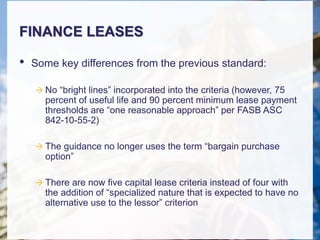
FINANCE LEASES
• Some key differences from the previous standard:
 No “bright lines” incorporated into the criteria (however, 75
percent of useful life and 90 percent minimum lease payment
thresholds are “one reasonable approach” per FASB ASC
842-10-55-2)
 The guidance no longer uses the term “bargain purchase
option”
 There are now five capital lease criteria instead of four with
the addition of “specialized nature that is expected to have no
alternative use to the lessor” criterion
LESSEE ACCOUNTING OVERVIEW
Balance Sheet Income
Statement
Cash Flow
Statement
• Right-of-use
(ROU) asset
• Lease liability
• Amortization
expense
• Interest expense
• Principal-
financing Interest-
operating
• Right-of-use
(ROU) asset
• Lease liability
• Single lease
expense on a
straight-line basis
• Lease expense-
usually operating
Classification is similar to the classification in FASB ASC 840
Balance sheet presentation- can not present finance leases/operating leases
on same line and must break out each on face or in notes
Income statement presentation- Single lease expense presented in income
from continuing operations
FINANCE
OPERATING
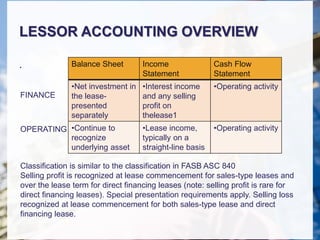
LESSOR ACCOUNTING OVERVIEW
. Balance Sheet Income
Statement
Cash Flow
Statement
•Net investment in
the lease-
presented
separately
•Interest income
and any selling
profit on
thelease1
•Operating activity
•Continue to
recognize
underlying asset
•Lease income,
typically on a
straight-line basis
•Operating activity
Classification is similar to the classification in FASB ASC 840
Selling profit is recognized at lease commencement for sales-type leases and
over the lease term for direct financing leases (note: selling profit is rare for
direct financing leases). Special presentation requirements apply. Selling loss
recognized at lease commencement for both sales-type lease and direct
financing lease.
FINANCE
OPERATING
LESSOR LEASES
“The accounting applied by a lessor is largely unchanged from that applied
under previous GAAP.”
-ASU 2016-02, Summary, page 4
LESSOR ACCOUNTING
• A lessor is required to classify a lease as a sales-type when it meets
any one of the following criteria:
 The lease transfers ownership of the underlying asset to the lessee by the end of
the lease term
 The lease grants the lessee an option to purchase the underlying asset that the
lessee is reasonably certain to exercise
 The lease term is for the major part of the remaining economic life of the
underlying asset
 The present value of the sum of the lease payments and any residual value
guaranteed by the lessee that is not already reflected in the lease payments
equals or exceeds substantially all of the fair value of the underlying asset
 The underlying asset is of such a specialized nature that it is expected to have
no alternative use to the lessor at the end of the lease term
LESSOR ACCOUNTING
• For a lease that does not qualify as a sales-type lease, a lessor is
required to classify a lease as a direct financing lease when both of the
following conditions are met:
• The present value of the sum of the lease payments and any residual
value guaranteed by the lessee that is not already reflected in the lease
payments and/or any other third party unrelated to the less or equals or
exceeds substantially all of the fair value of the underlying asset
 It is probable that the lessor will collect the lease payments plus any amounts
necessary to satisfy a residual value guarantee
• “Dealer profit” distinction in current U.S. GAAP (FASB ASC 840)is
eliminated
• If a lease does not meet the criteria prescribed for a direct financing
lease, it should be classified as an operating lease
RELATED PARTY LEASES
• Related party leases:
 The recognition and measurement requirements for all leases
should be applied by lessees and lessors that are related
parties on the basis of legally enforceable terms and
conditions of the arrangement
 In the separate financial statements of the related parties, the
classification and accounting for the leases should be the
same as for leases between unrelated parties
 Must also apply disclosure requirements of FASB
ASC 850, Related Party Disclosures
RELATED PARTY LEASES
• Related party leases:
Account for related-party leases based on legally
enforceable terms and conditions of the lease
Some related party transactions are not
documented or are not “arm’s length”
EFFECTIVE DATE AND TRANSITION
• Effective date and transition:
 For PBEs, NFP entities that are conduit bond obligors, or EBP plans that file with the
SEC, the amendments were effective for fiscal years beginning after December 15,
2018, including interim periods with in those fiscal years – so those entities have
adopted the new standard.
 For all other entities, the amendments are effective for fiscal years beginning after
December 15, 2021, and interim periods within fiscal years beginning after December
15, 2022
 Early adoption is permitted
 Modified retrospective approach, where entities will essentially run off those leases
existing at the beginning of the earliest comparative period presented
 For operating leases, a lessee will present a lease liability in the statement of financial
position at each reporting date equal to the present value of the remaining minimum
rental payments and a right-of-use asset that is derived from the lease liability
IMPLICATIONS
 Absent future change, leverage ratios based on current U.S.
GAAP could be violated upon the adoption of the new lease
standard since liabilities will be increased under most
definitions of liabilities in debt agreements
• Debt to equity increases
• Interest coverage decreases
• EBITDA increases
• Return on assets decreases
• Current ratio decreases
Leverage ratio covenants
could be violated
IMPLICATIONS
 The new lease standard makes a significant change in
accounting for related party leases by shifting from a
substance based criteria in current U.S. GAAP to accounting
for related party leases based on their legally enforceable
terms
 New processes and procedures will be necessary for
segregating lease and non-lease components
Related Party Leases
Non-lease Components
IMPLICATIONS
 Leases which embed payments for taxes and insurance in the
fixed lease payment may wish to consider revising the lease
to make these variable (pass-through) otherwise the
payments for taxes and insurance will be capitalized
Taxes and Insurance
IMPLICATIONS
 Assess the lease versus buy decision under the new standard
Lease versus Buy?
OTHER IMPLICATIONS
 Will you be able to track operating leases via journal entry or
will asset tracking software be needed?
 Will leasing arrangements evolve into services? Will greater
amounts of lease consideration become variable?
Tracking lease assets
Future of Leasing?
Biggest news in sales tax since 1990s
• National change to sales and use tax rules impacts you
through your suppliers.
• Sales tax nexus can be obtained by remote sales alone!
~South Dakota v. Wayfair
• Example - Online Retailer selling to construction
contractors and others
Manufacturing presentations… for
Construction?
• How low can you go? Sales tax can give you a competitive
advantage in bids for certain industries.
• What areas can be purchased sales tax exempt, from Subs to
GCs?
 Normally, subs would embed sales tax in their price, which you
would then upcharge.
 For “directly used in manufacturing” items, no one has to pay tax.
• Other industries and out of state too.
Agenda
• 2021/2022 Insurance Outlook
• Insurance Tips and Best Practices
• Insurance and Risk Management Issues
Commercial Property/Casualty Market
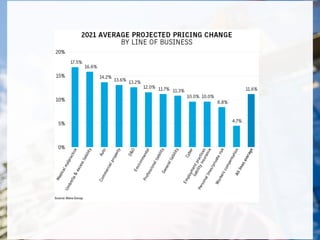
Executive Summary
The following are key takeaways from The council of Insurance Agents & Brokers’ Commercial
Property/Casualty Market Report Q2 2021 (April – June 30):
• Q2 2021 was the 15th consecutive quarter of increased premiums, with
respondents reporting an average increase of 8.3% across all-sized accounts.
• Premiums increased for all lines of business for the 5th consecutive quarter,
though price increases for all lines moderated in Q2 2021 compared to previous
quarters. The only exception was Cyber, which recorded the highest premium
increase out of all lines, 25.5%, surpassing the17.4% increase in Umbrella by a
significant margin.
• Respondents agreed a rise in ransomware attacks, combined with lackluster risk
management protocols and lack of employee training, was one of the primary
drivers behind the notable increase in Cyber prices.
• Underwriting tightened significantly for troubled lines like Cyber and Umbrella.
Additionally, capacity contracted for both of those lines, with more than 80% of
respondents reporting a decrease in capacity for Cyber, and more than 70%
reporting the same for Umbrella.
2021/2022 Rate Outlook
• Property +1% to 20%
• Contractors Equipment Flat to 15%
• General Liability +5% to 20%
• Auto +5% to 15% (depending on fleet size and losses)
• Heavy Fleets, Trucks, Losses – increases higher - +10% to 25%
• Builders Risk Flat to 5% - very competitive for MNC or better
• Builders Risk – Frame – rates continue to go up, terms and conditions
• Rates are up/Controls, Capacity, water/fire/theft mitigation requirements
• Umbrella/Excess +10% to 30%, more if over $10 Mil limit or a layered tower
• Premium is up due to underlying premium increases, rate increases, capacity issues
• Professional Flat to +10%
• Executive Risk – EPL, Crime, Fiduciary, Cyber 10% to 25%, Cyber could be more
• Workers Compensation (outside Ohio) – (5%) to Flat
Insurance Tips and Best Practices
• Auto
• Claim issues – valuations (ACV vs market), catalytic converters
• Implement and practice a formal Fleet Safety Program
• Written Distracted Driving Policy
• Be Proactive with MVRs – new hires, current drivers, “own the process”
• Drivers eligibility guidelines
• Respond and implement recommendations from Insurance Company
• Telematics systems for larger fleets – ask your insurance company about
discounts
Insurance Tips and Best Practices
• General Liability for Contractors
• Update your subcontract agreement – insurance requirements and indemnity
• Contractual Risk Transfer Program – Contracts, Certificates
• Subcontractor pre-qualification
• Implement a QC/QA program
• “Occurrence” redefined endorsement
• Implement process to review upstream contracts for new or different insurance
requirements
• Review new Communicable Disease Exclusions
2021 Risk Management Issues
• Auto – Fleet Safety Program and Policy, Pro-active MVR process
• Cyber Liability/Crime – Risk Assessment and Training, Review your open ports
– 445 and 3389 *, MFA’s
• Employment Practices Liability – COVID-19 issues
• 1. Leave and Discrimination 2. Breach of contract 3. WARN Act 4. Wage and hour violations
• Frame Builders Risk over $10,000,000 – start early
• Umbrella/Excess – higher limits, layered tower, - i.e. Engie requirements
• Wrap-ups/OCIP/CCIP
Risk Management Issues
• Cyber Liability and Crime
• Computer Fraud
• Funds Transfer Fraud
• Social Engineering (Wire Transfer Fraud)
• Privacy and Security
• Breach Notification
• Extortion/Ransomware
• Business Interruption
• Ask for a proposal, consult with your CPA, IT firm, and Banker
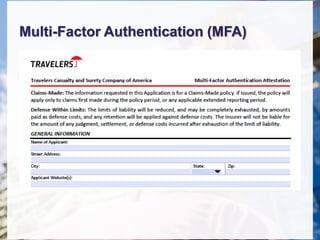
Multi-Factor Authentication (MFA)
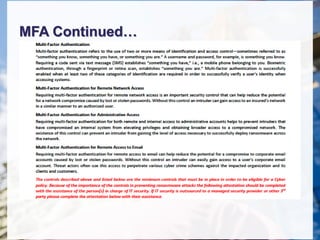
MFA Continued…
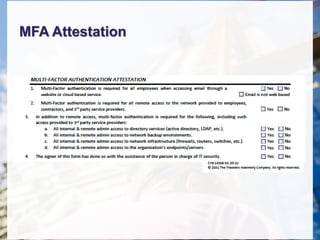
MFA Attestation
OCIPs, CCIPs, Wrap-Ups
• Ask for the Wrap-up manual
• Read and Review the manual
• Send to your Insurance Advisor
• Understand the responsibilities of all parties
Agenda
 Highlights of Biden Tax Plan
 House Ways and Means Committee Report
 Legislative Update
 Planning Considerations
Biden Tax Plan
 The Biden Administration released the “Green Book” in late May 2021
providing more detail on tax plan from the election period.
 Corporate tax rate increase to flat 28%
 Currently flat 21% under Tax Cut and Jobs Act
 Lower than 35% prior to 2018 (graduated rates)
 Alternative minimum tax with financial statement income in excess of
$100M to pay a minimum of 15% tax on financial statement income
 Increase top marginal rate for individuals with income greater than $400k
from 37% to 39.6%
 Phase out 199A deduction on income over $400k
 Raise capital gain rates to 39.6% for income over $1M (+3.8% surtax for
Net Investment Income) – Retroactive for gains recognized after 4/28/21
 Impose 12.4% Social Security payroll tax on incomes over $400k (2021
S.S. Wage limit is $142,800)
Biden Tax Plan
 Overview of Individual Tax Rates
 Old Law – 10%, 15%, 25%, 28%, 33%, 35%, 39.6%
 TCJA – 10%, 12%, 22%, 24%, 32%, 35%, 37%
 Biden’s Plan – 10%, 12%, 22%, 24%, 32%, 35%, 39.6%
 Under current law $400,000 falls in the 32% bracket so not clear
how the overall tax brackets would be impacted under Biden
plan
 Currently Qualified Business Income (199A) is taxed at effective
rate of 29.6%
 Repeal 1031 Like-kind Exchange for taxpayers making over
$400K – Green Book proposes a cap of $500K per taxpayer
Biden Tax Plan
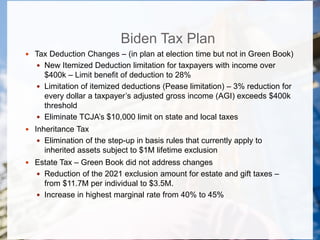
 Tax Deduction Changes – (in plan at election time but not in Green Book)
 New Itemized Deduction limitation for taxpayers with income over
$400k – Limit benefit of deduction to 28%
 Limitation of itemized deductions (Pease limitation) – 3% reduction for
every dollar a taxpayer’s adjusted gross income (AGI) exceeds $400k
threshold
 Eliminate TCJA’s $10,000 limit on state and local taxes
 Inheritance Tax
 Elimination of the step-up in basis rules that currently apply to
inherited assets subject to $1M lifetime exclusion
 Estate Tax – Green Book did not address changes
 Reduction of the 2021 exclusion amount for estate and gift taxes –
from $11.7M per individual to $3.5M.
 Increase in highest marginal rate from 40% to 45%
House Ways & Means Committee Report
 9/13/21 – Proposed changes released, subject to additional changes
 Most proposed changes are effective after December 31, 2021
 Capital Gains rate increases would be effective for tax years ending
after September 13, 2021.
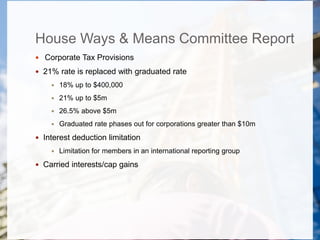
House Ways & Means Committee Report
 Corporate Tax Provisions
 21% rate is replaced with graduated rate
 18% up to $400,000
 21% up to $5m
 26.5% above $5m
 Graduated rate phases out for corporations greater than $10m
 Interest deduction limitation
 Limitation for members in an international reporting group
 Carried interests/cap gains
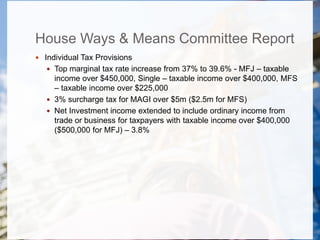
House Ways & Means Committee Report
 Individual Tax Provisions
 Top marginal tax rate increase from 37% to 39.6% - MFJ – taxable
income over $450,000, Single – taxable income over $400,000, MFS
– taxable income over $225,000
 3% surcharge tax for MAGI over $5m ($2.5m for MFS)
 Net Investment income extended to include ordinary income from
trade or business for taxpayers with taxable income over $400,000
($500,000 for MFJ) – 3.8%
House Ways & Means Committee Report
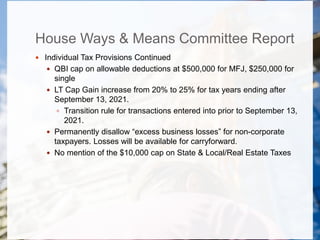
 Individual Tax Provisions Continued
 QBI cap on allowable deductions at $500,000 for MFJ, $250,000 for
single
 LT Cap Gain increase from 20% to 25% for tax years ending after
September 13, 2021.
 Transition rule for transactions entered into prior to September 13,
2021.
 Permanently disallow “excess business losses” for non-corporate
taxpayers. Losses will be available for carryforward.
 No mention of the $10,000 cap on State & Local/Real Estate Taxes
House Ways & Means Committee Report
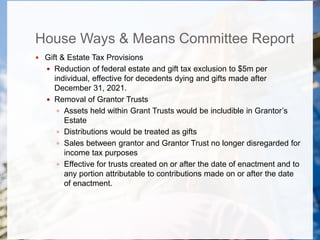
 Gift & Estate Tax Provisions
 Reduction of federal estate and gift tax exclusion to $5m per
individual, effective for decedents dying and gifts made after
December 31, 2021.
 Removal of Grantor Trusts
 Assets held within Grant Trusts would be includible in Grantor’s
Estate
 Distributions would be treated as gifts
 Sales between grantor and Grantor Trust no longer disregarded for
income tax purposes
 Effective for trusts created on or after the date of enactment and to
any portion attributable to contributions made on or after the date
of enactment.
House Ways & Means Committee Report
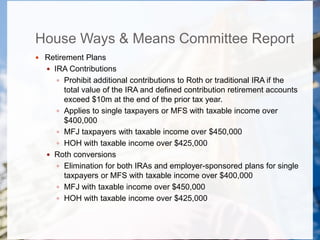
 Retirement Plans
 IRA Contributions
 Prohibit additional contributions to Roth or traditional IRA if the
total value of the IRA and defined contribution retirement accounts
exceed $10m at the end of the prior tax year.
 Applies to single taxpayers or MFS with taxable income over
$400,000
 MFJ taxpayers with taxable income over $450,000
 HOH with taxable income over $425,000
 Roth conversions
 Elimination for both IRAs and employer-sponsored plans for single
taxpayers or MFS with taxable income over $400,000
 MFJ with taxable income over $450,000
 HOH with taxable income over $425,000
House Ways & Means Committee Report
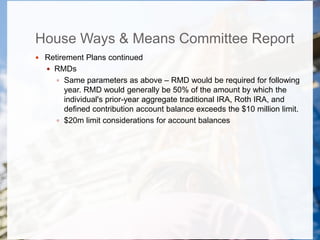
 Retirement Plans continued
 RMDs
 Same parameters as above – RMD would be required for following
year. RMD would generally be 50% of the amount by which the
individual's prior-year aggregate traditional IRA, Roth IRA, and
defined contribution account balance exceeds the $10 million limit.
 $20m limit considerations for account balances
Legislative Update
 Challenging legislative process
 Bi-partisan Infrastructure Packages
 Additional spending and potential tax increases outside of the packages
which leads to differences in plans which lead to difference in party views
 $3.5T infrastructure bill funded with $1.7T in tax increases/spending cuts
and $1.8T funded in deficit financing – does this end up being a smaller
amount?
 House/Senate passage and possible conference – is there time by year-
end 2021?
Legislative Update
 Budget reconciliation - With the 50/50 Senate instead of needing the
standard 60 votes for passage, it instead requires only a majority of 51
votes – tie breaker is Vice President
 Budget reconciliation can only be used for bills impacting revenue or
spending (tax bills are eligible)
 Recent tax law changes under budget reconciliation: 2001 tax cuts, 2003
tax cuts, 2010 health reform law and 2017 tax reform
 Based on all of the government funding and economical impact of the
pandemic what is the appetite for tax increases?
Planning Considerations
 Planning considerations when a tax increase is possible:
 Gain permanent tax savings
 Accelerate income/Defer deductions
 Examples - Installment sales and accelerated depreciation –
options of electing to accelerate income or defer deduction
 Bonus Depreciation under current law
 100 % bonus depreciation available for assets acquired between
September 27, 2017 and December 31, 2022
 Scheduled decrease under current law:
 2023 – the rate drops to 80%
 2024 – the rate drops to 60%
 2025 – the rate drops to 40%
 2026 – the rate drops to 20%
LIVE EVENT - 3rd Annual Fall Construction Risk Update - September 30

LIVE EVENT - 3rd Annual Fall Construction Risk Update - September 30

  • 4.
    ASU 2016-02 • ASU2016-02, Leases • Creates Topic 842, Leases, in the FASB Codification • Supersedes FASB ASC 840, Leases • Applies only to leasing of property, plant, and equipment • Entities that hold numerous equipment and real estate leases, in particular those with numerous operating leases, will be most affected by this new guidance
  • 6.
    HIGHLIGHTS • Operating leaseswill now be recorded in the statement of financial position as assets and liabilities • Retains a distinction between finance leases and operating leases
  • 7.
    HIGHLIGHTS • No more“bright-line” thresholds as under current U.S. GAAP  75% life  90% fair value  Bargain purchase option  Title transferred at the end of the lease term  FASB ASC 842-10-66-2 notes that numerical thresholds above are “one reasonable approach” to assessing lease classification criteria
  • 9.
    DEFINITION OF ALEASE  What is a lease? • Understanding the definition and determining whether a contract is or contains a lease will be crucial • Much more extensive than previous U.S GAAP Previous U.S. GAAP Definition New Definition under FASB ASC 842 An agreement conveying the right to use property, plant, or equipment (land and/or depreciable assets) usually for a stated period of time A contract, or part of a contract, that conveys the right to control the use of identified property, plant, or equipment (an identified asset) for a period of time in exchange for consideration
  • 10.
    DEFINITION OF ALEASE • Key differences in the 2 definitions:  New definition refers specifically to a contract and includes mention that a lease can be viewed as only being part of a contract  New definition specifically includes the term “control” within the context of the lease  New definition includes mention of the fact that the lease requires an "exchange of consideration” • This definition was changed from the original ED issued in 2010 (which retained the original definition currently in U.S. GAAP), as respondents noted that the 2010 definition would result in a significant increase
  • 11.
    RIGHT TO CONTROLUSE OF ASSET • An entity has the right to direct the use of the asset throughout the period of use in ether of the following situations: • The entity has the right to direct how and for what purpose the asset is used throughout the period of use • The decisions about how and for what purpose the asset will be used are predetermined and at least one of the following conditions exist-- – The entity has the right to operate the asset (or direct others to operate) throughout the period of use without the supplier having the right to change those operating instructions – The customer designed the asset (or specific aspects of it) in a way that predetermines how and for what
  • 13.
    COMMENCEMENT DATE • Thedate on which a lessor makes an underlying asset available for use by the lessee • Date on which the lessee is required to measure and record both:  The lease liability at the present value of the lease payments not yet paid, using the discount rate for the lease  The right-of-use asset
  • 14.
    DISCOUNT RATE • Therate that the entity uses to discount future lease payments should be the rate implicit in the lease if it is readily determinable • If not determinable, the entity should use its incremental borrowing rate Implicit Rate Incremental Borrowing Rate
  • 15.
    DISCOUNT RATE • Alessee may use a single discount rate to apply to a portfolio of leases assuming the result would not be significantly different than individual discount rates Private entities are permitted an accounting policy election to use a risk free discount rate for the lease (normally the federal funds rate)
  • 16.
    LEASE TERM • Thelease term should be the sum of the non-cancellable period of the lease along with any periods covered by an option to extend the lease if the lessee is reasonably certain to exercise that option as well as any options to extend that would be controlled by a lessor Non- Cancellable Lease Period Periods Likely to Extend Options to Extend Controlled by Lessor
  • 18.
    LESSEE ACCOUNTING OVERVIEW •Classification is similar to the classification in FASB ASC 840 • Balance sheet presentation- can not present finance leases/operating leases on same line and must break out each on face or in notes • Income statement presentation- Single lease expense presented in income from continuing operations Balance Sheet Income Statement Cash Flow Statement • Right-of-use (ROU) asset • Lease liability • Amortization expense • Interest expense • Principal- financing Interest- operating • Right-of-use (ROU) asset • Lease liability • Single lease expense on a straight-line basis • Lease expense- usually operating
  • 20.
    OPERATING LEASES • Lesseeaccounting for operating leases:  Recognize a right-of-use asset and a lease liability, initially measured at the present value of the lease payments, in the statement of financial position  Recognize a single lease cost, calculated so that the cost of the lease is allocated over the lease term on a generally straight-line basis  Classify all cash payments within operating activities in the SOCF  Variable lease payments (which are not in substance fixed payments) that depend on an index or a rate (such as the Consumer Price Index or a market interest rate), initially measured using the index or rate at the commencement date • Not updated unless a remeasurement event takes place • To the extent more payments are shifted to variable lease payments, absent a remeasurement event, balance sheet right-of use asset and lease liability would decrease
  • 21.
    OPERATING LEASE EXAMPLE Paymentsof $10,000 annually for five years Interest rate at 5% Year Lease Liability Cash Paid Interest Accretion Right of Use Asset Amortization of Right of Use Asset (PLUG) Straight Line Lease Expense A B A+B 0 $43,295 $43,295 1 $35,460 $10,000 $2,165 $35,460 $7,835 $10,000 2 $27,232 $10,000 $1,772 $27,232 $8,228 $10,000 3 $18,594 $10,000 $1,362 $18,594 $8,638 $10,000 4 $9,524 $10,000 $930 $9,524 $9,070 $10,000 5 $0 $10,000 $476 $0 $9,524 $10,000 TOTAL $50,000 $6,705 $43,295 $50,000
  • 22.
    OPERATING LEASE EXAMPLE JournalEntry at Inception: Right of Use Asset $ 43,295 Lease Liability $ 43,295 Year 1 Journal Entry: Lease Expense (amortization of ROU) $ 7,835 Lease Expense (accretion of lease liability) $ 2,165 Lease Liability $ 7,835 Cash $ 10,000 Right of Use Asset $ 7,835 Year Lease Liability Cash Paid Interest Accretion Right of Use Asset Amortization of Right of Use Asset (PLUG) Straight Line Lease Expense A B A+B 0 $43,295 $43,295 1 $35,460 $10,000 $2,165 $35,460 $7,835 $10,000
  • 24.
    FINANCE LEASES • Alessee is required to classify a lease as a finance lease when it meets any one of the following criteria:  The lease transfers ownership of the underlying asset to the lessee by the end of the lease term  The lease grants the lessee an option to purchase the underlying asset that the lessee is reasonably certain to exercise  The lease term is the major part of the remaining economic life of the underlying asset  The present value of the sum of the lease payments and any residual value guarantees by the lessee that is not already reflected in the lease payments equals or exceeds substantially all of the fair value of the underlying asset  The underlying asset is of such a specialized nature that it is expected to have no alternative use to the lessor at the end of the lease term
  • 25.
    FINANCE LEASES • Lesseeaccounting for finance leases:  Recognize a right-of-use asset and a lease liability, initially measured at the present value of the lease payments, in the statement of financial position  Recognize interest on the lease liability separately from amortization of the right-of-use asset in the statement of comprehensive income  Classify repayments of the principal portion of the lease liability within financing activities and payments of interest on the lease liability and variable lease payments within operating activities in the statement of cash flows
  • 26.
    FINANCE LEASES • Somekey differences from the previous standard:  No “bright lines” incorporated into the criteria (however, 75 percent of useful life and 90 percent minimum lease payment thresholds are “one reasonable approach” per FASB ASC 842-10-55-2)  The guidance no longer uses the term “bargain purchase option”  There are now five capital lease criteria instead of four with the addition of “specialized nature that is expected to have no alternative use to the lessor” criterion
  • 27.
    LESSEE ACCOUNTING OVERVIEW BalanceSheet Income Statement Cash Flow Statement • Right-of-use (ROU) asset • Lease liability • Amortization expense • Interest expense • Principal- financing Interest- operating • Right-of-use (ROU) asset • Lease liability • Single lease expense on a straight-line basis • Lease expense- usually operating Classification is similar to the classification in FASB ASC 840 Balance sheet presentation- can not present finance leases/operating leases on same line and must break out each on face or in notes Income statement presentation- Single lease expense presented in income from continuing operations FINANCE OPERATING
  • 29.
    LESSOR ACCOUNTING OVERVIEW .Balance Sheet Income Statement Cash Flow Statement •Net investment in the lease- presented separately •Interest income and any selling profit on thelease1 •Operating activity •Continue to recognize underlying asset •Lease income, typically on a straight-line basis •Operating activity Classification is similar to the classification in FASB ASC 840 Selling profit is recognized at lease commencement for sales-type leases and over the lease term for direct financing leases (note: selling profit is rare for direct financing leases). Special presentation requirements apply. Selling loss recognized at lease commencement for both sales-type lease and direct financing lease. FINANCE OPERATING
  • 30.
    LESSOR LEASES “The accountingapplied by a lessor is largely unchanged from that applied under previous GAAP.” -ASU 2016-02, Summary, page 4
  • 31.
    LESSOR ACCOUNTING • Alessor is required to classify a lease as a sales-type when it meets any one of the following criteria:  The lease transfers ownership of the underlying asset to the lessee by the end of the lease term  The lease grants the lessee an option to purchase the underlying asset that the lessee is reasonably certain to exercise  The lease term is for the major part of the remaining economic life of the underlying asset  The present value of the sum of the lease payments and any residual value guaranteed by the lessee that is not already reflected in the lease payments equals or exceeds substantially all of the fair value of the underlying asset  The underlying asset is of such a specialized nature that it is expected to have no alternative use to the lessor at the end of the lease term
  • 32.
    LESSOR ACCOUNTING • Fora lease that does not qualify as a sales-type lease, a lessor is required to classify a lease as a direct financing lease when both of the following conditions are met: • The present value of the sum of the lease payments and any residual value guaranteed by the lessee that is not already reflected in the lease payments and/or any other third party unrelated to the less or equals or exceeds substantially all of the fair value of the underlying asset  It is probable that the lessor will collect the lease payments plus any amounts necessary to satisfy a residual value guarantee • “Dealer profit” distinction in current U.S. GAAP (FASB ASC 840)is eliminated • If a lease does not meet the criteria prescribed for a direct financing lease, it should be classified as an operating lease
  • 34.
    RELATED PARTY LEASES •Related party leases:  The recognition and measurement requirements for all leases should be applied by lessees and lessors that are related parties on the basis of legally enforceable terms and conditions of the arrangement  In the separate financial statements of the related parties, the classification and accounting for the leases should be the same as for leases between unrelated parties  Must also apply disclosure requirements of FASB ASC 850, Related Party Disclosures
  • 35.
    RELATED PARTY LEASES •Related party leases: Account for related-party leases based on legally enforceable terms and conditions of the lease Some related party transactions are not documented or are not “arm’s length”
  • 37.
    EFFECTIVE DATE ANDTRANSITION • Effective date and transition:  For PBEs, NFP entities that are conduit bond obligors, or EBP plans that file with the SEC, the amendments were effective for fiscal years beginning after December 15, 2018, including interim periods with in those fiscal years – so those entities have adopted the new standard.  For all other entities, the amendments are effective for fiscal years beginning after December 15, 2021, and interim periods within fiscal years beginning after December 15, 2022  Early adoption is permitted  Modified retrospective approach, where entities will essentially run off those leases existing at the beginning of the earliest comparative period presented  For operating leases, a lessee will present a lease liability in the statement of financial position at each reporting date equal to the present value of the remaining minimum rental payments and a right-of-use asset that is derived from the lease liability
  • 39.
    IMPLICATIONS  Absent futurechange, leverage ratios based on current U.S. GAAP could be violated upon the adoption of the new lease standard since liabilities will be increased under most definitions of liabilities in debt agreements • Debt to equity increases • Interest coverage decreases • EBITDA increases • Return on assets decreases • Current ratio decreases Leverage ratio covenants could be violated
  • 40.
    IMPLICATIONS  The newlease standard makes a significant change in accounting for related party leases by shifting from a substance based criteria in current U.S. GAAP to accounting for related party leases based on their legally enforceable terms  New processes and procedures will be necessary for segregating lease and non-lease components Related Party Leases Non-lease Components
  • 41.
    IMPLICATIONS  Leases whichembed payments for taxes and insurance in the fixed lease payment may wish to consider revising the lease to make these variable (pass-through) otherwise the payments for taxes and insurance will be capitalized Taxes and Insurance
  • 42.
    IMPLICATIONS  Assess thelease versus buy decision under the new standard Lease versus Buy?
  • 43.
    OTHER IMPLICATIONS  Willyou be able to track operating leases via journal entry or will asset tracking software be needed?  Will leasing arrangements evolve into services? Will greater amounts of lease consideration become variable? Tracking lease assets Future of Leasing?
  • 46.
    Biggest news insales tax since 1990s • National change to sales and use tax rules impacts you through your suppliers. • Sales tax nexus can be obtained by remote sales alone! ~South Dakota v. Wayfair • Example - Online Retailer selling to construction contractors and others
  • 47.
    Manufacturing presentations… for Construction? •How low can you go? Sales tax can give you a competitive advantage in bids for certain industries. • What areas can be purchased sales tax exempt, from Subs to GCs?  Normally, subs would embed sales tax in their price, which you would then upcharge.  For “directly used in manufacturing” items, no one has to pay tax. • Other industries and out of state too.
  • 51.
    Agenda • 2021/2022 InsuranceOutlook • Insurance Tips and Best Practices • Insurance and Risk Management Issues
  • 52.
    Commercial Property/Casualty Market ExecutiveSummary The following are key takeaways from The council of Insurance Agents & Brokers’ Commercial Property/Casualty Market Report Q2 2021 (April – June 30): • Q2 2021 was the 15th consecutive quarter of increased premiums, with respondents reporting an average increase of 8.3% across all-sized accounts. • Premiums increased for all lines of business for the 5th consecutive quarter, though price increases for all lines moderated in Q2 2021 compared to previous quarters. The only exception was Cyber, which recorded the highest premium increase out of all lines, 25.5%, surpassing the17.4% increase in Umbrella by a significant margin. • Respondents agreed a rise in ransomware attacks, combined with lackluster risk management protocols and lack of employee training, was one of the primary drivers behind the notable increase in Cyber prices. • Underwriting tightened significantly for troubled lines like Cyber and Umbrella. Additionally, capacity contracted for both of those lines, with more than 80% of respondents reporting a decrease in capacity for Cyber, and more than 70% reporting the same for Umbrella.
  • 53.
    2021/2022 Rate Outlook •Property +1% to 20% • Contractors Equipment Flat to 15% • General Liability +5% to 20% • Auto +5% to 15% (depending on fleet size and losses) • Heavy Fleets, Trucks, Losses – increases higher - +10% to 25% • Builders Risk Flat to 5% - very competitive for MNC or better • Builders Risk – Frame – rates continue to go up, terms and conditions • Rates are up/Controls, Capacity, water/fire/theft mitigation requirements • Umbrella/Excess +10% to 30%, more if over $10 Mil limit or a layered tower • Premium is up due to underlying premium increases, rate increases, capacity issues • Professional Flat to +10% • Executive Risk – EPL, Crime, Fiduciary, Cyber 10% to 25%, Cyber could be more • Workers Compensation (outside Ohio) – (5%) to Flat
  • 55.
    Insurance Tips andBest Practices • Auto • Claim issues – valuations (ACV vs market), catalytic converters • Implement and practice a formal Fleet Safety Program • Written Distracted Driving Policy • Be Proactive with MVRs – new hires, current drivers, “own the process” • Drivers eligibility guidelines • Respond and implement recommendations from Insurance Company • Telematics systems for larger fleets – ask your insurance company about discounts
  • 56.
    Insurance Tips andBest Practices • General Liability for Contractors • Update your subcontract agreement – insurance requirements and indemnity • Contractual Risk Transfer Program – Contracts, Certificates • Subcontractor pre-qualification • Implement a QC/QA program • “Occurrence” redefined endorsement • Implement process to review upstream contracts for new or different insurance requirements • Review new Communicable Disease Exclusions
  • 58.
    2021 Risk ManagementIssues • Auto – Fleet Safety Program and Policy, Pro-active MVR process • Cyber Liability/Crime – Risk Assessment and Training, Review your open ports – 445 and 3389 *, MFA’s • Employment Practices Liability – COVID-19 issues • 1. Leave and Discrimination 2. Breach of contract 3. WARN Act 4. Wage and hour violations • Frame Builders Risk over $10,000,000 – start early • Umbrella/Excess – higher limits, layered tower, - i.e. Engie requirements • Wrap-ups/OCIP/CCIP
  • 59.
    Risk Management Issues •Cyber Liability and Crime • Computer Fraud • Funds Transfer Fraud • Social Engineering (Wire Transfer Fraud) • Privacy and Security • Breach Notification • Extortion/Ransomware • Business Interruption • Ask for a proposal, consult with your CPA, IT firm, and Banker
  • 60.
  • 61.
  • 62.
  • 63.
    OCIPs, CCIPs, Wrap-Ups •Ask for the Wrap-up manual • Read and Review the manual • Send to your Insurance Advisor • Understand the responsibilities of all parties
  • 66.
    Agenda  Highlights ofBiden Tax Plan  House Ways and Means Committee Report  Legislative Update  Planning Considerations
  • 67.
    Biden Tax Plan The Biden Administration released the “Green Book” in late May 2021 providing more detail on tax plan from the election period.  Corporate tax rate increase to flat 28%  Currently flat 21% under Tax Cut and Jobs Act  Lower than 35% prior to 2018 (graduated rates)  Alternative minimum tax with financial statement income in excess of $100M to pay a minimum of 15% tax on financial statement income  Increase top marginal rate for individuals with income greater than $400k from 37% to 39.6%  Phase out 199A deduction on income over $400k  Raise capital gain rates to 39.6% for income over $1M (+3.8% surtax for Net Investment Income) – Retroactive for gains recognized after 4/28/21  Impose 12.4% Social Security payroll tax on incomes over $400k (2021 S.S. Wage limit is $142,800)
  • 68.
    Biden Tax Plan Overview of Individual Tax Rates  Old Law – 10%, 15%, 25%, 28%, 33%, 35%, 39.6%  TCJA – 10%, 12%, 22%, 24%, 32%, 35%, 37%  Biden’s Plan – 10%, 12%, 22%, 24%, 32%, 35%, 39.6%  Under current law $400,000 falls in the 32% bracket so not clear how the overall tax brackets would be impacted under Biden plan  Currently Qualified Business Income (199A) is taxed at effective rate of 29.6%  Repeal 1031 Like-kind Exchange for taxpayers making over $400K – Green Book proposes a cap of $500K per taxpayer
  • 69.
    Biden Tax Plan Tax Deduction Changes – (in plan at election time but not in Green Book)  New Itemized Deduction limitation for taxpayers with income over $400k – Limit benefit of deduction to 28%  Limitation of itemized deductions (Pease limitation) – 3% reduction for every dollar a taxpayer’s adjusted gross income (AGI) exceeds $400k threshold  Eliminate TCJA’s $10,000 limit on state and local taxes  Inheritance Tax  Elimination of the step-up in basis rules that currently apply to inherited assets subject to $1M lifetime exclusion  Estate Tax – Green Book did not address changes  Reduction of the 2021 exclusion amount for estate and gift taxes – from $11.7M per individual to $3.5M.  Increase in highest marginal rate from 40% to 45%
  • 70.
    House Ways &Means Committee Report  9/13/21 – Proposed changes released, subject to additional changes  Most proposed changes are effective after December 31, 2021  Capital Gains rate increases would be effective for tax years ending after September 13, 2021.
  • 71.
    House Ways &Means Committee Report  Corporate Tax Provisions  21% rate is replaced with graduated rate  18% up to $400,000  21% up to $5m  26.5% above $5m  Graduated rate phases out for corporations greater than $10m  Interest deduction limitation  Limitation for members in an international reporting group  Carried interests/cap gains
  • 72.
    House Ways &Means Committee Report  Individual Tax Provisions  Top marginal tax rate increase from 37% to 39.6% - MFJ – taxable income over $450,000, Single – taxable income over $400,000, MFS – taxable income over $225,000  3% surcharge tax for MAGI over $5m ($2.5m for MFS)  Net Investment income extended to include ordinary income from trade or business for taxpayers with taxable income over $400,000 ($500,000 for MFJ) – 3.8%
  • 73.
    House Ways &Means Committee Report  Individual Tax Provisions Continued  QBI cap on allowable deductions at $500,000 for MFJ, $250,000 for single  LT Cap Gain increase from 20% to 25% for tax years ending after September 13, 2021.  Transition rule for transactions entered into prior to September 13, 2021.  Permanently disallow “excess business losses” for non-corporate taxpayers. Losses will be available for carryforward.  No mention of the $10,000 cap on State & Local/Real Estate Taxes
  • 74.
    House Ways &Means Committee Report  Gift & Estate Tax Provisions  Reduction of federal estate and gift tax exclusion to $5m per individual, effective for decedents dying and gifts made after December 31, 2021.  Removal of Grantor Trusts  Assets held within Grant Trusts would be includible in Grantor’s Estate  Distributions would be treated as gifts  Sales between grantor and Grantor Trust no longer disregarded for income tax purposes  Effective for trusts created on or after the date of enactment and to any portion attributable to contributions made on or after the date of enactment.
  • 75.
    House Ways &Means Committee Report  Retirement Plans  IRA Contributions  Prohibit additional contributions to Roth or traditional IRA if the total value of the IRA and defined contribution retirement accounts exceed $10m at the end of the prior tax year.  Applies to single taxpayers or MFS with taxable income over $400,000  MFJ taxpayers with taxable income over $450,000  HOH with taxable income over $425,000  Roth conversions  Elimination for both IRAs and employer-sponsored plans for single taxpayers or MFS with taxable income over $400,000  MFJ with taxable income over $450,000  HOH with taxable income over $425,000
  • 76.
    House Ways &Means Committee Report  Retirement Plans continued  RMDs  Same parameters as above – RMD would be required for following year. RMD would generally be 50% of the amount by which the individual's prior-year aggregate traditional IRA, Roth IRA, and defined contribution account balance exceeds the $10 million limit.  $20m limit considerations for account balances
  • 77.
    Legislative Update  Challenginglegislative process  Bi-partisan Infrastructure Packages  Additional spending and potential tax increases outside of the packages which leads to differences in plans which lead to difference in party views  $3.5T infrastructure bill funded with $1.7T in tax increases/spending cuts and $1.8T funded in deficit financing – does this end up being a smaller amount?  House/Senate passage and possible conference – is there time by year- end 2021?
  • 78.
    Legislative Update  Budgetreconciliation - With the 50/50 Senate instead of needing the standard 60 votes for passage, it instead requires only a majority of 51 votes – tie breaker is Vice President  Budget reconciliation can only be used for bills impacting revenue or spending (tax bills are eligible)  Recent tax law changes under budget reconciliation: 2001 tax cuts, 2003 tax cuts, 2010 health reform law and 2017 tax reform  Based on all of the government funding and economical impact of the pandemic what is the appetite for tax increases?
  • 79.
    Planning Considerations  Planningconsiderations when a tax increase is possible:  Gain permanent tax savings  Accelerate income/Defer deductions  Examples - Installment sales and accelerated depreciation – options of electing to accelerate income or defer deduction  Bonus Depreciation under current law  100 % bonus depreciation available for assets acquired between September 27, 2017 and December 31, 2022  Scheduled decrease under current law:  2023 – the rate drops to 80%  2024 – the rate drops to 60%  2025 – the rate drops to 40%  2026 – the rate drops to 20%