BASIC ACCOUNTING
TERMS
By SHANU VAID
COMMERCE EDUCATOR
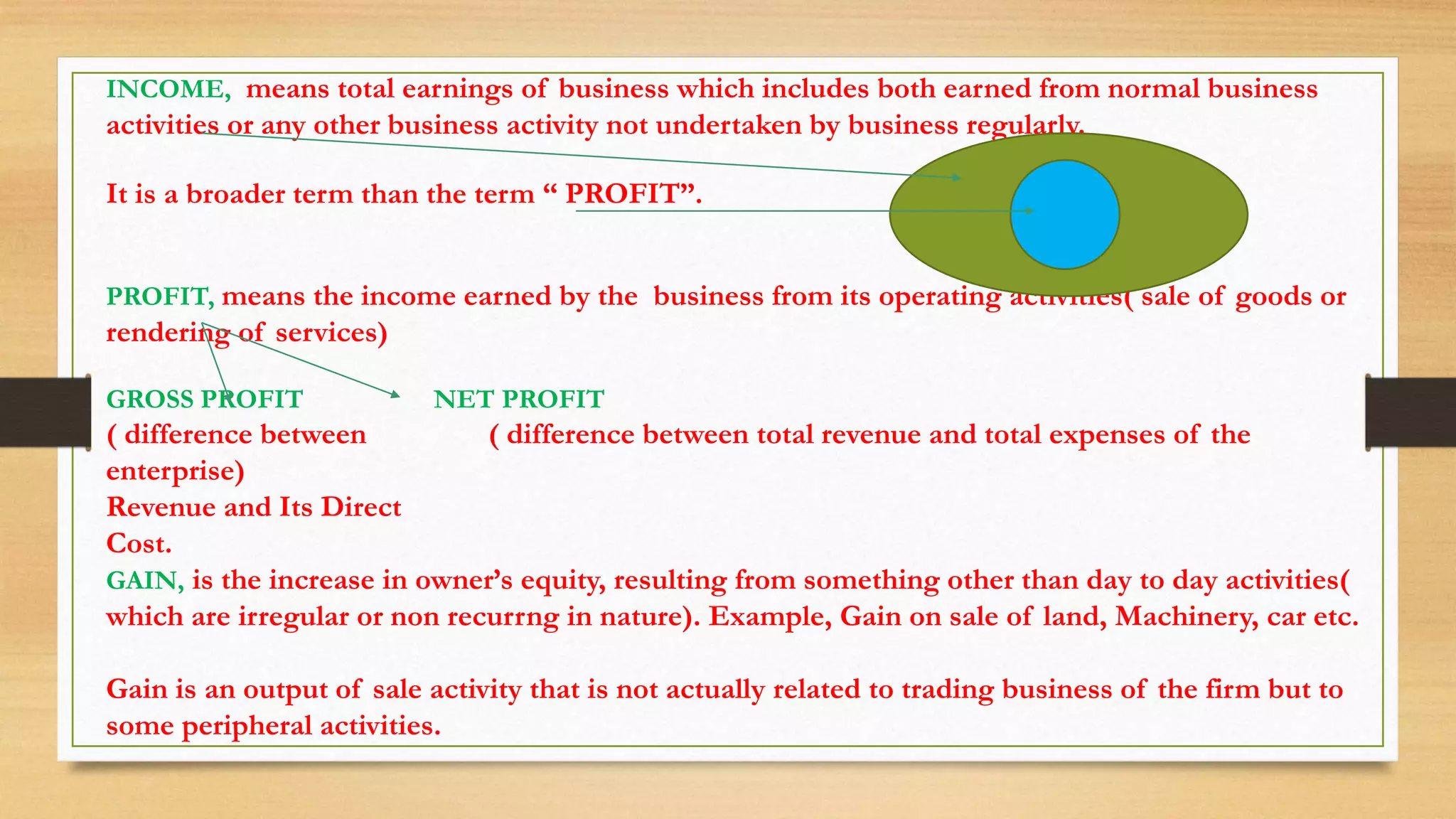
INCOME, means total earnings of business which includes both earned from normal business
activities or any other business activity not undertaken by business regularly.
It is a broader term than the term “ PROFIT”.
PROFIT, means the income earned by the business from its operating activities( sale of goods or
rendering of services)
GROSS PROFIT NET PROFIT
( difference between ( difference between total revenue and total expenses of the
enterprise)
Revenue and Its Direct
Cost.
GAIN, is the increase in owner’s equity, resulting from something other than day to day activities(
which are irregular or non recurrng in nature). Example, Gain on sale of land, Machinery, car etc.
Gain is an output of sale activity that is not actually related to trading business of the firm but to
some peripheral activities.
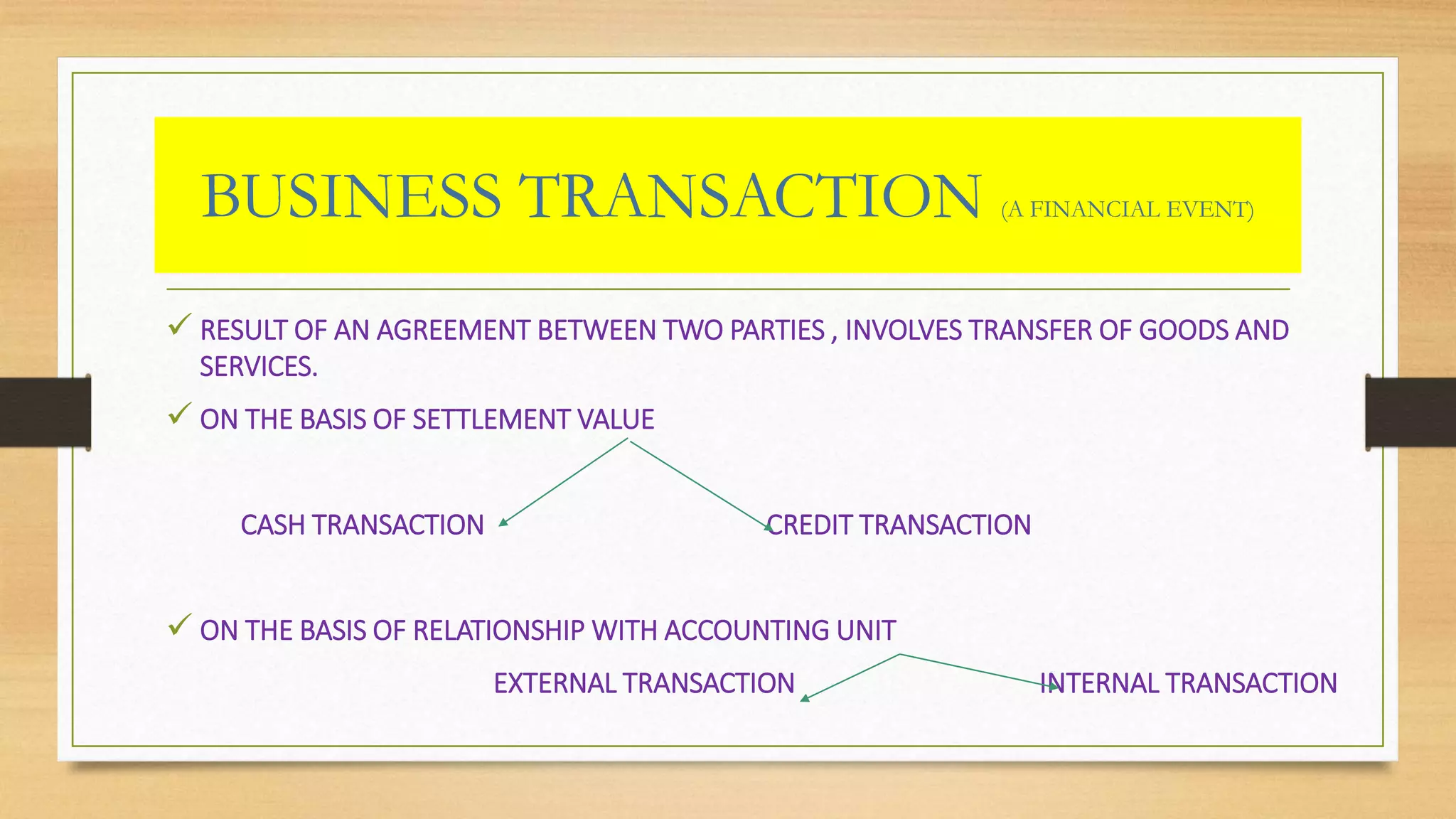
BUSINESS TRANSACTION (A FINANCIAL EVENT)
 RESULT OF AN AGREEMENT BETWEEN TWO PARTIES , INVOLVES TRANSFER OF GOODS AND
SERVICES.
 ON THE BASIS OF SETTLEMENT VALUE
CASH TRANSACTION CREDIT TRANSACTION
 ON THE BASIS OF RELATIONSHIP WITH ACCOUNTING UNIT
EXTERNAL TRANSACTION INTERNAL TRANSACTION
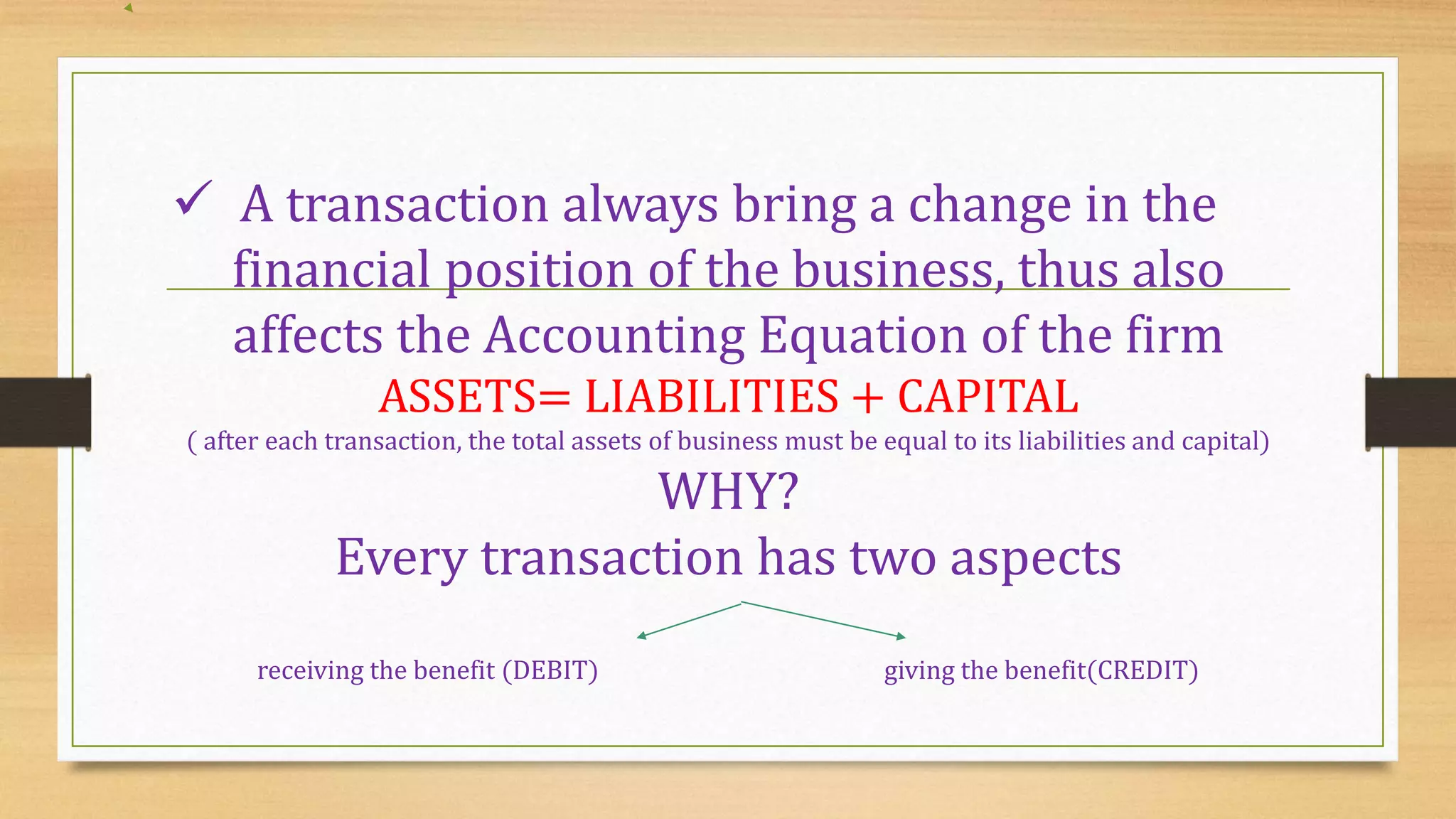
 A transaction always bring a change in the
financial position of the business, thus also
affects the Accounting Equation of the firm
ASSETS= LIABILITIES + CAPITAL
( after each transaction, the total assets of business must be equal to its liabilities and capital)
WHY?
Every transaction has two aspects
receiving the benefit (DEBIT) giving the benefit(CREDIT)
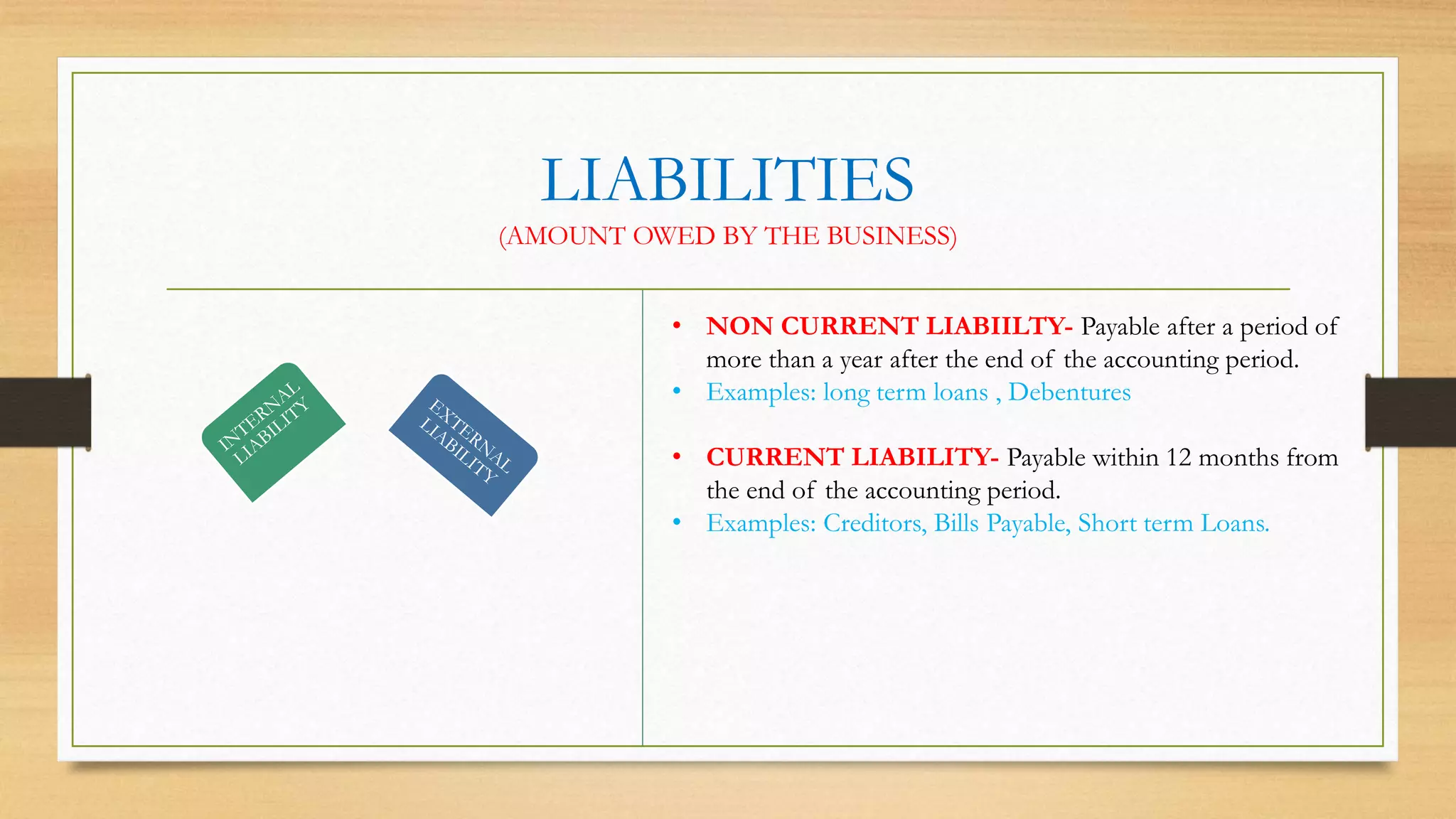
LIABILITIES
(AMOUNT OWED BY THE BUSINESS)
• NON CURRENT LIABIILTY- Payable after a period of
more than a year after the end of the accounting period.
• Examples: long term loans , Debentures
• CURRENT LIABILITY- Payable within 12 months from
the end of the accounting period.
• Examples: Creditors, Bills Payable, Short term Loans.
CAPITAL( OWNER’s EQUITY/NET WORTH)
( amount invested by the Owner in a Firm)
In the form of CASH ASSETS
Considered an INTERNAL Liability. WHY?
BUSINESS ENTITY CONCEPT– business is separate from its owner. Transactions are recorded in the
books from the business point of view.
DRAWINGS
(amount withdrawn by the Owner for personal use.)
In the form of CASH In the form of GOODS, at Purchase Cost.
[DEBITED TO DRAWINGS A/c]
In balance Sheet, CAPITAL
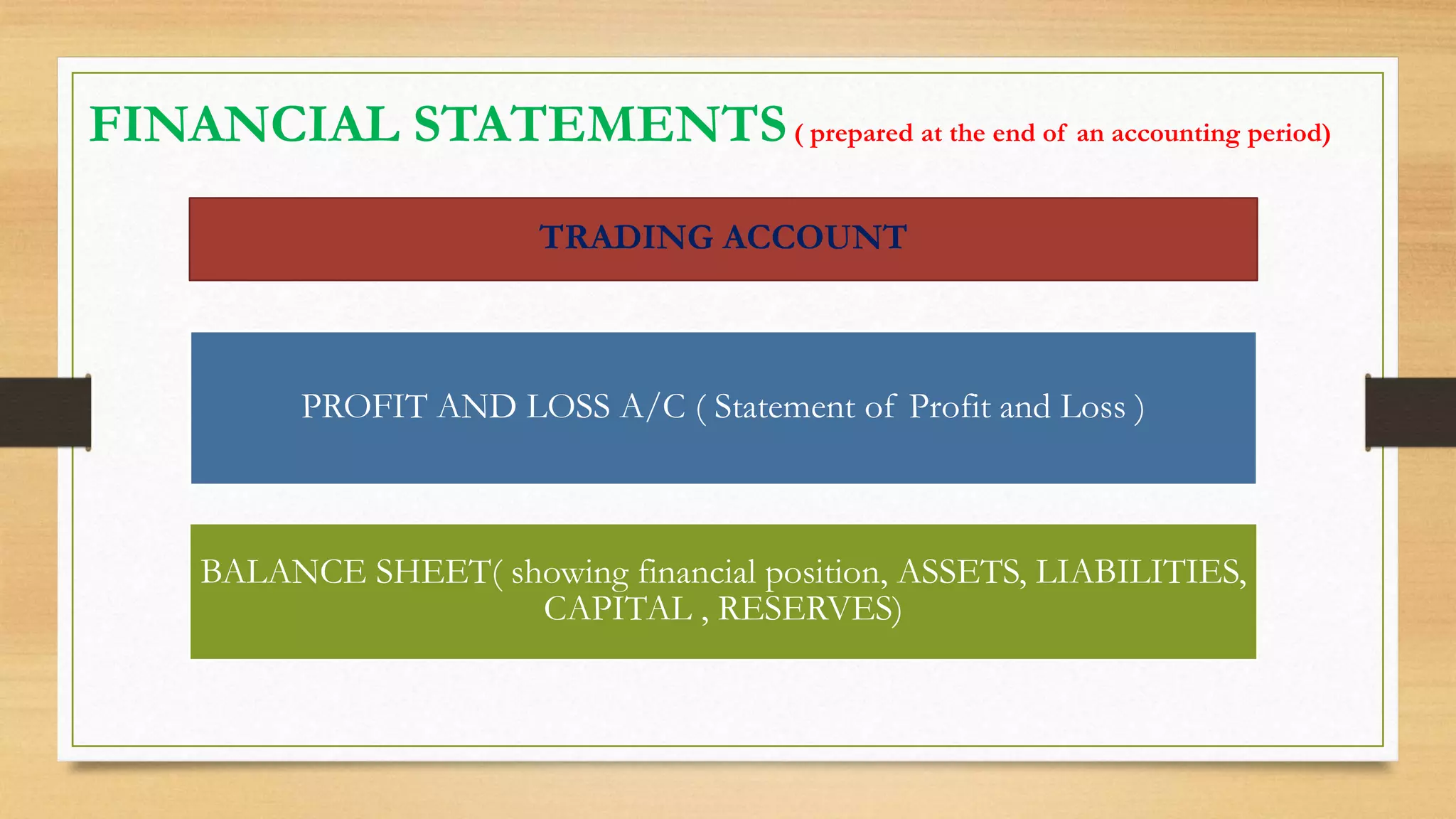
FINANCIAL STATEMENTS( prepared at the end of an accounting period)
TRADING ACCOUNT
PROFIT AND LOSS A/C ( Statement of Profit and Loss )
BALANCE SHEET( showing financial position, ASSETS, LIABILITIES,
CAPITAL , RESERVES)
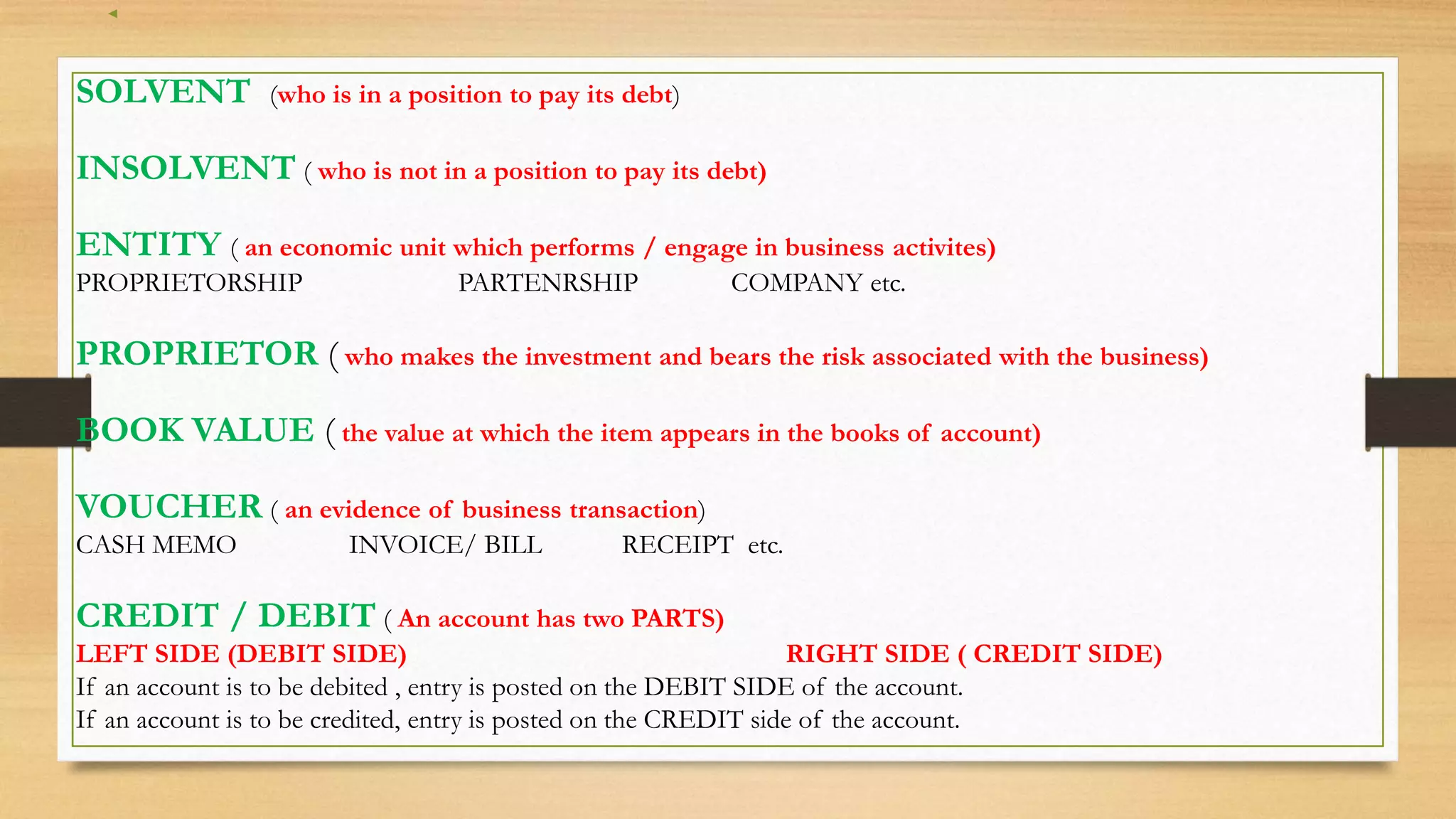
SOLVENT (who is in a position to pay its debt)
INSOLVENT ( who is not in a position to pay its debt)
ENTITY ( an economic unit which performs / engage in business activites)
PROPRIETORSHIP PARTENRSHIP COMPANY etc.
PROPRIETOR ( who makes the investment and bears the risk associated with the business)
BOOK VALUE ( the value at which the item appears in the books of account)
VOUCHER ( an evidence of business transaction)
CASH MEMO INVOICE/ BILL RECEIPT etc.
CREDIT / DEBIT ( An account has two PARTS)
LEFT SIDE (DEBIT SIDE) RIGHT SIDE ( CREDIT SIDE)
If an account is to be debited , entry is posted on the DEBIT SIDE of the account.
If an account is to be credited, entry is posted on the CREDIT side of the account.
GOODS
• (are the physical items of trade, the items in which the firm deals, purchased /
produced to be sold)
CASH
CREDIT
Goods
“Purchase”
CASH
CREDIT
Goods
“Sale”
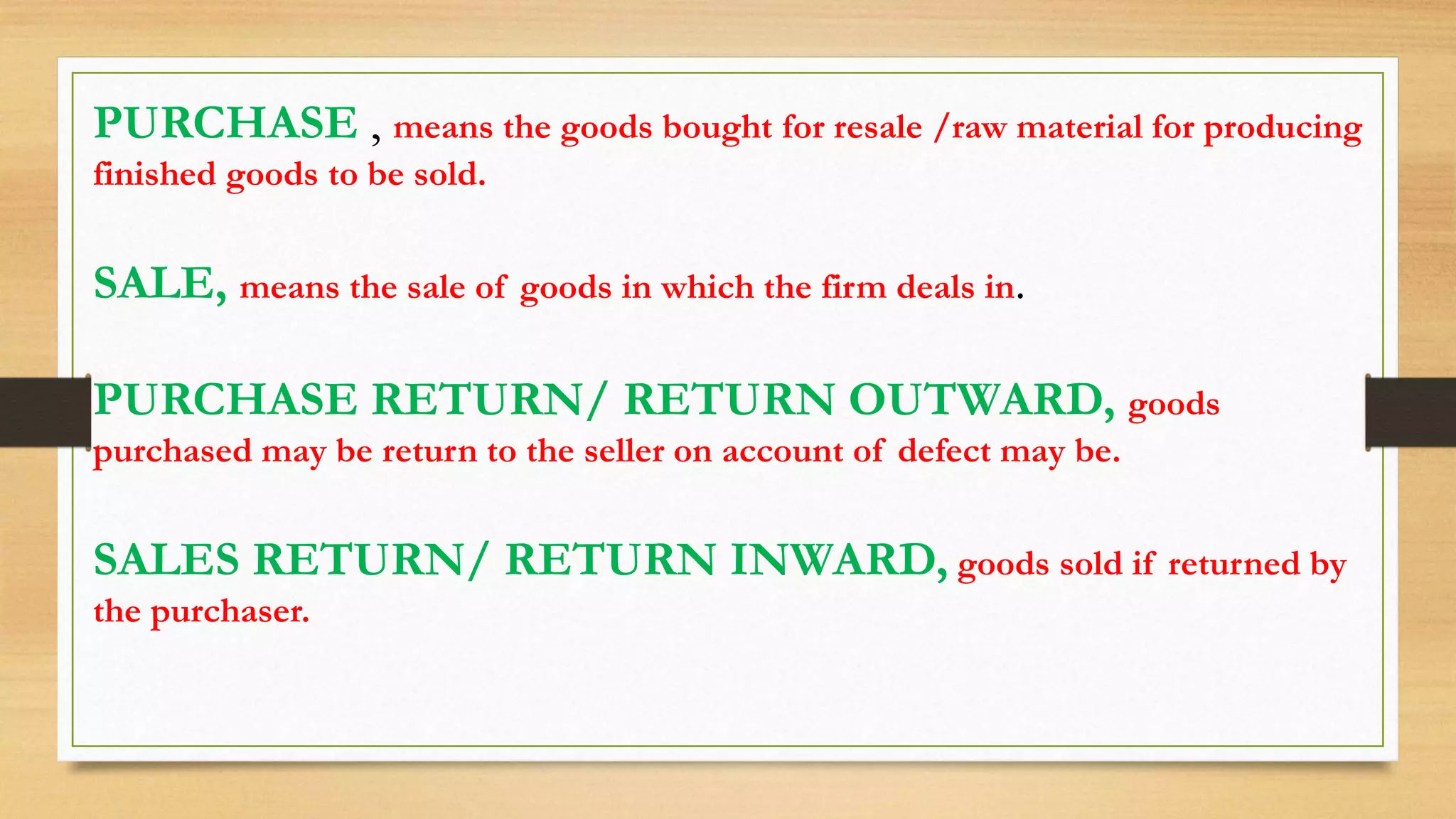
PURCHASE , means the goods bought for resale /raw material for producing
finished goods to be sold.
SALE, means the sale of goods in which the firm deals in.
PURCHASE RETURN/ RETURN OUTWARD, goods
purchased may be return to the seller on account of defect may be.
SALES RETURN/ RETURN INWARD, goods sold if returned by
the purchaser.
STOCK ( amount of goods/ tangible assets held by a firm for
sale/ using it in producing goods for sale.)
stock may be divided into three parts:
1. Stock of Raw Material
2. Stock of Work in Progress
3. Stock of finished Goods.
Stock is shown in the BALANCE SHEET, AS CURRENT ASSET.
VALUED AT COST OR MARKET PRICE WHICHEVER IS
LOWER.
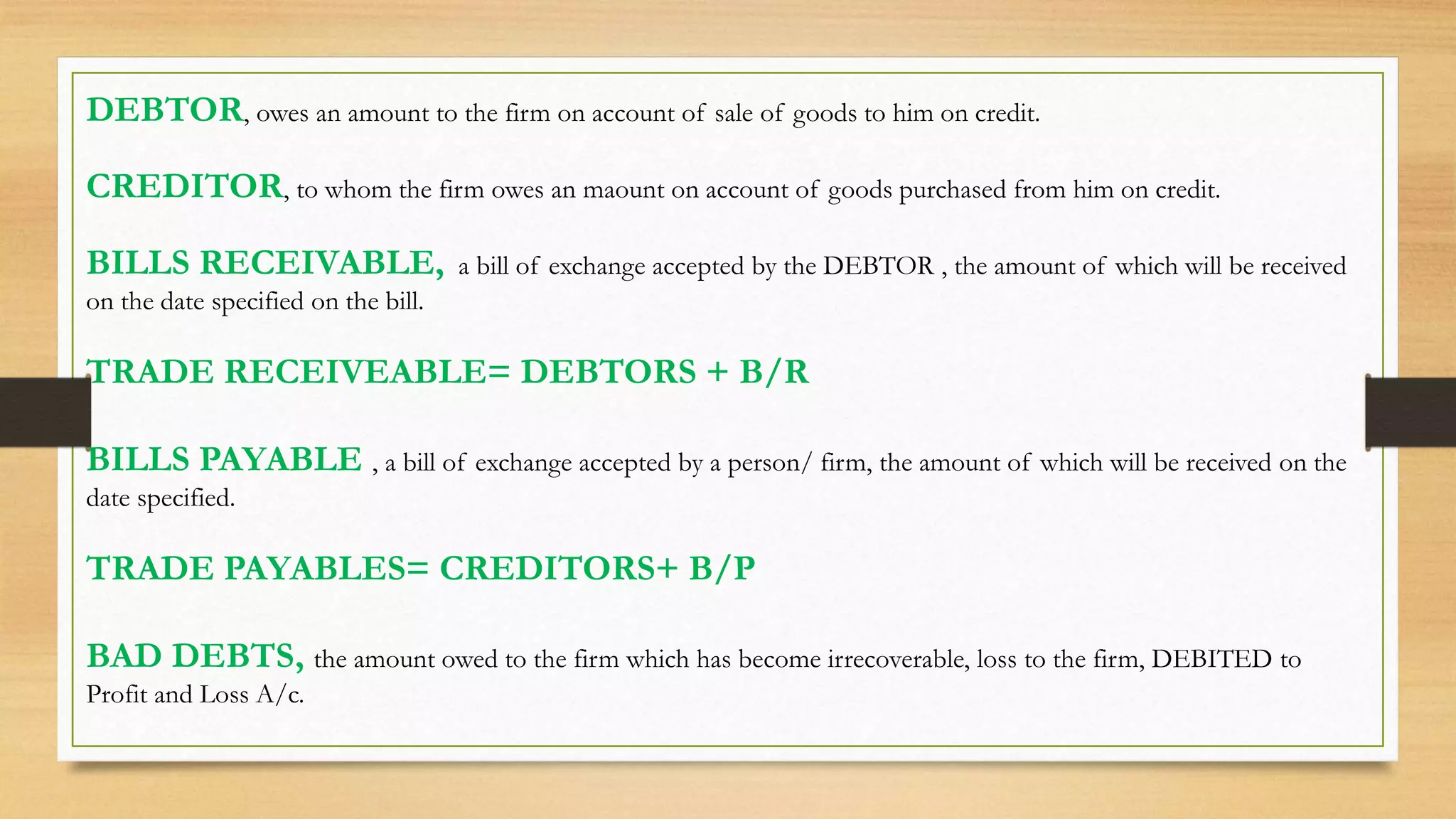
DEBTOR, owes an amount to the firm on account of sale of goods to him on credit.
CREDITOR, to whom the firm owes an maount on account of goods purchased from him on credit.
BILLS RECEIVABLE, a bill of exchange accepted by the DEBTOR , the amount of which will be received
on the date specified on the bill.
TRADE RECEIVEABLE= DEBTORS + B/R
BILLS PAYABLE , a bill of exchange accepted by a person/ firm, the amount of which will be received on the
date specified.
TRADE PAYABLES= CREDITORS+ B/P
BAD DEBTS, the amount owed to the firm which has become irrecoverable, loss to the firm, DEBITED to
Profit and Loss A/c.
DISCOUNT (is the rebate and allowance given
the seller to the buyer.)
TRADE DISCOUNT
• Reduction in prices by the seller when purchaser buy goods of certain quantity
• Sales / Purchases are recorded at SALES/ PURCHASES- TRADE DISCOUNT.
• Not recorded in the books of Accounts.
CASH DISCOUNT
• When discount allowed for timely payment of amount due.
• Recorded in the books of accounts.
• Expense for the party allowing the discount, income for the party receiving the discount.
EXPENDITURE( amount spent/
incurred to acquire assets, goods and services)
CAPITAL EXPENDITURE
REVENUE
EXPENDITURE
DEFERRED REVENUE
EXPENDITURE
CAPITAL EXPENDITURE, amount incurred to acquire assets/ improve
the existing assets to increase the efficiency, earning capacity of the business.
Long term Benefits it gives to the business. Purchase of Machinery, Furniture,
Computer.
• REVENUE EXPENDITURE,
amount spent whose benefit is
consumed within the accounting
period. Cost of goods sold,
Salaries, rent, Electricity
expenses etc.
• DEFERRED REVENUE
EXPENDITURE, is a revenue
expenditure but benefits accrue
for more than one accounting
period.
• Huge Advertising Expenditure.
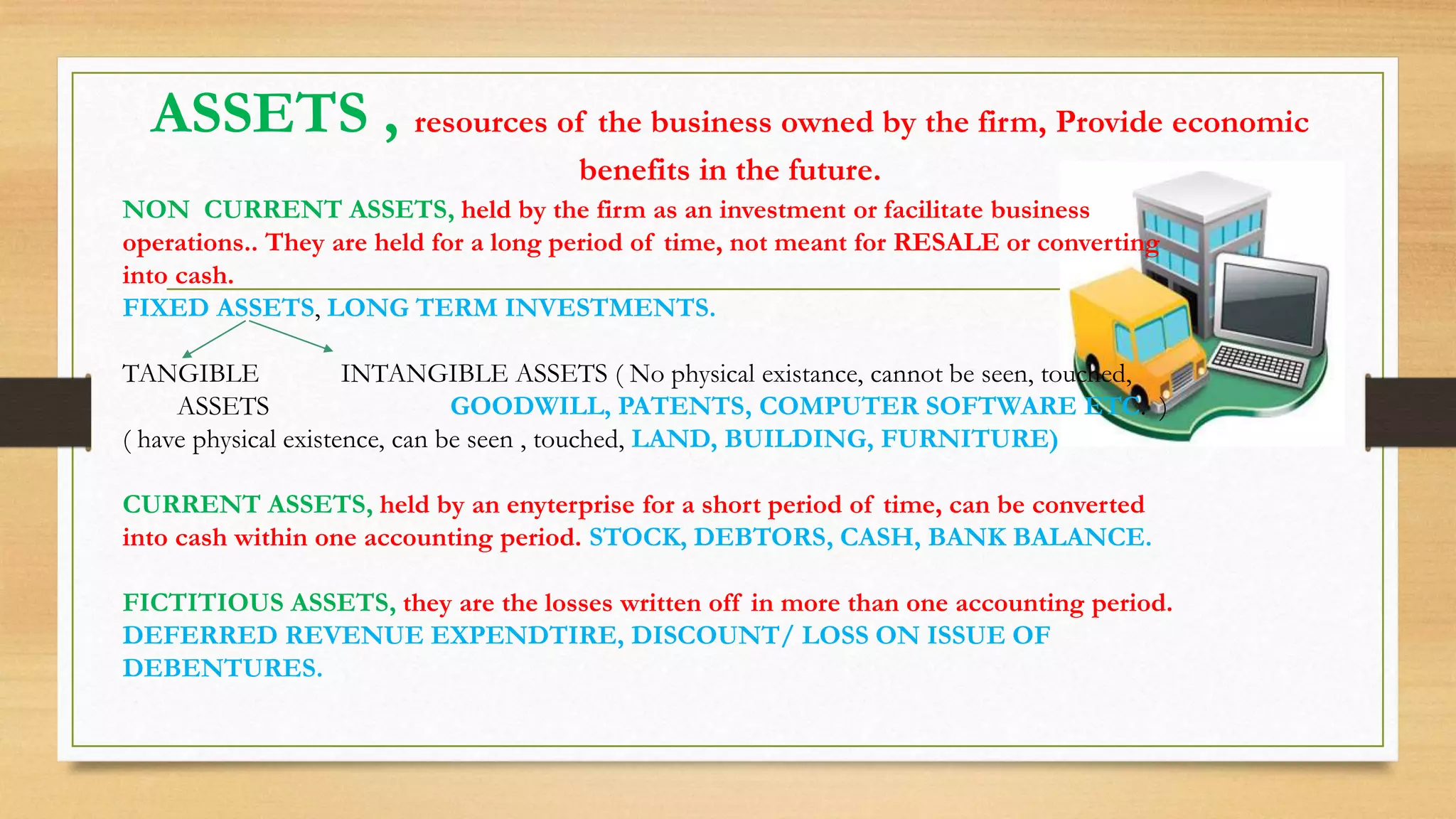
ASSETS , resources of the business owned by the firm, Provide economic
benefits in the future.
NON CURRENT ASSETS, held by the firm as an investment or facilitate business
operations.. They are held for a long period of time, not meant for RESALE or converting
into cash.
FIXED ASSETS, LONG TERM INVESTMENTS.
TANGIBLE INTANGIBLE ASSETS ( No physical existance, cannot be seen, touched,
ASSETS GOODWILL, PATENTS, COMPUTER SOFTWARE ETC. )
( have physical existence, can be seen , touched, LAND, BUILDING, FURNITURE)
CURRENT ASSETS, held by an enyterprise for a short period of time, can be converted
into cash within one accounting period. STOCK, DEBTORS, CASH, BANK BALANCE.
FICTITIOUS ASSETS, they are the losses written off in more than one accounting period.
DEFERRED REVENUE EXPENDTIRE, DISCOUNT/ LOSS ON ISSUE OF
DEBENTURES.
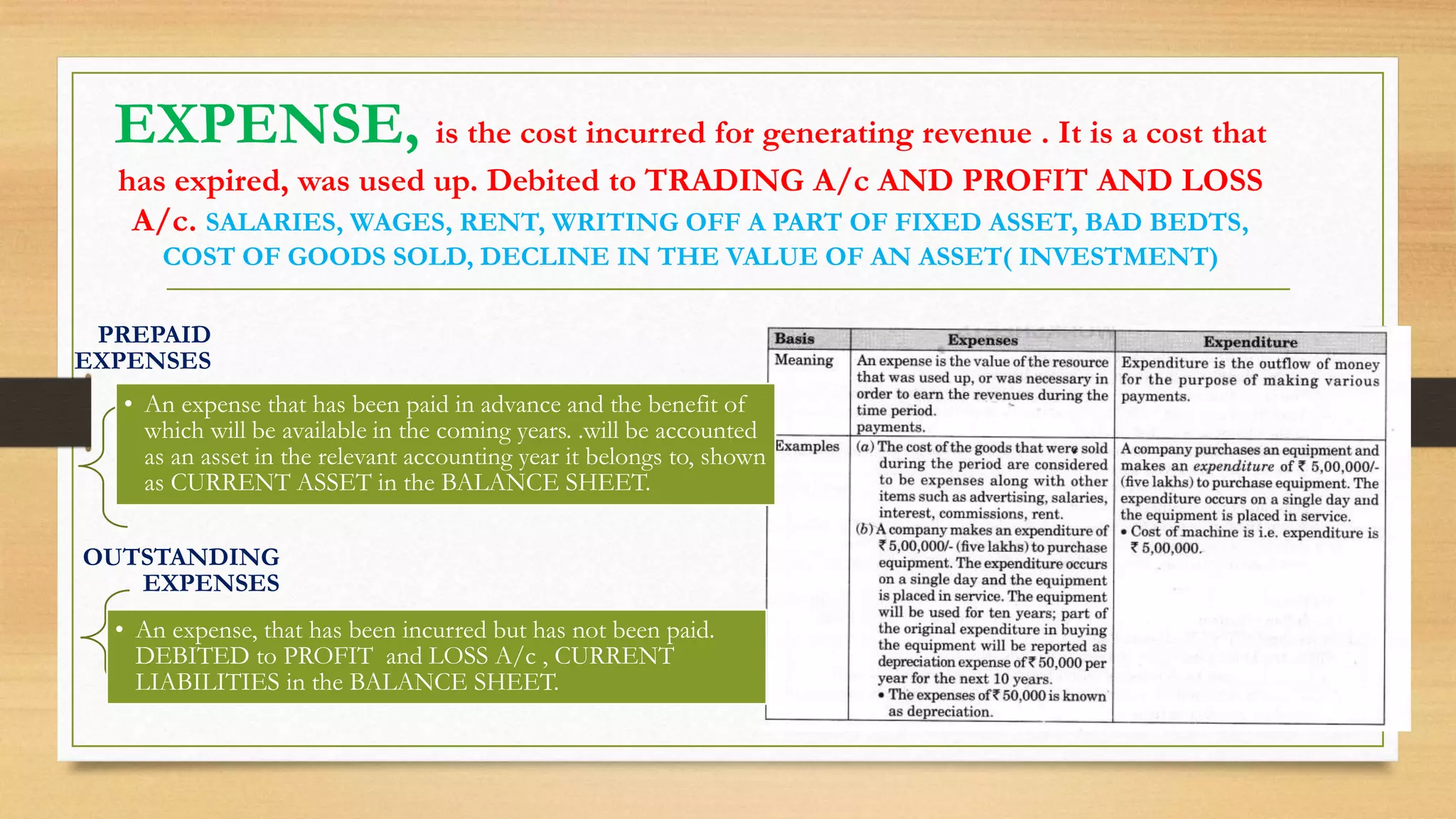
EXPENSE, is the cost incurred for generating revenue . It is a cost that
has expired, was used up. Debited to TRADING A/c AND PROFIT AND LOSS
A/c. SALARIES, WAGES, RENT, WRITING OFF A PART OF FIXED ASSET, BAD BEDTS,
COST OF GOODS SOLD, DECLINE IN THE VALUE OF AN ASSET( INVESTMENT)
PREPAID
EXPENSES
• An expense that has been paid in advance and the benefit of
which will be available in the coming years. .will be accounted
as an asset in the relevant accounting year it belongs to, shown
as CURRENT ASSET in the BALANCE SHEET.
OUTSTANDING
EXPENSES
• An expense, that has been incurred but has not been paid.
DEBITED to PROFIT and LOSS A/c , CURRENT
LIABILITIES in the BALANCE SHEET.

BASIC ACCOUNTING TERMS .pptx

  • 1.
    BASIC ACCOUNTING TERMS By SHANUVAID COMMERCE EDUCATOR
  • 2.
    INCOME, means totalearnings of business which includes both earned from normal business activities or any other business activity not undertaken by business regularly. It is a broader term than the term “ PROFIT”. PROFIT, means the income earned by the business from its operating activities( sale of goods or rendering of services) GROSS PROFIT NET PROFIT ( difference between ( difference between total revenue and total expenses of the enterprise) Revenue and Its Direct Cost. GAIN, is the increase in owner’s equity, resulting from something other than day to day activities( which are irregular or non recurrng in nature). Example, Gain on sale of land, Machinery, car etc. Gain is an output of sale activity that is not actually related to trading business of the firm but to some peripheral activities.
  • 3.
    BUSINESS TRANSACTION (AFINANCIAL EVENT)  RESULT OF AN AGREEMENT BETWEEN TWO PARTIES , INVOLVES TRANSFER OF GOODS AND SERVICES.  ON THE BASIS OF SETTLEMENT VALUE CASH TRANSACTION CREDIT TRANSACTION  ON THE BASIS OF RELATIONSHIP WITH ACCOUNTING UNIT EXTERNAL TRANSACTION INTERNAL TRANSACTION
  • 4.
     A transactionalways bring a change in the financial position of the business, thus also affects the Accounting Equation of the firm ASSETS= LIABILITIES + CAPITAL ( after each transaction, the total assets of business must be equal to its liabilities and capital) WHY? Every transaction has two aspects receiving the benefit (DEBIT) giving the benefit(CREDIT)
  • 5.
    LIABILITIES (AMOUNT OWED BYTHE BUSINESS) • NON CURRENT LIABIILTY- Payable after a period of more than a year after the end of the accounting period. • Examples: long term loans , Debentures • CURRENT LIABILITY- Payable within 12 months from the end of the accounting period. • Examples: Creditors, Bills Payable, Short term Loans.
  • 6.
    CAPITAL( OWNER’s EQUITY/NETWORTH) ( amount invested by the Owner in a Firm) In the form of CASH ASSETS Considered an INTERNAL Liability. WHY? BUSINESS ENTITY CONCEPT– business is separate from its owner. Transactions are recorded in the books from the business point of view.
  • 7.
    DRAWINGS (amount withdrawn bythe Owner for personal use.) In the form of CASH In the form of GOODS, at Purchase Cost. [DEBITED TO DRAWINGS A/c] In balance Sheet, CAPITAL
  • 8.
    FINANCIAL STATEMENTS( preparedat the end of an accounting period) TRADING ACCOUNT PROFIT AND LOSS A/C ( Statement of Profit and Loss ) BALANCE SHEET( showing financial position, ASSETS, LIABILITIES, CAPITAL , RESERVES)
  • 9.
    SOLVENT (who isin a position to pay its debt) INSOLVENT ( who is not in a position to pay its debt) ENTITY ( an economic unit which performs / engage in business activites) PROPRIETORSHIP PARTENRSHIP COMPANY etc. PROPRIETOR ( who makes the investment and bears the risk associated with the business) BOOK VALUE ( the value at which the item appears in the books of account) VOUCHER ( an evidence of business transaction) CASH MEMO INVOICE/ BILL RECEIPT etc. CREDIT / DEBIT ( An account has two PARTS) LEFT SIDE (DEBIT SIDE) RIGHT SIDE ( CREDIT SIDE) If an account is to be debited , entry is posted on the DEBIT SIDE of the account. If an account is to be credited, entry is posted on the CREDIT side of the account.
  • 10.
    GOODS • (are thephysical items of trade, the items in which the firm deals, purchased / produced to be sold) CASH CREDIT Goods “Purchase” CASH CREDIT Goods “Sale”
  • 11.
    PURCHASE , meansthe goods bought for resale /raw material for producing finished goods to be sold. SALE, means the sale of goods in which the firm deals in. PURCHASE RETURN/ RETURN OUTWARD, goods purchased may be return to the seller on account of defect may be. SALES RETURN/ RETURN INWARD, goods sold if returned by the purchaser.
  • 12.
    STOCK ( amountof goods/ tangible assets held by a firm for sale/ using it in producing goods for sale.) stock may be divided into three parts: 1. Stock of Raw Material 2. Stock of Work in Progress 3. Stock of finished Goods. Stock is shown in the BALANCE SHEET, AS CURRENT ASSET. VALUED AT COST OR MARKET PRICE WHICHEVER IS LOWER.
  • 13.
    DEBTOR, owes anamount to the firm on account of sale of goods to him on credit. CREDITOR, to whom the firm owes an maount on account of goods purchased from him on credit. BILLS RECEIVABLE, a bill of exchange accepted by the DEBTOR , the amount of which will be received on the date specified on the bill. TRADE RECEIVEABLE= DEBTORS + B/R BILLS PAYABLE , a bill of exchange accepted by a person/ firm, the amount of which will be received on the date specified. TRADE PAYABLES= CREDITORS+ B/P BAD DEBTS, the amount owed to the firm which has become irrecoverable, loss to the firm, DEBITED to Profit and Loss A/c.
  • 14.
    DISCOUNT (is therebate and allowance given the seller to the buyer.) TRADE DISCOUNT • Reduction in prices by the seller when purchaser buy goods of certain quantity • Sales / Purchases are recorded at SALES/ PURCHASES- TRADE DISCOUNT. • Not recorded in the books of Accounts. CASH DISCOUNT • When discount allowed for timely payment of amount due. • Recorded in the books of accounts. • Expense for the party allowing the discount, income for the party receiving the discount.
  • 15.
    EXPENDITURE( amount spent/ incurredto acquire assets, goods and services) CAPITAL EXPENDITURE REVENUE EXPENDITURE DEFERRED REVENUE EXPENDITURE
  • 16.
    CAPITAL EXPENDITURE, amountincurred to acquire assets/ improve the existing assets to increase the efficiency, earning capacity of the business. Long term Benefits it gives to the business. Purchase of Machinery, Furniture, Computer. • REVENUE EXPENDITURE, amount spent whose benefit is consumed within the accounting period. Cost of goods sold, Salaries, rent, Electricity expenses etc. • DEFERRED REVENUE EXPENDITURE, is a revenue expenditure but benefits accrue for more than one accounting period. • Huge Advertising Expenditure.
  • 17.
    ASSETS , resourcesof the business owned by the firm, Provide economic benefits in the future. NON CURRENT ASSETS, held by the firm as an investment or facilitate business operations.. They are held for a long period of time, not meant for RESALE or converting into cash. FIXED ASSETS, LONG TERM INVESTMENTS. TANGIBLE INTANGIBLE ASSETS ( No physical existance, cannot be seen, touched, ASSETS GOODWILL, PATENTS, COMPUTER SOFTWARE ETC. ) ( have physical existence, can be seen , touched, LAND, BUILDING, FURNITURE) CURRENT ASSETS, held by an enyterprise for a short period of time, can be converted into cash within one accounting period. STOCK, DEBTORS, CASH, BANK BALANCE. FICTITIOUS ASSETS, they are the losses written off in more than one accounting period. DEFERRED REVENUE EXPENDTIRE, DISCOUNT/ LOSS ON ISSUE OF DEBENTURES.
  • 18.
    EXPENSE, is thecost incurred for generating revenue . It is a cost that has expired, was used up. Debited to TRADING A/c AND PROFIT AND LOSS A/c. SALARIES, WAGES, RENT, WRITING OFF A PART OF FIXED ASSET, BAD BEDTS, COST OF GOODS SOLD, DECLINE IN THE VALUE OF AN ASSET( INVESTMENT) PREPAID EXPENSES • An expense that has been paid in advance and the benefit of which will be available in the coming years. .will be accounted as an asset in the relevant accounting year it belongs to, shown as CURRENT ASSET in the BALANCE SHEET. OUTSTANDING EXPENSES • An expense, that has been incurred but has not been paid. DEBITED to PROFIT and LOSS A/c , CURRENT LIABILITIES in the BALANCE SHEET.