While it is no longer necessary to eat artificial sweeteners and low joule foods,
there is still a place for them in certain circumstances and these products are
available in the supermarket. There are two groups of alternative sweeteners:
non-nutritive sweeteners (also known as ‘artificial’ or ‘intense’ sweeteners) and
nutritive sweeteners. These are listed below.
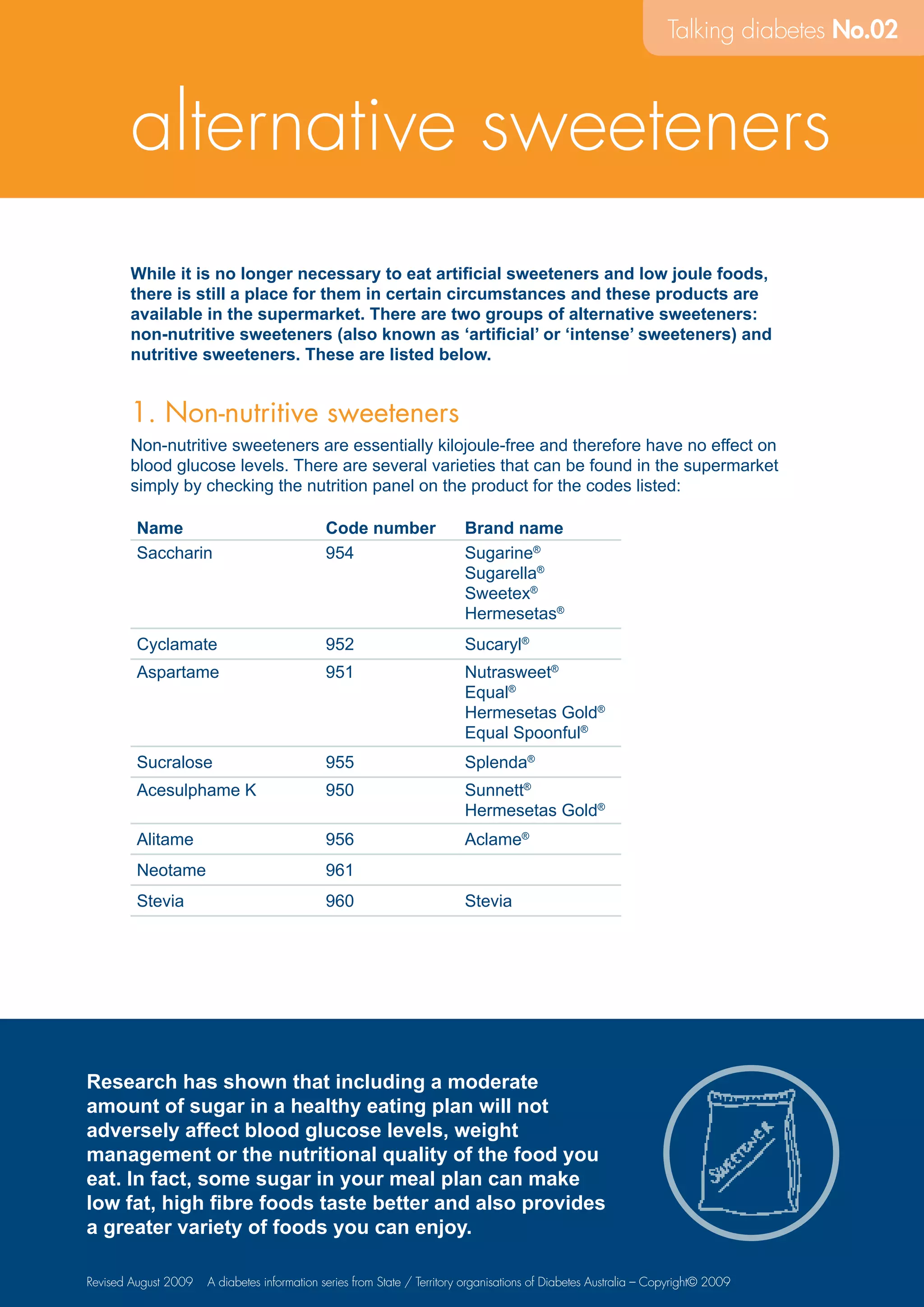
1. Non-nutritive sweeteners
Non-nutritive sweeteners are essentially kilojoule-free and therefore have no effect on
blood glucose levels. There are several varieties that can be found in the supermarket
simply by checking the nutrition panel on the product for the codes listed:
Name Code number Brand name
Saccharin 954 Sugarine®
Sugarella®
Sweetex®
Hermesetas®
Cyclamate 952 Sucaryl®
Aspartame 951 Nutrasweet®
Equal®
Hermesetas Gold®
Equal Spoonful®
Sucralose 955 Splenda®
Acesulphame K 950 Sunnett®
Hermesetas Gold®
Alitame 956 Aclame®
Neotame 961
Stevia 960 Stevia
Research has shown that including a moderate
amount of sugar in a healthy eating plan will not
adversely affect blood glucose levels, weight
management or the nutritional quality of the food you
eat. In fact, some sugar in your meal plan can make
low fat, high fibre foods taste better and also provides
a greater variety of foods you can enjoy.
Talking diabetes No.02
Revised August 2009 A diabetes information series from State / Territory organisations of Diabetes Australia – Copyright© 2009
alternative sweeteners
Are non-nutritive sweeteners safe?
Yes. Non-nutritive sweeteners available in Australia have been thoroughly tested and
approved by Food Standards Australia and New Zealand (FSANZ) and are considered
quite safe to eat.
For women who are pregnant or breastfeeding, and want to take non-nutritive
sweeteners, the following sweeteners are recommended: Acesulphame K, Alitame,
Aspartame (eg: Equal®
) and Sucralose (eg: Splenda®
).
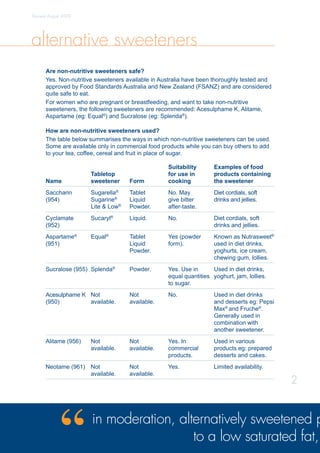
How are non-nutritive sweeteners used?
The table below summarises the ways in which non-nutritive sweeteners can be used.
Some are available only in commercial food products while you can buy others to add
to your tea, coffee, cereal and fruit in place of sugar.
			 Suitability	 Examples of food	
	 Tabletop		 for use in	 products containing	
Name	 sweetener	 Form	 cooking	 the sweetener
Saccharin	 Sugarella®
	 Tablet	 No. May 	 Diet cordials, soft		
(954)	 Sugarine®
	 Liquid	 give bitter 	 drinks and jellies.	 	
	 Lite  Low®
	 Powder.	 after-taste.	
Cyclamate	 Sucaryl®
	 Liquid.	 No.	 Diet cordials, soft 	
(952)				 drinks and jellies.
Aspartame®
	 Equal®
	 Tablet	 Yes (powder	 Known as Nutrasweet®
(951)		 Liquid	 form).	 used in diet drinks,	
		 Powder.		 yoghurts, ice cream,	
				 chewing gum, lollies.
Sucralose (955)	 Splenda®
	 Powder.	 Yes. Use in	 Used in diet drinks, 	
			 equal quantities	 yoghurt, jam, lollies.	
			 to sugar.
Acesulphame K	 Not	 Not	 No.	 Used in diet drinks 	
(950)	 available.	 available.		 and desserts eg: Pepsi	
				 Max®
and Fruche®
.	
				 Generally used in	
				 combination with 	
				 another sweetener.
Alitame (956)	 Not	 Not	 Yes. In	 Used in various		
	 available.	 available.	 commercial	 products eg: prepared	
			 products.	 desserts and cakes.
Neotame (961)	 Not	 Not	 Yes.	 Limited availability.	
	 available.	 available.
in moderation, alternatively sweetened p
to a low saturated fat,
2
Revised August 2009
Cooking with sweeteners
As heat can change the taste of most non-nutritive sweeteners, they are best added
after you have finished cooking. Splenda®
, Equal Spoonful®
and neotame are the only
ones that can be added during cooking or baking, without affecting the taste.
When checking if a product containing a non-nutritive sweetener is suitable to include in
your eating plan, read the label to check the other ingredients and nutritional values. For
example, a product containing an alternative sweetener which is high in fat (particularly
saturated fat) should not be eaten in large amounts (eg: ‘sugar-free’ chocolate).
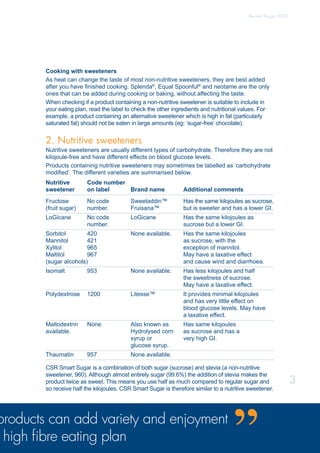
2. Nutritive sweeteners
Nutritive sweeteners are usually different types of carbohydrate. Therefore they are not
kilojoule-free and have different effects on blood glucose levels.
Products containing nutritive sweeteners may sometimes be labelled as ‘carbohydrate
modified’. The different varieties are summarised below.
Nutritive	 Code number		
sweetener	 on label	 Brand name	 Additional comments
Fructose	 No code	 Sweetaddin™	 Has the same kilojoules as sucrose,
(fruit sugar)	 number.	 Fruisana™	 but is sweeter and has a lower GI.
LoGicane	 No code	 LoGicane	 Has the same kilojoules as 		
	 number.		 sucrose but a lower GI.
Sorbitol	 420	 None available.	 Has the same kilojoules
Mannitol	 421		 as sucrose, with the
Xylitol	 965		 exception of mannitol.
Maltitol	 967		 May have a laxative effect
(sugar alcohols)		 and cause wind and diarrhoea.
Isomalt	 953	 None available.	 Has less kilojoules and half		
			 the sweetness of sucrose.		
			 May have a laxative effect.
Polydextrose	 1200	 Litesse™	 It provides minimal kilojoules 	
			 and has very little effect on 		
			 blood glucose levels. May have 	
			 a laxative effect.
Maltodextrin	 None	 Also known as	 Has same kilojoules			
available.		 Hydrolysed corn 	 as sucrose and has a		
		 syrup or 	 very high GI.				
		 glucose syrup.	
Thaumatin	 957	 None available.
CSR Smart Sugar is a combination of both sugar (sucrose) and stevia (a non-nutritive
sweetener, 960). Although almost entirely sugar (99.6%) the addition of stevia makes the
product twice as sweet. This means you use half as much compared to regular sugar and
so receive half the kilojoules. CSR Smart Sugar is therefore similar to a nutritive sweetener.
products can add variety and enjoyment
high fibre eating plan
3
Revised August 2009
alternative sweeteners
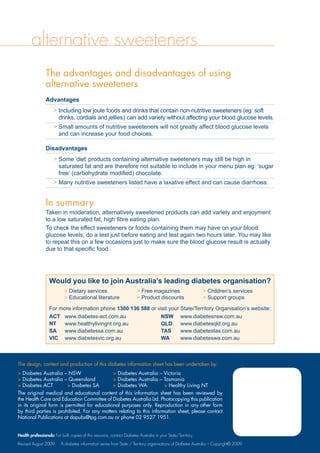
The advantages and disadvantages of using
alternative sweeteners
Advantages
 Including low joule foods and drinks that contain non-nutritive sweeteners (eg: soft
drinks, cordials and jellies) can add variety without affecting your blood glucose levels.
 Small amounts of nutritive sweeteners will not greatly affect blood glucose levels
and can increase your food choices.
Disadvantages
 Some ‘diet’ products containing alternative sweeteners may still be high in	
saturated fat and are therefore not suitable to include in your menu plan eg: ‘sugar
free’ (carbohydrate modified) chocolate.
 Many nutritive sweeteners listed have a laxative effect and can cause diarrhoea.
In summary
Taken in moderation, alternatively sweetened products can add variety and enjoyment
to a low saturated fat, high fibre eating plan.
To check the effect sweeteners or foods containing them may have on your blood
glucose levels, do a test just before eating and test again two hours later. You may like
to repeat this on a few occasions just to make sure the blood glucose result is actually
due to that specific food.
Would you like to join Australia’s leading diabetes organisation?
 Dietary services	  Free magazines	  Children’s services
 Educational literature	  Product discounts	  Support groups
For more information phone 1300 136 588 or visit your State/Territory Organisation’s website:
ACT	 www.diabetes-act.com.au	 NSW	 www.diabetesnsw.com.au
NT	 www.healthylivingnt.org.au	 QLD	 www.diabetesqld.org.au
SA	 www.diabetessa.com.au		 TAS	 www.diabetestas.com.au
VIC	 www.diabetesvic.org.au		 WA	 www.diabeteswa.com.au
The design, content and production of this diabetes information sheet has been undertaken by:
 Diabetes Australia – NSW	  Diabetes Australia – Victoria
 Diabetes Australia – Queensland	  Diabetes Australia – Tasmania
 Diabetes ACT	  Diabetes SA	  Diabetes WA	  Healthy Living NT
The original medical and educational content of this information sheet has been reviewed by
the Health Care and Education Committee of Diabetes Australia Ltd. Photocopying this publication
in its original form is permitted for educational purposes only. Reproduction in any other form
by third parties is prohibited. For any matters relating to this information sheet, please contact
National Publications at dapubs@tpg.com.au or phone 02 9527 1951.
Health professionals: For bulk copies of this resource, contact Diabetes Australia in your State/Territory.
Revised August 2009 A diabetes information series from State / Territory organisations of Diabetes Australia – Copyright© 2009

F8 aus alternative sweeteners

  • 1.
    While it isno longer necessary to eat artificial sweeteners and low joule foods, there is still a place for them in certain circumstances and these products are available in the supermarket. There are two groups of alternative sweeteners: non-nutritive sweeteners (also known as ‘artificial’ or ‘intense’ sweeteners) and nutritive sweeteners. These are listed below. 1. Non-nutritive sweeteners Non-nutritive sweeteners are essentially kilojoule-free and therefore have no effect on blood glucose levels. There are several varieties that can be found in the supermarket simply by checking the nutrition panel on the product for the codes listed: Name Code number Brand name Saccharin 954 Sugarine® Sugarella® Sweetex® Hermesetas® Cyclamate 952 Sucaryl® Aspartame 951 Nutrasweet® Equal® Hermesetas Gold® Equal Spoonful® Sucralose 955 Splenda® Acesulphame K 950 Sunnett® Hermesetas Gold® Alitame 956 Aclame® Neotame 961 Stevia 960 Stevia Research has shown that including a moderate amount of sugar in a healthy eating plan will not adversely affect blood glucose levels, weight management or the nutritional quality of the food you eat. In fact, some sugar in your meal plan can make low fat, high fibre foods taste better and also provides a greater variety of foods you can enjoy. Talking diabetes No.02 Revised August 2009 A diabetes information series from State / Territory organisations of Diabetes Australia – Copyright© 2009 alternative sweeteners
  • 2.
    alternative sweeteners Are non-nutritivesweeteners safe? Yes. Non-nutritive sweeteners available in Australia have been thoroughly tested and approved by Food Standards Australia and New Zealand (FSANZ) and are considered quite safe to eat. For women who are pregnant or breastfeeding, and want to take non-nutritive sweeteners, the following sweeteners are recommended: Acesulphame K, Alitame, Aspartame (eg: Equal® ) and Sucralose (eg: Splenda® ). How are non-nutritive sweeteners used? The table below summarises the ways in which non-nutritive sweeteners can be used. Some are available only in commercial food products while you can buy others to add to your tea, coffee, cereal and fruit in place of sugar. Suitability Examples of food Tabletop for use in products containing Name sweetener Form cooking the sweetener Saccharin Sugarella® Tablet No. May Diet cordials, soft (954) Sugarine® Liquid give bitter drinks and jellies. Lite Low® Powder. after-taste. Cyclamate Sucaryl® Liquid. No. Diet cordials, soft (952) drinks and jellies. Aspartame® Equal® Tablet Yes (powder Known as Nutrasweet® (951) Liquid form). used in diet drinks, Powder. yoghurts, ice cream, chewing gum, lollies. Sucralose (955) Splenda® Powder. Yes. Use in Used in diet drinks, equal quantities yoghurt, jam, lollies. to sugar. Acesulphame K Not Not No. Used in diet drinks (950) available. available. and desserts eg: Pepsi Max® and Fruche® . Generally used in combination with another sweetener. Alitame (956) Not Not Yes. In Used in various available. available. commercial products eg: prepared products. desserts and cakes. Neotame (961) Not Not Yes. Limited availability. available. available. in moderation, alternatively sweetened p to a low saturated fat, 2 Revised August 2009
  • 3.
    Cooking with sweeteners Asheat can change the taste of most non-nutritive sweeteners, they are best added after you have finished cooking. Splenda® , Equal Spoonful® and neotame are the only ones that can be added during cooking or baking, without affecting the taste. When checking if a product containing a non-nutritive sweetener is suitable to include in your eating plan, read the label to check the other ingredients and nutritional values. For example, a product containing an alternative sweetener which is high in fat (particularly saturated fat) should not be eaten in large amounts (eg: ‘sugar-free’ chocolate). 2. Nutritive sweeteners Nutritive sweeteners are usually different types of carbohydrate. Therefore they are not kilojoule-free and have different effects on blood glucose levels. Products containing nutritive sweeteners may sometimes be labelled as ‘carbohydrate modified’. The different varieties are summarised below. Nutritive Code number sweetener on label Brand name Additional comments Fructose No code Sweetaddin™ Has the same kilojoules as sucrose, (fruit sugar) number. Fruisana™ but is sweeter and has a lower GI. LoGicane No code LoGicane Has the same kilojoules as number. sucrose but a lower GI. Sorbitol 420 None available. Has the same kilojoules Mannitol 421 as sucrose, with the Xylitol 965 exception of mannitol. Maltitol 967 May have a laxative effect (sugar alcohols) and cause wind and diarrhoea. Isomalt 953 None available. Has less kilojoules and half the sweetness of sucrose. May have a laxative effect. Polydextrose 1200 Litesse™ It provides minimal kilojoules and has very little effect on blood glucose levels. May have a laxative effect. Maltodextrin None Also known as Has same kilojoules available. Hydrolysed corn as sucrose and has a syrup or very high GI. glucose syrup. Thaumatin 957 None available. CSR Smart Sugar is a combination of both sugar (sucrose) and stevia (a non-nutritive sweetener, 960). Although almost entirely sugar (99.6%) the addition of stevia makes the product twice as sweet. This means you use half as much compared to regular sugar and so receive half the kilojoules. CSR Smart Sugar is therefore similar to a nutritive sweetener. products can add variety and enjoyment high fibre eating plan 3 Revised August 2009
  • 4.
    alternative sweeteners The advantagesand disadvantages of using alternative sweeteners Advantages Including low joule foods and drinks that contain non-nutritive sweeteners (eg: soft drinks, cordials and jellies) can add variety without affecting your blood glucose levels. Small amounts of nutritive sweeteners will not greatly affect blood glucose levels and can increase your food choices. Disadvantages Some ‘diet’ products containing alternative sweeteners may still be high in saturated fat and are therefore not suitable to include in your menu plan eg: ‘sugar free’ (carbohydrate modified) chocolate. Many nutritive sweeteners listed have a laxative effect and can cause diarrhoea. In summary Taken in moderation, alternatively sweetened products can add variety and enjoyment to a low saturated fat, high fibre eating plan. To check the effect sweeteners or foods containing them may have on your blood glucose levels, do a test just before eating and test again two hours later. You may like to repeat this on a few occasions just to make sure the blood glucose result is actually due to that specific food. Would you like to join Australia’s leading diabetes organisation? Dietary services Free magazines Children’s services Educational literature Product discounts Support groups For more information phone 1300 136 588 or visit your State/Territory Organisation’s website: ACT www.diabetes-act.com.au NSW www.diabetesnsw.com.au NT www.healthylivingnt.org.au QLD www.diabetesqld.org.au SA www.diabetessa.com.au TAS www.diabetestas.com.au VIC www.diabetesvic.org.au WA www.diabeteswa.com.au The design, content and production of this diabetes information sheet has been undertaken by: Diabetes Australia – NSW Diabetes Australia – Victoria Diabetes Australia – Queensland Diabetes Australia – Tasmania Diabetes ACT Diabetes SA Diabetes WA Healthy Living NT The original medical and educational content of this information sheet has been reviewed by the Health Care and Education Committee of Diabetes Australia Ltd. Photocopying this publication in its original form is permitted for educational purposes only. Reproduction in any other form by third parties is prohibited. For any matters relating to this information sheet, please contact National Publications at dapubs@tpg.com.au or phone 02 9527 1951. Health professionals: For bulk copies of this resource, contact Diabetes Australia in your State/Territory. Revised August 2009 A diabetes information series from State / Territory organisations of Diabetes Australia – Copyright© 2009