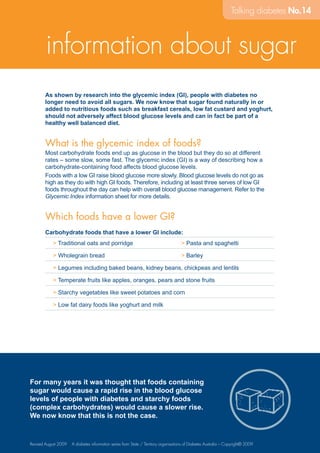
As shown by research into the glycemic index (GI), people with diabetes no
longer need to avoid all sugars. We now know that sugar found naturally in or
added to nutritious foods such as breakfast cereals, low fat custard and yoghurt,
should not adversely affect blood glucose levels and can in fact be part of a
healthy well balanced diet.
What is the glycemic index of foods?
Most carbohydrate foods end up as glucose in the blood but they do so at different
rates – some slow, some fast. The glycemic index (GI) is a way of describing how a
carbohydrate-containing food affects blood glucose levels.
Foods with a low GI raise blood glucose more slowly. Blood glucose levels do not go as
high as they do with high GI foods. Therefore, including at least three serves of low GI
foods throughout the day can help with overall blood glucose management. Refer to the
Glycemic Index information sheet for more details.
Which foods have a lower GI?
Carbohydrate foods that have a lower GI include:
 Traditional oats and porridge	  Pasta and spaghetti
 Wholegrain bread	  Barley
 Legumes including baked beans, kidney beans, chickpeas and lentils
 Temperate fruits like apples, oranges, pears and stone fruits
 Starchy vegetables like sweet potatoes and corn
 Low fat dairy foods like yoghurt and milk
For many years it was thought that foods containing
sugar would cause a rapid rise in the blood glucose
levels of people with diabetes and starchy foods
(complex carbohydrates) would cause a slower rise.
We now know that this is not the case.
Talking diabetes No.14
Revised August 2009 A diabetes information series from State / Territory organisations of Diabetes Australia – Copyright© 2009
information about sugar
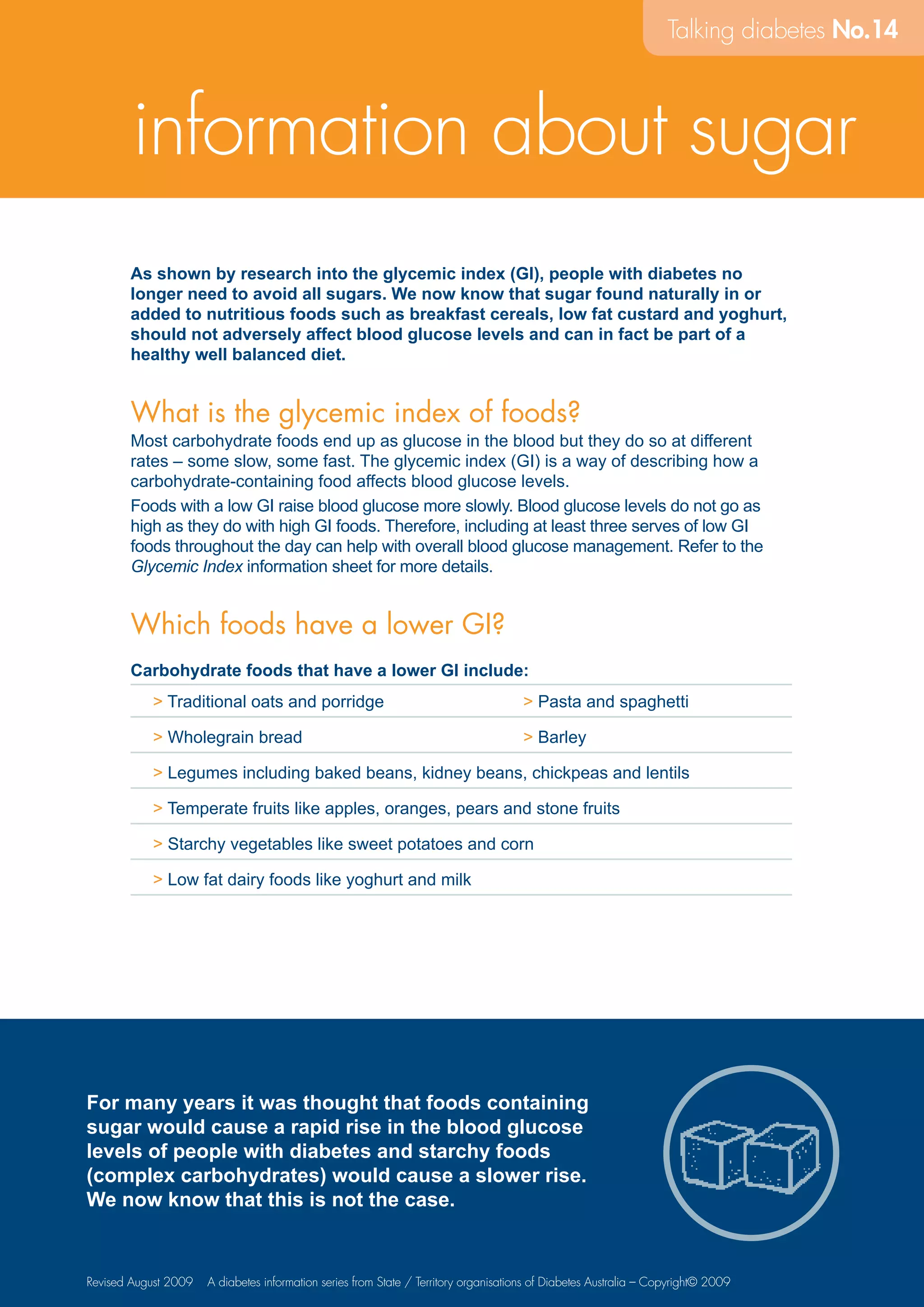
What is the GI of sugar?
The GI of sugar (also known as sucrose or table sugar) is moderate (neither high nor
low). To put this into context, the GI of sugar is compared in the table below with a few
examples of widely used healthy foods:
Food item	 Glycemic index comparison
Many tropical fruits	 GI of sugar is similar
Weet Bix®
	 GI of sugar is similar
Wholemeal bread	 GI of sugar is slightly lower
Most kinds of rice and potato	 GI of sugar is much lower
That is why it is no longer necessary to avoid all sugars. Or course, this doesn’t
mean you should start eating tablespoons of sugar with everything. What it does mean
is that the emphasis no longer needs to be on avoiding sugar at all costs.
In general, your meals need to be based on a variety of foods that are lower in fat
(particularly saturated fat), high in fibre and with a low GI. Including some sugar with
these foods will not upset your diabetes management and may make it easier to follow
a healthy eating plan.
How much sugar can I have in a day?
The exact amount of sugar to include in your eating plan cannot be specifically stated
as it will depend very much on the individual. Your age, activity level, weight, diabetes
medication and overall blood glucose management will all play a part. For more specific
information about how much sugar in a day is best for you, your dietitian or diabetes
educator will help.
Here are some ideas on how to use sugar in a healthy eating plan:
 Add a teaspoon of sugar to porridge, All Bran®
, Guardian®
, etc.
 Add a scrape of honey or regular jam to wholegrain, wholemeal or high fibre
white bread, preferably with a low GI.
 It’s okay to use some sugar in recipes for cakes, muffins and biscuits.
 Choose lower fat sweet commercial biscuits eg: Arnott’s Full o’ Fruit®
or
Snack Right Fruit Slice®
.
 Sugar in low fat savoury foods is usually present in small amounts and is unlikely
to have any effect on blood glucose levels eg: baked beans, tomato sauce, pickles
and chutney.
Revised August 2009
a moderate amount of sugar in a healthy eating p
2
Is it necessary to include added sugar if you
don’t want to?
Not at all, the choice is yours. Small amounts of added sugar can make many nutritious
foods more enjoyable without having a major effect on your blood glucose levels. On the
other hand, there is a variety of alternative sweeteners available in Australia that can be
used as an effective substitute. Refer to the Alternative Sweeteners information sheet.
When is sugar not the best choice?
When the food is made mainly from sugar
 It is best not to eat foods in which sugar is the main ingredient. For example, soft
drinks, cordials and lollies have sugar as their main ingredient and don’t provide
any additional nutritional value. As a rule, these products are best used in cases
of low blood glucose (’hypos’) or during exercise. Otherwise, choose alternatively
sweetened, low calorie/kilojoule drinks such as Diet Coke®
, Pepsi Max®
, Diet
Ginger Ale, Weight Watchers®
, Schweppes or Cottees®
low joule cordials.
When the food is high in sugar and fat
 It is best not to eat foods too often that are high in sugar and fat (particularly
saturated fat). For example, many foods that are high in sugar like most cakes,
biscuits and chocolates are also loaded with fat. Too much total and saturated fat
can put on weight, increase blood cholesterol and triglycerides and in the long run
upset your diabetes management.
When you need to cut down on carbohydrates
 If you’ve been advised to cut down on the amount of energy (calories/kilojoules)
or carbohydrate you eat, not eating added sugars can help you to reduce calories/
kilojoules and may help you to lose weight and reduce your blood glucose levels.
plan will not adversely affect blood glucose levels
Revised August 2009
3
information about sugar
More information
To find out more about sugar, consult an Accredited Practising Dietitian (APD):
 The Dietitians Association of Australia on 1800 812 942
 Your State or Territory Diabetes Organisation on 1300 136 588
Dietitians are based in many local hospitals, diabetes centres and community health
centres and are also listed in the telephone book.
The design, content and production of this diabetes information sheet has been undertaken by:
 Diabetes Australia – NSW	  Diabetes Australia – Victoria
 Diabetes Australia – Queensland	  Diabetes Australia – Tasmania
 Diabetes ACT	  Diabetes SA	  Diabetes WA	  Healthy Living NT
The original medical and educational content of this information sheet has been reviewed by
the Health Care and Education Committee of Diabetes Australia Ltd. Photocopying this publication
in its original form is permitted for educational purposes only. Reproduction in any other form
by third parties is prohibited. For any matters relating to this information sheet, please contact
National Publications at dapubs@tpg.com.au or phone 02 9527 1951.
Would you like to join Australia’s leading diabetes organisation?
 Dietary services	  Free magazines	  Children’s services
 Educational literature	  Product discounts	  Support groups
For more information phone 1300 136 588 or visit your State/Territory Organisation’s website:
ACT	 www.diabetes-act.com.au	 NSW	 www.diabetesnsw.com.au
NT	 www.healthylivingnt.org.au	 QLD	 www.diabetesqld.org.au
SA	 www.diabetessa.com.au		 TAS	 www.diabetestas.com.au
VIC	 www.diabetesvic.org.au		 WA	 www.diabeteswa.com.au
Health professionals: For bulk copies of this resource, contact Diabetes Australia in your State/Territory.
Revised August 2009 A diabetes information series from State / Territory organisations of Diabetes Australia – Copyright© 2009

F8 aus information about sugar 2009

  • 1.
    As shown byresearch into the glycemic index (GI), people with diabetes no longer need to avoid all sugars. We now know that sugar found naturally in or added to nutritious foods such as breakfast cereals, low fat custard and yoghurt, should not adversely affect blood glucose levels and can in fact be part of a healthy well balanced diet. What is the glycemic index of foods? Most carbohydrate foods end up as glucose in the blood but they do so at different rates – some slow, some fast. The glycemic index (GI) is a way of describing how a carbohydrate-containing food affects blood glucose levels. Foods with a low GI raise blood glucose more slowly. Blood glucose levels do not go as high as they do with high GI foods. Therefore, including at least three serves of low GI foods throughout the day can help with overall blood glucose management. Refer to the Glycemic Index information sheet for more details. Which foods have a lower GI? Carbohydrate foods that have a lower GI include: Traditional oats and porridge Pasta and spaghetti Wholegrain bread Barley Legumes including baked beans, kidney beans, chickpeas and lentils Temperate fruits like apples, oranges, pears and stone fruits Starchy vegetables like sweet potatoes and corn Low fat dairy foods like yoghurt and milk For many years it was thought that foods containing sugar would cause a rapid rise in the blood glucose levels of people with diabetes and starchy foods (complex carbohydrates) would cause a slower rise. We now know that this is not the case. Talking diabetes No.14 Revised August 2009 A diabetes information series from State / Territory organisations of Diabetes Australia – Copyright© 2009 information about sugar
  • 2.
    information about sugar Whatis the GI of sugar? The GI of sugar (also known as sucrose or table sugar) is moderate (neither high nor low). To put this into context, the GI of sugar is compared in the table below with a few examples of widely used healthy foods: Food item Glycemic index comparison Many tropical fruits GI of sugar is similar Weet Bix® GI of sugar is similar Wholemeal bread GI of sugar is slightly lower Most kinds of rice and potato GI of sugar is much lower That is why it is no longer necessary to avoid all sugars. Or course, this doesn’t mean you should start eating tablespoons of sugar with everything. What it does mean is that the emphasis no longer needs to be on avoiding sugar at all costs. In general, your meals need to be based on a variety of foods that are lower in fat (particularly saturated fat), high in fibre and with a low GI. Including some sugar with these foods will not upset your diabetes management and may make it easier to follow a healthy eating plan. How much sugar can I have in a day? The exact amount of sugar to include in your eating plan cannot be specifically stated as it will depend very much on the individual. Your age, activity level, weight, diabetes medication and overall blood glucose management will all play a part. For more specific information about how much sugar in a day is best for you, your dietitian or diabetes educator will help. Here are some ideas on how to use sugar in a healthy eating plan: Add a teaspoon of sugar to porridge, All Bran® , Guardian® , etc. Add a scrape of honey or regular jam to wholegrain, wholemeal or high fibre white bread, preferably with a low GI. It’s okay to use some sugar in recipes for cakes, muffins and biscuits. Choose lower fat sweet commercial biscuits eg: Arnott’s Full o’ Fruit® or Snack Right Fruit Slice® . Sugar in low fat savoury foods is usually present in small amounts and is unlikely to have any effect on blood glucose levels eg: baked beans, tomato sauce, pickles and chutney. Revised August 2009 a moderate amount of sugar in a healthy eating p 2
  • 3.
    Is it necessaryto include added sugar if you don’t want to? Not at all, the choice is yours. Small amounts of added sugar can make many nutritious foods more enjoyable without having a major effect on your blood glucose levels. On the other hand, there is a variety of alternative sweeteners available in Australia that can be used as an effective substitute. Refer to the Alternative Sweeteners information sheet. When is sugar not the best choice? When the food is made mainly from sugar It is best not to eat foods in which sugar is the main ingredient. For example, soft drinks, cordials and lollies have sugar as their main ingredient and don’t provide any additional nutritional value. As a rule, these products are best used in cases of low blood glucose (’hypos’) or during exercise. Otherwise, choose alternatively sweetened, low calorie/kilojoule drinks such as Diet Coke® , Pepsi Max® , Diet Ginger Ale, Weight Watchers® , Schweppes or Cottees® low joule cordials. When the food is high in sugar and fat It is best not to eat foods too often that are high in sugar and fat (particularly saturated fat). For example, many foods that are high in sugar like most cakes, biscuits and chocolates are also loaded with fat. Too much total and saturated fat can put on weight, increase blood cholesterol and triglycerides and in the long run upset your diabetes management. When you need to cut down on carbohydrates If you’ve been advised to cut down on the amount of energy (calories/kilojoules) or carbohydrate you eat, not eating added sugars can help you to reduce calories/ kilojoules and may help you to lose weight and reduce your blood glucose levels. plan will not adversely affect blood glucose levels Revised August 2009 3
  • 4.
    information about sugar Moreinformation To find out more about sugar, consult an Accredited Practising Dietitian (APD): The Dietitians Association of Australia on 1800 812 942 Your State or Territory Diabetes Organisation on 1300 136 588 Dietitians are based in many local hospitals, diabetes centres and community health centres and are also listed in the telephone book. The design, content and production of this diabetes information sheet has been undertaken by: Diabetes Australia – NSW Diabetes Australia – Victoria Diabetes Australia – Queensland Diabetes Australia – Tasmania Diabetes ACT Diabetes SA Diabetes WA Healthy Living NT The original medical and educational content of this information sheet has been reviewed by the Health Care and Education Committee of Diabetes Australia Ltd. Photocopying this publication in its original form is permitted for educational purposes only. Reproduction in any other form by third parties is prohibited. For any matters relating to this information sheet, please contact National Publications at dapubs@tpg.com.au or phone 02 9527 1951. Would you like to join Australia’s leading diabetes organisation? Dietary services Free magazines Children’s services Educational literature Product discounts Support groups For more information phone 1300 136 588 or visit your State/Territory Organisation’s website: ACT www.diabetes-act.com.au NSW www.diabetesnsw.com.au NT www.healthylivingnt.org.au QLD www.diabetesqld.org.au SA www.diabetessa.com.au TAS www.diabetestas.com.au VIC www.diabetesvic.org.au WA www.diabeteswa.com.au Health professionals: For bulk copies of this resource, contact Diabetes Australia in your State/Territory. Revised August 2009 A diabetes information series from State / Territory organisations of Diabetes Australia – Copyright© 2009