IOSR Journal of Mechanical and Civil Engineering (IOSR-JMCE)
e-ISSN: 2278-1684,p-ISSN: 2320-334X, Volume 13, Issue 3, Ver. II (May- Jun. 2016), PP 30-38
www.iosrjournals.org
DOI: 10.9790/1684-1303023038 www.iosrjournals.org 30 | Page
Application of Affine Theorem to Orthotropic Rectangular
Reinforced Concrete Slab with Long Side Opening Symmetric
About Vertical Axis
Dr.T.V.S. Vara Lakshmi1
, Prof. K. Rambabu2
, Prof. K. Srinivasa Rao3
1
(Department of Civil Engineering, University College of Engineering and Technology, Acharya Nagarjuna
University, Guntur, Andhra Pradesh, India).
2(Department of Civil Engineering, College of Engineering, Andhra University, Visakhapatnam, Andhra
Pradesh, India).
3(Department of Civil Engineering ,College of Engineering, Andhra University, Visakhapatnam, Andhra
Pradesh, India).
Abstract: An attempt has been made to apply affinity theorem to determine collapse load of two-way
orthotropic slab with long side opening symmetric to vertical axis. Keeping in view the basic principles of yield
line theory, all possible admissible yield line patterns for Continuous Slab (CS), Simply Supported Slab (SS),
Two Short Sides Continuous Slab (TSC), and Two Long Sides Continuous Slab (TLC) are considered for the
given configuration of the slab subjected to uniformly distributed load (udl). A computer program has been
developed to solve the virtual work equations. Illustration of above methodology has been brought out with
numerical examples. Relevant tables for given data and the governing admissible failure patterns of the slab for
different sizes of openings are presented using affine theorem. In this paper, authors also present the
transformation of orthotropic slab into an equivalent isotropic slab using affine theorem. A slab with longer
side opening is used. Here aspect ratio of opening is quite different from that of slab.
Keywords: aspect ratio, long side opening, configuration, affinity theorem, orthotropic slab, uniformly
distributed load, ultimate load and ultimate moment.
I. Introduction
Openings in slabs are usually required for plumbing, fire protection pipes, heat and ventilation ducts
and air conditioning. Larger openings that could amount to the elimination of a large area within a slab panel are
sometimes required for stairs and elevators shafts. For newly constructed slabs, the locations and sizes of the
required openings are usually predetermined in the early stages of design and are accommodated accordingly.
Such two way slabs subjected to uniformly distributed load and supported on various edge conditions are being
analyzed by using yield-line method as suggested by Johansen, K.W1
. Many researchers (Goli, H.B. and
Gesund,H.2
, Rambabu, K. and Gloi,H.B.3
, Islam,S. and Park,R.4
, Zaslavsky.Aron5
, Siva Rama Prasad, Ch and
Goli,H.B.6
, Sudhakar, K.J. and Goli,H.B.7
, Veerendra Kumar and Milan Bandyopadhya8
) adopted the yield-line
analysis and virtual work method in deriving the virtual work equations of the rectangular reinforced concrete
solid slabs subjected to uniformly distributed load and supported on various edge conditions. Johansen, K.W1
,
also presented the analysis of orthogonal solid slabs implicitly to that of an equivalent Isotropic Slab by using
“Affine Theorem” provided the ratio of negative to positive moments is same in orthogonal directions. Various
design charts are presented for Two-way slabs with longer side opening subjected to uniformly distributed load
for different edge conditions. Islam,S. and Park,R.4
presented design charts for CS and SS slabs with equal
openings, i.e. ratio of openings and aspect ratio are same.
II. Methodology
The method of determining collapse loads based on principle of virtual work has proved to be a
powerful tool for a structural engineer, despite it gives an upper bound value. The work equations are formed by
equating the energy absorbed by yield lines and the work done by the external load of the orthogonal rectangular
slab with long side openings where a small virtual displacement is given to the slab. The same principle was
also used by Islam,S. and Park,R.4
in their paper. In other words, the work equation is given by
      0,0,, xmymdxdyyxW yyultxxultult  --------------------(1) where Wult
is the ultimate load per unit area of slab, δ(x,y) is the virtual displacement in the direction of the loading at the
element of area of dimensions dx, dy, mult,x and mult,y are the yield moments per unit width in the x and y
directions, өx and өy are the components of the virtual rotation of the slab segments in the x and y directions and
x0 and y0 are the projected length of the yield lines in x and y directions of slab. The equation (1) contains terms
Application Of Affine Theorem To Orthotropic Rectangular Reinforced Concrete Slab With Long Side.
DOI: 10.9790/1684-1303023038 www.iosrjournals.org 31 | Page
C1, C2, C3 and C4 which define the positions of the node points of the yield lines. The values of C1, C2, C3 and C4
to be used in the equation are those which give the minimum load to cause failure. A computer program has
been written to find the minimum values of C1, C2, C3 and C4 (in terms of r1, r2, r3 and r4) which in turn will give
the minimum load carrying capacity of the slab. For definitions of various parameters refer notations. Johansen1
has proved that the yield line theory is an upper bound method, so care has been taken to examine all the
possible yield line patterns for each boundary (4 edge‟s) condition of slab to ensure that the most critical
collapse mode is considered otherwise the load carrying capacity of the slab will be overestimated.
III. Formulation Of Virtual Work Equations
There are several possible yield line patterns associated with different edge conditions of the slab. For
four edge condition of slab, the possible admissible failure yield line patterns are only ten for CS, SS, TSC and
TLC edge conditions. These admissible failure yield line patterns are obtained basing on the yield line principle
(Johansen.
K.W1
). For the given configuration of the slab, these ten failure patterns and corresponding equations
have been investigated depending upon the edge condition of the slab using a computer program.
The orthogonal reinforced rectangular slab having long side opening with the given configuration and the yield
criteria are shown in notations. The slab is subjected to uniformly distributed load (Wult) and supported on
different boundary conditions. Note that the slab is not carrying any load over the area of the opening.
The virtual work equations are derived for the predicted possible admissible failure yield line patterns using the
virtual work equation for continuous edge (CS) condition of slab. To get the equations for other edge conditions
of the slab, modification should be carried out in the numerators of the equations of each failure patterns. For SS
slab I1=I2=0, for TSC slab I2=0, for TLC slab I1=0.
IV. Virtual Work Equations For Continuous Slab (CS)
Ten possible failure patterns are predicted for Continuous Slab (CS), Simply Supported Slab (SS), Two
Long Sides Continuous Slab (TSC) and Two Long Sides Continuous Slab (TLC) and four edge conditions of
the slab. Some of the governing failure pattern for different edge conditions and for different data is presented in
Table-1. Considering the failure Pattern-1of a continuous slab. Three unknown dimensions C1, C2, & C3 are
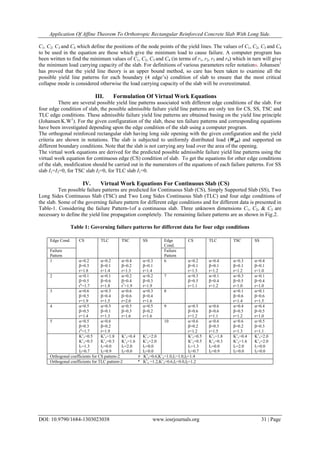
necessary to define the yield line propagation completely. The remaining failure patterns are as shown in Fig.2.
Table 1: Governing failure patterns for different data for four edge conditions
Edge Cond. CS TLC TSC SS Edge
Cond.
CS TLC TSC SS
Failure
Pattern
Failure
Pattern
1 α=0.2
β=0.3
r=1.8
α=0.2
β=0.1
r=1.4
α=0.4
β=0.2
r=1.3
α=0.3
β=0.1
r=1.4
6 α=0.2
β=0.1
r=1.3
α=0.4
β=0.1
r=1.2
α=0.3
β=0.1
r=1.2
α=0.4
β=0.1
r=1.0
2 α=0.1
β=0.5
r#
=1.7
α=0.1
β=0.6
r=1.8
α=0.2
β=0.4
r*
=1.9
α=0.2
β=0.3
r=1.9
7 α=0.3
β=0.5
r=1.1
α=0.1
β=0.4
r=1.2
α=0.3
β=0.5
r=1.0
α=0.1
β=0.4
r=1.0
3 α=0.6
β=0.5
r=1.9
α=0.3
β=0.4
r=1.5
α=0.6
β=0.6
r=2.0
α=0.3
β=0.4
r=1.6
8 α=0.1
β=0.6
r=1.4
α=0.1
β=0.6
r=1.5
4 α=0.5
β=0.5
r=1.4
α=0.5
β=0.1
r=1.3
α=0.5
β=0.3
r=1.6
α=0.5
β=0.2
r=1.6
9 α=0.5
β=0.6
r=1.2
α=0.6
β=0.6
r=1.1
α=0.4
β=0.5
r=1.2
α=0.4
β=0.5
r=1.0
5 α=0.5
β=0.3
r#
=1.7
α=0.6
β=0.2
r=1.9
10 α=0.6
β=0.2
r=1.2
α=0.6
β=0.3
r=1.5
α=0.6
β=0.2
r=1.3
α=0.5
β=0.3
r=1.1
K‟x=0.5
K‟y=0.5
I1=1.3
I2=0.7
K‟x=1.8
K‟y=0.3
I1=0.0
I2=0.9
K‟x=0.4
K‟y=1.6
I1=2.0
I2=0.0
K‟x=2.0
K‟y=2.0
I1=0.0
I2=0.0
K‟x=0.5
K‟y=0.5
I1=1.3
I2=0.7
K‟x=1.8
K‟y=0.3
I1=0.0
I2=0.9
K‟x=0.4
K‟y=1.6
I1=2.0
I2=0.0
K‟x=2.0
K‟y=2.0
I1=0.0
I2=0.0
Orthogonal coefficients for CS pattern-2 # K1
x=0.6,K‟y=1.0,I1=1.0,I2=1.4
Orthogonal coefficients for TLC pattern-2 * K1
x =1.2,K‟y=0.6,I1=0.0,I2=1.2
Application Of Affine Theorem To Orthotropic Rectangular Reinforced Concrete Slab With Long Side.
DOI: 10.9790/1684-1303023038 www.iosrjournals.org 32 | Page
Fig 2 Patterns from 2 to 10 of a continuous slab
Virtual Work Equations For Continuous Slab (CS)
External Work Done by Segment „A‟:
1
YXultult
1Y
6r
LLW
3
WCL
2
1

External Work Done by Segment „B‟:  
32
1
232
1
3232131
www ultult
X
ult
CCCCCLCC 














32313
323231331
3
1
3
1
2
1
6
1
3
1
2
1
2
1
6
1
rrrrr
LL
rrrrrrrrr
LL
YXult
YXult
w
w
External Work Done by Segment „C‟:
2
2
632
1
r
LL
CL
YXultult
Y
ww 
External Work Done by Segment
Application Of Affine Theorem To Orthotropic Rectangular Reinforced Concrete Slab With Long Side.
DOI: 10.9790/1684-1303023038 www.iosrjournals.org 33 | Page
„D‟:       
 w
www
ult
Y
Y
YX
ult
Y
ult
YX
ult
Y
CL
L
LLCLCCLCCLCLC
3
3232131
2
32
1
232
1










     
 













123
1
3
1
2
1
3
3
2
32
3
31
3
3
3
r
r
rr
r
rr
r
r
r
LL YXultw

Total Work Done: work done by the segments (A+B+C+D)
     
 













123
1
3
1
2
1
6
1
3
1
3
1
2
1
6
1
3
3
2
32
3
31
3
3
3
2323131 r
r
rr
r
rr
r
r
r
rrrrrrr
LL YXultw

 







126
1
6
1
2
1
3
3
2
21
2
r
r
rr
rLYultw

Energy Absorbed By Yield Lines
 
 
 3
4
32
3
23
2
31
1
1 CL
LL
mI
CL
L
mK
C
L
mI
C
L
mK
C
L
mI
C
L
mK
C
L
mI
C
L
mK
Y
XX
Y
X
Y
yy
X
XX
Y
yy
X






     
 
 
  










1
1
1 3
3
4
3
32
332
1
1
r
rr
I
r
rr
K
r
r
IKrrIK
r
r
IKm YXYX

Equating total work done by the segments to the energy absorbed by yield line we get Equation-1 for failure
pattern-1
Equation-1 for Failure Pattern-1:
     
 
 
 
 













126
1
6
1
2
1
1
1
1
3
3
2
21
3
3
4
3
32
332
1
1
2
r
r
rr
r
r
rr
I
r
rr
K
r
r
IKrrIK
r
r
IK YXYX
ult
yult
m
LW


Equation-2 for Failure Pattern-2:
       
 
 
   







 






2
r1
r6
1
r6
1
2
1
r
1r
1rr
IK
r
r
IKrrI1rrK
r
r
IK
L
3
2
21
3
3
4Y
2
3X323Y
1
1X
ult
2
yult
m
W
Equation-3 for Failure Pattern-3:
           
 
         





 






















2
1
48
1
48
1
8
1
8
1
1
1
2
1
1
2
1
2
3
32
2
32
1
2
2
2
1
3
3
4
2
3
2
2
32
1
1
2
1
2




rrrrr
r
r
rr
IK
r
r
I
r
r
KrrIK
r
r
I
r
r
K
L
YXYX
ult
yult
m
W
Equation-4 for Failure Pattern-4:
 
      
 
  
 
 
 
         
 












































 






 










 


2
2
2
1
3
3
3
2
3
21
32
3
2
21
3
3
4Y
2
3
3
322
X
32
2
3
1
3
3Y
1
1
3
3
2
11
X
ult
2
yult
rr
r48
11r
2
1r
r
1
r
1
6
1r
8
1
rrr
1r
1rr
IK
r
r
I
r2
11rr
1
r
r
K
rrI
r
1r
r
1r
rrK
r
r
I
r2
11rr
1
r
r
K
L
m
W
Equation-5 for Failure Pattern-5:
 
  
   
  
 
 
   
 
 
   
 
 
 
     


































































 





 


3
3
3
2
2
3
3
3
2
1
3
2
3
2
2
2
1
2
32
2
3
3
2
31
2
3
3
21
3
3
4
32
3
31
3
3
3
Y
2
3
3
322
X32Y
1
1
3
311
X
ult
2
yult
48r
α11rr
48r
α11rr
1r2
r
8
α1
8
α1
16
r
16
r
6r
1
-
6r
1
-
2
1
r
1r
α1rr
I
1rr
βr
1rr
βr
α11
1r
rr
K
r
r
I
2r
α11rr
β1
r
r
KrrIK
r
r
I
2r
α11rr
β1
r
r
K
L
m
W


r
r
rrrr
Application Of Affine Theorem To Orthotropic Rectangular Reinforced Concrete Slab With Long Side.
DOI: 10.9790/1684-1303023038 www.iosrjournals.org 34 | Page
Equation-6 for Failure Pattern-6:
     
 
 











2
rαβ
6r
1
6r
1
2
1
r
α1rrIrrK
1rr
r
IKrrIK
r
r
IK
L
4
2
43
444Y
1
1
3X32Y
1
1X
ult
2
yult
m
W
Equation-7 for Failure Pattern-7:
 
 
 
   
   
 
       
 
 
  


































 

















 







 


2
1414
2
1
1
14
1
1
1
4
ult
148r
3α-12
1
1-r8
2α-1
1
48r
3α1
1
8
2α1
1
3
6r
1
-
2
-1
r
α1
4
rr
4
I
y
K
13
I
12
1
1
1x
K
3
rr
2
I
y
K
r
1
r
1
I
2
1
11
r
1
r
x
K
2
y
L
m
W
r
rrrr
rr
r
rr
r
rr
r
r
r
ult 




Equation-8 for Failure Pattern-8:
   
 
 
 
 
 
   
 
 
 
     
 
 
 
 









































 






















 




2
1
148r
3α-12
1
148r
3α-12
1
48r
3α1
1
48r
3α1
1
1
1
8
2α1
1r
α1
4
rr
4
I
y
K
13
I
12
1
12
1
1x
K
3
rr
2
I1
3
rr
y
K
r
1
r
1
I
2
1
1
2
1
1
r
1
r
x
K
2
y
L
2
3
2
14
2
134
2
3
22
1
1
14
1
13
1
1
1
34
ult
m
W




r
r
r
r
rrr
r
r
rr
r
rr
r
rr
r
rr
r
r
r
r
r
ult
Equation-9 for Failure Pattern-9:
        
 
   
   
   
   
 
     
  







































 







 


2
14
32
1
4
32
1
32
3
1
22
1
2
3
44Y
1
1
3
14
1
1
1
X32
1
13
1
3
3Y
1
1
1
4
1
X
ult
2
yult
1r48r
-1r
48r
-1r
6
-1r
1-r8
-1r
2
-1r
r
α1rrIK
1rr
r
I
1r2
1
1
1rr
r
KI
111
rrK
r
r
I
r
r
2
1
1K
L
m
W





r
r
rr
r
rr
r
r
r
r
Equation-10 for Failure Pattern-10:
 
 
 
   
 
 
    
 
 
   
  
















































 







 


2148r
3α-12
1
48r
3α1
1
1
1
8
2α1
1
66r
1
6
1
-
2
1
r
α1
4
rr
4
I11
4
rr
y
K
13
I
12
1
1
1x
K
3
rr
2
I
y
K
r
1
r
1
I
2
1
11
r
1
r
x
K
2
y
L
4
2
2
144
22
2
4
3
43
4
1
1
14
1
1
1
4
ult
m
W
r
r
rr
r
rr
r
r
rr
r
rr
r
rr
r
r
r
ult






The respective equations for corresponding failure patterns can be obtained for other edge conditions (CS, SS,
TSC, TLC) by making respective negative yield lines zero.
Minimization of the Virtual Work Equations
The value
ult
yult
m
LW
2
of these equations consist of the unknown non dimensional parameters r1, r2, r3
and r4 which define the positions of the yield lines. A computer program has been developed for various values
of the non dimensional parameters r1, r2, r3 and r4 within their allowable ranges in order to find the minimum
value of
ult
yult
m
LW
2
for the yield line failure patterns considered. In this computer program, the values of r1, r2, r3
and r4 were varied at increments of 0.1. Using the above equations, one can develop useful charts basing on
orthogonality which may be used either for design or analysis in general. The governing failure patterns for
different data and edge conditions of the slab are presented in Table 1.
Application Of Affine Theorem To Orthotropic Rectangular Reinforced Concrete Slab With Long Side.
DOI: 10.9790/1684-1303023038 www.iosrjournals.org 35 | Page
EXAMPLE: Continuous Slab (CS) (Negative moment to positive moment ratio in both directions is same and
unity) Transform an orthotropic slab to an equivalent Isotropic Slab in which the ratio of Negative moment to
positive moment in both directions is same and unity using affine theorem. Since 0121 .'KI'KI yx  , the
transformation of the given orthotropic slab (Fig.11a)) in X – direction is transformed to an equivalent isotropic
slab (Fig.11 (b)) by dividing with  . This principle is illustrated in Fig.11 using the above methodology. Few
numerical examples are presented in Table 2.
Table 2: Numerical examples based on Theorem’s VI & VII of Johansen3
for CS condition
Example (CS) Orthogonal Moment
Coefficients
Aspect
Ratio (r)
Strength
WultLy
2
/mult
Aspect
Ratio (r*)Sl. No. Openings
1 α=0.5,β=0.6 K'x =0.25, K'y =1.0
I1= I3= 0.25, I2= I4= 1.0,
µ=0.25, ∑K =2.25
1.0 30.20383 2.0
2 α=0.4,β=0.6 K'x =0.5, K'y =1.0
I1= I3= 0.5, I2= I4= 1.0,
µ=0.5, ∑K =2.5
1.4 29.81401 1.98
3 α=0.3,β=0.5 K'x =0.667, K'y =1.0,
I1= I3= 0.667, I2= I4= 1.0,
µ=0.667, ∑K =3.33
1.6 28.03296 1.959
4 α=0.2,β=0.5 K'x =1.0, K'y =1.0,
I1= I3= 1.0, I2= I4= 1.0,
µ=1.0, ∑K =4.0
1.3 38.76392 1.3
5 α=0.3,β=0.6 K'x =1.5, K'y =1.0,
I1= I3= 1.5, I2= I4= 1.0,
µ=1.5, ∑K =5.0
1.9 35.4455 1.551
6 α=0.2,β=0.6 K'x =2.0, K'y =1.0,
I1= I3= 2.0, I2= I4= 1.0,
µ=2.0, ∑K =6.0
1.7 42.76975 1.202
NOTE: 1. r*: equivalent isotropic slab aspect ratio,
2. I1/ K'x = I2/ K'y = 1.0
Note: In the case of SS, TLC and TSC edge conditions of the slab; the affine theorem cannot be applied because
the negative moment is not present along one of the edges of the given slab. Therefore one can design the slab
as orthotropic using any available computer program.
I4m
I1m
I2m
I3m
LY=10
LX=14
I4m
I1m
I2m
I3m
LY=10
LX=19.7989
Figure: 3(A)
Orthotropic slab for CS condition
Figure: 3(B)
Equivalent isotropic slab for CS
condition
K'X = I1= I3 = 0.5, K'Y = I2 = I4 =1.0, α = 0.4,
β = 0.6, I1/K'X = I2/K'Y = 1.0, µ = 0.5, r =
LX/LY = 14/10 = 1.4, ∑K = 3 In order to
check on affine theorem a computer
program is used to evaluate the value of
WultLY
2
/mult and the value is 29.81401.
As per affine theorem, the transformed K'X = I1 = I3
=K'Y = I2 = I4 =1.0, α = 0.4, β = 0.6, LX = LX/√µ =
14/√0.5 = 19.7989 m, r = 19.7989/10 = 1.9798, µ =
1.0, ∑K = 4, the value of WultL y
2
/m ult is obtained
from Graph 4.1 for r = 1.9798.Taking this value
one can design the given orthotropic slab without
using computer program.
Application Of Affine Theorem To Orthotropic Rectangular Reinforced Concrete Slab With Long Side.
DOI: 10.9790/1684-1303023038 www.iosrjournals.org 36 | Page
Table 3 shows strength and failure pattern for continuous slab (CS) based on the principle μ =r2
for
different values of coefficient of orthotropy(μ) and their corresponding orthogonal affine moment coefficients.
Table 3: Continuous slab (CS), based on the principle µ=r2
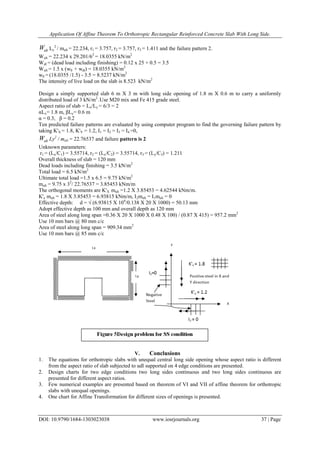
Analysis the safe uniformly distributed load on a rectangular two - way slab with longer side opening
supported two long edges continuous as shown in Fig. 4., for the following data.
A slab 9 m X 6 m with an opening size of 2.7 m X 1.8 m reinforced with 12 mm φ bars @ 110 mm c/c
perpendicular to long span and 10 mm φ bars @ 150 mm c/c perpendicular to long span is considered. Two
meshes are used one at top and the other at bottom. Thickness of the slab is 120 mm. The characteristic strength
of concrete is 20 MPa and steel is Fe 415. Calculate the intensity of live load on the slab. According to IS 456-
2000,
zAfm styult 87.0 , where   bdfAfdz cksty /1
Assuming Effective depth of slab in long span direction = 100 mm
Effective depth of slab in long span direction = 100 mm
Area of the steel perpendicular to long span = 1028.1575 mm2
Area of the steel perpendicular to long span = 523.5987 mm2
The ultimate moments in long and long span directions can be found using above expression.
Therefore mult parallel to long span = 29.201 kNm/m
mult parallel to long span = 16.850 kNm/m
For aspect ratio of slab r = 9/6 =1.5 and taking mult = 29.201 kNm/m, the orthogonal coefficients will be K'X =
0.577, K'Y = 1.0, I1 = I3 = 0, I2 = I4 = 1.0. With these orthogonal coefficients and for α = 0.3, β = 0.3, r = 9/6
=1.5; ten predicted failure patterns are evaluated by using computer program to find the governing failure
pattern and the final results are as follows.
Application Of Affine Theorem To Orthotropic Rectangular Reinforced Concrete Slab With Long Side.
DOI: 10.9790/1684-1303023038 www.iosrjournals.org 37 | Page
ultW Ly
2
/ mult = 22.234, r1 = 3.757, r2 = 3.757, r3 = 1.411 and the failure pattern 2.
Wult = 22.234 x 29.201/62
= 18.0355 kN/m2
Wdl = (dead load including finishing) = 0.12 x 25 + 0.5 = 3.5
Wult = 1.5 x (wll + wdl) = 18.0355 kN/m2
wll = (18.0355 /1.5) - 3.5 = 8.5237 kN/m2
The intensity of live load on the slab is 8.523 kN/m2
Design a simply supported slab 6 m X 3 m with long side opening of 1.8 m X 0.6 m to carry a uniformly
distributed load of 3 kN/m2
.Use M20 mix and Fe 415 grade steel.
Aspect ratio of slab = Lx/Ly = 6/3 = 2
αLx= 1.8 m, βLy= 0.6 m
α = 0.3, β = 0.2
Ten predicted failure patterns are evaluated by using computer program to find the governing failure pattern by
taking K'X = 1.8, K'Y = 1.2, I1 = I2 = I3 = I4 =0,
ultW Ly2
/ mult = 22.76537 and failure pattern is 2
Unknown parameters:
r1 = (Lx/C1) = 3.55714, r2 = (Lx/C2) = 3.55714, r3 = (Ly/C3) = 1.211
Overall thickness of slab = 120 mm
Dead loads including finishing = 3.5 kN/m2
Total load = 6.5 kN/m2
Ultimate total load =1.5 x 6.5 = 9.75 kN/m2
mult = 9.75 x 32
/ 22.76537 = 3.85453 kNm/m
The orthogonal moments are K'X mult =1.2 X 3.85453 = 4.62544 kNm/m.
K'y mult = 1.8 X 3.85453 = 6.93815 kNm/m, I2mult = I1mult = 0
Effective depth: d = √ (6.93815 X 10⁶
/0.138 X 20 X 1000) = 50.13 mm
Adopt effective depth as 100 mm and overall depth as 120 mm
Area of steel along long span =0.36 X 20 X 1000 X 0.48 X 100) / (0.87 X 415) = 957.2 mm2
Use 10 mm bars @ 80 mm c/c
Area of steel along long span = 909.34 mm2
Use 10 mm bars @ 85 mm c/c
V. Conclusions
1. The equations for orthotropic slabs with unequal central long side opening whose aspect ratio is different
from the aspect ratio of slab subjected to udl supported on 4 edge conditions are presented.
2. Design charts for two edge conditions two long sides continuous and two long sides continuous are
presented for different aspect ratios.
3. Few numerical examples are presented based on theorem of VI and VII of affine theorem for orthotropic
slabs with unequal openings.
4. One chart for Affine Transformation for different sizes of openings is presented.
Application Of Affine Theorem To Orthotropic Rectangular Reinforced Concrete Slab With Long Side.
DOI: 10.9790/1684-1303023038 www.iosrjournals.org 38 | Page
References
[1] Johansen, K.W., “Yield-Line Theory “, Cement and Concrete Association, London, 1962, pp. 181.
[2] Goli, H B. and Gesund, H., “Linearity in Limit State Design of Orthotropic Slabs” J. of Structural Division, ASCE,, Oct.1979,
Vol.105, No. ST10, pp.1901-1915.
[3] Rambabu, K. and Goli, H B. “Simplified approach to design orthogonal slabs using affine theorem”, Journal of Structural
Engineering, Chennai, India, Dec 2006-Jan 2007,Vol.33,No.5, pp.435-442.
[4] Islam, S. and Park, R., “Yield line analysis of two-way reinforced concrete slabs with openings”, The Structural Engineer, June
1971, Vol. 49, No. 6, pp. 269-275.
[5] Zaslavsky. Aron, Yield line analysis of rectangular slabs with central opening”, Proc. Of ACI, December 1967, Vol. No.64, pp.
838-844.
[6] Siva Rama Prasad, Ch., and Goli, H. B., “Limit State Coefficients for Orthogonal Slabs.” International Journal of Structural
Engineering, India, Jan-June 1987, Vol.7, No.1, pp. 93-111.
[7] Sudhakar, K.J., and Goli, H B., “Limit State Coefficients for Trapezoidal- Shaped Slabs Supported on Three Sides”, Journal of
Structural Engineering, Chennai, India, June-July 2005, Vol.32, No.2, pp.101-108.
[8] Veerendra Kumar and Milan Bandyopadhyay “ Yield line analysis of two way reinforced concrete slabs having two adjacent edges
discontinuous with openings” ,Journal of Structural Engineering, Chennai, India, June-July 2009,Vol.36,No.2, pp.82-99.
[9] “Indian Standard Plain and Reinforced Concrete-Code of Practice”, IS 456:2000, BIS New Delhi
Notations:
Continuous edge
Simply supported edge
Free edge
Negative yield line
CS A slab supported on all sides continuously (restrained)
I1 and I2 Negative moment coefficients in their corresponding directions
I1mult Negative ultimate yield moment per unit length provided by top tension
Reinforcement bars placed parallel to x-axis.
I2mult Negative ultimate yield moment per unit length provided by top tension
Reinforcement bars placed parallel to y-axis.
K1
xmult Positive ultimate yield moment per unit length provided by bottom tension
Bars placed parallel to X-axis
K1
ymult Positive ultimate yield moment per unit length provided by bottom tension
Bars placed parallel to Y-axis
K1
x
y
K
K
'
'
K2
yK
I
'
2
Lx, Ly Slab dimensions in X and Y directions respectively
mult Ultimate Yield moment per unit length of the slab
r Aspect ratio of slab defined by Lx/Ly.
r1, r2, r3, r4 Non dimensional parameters of yield line propagation
SS A slab simply supported on all sides
TLC A slab restrained on two long edges and other two sides simply supported
TSC A slab restrained on two long edges and other two sides simply supported
udl Uniformly Distributed Load
Wult Ultimate uniformly distributed load per unit area of slab.
α, β coefficients of opening in the slab
μ Coefficient of orthotropy
 
 2
1
IK
IK
y
x



'
'

F1303023038

  • 1.
    IOSR Journal ofMechanical and Civil Engineering (IOSR-JMCE) e-ISSN: 2278-1684,p-ISSN: 2320-334X, Volume 13, Issue 3, Ver. II (May- Jun. 2016), PP 30-38 www.iosrjournals.org DOI: 10.9790/1684-1303023038 www.iosrjournals.org 30 | Page Application of Affine Theorem to Orthotropic Rectangular Reinforced Concrete Slab with Long Side Opening Symmetric About Vertical Axis Dr.T.V.S. Vara Lakshmi1 , Prof. K. Rambabu2 , Prof. K. Srinivasa Rao3 1 (Department of Civil Engineering, University College of Engineering and Technology, Acharya Nagarjuna University, Guntur, Andhra Pradesh, India). 2(Department of Civil Engineering, College of Engineering, Andhra University, Visakhapatnam, Andhra Pradesh, India). 3(Department of Civil Engineering ,College of Engineering, Andhra University, Visakhapatnam, Andhra Pradesh, India). Abstract: An attempt has been made to apply affinity theorem to determine collapse load of two-way orthotropic slab with long side opening symmetric to vertical axis. Keeping in view the basic principles of yield line theory, all possible admissible yield line patterns for Continuous Slab (CS), Simply Supported Slab (SS), Two Short Sides Continuous Slab (TSC), and Two Long Sides Continuous Slab (TLC) are considered for the given configuration of the slab subjected to uniformly distributed load (udl). A computer program has been developed to solve the virtual work equations. Illustration of above methodology has been brought out with numerical examples. Relevant tables for given data and the governing admissible failure patterns of the slab for different sizes of openings are presented using affine theorem. In this paper, authors also present the transformation of orthotropic slab into an equivalent isotropic slab using affine theorem. A slab with longer side opening is used. Here aspect ratio of opening is quite different from that of slab. Keywords: aspect ratio, long side opening, configuration, affinity theorem, orthotropic slab, uniformly distributed load, ultimate load and ultimate moment. I. Introduction Openings in slabs are usually required for plumbing, fire protection pipes, heat and ventilation ducts and air conditioning. Larger openings that could amount to the elimination of a large area within a slab panel are sometimes required for stairs and elevators shafts. For newly constructed slabs, the locations and sizes of the required openings are usually predetermined in the early stages of design and are accommodated accordingly. Such two way slabs subjected to uniformly distributed load and supported on various edge conditions are being analyzed by using yield-line method as suggested by Johansen, K.W1 . Many researchers (Goli, H.B. and Gesund,H.2 , Rambabu, K. and Gloi,H.B.3 , Islam,S. and Park,R.4 , Zaslavsky.Aron5 , Siva Rama Prasad, Ch and Goli,H.B.6 , Sudhakar, K.J. and Goli,H.B.7 , Veerendra Kumar and Milan Bandyopadhya8 ) adopted the yield-line analysis and virtual work method in deriving the virtual work equations of the rectangular reinforced concrete solid slabs subjected to uniformly distributed load and supported on various edge conditions. Johansen, K.W1 , also presented the analysis of orthogonal solid slabs implicitly to that of an equivalent Isotropic Slab by using “Affine Theorem” provided the ratio of negative to positive moments is same in orthogonal directions. Various design charts are presented for Two-way slabs with longer side opening subjected to uniformly distributed load for different edge conditions. Islam,S. and Park,R.4 presented design charts for CS and SS slabs with equal openings, i.e. ratio of openings and aspect ratio are same. II. Methodology The method of determining collapse loads based on principle of virtual work has proved to be a powerful tool for a structural engineer, despite it gives an upper bound value. The work equations are formed by equating the energy absorbed by yield lines and the work done by the external load of the orthogonal rectangular slab with long side openings where a small virtual displacement is given to the slab. The same principle was also used by Islam,S. and Park,R.4 in their paper. In other words, the work equation is given by       0,0,, xmymdxdyyxW yyultxxultult  --------------------(1) where Wult is the ultimate load per unit area of slab, δ(x,y) is the virtual displacement in the direction of the loading at the element of area of dimensions dx, dy, mult,x and mult,y are the yield moments per unit width in the x and y directions, өx and өy are the components of the virtual rotation of the slab segments in the x and y directions and x0 and y0 are the projected length of the yield lines in x and y directions of slab. The equation (1) contains terms
  • 2.
    Application Of AffineTheorem To Orthotropic Rectangular Reinforced Concrete Slab With Long Side. DOI: 10.9790/1684-1303023038 www.iosrjournals.org 31 | Page C1, C2, C3 and C4 which define the positions of the node points of the yield lines. The values of C1, C2, C3 and C4 to be used in the equation are those which give the minimum load to cause failure. A computer program has been written to find the minimum values of C1, C2, C3 and C4 (in terms of r1, r2, r3 and r4) which in turn will give the minimum load carrying capacity of the slab. For definitions of various parameters refer notations. Johansen1 has proved that the yield line theory is an upper bound method, so care has been taken to examine all the possible yield line patterns for each boundary (4 edge‟s) condition of slab to ensure that the most critical collapse mode is considered otherwise the load carrying capacity of the slab will be overestimated. III. Formulation Of Virtual Work Equations There are several possible yield line patterns associated with different edge conditions of the slab. For four edge condition of slab, the possible admissible failure yield line patterns are only ten for CS, SS, TSC and TLC edge conditions. These admissible failure yield line patterns are obtained basing on the yield line principle (Johansen. K.W1 ). For the given configuration of the slab, these ten failure patterns and corresponding equations have been investigated depending upon the edge condition of the slab using a computer program. The orthogonal reinforced rectangular slab having long side opening with the given configuration and the yield criteria are shown in notations. The slab is subjected to uniformly distributed load (Wult) and supported on different boundary conditions. Note that the slab is not carrying any load over the area of the opening. The virtual work equations are derived for the predicted possible admissible failure yield line patterns using the virtual work equation for continuous edge (CS) condition of slab. To get the equations for other edge conditions of the slab, modification should be carried out in the numerators of the equations of each failure patterns. For SS slab I1=I2=0, for TSC slab I2=0, for TLC slab I1=0. IV. Virtual Work Equations For Continuous Slab (CS) Ten possible failure patterns are predicted for Continuous Slab (CS), Simply Supported Slab (SS), Two Long Sides Continuous Slab (TSC) and Two Long Sides Continuous Slab (TLC) and four edge conditions of the slab. Some of the governing failure pattern for different edge conditions and for different data is presented in Table-1. Considering the failure Pattern-1of a continuous slab. Three unknown dimensions C1, C2, & C3 are necessary to define the yield line propagation completely. The remaining failure patterns are as shown in Fig.2. Table 1: Governing failure patterns for different data for four edge conditions Edge Cond. CS TLC TSC SS Edge Cond. CS TLC TSC SS Failure Pattern Failure Pattern 1 α=0.2 β=0.3 r=1.8 α=0.2 β=0.1 r=1.4 α=0.4 β=0.2 r=1.3 α=0.3 β=0.1 r=1.4 6 α=0.2 β=0.1 r=1.3 α=0.4 β=0.1 r=1.2 α=0.3 β=0.1 r=1.2 α=0.4 β=0.1 r=1.0 2 α=0.1 β=0.5 r# =1.7 α=0.1 β=0.6 r=1.8 α=0.2 β=0.4 r* =1.9 α=0.2 β=0.3 r=1.9 7 α=0.3 β=0.5 r=1.1 α=0.1 β=0.4 r=1.2 α=0.3 β=0.5 r=1.0 α=0.1 β=0.4 r=1.0 3 α=0.6 β=0.5 r=1.9 α=0.3 β=0.4 r=1.5 α=0.6 β=0.6 r=2.0 α=0.3 β=0.4 r=1.6 8 α=0.1 β=0.6 r=1.4 α=0.1 β=0.6 r=1.5 4 α=0.5 β=0.5 r=1.4 α=0.5 β=0.1 r=1.3 α=0.5 β=0.3 r=1.6 α=0.5 β=0.2 r=1.6 9 α=0.5 β=0.6 r=1.2 α=0.6 β=0.6 r=1.1 α=0.4 β=0.5 r=1.2 α=0.4 β=0.5 r=1.0 5 α=0.5 β=0.3 r# =1.7 α=0.6 β=0.2 r=1.9 10 α=0.6 β=0.2 r=1.2 α=0.6 β=0.3 r=1.5 α=0.6 β=0.2 r=1.3 α=0.5 β=0.3 r=1.1 K‟x=0.5 K‟y=0.5 I1=1.3 I2=0.7 K‟x=1.8 K‟y=0.3 I1=0.0 I2=0.9 K‟x=0.4 K‟y=1.6 I1=2.0 I2=0.0 K‟x=2.0 K‟y=2.0 I1=0.0 I2=0.0 K‟x=0.5 K‟y=0.5 I1=1.3 I2=0.7 K‟x=1.8 K‟y=0.3 I1=0.0 I2=0.9 K‟x=0.4 K‟y=1.6 I1=2.0 I2=0.0 K‟x=2.0 K‟y=2.0 I1=0.0 I2=0.0 Orthogonal coefficients for CS pattern-2 # K1 x=0.6,K‟y=1.0,I1=1.0,I2=1.4 Orthogonal coefficients for TLC pattern-2 * K1 x =1.2,K‟y=0.6,I1=0.0,I2=1.2
  • 3.
    Application Of AffineTheorem To Orthotropic Rectangular Reinforced Concrete Slab With Long Side. DOI: 10.9790/1684-1303023038 www.iosrjournals.org 32 | Page Fig 2 Patterns from 2 to 10 of a continuous slab Virtual Work Equations For Continuous Slab (CS) External Work Done by Segment „A‟: 1 YXultult 1Y 6r LLW 3 WCL 2 1  External Work Done by Segment „B‟:   32 1 232 1 3232131 www ultult X ult CCCCCLCC                32313 323231331 3 1 3 1 2 1 6 1 3 1 2 1 2 1 6 1 rrrrr LL rrrrrrrrr LL YXult YXult w w External Work Done by Segment „C‟: 2 2 632 1 r LL CL YXultult Y ww  External Work Done by Segment
  • 4.
    Application Of AffineTheorem To Orthotropic Rectangular Reinforced Concrete Slab With Long Side. DOI: 10.9790/1684-1303023038 www.iosrjournals.org 33 | Page „D‟:         w www ult Y Y YX ult Y ult YX ult Y CL L LLCLCCLCCLCLC 3 3232131 2 32 1 232 1                                123 1 3 1 2 1 3 3 2 32 3 31 3 3 3 r r rr r rr r r r LL YXultw  Total Work Done: work done by the segments (A+B+C+D)                      123 1 3 1 2 1 6 1 3 1 3 1 2 1 6 1 3 3 2 32 3 31 3 3 3 2323131 r r rr r rr r r r rrrrrrr LL YXultw           126 1 6 1 2 1 3 3 2 21 2 r r rr rLYultw  Energy Absorbed By Yield Lines      3 4 32 3 23 2 31 1 1 CL LL mI CL L mK C L mI C L mK C L mI C L mK C L mI C L mK Y XX Y X Y yy X XX Y yy X                              1 1 1 3 3 4 3 32 332 1 1 r rr I r rr K r r IKrrIK r r IKm YXYX  Equating total work done by the segments to the energy absorbed by yield line we get Equation-1 for failure pattern-1 Equation-1 for Failure Pattern-1:                            126 1 6 1 2 1 1 1 1 3 3 2 21 3 3 4 3 32 332 1 1 2 r r rr r r rr I r rr K r r IKrrIK r r IK YXYX ult yult m LW   Equation-2 for Failure Pattern-2:                                2 r1 r6 1 r6 1 2 1 r 1r 1rr IK r r IKrrI1rrK r r IK L 3 2 21 3 3 4Y 2 3X323Y 1 1X ult 2 yult m W Equation-3 for Failure Pattern-3:                                                      2 1 48 1 48 1 8 1 8 1 1 1 2 1 1 2 1 2 3 32 2 32 1 2 2 2 1 3 3 4 2 3 2 2 32 1 1 2 1 2     rrrrr r r rr IK r r I r r KrrIK r r I r r K L YXYX ult yult m W Equation-4 for Failure Pattern-4:                                                                                                     2 2 2 1 3 3 3 2 3 21 32 3 2 21 3 3 4Y 2 3 3 322 X 32 2 3 1 3 3Y 1 1 3 3 2 11 X ult 2 yult rr r48 11r 2 1r r 1 r 1 6 1r 8 1 rrr 1r 1rr IK r r I r2 11rr 1 r r K rrI r 1r r 1r rrK r r I r2 11rr 1 r r K L m W Equation-5 for Failure Pattern-5:                                                                                                                      3 3 3 2 2 3 3 3 2 1 3 2 3 2 2 2 1 2 32 2 3 3 2 31 2 3 3 21 3 3 4 32 3 31 3 3 3 Y 2 3 3 322 X32Y 1 1 3 311 X ult 2 yult 48r α11rr 48r α11rr 1r2 r 8 α1 8 α1 16 r 16 r 6r 1 - 6r 1 - 2 1 r 1r α1rr I 1rr βr 1rr βr α11 1r rr K r r I 2r α11rr β1 r r KrrIK r r I 2r α11rr β1 r r K L m W   r r rrrr
  • 5.
    Application Of AffineTheorem To Orthotropic Rectangular Reinforced Concrete Slab With Long Side. DOI: 10.9790/1684-1303023038 www.iosrjournals.org 34 | Page Equation-6 for Failure Pattern-6:                      2 rαβ 6r 1 6r 1 2 1 r α1rrIrrK 1rr r IKrrIK r r IK L 4 2 43 444Y 1 1 3X32Y 1 1X ult 2 yult m W Equation-7 for Failure Pattern-7:                                                                                                  2 1414 2 1 1 14 1 1 1 4 ult 148r 3α-12 1 1-r8 2α-1 1 48r 3α1 1 8 2α1 1 3 6r 1 - 2 -1 r α1 4 rr 4 I y K 13 I 12 1 1 1x K 3 rr 2 I y K r 1 r 1 I 2 1 11 r 1 r x K 2 y L m W r rrrr rr r rr r rr r r r ult      Equation-8 for Failure Pattern-8:                                                                                                              2 1 148r 3α-12 1 148r 3α-12 1 48r 3α1 1 48r 3α1 1 1 1 8 2α1 1r α1 4 rr 4 I y K 13 I 12 1 12 1 1x K 3 rr 2 I1 3 rr y K r 1 r 1 I 2 1 1 2 1 1 r 1 r x K 2 y L 2 3 2 14 2 134 2 3 22 1 1 14 1 13 1 1 1 34 ult m W     r r r r rrr r r rr r rr r rr r rr r r r r r ult Equation-9 for Failure Pattern-9:                                                                                           2 14 32 1 4 32 1 32 3 1 22 1 2 3 44Y 1 1 3 14 1 1 1 X32 1 13 1 3 3Y 1 1 1 4 1 X ult 2 yult 1r48r -1r 48r -1r 6 -1r 1-r8 -1r 2 -1r r α1rrIK 1rr r I 1r2 1 1 1rr r KI 111 rrK r r I r r 2 1 1K L m W      r r rr r rr r r r r Equation-10 for Failure Pattern-10:                                                                                            2148r 3α-12 1 48r 3α1 1 1 1 8 2α1 1 66r 1 6 1 - 2 1 r α1 4 rr 4 I11 4 rr y K 13 I 12 1 1 1x K 3 rr 2 I y K r 1 r 1 I 2 1 11 r 1 r x K 2 y L 4 2 2 144 22 2 4 3 43 4 1 1 14 1 1 1 4 ult m W r r rr r rr r r rr r rr r rr r r r ult       The respective equations for corresponding failure patterns can be obtained for other edge conditions (CS, SS, TSC, TLC) by making respective negative yield lines zero. Minimization of the Virtual Work Equations The value ult yult m LW 2 of these equations consist of the unknown non dimensional parameters r1, r2, r3 and r4 which define the positions of the yield lines. A computer program has been developed for various values of the non dimensional parameters r1, r2, r3 and r4 within their allowable ranges in order to find the minimum value of ult yult m LW 2 for the yield line failure patterns considered. In this computer program, the values of r1, r2, r3 and r4 were varied at increments of 0.1. Using the above equations, one can develop useful charts basing on orthogonality which may be used either for design or analysis in general. The governing failure patterns for different data and edge conditions of the slab are presented in Table 1.
  • 6.
    Application Of AffineTheorem To Orthotropic Rectangular Reinforced Concrete Slab With Long Side. DOI: 10.9790/1684-1303023038 www.iosrjournals.org 35 | Page EXAMPLE: Continuous Slab (CS) (Negative moment to positive moment ratio in both directions is same and unity) Transform an orthotropic slab to an equivalent Isotropic Slab in which the ratio of Negative moment to positive moment in both directions is same and unity using affine theorem. Since 0121 .'KI'KI yx  , the transformation of the given orthotropic slab (Fig.11a)) in X – direction is transformed to an equivalent isotropic slab (Fig.11 (b)) by dividing with  . This principle is illustrated in Fig.11 using the above methodology. Few numerical examples are presented in Table 2. Table 2: Numerical examples based on Theorem’s VI & VII of Johansen3 for CS condition Example (CS) Orthogonal Moment Coefficients Aspect Ratio (r) Strength WultLy 2 /mult Aspect Ratio (r*)Sl. No. Openings 1 α=0.5,β=0.6 K'x =0.25, K'y =1.0 I1= I3= 0.25, I2= I4= 1.0, µ=0.25, ∑K =2.25 1.0 30.20383 2.0 2 α=0.4,β=0.6 K'x =0.5, K'y =1.0 I1= I3= 0.5, I2= I4= 1.0, µ=0.5, ∑K =2.5 1.4 29.81401 1.98 3 α=0.3,β=0.5 K'x =0.667, K'y =1.0, I1= I3= 0.667, I2= I4= 1.0, µ=0.667, ∑K =3.33 1.6 28.03296 1.959 4 α=0.2,β=0.5 K'x =1.0, K'y =1.0, I1= I3= 1.0, I2= I4= 1.0, µ=1.0, ∑K =4.0 1.3 38.76392 1.3 5 α=0.3,β=0.6 K'x =1.5, K'y =1.0, I1= I3= 1.5, I2= I4= 1.0, µ=1.5, ∑K =5.0 1.9 35.4455 1.551 6 α=0.2,β=0.6 K'x =2.0, K'y =1.0, I1= I3= 2.0, I2= I4= 1.0, µ=2.0, ∑K =6.0 1.7 42.76975 1.202 NOTE: 1. r*: equivalent isotropic slab aspect ratio, 2. I1/ K'x = I2/ K'y = 1.0 Note: In the case of SS, TLC and TSC edge conditions of the slab; the affine theorem cannot be applied because the negative moment is not present along one of the edges of the given slab. Therefore one can design the slab as orthotropic using any available computer program. I4m I1m I2m I3m LY=10 LX=14 I4m I1m I2m I3m LY=10 LX=19.7989 Figure: 3(A) Orthotropic slab for CS condition Figure: 3(B) Equivalent isotropic slab for CS condition K'X = I1= I3 = 0.5, K'Y = I2 = I4 =1.0, α = 0.4, β = 0.6, I1/K'X = I2/K'Y = 1.0, µ = 0.5, r = LX/LY = 14/10 = 1.4, ∑K = 3 In order to check on affine theorem a computer program is used to evaluate the value of WultLY 2 /mult and the value is 29.81401. As per affine theorem, the transformed K'X = I1 = I3 =K'Y = I2 = I4 =1.0, α = 0.4, β = 0.6, LX = LX/√µ = 14/√0.5 = 19.7989 m, r = 19.7989/10 = 1.9798, µ = 1.0, ∑K = 4, the value of WultL y 2 /m ult is obtained from Graph 4.1 for r = 1.9798.Taking this value one can design the given orthotropic slab without using computer program.
  • 7.
    Application Of AffineTheorem To Orthotropic Rectangular Reinforced Concrete Slab With Long Side. DOI: 10.9790/1684-1303023038 www.iosrjournals.org 36 | Page Table 3 shows strength and failure pattern for continuous slab (CS) based on the principle μ =r2 for different values of coefficient of orthotropy(μ) and their corresponding orthogonal affine moment coefficients. Table 3: Continuous slab (CS), based on the principle µ=r2 Analysis the safe uniformly distributed load on a rectangular two - way slab with longer side opening supported two long edges continuous as shown in Fig. 4., for the following data. A slab 9 m X 6 m with an opening size of 2.7 m X 1.8 m reinforced with 12 mm φ bars @ 110 mm c/c perpendicular to long span and 10 mm φ bars @ 150 mm c/c perpendicular to long span is considered. Two meshes are used one at top and the other at bottom. Thickness of the slab is 120 mm. The characteristic strength of concrete is 20 MPa and steel is Fe 415. Calculate the intensity of live load on the slab. According to IS 456- 2000, zAfm styult 87.0 , where   bdfAfdz cksty /1 Assuming Effective depth of slab in long span direction = 100 mm Effective depth of slab in long span direction = 100 mm Area of the steel perpendicular to long span = 1028.1575 mm2 Area of the steel perpendicular to long span = 523.5987 mm2 The ultimate moments in long and long span directions can be found using above expression. Therefore mult parallel to long span = 29.201 kNm/m mult parallel to long span = 16.850 kNm/m For aspect ratio of slab r = 9/6 =1.5 and taking mult = 29.201 kNm/m, the orthogonal coefficients will be K'X = 0.577, K'Y = 1.0, I1 = I3 = 0, I2 = I4 = 1.0. With these orthogonal coefficients and for α = 0.3, β = 0.3, r = 9/6 =1.5; ten predicted failure patterns are evaluated by using computer program to find the governing failure pattern and the final results are as follows.
  • 8.
    Application Of AffineTheorem To Orthotropic Rectangular Reinforced Concrete Slab With Long Side. DOI: 10.9790/1684-1303023038 www.iosrjournals.org 37 | Page ultW Ly 2 / mult = 22.234, r1 = 3.757, r2 = 3.757, r3 = 1.411 and the failure pattern 2. Wult = 22.234 x 29.201/62 = 18.0355 kN/m2 Wdl = (dead load including finishing) = 0.12 x 25 + 0.5 = 3.5 Wult = 1.5 x (wll + wdl) = 18.0355 kN/m2 wll = (18.0355 /1.5) - 3.5 = 8.5237 kN/m2 The intensity of live load on the slab is 8.523 kN/m2 Design a simply supported slab 6 m X 3 m with long side opening of 1.8 m X 0.6 m to carry a uniformly distributed load of 3 kN/m2 .Use M20 mix and Fe 415 grade steel. Aspect ratio of slab = Lx/Ly = 6/3 = 2 αLx= 1.8 m, βLy= 0.6 m α = 0.3, β = 0.2 Ten predicted failure patterns are evaluated by using computer program to find the governing failure pattern by taking K'X = 1.8, K'Y = 1.2, I1 = I2 = I3 = I4 =0, ultW Ly2 / mult = 22.76537 and failure pattern is 2 Unknown parameters: r1 = (Lx/C1) = 3.55714, r2 = (Lx/C2) = 3.55714, r3 = (Ly/C3) = 1.211 Overall thickness of slab = 120 mm Dead loads including finishing = 3.5 kN/m2 Total load = 6.5 kN/m2 Ultimate total load =1.5 x 6.5 = 9.75 kN/m2 mult = 9.75 x 32 / 22.76537 = 3.85453 kNm/m The orthogonal moments are K'X mult =1.2 X 3.85453 = 4.62544 kNm/m. K'y mult = 1.8 X 3.85453 = 6.93815 kNm/m, I2mult = I1mult = 0 Effective depth: d = √ (6.93815 X 10⁶ /0.138 X 20 X 1000) = 50.13 mm Adopt effective depth as 100 mm and overall depth as 120 mm Area of steel along long span =0.36 X 20 X 1000 X 0.48 X 100) / (0.87 X 415) = 957.2 mm2 Use 10 mm bars @ 80 mm c/c Area of steel along long span = 909.34 mm2 Use 10 mm bars @ 85 mm c/c V. Conclusions 1. The equations for orthotropic slabs with unequal central long side opening whose aspect ratio is different from the aspect ratio of slab subjected to udl supported on 4 edge conditions are presented. 2. Design charts for two edge conditions two long sides continuous and two long sides continuous are presented for different aspect ratios. 3. Few numerical examples are presented based on theorem of VI and VII of affine theorem for orthotropic slabs with unequal openings. 4. One chart for Affine Transformation for different sizes of openings is presented.
  • 9.
    Application Of AffineTheorem To Orthotropic Rectangular Reinforced Concrete Slab With Long Side. DOI: 10.9790/1684-1303023038 www.iosrjournals.org 38 | Page References [1] Johansen, K.W., “Yield-Line Theory “, Cement and Concrete Association, London, 1962, pp. 181. [2] Goli, H B. and Gesund, H., “Linearity in Limit State Design of Orthotropic Slabs” J. of Structural Division, ASCE,, Oct.1979, Vol.105, No. ST10, pp.1901-1915. [3] Rambabu, K. and Goli, H B. “Simplified approach to design orthogonal slabs using affine theorem”, Journal of Structural Engineering, Chennai, India, Dec 2006-Jan 2007,Vol.33,No.5, pp.435-442. [4] Islam, S. and Park, R., “Yield line analysis of two-way reinforced concrete slabs with openings”, The Structural Engineer, June 1971, Vol. 49, No. 6, pp. 269-275. [5] Zaslavsky. Aron, Yield line analysis of rectangular slabs with central opening”, Proc. Of ACI, December 1967, Vol. No.64, pp. 838-844. [6] Siva Rama Prasad, Ch., and Goli, H. B., “Limit State Coefficients for Orthogonal Slabs.” International Journal of Structural Engineering, India, Jan-June 1987, Vol.7, No.1, pp. 93-111. [7] Sudhakar, K.J., and Goli, H B., “Limit State Coefficients for Trapezoidal- Shaped Slabs Supported on Three Sides”, Journal of Structural Engineering, Chennai, India, June-July 2005, Vol.32, No.2, pp.101-108. [8] Veerendra Kumar and Milan Bandyopadhyay “ Yield line analysis of two way reinforced concrete slabs having two adjacent edges discontinuous with openings” ,Journal of Structural Engineering, Chennai, India, June-July 2009,Vol.36,No.2, pp.82-99. [9] “Indian Standard Plain and Reinforced Concrete-Code of Practice”, IS 456:2000, BIS New Delhi Notations: Continuous edge Simply supported edge Free edge Negative yield line CS A slab supported on all sides continuously (restrained) I1 and I2 Negative moment coefficients in their corresponding directions I1mult Negative ultimate yield moment per unit length provided by top tension Reinforcement bars placed parallel to x-axis. I2mult Negative ultimate yield moment per unit length provided by top tension Reinforcement bars placed parallel to y-axis. K1 xmult Positive ultimate yield moment per unit length provided by bottom tension Bars placed parallel to X-axis K1 ymult Positive ultimate yield moment per unit length provided by bottom tension Bars placed parallel to Y-axis K1 x y K K ' ' K2 yK I ' 2 Lx, Ly Slab dimensions in X and Y directions respectively mult Ultimate Yield moment per unit length of the slab r Aspect ratio of slab defined by Lx/Ly. r1, r2, r3, r4 Non dimensional parameters of yield line propagation SS A slab simply supported on all sides TLC A slab restrained on two long edges and other two sides simply supported TSC A slab restrained on two long edges and other two sides simply supported udl Uniformly Distributed Load Wult Ultimate uniformly distributed load per unit area of slab. α, β coefficients of opening in the slab μ Coefficient of orthotropy    2 1 IK IK y x    ' '