International Research Journal of Engineering and Technology (IRJET) e-ISSN: 2395-0056
Volume: 04 Issue: 10 | Oct -2017 www.irjet.net p-ISSN: 2395-0072
© 2017, IRJET | Impact Factor value: 5.181 | ISO 9001:2008 Certified Journal | Page 399
PERFORMANCE OF CONCRETE BY USING STEEL FIBRE
An Experimental Study
Er. Niranjan Luhania
1
, Er. Nidhish Goswami 2, Dr. Bharat Nagar
3
1M.Tech Scholar, Jagannath University, jaipur, Rajasthan, India
2Asst Professor, Department of Civil Engg, Jagannath University, jaipur, Rajasthan, India
3 H.O.D, Department of civil engineering, jagannath university, jaipur, Rajasthan, India
---------------------------------------------------------------------***---------------------------------------------------------------------
Abstract - The purpose of this research is based on the
investigation of the use of steel fibres in structural concrete
to enhance the mechanical properties of concrete. The
objective of the study was to determine and compare the
differences in properties of concrete containing without
fibres and concrete with fibres. This investigation was
carried out using several tests, compressive test and flexural
test. A total of eleven mix batches of concrete containing 0%
to 5% with an interval of 1% by wt. of cement. ‘Hooked’ steel
fibres were tested to determine the enhancement of
mechanical properties of concrete. The workability of
concrete significantly reduced as the fibre dosage rate
increases.
Key Words: Steel Fibre , Compressive test, Hooked
Steel Fibre, Flexural test, Spliting tensile strength.
1. INTRODUCTION
Concrete is mostly wide construction material in the world
due to its ability it can be mould and shape. However
concrete has some deficiencies as listed below, Low tensile
strength, Low post cracking capacity, Brittleness and low
ductility, Limited fatigue life, not capable of
accommodating large deformations, Low impact strength.
These properties can be improved by the use of steel fiber
reinforced concrete. The fibers are dispersed and
distributed randomly in the concrete during mixing, and
thus improve concrete properties in all directions. The
fiber helps to arresting the internal widening cracks and
fly ash helps as an admixture for improving the properties
of concrete. The introduction of the paper should explain
the nature of the problem, previous work, purpose, and
the contribution of the paper. The contents of each section
may be provided to understand easily about the paper.
Sample paragraph, The entire document should be in
cambria font. Type 3 fonts must not be used. Other font
types may be used if needed for special purposes. The
entire document should be in cambria font. Type 3 fonts
must not be used. Other font types may be used if needed
for special purposes.
2. LITERATURE SURVEY
Ganeshan N et al, (2007)[1] „steel fibre reinforced
high performance concrete for seismic resistant
structure‟ Civil Engineering and construction.
They had investigate a series of compression tests were
conducted on 150mm x 150mm x 150mm cubes, 150mm x
300mm cylinders to find compressive strength, static and
dynamic modulus of elasticity with and without steel
fibers of volume fractions 0%, 0.5%, 1%, 1.5% of 0.5mm
dia of aspect ratio 60 on PPC concrete. The weight density
of concrete increasing with increasing of steel fibre
content. Compressive strength and modulus of elasticity
increased with addition of steel fibers. The compressive
strength increased with the increase in silica fume with
normal concrete. As a result the incorporation of steel
fibers, silica fume and cement as produced a strong
composite with superior crack resistance, improved
ductility and strength behaviour prior to loading.
Bhikshma V, Ravande Kishor and Nitturkar (2005)
[2],” Mechanical properties of fibre reinforced high
strength concrete „Recent advances in concrete and
construction tech.
They had studied the effect of fibers on workability,
compressive strength, split tensile strength, modulus of
rupture of concrete and also studied the effect of fibers on
impact and toughness of concrete. They investigated an
experimental study were steel fibers added at the volume
of 0.5%, 1%, 1.5%, 2%.. They draw the following
conclusions: Due to high content of fibre, large surface
area of fibers, fibers are sure to absorb more cement paste
and increase of viscosity of mixture makes slump loss. The
compressive strength increased from 6% to 17% with the
increase of volume fraction of fibers. The split tensile
strength increased from 18% to 47% with the increase of
volume fraction of fibers. Flexural strength increased from
22% to 63% with the increase of volume fraction of fibers.
Modulus of elasticity increased from 8% to 25% with the
increase of volume fraction of fibers. Toughness increased
by 19.27% with the increase of volume fraction of fibers
when compared to plain concrete.
International Research Journal of Engineering and Technology (IRJET) e-ISSN: 2395-0056
Volume: 04 Issue: 10 | Oct -2017 www.irjet.net p-ISSN: 2395-0072
© 2017, IRJET | Impact Factor value: 5.181 | ISO 9001:2008 Certified Journal | Page 400
3. EXPERIMENTAL INVESTIGATION
Materials: Ordinary Portland Cement (OPC) of 43 grade
J.K. Cement was used throughout the course of
investigation. Specific gravity of this cement is 3.15.
Table -3.1: Properties of Cement
Sl. No Property Result
1. Normal Consistency 32%
2. Initial Setting time 30 mins
3. Specific Gravity 3.15
4. Fineness of cement 95%
Fine Aggregate
Natural sand used Specific gravity was2.50,sieve analysis=
III zone Natural sand as per IS: 383-1987 was used. Locally
available River sand having bulk density 1860 kg/m
3
was
used The properties of fine aggregate are shown in Tab 3.2
Table 3.2: Properties of fine aggregate
Coarse Aggeragate
Natural coarse aggregates were obtained from Gunawata
(Rajasthan). Specific gravity of these aggregates were2.8.
Crushed aggregate confirming to IS: 383-1987 was used.
Aggregates of size 20mm and 12.5 mm of specific gravity
2.74 and fineness modulus 7.20 were used
Super Plasticizer
There are different type of chemical admixture which are
being used in construction and they may be retarding
admixture, accelerating admixture, water reducing
admixture, air-entraining admixture, Super plasticizing
admixture and retarding super plasticizing admixture but
because of higher grade of concrete water reducing super
plasticizer (workability aid) has been used here in this
thesis work i.e. naphtha based as per IS 9103:1999.The
super plasticizer which is used for the experimental
performance is KavassuPlast SP-431/ Shaliplast SP-431.
It was advised by the manufacturer to shakeit well before
use.
Brand of Admixure: Shalimar and Kavassu Brand
Product Description: ShaliplastSP-431/KavassuPlast SP-
431
Product Form : Black Brown liquid
KavassuPlast SP-431/Shaliplast SP-431 is a chloride free
super-plasticizer & water reducing agent for concrete. It
has high workability to flow for concrete mixes so that the
voids can be filled by the concrete slurry even with very
less amount of compaction. The properties of super
plasticizer are shown in Table 3.3.
Table - 3.3: Properties of super plasticizer
Specific Gravity 1.20 – 1.5
Chloride content NIL
Air entrainment approximately 1% additional air is
entrained
*As per manufacturers manual
4. Mix Proportioning
Concrete mix design in this experiment was designed as
per the guidelines specified in ACI234R – 96 .All the
samples were prepared using design mix. M35 grade of
concrete was used for the present investigation. Mix design
was done based on I.S 10262-1982. The Table 4.1 shows
mix proportion of concrete (Kg)
Table 4.1: Mix Proportioning
Sl. No Material
Quantity(kg) (Kg/m
3
)
1. Cement (OPC) 405
2. Fine Aggregate 660
3. Coarse Aggregate 1122
4. Water 162
Table - 4.2 Mix Proportions for (M35) Grade for steel fiber
S.
N
o.
%
Steel
Fibre
W/C
Rati
o
Mix Proportion (Kg/M3)
Ceme
nt
San
d
Agg(20m
m)
Agg(10m
m)
Wate
r
1 0 0.40 405 660 429 393 162
2 1.0 0.40 400.9
5
660 429 393 162
3 2.0 0.40 396.9 660 429 393 162
4 3.0 0.40 392.8
5
660 429 393 162
5 4.0 0.40 388.8 660 429 393 162
6 5.0 0.40 284.7
5
660 429 393 162
Super plastisizer is used in Mixed design is 1.26% of cement.
S. No Property Result
1. Specific Gravity 2.50
2. Fineness modulus 2.28
3. Grading zone III
International Research Journal of Engineering and Technology (IRJET) e-ISSN: 2395-0056
Volume: 04 Issue: 10 | Oct -2017 www.irjet.net p-ISSN: 2395-0072
© 2017, IRJET | Impact Factor value: 5.181 | ISO 9001:2008 Certified Journal | Page 401
Table - 4.3: Cube of Size (150x150x150) for % SFRC
S.N
o.
%
Ste
el
Fib
re
W/
C
Rat
io
Mix Proportion (Kg)
Steel
Fibre
Cem
ent
San
d
Agg(20
mm)
Agg(10
mm)
Wat
er
1 0 0.4
0
0 1.36
7
2.2
28
2.734 1.326 0.54
68
2 1 0.4
0
0.013
67
1.35
33
2.2
28
2.734 1.326 0.54
68
3 2 0.4
0
0.027
34
1.33
96
2.2
28
2.734 1.326 0.54
68
4 3 0.4
0
0.041
0
1.32
59
2.2
28
2.734 1.326 0.54
68
5 4 0.4
0
0.054
68
1.31
23
2.2
28
2.734 1.326 0.54
68
6 5 0.4
0
0.068
35
1.29
86
2.2
28
2.734 1.326 0.54
68
Super plastisizer is used in Mixed design is 1.26% of cement = 0.0169 kg
5. Experimental methodology
Compressive strength test:
For compressive strength test, cube specimens of
dimensions 150 x 150 x 150 mm were cast for M35 grade
of concrete. Superplasticized (1.26% by weight of cement)
was added to this. The moulds were filled with 0%, 1%
2%, 3%, 4% and 5% steel fibres. Vibration was given to
the moulds using table vibrator. The top surface of the
specimen was levelled and finished. After 24 hours the
specimens were demoulded and were transferred to
curing tank where in they were allowed to cure for 28
days. After 28 days curing, these cubes were tested on
digital compression testing machine as per I.S. 516-1959.
The failure load was noted. In each category three cubes
were tested and their average value is reported. The
compressive strength was calculated as follows.
Compressive strength (MPa) = Failure load / cross
sectional area.
Table - 5.1: Compression Strength of Cube on M35 for 7
and 28 days.
% of Steel
fiber
7 days (N/mm2) 28 days
(N/mm2)
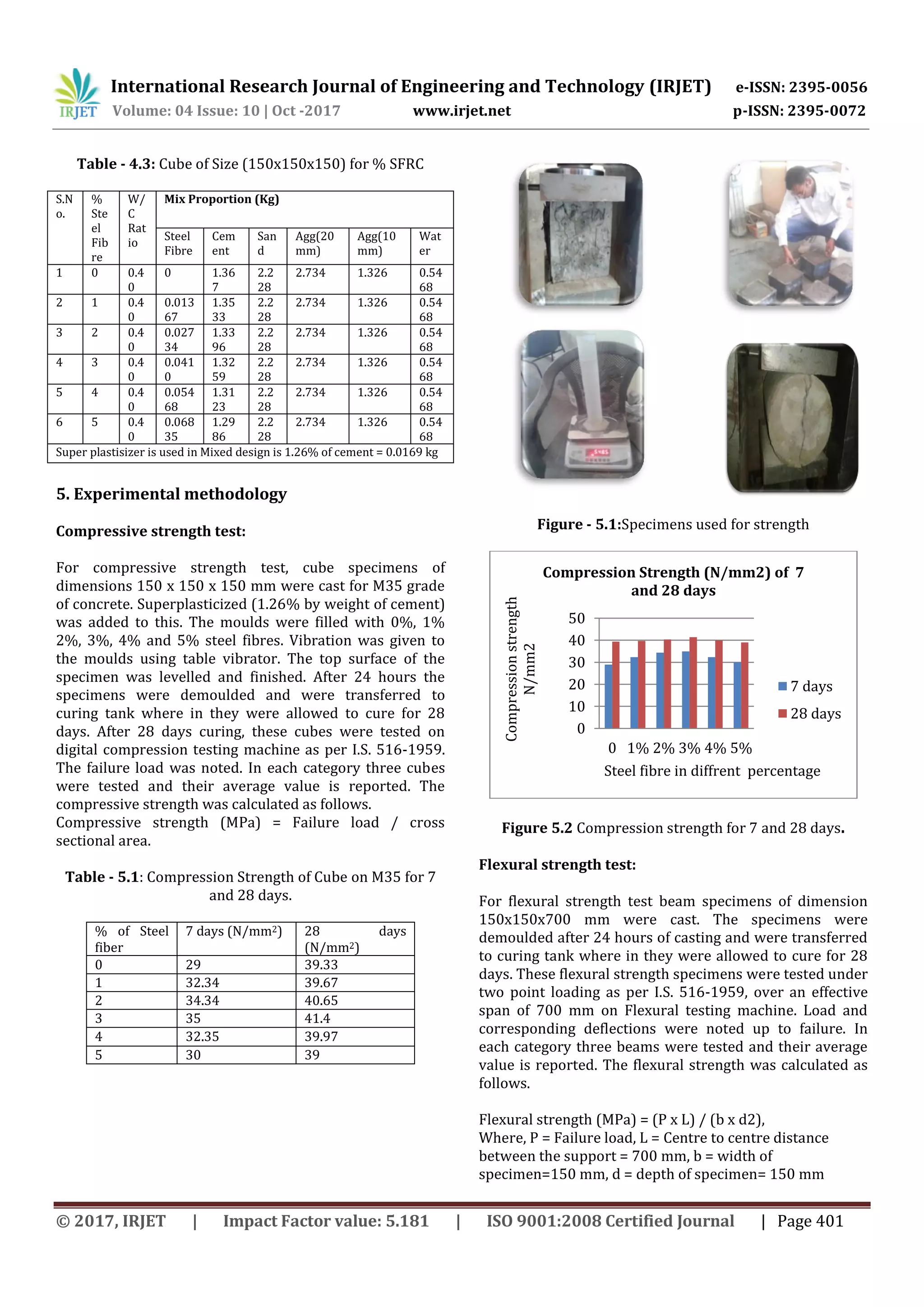
0 29 39.33
1 32.34 39.67
2 34.34 40.65
3 35 41.4
4 32.35 39.97
5 30 39
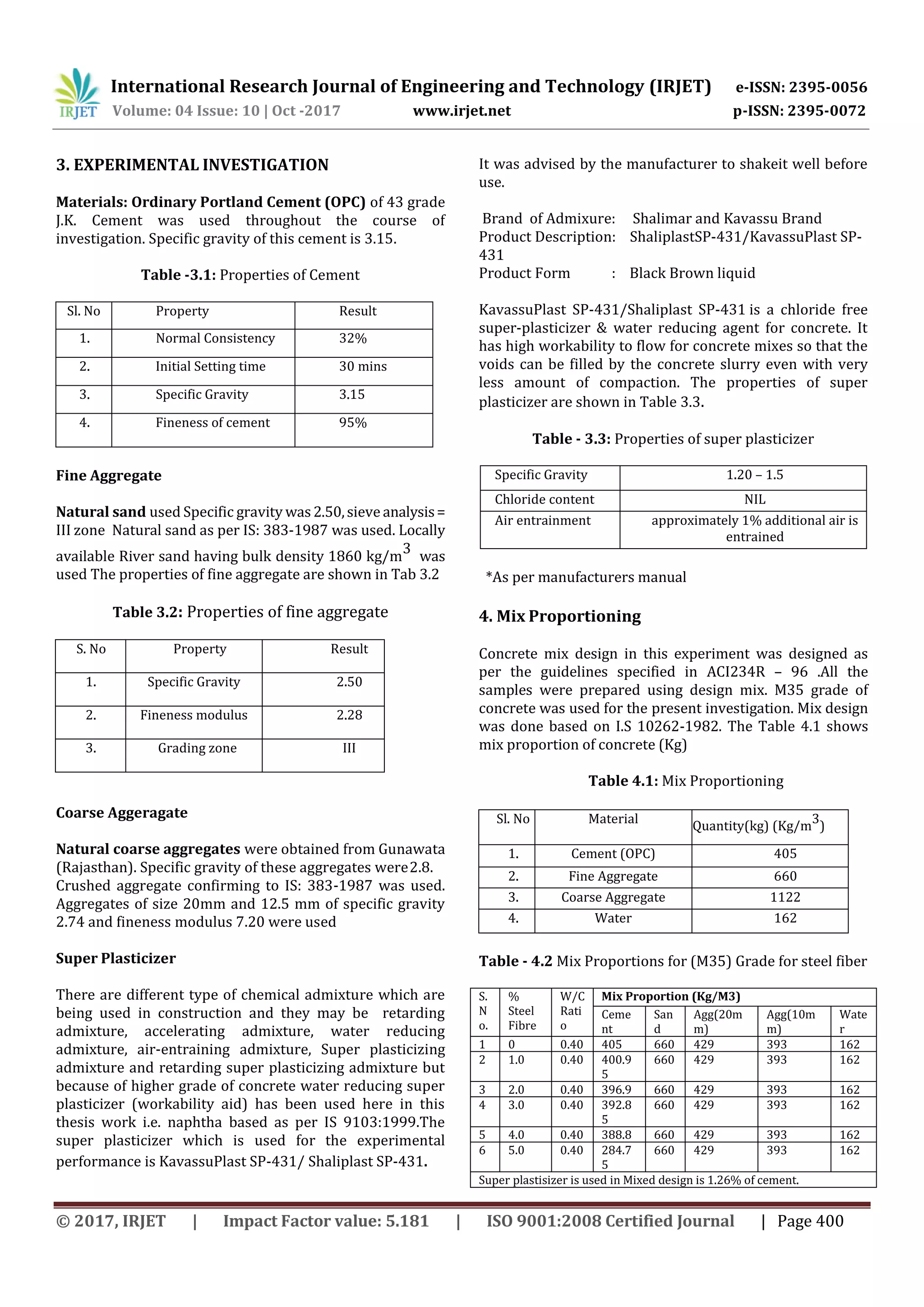
Figure - 5.1:Specimens used for strength
Figure 5.2 Compression strength for 7 and 28 days.
Flexural strength test:
For flexural strength test beam specimens of dimension
150x150x700 mm were cast. The specimens were
demoulded after 24 hours of casting and were transferred
to curing tank where in they were allowed to cure for 28
days. These flexural strength specimens were tested under
two point loading as per I.S. 516-1959, over an effective
span of 700 mm on Flexural testing machine. Load and
corresponding deflections were noted up to failure. In
each category three beams were tested and their average
value is reported. The flexural strength was calculated as
follows.
Flexural strength (MPa) = (P x L) / (b x d2),
Where, P = Failure load, L = Centre to centre distance
between the support = 700 mm, b = width of
specimen=150 mm, d = depth of specimen= 150 mm
0
10
20
30
40
50
0 1% 2% 3% 4% 5%
Compressionstrength
N/mm2
Steel fibre in diffrent percentage
Compression Strength (N/mm2) of 7
and 28 days
7 days
28 days
International Research Journal of Engineering and Technology (IRJET) e-ISSN: 2395-0056
Volume: 04 Issue: 10 | Oct -2017 www.irjet.net p-ISSN: 2395-0072
© 2017, IRJET | Impact Factor value: 5.181 | ISO 9001:2008 Certified Journal | Page 402
Table - 5.2 Flexural Strength Of M35 Grade Of Concrete
% of Steel
fiber
7 days
(N/mm2)
28 days (N/mm2)
0 5.11 6.03
1 5.30 6.01
2 5.68 6.09
3 5.74 6.20
4 5.82 7.01
5 5.38 6.90
Figure - 5.3 Flexural Strength Of M35 Grade Of Concrete
Split tensile strength test
For Split tensile strength test, cylinder specimens of
dimension 150 mm diameter and 300 mm length were
cast. The specimens were demoulded after 24 hours of
casting and were transferred to curing tank where in they
were allowed to cure for 28 days. These specimens were
tested under compression testing machine. In each
category three cylinders were tested and their average
value is reported. Split Tensile strength was calculated as
follows as split tensile strength: Split Tensile strength
(MPa) = 2P / π DL, Where, P = failure load, D = diameter of
cylinder, L = length of cylinder
Table - 5.3 Splite Tensile Strength Of M35 Grade Of
Concrete
Figure - 5.4 Split Tensile Strength of M35
6. CONCLUSION
The mixing of the Hooked steel fibres in the cubes ands
column of two different percentage is improving the
compressive strength of the cubes. Steel fibre reinforced
concrete column arrest the initiation of the failure of the
column and takes more load. The cube and column
containing proportion of steel fibre, 3% and 2% carries
more loads. The Flexural strength of beam at 4% carries
more load.
1. Density of concrete is more as the percentage of steel
fiber increases.
2. Slump will lose at the higher percentage of steel fiber &
lesser fly ash content.
3. Workability of concrete is improves when fly as
percentage increases.
4.The Super-plasticizer is necessary for higher grade to get
required slump & workable mix.
5. The wet and dry density (7 and 28 Days) goes on
decreasing as the percentage fibre volume fraction
increases.
7. REFERENCES
[1] Ganeshan N et al, (2007) „steel fibre reinforced high
performance concrete for seismic resistant structure‟
Civil Engineering and construction Review, December
2007, pp 54-63
[2] Bhikshma V, Ravande Kishor and Nitturkar (2005),”
Mechanical properties of fibre reinforced high
strength concrete „Recent advances in concrete and
construction tech‟6-8 Jan 2005, Chennai, pp 23-33
0
2
4
6
8
0 1% 2% 3% 4% 5%
Flexuralstrength
N/mm2
Steel fibre in diffrent percentage
Flexural Strength (N/mm2) of 7 and 28
days
7 days
28 days
0
1
2
3
4
5
6
0 1% 2% 3%
N/mm2
Steel fibre Percentage
Split Tensile Strength of M35
7 days
28 days
% of Steel fiber 7 days (N/mm2) 28 days (N/mm2)
0 3.21 4.41
1 3.53 4.77
2 4.06 5.07
3 3.21 4.87
International Research Journal of Engineering and Technology (IRJET) e-ISSN: 2395-0056
Volume: 04 Issue: 10 | Oct -2017 www.irjet.net p-ISSN: 2395-0072
© 2017, IRJET | Impact Factor value: 5.181 | ISO 9001:2008 Certified Journal | Page 403
[3] Balaguru P and Najm H (2004), “High-performance
fibre reinforced concrete mixture proportion with
high fibre volume fractions”, Material Journal, volume
101, issue 4, July 1, 2004 pp281-286
[4] Ghavami, K., Rodrigues, C.and. Paciornik, S.,
“Bamboo: Functionally Graded Composite Material”,
Asian Journal of Civil Engineering (building &
housing), Vol. 4. (2003), pp 1-10
[5] Tensing D,Jeminah and Jaygopal L S (2003) “
Permeability studies on steel fibre reinforced concrete
and influence of fly ash” National seminar on advance
in construction materials,14-15 feb 2003.
[6] Madan S. K., Rajeshkumar G., and Sign S.P., “Steel
Fibers as Replacement to Web Reinforcement for RCC
Deep Beam in Shear”, Asian journal of Civil
Engineering Building and Housing), Vol. 8, No. 5
(2007), pp 479-489
[7] Damgir R.M.and Ishaque M.I.M (2003) “Effect of silica
fume and steel fibre composite on strength properties
of high performan ce concrete”, proceedimg of the
INCONTEST 2003, Coimbatore,10-12 sept
2003,pp281-286
[8] Raghuprasad .P.S, Ravindranatha (2003)
“Experimental investigation on flexural strength of
slurry infiltrated fibre concrete” proceedimg of the
INCONTEST 2003, Coimbatore, 10-12 sept 2003, pp
403-408
[9] S.K. Madan, g. Rajesh Kumar, “Steel fibers replacement
of web reinforcement for RCC deep beam in shear”,
Asian Journal of Civil Engineering (Building and
Housing), Vol. 8, No. 56(2007), pp 479-489
[10] Permalatha J and Govindraj V (2003)
“Experimental studies on fibre reinforced concrete”
”proceedimg of the INCONTEST 2003, Coimbatore, 10-
12 sept 2003, pp 462-468
BIOGRAPHIES
Er. NIRANJAN LUHANIA
M.Tech Scholar, Jagannath
University, jaipur, Rajasthan,
India.

Performance of Concrete by using Steel Fibre an Experimental Study

  • 1.
    International Research Journalof Engineering and Technology (IRJET) e-ISSN: 2395-0056 Volume: 04 Issue: 10 | Oct -2017 www.irjet.net p-ISSN: 2395-0072 © 2017, IRJET | Impact Factor value: 5.181 | ISO 9001:2008 Certified Journal | Page 399 PERFORMANCE OF CONCRETE BY USING STEEL FIBRE An Experimental Study Er. Niranjan Luhania 1 , Er. Nidhish Goswami 2, Dr. Bharat Nagar 3 1M.Tech Scholar, Jagannath University, jaipur, Rajasthan, India 2Asst Professor, Department of Civil Engg, Jagannath University, jaipur, Rajasthan, India 3 H.O.D, Department of civil engineering, jagannath university, jaipur, Rajasthan, India ---------------------------------------------------------------------***--------------------------------------------------------------------- Abstract - The purpose of this research is based on the investigation of the use of steel fibres in structural concrete to enhance the mechanical properties of concrete. The objective of the study was to determine and compare the differences in properties of concrete containing without fibres and concrete with fibres. This investigation was carried out using several tests, compressive test and flexural test. A total of eleven mix batches of concrete containing 0% to 5% with an interval of 1% by wt. of cement. ‘Hooked’ steel fibres were tested to determine the enhancement of mechanical properties of concrete. The workability of concrete significantly reduced as the fibre dosage rate increases. Key Words: Steel Fibre , Compressive test, Hooked Steel Fibre, Flexural test, Spliting tensile strength. 1. INTRODUCTION Concrete is mostly wide construction material in the world due to its ability it can be mould and shape. However concrete has some deficiencies as listed below, Low tensile strength, Low post cracking capacity, Brittleness and low ductility, Limited fatigue life, not capable of accommodating large deformations, Low impact strength. These properties can be improved by the use of steel fiber reinforced concrete. The fibers are dispersed and distributed randomly in the concrete during mixing, and thus improve concrete properties in all directions. The fiber helps to arresting the internal widening cracks and fly ash helps as an admixture for improving the properties of concrete. The introduction of the paper should explain the nature of the problem, previous work, purpose, and the contribution of the paper. The contents of each section may be provided to understand easily about the paper. Sample paragraph, The entire document should be in cambria font. Type 3 fonts must not be used. Other font types may be used if needed for special purposes. The entire document should be in cambria font. Type 3 fonts must not be used. Other font types may be used if needed for special purposes. 2. LITERATURE SURVEY Ganeshan N et al, (2007)[1] „steel fibre reinforced high performance concrete for seismic resistant structure‟ Civil Engineering and construction. They had investigate a series of compression tests were conducted on 150mm x 150mm x 150mm cubes, 150mm x 300mm cylinders to find compressive strength, static and dynamic modulus of elasticity with and without steel fibers of volume fractions 0%, 0.5%, 1%, 1.5% of 0.5mm dia of aspect ratio 60 on PPC concrete. The weight density of concrete increasing with increasing of steel fibre content. Compressive strength and modulus of elasticity increased with addition of steel fibers. The compressive strength increased with the increase in silica fume with normal concrete. As a result the incorporation of steel fibers, silica fume and cement as produced a strong composite with superior crack resistance, improved ductility and strength behaviour prior to loading. Bhikshma V, Ravande Kishor and Nitturkar (2005) [2],” Mechanical properties of fibre reinforced high strength concrete „Recent advances in concrete and construction tech. They had studied the effect of fibers on workability, compressive strength, split tensile strength, modulus of rupture of concrete and also studied the effect of fibers on impact and toughness of concrete. They investigated an experimental study were steel fibers added at the volume of 0.5%, 1%, 1.5%, 2%.. They draw the following conclusions: Due to high content of fibre, large surface area of fibers, fibers are sure to absorb more cement paste and increase of viscosity of mixture makes slump loss. The compressive strength increased from 6% to 17% with the increase of volume fraction of fibers. The split tensile strength increased from 18% to 47% with the increase of volume fraction of fibers. Flexural strength increased from 22% to 63% with the increase of volume fraction of fibers. Modulus of elasticity increased from 8% to 25% with the increase of volume fraction of fibers. Toughness increased by 19.27% with the increase of volume fraction of fibers when compared to plain concrete.
  • 2.
    International Research Journalof Engineering and Technology (IRJET) e-ISSN: 2395-0056 Volume: 04 Issue: 10 | Oct -2017 www.irjet.net p-ISSN: 2395-0072 © 2017, IRJET | Impact Factor value: 5.181 | ISO 9001:2008 Certified Journal | Page 400 3. EXPERIMENTAL INVESTIGATION Materials: Ordinary Portland Cement (OPC) of 43 grade J.K. Cement was used throughout the course of investigation. Specific gravity of this cement is 3.15. Table -3.1: Properties of Cement Sl. No Property Result 1. Normal Consistency 32% 2. Initial Setting time 30 mins 3. Specific Gravity 3.15 4. Fineness of cement 95% Fine Aggregate Natural sand used Specific gravity was2.50,sieve analysis= III zone Natural sand as per IS: 383-1987 was used. Locally available River sand having bulk density 1860 kg/m 3 was used The properties of fine aggregate are shown in Tab 3.2 Table 3.2: Properties of fine aggregate Coarse Aggeragate Natural coarse aggregates were obtained from Gunawata (Rajasthan). Specific gravity of these aggregates were2.8. Crushed aggregate confirming to IS: 383-1987 was used. Aggregates of size 20mm and 12.5 mm of specific gravity 2.74 and fineness modulus 7.20 were used Super Plasticizer There are different type of chemical admixture which are being used in construction and they may be retarding admixture, accelerating admixture, water reducing admixture, air-entraining admixture, Super plasticizing admixture and retarding super plasticizing admixture but because of higher grade of concrete water reducing super plasticizer (workability aid) has been used here in this thesis work i.e. naphtha based as per IS 9103:1999.The super plasticizer which is used for the experimental performance is KavassuPlast SP-431/ Shaliplast SP-431. It was advised by the manufacturer to shakeit well before use. Brand of Admixure: Shalimar and Kavassu Brand Product Description: ShaliplastSP-431/KavassuPlast SP- 431 Product Form : Black Brown liquid KavassuPlast SP-431/Shaliplast SP-431 is a chloride free super-plasticizer & water reducing agent for concrete. It has high workability to flow for concrete mixes so that the voids can be filled by the concrete slurry even with very less amount of compaction. The properties of super plasticizer are shown in Table 3.3. Table - 3.3: Properties of super plasticizer Specific Gravity 1.20 – 1.5 Chloride content NIL Air entrainment approximately 1% additional air is entrained *As per manufacturers manual 4. Mix Proportioning Concrete mix design in this experiment was designed as per the guidelines specified in ACI234R – 96 .All the samples were prepared using design mix. M35 grade of concrete was used for the present investigation. Mix design was done based on I.S 10262-1982. The Table 4.1 shows mix proportion of concrete (Kg) Table 4.1: Mix Proportioning Sl. No Material Quantity(kg) (Kg/m 3 ) 1. Cement (OPC) 405 2. Fine Aggregate 660 3. Coarse Aggregate 1122 4. Water 162 Table - 4.2 Mix Proportions for (M35) Grade for steel fiber S. N o. % Steel Fibre W/C Rati o Mix Proportion (Kg/M3) Ceme nt San d Agg(20m m) Agg(10m m) Wate r 1 0 0.40 405 660 429 393 162 2 1.0 0.40 400.9 5 660 429 393 162 3 2.0 0.40 396.9 660 429 393 162 4 3.0 0.40 392.8 5 660 429 393 162 5 4.0 0.40 388.8 660 429 393 162 6 5.0 0.40 284.7 5 660 429 393 162 Super plastisizer is used in Mixed design is 1.26% of cement. S. No Property Result 1. Specific Gravity 2.50 2. Fineness modulus 2.28 3. Grading zone III
  • 3.
    International Research Journalof Engineering and Technology (IRJET) e-ISSN: 2395-0056 Volume: 04 Issue: 10 | Oct -2017 www.irjet.net p-ISSN: 2395-0072 © 2017, IRJET | Impact Factor value: 5.181 | ISO 9001:2008 Certified Journal | Page 401 Table - 4.3: Cube of Size (150x150x150) for % SFRC S.N o. % Ste el Fib re W/ C Rat io Mix Proportion (Kg) Steel Fibre Cem ent San d Agg(20 mm) Agg(10 mm) Wat er 1 0 0.4 0 0 1.36 7 2.2 28 2.734 1.326 0.54 68 2 1 0.4 0 0.013 67 1.35 33 2.2 28 2.734 1.326 0.54 68 3 2 0.4 0 0.027 34 1.33 96 2.2 28 2.734 1.326 0.54 68 4 3 0.4 0 0.041 0 1.32 59 2.2 28 2.734 1.326 0.54 68 5 4 0.4 0 0.054 68 1.31 23 2.2 28 2.734 1.326 0.54 68 6 5 0.4 0 0.068 35 1.29 86 2.2 28 2.734 1.326 0.54 68 Super plastisizer is used in Mixed design is 1.26% of cement = 0.0169 kg 5. Experimental methodology Compressive strength test: For compressive strength test, cube specimens of dimensions 150 x 150 x 150 mm were cast for M35 grade of concrete. Superplasticized (1.26% by weight of cement) was added to this. The moulds were filled with 0%, 1% 2%, 3%, 4% and 5% steel fibres. Vibration was given to the moulds using table vibrator. The top surface of the specimen was levelled and finished. After 24 hours the specimens were demoulded and were transferred to curing tank where in they were allowed to cure for 28 days. After 28 days curing, these cubes were tested on digital compression testing machine as per I.S. 516-1959. The failure load was noted. In each category three cubes were tested and their average value is reported. The compressive strength was calculated as follows. Compressive strength (MPa) = Failure load / cross sectional area. Table - 5.1: Compression Strength of Cube on M35 for 7 and 28 days. % of Steel fiber 7 days (N/mm2) 28 days (N/mm2) 0 29 39.33 1 32.34 39.67 2 34.34 40.65 3 35 41.4 4 32.35 39.97 5 30 39 Figure - 5.1:Specimens used for strength Figure 5.2 Compression strength for 7 and 28 days. Flexural strength test: For flexural strength test beam specimens of dimension 150x150x700 mm were cast. The specimens were demoulded after 24 hours of casting and were transferred to curing tank where in they were allowed to cure for 28 days. These flexural strength specimens were tested under two point loading as per I.S. 516-1959, over an effective span of 700 mm on Flexural testing machine. Load and corresponding deflections were noted up to failure. In each category three beams were tested and their average value is reported. The flexural strength was calculated as follows. Flexural strength (MPa) = (P x L) / (b x d2), Where, P = Failure load, L = Centre to centre distance between the support = 700 mm, b = width of specimen=150 mm, d = depth of specimen= 150 mm 0 10 20 30 40 50 0 1% 2% 3% 4% 5% Compressionstrength N/mm2 Steel fibre in diffrent percentage Compression Strength (N/mm2) of 7 and 28 days 7 days 28 days
  • 4.
    International Research Journalof Engineering and Technology (IRJET) e-ISSN: 2395-0056 Volume: 04 Issue: 10 | Oct -2017 www.irjet.net p-ISSN: 2395-0072 © 2017, IRJET | Impact Factor value: 5.181 | ISO 9001:2008 Certified Journal | Page 402 Table - 5.2 Flexural Strength Of M35 Grade Of Concrete % of Steel fiber 7 days (N/mm2) 28 days (N/mm2) 0 5.11 6.03 1 5.30 6.01 2 5.68 6.09 3 5.74 6.20 4 5.82 7.01 5 5.38 6.90 Figure - 5.3 Flexural Strength Of M35 Grade Of Concrete Split tensile strength test For Split tensile strength test, cylinder specimens of dimension 150 mm diameter and 300 mm length were cast. The specimens were demoulded after 24 hours of casting and were transferred to curing tank where in they were allowed to cure for 28 days. These specimens were tested under compression testing machine. In each category three cylinders were tested and their average value is reported. Split Tensile strength was calculated as follows as split tensile strength: Split Tensile strength (MPa) = 2P / π DL, Where, P = failure load, D = diameter of cylinder, L = length of cylinder Table - 5.3 Splite Tensile Strength Of M35 Grade Of Concrete Figure - 5.4 Split Tensile Strength of M35 6. CONCLUSION The mixing of the Hooked steel fibres in the cubes ands column of two different percentage is improving the compressive strength of the cubes. Steel fibre reinforced concrete column arrest the initiation of the failure of the column and takes more load. The cube and column containing proportion of steel fibre, 3% and 2% carries more loads. The Flexural strength of beam at 4% carries more load. 1. Density of concrete is more as the percentage of steel fiber increases. 2. Slump will lose at the higher percentage of steel fiber & lesser fly ash content. 3. Workability of concrete is improves when fly as percentage increases. 4.The Super-plasticizer is necessary for higher grade to get required slump & workable mix. 5. The wet and dry density (7 and 28 Days) goes on decreasing as the percentage fibre volume fraction increases. 7. REFERENCES [1] Ganeshan N et al, (2007) „steel fibre reinforced high performance concrete for seismic resistant structure‟ Civil Engineering and construction Review, December 2007, pp 54-63 [2] Bhikshma V, Ravande Kishor and Nitturkar (2005),” Mechanical properties of fibre reinforced high strength concrete „Recent advances in concrete and construction tech‟6-8 Jan 2005, Chennai, pp 23-33 0 2 4 6 8 0 1% 2% 3% 4% 5% Flexuralstrength N/mm2 Steel fibre in diffrent percentage Flexural Strength (N/mm2) of 7 and 28 days 7 days 28 days 0 1 2 3 4 5 6 0 1% 2% 3% N/mm2 Steel fibre Percentage Split Tensile Strength of M35 7 days 28 days % of Steel fiber 7 days (N/mm2) 28 days (N/mm2) 0 3.21 4.41 1 3.53 4.77 2 4.06 5.07 3 3.21 4.87
  • 5.
    International Research Journalof Engineering and Technology (IRJET) e-ISSN: 2395-0056 Volume: 04 Issue: 10 | Oct -2017 www.irjet.net p-ISSN: 2395-0072 © 2017, IRJET | Impact Factor value: 5.181 | ISO 9001:2008 Certified Journal | Page 403 [3] Balaguru P and Najm H (2004), “High-performance fibre reinforced concrete mixture proportion with high fibre volume fractions”, Material Journal, volume 101, issue 4, July 1, 2004 pp281-286 [4] Ghavami, K., Rodrigues, C.and. Paciornik, S., “Bamboo: Functionally Graded Composite Material”, Asian Journal of Civil Engineering (building & housing), Vol. 4. (2003), pp 1-10 [5] Tensing D,Jeminah and Jaygopal L S (2003) “ Permeability studies on steel fibre reinforced concrete and influence of fly ash” National seminar on advance in construction materials,14-15 feb 2003. [6] Madan S. K., Rajeshkumar G., and Sign S.P., “Steel Fibers as Replacement to Web Reinforcement for RCC Deep Beam in Shear”, Asian journal of Civil Engineering Building and Housing), Vol. 8, No. 5 (2007), pp 479-489 [7] Damgir R.M.and Ishaque M.I.M (2003) “Effect of silica fume and steel fibre composite on strength properties of high performan ce concrete”, proceedimg of the INCONTEST 2003, Coimbatore,10-12 sept 2003,pp281-286 [8] Raghuprasad .P.S, Ravindranatha (2003) “Experimental investigation on flexural strength of slurry infiltrated fibre concrete” proceedimg of the INCONTEST 2003, Coimbatore, 10-12 sept 2003, pp 403-408 [9] S.K. Madan, g. Rajesh Kumar, “Steel fibers replacement of web reinforcement for RCC deep beam in shear”, Asian Journal of Civil Engineering (Building and Housing), Vol. 8, No. 56(2007), pp 479-489 [10] Permalatha J and Govindraj V (2003) “Experimental studies on fibre reinforced concrete” ”proceedimg of the INCONTEST 2003, Coimbatore, 10- 12 sept 2003, pp 462-468 BIOGRAPHIES Er. NIRANJAN LUHANIA M.Tech Scholar, Jagannath University, jaipur, Rajasthan, India.