SEMINAR ON INVITRO &
INVIVO STUDIES OF
ANTIANGINAL &
ANTIMALARIAL DRUGS
PRESENTED BY,
CHARU PUNDIR
M.PHARM 1ST YEAR
DEPT. OF PHARMACOLOGY
& TOXICOLOGY

ANTIANGINAL
MODELS
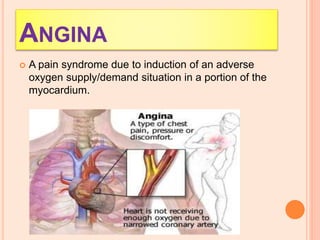
ANGINA
 A pain syndrome due to induction of an adverse
oxygen supply/demand situation in a portion of the
myocardium.
TYPES
 Classical angina (common form): attacks are
provoked by exercise, emotion, eating or coitus.
 Variant/Prinzmetal’s angina (uncommon form):
attacks occur at rest or during sleep and are
unpredictable.
 Unstable angina: due to rapid increase in duration
and severity of attacks. Artheromatous plaque
formation takes place.
TREATMENT
•NITRATES- GTN, Isosorbide dinitrate, mononitrate
•β-BLOCKERS- Propanolol, Metopronol
•CCB- Verapamil, Diltiazem
•POTASSIUM CHANNEL OPENER- Nicorandil
MODELS TO SCREEN
ANTIANGINAL DRUGS
IN VITRO MODELS
• Langendorff heart preparation
• Isolated Rabbit Aorta preparation
• Calcium Antagonism in pithed rat
• Relaxation of Bovine Coronary Artery
• Coronary Artery Ligation in Isolated Rat Heart
• Isolated Heart-lung Preparation
• Plastic Casts Technique in Dogs
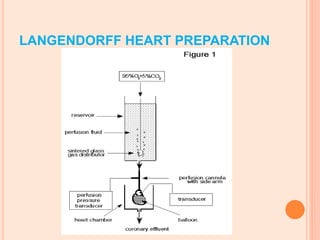
LANGENDORFF HEART PREPARATION
APPLICATIONS
 Testing of coronary vasodilator drugs,
electrophysiological evaluations
 Recording positive inotropic effects, negative
inotropic effects, calcium antagonism, effect on
potassium outflow induced by glycosides and
determination of hypoxic damage.
 Metabolic studies- arrhythmogenic, antiarryhythmic
and antifibrillatory effects.
 To study EDRF release from coronary vascular bed
PRINCIPLE
Heart is perfused in a retrograde direction from the
aorta either at constant pressure or constant flow
with oxygenated saline solutions.
Perfusate solution do not flow via normal
ventricular circulatory pathway. Thus left ventricle
do not generate pressure volume which represents
typical cardiac function.
PROCEDURE
 Guinea pigs (wt. 300-500g) are sacrificed by
stunning.
 Heart is isolated by transabdominal incision. Heart
is cradled btw fingers and lifted before incising the
aorta,vena cava and pulmonary veins.
 After excision heart is dipped in cold perfusion
solution(4◦C)
 Aorta is located and cannula is inserted into it and
heart is perfused with oxygenated Kreb’s solution.
 Heart is transferred to a double wall Plexiglas perfusion
apparatus maintained at 37◦C.
 Oxygenated Kreb’s solution is perfuse at a constant
pressure of 40mm Hg.
 Small steel hook with a string is attached to the apex of
the heart.
 Contractile force is measured isometric ally by a force
transducer and recorded on a polygraph.
 Heart rate is measured through a chronometer coupled to
the polygraph.
 Antianginal effect of the test drug is indicated by an
increase in coronary blood flow.
 Which is then further treated with drug and compared
with control.
CALCIUM ANTAGONISM IN
PITHED RATS
 Sprague-Dawley rats
(250-350g) are
anesthetized ip with
Methohexitone sodium.
 Trachea is cannulated
 Rats are provided with
artificial respiration.
 Pithing rod is used as a
stimulating electrode and
continuous electrical
stimulation producing a
cardio-accelerator
response.
 Jugular vein is cannulated
for administration of drugs
and blood pressure is
recorded via carotid artery
using a pressure transducer.
 In the femoral region, an
indifferent electrode is
inserted sc
 CCBs & beta blockers are
administered which causes
tachycardia
 ID50 calculated and
compared.
INVIVO MODELS
 Occlusion of coronary artery
 Microspheres-induced acute ischemia
 Isoproterenol-induced myocardial necrosis
 Stenosis-induced coronary thrombosis model
 Electrical stimulation-induced coronary thrombosis
 Myocardial-ischemic preconditioning model
 Models of coronary flow measurement
ISOPROTERENOL-INDUCED MYOCARDIAL
NECROSIS
 Wistar rats (150-200g) are
pretreated with test drugs
orally or sc for atleast a week.
 Isoproterenol is injected sc
on 2 consecutive days.
 Mortality as well as
symptoms are recorded in
each group and compared to
group injected with
isoproterenol only.
 After 48 hrs of 1st dose
animals are sacrificed.
 Heart is removed , weighed
and preserved for various
hemodynamic parameters.
 Degree of histopathological
changes can be graded as
follows:
 Grade 0: no change
 Grade 1: focal areas of
necrosis
 Grade 2: focal areas of
necrosis and muscle fiber
fragmentation
 Grade 3: confluent areas of
necrosis, edema and
inflammation and muscle
fiber fragmenation
 Grade 4: massive areas of
necrosis, edema and
inflammation and mural
thrombi
MYOCARDIAL-ISCHEMIC
PRECONDITIONING MODEL
 Rabbits (3-4 kg) are
anesthetized with ketamine
xylazine.
 Trachea canulated and animal is
set up for artificial respiration
 Right femoral artery and vein are
catheterised for measuring
hemodynamic parameters.
 A 4-0 suture is looped loosely
around the marginal branch of
left coronary artery to facilitate
coronary occlusion.
 Ischemic preconditioning is
induced by tightening the loop
around the coronary artery for 5
min and then loosening to
reperfuse the myocardium for 10
min prior to a subsequent 30 min
occlusion.
 After 30 min. ischemia, ligation is
released for 120 min of
reperfusion.
 Prior to 30 min of occlusion
rabbits are selected to receive
ischemic preconditioning, no
preconditioning or
preconditioning along with the
administration of test compound.
 Animals are sacrificed after
reperfusion duration.
 Compared with the controlled
groups.
 Data is analysed by ANOVA
using statistical software.
ANTIMALARIAL
MODELS
MALARIA
A Protozoal disease caused by parasites of the genus
Plasmodium and transmitted to man by certain
species of infected female anopheles mosquito.
 Five species of the genus Plasmodium cause nearly all
malarial infections in humans.
 Falciparum – life threatening
 Vivax
 Ovale
 Malariae
 Knowlesi
(in Southeast Asia—the monkey malaria parasite )
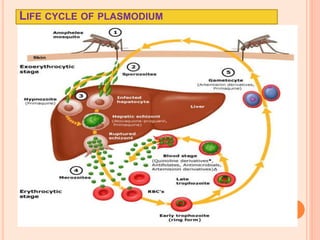
LIFE CYCLE OF PLASMODIUM
TREATMENT
 Quinolones
 Cinchona
 Biguanides
 Diaminopyrimidines
 Sulfonamides and sulfone
 Tetracyclines
 Sesquiterpine
 Amino alcohols
 Mannich base
 naphthoquinone
IN VITRO METHODS FOR SCREENING
ANTIMALARIAL COMPOUNDS
 3H Hypoxanthine uptake
 Giemsa stained slide method
 Micro test
 Flow cytometry
 Measurement of LDH activity of P. falciparum
 Isobologram analysis
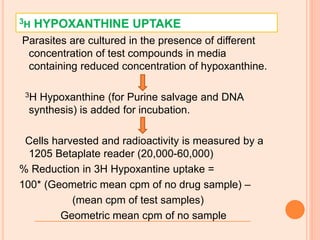
3H HYPOXANTHINE UPTAKE
Parasites are cultured in the presence of different
concentration of test compounds in media
containing reduced concentration of hypoxanthine.
3H Hypoxanthine (for Purine salvage and DNA
synthesis) is added for incubation.
Cells harvested and radioactivity is measured by a
1205 Betaplate reader (20,000-60,000)
% Reduction in 3H Hypoxantine uptake =
100* (Geometric mean cpm of no drug sample) –
(mean cpm of test samples)
Geometric mean cpm of no sample
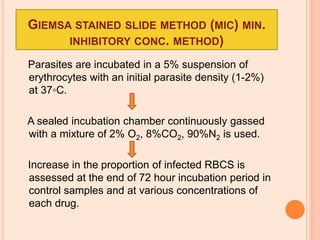
GIEMSA STAINED SLIDE METHOD (MIC) MIN.
INHIBITORY CONC. METHOD)
Parasites are incubated in a 5% suspension of
erythrocytes with an initial parasite density (1-2%)
at 37◦C.
A sealed incubation chamber continuously gassed
with a mixture of 2% O2, 8%CO2, 90%N2 is used.
Increase in the proportion of infected RBCS is
assessed at the end of 72 hour incubation period in
control samples and at various concentrations of
each drug.
IN VIVO METHODS
 Plasmodium berghei 4 day suppression test
 Hill’s test for causal prophylaxix and residual
activity
 Sporonoicidal activity testing
 Plasmodium cynomolgi rhesus model
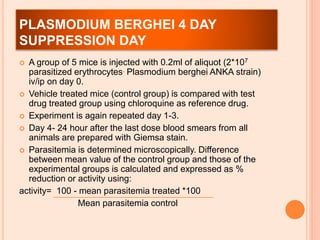
PLASMODIUM BERGHEI 4 DAY
SUPPRESSION DAY
 A group of 5 mice is injected with 0.2ml of aliquot (2*107
parasitized erythrocytes. Plasmodium berghei ANKA strain)
iv/ip on day 0.
 Vehicle treated mice (control group) is compared with test
drug treated group using chloroquine as reference drug.
 Experiment is again repeated day 1-3.
 Day 4- 24 hour after the last dose blood smears from all
animals are prepared with Giemsa stain.
 Parasitemia is determined microscopically. Difference
between mean value of the control group and those of the
experimental groups is calculated and expressed as %
reduction or activity using:
activity= 100 - mean parasitemia treated *100
Mean parasitemia control
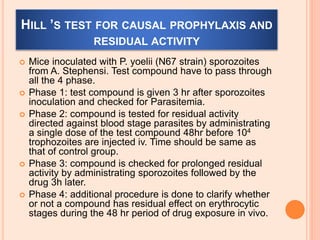
HILL ’S TEST FOR CAUSAL PROPHYLAXIS AND
RESIDUAL ACTIVITY
 Mice inoculated with P. yoelii (N67 strain) sporozoites
from A. Stephensi. Test compound have to pass through
all the 4 phase.
 Phase 1: test compound is given 3 hr after sporozoites
inoculation and checked for Parasitemia.
 Phase 2: compound is tested for residual activity
directed against blood stage parasites by administrating
a single dose of the test compound 48hr before 104
trophozoites are injected iv. Time should be same as
that of control group.
 Phase 3: compound is checked for prolonged residual
activity by administrating sporozoites followed by the
drug 3h later.
 Phase 4: additional procedure is done to clarify whether
or not a compound has residual effect on erythrocytic
stages during the 48 hr period of drug exposure in vivo.
REFERENCES
 Vogels Gerhard, Drug discovery and evaluation
Pharmacological assays, Springer publications, 3rd
edition, 2008, 253-257.
 Gupta S.K, Drug screening methods (preclinical
evaluation of new drugs), Jaypee Publishers, 2nd edition,
2009, 314-327.
 B.S. Kalra, S. Chawla, P. Gupta, N. Valecha*,
Screening of antimalarial drug – An overview, Indian J
Pharmacol , February 2006, Vol. 38, Issue 1, 5-12.
 Tripathi KD, Essential of medical pharmacology, Jaypee
publishers, 6th edition, 2010, 521-780.
 Ross and Wilson, Anatomy and Physiology, Churchill
Livingstone, 10th edition, 2006, 75-89.
THANK U………

Screening methods for antianginal & antimalarial drugs

  • 1.
    SEMINAR ON INVITRO& INVIVO STUDIES OF ANTIANGINAL & ANTIMALARIAL DRUGS PRESENTED BY, CHARU PUNDIR M.PHARM 1ST YEAR DEPT. OF PHARMACOLOGY & TOXICOLOGY 
  • 2.
  • 3.
    ANGINA  A painsyndrome due to induction of an adverse oxygen supply/demand situation in a portion of the myocardium.
  • 4.
    TYPES  Classical angina(common form): attacks are provoked by exercise, emotion, eating or coitus.  Variant/Prinzmetal’s angina (uncommon form): attacks occur at rest or during sleep and are unpredictable.  Unstable angina: due to rapid increase in duration and severity of attacks. Artheromatous plaque formation takes place.
  • 5.
    TREATMENT •NITRATES- GTN, Isosorbidedinitrate, mononitrate •β-BLOCKERS- Propanolol, Metopronol •CCB- Verapamil, Diltiazem •POTASSIUM CHANNEL OPENER- Nicorandil
  • 6.
  • 7.
    IN VITRO MODELS •Langendorff heart preparation • Isolated Rabbit Aorta preparation • Calcium Antagonism in pithed rat • Relaxation of Bovine Coronary Artery • Coronary Artery Ligation in Isolated Rat Heart • Isolated Heart-lung Preparation • Plastic Casts Technique in Dogs
  • 8.
  • 9.
    APPLICATIONS  Testing ofcoronary vasodilator drugs, electrophysiological evaluations  Recording positive inotropic effects, negative inotropic effects, calcium antagonism, effect on potassium outflow induced by glycosides and determination of hypoxic damage.  Metabolic studies- arrhythmogenic, antiarryhythmic and antifibrillatory effects.  To study EDRF release from coronary vascular bed
  • 10.
    PRINCIPLE Heart is perfusedin a retrograde direction from the aorta either at constant pressure or constant flow with oxygenated saline solutions. Perfusate solution do not flow via normal ventricular circulatory pathway. Thus left ventricle do not generate pressure volume which represents typical cardiac function.
  • 11.
    PROCEDURE  Guinea pigs(wt. 300-500g) are sacrificed by stunning.  Heart is isolated by transabdominal incision. Heart is cradled btw fingers and lifted before incising the aorta,vena cava and pulmonary veins.  After excision heart is dipped in cold perfusion solution(4◦C)  Aorta is located and cannula is inserted into it and heart is perfused with oxygenated Kreb’s solution.
  • 12.
     Heart istransferred to a double wall Plexiglas perfusion apparatus maintained at 37◦C.  Oxygenated Kreb’s solution is perfuse at a constant pressure of 40mm Hg.  Small steel hook with a string is attached to the apex of the heart.  Contractile force is measured isometric ally by a force transducer and recorded on a polygraph.  Heart rate is measured through a chronometer coupled to the polygraph.  Antianginal effect of the test drug is indicated by an increase in coronary blood flow.  Which is then further treated with drug and compared with control.
  • 13.
    CALCIUM ANTAGONISM IN PITHEDRATS  Sprague-Dawley rats (250-350g) are anesthetized ip with Methohexitone sodium.  Trachea is cannulated  Rats are provided with artificial respiration.  Pithing rod is used as a stimulating electrode and continuous electrical stimulation producing a cardio-accelerator response.  Jugular vein is cannulated for administration of drugs and blood pressure is recorded via carotid artery using a pressure transducer.  In the femoral region, an indifferent electrode is inserted sc  CCBs & beta blockers are administered which causes tachycardia  ID50 calculated and compared.
  • 14.
    INVIVO MODELS  Occlusionof coronary artery  Microspheres-induced acute ischemia  Isoproterenol-induced myocardial necrosis  Stenosis-induced coronary thrombosis model  Electrical stimulation-induced coronary thrombosis  Myocardial-ischemic preconditioning model  Models of coronary flow measurement
  • 15.
    ISOPROTERENOL-INDUCED MYOCARDIAL NECROSIS  Wistarrats (150-200g) are pretreated with test drugs orally or sc for atleast a week.  Isoproterenol is injected sc on 2 consecutive days.  Mortality as well as symptoms are recorded in each group and compared to group injected with isoproterenol only.  After 48 hrs of 1st dose animals are sacrificed.  Heart is removed , weighed and preserved for various hemodynamic parameters.  Degree of histopathological changes can be graded as follows:  Grade 0: no change  Grade 1: focal areas of necrosis  Grade 2: focal areas of necrosis and muscle fiber fragmentation  Grade 3: confluent areas of necrosis, edema and inflammation and muscle fiber fragmenation  Grade 4: massive areas of necrosis, edema and inflammation and mural thrombi
  • 16.
    MYOCARDIAL-ISCHEMIC PRECONDITIONING MODEL  Rabbits(3-4 kg) are anesthetized with ketamine xylazine.  Trachea canulated and animal is set up for artificial respiration  Right femoral artery and vein are catheterised for measuring hemodynamic parameters.  A 4-0 suture is looped loosely around the marginal branch of left coronary artery to facilitate coronary occlusion.  Ischemic preconditioning is induced by tightening the loop around the coronary artery for 5 min and then loosening to reperfuse the myocardium for 10 min prior to a subsequent 30 min occlusion.  After 30 min. ischemia, ligation is released for 120 min of reperfusion.  Prior to 30 min of occlusion rabbits are selected to receive ischemic preconditioning, no preconditioning or preconditioning along with the administration of test compound.  Animals are sacrificed after reperfusion duration.  Compared with the controlled groups.  Data is analysed by ANOVA using statistical software.
  • 17.
  • 18.
    MALARIA A Protozoal diseasecaused by parasites of the genus Plasmodium and transmitted to man by certain species of infected female anopheles mosquito.  Five species of the genus Plasmodium cause nearly all malarial infections in humans.  Falciparum – life threatening  Vivax  Ovale  Malariae  Knowlesi (in Southeast Asia—the monkey malaria parasite )
  • 19.
    LIFE CYCLE OFPLASMODIUM
  • 20.
    TREATMENT  Quinolones  Cinchona Biguanides  Diaminopyrimidines  Sulfonamides and sulfone  Tetracyclines  Sesquiterpine  Amino alcohols  Mannich base  naphthoquinone
  • 21.
    IN VITRO METHODSFOR SCREENING ANTIMALARIAL COMPOUNDS  3H Hypoxanthine uptake  Giemsa stained slide method  Micro test  Flow cytometry  Measurement of LDH activity of P. falciparum  Isobologram analysis
  • 22.
    3H HYPOXANTHINE UPTAKE Parasitesare cultured in the presence of different concentration of test compounds in media containing reduced concentration of hypoxanthine. 3H Hypoxanthine (for Purine salvage and DNA synthesis) is added for incubation. Cells harvested and radioactivity is measured by a 1205 Betaplate reader (20,000-60,000) % Reduction in 3H Hypoxantine uptake = 100* (Geometric mean cpm of no drug sample) – (mean cpm of test samples) Geometric mean cpm of no sample
  • 23.
    GIEMSA STAINED SLIDEMETHOD (MIC) MIN. INHIBITORY CONC. METHOD) Parasites are incubated in a 5% suspension of erythrocytes with an initial parasite density (1-2%) at 37◦C. A sealed incubation chamber continuously gassed with a mixture of 2% O2, 8%CO2, 90%N2 is used. Increase in the proportion of infected RBCS is assessed at the end of 72 hour incubation period in control samples and at various concentrations of each drug.
  • 24.
    IN VIVO METHODS Plasmodium berghei 4 day suppression test  Hill’s test for causal prophylaxix and residual activity  Sporonoicidal activity testing  Plasmodium cynomolgi rhesus model
  • 25.
    PLASMODIUM BERGHEI 4DAY SUPPRESSION DAY  A group of 5 mice is injected with 0.2ml of aliquot (2*107 parasitized erythrocytes. Plasmodium berghei ANKA strain) iv/ip on day 0.  Vehicle treated mice (control group) is compared with test drug treated group using chloroquine as reference drug.  Experiment is again repeated day 1-3.  Day 4- 24 hour after the last dose blood smears from all animals are prepared with Giemsa stain.  Parasitemia is determined microscopically. Difference between mean value of the control group and those of the experimental groups is calculated and expressed as % reduction or activity using: activity= 100 - mean parasitemia treated *100 Mean parasitemia control
  • 26.
    HILL ’S TESTFOR CAUSAL PROPHYLAXIS AND RESIDUAL ACTIVITY  Mice inoculated with P. yoelii (N67 strain) sporozoites from A. Stephensi. Test compound have to pass through all the 4 phase.  Phase 1: test compound is given 3 hr after sporozoites inoculation and checked for Parasitemia.  Phase 2: compound is tested for residual activity directed against blood stage parasites by administrating a single dose of the test compound 48hr before 104 trophozoites are injected iv. Time should be same as that of control group.  Phase 3: compound is checked for prolonged residual activity by administrating sporozoites followed by the drug 3h later.  Phase 4: additional procedure is done to clarify whether or not a compound has residual effect on erythrocytic stages during the 48 hr period of drug exposure in vivo.
  • 27.
    REFERENCES  Vogels Gerhard,Drug discovery and evaluation Pharmacological assays, Springer publications, 3rd edition, 2008, 253-257.  Gupta S.K, Drug screening methods (preclinical evaluation of new drugs), Jaypee Publishers, 2nd edition, 2009, 314-327.  B.S. Kalra, S. Chawla, P. Gupta, N. Valecha*, Screening of antimalarial drug – An overview, Indian J Pharmacol , February 2006, Vol. 38, Issue 1, 5-12.  Tripathi KD, Essential of medical pharmacology, Jaypee publishers, 6th edition, 2010, 521-780.  Ross and Wilson, Anatomy and Physiology, Churchill Livingstone, 10th edition, 2006, 75-89.
  • 28.