EXTERNAL MARKETING
ENVIRONMENT
PRESENTED BY:
ANKIT BANSAL
DHIRENDRA ADABARIA
It refers to the environment that has an
indirect influence on the business. The
factors are uncontrollable by the
business. There are two types of external
environment:
1. MICRO- ENVIRONMENT
2. MACRO- ENVIRONMENT
EXTERNAL ENVIRONMENT
Micro Environment
The micro environment is also known as the task
environment and operating environment because the
micro environmental forces have a direct bearing on
the operations of the firm. Micro environmental
factors are closely related to a specific firm and are
included as a part of the firm’s total marketing
system.
FACTORS OF MICRO ENVIRONMENT
Company’s internal environment
suppliers
intermediaries
customer
competitors
public
MICRO
MARKEING
ENVIRONMENT
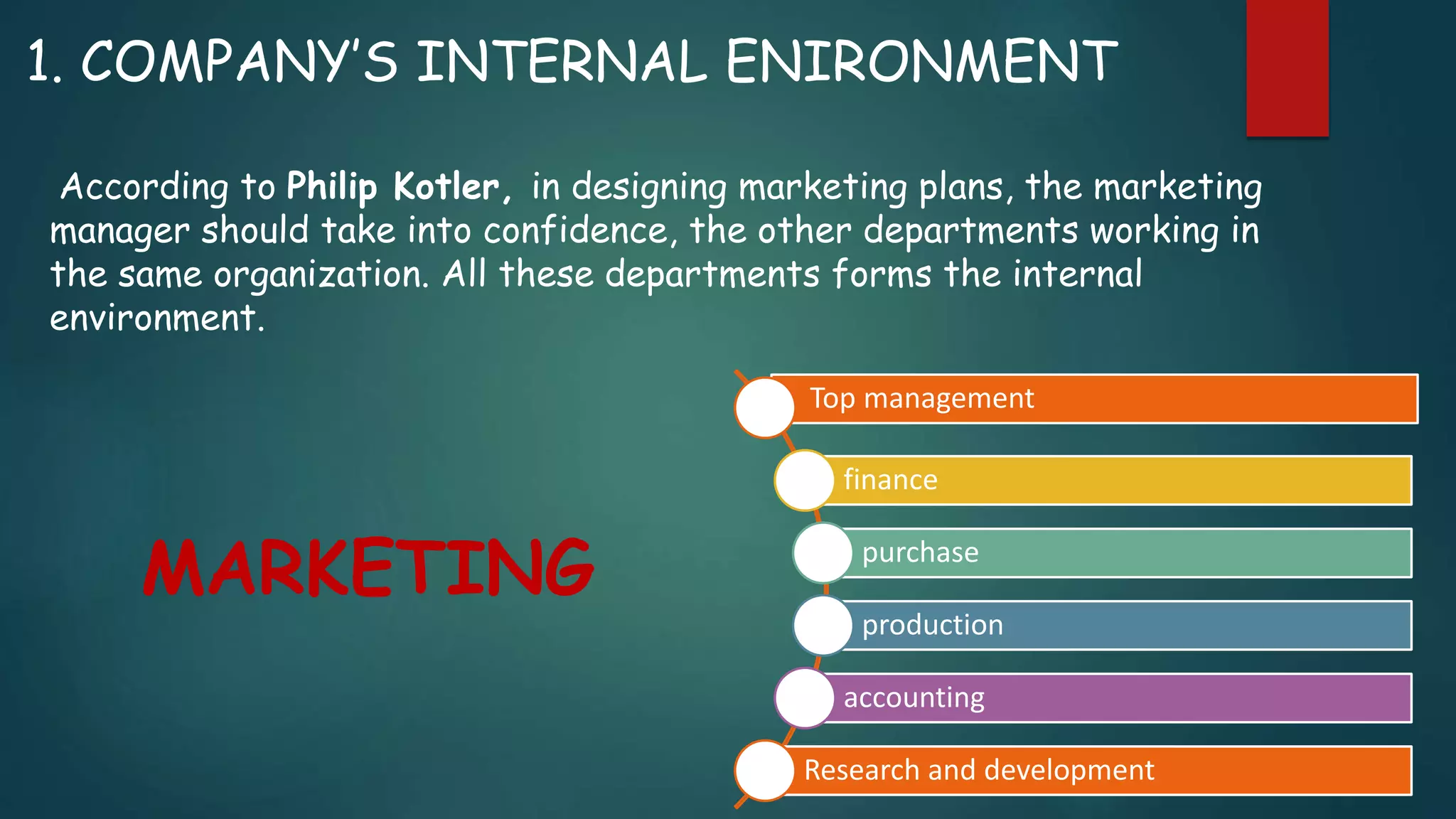
1. COMPANY’S INTERNAL ENIRONMENT
According to Philip Kotler, in designing marketing plans, the marketing
manager should take into confidence, the other departments working in
the same organization. All these departments forms the internal
environment.
MARKETING
Top management
finance
purchase
production
accounting
Research and development
2.Suppliers
An important force in the micro environment of a company is the
suppliers, i.e., those who supply the inputs like raw materials and
components to the company. supplier problems can seriously affect
marketing. The company should develop specifications, searching
the potential suppliers, selecting the suppliers who can supply the
best mix of quantity, quality, credit facility, warranties, low price.
3.Marketing Intermediaries
Like suppliers, marketing intermediaries also form an
important component of the company’s overall value delivery
system. It help the company to promote, sell and distribute
its products to final buyer. The marketing intermediaries
include middlemen such as agents, reseller and merchants that
help the company find customers or close sales with them.
4.Customer
The major task of a business is to create and sustain customers. A
business exists only because of its customers.
TYPES OF
CUTOMERS
Ultimate customers
Industrial customers
resellers
Govt. customers
Foreign customers
5.Competitors
Competitors are those individuals and firms who sells similar
goods and services in the same market.it is therefore
necessary to build an efficient system of marketing. No
single competitive marketing strategy is best for all
companies. Each firm should consider its own size and
industry position as compared to those of its competitors.
6.Public
Public can be said as any group that has an actual or potential interest in or on an
organization’s ability to achieve its objectives. It is the duty of the company to satisfy the
people at large.
TYPES OF
PUBLIC
Financial public
Media public
Govt. public
Citizen action public
Internal public
Local public
General public
MACRO ENVIRONMENT
Macro environment is also known as General
environment and remote environment. Macro
factors are generally more uncontrollable than
micro environment factors. When the macro
factors become uncontrollable , the success of
company depends upon its adaptability to the
environment.
FACTORS OF MACRO ENVIRONMENT
• DEMOGRAPHIC ENVIRONMENT
• ECONOMIC ENVIRONMENT
• SOCIO-CULTURAL ENVIRONMEN
• POLITICAL AND LEGAL ENVIRONMENT
• COMPETITIVE FORCES
• CONSUMER DEMAND
• ECOLOGICAL ENVIRONMENT
• TECHNOLOGICAL ENVIRONMENT
1.DEMOGRAPHIC ENVIRONMENT
Demographic factors include detail about the
population structure, age-group, income group,
division according to sex, marital status,
occupation, profession, etc. . The study of
demographic features of the target market helps
the marketer to develop an understanding about
prospective consumers and market potentials of a
product and facilitates market segmentation.
Without knowing the demographic features, a
marketer can not market his product successfully
because it is the people whose needs have to be
satisfied, keeping in view their capacity to spend
and their willingness to spend.
Economic environment means the purchasing power and
desire to spend the income by the consumers, result in
effective demand, which in turn, is influenced by
economic conditions. High economic growth assures
higher level of employment and income, and this leads
to marketing boom in many industries.
Marketing environment is also influenced by many
other economic factors such as:
I. Interest rate
II. Money supply
III.Price level
IV. Consumer credit
2.Economic Environment
3.Social and Cultural Environment
Socio-cultural environment determines
the value system of the society which in
turns affects the marketing
environment. Cultural differences such
as religion, languages, food habits, dress
code, festivals and consumer’s
aspirations also influence the marketing
environment.
Sociological factors
• Caste structure
• Mobility of labour
• customs
• Cultural heritage
• Life style
• Social values
• Beliefs
• View towards scientific
methods.
4.Political and legal Environment
It is also know as public policy
environment. Political and legal
forces are gaining considerable
importance in marketing activities
and operations of business
enterprises. Marketing systems are
affected by govt. monetary and
fiscal policies, import and export
policies, custom duties etc. e.g. anti-
pollution laws also influence
marketing plans and policies. Thus,
marketers should keep in mind the
public policy of the govt. and laws of
the land while preparing marketing
plans, policies and strategies.
5.Competitive forces
The existence of competition in
the market is essential for
building a strong market
particularly in case of a
democratic society. In the free
market economy, it is not
possible to take any marketing
decision without evaluating the
existence of competition. The
marketing manager has little or
no control over the actions of
the competitor.
6.Consumer demand
Consumer demand is ever
changing, unpredictable and also
immeasurable with accuracy. In
modern marketing concept,
customer needs and desires act
as the Centre of the marketing
universe. Consumer demand is
also an uncontrollable marketing
environment, which affect the
overall marketing environment.
7.Ecological Environment
Physical and geographical factors can
play an important role in constituting
the noneconomic environment and
thereby affect the business .The
application of modern technology in
industries lead to rapid economic
growth at a huge social cost i.e.
deterioration of the physical
environment around us, e.g. air pollution
, noise pollution and water pollution ,
etc. this as increased the social
responsibility of the business.
Nowadays, a marketer is not only
required to satisfy the needs of his
customers but also the needs of the
society as a whole.
8.Technological Environment
Science and technology are always changing.
This changing face of science and
technology has great impact on the
marketing environment. Change in
technology means change in production and
production possibilities, their manufacturing
process, cost and qualities. Technology is a
major effective force in every business and
industry. Its consequent stresses on
marketing cannot be denied. A new
development may bring a new industry into
existence or makes an existing profitable
product quite obsolete.
THANK YOU

External marketing environment

  • 1.
  • 2.
    It refers tothe environment that has an indirect influence on the business. The factors are uncontrollable by the business. There are two types of external environment: 1. MICRO- ENVIRONMENT 2. MACRO- ENVIRONMENT EXTERNAL ENVIRONMENT
  • 3.
    Micro Environment The microenvironment is also known as the task environment and operating environment because the micro environmental forces have a direct bearing on the operations of the firm. Micro environmental factors are closely related to a specific firm and are included as a part of the firm’s total marketing system.
  • 4.
    FACTORS OF MICROENVIRONMENT Company’s internal environment suppliers intermediaries customer competitors public MICRO MARKEING ENVIRONMENT
  • 5.
    1. COMPANY’S INTERNALENIRONMENT According to Philip Kotler, in designing marketing plans, the marketing manager should take into confidence, the other departments working in the same organization. All these departments forms the internal environment. MARKETING Top management finance purchase production accounting Research and development
  • 6.
    2.Suppliers An important forcein the micro environment of a company is the suppliers, i.e., those who supply the inputs like raw materials and components to the company. supplier problems can seriously affect marketing. The company should develop specifications, searching the potential suppliers, selecting the suppliers who can supply the best mix of quantity, quality, credit facility, warranties, low price.
  • 7.
    3.Marketing Intermediaries Like suppliers,marketing intermediaries also form an important component of the company’s overall value delivery system. It help the company to promote, sell and distribute its products to final buyer. The marketing intermediaries include middlemen such as agents, reseller and merchants that help the company find customers or close sales with them.
  • 8.
    4.Customer The major taskof a business is to create and sustain customers. A business exists only because of its customers. TYPES OF CUTOMERS Ultimate customers Industrial customers resellers Govt. customers Foreign customers
  • 9.
    5.Competitors Competitors are thoseindividuals and firms who sells similar goods and services in the same market.it is therefore necessary to build an efficient system of marketing. No single competitive marketing strategy is best for all companies. Each firm should consider its own size and industry position as compared to those of its competitors.
  • 10.
    6.Public Public can besaid as any group that has an actual or potential interest in or on an organization’s ability to achieve its objectives. It is the duty of the company to satisfy the people at large. TYPES OF PUBLIC Financial public Media public Govt. public Citizen action public Internal public Local public General public
  • 11.
    MACRO ENVIRONMENT Macro environmentis also known as General environment and remote environment. Macro factors are generally more uncontrollable than micro environment factors. When the macro factors become uncontrollable , the success of company depends upon its adaptability to the environment.
  • 12.
    FACTORS OF MACROENVIRONMENT • DEMOGRAPHIC ENVIRONMENT • ECONOMIC ENVIRONMENT • SOCIO-CULTURAL ENVIRONMEN • POLITICAL AND LEGAL ENVIRONMENT • COMPETITIVE FORCES • CONSUMER DEMAND • ECOLOGICAL ENVIRONMENT • TECHNOLOGICAL ENVIRONMENT
  • 13.
    1.DEMOGRAPHIC ENVIRONMENT Demographic factorsinclude detail about the population structure, age-group, income group, division according to sex, marital status, occupation, profession, etc. . The study of demographic features of the target market helps the marketer to develop an understanding about prospective consumers and market potentials of a product and facilitates market segmentation. Without knowing the demographic features, a marketer can not market his product successfully because it is the people whose needs have to be satisfied, keeping in view their capacity to spend and their willingness to spend.
  • 14.
    Economic environment meansthe purchasing power and desire to spend the income by the consumers, result in effective demand, which in turn, is influenced by economic conditions. High economic growth assures higher level of employment and income, and this leads to marketing boom in many industries. Marketing environment is also influenced by many other economic factors such as: I. Interest rate II. Money supply III.Price level IV. Consumer credit 2.Economic Environment
  • 15.
    3.Social and CulturalEnvironment Socio-cultural environment determines the value system of the society which in turns affects the marketing environment. Cultural differences such as religion, languages, food habits, dress code, festivals and consumer’s aspirations also influence the marketing environment. Sociological factors • Caste structure • Mobility of labour • customs • Cultural heritage • Life style • Social values • Beliefs • View towards scientific methods.
  • 16.
    4.Political and legalEnvironment It is also know as public policy environment. Political and legal forces are gaining considerable importance in marketing activities and operations of business enterprises. Marketing systems are affected by govt. monetary and fiscal policies, import and export policies, custom duties etc. e.g. anti- pollution laws also influence marketing plans and policies. Thus, marketers should keep in mind the public policy of the govt. and laws of the land while preparing marketing plans, policies and strategies.
  • 17.
    5.Competitive forces The existenceof competition in the market is essential for building a strong market particularly in case of a democratic society. In the free market economy, it is not possible to take any marketing decision without evaluating the existence of competition. The marketing manager has little or no control over the actions of the competitor.
  • 18.
    6.Consumer demand Consumer demandis ever changing, unpredictable and also immeasurable with accuracy. In modern marketing concept, customer needs and desires act as the Centre of the marketing universe. Consumer demand is also an uncontrollable marketing environment, which affect the overall marketing environment.
  • 19.
    7.Ecological Environment Physical andgeographical factors can play an important role in constituting the noneconomic environment and thereby affect the business .The application of modern technology in industries lead to rapid economic growth at a huge social cost i.e. deterioration of the physical environment around us, e.g. air pollution , noise pollution and water pollution , etc. this as increased the social responsibility of the business. Nowadays, a marketer is not only required to satisfy the needs of his customers but also the needs of the society as a whole.
  • 20.
    8.Technological Environment Science andtechnology are always changing. This changing face of science and technology has great impact on the marketing environment. Change in technology means change in production and production possibilities, their manufacturing process, cost and qualities. Technology is a major effective force in every business and industry. Its consequent stresses on marketing cannot be denied. A new development may bring a new industry into existence or makes an existing profitable product quite obsolete.
  • 21.