External Analysis
Dr. Gopal Thapa
Chapter 2 - External and
PPT 2-2
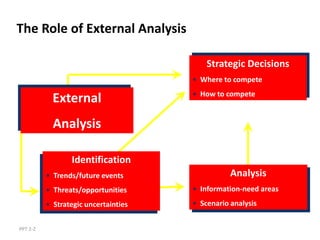
The Role of External Analysis
External
Analysis
Strategic Decisions
• Where to compete
• How to compete
Analysis
• Information-need areas
• Scenario analysis
Identification
• Trends/future events
• Threats/opportunities
• Strategic uncertainties
Figure 3.1
Chapter 2 - External and
PPT 2-3
Strategic Uncertainties
• Will a major firm enter?
• Will a tofu-based dessert
product be accepted?
• Will a technology be replaced?
• Will the dollar strengthen
against an off-shore currency?
• Will computer-based
operations be feasible with
current technology?
• How sensitive is the market to
price?
Strategic Decisions
• Investment in a product market
• Investment in a tofu-based product
• Investment in a technology
• Commitment to off-shore
manufacturing
• Investment in a new system
• A strategy of maintaining price parity
Chapter 2 - External and
PPT 2-4
Strategic Uncertainties
What will the
future demand?
• Performance improvements?
• Competitive technological
developments?
• Financial capacity of health care
industry?
External Analysis
Customer Analysis
Chapter 2 - External and
PPT 2-6
Customer Analysis
Segmentation
• Identification of customers groups that respond differently
from other groups to competitive offerings. Thus, a successful
segmentation strategy requires the conceptualization,
development, and evaluation of a competitive offering.
• Who are the biggest customers? The most profitable? The
most attractive potential customers?
Figure 2.2
Chapter 2 - External and
PPT 2-7
Examples of Approaches to Defining Segments
Customer Characteristics
• Geographic
• Type of organization
• Size of firm
• Lifestyle
• Sex
• Age
• Occupation
Figure 2.3
Chapter 2 - External and
PPT 2-8
Examples of Approaches to Defining Segments
Product-Related Approaches
• User type
• Usage
• Benefits sought
• Price sensitivity
• Competitor
• Application
• Brand loyalty
Figure 2.3
Chapter 2 - External and
PPT 2-9
Segmentation
How should segments be defined?
– Benefit Segmentation
– Price Sensitivity
– Loyalty
– Applications
– Multiple Segments versus Focus Strategy
Chapter 2 - External and
PPT 2-10
Customer Analysis
Customer Motivations
• What elements of the product/service do customers value most?
• What are the customers’ objectives? What are they really buying?
• How do segments differ in their motivation priorities?
• What changes are occurring in customer motivation? In customer
priorities?
Figure 3.2
Chapter 2 - External and
PPT 2-11
Customer Motivation Analysis
Identify
Motivations
Group and
Structure
Motivations
Assess
Motivation
Importance
Assign Strategic
Roles to Motivations
Figure 2.6
Chapter 2 - External and
PPT 2-12
The Customer as Active Partner
• Encourage Active Dialogue
• Mobilize Customer Communities
• Manage Customer Diversity
• Co-creating Personalized Experiences
Chapter 2 - External and
PPT 2-13
Customer Analysis
Unmet Needs
• Why are some customers dissatisfied? Why are some changing brands or
suppliers?
• What are the severity and incidence of consumer problems?
• What are the unmet needs that customers can identify? Are there some of
which consumers are unaware?
• Do these unmet needs represent leverage points for competitors?
Figure 2.2
External Analysis
Competitor Analysis
Chapter 3 - Competitor
PPT 3-15
Competitor Identification
Customer-Based Approaches
– Customer choices – What brand would you buy if your
favorite was unavailable?
– Application associations – What applications? What
brands for each application?
– What product substitutes?
Chapter 3 - Competitor
PPT 3-16
Competitor Identification
Strategic Groups
–Pursue similar competitive strategies
–Have similar characteristics
–Have similar assets and competencies
Chapter 3 - Competitor
PPT 3-17
Competitor Analysis
Potential Competitors
–Market expansion
–Product expansion
–Backward integration
–Forward integration
–Export assets or competencies
–Retaliatory or defensive strategies
Chapter 3 - Competitor
PPT 3-18
Understanding the Competitors
Objectives and
Commitment
Image and
Positioning
Size, Growth
& Profitability
Current and Past
Strategies
Strengths and
Weaknesses
Cost Structure
Exit Barriers Organization and
Culture
Competitor
Actions
Figure 3.3
Chapter 3 - Competitor
PPT 3-19
Identify Assets and Competencies
1) What businesses have been successful over time?
What assets or competencies contributed to
their success?
What businesses have had chronically low
performance?
Why?
What assets or competencies do they lack?
Chapter 3 - Competitor
PPT 3-20
2) What are the key customer motivations?
What is really important to the customer?
3) What are the large mobility barriers (both
entry and exit)?
Relevant Assets and Competencies
Chapter 3 - Competitor
PPT 3-21
4) Consider the components of the value chain.
Do any provide the potential to generate a
competitive advantage?
Relevant Assets and Competencies
Chapter 3 - Competitor
PPT 3-22
The Value Chain
Source: Reprinted with permission ã 1985 Michael Porter
ServiceOperations
Outbound
Logistics
Inbound
Logistics
Marketing
&
Sales
Primary Activities
SupportActivities
Firm Infrastructure
Human Resource Management
Technology Development
Procurement
Any Queries?
Thank You

External analysis

  • 1.
  • 2.
    Chapter 2 -External and PPT 2-2 The Role of External Analysis External Analysis Strategic Decisions • Where to compete • How to compete Analysis • Information-need areas • Scenario analysis Identification • Trends/future events • Threats/opportunities • Strategic uncertainties Figure 3.1
  • 3.
    Chapter 2 -External and PPT 2-3 Strategic Uncertainties Strategic Uncertainties • Will a major firm enter? • Will a tofu-based dessert product be accepted? • Will a technology be replaced? • Will the dollar strengthen against an off-shore currency? • Will computer-based operations be feasible with current technology? • How sensitive is the market to price? Strategic Decisions • Investment in a product market • Investment in a tofu-based product • Investment in a technology • Commitment to off-shore manufacturing • Investment in a new system • A strategy of maintaining price parity
  • 4.
    Chapter 2 -External and PPT 2-4 Strategic Uncertainties What will the future demand? • Performance improvements? • Competitive technological developments? • Financial capacity of health care industry?
  • 5.
  • 6.
    Chapter 2 -External and PPT 2-6 Customer Analysis Segmentation • Identification of customers groups that respond differently from other groups to competitive offerings. Thus, a successful segmentation strategy requires the conceptualization, development, and evaluation of a competitive offering. • Who are the biggest customers? The most profitable? The most attractive potential customers? Figure 2.2
  • 7.
    Chapter 2 -External and PPT 2-7 Examples of Approaches to Defining Segments Customer Characteristics • Geographic • Type of organization • Size of firm • Lifestyle • Sex • Age • Occupation Figure 2.3
  • 8.
    Chapter 2 -External and PPT 2-8 Examples of Approaches to Defining Segments Product-Related Approaches • User type • Usage • Benefits sought • Price sensitivity • Competitor • Application • Brand loyalty Figure 2.3
  • 9.
    Chapter 2 -External and PPT 2-9 Segmentation How should segments be defined? – Benefit Segmentation – Price Sensitivity – Loyalty – Applications – Multiple Segments versus Focus Strategy
  • 10.
    Chapter 2 -External and PPT 2-10 Customer Analysis Customer Motivations • What elements of the product/service do customers value most? • What are the customers’ objectives? What are they really buying? • How do segments differ in their motivation priorities? • What changes are occurring in customer motivation? In customer priorities? Figure 3.2
  • 11.
    Chapter 2 -External and PPT 2-11 Customer Motivation Analysis Identify Motivations Group and Structure Motivations Assess Motivation Importance Assign Strategic Roles to Motivations Figure 2.6
  • 12.
    Chapter 2 -External and PPT 2-12 The Customer as Active Partner • Encourage Active Dialogue • Mobilize Customer Communities • Manage Customer Diversity • Co-creating Personalized Experiences
  • 13.
    Chapter 2 -External and PPT 2-13 Customer Analysis Unmet Needs • Why are some customers dissatisfied? Why are some changing brands or suppliers? • What are the severity and incidence of consumer problems? • What are the unmet needs that customers can identify? Are there some of which consumers are unaware? • Do these unmet needs represent leverage points for competitors? Figure 2.2
  • 14.
  • 15.
    Chapter 3 -Competitor PPT 3-15 Competitor Identification Customer-Based Approaches – Customer choices – What brand would you buy if your favorite was unavailable? – Application associations – What applications? What brands for each application? – What product substitutes?
  • 16.
    Chapter 3 -Competitor PPT 3-16 Competitor Identification Strategic Groups –Pursue similar competitive strategies –Have similar characteristics –Have similar assets and competencies
  • 17.
    Chapter 3 -Competitor PPT 3-17 Competitor Analysis Potential Competitors –Market expansion –Product expansion –Backward integration –Forward integration –Export assets or competencies –Retaliatory or defensive strategies
  • 18.
    Chapter 3 -Competitor PPT 3-18 Understanding the Competitors Objectives and Commitment Image and Positioning Size, Growth & Profitability Current and Past Strategies Strengths and Weaknesses Cost Structure Exit Barriers Organization and Culture Competitor Actions Figure 3.3
  • 19.
    Chapter 3 -Competitor PPT 3-19 Identify Assets and Competencies 1) What businesses have been successful over time? What assets or competencies contributed to their success? What businesses have had chronically low performance? Why? What assets or competencies do they lack?
  • 20.
    Chapter 3 -Competitor PPT 3-20 2) What are the key customer motivations? What is really important to the customer? 3) What are the large mobility barriers (both entry and exit)? Relevant Assets and Competencies
  • 21.
    Chapter 3 -Competitor PPT 3-21 4) Consider the components of the value chain. Do any provide the potential to generate a competitive advantage? Relevant Assets and Competencies
  • 22.
    Chapter 3 -Competitor PPT 3-22 The Value Chain Source: Reprinted with permission ã 1985 Michael Porter ServiceOperations Outbound Logistics Inbound Logistics Marketing & Sales Primary Activities SupportActivities Firm Infrastructure Human Resource Management Technology Development Procurement
  • 23.