
The Management of Service and
Quality in Retailing
Dr. Gopal Thapa
Tribhuvan University
What constitutes Retailing
 Tangible features
 Intangible services
2/5/2023 Prepared by Dr. Gopal Thapa 2
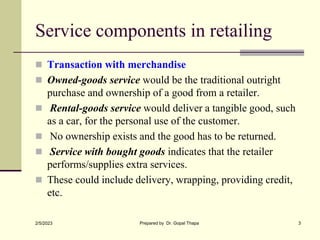
Service components in retailing
 Transaction with merchandise
 Owned-goods service would be the traditional outright
purchase and ownership of a good from a retailer.
 Rental-goods service would deliver a tangible good, such
as a car, for the personal use of the customer.
 No ownership exists and the good has to be returned.
 Service with bought goods indicates that the retailer
performs/supplies extra services.
 These could include delivery, wrapping, providing credit,
etc.
2/5/2023 Prepared by Dr. Gopal Thapa 3
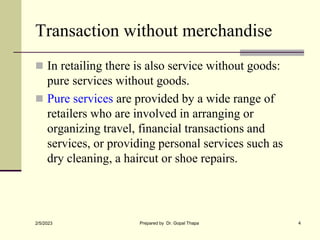
Transaction without merchandise
 In retailing there is also service without goods:
pure services without goods.
 Pure services are provided by a wide range of
retailers who are involved in arranging or
organizing travel, financial transactions and
services, or providing personal services such as
dry cleaning, a haircut or shoe repairs.
2/5/2023 Prepared by Dr. Gopal Thapa 4
Service Characteristics
 intangibility;
 perishability;
 inseparability
2/5/2023 Prepared by Dr. Gopal Thapa 5
Service Quality Management
2/5/2023 Prepared by Dr. Gopal Thapa 6
 Product-attribute approach
 Consumer-oriented approach
Product-attribute approach
 The product-attribute approach is based upon
trying to match the product’s conformance to
standardized requirements which have been set by
reference to what company managers think the
failure point to be.
 Product-attribute approaches rely on trying to
control the company’s output by using an internal
standard-setting perspective.
 This relies on an inward-looking and trading-led
management style, rather than a marketing-led
approach.
2/5/2023 Prepared by Dr. Gopal Thapa 7
Consumer-oriented approach
 It recognizes that the holistic process of service
delivery has to be controlled by taking into
consideration the expectations and attitudes of
retail customers.
 If the starting point for management is the
understanding of how quality is judged by
customers then the perception processes of this
judgment, as to whether a service is good or bad,
can be managed.
2/5/2023 Prepared by Dr. Gopal Thapa 8
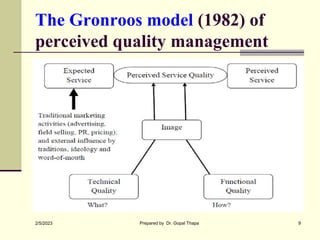
The Gronroos model (1982) of
perceived quality management
2/5/2023 Prepared by Dr. Gopal Thapa 9
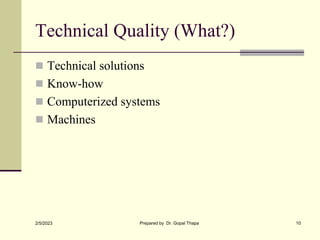
Technical Quality (What?)
 Technical solutions
 Know-how
 Computerized systems
 Machines
2/5/2023 Prepared by Dr. Gopal Thapa 10
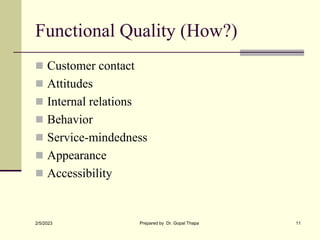
Functional Quality (How?)
 Customer contact
 Attitudes
 Internal relations
 Behavior
 Service-mindedness
 Appearance
 Accessibility
2/5/2023 Prepared by Dr. Gopal Thapa 11
2/5/2023 Prepared by Dr. Gopal Thapa 12
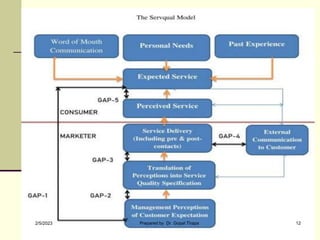
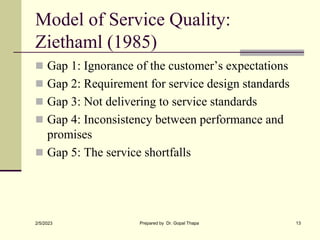
Model of Service Quality:
Ziethaml (1985)
 Gap 1: Ignorance of the customer’s expectations
 Gap 2: Requirement for service design standards
 Gap 3: Not delivering to service standards
 Gap 4: Inconsistency between performance and
promises
 Gap 5: The service shortfalls
2/5/2023 Prepared by Dr. Gopal Thapa 13
Implementation of Service
Management
 Leadership and commitment by senior management,
 The focus of all changes and objectives should be defined
by the customer
 The orientation of the organization needs to adopt a
process and systems approach to match or exceed customer
expectations
 Human resource management is required to motivate,
reward, train and educate staff
 to understand and deliver the concepts of quality.
2/5/2023 Prepared by Dr. Gopal Thapa 14
Implementation of Service
Management ( contd…)
 Assessment needs to be made of the added value
and benefit of any change rather than there being
an emphasis on costs and profit implications.
 That is, the long-term benefits of any change need
to be the focus of decision-making.
 A need for quality audits and control to ensure the
service meets or exceeds customer expectations
must be recognized.
2/5/2023 Prepared by Dr. Gopal Thapa 15
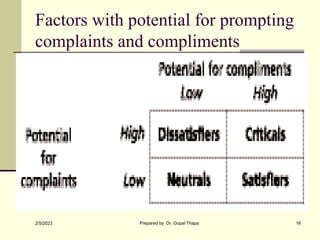
Factors with potential for prompting
complaints and compliments
2/5/2023 Prepared by Dr. Gopal Thapa 16
Growing emphasis on quality
control
 Companies need to find new ways of creating
differential advantage by providing better service
levels than their competitors.
 Retail competition has increased because services
and goods are available from a wide range of
channels and manufacturers are creating
technically satisfactory goods that require little
after-sales service.
2/5/2023 Prepared by Dr. Gopal Thapa 17
Growing emphasis on quality
control (Contd..)
 The increased levels of consumerism and the
greater media attention on quality have meant that
companies have to be more responsive to quality
issues.
 Consumers are far more aware of their rights and
are less likely to suffer quietly from the results of
poor quality.
2/5/2023 Prepared by Dr. Gopal Thapa 18
Growing emphasis on quality
control (Contd..)
 There has been a growing sophistication of consumer
markets, with the non-price factors of image, retail offer
positioning and service delivery processes becoming more
important.
 Technology is one of the new applications to quality
enhancement.
 It can aid service by providing higher levels of
convenience:
 for example, automatic vending or ticketing machines, bar
code checkout systems to improve accuracy and speed of
transaction, or smart card developments – all of which
provide memory of purchases.
2/5/2023 Prepared by Dr. Gopal Thapa 19
Key Terms For Quality
 Quality is the totality of relationships between
service providers (functional aspects) and the
features of retailing (technical aspects) which are
related to the delivery of satisfaction.
 Quality control checks, and also monitoring
processes to ensure that measurement of service
delivery is taking place
2/5/2023 Prepared by Dr. Gopal Thapa 20
Key Terms For Quality (Contd…)
 Total quality management (TQM) is a holistic
organizational approach which systematically attempts to
improve customer satisfaction by focusing on continuous
quality improvements without incurring unacceptable cost
increases.
 TQM is managed by quality assurance arrangements; that
is, a system is instituted to allocate responsibility for
planned and systematic activities which will ensure that the
product will provide the right levels of satisfaction for all
concerned.
2/5/2023 Prepared by Dr. Gopal Thapa 21
Key Terms For Quality (Contd…)
 In order to measure whether the quality delivery
complies with the planned delivery of the service a
quality audit needs to take place to judge the
effectiveness of the total service delivery
arrangements.
 For a system to be audited correctly a method of
creating unbiased feedback must be found.
2/5/2023 Prepared by Dr. Gopal Thapa 22
Characteristics of Quality
 Merchandise
 Service
2/5/2023 Prepared by Dr. Gopal Thapa 23
Merchandise categories
 performance based upon inherent operating
characteristics, such as the sound and clarity of a
hi-fi system;
 features which add to the basic function of the
product;
 reliability of the product not to break down in
normal use;
 conformance to standards of safety or operating
performance needs;
2/5/2023 Prepared by Dr. Gopal Thapa 24
Merchandise categories (Contd..)
 durability based upon the length of time a product
will last;
 serviceability – relating to the after-sales service
and ability to be repaired;
 aesthetics of the look, feel, design, sound and
smell of the product;
 image of the brand association, reputation and
personality of the product.
2/5/2023 Prepared by Dr. Gopal Thapa 25
Service categories
 Tangibles
 Reliability
 Responsiveness
 Competence
 Empathy
2/5/2023 Prepared by Dr. Gopal Thapa 26
QUALITY AUDITING SYSTEMS
(Based on Customers Preferences)
 external appearance of the branch;
 merchandise pricing in window display;
 greeting upon entry;
 staff approachability;
 staff availability to help;
 manager availability;
 whether the manager is recognizable;
 the number of customers served simultaneously by
one staff member;
2/5/2023 Prepared by Dr. Gopal Thapa 27
QUALITY AUDITING SYSTEMS
(Based on Customers Preferences)
 efficiency/promptness of enquiry handling;
 branch stock levels;
 staff awareness of fashion trends;
 speed of stock location;
 staff awareness of advertised lines;
 helpfulness of staff advice;
 honesty of staff advice;
 standard of fitting rooms;
2/5/2023 Prepared by Dr. Gopal Thapa 28
QUALITY AUDITING SYSTEMS
(Based on Customers Preferences)
 availability of advertised stock;
 colour/size availability;
 selection within size;
 availability of alterations advice;
 availability of garment reservation;
 eye-catching quality of window displays;
 eye-catching quality of interior displays;
 speed of till transaction;
 comparability of service in other Jaeger branches.
2/5/2023 Prepared by Dr. Gopal Thapa 29
Benchmarking
 A method now widely used for assessment of the
service standards of a company is to compare
them with those which are deemed to be the best
available
 It is a continuous process of selecting the best
practices and services against which to judge.
 It is based upon the Japanese concept dantotsu,
meaning ‘best of the best’
 If you seek out and match the best practice there
is the possibility of the attainment of superiority
2/5/2023 Prepared by Dr. Gopal Thapa 30
Four Types of Benchmarking
 Internal: where the best internal company
examples are utilized
 Competitive: based upon external directly
competing retailers and their merchandise
 Functional: which measures against the best
external market leaders or functional operations
 Generic: which is to take measures of the best
practices regardless of what sectors or industry is
represented
2/5/2023 Prepared by Dr. Gopal Thapa 31
Service Recovery
 Service recovery relates to the planned systems
and effort that a firm provides to correct a problem
following a service failure with the specific
objective of retaining a customer’s goodwill.
 Given that the estimated cost of finding a new
customer is five times that of retaining an existing
one,
 there is growing emphasis on customer retention
and relationship marketing..
2/5/2023 Prepared by Dr. Gopal Thapa 32
Service Recovery
 When a dissatisfied customer defects, the lifetime
value of that individual and anyone else who
switches due to negative comments is affected
 Long-term revenue can be enhanced by service
recovery strategies.
2/5/2023 Prepared by Dr. Gopal Thapa 33
Service Recovery
 Good service recovery procedures allow a
customer to refocus on the satisfactions received
from the service delivery process rather than to
question why corrective action was not taken.
 A problem tests the system and if a customer
complaint is dealt with appropriately the customer
is likely to become more loyal.
2/5/2023 Prepared by Dr. Gopal Thapa 34
Effective recovery requires
 Acting fast
 Admitting mistakes
 Empathy
 Relationship
 Informing and clarifying
 Remedial action
2/5/2023 Prepared by Dr. Gopal Thapa 35
Individual service recovery
strategies
 Watching for sign language
 Preplanning
 Training
 Empowerment
2/5/2023 Prepared by Dr. Gopal Thapa 36
Any Queries?
Thank you
2/5/2023 Prepared by Dr. Gopal Thapa 37

Retail service.ppt

  • 1.
    The Management ofService and Quality in Retailing Dr. Gopal Thapa Tribhuvan University
  • 2.
    What constitutes Retailing Tangible features  Intangible services 2/5/2023 Prepared by Dr. Gopal Thapa 2
  • 3.
    Service components inretailing  Transaction with merchandise  Owned-goods service would be the traditional outright purchase and ownership of a good from a retailer.  Rental-goods service would deliver a tangible good, such as a car, for the personal use of the customer.  No ownership exists and the good has to be returned.  Service with bought goods indicates that the retailer performs/supplies extra services.  These could include delivery, wrapping, providing credit, etc. 2/5/2023 Prepared by Dr. Gopal Thapa 3
  • 4.
    Transaction without merchandise In retailing there is also service without goods: pure services without goods.  Pure services are provided by a wide range of retailers who are involved in arranging or organizing travel, financial transactions and services, or providing personal services such as dry cleaning, a haircut or shoe repairs. 2/5/2023 Prepared by Dr. Gopal Thapa 4
  • 5.
    Service Characteristics  intangibility; perishability;  inseparability 2/5/2023 Prepared by Dr. Gopal Thapa 5
  • 6.
    Service Quality Management 2/5/2023Prepared by Dr. Gopal Thapa 6  Product-attribute approach  Consumer-oriented approach
  • 7.
    Product-attribute approach  Theproduct-attribute approach is based upon trying to match the product’s conformance to standardized requirements which have been set by reference to what company managers think the failure point to be.  Product-attribute approaches rely on trying to control the company’s output by using an internal standard-setting perspective.  This relies on an inward-looking and trading-led management style, rather than a marketing-led approach. 2/5/2023 Prepared by Dr. Gopal Thapa 7
  • 8.
    Consumer-oriented approach  Itrecognizes that the holistic process of service delivery has to be controlled by taking into consideration the expectations and attitudes of retail customers.  If the starting point for management is the understanding of how quality is judged by customers then the perception processes of this judgment, as to whether a service is good or bad, can be managed. 2/5/2023 Prepared by Dr. Gopal Thapa 8
  • 9.
    The Gronroos model(1982) of perceived quality management 2/5/2023 Prepared by Dr. Gopal Thapa 9
  • 10.
    Technical Quality (What?) Technical solutions  Know-how  Computerized systems  Machines 2/5/2023 Prepared by Dr. Gopal Thapa 10
  • 11.
    Functional Quality (How?) Customer contact  Attitudes  Internal relations  Behavior  Service-mindedness  Appearance  Accessibility 2/5/2023 Prepared by Dr. Gopal Thapa 11
  • 12.
    2/5/2023 Prepared byDr. Gopal Thapa 12
  • 13.
    Model of ServiceQuality: Ziethaml (1985)  Gap 1: Ignorance of the customer’s expectations  Gap 2: Requirement for service design standards  Gap 3: Not delivering to service standards  Gap 4: Inconsistency between performance and promises  Gap 5: The service shortfalls 2/5/2023 Prepared by Dr. Gopal Thapa 13
  • 14.
    Implementation of Service Management Leadership and commitment by senior management,  The focus of all changes and objectives should be defined by the customer  The orientation of the organization needs to adopt a process and systems approach to match or exceed customer expectations  Human resource management is required to motivate, reward, train and educate staff  to understand and deliver the concepts of quality. 2/5/2023 Prepared by Dr. Gopal Thapa 14
  • 15.
    Implementation of Service Management( contd…)  Assessment needs to be made of the added value and benefit of any change rather than there being an emphasis on costs and profit implications.  That is, the long-term benefits of any change need to be the focus of decision-making.  A need for quality audits and control to ensure the service meets or exceeds customer expectations must be recognized. 2/5/2023 Prepared by Dr. Gopal Thapa 15
  • 16.
    Factors with potentialfor prompting complaints and compliments 2/5/2023 Prepared by Dr. Gopal Thapa 16
  • 17.
    Growing emphasis onquality control  Companies need to find new ways of creating differential advantage by providing better service levels than their competitors.  Retail competition has increased because services and goods are available from a wide range of channels and manufacturers are creating technically satisfactory goods that require little after-sales service. 2/5/2023 Prepared by Dr. Gopal Thapa 17
  • 18.
    Growing emphasis onquality control (Contd..)  The increased levels of consumerism and the greater media attention on quality have meant that companies have to be more responsive to quality issues.  Consumers are far more aware of their rights and are less likely to suffer quietly from the results of poor quality. 2/5/2023 Prepared by Dr. Gopal Thapa 18
  • 19.
    Growing emphasis onquality control (Contd..)  There has been a growing sophistication of consumer markets, with the non-price factors of image, retail offer positioning and service delivery processes becoming more important.  Technology is one of the new applications to quality enhancement.  It can aid service by providing higher levels of convenience:  for example, automatic vending or ticketing machines, bar code checkout systems to improve accuracy and speed of transaction, or smart card developments – all of which provide memory of purchases. 2/5/2023 Prepared by Dr. Gopal Thapa 19
  • 20.
    Key Terms ForQuality  Quality is the totality of relationships between service providers (functional aspects) and the features of retailing (technical aspects) which are related to the delivery of satisfaction.  Quality control checks, and also monitoring processes to ensure that measurement of service delivery is taking place 2/5/2023 Prepared by Dr. Gopal Thapa 20
  • 21.
    Key Terms ForQuality (Contd…)  Total quality management (TQM) is a holistic organizational approach which systematically attempts to improve customer satisfaction by focusing on continuous quality improvements without incurring unacceptable cost increases.  TQM is managed by quality assurance arrangements; that is, a system is instituted to allocate responsibility for planned and systematic activities which will ensure that the product will provide the right levels of satisfaction for all concerned. 2/5/2023 Prepared by Dr. Gopal Thapa 21
  • 22.
    Key Terms ForQuality (Contd…)  In order to measure whether the quality delivery complies with the planned delivery of the service a quality audit needs to take place to judge the effectiveness of the total service delivery arrangements.  For a system to be audited correctly a method of creating unbiased feedback must be found. 2/5/2023 Prepared by Dr. Gopal Thapa 22
  • 23.
    Characteristics of Quality Merchandise  Service 2/5/2023 Prepared by Dr. Gopal Thapa 23
  • 24.
    Merchandise categories  performancebased upon inherent operating characteristics, such as the sound and clarity of a hi-fi system;  features which add to the basic function of the product;  reliability of the product not to break down in normal use;  conformance to standards of safety or operating performance needs; 2/5/2023 Prepared by Dr. Gopal Thapa 24
  • 25.
    Merchandise categories (Contd..) durability based upon the length of time a product will last;  serviceability – relating to the after-sales service and ability to be repaired;  aesthetics of the look, feel, design, sound and smell of the product;  image of the brand association, reputation and personality of the product. 2/5/2023 Prepared by Dr. Gopal Thapa 25
  • 26.
    Service categories  Tangibles Reliability  Responsiveness  Competence  Empathy 2/5/2023 Prepared by Dr. Gopal Thapa 26
  • 27.
    QUALITY AUDITING SYSTEMS (Basedon Customers Preferences)  external appearance of the branch;  merchandise pricing in window display;  greeting upon entry;  staff approachability;  staff availability to help;  manager availability;  whether the manager is recognizable;  the number of customers served simultaneously by one staff member; 2/5/2023 Prepared by Dr. Gopal Thapa 27
  • 28.
    QUALITY AUDITING SYSTEMS (Basedon Customers Preferences)  efficiency/promptness of enquiry handling;  branch stock levels;  staff awareness of fashion trends;  speed of stock location;  staff awareness of advertised lines;  helpfulness of staff advice;  honesty of staff advice;  standard of fitting rooms; 2/5/2023 Prepared by Dr. Gopal Thapa 28
  • 29.
    QUALITY AUDITING SYSTEMS (Basedon Customers Preferences)  availability of advertised stock;  colour/size availability;  selection within size;  availability of alterations advice;  availability of garment reservation;  eye-catching quality of window displays;  eye-catching quality of interior displays;  speed of till transaction;  comparability of service in other Jaeger branches. 2/5/2023 Prepared by Dr. Gopal Thapa 29
  • 30.
    Benchmarking  A methodnow widely used for assessment of the service standards of a company is to compare them with those which are deemed to be the best available  It is a continuous process of selecting the best practices and services against which to judge.  It is based upon the Japanese concept dantotsu, meaning ‘best of the best’  If you seek out and match the best practice there is the possibility of the attainment of superiority 2/5/2023 Prepared by Dr. Gopal Thapa 30
  • 31.
    Four Types ofBenchmarking  Internal: where the best internal company examples are utilized  Competitive: based upon external directly competing retailers and their merchandise  Functional: which measures against the best external market leaders or functional operations  Generic: which is to take measures of the best practices regardless of what sectors or industry is represented 2/5/2023 Prepared by Dr. Gopal Thapa 31
  • 32.
    Service Recovery  Servicerecovery relates to the planned systems and effort that a firm provides to correct a problem following a service failure with the specific objective of retaining a customer’s goodwill.  Given that the estimated cost of finding a new customer is five times that of retaining an existing one,  there is growing emphasis on customer retention and relationship marketing.. 2/5/2023 Prepared by Dr. Gopal Thapa 32
  • 33.
    Service Recovery  Whena dissatisfied customer defects, the lifetime value of that individual and anyone else who switches due to negative comments is affected  Long-term revenue can be enhanced by service recovery strategies. 2/5/2023 Prepared by Dr. Gopal Thapa 33
  • 34.
    Service Recovery  Goodservice recovery procedures allow a customer to refocus on the satisfactions received from the service delivery process rather than to question why corrective action was not taken.  A problem tests the system and if a customer complaint is dealt with appropriately the customer is likely to become more loyal. 2/5/2023 Prepared by Dr. Gopal Thapa 34
  • 35.
    Effective recovery requires Acting fast  Admitting mistakes  Empathy  Relationship  Informing and clarifying  Remedial action 2/5/2023 Prepared by Dr. Gopal Thapa 35
  • 36.
    Individual service recovery strategies Watching for sign language  Preplanning  Training  Empowerment 2/5/2023 Prepared by Dr. Gopal Thapa 36
  • 37.
    Any Queries? Thank you 2/5/2023Prepared by Dr. Gopal Thapa 37