



By Godavari Adal
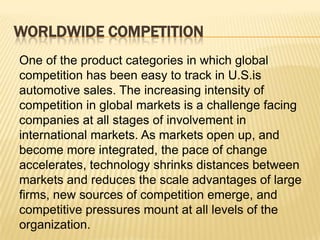
EXPORT MARKETING
         Submitted to :- Prof. Nitin Agarwal
The Oxford University Press
defines Export marketing as
“marketing on a worldwide
scale reconciling or taking
commercial advantage of
global operational
differences, similarities and
opportunities in order to meet
global objectives.”
WORLDWIDE COMPETITION
One of the product categories in which global
competition has been easy to track in U.S.is
automotive sales. The increasing intensity of
competition in global markets is a challenge facing
companies at all stages of involvement in
international markets. As markets open up, and
become more integrated, the pace of change
accelerates, technology shrinks distances between
markets and reduces the scale advantages of large
firms, new sources of competition emerge, and
competitive pressures mount at all levels of the
organization.
INDIAN
MEANING
R.L. Kramer defines “ export marketing
involves export business with individuals,
firms organizations and/or government
entities in the countries”
Export market is a systematic process to
designing and delivering products to satisfy
overseas customer and to achieve objective
of the firm.
FEATURES OF EXPORT MARKETING
 Systematic process
 Customer focus
 Trade barriers
 Trading blocs
 Documentation
 Diverse customs and tradition
 International market research
 Spreading of risks
 Reputation
MOTIVATION FOR EXPORT MARKETING

 Rate of profit
 Sales and production stability

 Monopoly power

 Competition in domestic market

 Economic growth

 Government policies

 WTO
PROBLEMS FACED BY INDIAN EXPORTER

 Recession in the world markets
 Reduction in export incentives

 Competition from china

 Problem of production standards

 Problems of sea pirates attacks

 Problems of subsidies by developed
  countries
 Documentation formalities
SUNRISE EXPORT

 Horticulture products such as fruits and
  vegetables.
 Green technology products such as wind
  turbines, electric cars, etc.
 Dairy products

 Value added marine products

 Processed fruits and vegetable products.

 Value added meat products ,etc.
Export marketing
Export marketing

Export marketing

  • 1.
    By Godavari Adal EXPORTMARKETING Submitted to :- Prof. Nitin Agarwal
  • 2.
    The Oxford UniversityPress defines Export marketing as “marketing on a worldwide scale reconciling or taking commercial advantage of global operational differences, similarities and opportunities in order to meet global objectives.”
  • 3.
    WORLDWIDE COMPETITION One ofthe product categories in which global competition has been easy to track in U.S.is automotive sales. The increasing intensity of competition in global markets is a challenge facing companies at all stages of involvement in international markets. As markets open up, and become more integrated, the pace of change accelerates, technology shrinks distances between markets and reduces the scale advantages of large firms, new sources of competition emerge, and competitive pressures mount at all levels of the organization.
  • 4.
  • 5.
    MEANING R.L. Kramer defines“ export marketing involves export business with individuals, firms organizations and/or government entities in the countries” Export market is a systematic process to designing and delivering products to satisfy overseas customer and to achieve objective of the firm.
  • 6.
    FEATURES OF EXPORTMARKETING  Systematic process  Customer focus  Trade barriers  Trading blocs  Documentation  Diverse customs and tradition  International market research  Spreading of risks  Reputation
  • 7.
    MOTIVATION FOR EXPORTMARKETING  Rate of profit  Sales and production stability  Monopoly power  Competition in domestic market  Economic growth  Government policies  WTO
  • 8.
    PROBLEMS FACED BYINDIAN EXPORTER  Recession in the world markets  Reduction in export incentives  Competition from china  Problem of production standards  Problems of sea pirates attacks  Problems of subsidies by developed countries  Documentation formalities
  • 11.
    SUNRISE EXPORT  Horticultureproducts such as fruits and vegetables.  Green technology products such as wind turbines, electric cars, etc.  Dairy products  Value added marine products  Processed fruits and vegetable products.  Value added meat products ,etc.