FLIXBOROUGH DISASTER:
EXPLOSION OF CHEMICAL PLANT
NUR AMIRA BINTI AZMI
(SA14052)
NURUL ATIRAH BINTI ABDUL RAZAK
(SA15055)
INTRODUCTION
•On Saturday 1 June 1974 at 4:53 p.m.,
Nypro (UK) site at Flixborough was
severely damaged by a large explosion
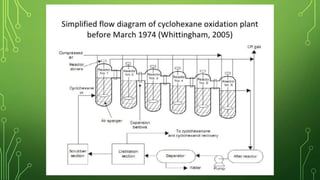
•Before the explosion: vertical crack on
reactor no 5 was leaking cyclohexane on
27 March 1974
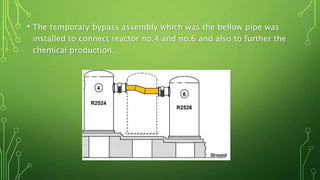
• The temporary bypass assembly which was the bellow pipe was
installed to connect reactor no.4 and no.6 and also to further the
chemical production.
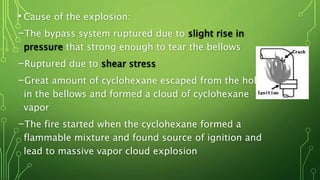
• Cause of the explosion:
-The bypass system ruptured due to slight rise in
pressure that strong enough to tear the bellows
-Ruptured due to shear stress
-Great amount of cyclohexane escaped from the holes
in the bellows and formed a cloud of cyclohexane
vapor
-The fire started when the cyclohexane formed a
flammable mixture and found source of ignition and
lead to massive vapor cloud explosion
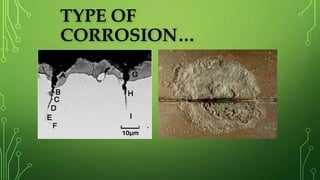
TYPE OF
CORROSION…
•An environmentally well-known as a failure
caused by exposure to a corroding while under
a sustained tensile stress. (M.E. SAMIR, 2013)
•SCC is a cracking process that requires the
simultaneous action of a corrodent and
sustained tensile stress. (WebCorr website)
•Most rapid and unpredictable
STRESS CORROSION CRACKING (SCC)
•The process of SCC consist of 3 stages:
1. Crack initiation
2.Crack propagation
3.Brittle fracture
MECHANISM..
•SCC is initiated by stress concentrations at
defects on the material surface. The defect
may also be a result of pitting corrosion,
crevice corrosion, intergranular corrosion
or local galvanic corrosion.
CRACK INITIATION..
CRACK PROPAGATION..
• The passivation film at the tip of the crack is broken due to
plastic deformation. Pure and normally very active metal is
exposed and will be attacked by corrosion.
• Growth rate will be a combination of corrosion and cracking. The
crack start to growth when the stress concentration at the end of
te crack (KI) exceeds the threshold stress intensity factor for SCC
BRITTLE FRACTURE..
• When the stress concentration at the end of the crack exceeds the critical
stress intensity factor (KI > KIC), there will be a rapid, unstable brittle
fracture.
•NO UNIFIED MECHANISM in literature.
•Various model that have been proposed:
1. Adsorption model
2.Film rupture model
3.Pre-existing active path model
4.Embrittlement model
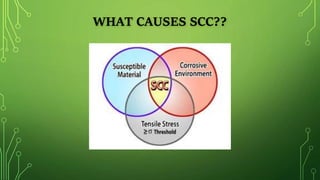
WHAT CAUSES SCC??
•Sources of tensile stress:
1. Assembly stress
2.Residual stress
3.Concentration of stress at the root of pre-
existing cracks or notches.
FACTOR : FLIXBOROUGH
• Presence of nitrates that had contaminated with
river water.
• Intergranular crack.
• Conjoint action of stress of an appropriate
magnitude and a corrosive environment, of a
specific composition, upon steel having a wide
range of composition of structures.
CASE DETAILS (COMMENT)
•Carelessness and less knowledge of the
workers/engineers.
• No references in designed the pipe.
• The only calculations made were of the capacity of the assembly
needed to carry the required flow.
• Nitrate treated cooling water be sprayed on the top of the reactor
SUGGESTION FOR PREVENTION
• - STEEL SELECTION
•- FABRICATION
•- SURFACE TREATMENT
•- DESIGN STRESSES
•- PROTECTIVE COATING
• STEEL SELECTION :
• -used in corrosive environment likely to cause SCC
• - steel more resistant to SCC
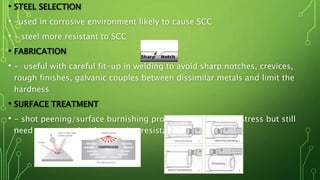
• FABRICATION
• - useful with careful fit-up in welding to avoid sharp notches, crevices,
rough finishes, galvanic couples between dissimilar metals and limit the
hardness
• SURFACE TREATMENT
• - shot peening/surface burnishing produces compressive stress but still
need to use steel with corrosion resistant
• DESIGNED STRESSES
• - designed with limit stresses below 50% yield stress
• PROTECTIVE COATING
• - organic coatings because adherent and nonporous
SIMILAR CASES IN THE WORLD
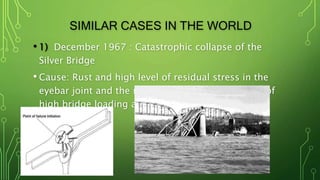
• 1) December 1967 : Catastrophic collapse of the
Silver Bridge
• Cause: Rust and high level of residual stress in the
eyebar joint and the main chain joint failed result of
high bridge loading and low temperature
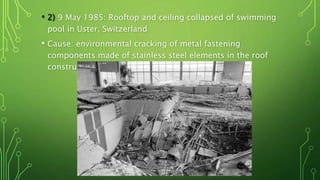
• 2) 9 May 1985: Rooftop and ceiling collapsed of swimming
pool in Uster, Switzerland
• Cause: environmental cracking of metal fastening
components made of stainless steel elements in the roof
construction
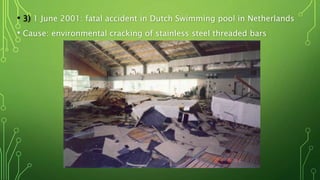
• 3) 1 June 2001: fatal accident in Dutch Swimming pool in Netherlands
• Cause: environmental cracking of stainless steel threaded bars
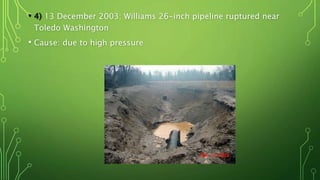
• 4) 13 December 2003: Williams 26-inch pipeline ruptured near
Toledo Washington
• Cause: due to high pressure
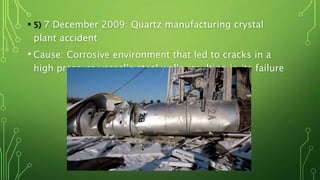
• 5) 7 December 2009: Quartz manufacturing crystal
plant accident
• Cause: Corrosive environment that led to cracks in a
high pressure vessel’s steel walls resulting in its failure

Flixborough Disaster slide

  • 1.
    FLIXBOROUGH DISASTER: EXPLOSION OFCHEMICAL PLANT NUR AMIRA BINTI AZMI (SA14052) NURUL ATIRAH BINTI ABDUL RAZAK (SA15055)
  • 2.
    INTRODUCTION •On Saturday 1June 1974 at 4:53 p.m., Nypro (UK) site at Flixborough was severely damaged by a large explosion •Before the explosion: vertical crack on reactor no 5 was leaking cyclohexane on 27 March 1974
  • 4.
    • The temporarybypass assembly which was the bellow pipe was installed to connect reactor no.4 and no.6 and also to further the chemical production.
  • 5.
    • Cause ofthe explosion: -The bypass system ruptured due to slight rise in pressure that strong enough to tear the bellows -Ruptured due to shear stress -Great amount of cyclohexane escaped from the holes in the bellows and formed a cloud of cyclohexane vapor -The fire started when the cyclohexane formed a flammable mixture and found source of ignition and lead to massive vapor cloud explosion
  • 6.
  • 7.
    •An environmentally well-knownas a failure caused by exposure to a corroding while under a sustained tensile stress. (M.E. SAMIR, 2013) •SCC is a cracking process that requires the simultaneous action of a corrodent and sustained tensile stress. (WebCorr website) •Most rapid and unpredictable STRESS CORROSION CRACKING (SCC)
  • 8.
    •The process ofSCC consist of 3 stages: 1. Crack initiation 2.Crack propagation 3.Brittle fracture MECHANISM..
  • 9.
    •SCC is initiatedby stress concentrations at defects on the material surface. The defect may also be a result of pitting corrosion, crevice corrosion, intergranular corrosion or local galvanic corrosion. CRACK INITIATION..
  • 10.
    CRACK PROPAGATION.. • Thepassivation film at the tip of the crack is broken due to plastic deformation. Pure and normally very active metal is exposed and will be attacked by corrosion. • Growth rate will be a combination of corrosion and cracking. The crack start to growth when the stress concentration at the end of te crack (KI) exceeds the threshold stress intensity factor for SCC
  • 11.
    BRITTLE FRACTURE.. • Whenthe stress concentration at the end of the crack exceeds the critical stress intensity factor (KI > KIC), there will be a rapid, unstable brittle fracture.
  • 12.
    •NO UNIFIED MECHANISMin literature. •Various model that have been proposed: 1. Adsorption model 2.Film rupture model 3.Pre-existing active path model 4.Embrittlement model
  • 13.
  • 14.
    •Sources of tensilestress: 1. Assembly stress 2.Residual stress 3.Concentration of stress at the root of pre- existing cracks or notches.
  • 15.
    FACTOR : FLIXBOROUGH •Presence of nitrates that had contaminated with river water. • Intergranular crack. • Conjoint action of stress of an appropriate magnitude and a corrosive environment, of a specific composition, upon steel having a wide range of composition of structures.
  • 16.
    CASE DETAILS (COMMENT) •Carelessnessand less knowledge of the workers/engineers. • No references in designed the pipe. • The only calculations made were of the capacity of the assembly needed to carry the required flow. • Nitrate treated cooling water be sprayed on the top of the reactor
  • 17.
    SUGGESTION FOR PREVENTION •- STEEL SELECTION •- FABRICATION •- SURFACE TREATMENT •- DESIGN STRESSES •- PROTECTIVE COATING
  • 18.
    • STEEL SELECTION: • -used in corrosive environment likely to cause SCC • - steel more resistant to SCC • FABRICATION • - useful with careful fit-up in welding to avoid sharp notches, crevices, rough finishes, galvanic couples between dissimilar metals and limit the hardness • SURFACE TREATMENT • - shot peening/surface burnishing produces compressive stress but still need to use steel with corrosion resistant
  • 19.
    • DESIGNED STRESSES •- designed with limit stresses below 50% yield stress • PROTECTIVE COATING • - organic coatings because adherent and nonporous
  • 20.
    SIMILAR CASES INTHE WORLD • 1) December 1967 : Catastrophic collapse of the Silver Bridge • Cause: Rust and high level of residual stress in the eyebar joint and the main chain joint failed result of high bridge loading and low temperature
  • 21.
    • 2) 9May 1985: Rooftop and ceiling collapsed of swimming pool in Uster, Switzerland • Cause: environmental cracking of metal fastening components made of stainless steel elements in the roof construction
  • 22.
    • 3) 1June 2001: fatal accident in Dutch Swimming pool in Netherlands • Cause: environmental cracking of stainless steel threaded bars
  • 23.
    • 4) 13December 2003: Williams 26-inch pipeline ruptured near Toledo Washington • Cause: due to high pressure
  • 24.
    • 5) 7December 2009: Quartz manufacturing crystal plant accident • Cause: Corrosive environment that led to cracks in a high pressure vessel’s steel walls resulting in its failure