TNT Production
1
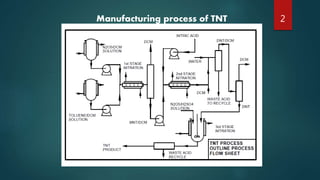
Manufacturing process of TNT 2
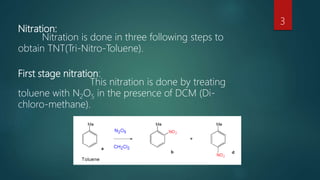
Nitration:
Nitration is done in three following steps to
obtain TNT(Tri-Nitro-Toluene).
First stage nitration:
This nitration is done by treating
toluene with N2O5 in the presence of DCM (Di-
chloro-methane).
3
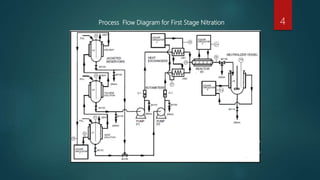
Process Flow Diagram for First Stage Nitration 4
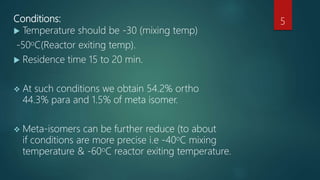
Conditions:
 Temperature should be -30 (mixing temp)
-50oC(Reactor exiting temp).
 Residence time 15 to 20 min.
 At such conditions we obtain 54.2% ortho
44.3% para and 1.5% of meta isomer.
 Meta-isomers can be further reduce (to about
if conditions are more precise i.e -40oC mixing
temperature & -60oC reactor exiting temperature.
5
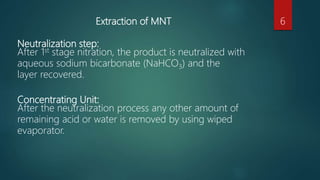
Extraction of MNT
Neutralization step:
After 1st stage nitration, the product is neutralized with
aqueous sodium bicarbonate (NaHCO3) and the
layer recovered.
Concentrating Unit:
After the neutralization process any other amount of
remaining acid or water is removed by using wiped
evaporator.
6
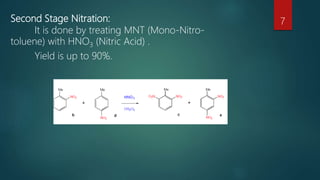
Second Stage Nitration:
It is done by treating MNT (Mono-Nitro-
toluene) with HNO3 (Nitric Acid) .
Yield is up to 90%.
7
Addition of DCM:
 Act as a heat sink for removal of heat.
 Secondly to slow down the reaction and therefore control
the exotherm.
Conditions:
 6oC to 30oC temperature.
 Reaction time 5 min.
 Residence time up to 10 min.
8
Extraction of DNT
 Measured amount of DCM and water is added to
induce phase separation.
 The layer is separated and DNT is isolated from
each layer.
9
 Waste acids are recovered.
 Recovery of DCM by cryogenic condensation.
 After this DNT is introduced in Third stage
reaction chamber.
10
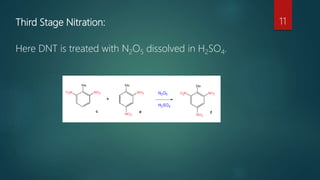
Third Stage Nitration:
Here DNT is treated with N2O5 dissolved in H2SO4.
11
Conditions:
 Temperature should be 50oC to 70oC.
 Reaction time 6.5 hr.
Yield obtained is about 85%
Kinetics:
Kinetics of this reaction is relatively slow, that’s why
we have to shift this process to batch process.
12
Extracting of TNT:
 Addition of DCM will extract most of the TNT
the acid.
 Two layers are formed with around 75% of the
in the organic layer.
 Dilution with water and addition of DCM to the
acid layer recovered the majority of the
TNT.
13
Neutralization:
 It is neutralized by adding NaHCO3.
 After neutralization DCM is removed giving solid
product of TNT
Washing:
It is washed with cold water.
14
Drying:
 Drying in a vacuum oven at 50oC
overnight
 TNT as a yellow/white solid (88%).
 A purity of 99%.
15
Advantages:
 Better Yield.
 Lowest possible formation of meta isomers.
Disadvantages:
 Expensive raw materials (N2O5 AND DCM).
 Time consuming.
16
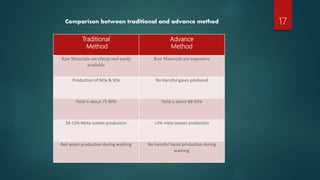
Traditional
Method
Advance
Method
Raw Materials are cheap and easily
available
Raw Materials are expensive
Production of NOx & SOx No Harmful gases produced
Yield is about 75-80% Yield is about 88-95%
14-15% Meta isomer production >2% meta isomer production
Red water production during washing No harmful liquid production during
washing
Comparison between traditional and advance method 17
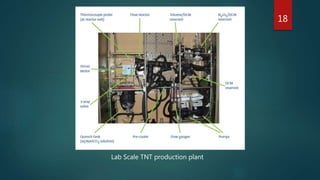
Lab Scale TNT production plant
18
19

Tnt production

  • 1.
  • 2.
  • 3.
    Nitration: Nitration is donein three following steps to obtain TNT(Tri-Nitro-Toluene). First stage nitration: This nitration is done by treating toluene with N2O5 in the presence of DCM (Di- chloro-methane). 3
  • 4.
    Process Flow Diagramfor First Stage Nitration 4
  • 5.
    Conditions:  Temperature shouldbe -30 (mixing temp) -50oC(Reactor exiting temp).  Residence time 15 to 20 min.  At such conditions we obtain 54.2% ortho 44.3% para and 1.5% of meta isomer.  Meta-isomers can be further reduce (to about if conditions are more precise i.e -40oC mixing temperature & -60oC reactor exiting temperature. 5
  • 6.
    Extraction of MNT Neutralizationstep: After 1st stage nitration, the product is neutralized with aqueous sodium bicarbonate (NaHCO3) and the layer recovered. Concentrating Unit: After the neutralization process any other amount of remaining acid or water is removed by using wiped evaporator. 6
  • 7.
    Second Stage Nitration: Itis done by treating MNT (Mono-Nitro- toluene) with HNO3 (Nitric Acid) . Yield is up to 90%. 7
  • 8.
    Addition of DCM: Act as a heat sink for removal of heat.  Secondly to slow down the reaction and therefore control the exotherm. Conditions:  6oC to 30oC temperature.  Reaction time 5 min.  Residence time up to 10 min. 8
  • 9.
    Extraction of DNT Measured amount of DCM and water is added to induce phase separation.  The layer is separated and DNT is isolated from each layer. 9
  • 10.
     Waste acidsare recovered.  Recovery of DCM by cryogenic condensation.  After this DNT is introduced in Third stage reaction chamber. 10
  • 11.
    Third Stage Nitration: HereDNT is treated with N2O5 dissolved in H2SO4. 11
  • 12.
    Conditions:  Temperature shouldbe 50oC to 70oC.  Reaction time 6.5 hr. Yield obtained is about 85% Kinetics: Kinetics of this reaction is relatively slow, that’s why we have to shift this process to batch process. 12
  • 13.
    Extracting of TNT: Addition of DCM will extract most of the TNT the acid.  Two layers are formed with around 75% of the in the organic layer.  Dilution with water and addition of DCM to the acid layer recovered the majority of the TNT. 13
  • 14.
    Neutralization:  It isneutralized by adding NaHCO3.  After neutralization DCM is removed giving solid product of TNT Washing: It is washed with cold water. 14
  • 15.
    Drying:  Drying ina vacuum oven at 50oC overnight  TNT as a yellow/white solid (88%).  A purity of 99%. 15
  • 16.
    Advantages:  Better Yield. Lowest possible formation of meta isomers. Disadvantages:  Expensive raw materials (N2O5 AND DCM).  Time consuming. 16
  • 17.
    Traditional Method Advance Method Raw Materials arecheap and easily available Raw Materials are expensive Production of NOx & SOx No Harmful gases produced Yield is about 75-80% Yield is about 88-95% 14-15% Meta isomer production >2% meta isomer production Red water production during washing No harmful liquid production during washing Comparison between traditional and advance method 17
  • 18.
    Lab Scale TNTproduction plant 18
  • 19.