Apr-26-2017
Exploring the replication
and sharding in MongoDB
• Master degree, Software Engineering
• Working with databases since 2007
• MySQL, LAMP, Linux since 2010
• Pythian OSDB managed services since 2014
• Lead Database Consultant since 2016
• C100DBA: MongoDB certified DBA
https://mk.linkedin.com/in/igorle @igorLE
About me
© 2017 Pythian. Confidential
Overview
• What is replica set, how replication works, replication concepts
• Replica set features, deployment architectures
• Vertical vs Horizontal scaling
• What is a sharded cluster in MongoDB
• Cluster components - shards, config servers, mongos
• Shard keys and chunks
• Hashed vs range based sharding
• QA
© 2017 Pythian. Confidential
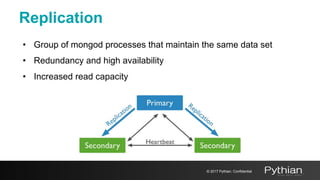
Replication
• Group of mongod processes that maintain the same data set
• Redundancy and high availability
• Increased read capacity
© 2017 Pythian. Confidential
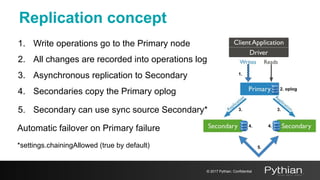
Replication concept
1. Write operations go to the Primary node
2. All changes are recorded into operations log
3. Asynchronous replication to Secondary
4. Secondaries copy the Primary oplog
5. Secondary can use sync source Secondary*
Automatic failover on Primary failure
*settings.chainingAllowed (true by default)
© 2017 Pythian. Confidential
2. oplog
1.
3. 3.
4. 4.
5.
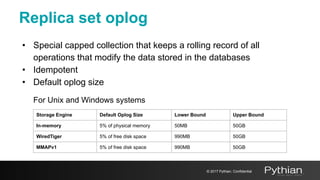
Replica set oplog
• Special capped collection that keeps a rolling record of all
operations that modify the data stored in the databases
• Idempotent
• Default oplog size
For Unix and Windows systems
Storage Engine Default Oplog Size Lower Bound Upper Bound
In-memory 5% of physical memory 50MB 50GB
WiredTiger 5% of free disk space 990MB 50GB
MMAPv1 5% of free disk space 990MB 50GB
© 2017 Pythian. Confidential
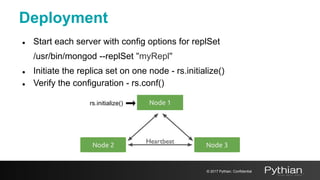
● Start each server with config options for replSet
/usr/bin/mongod --replSet "myRepl"
● Initiate the replica set on one node - rs.initialize()
● Verify the configuration - rs.conf()
Deployment
© 2017 Pythian. Confidential
Node 2 Node 3
rs.initialize() Node 1
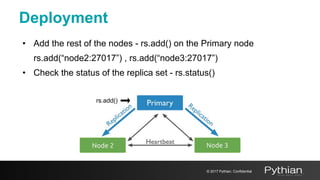
• Add the rest of the nodes - rs.add() on the Primary node
rs.add(“node2:27017”) , rs.add(“node3:27017”)
• Check the status of the replica set - rs.status()
Deployment
© 2017 Pythian. Confidential
Node 2 Node 3
rs.add()
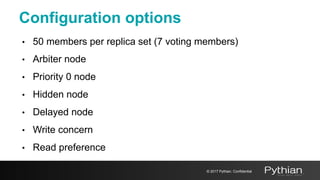
Configuration options
• 50 members per replica set (7 voting members)
• Arbiter node
• Priority 0 node
• Hidden node
• Delayed node
• Write concern
• Read preference
© 2017 Pythian. Confidential
Arbiter node
• Does not hold copy of data
• Votes in elections
hidden : true
© 2017 Pythian. Confidential
Arbiter
Priority 0 node
Priority - floating point (i.e. decimal) number between 0 and 1000
• Never becomes primary
• Visible to application
• Node with highest priority is eventually elected as Primary
© 2017 Pythian. Confidential
Secondary
priority : 0
Hidden node
• Never becomes primary
• Not visible to application
• Use cases
○ reporting
○ backups
hidden : true
© 2017 Pythian. Confidential
hidden: true priority:0
Secondary
hidden : true priority : 0
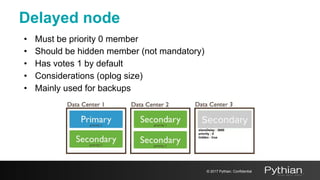
Delayed node
• Must be priority 0 member
• Should be hidden member (not mandatory)
• Has votes 1 by default
• Considerations (oplog size)
• Mainly used for backups
© 2017 Pythian. Confidential
Secondary
slaveDelay : 3600
priority : 0
hidden : true
Write concern
{ w: <value>, j: <boolean>, wtimeout: <number> }
● w - number of mongod instances that
acknowledged the write operation
● j - acknowledgement that the write operation
has been written to the journal
● wtimeout - time limit to prevent write operations
from blocking indefinitely
© 2017 Pythian. Confidential
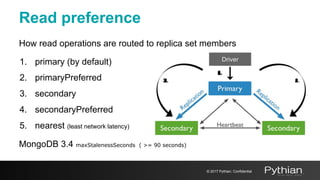
Read preference
How read operations are routed to replica set members
1. primary (by default)
2. primaryPreferred
3. secondary
4. secondaryPreferred
5. nearest (least network latency)
MongoDB 3.4 maxStalenessSeconds ( >= 90 seconds)
© 2017 Pythian. Confidential
Driver
1.
2. 2.
2.
3. 3.4.4.
4.
5. 5.
5.
• CPU
• RAM
• DISK
Scaling (vertical)
© 2017 Pythian. Confidential
• Method for distributing data across multiple machines
• Splitting data across multiple horizontal partitions
Scaling (horizontal) - Sharding
© 2017 Pythian. Confidential
Sharding with MongoDB
Shard
© 2017 Pythian. Confidential
Shard
Data
Sharding with MongoDB
• Shard/Replica set
(subset of the sharded data)
• Config servers
(metadata and config settings)
• mongos
(query router, cluster interface)
© 2017 Pythian. Confidential
Shard
Data
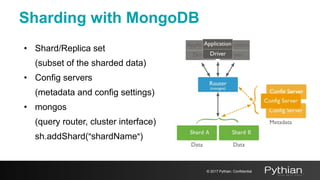
Sharding with MongoDB
• Shard/Replica set
(subset of the sharded data)
• Config servers
(metadata and config settings)
• mongos
(query router, cluster interface)
sh.addShard("shardName")
© 2017 Pythian. Confidential
A B
Shards
• Contains subset of sharded data
• Replica set for redundancy and HA
• Primary shard
• Non sharded collections
• --shardsvr in config file (port 27018)
© 2017 Pythian. Confidential
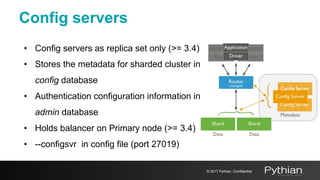
Config servers
• Config servers as replica set only (>= 3.4)
• Stores the metadata for sharded cluster in
config database
• Authentication configuration information in
admin database
• Holds balancer on Primary node (>= 3.4)
• --configsvr in config file (port 27019)
© 2017 Pythian. Confidential
mongos
• Caching metadata from config servers
• Routes queries to shards
• No persistent state
• Updates cache on metadata changes
• Holds balancer (mongodb <= 3.2)
• mongos version 3.4 can not connect to
earlier mongod version
© 2017 Pythian. Confidential
Sharding collection
• Enable sharding on database
sh.enableSharding("users")
• Shard collection
sh.shardCollection("users.history", { user_id : 1 } )
• Shard key - indexed key that exists in every document
○ range based
sh.shardCollection("users.history", { user_id : 1 } )
○ hashed based
sh.shardCollection( "users.history", { user_id : "hashed" } )
© 2017 Pythian. Confidential
Shard keys and chunks
Choosing Shard key
• Large Shard Key Cardinality
• Low Shard Key Frequency
• Non-Monotonically changing shard keys
Chunks
• A contiguous range of shard key values within a particular shard
• Inclusive lower and exclusive upper range based on shard key
• Default size of 64MB
© 2017 Pythian. Confidential
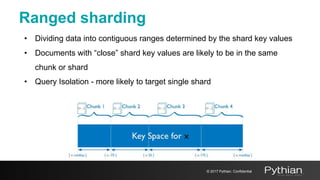
Ranged sharding
• Dividing data into contiguous ranges determined by the shard key values
• Documents with “close” shard key values are likely to be in the same
chunk or shard
• Query Isolation - more likely to target single shard
© 2017 Pythian. Confidential
Hashed sharding
• Uses a hashed index of a single field as the shard key to partition data
• More even data distribution at the cost of reducing Query Isolation
• Applications do not need to compute hashes
• Keys that change monotonically like ObjectId or timestamps are ideal
© 2017 Pythian. Confidential
Shard keys limitations
• Must be ascending indexed key or indexed compound keys that
exists in every document in the collection
• Cannot be multikey index, a text index or a geospatial index
• Cannot exceed 512 bytes
• Immutable key - can not be updated/changed
• Update operations that affect a single document must include the
shard key or the _id field
• No option for sharding if unique indexes on other fields exist
• No option for second unique index if the shard key is unique index
© 2017 Pythian. Confidential
Summary
• Replica set with odd number of voting members
• Hidden or Delayed member for dedicated functions (backups …)
• Dataset fits into single server, keep unsharded deployment
• Horizontal scaling - shards running as replica sets
• Shard keys are immutable with max size of 512 bytes
• Shard keys must exists in every document in the collection
• Ranged sharding may not distribute the data evenly
• Hashed sharding distributes the data randomly
© 2017 Pythian. Confidential
Questions?
© 2017 Pythian. Confidential
We’re Hiring!
https://www.pythian.com/careers/
© 2017 Pythian. Confidential

Exploring the replication and sharding in MongoDB

  • 1.
  • 2.
    • Master degree,Software Engineering • Working with databases since 2007 • MySQL, LAMP, Linux since 2010 • Pythian OSDB managed services since 2014 • Lead Database Consultant since 2016 • C100DBA: MongoDB certified DBA https://mk.linkedin.com/in/igorle @igorLE About me © 2017 Pythian. Confidential
  • 3.
    Overview • What isreplica set, how replication works, replication concepts • Replica set features, deployment architectures • Vertical vs Horizontal scaling • What is a sharded cluster in MongoDB • Cluster components - shards, config servers, mongos • Shard keys and chunks • Hashed vs range based sharding • QA © 2017 Pythian. Confidential
  • 4.
    Replication • Group ofmongod processes that maintain the same data set • Redundancy and high availability • Increased read capacity © 2017 Pythian. Confidential
  • 5.
    Replication concept 1. Writeoperations go to the Primary node 2. All changes are recorded into operations log 3. Asynchronous replication to Secondary 4. Secondaries copy the Primary oplog 5. Secondary can use sync source Secondary* Automatic failover on Primary failure *settings.chainingAllowed (true by default) © 2017 Pythian. Confidential 2. oplog 1. 3. 3. 4. 4. 5.
  • 6.
    Replica set oplog •Special capped collection that keeps a rolling record of all operations that modify the data stored in the databases • Idempotent • Default oplog size For Unix and Windows systems Storage Engine Default Oplog Size Lower Bound Upper Bound In-memory 5% of physical memory 50MB 50GB WiredTiger 5% of free disk space 990MB 50GB MMAPv1 5% of free disk space 990MB 50GB © 2017 Pythian. Confidential
  • 7.
    ● Start eachserver with config options for replSet /usr/bin/mongod --replSet "myRepl" ● Initiate the replica set on one node - rs.initialize() ● Verify the configuration - rs.conf() Deployment © 2017 Pythian. Confidential Node 2 Node 3 rs.initialize() Node 1
  • 8.
    • Add therest of the nodes - rs.add() on the Primary node rs.add(“node2:27017”) , rs.add(“node3:27017”) • Check the status of the replica set - rs.status() Deployment © 2017 Pythian. Confidential Node 2 Node 3 rs.add()
  • 9.
    Configuration options • 50members per replica set (7 voting members) • Arbiter node • Priority 0 node • Hidden node • Delayed node • Write concern • Read preference © 2017 Pythian. Confidential
  • 10.
    Arbiter node • Doesnot hold copy of data • Votes in elections hidden : true © 2017 Pythian. Confidential Arbiter
  • 11.
    Priority 0 node Priority- floating point (i.e. decimal) number between 0 and 1000 • Never becomes primary • Visible to application • Node with highest priority is eventually elected as Primary © 2017 Pythian. Confidential Secondary priority : 0
  • 12.
    Hidden node • Neverbecomes primary • Not visible to application • Use cases ○ reporting ○ backups hidden : true © 2017 Pythian. Confidential hidden: true priority:0 Secondary hidden : true priority : 0
  • 13.
    Delayed node • Mustbe priority 0 member • Should be hidden member (not mandatory) • Has votes 1 by default • Considerations (oplog size) • Mainly used for backups © 2017 Pythian. Confidential Secondary slaveDelay : 3600 priority : 0 hidden : true
  • 14.
    Write concern { w:<value>, j: <boolean>, wtimeout: <number> } ● w - number of mongod instances that acknowledged the write operation ● j - acknowledgement that the write operation has been written to the journal ● wtimeout - time limit to prevent write operations from blocking indefinitely © 2017 Pythian. Confidential
  • 15.
    Read preference How readoperations are routed to replica set members 1. primary (by default) 2. primaryPreferred 3. secondary 4. secondaryPreferred 5. nearest (least network latency) MongoDB 3.4 maxStalenessSeconds ( >= 90 seconds) © 2017 Pythian. Confidential Driver 1. 2. 2. 2. 3. 3.4.4. 4. 5. 5. 5.
  • 16.
    • CPU • RAM •DISK Scaling (vertical) © 2017 Pythian. Confidential
  • 17.
    • Method fordistributing data across multiple machines • Splitting data across multiple horizontal partitions Scaling (horizontal) - Sharding © 2017 Pythian. Confidential
  • 18.
    Sharding with MongoDB Shard ©2017 Pythian. Confidential Shard Data
  • 19.
    Sharding with MongoDB •Shard/Replica set (subset of the sharded data) • Config servers (metadata and config settings) • mongos (query router, cluster interface) © 2017 Pythian. Confidential Shard Data
  • 20.
    Sharding with MongoDB •Shard/Replica set (subset of the sharded data) • Config servers (metadata and config settings) • mongos (query router, cluster interface) sh.addShard("shardName") © 2017 Pythian. Confidential A B
  • 21.
    Shards • Contains subsetof sharded data • Replica set for redundancy and HA • Primary shard • Non sharded collections • --shardsvr in config file (port 27018) © 2017 Pythian. Confidential
  • 22.
    Config servers • Configservers as replica set only (>= 3.4) • Stores the metadata for sharded cluster in config database • Authentication configuration information in admin database • Holds balancer on Primary node (>= 3.4) • --configsvr in config file (port 27019) © 2017 Pythian. Confidential
  • 23.
    mongos • Caching metadatafrom config servers • Routes queries to shards • No persistent state • Updates cache on metadata changes • Holds balancer (mongodb <= 3.2) • mongos version 3.4 can not connect to earlier mongod version © 2017 Pythian. Confidential
  • 24.
    Sharding collection • Enablesharding on database sh.enableSharding("users") • Shard collection sh.shardCollection("users.history", { user_id : 1 } ) • Shard key - indexed key that exists in every document ○ range based sh.shardCollection("users.history", { user_id : 1 } ) ○ hashed based sh.shardCollection( "users.history", { user_id : "hashed" } ) © 2017 Pythian. Confidential
  • 25.
    Shard keys andchunks Choosing Shard key • Large Shard Key Cardinality • Low Shard Key Frequency • Non-Monotonically changing shard keys Chunks • A contiguous range of shard key values within a particular shard • Inclusive lower and exclusive upper range based on shard key • Default size of 64MB © 2017 Pythian. Confidential
  • 26.
    Ranged sharding • Dividingdata into contiguous ranges determined by the shard key values • Documents with “close” shard key values are likely to be in the same chunk or shard • Query Isolation - more likely to target single shard © 2017 Pythian. Confidential
  • 27.
    Hashed sharding • Usesa hashed index of a single field as the shard key to partition data • More even data distribution at the cost of reducing Query Isolation • Applications do not need to compute hashes • Keys that change monotonically like ObjectId or timestamps are ideal © 2017 Pythian. Confidential
  • 28.
    Shard keys limitations •Must be ascending indexed key or indexed compound keys that exists in every document in the collection • Cannot be multikey index, a text index or a geospatial index • Cannot exceed 512 bytes • Immutable key - can not be updated/changed • Update operations that affect a single document must include the shard key or the _id field • No option for sharding if unique indexes on other fields exist • No option for second unique index if the shard key is unique index © 2017 Pythian. Confidential
  • 29.
    Summary • Replica setwith odd number of voting members • Hidden or Delayed member for dedicated functions (backups …) • Dataset fits into single server, keep unsharded deployment • Horizontal scaling - shards running as replica sets • Shard keys are immutable with max size of 512 bytes • Shard keys must exists in every document in the collection • Ranged sharding may not distribute the data evenly • Hashed sharding distributes the data randomly © 2017 Pythian. Confidential
  • 30.
  • 31.