ASeminar
On
Theme: The Dynamic Earth
Mountain top to Ocean trench
Date of presentation:27 Feb., 2018
Submitted by-
Miss. VISHAKHA NATHANI18:42
CONTENT
1. Introduction to interior of the Earth
2. Continental drift theory
3. Plate tectonics
4. Convergent plate boundaries
5. Formation of Andes
6. Formation of Himalayas
7. Mariana Trench
8. Summary
9. References
18:42
INTRODUCTION
Interior of the earth18:42
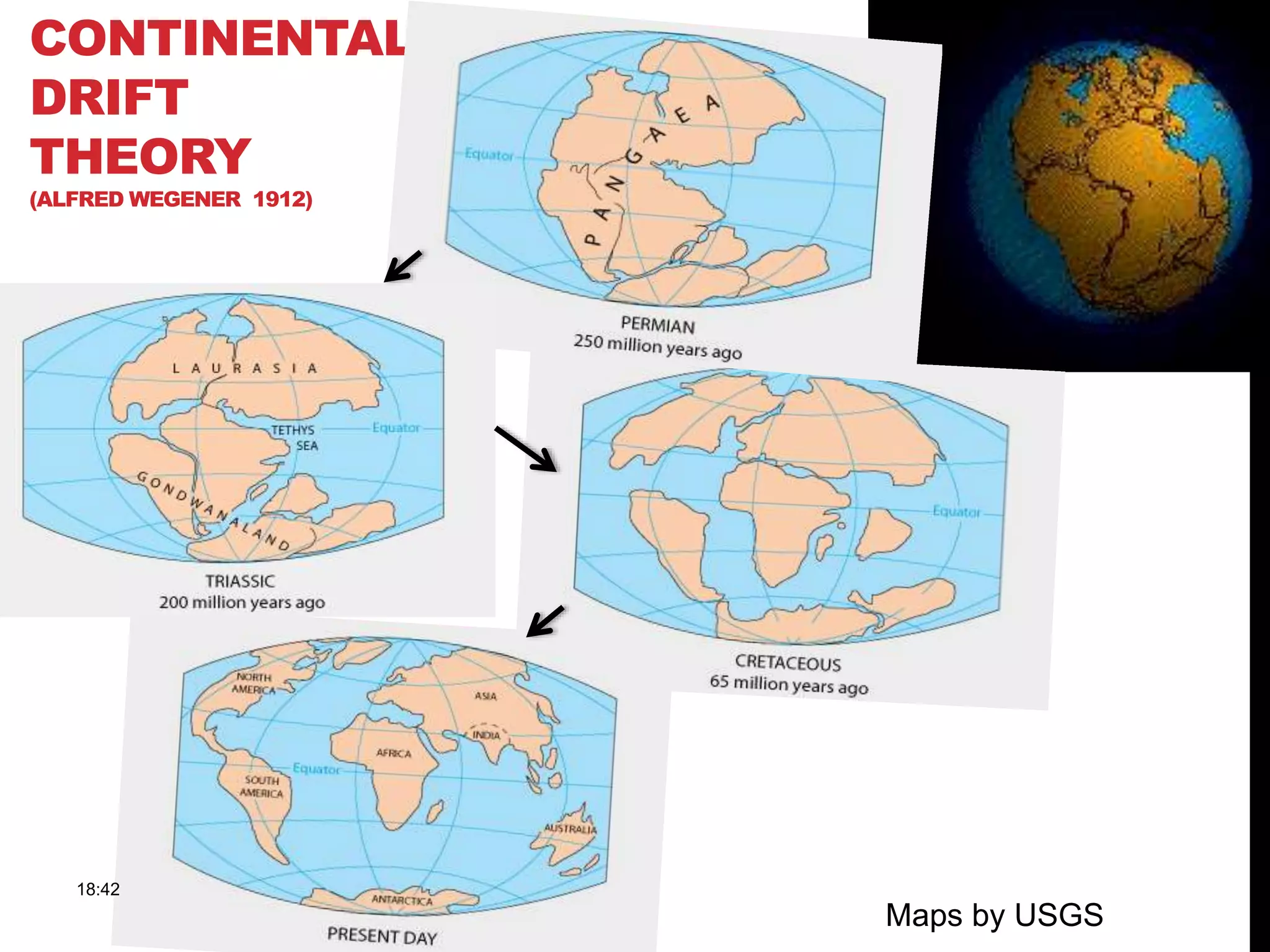
CONTINENTAL
DRIFT
THEORY
(ALFRED WEGENER 1912)
Maps by USGS
18:42
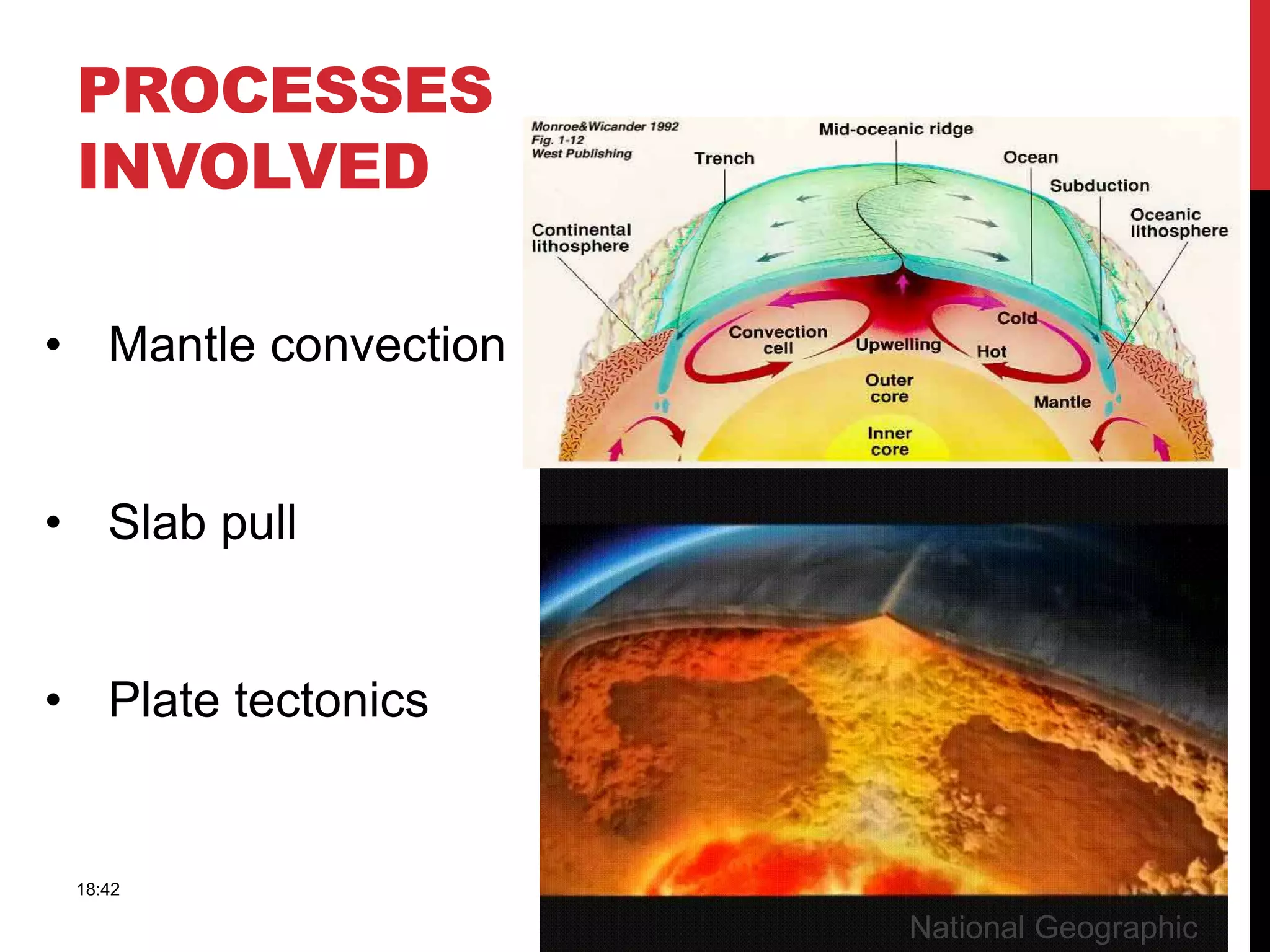
• Mantle convection
• Slab pull
• Plate tectonics
PROCESSES
INVOLVED
National Geographic
18:42
HOW IS MANTLE CONVECTION
RELATED TO PLATE TECTONICS?
• The mantle’s convective motions break the
lithosphere into plates and move them around
the surface of the planet.
• These plates may move away from, move by, or
collide with each other.
• New theory: Slab pull and ridge push
• This process forms ocean basins, shifts
continents, and pushes up mountains, mid
oceanic ridges, island arcs, volcanoes etc.
18:42
TYPES OF COLLISION
a) Continental/oceanic boundary : Andes
mountains
b) Oceanic/oceanic boundary: Trench and island
arc
c) Continental/continental boundary: Himalayas
18:42
ANDES: WORLD'S LONGEST
MOUNTAIN RANGE
• Andes are known as world’s largest continental
mountain ranges about 4300 mi (6,962 m
highest)
• Lies along the western coast of South America.
• Formation- Convergent Boundary- Continental-
ocean collision- South American plate and
Nazca plate.
• This mountain range is a part of pacific ring of
fire.
• Aconcagua- second highest mountain of the
world
18:42
FORMATION OF ANDES
• Speed of Nazca plate towards south American plate is 79mm/y.
• This is marked on the ocean surface by the presence of the Peru-Chile (or
Atacama) Trench.
Video: from www.geolsoc.org.uk
18:42
FORMATION OF HIMALAYAS
• Himalayas are knows as the highest mountain
ranges approximately 9km above MSL.
• Formation- Convergent Boundary
• Continental- continental collision
• Indian and Eurasian Plates collided 50Ma and
continues today.
18:42
18:42
MARIANA TRENCH
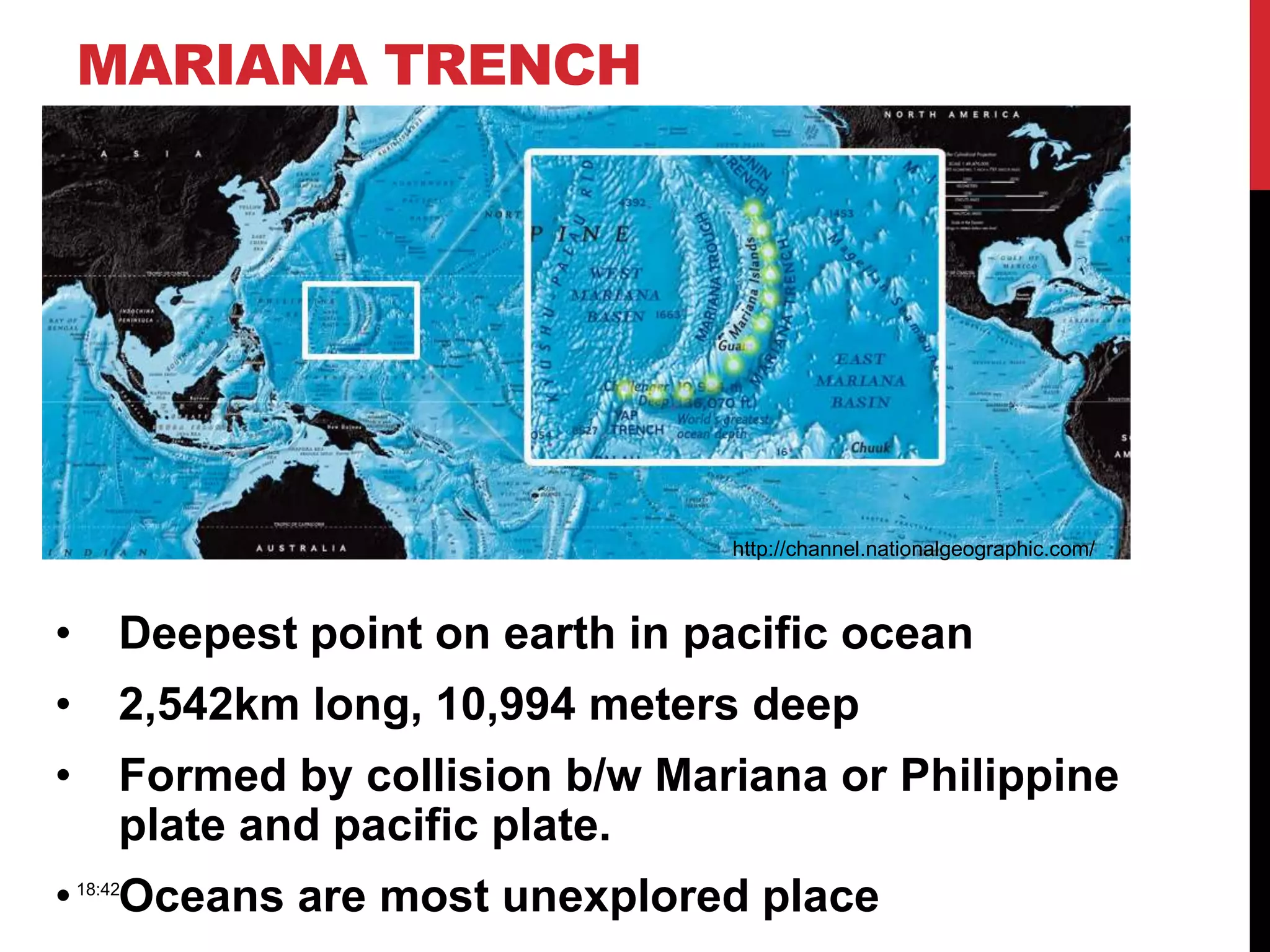
• Deepest point on earth in pacific ocean
• 2,542km long, 10,994 meters deep
• Formed by collision b/w Mariana or Philippine
plate and pacific plate.
• Oceans are most unexplored place
http://channel.nationalgeographic.com/
18:42
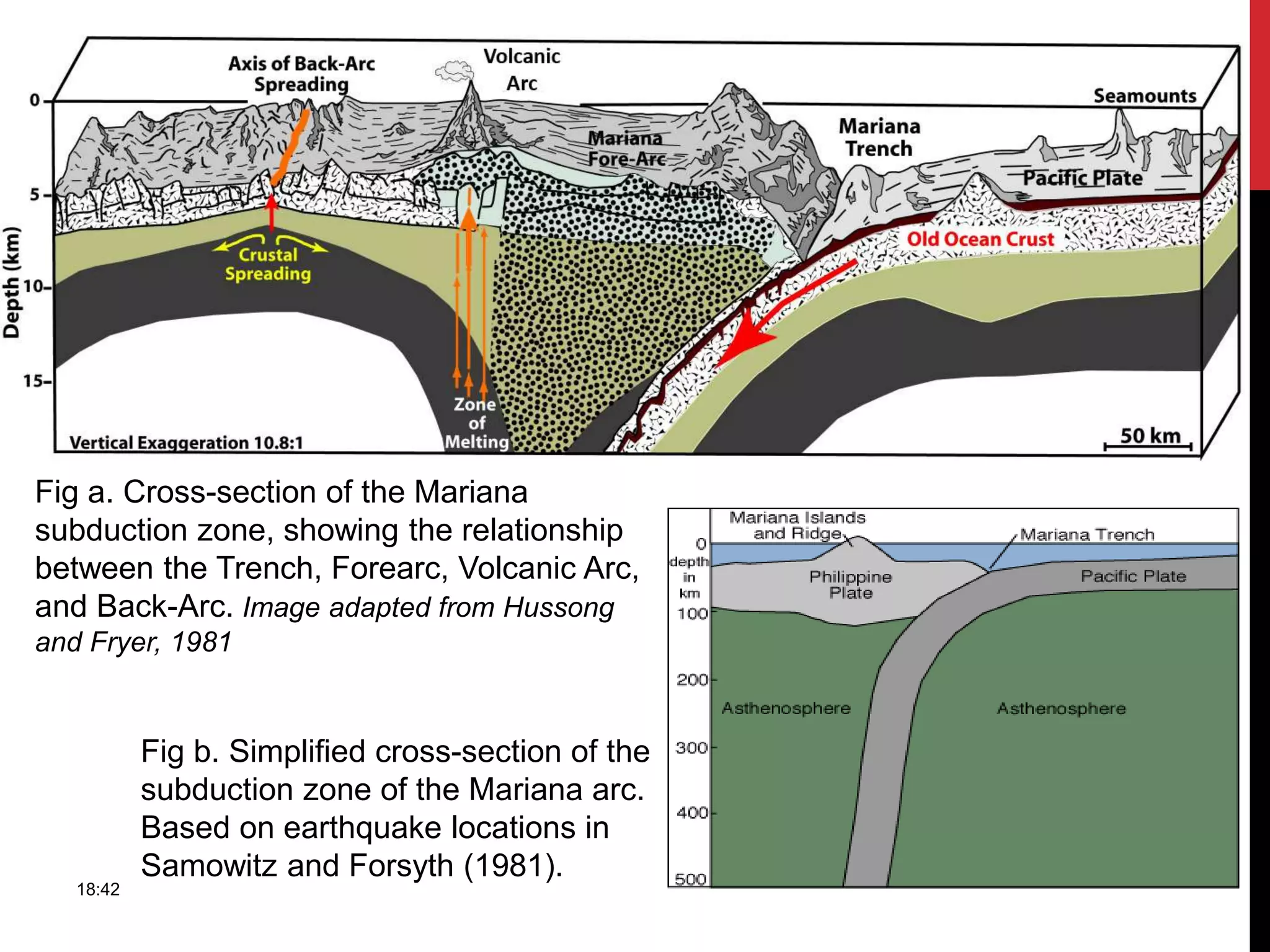
Fig b. Simplified cross-section of the
subduction zone of the Mariana arc.
Based on earthquake locations in
Samowitz and Forsyth (1981).
Fig a. Cross-section of the Mariana
subduction zone, showing the relationship
between the Trench, Forearc, Volcanic Arc,
and Back-Arc. Image adapted from Hussong
and Fryer, 1981
18:42
Challenger Deep
http://channel.nationalgeographic.com/
MT. EVEREST VS. MARIANA TRENCH
18:42
SUMMARY
• Earth is unique and dynamic, process inside the earth are
giving rise to volcanoes, mountains, island arcs, oceanic
trenches and many more topographical features.
• Tectonic Plates shift and drift giving rise to present
scenario of continents on Earth.
• These plate movements gave rise to classical mountain
ranges and many other features.
• Most elevated part of the earth crust is Mount Everest, part
of Himalayan mountain. The largest mountain range is
Andes mountains and the deepest part of the ocean floor
is Mariana trench. If compared Mariana trench is deeper
then the height of Mount Everest.
• From mountain top to ocean floor we have lot more to
explore.
18:42
REFERENCES
• Cliff ollier and colin pain (first published 2000), the origin of
mountains
• Jon erickson, plate tectonics unraveling the mysteries of the
earth
• The late Philip Kerey, Keitha Klepeis, Frederick vine, Global
Tectonics
• Andes: World's Longest Mountain Range, By Kim Ann
Zimmermann, Live Science Contributor
• www.sciencedaily.com
• weatherdork.weebly.com
18:42
18:42

Exploring the Dynamic Earth- Mountain top to ocean trench

  • 1.
    ASeminar On Theme: The DynamicEarth Mountain top to Ocean trench Date of presentation:27 Feb., 2018 Submitted by- Miss. VISHAKHA NATHANI18:42
  • 2.
    CONTENT 1. Introduction tointerior of the Earth 2. Continental drift theory 3. Plate tectonics 4. Convergent plate boundaries 5. Formation of Andes 6. Formation of Himalayas 7. Mariana Trench 8. Summary 9. References 18:42
  • 3.
  • 4.
  • 5.
    • Mantle convection •Slab pull • Plate tectonics PROCESSES INVOLVED National Geographic 18:42
  • 6.
    HOW IS MANTLECONVECTION RELATED TO PLATE TECTONICS? • The mantle’s convective motions break the lithosphere into plates and move them around the surface of the planet. • These plates may move away from, move by, or collide with each other. • New theory: Slab pull and ridge push • This process forms ocean basins, shifts continents, and pushes up mountains, mid oceanic ridges, island arcs, volcanoes etc. 18:42
  • 7.
    TYPES OF COLLISION a)Continental/oceanic boundary : Andes mountains b) Oceanic/oceanic boundary: Trench and island arc c) Continental/continental boundary: Himalayas 18:42
  • 8.
    ANDES: WORLD'S LONGEST MOUNTAINRANGE • Andes are known as world’s largest continental mountain ranges about 4300 mi (6,962 m highest) • Lies along the western coast of South America. • Formation- Convergent Boundary- Continental- ocean collision- South American plate and Nazca plate. • This mountain range is a part of pacific ring of fire. • Aconcagua- second highest mountain of the world 18:42
  • 9.
    FORMATION OF ANDES •Speed of Nazca plate towards south American plate is 79mm/y. • This is marked on the ocean surface by the presence of the Peru-Chile (or Atacama) Trench. Video: from www.geolsoc.org.uk 18:42
  • 10.
    FORMATION OF HIMALAYAS •Himalayas are knows as the highest mountain ranges approximately 9km above MSL. • Formation- Convergent Boundary • Continental- continental collision • Indian and Eurasian Plates collided 50Ma and continues today. 18:42
  • 11.
  • 12.
    MARIANA TRENCH • Deepestpoint on earth in pacific ocean • 2,542km long, 10,994 meters deep • Formed by collision b/w Mariana or Philippine plate and pacific plate. • Oceans are most unexplored place http://channel.nationalgeographic.com/ 18:42
  • 13.
    Fig b. Simplifiedcross-section of the subduction zone of the Mariana arc. Based on earthquake locations in Samowitz and Forsyth (1981). Fig a. Cross-section of the Mariana subduction zone, showing the relationship between the Trench, Forearc, Volcanic Arc, and Back-Arc. Image adapted from Hussong and Fryer, 1981 18:42
  • 14.
  • 15.
    SUMMARY • Earth isunique and dynamic, process inside the earth are giving rise to volcanoes, mountains, island arcs, oceanic trenches and many more topographical features. • Tectonic Plates shift and drift giving rise to present scenario of continents on Earth. • These plate movements gave rise to classical mountain ranges and many other features. • Most elevated part of the earth crust is Mount Everest, part of Himalayan mountain. The largest mountain range is Andes mountains and the deepest part of the ocean floor is Mariana trench. If compared Mariana trench is deeper then the height of Mount Everest. • From mountain top to ocean floor we have lot more to explore. 18:42
  • 16.
    REFERENCES • Cliff ollierand colin pain (first published 2000), the origin of mountains • Jon erickson, plate tectonics unraveling the mysteries of the earth • The late Philip Kerey, Keitha Klepeis, Frederick vine, Global Tectonics • Andes: World's Longest Mountain Range, By Kim Ann Zimmermann, Live Science Contributor • www.sciencedaily.com • weatherdork.weebly.com 18:42
  • 17.

Editor's Notes

  • #2 Earth is a unique planet restless and dynamic, continents shift and clash, volcanoes erupt, glaciers grow and recede, tectonic forces produces tremendous earthquakes. The active continental boundaries have formed some classical mountain ranges as Himalayans and Andes also trenches like Mariana. If we are saying that the earth is dynamic that means many processes are going on.
  • #4 The interior structure of the Earth is layered in spherical shells: An outer silicate solid crust, a highly viscous mantle, a liquid outer core that is much less viscous than the mantle, and a solid inner core.  LITHOSPHERE PLATE MOVEMENTS CONTINENTAL DRIFT
  • #5 250 million years ago the seven continents were altogether and called as “supercontinent”. Later on they drifted apart very slowly and the scenerio before 200 Ma is shown then 65Ma and the present condition of the continent.
  • #6 We can not see deep interior of the earth. To understand the dynamism of Earth let us first see mantle convection. Convection is the process by which less dense material rises and more dense material sinks. Less dense material are more buoyant than more dense. This fundamental planetary process has profoundly influenced the character and evolution of Earth. How is it important for the mountain building?
  • #7 I am going to explain the formation of two classical mountain ranges The highest and the largest, Himalayas and the Andes. Both the mountains are formed by the collision of two different tectonic plates
  • #8 Tectonic plates movements leads to the formation of Mighty Himalayas, Largest mountain ranges of earth the Andes, with 200 volcanoes and the deepest ocean trench “Mariana”.
  • #10 Image: From www.searchanddiscovery.com ‘Deepwater Fold-Thrust Belts: Not All the Beasts Are Equal’, Ana Krueger and Ed Gilbert, 2009