Explore open access books
#exploreOAbooks
@SN_OAbooks
IllustrationinspiredbytheworkofMarieCurie
Wifi network: Springer Nature-Guest
Password: spr%wm3n$
1
#exploreOAbooks
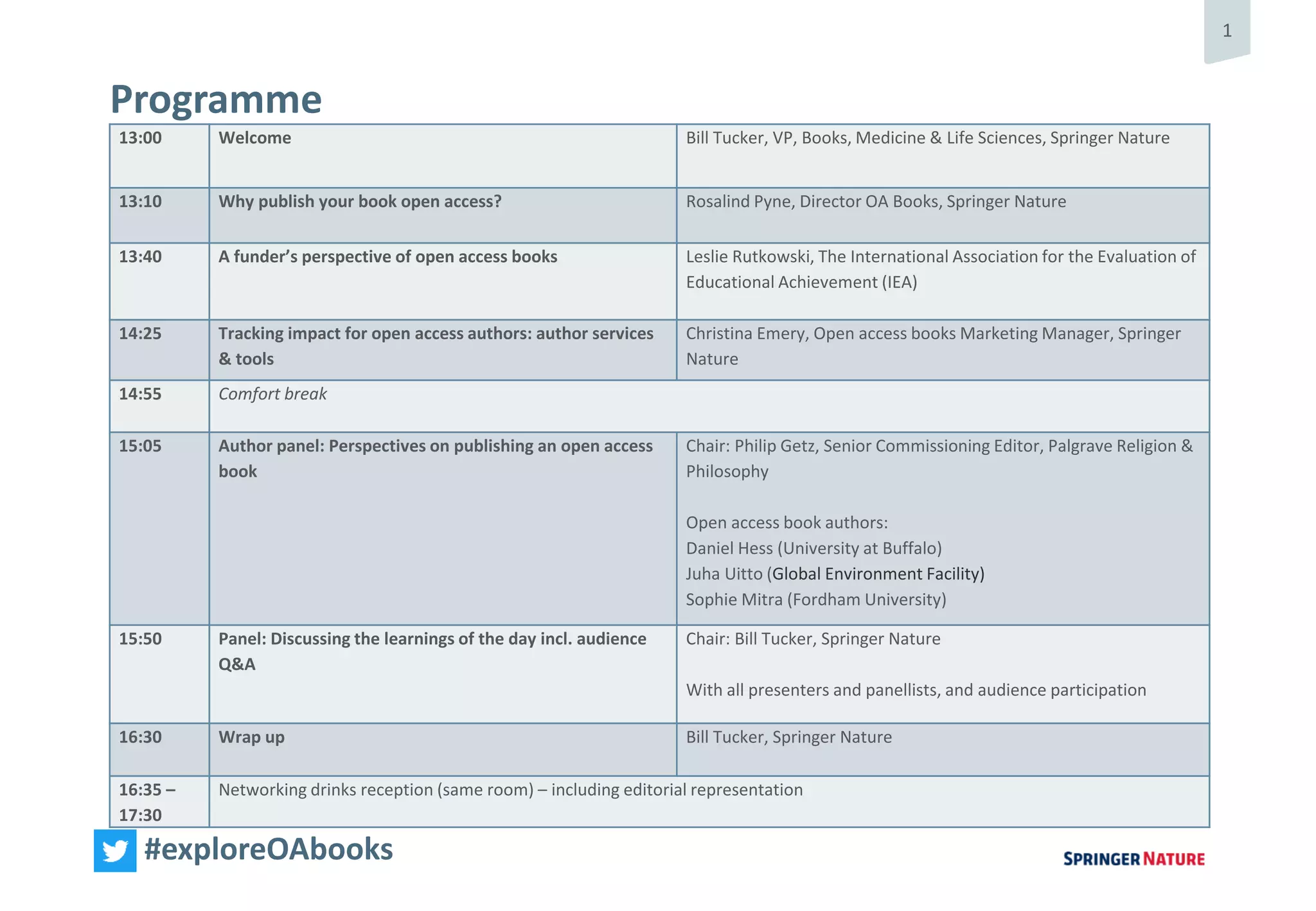
Programme
13:00 Welcome Bill Tucker, VP, Books, Medicine & Life Sciences, Springer Nature
13:10 Why publish your book open access? Rosalind Pyne, Director OA Books, Springer Nature
13:40 A funder’s perspective of open access books Leslie Rutkowski, The International Association for the Evaluation of
Educational Achievement (IEA)
14:25 Tracking impact for open access authors: author services
& tools
Christina Emery, Open access books Marketing Manager, Springer
Nature
14:55 Comfort break
15:05 Author panel: Perspectives on publishing an open access
book
Chair: Philip Getz, Senior Commissioning Editor, Palgrave Religion &
Philosophy
Open access book authors:
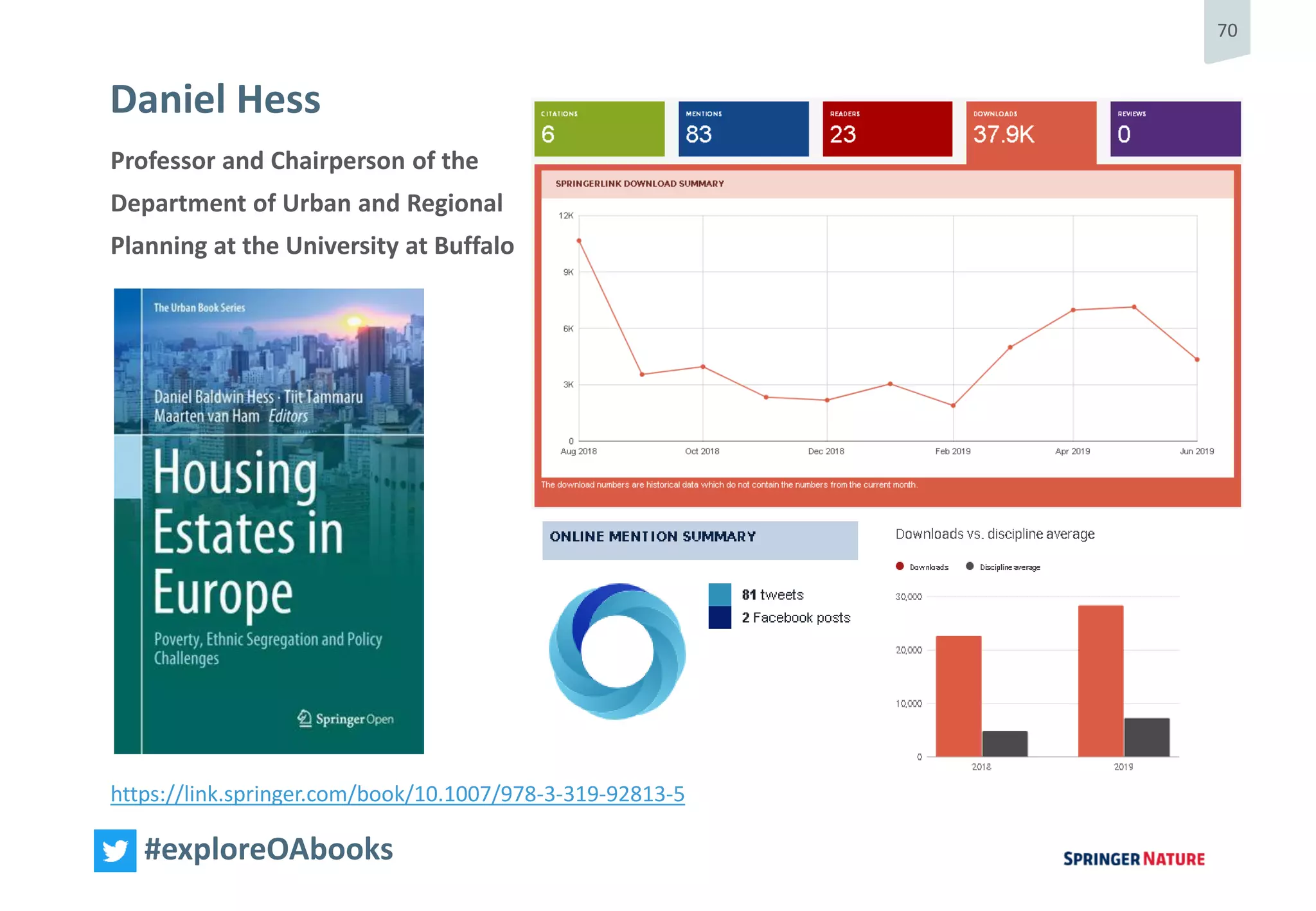
Daniel Hess (University at Buffalo)
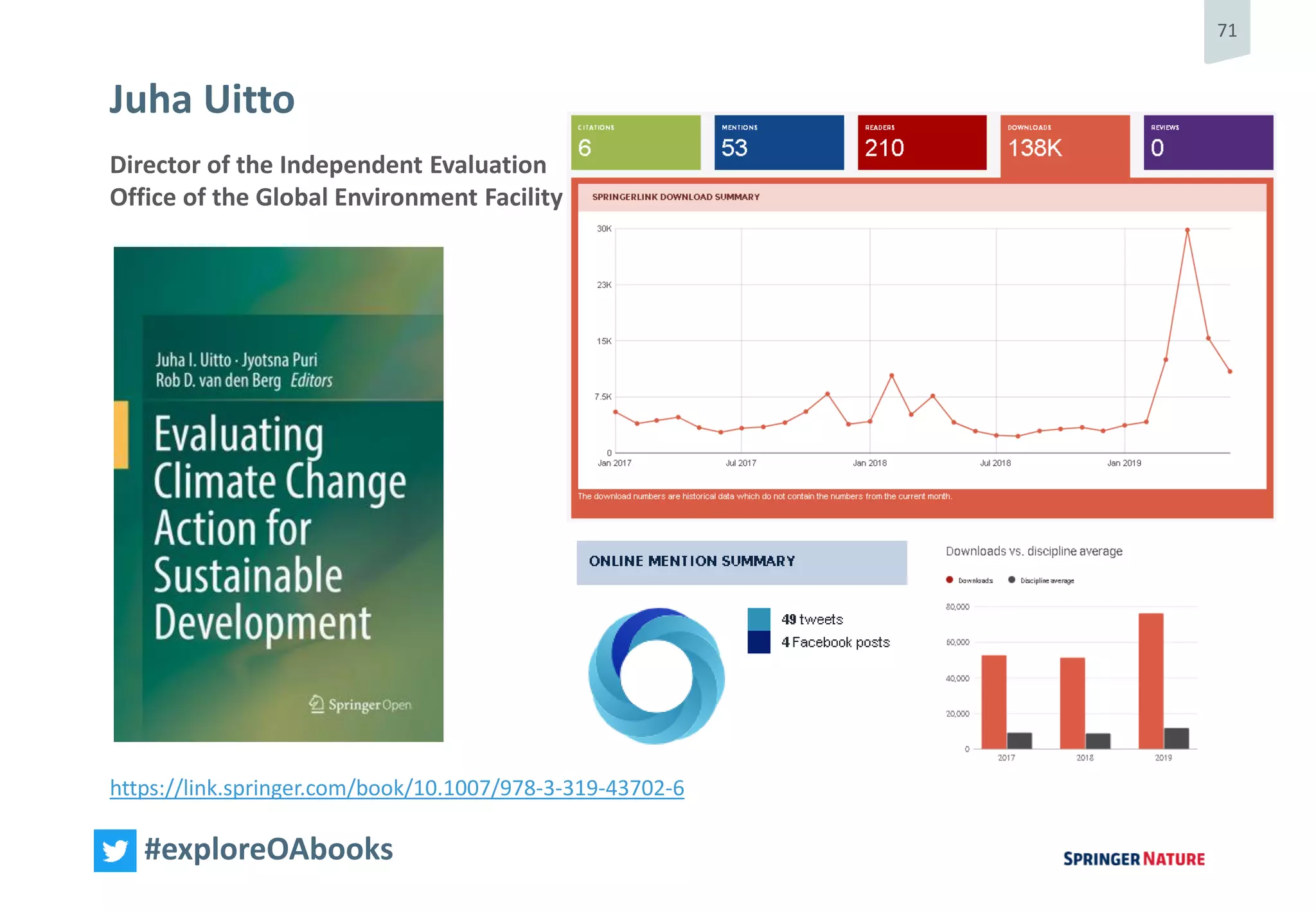
Juha Uitto (Global Environment Facility)
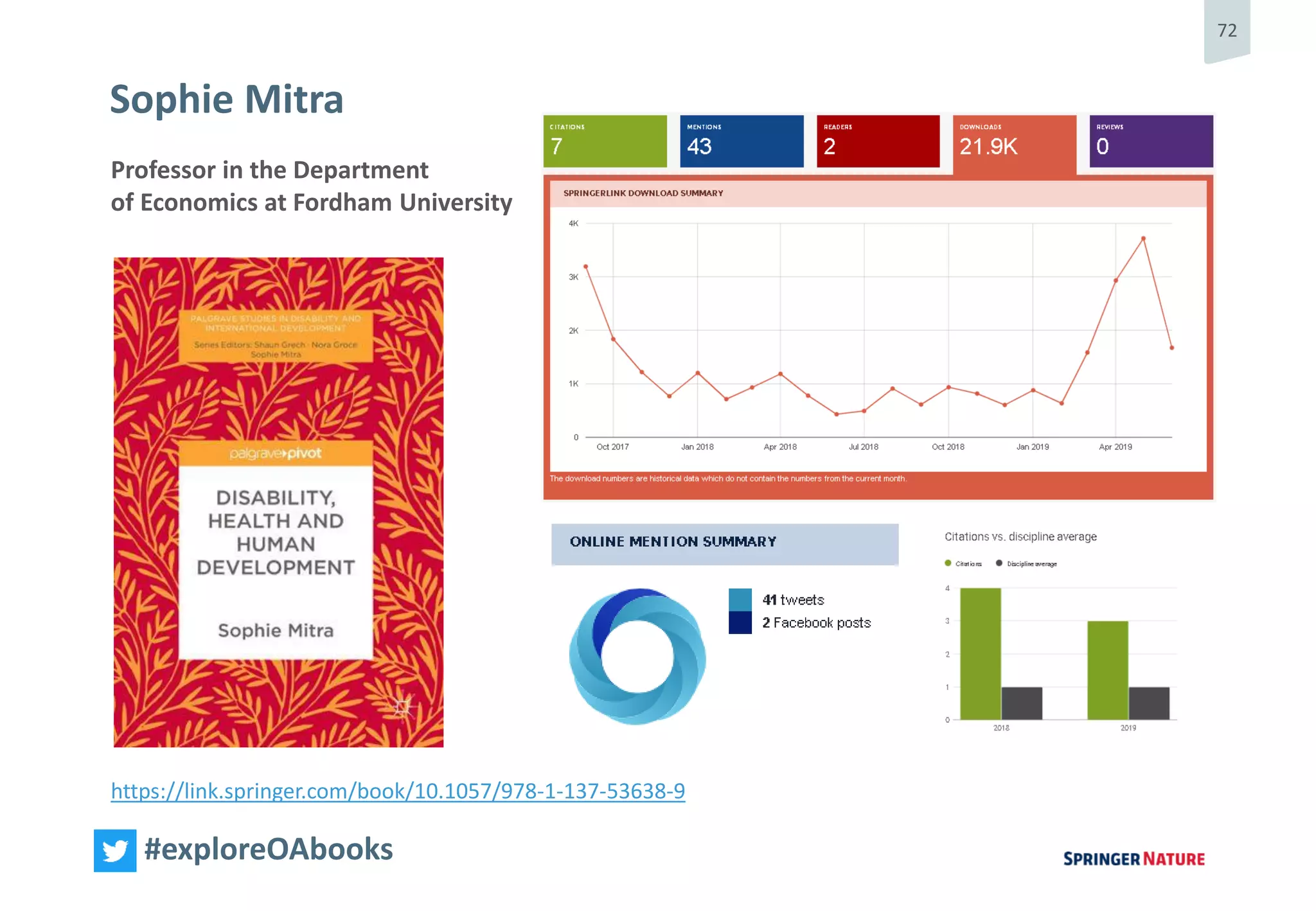
Sophie Mitra (Fordham University)
15:50 Panel: Discussing the learnings of the day incl. audience
Q&A
Chair: Bill Tucker, Springer Nature
With all presenters and panellists, and audience participation
16:30 Wrap up Bill Tucker, Springer Nature
16:35 –
17:30
Networking drinks reception (same room) – including editorial representation
22
1.0
Welcome
Bill Tucker
VP, Books, Medicine & Life Sciences, Springer Nature
3
#exploreOAbooks
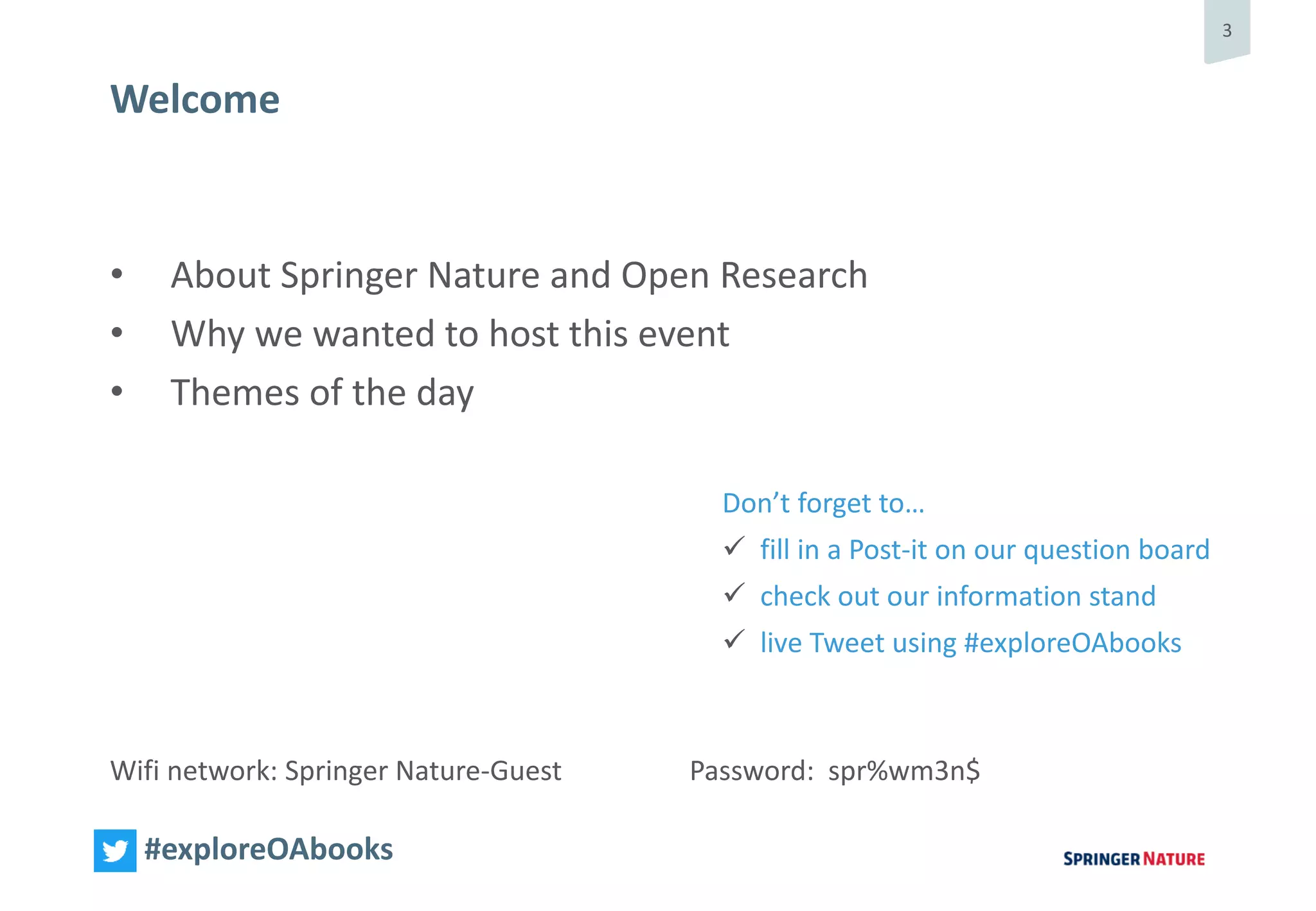
• About Springer Nature and Open Research
• Why we wanted to host this event
• Themes of the day
Wifi network: Springer Nature-Guest Password: spr%wm3n$
Welcome
Don’t forget to…
 fill in a Post-it on our question board
 check out our information stand
 live Tweet using #exploreOAbooks
44
2.0
Why publish your book open access?
Ros Pyne
Director OA Books, Springer Nature
5
What do we mean by open access?
How does it work in practice?
6
#exploreOAbooks
• Free to read and download, with no restrictions, immediately on
publication.
• Version of record: The version that is free is the publisher‘s final typeset
version (PDF, ePub, HTML, MOBI formats).
• Licensed for re-use and sharing: Creative Commons licence means readers
may freely use and share the work.
• Highly visible and discoverable: Book is available from publisher platforms
and many third-party sites
• Print: OA books are also available in print.
• High quality: The same rigorous peer-review process, copyediting and
proofreading services as non-OA books
• OA fee: An open access fee covers the costs of making the work OA.
What is an open access book?
Free to read and share; highly visible & discoverable; high quality
7
#exploreOAbooks
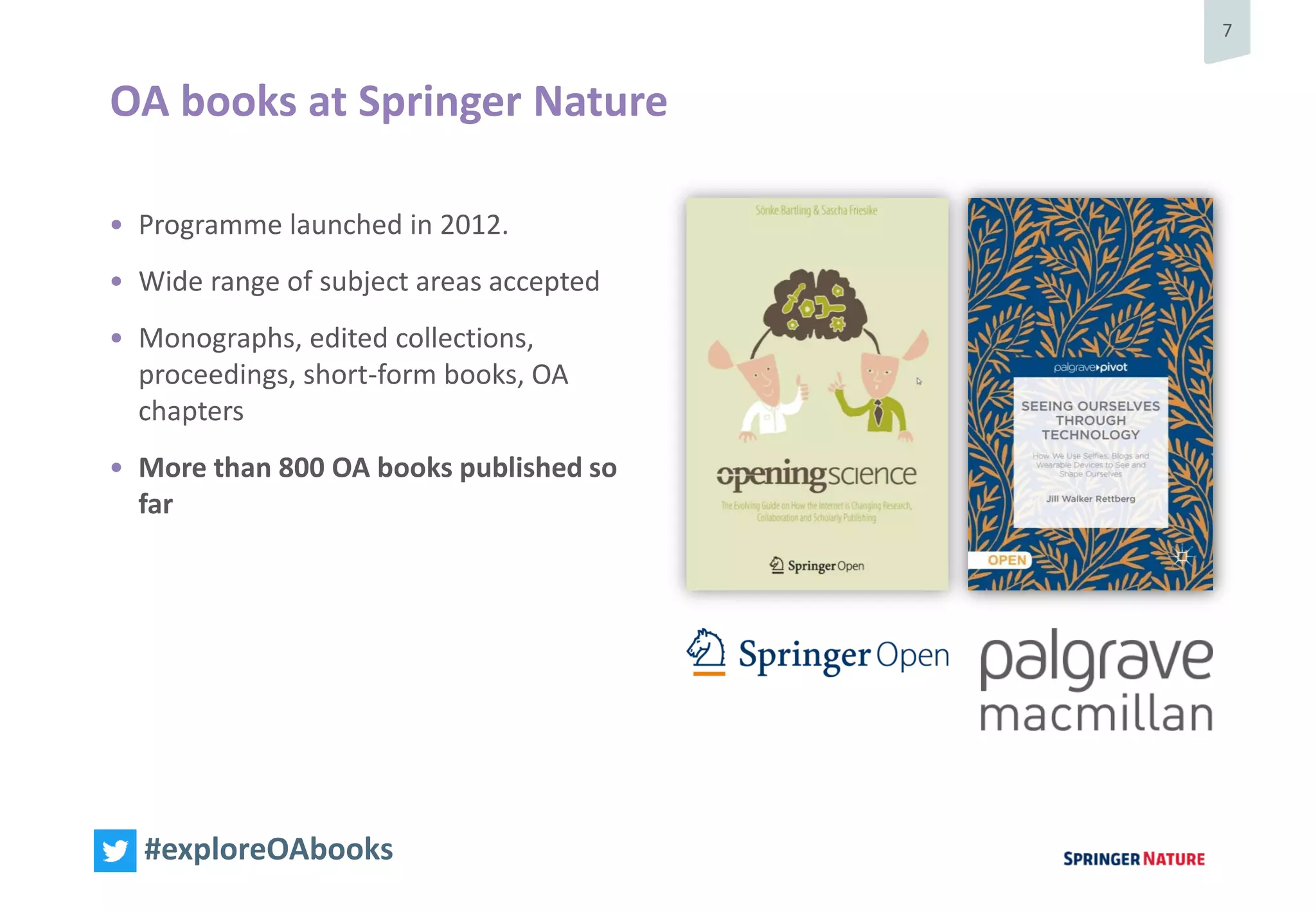
• Programme launched in 2012.
• Wide range of subject areas accepted
• Monographs, edited collections,
proceedings, short-form books, OA
chapters
• More than 800 OA books published so
far
OA books at Springer Nature
8
#exploreOAbooks
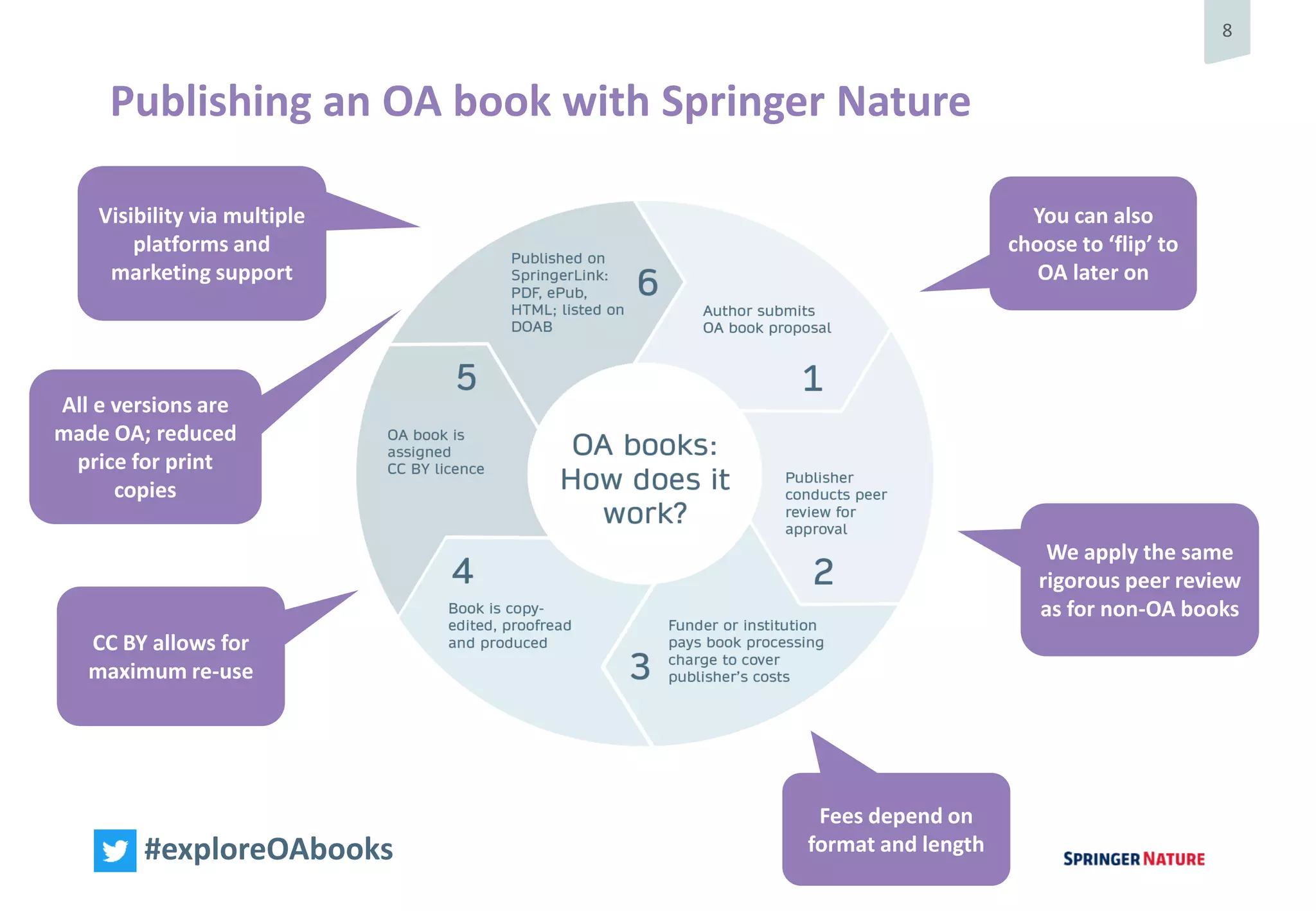
Publishing an OA book with Springer Nature
You can also
choose to ‘flip’ to
OA later on
We apply the same
rigorous peer review
as for non-OA books
Fees depend on
format and length
CC BY allows for
maximum re-use
All e versions are
made OA; reduced
price for print
copies
Visibility via multiple
platforms and
marketing support
9
So, why publish your book open access…?
10
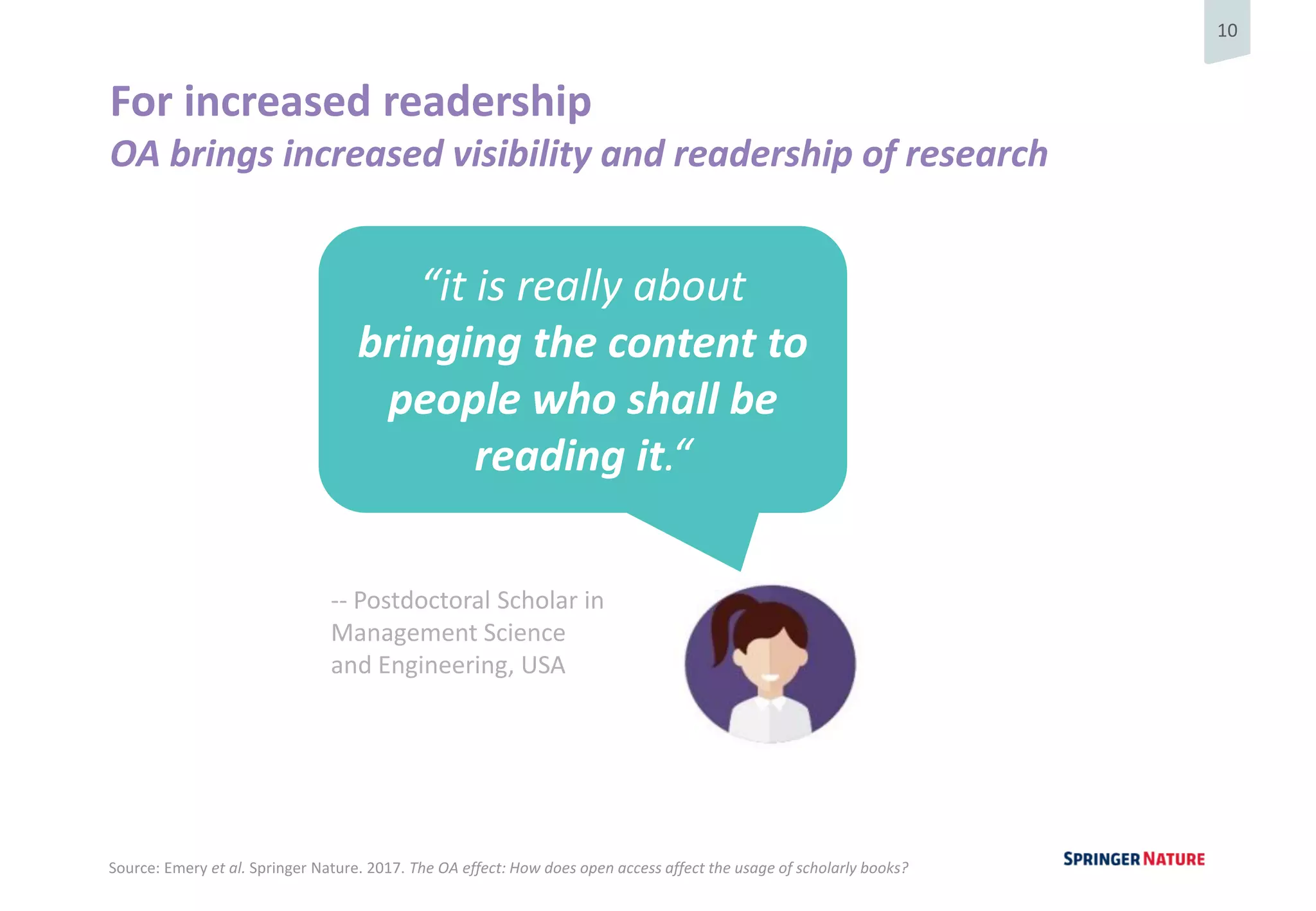
For increased readership
OA brings increased visibility and readership of research
Source: Emery et al. Springer Nature. 2017. The OA effect: How does open access affect the usage of scholarly books?
-- Postdoctoral Scholar in
Management Science
and Engineering, USA
“it is really about
bringing the content to
people who shall be
reading it.“
11
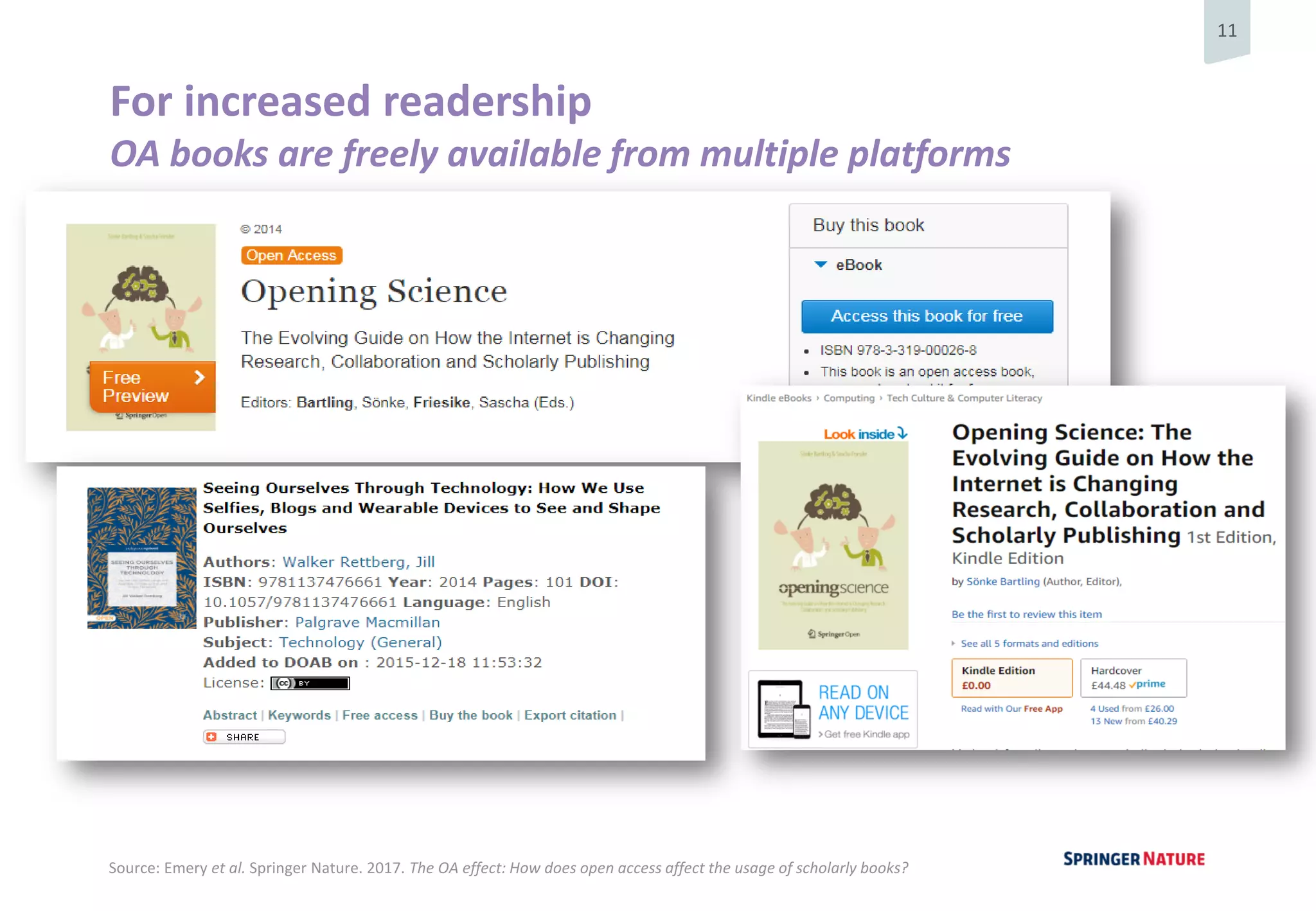
For increased readership
OA books are freely available from multiple platforms
Source: Emery et al. Springer Nature. 2017. The OA effect: How does open access affect the usage of scholarly books?
12
#exploreOAbooks
For increased readership
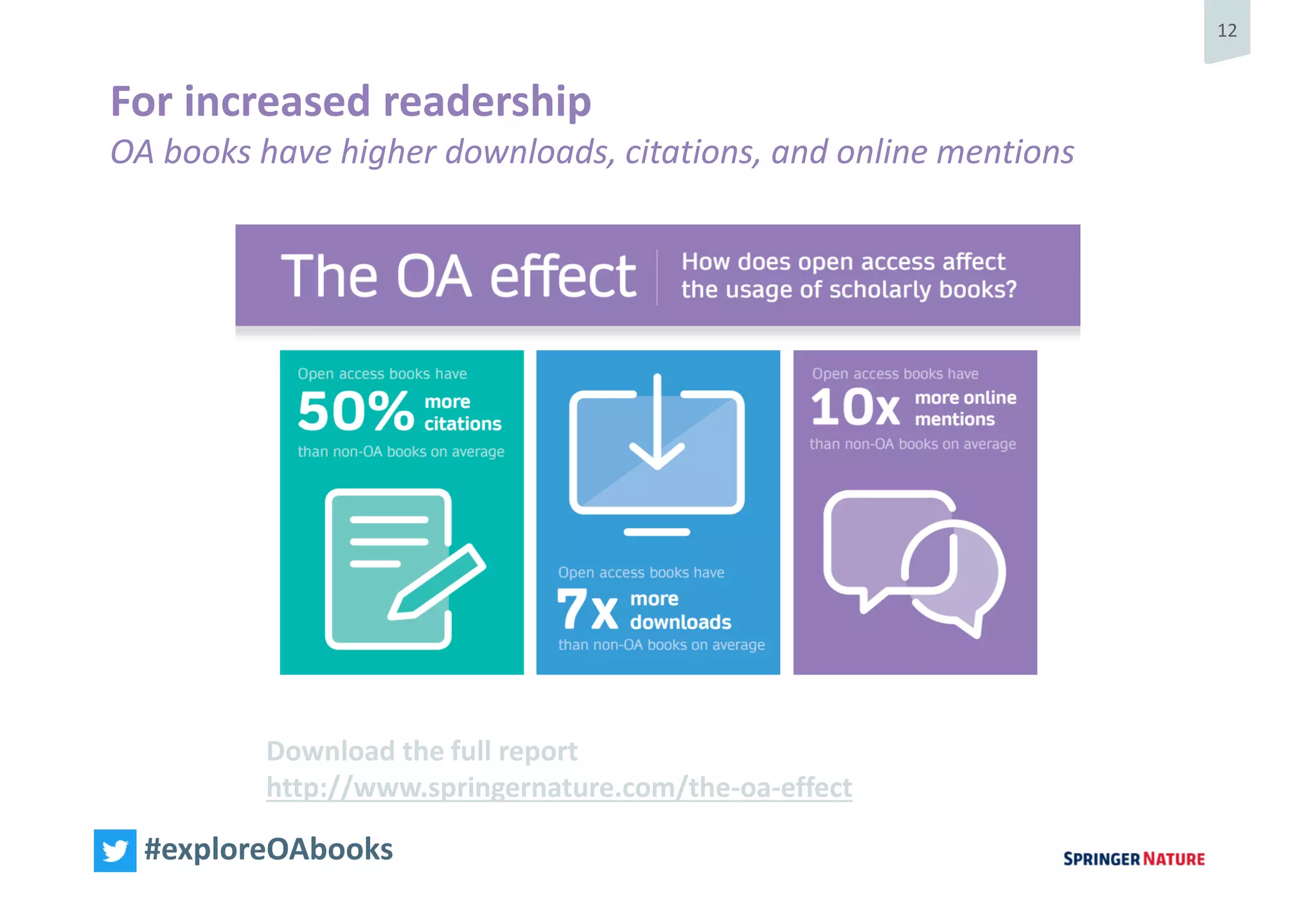
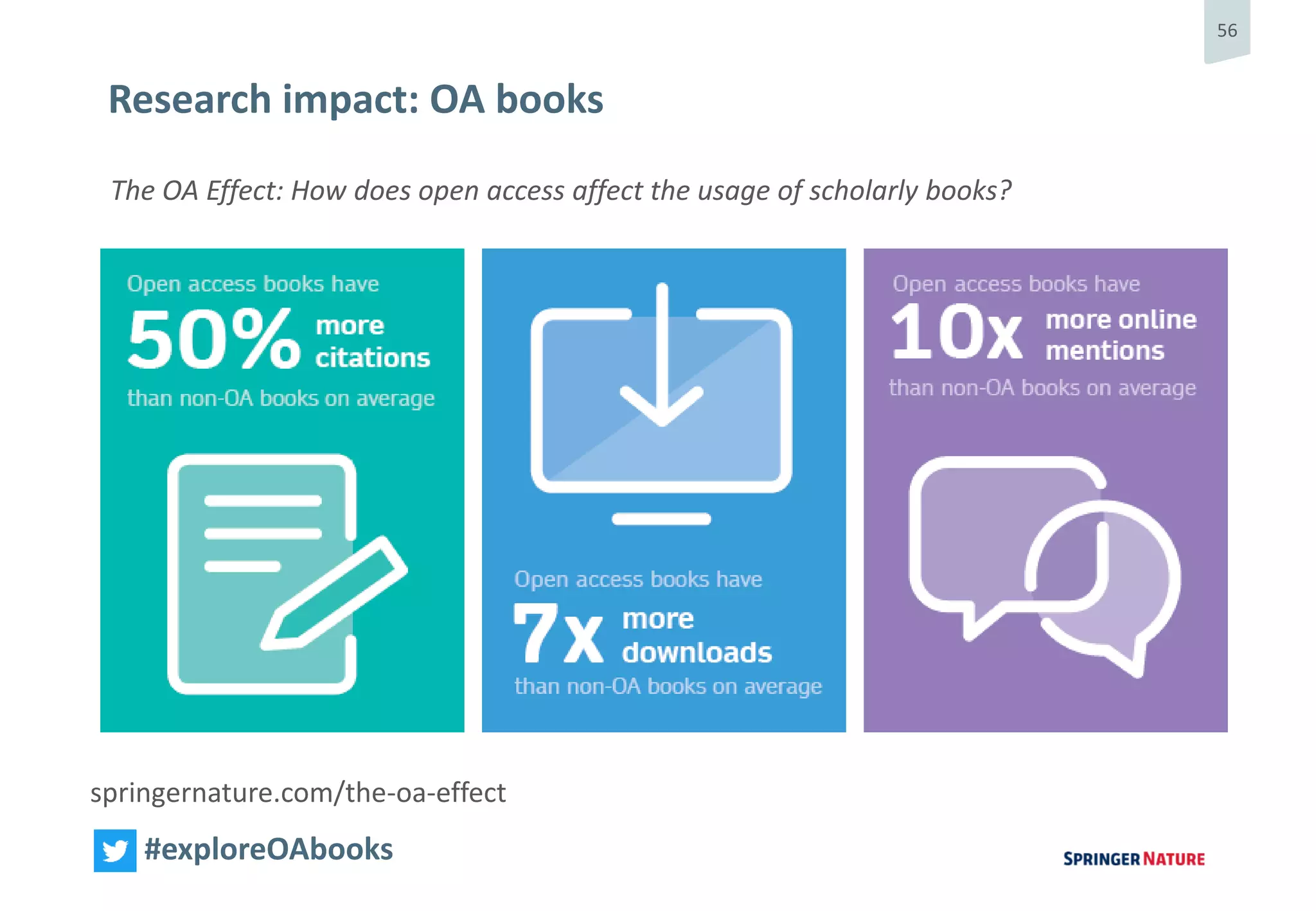
OA books have higher downloads, citations, and online mentions
Download the full report
http://www.springernature.com/the-oa-effect
13
To reach a wider global audience
There is an ethical argument for OA
“For me publishing a book that wasn’t OA on
the impact of international development would
be quite unethical, because I know that people
in Uganda would not be able to read the book.
For me [OA] was an absolute critical component
to the ethics of publishing.”
--- Helen Louise Ackers, Chair in
Global Social Science,
University of Salford
Source: Emery et al. Springer Nature. 2017. The OA effect: How does open access affect the usage of scholarly books?
14
#exploreOAbooks
To reach a wider global audience
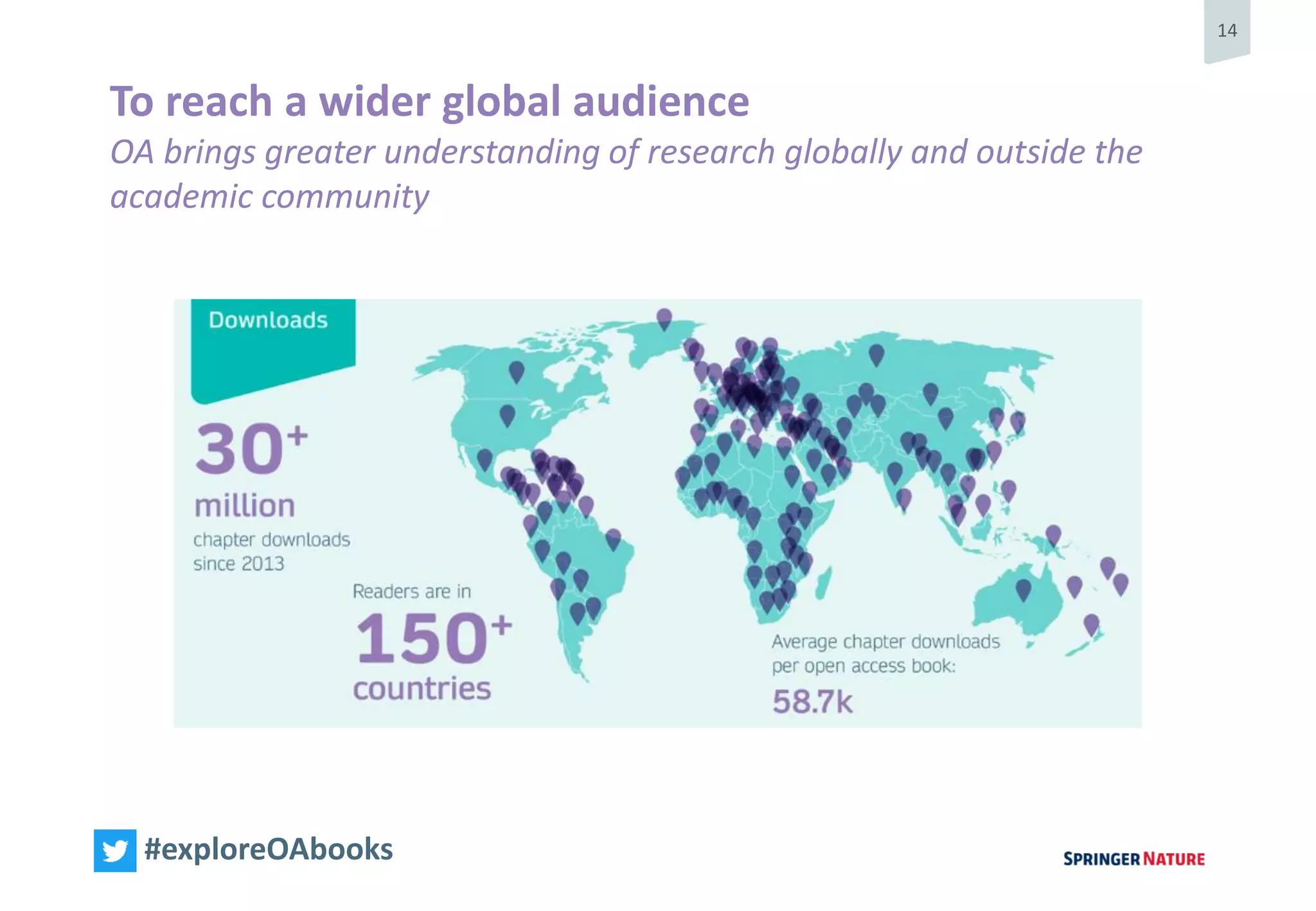
OA brings greater understanding of research globally and outside the
academic community
15
To reach a wider global audience
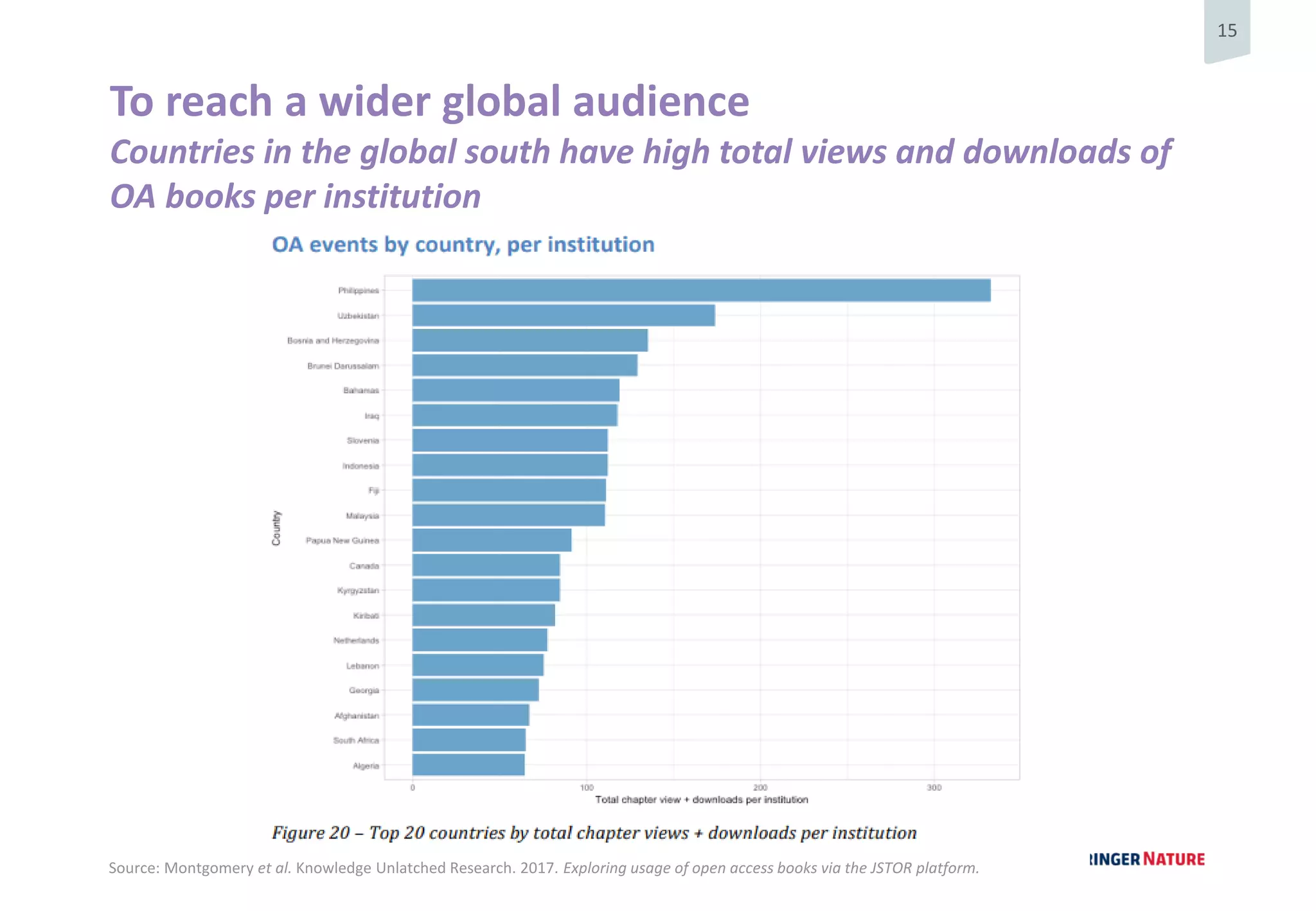
Countries in the global south have high total views and downloads of
OA books per institution
Source: Montgomery et al. Knowledge Unlatched Research. 2017. Exploring usage of open access books via the JSTOR platform.
16
To support reproducibility
OA helps verification of results, speeds up scholarly exchange
“with open science, it helps that
research results can be replicated,
verified, falsified, and reused for
scholarly as well as practical
applications.”
-- Falk Reckling, PhD, Head of
Department, Strategy – Policy,
Evaluation, Analysis, Austrian
Science Fund (FWF)
Source: Emery et al. Springer Nature. 2017. The OA effect: How does open access affect the usage of scholarly books?
17
To comply with public access mandates
OA is being adopted by major funders and institutions worldwide
“There is a political drive in
Norway towards open access to
research […] OA publishing is one
way to help meet this political
agenda.”
-- Professor Aslak Tveito,
CEO, Simula Research
Laboratory
“If it is publicly-funded
research [...] then I
think the public has the
right to access these
results.”
--- Philosophy
Professor,
Germany
18
To comply with public access mandates
There are an increasing number of funding initiatives for OA books
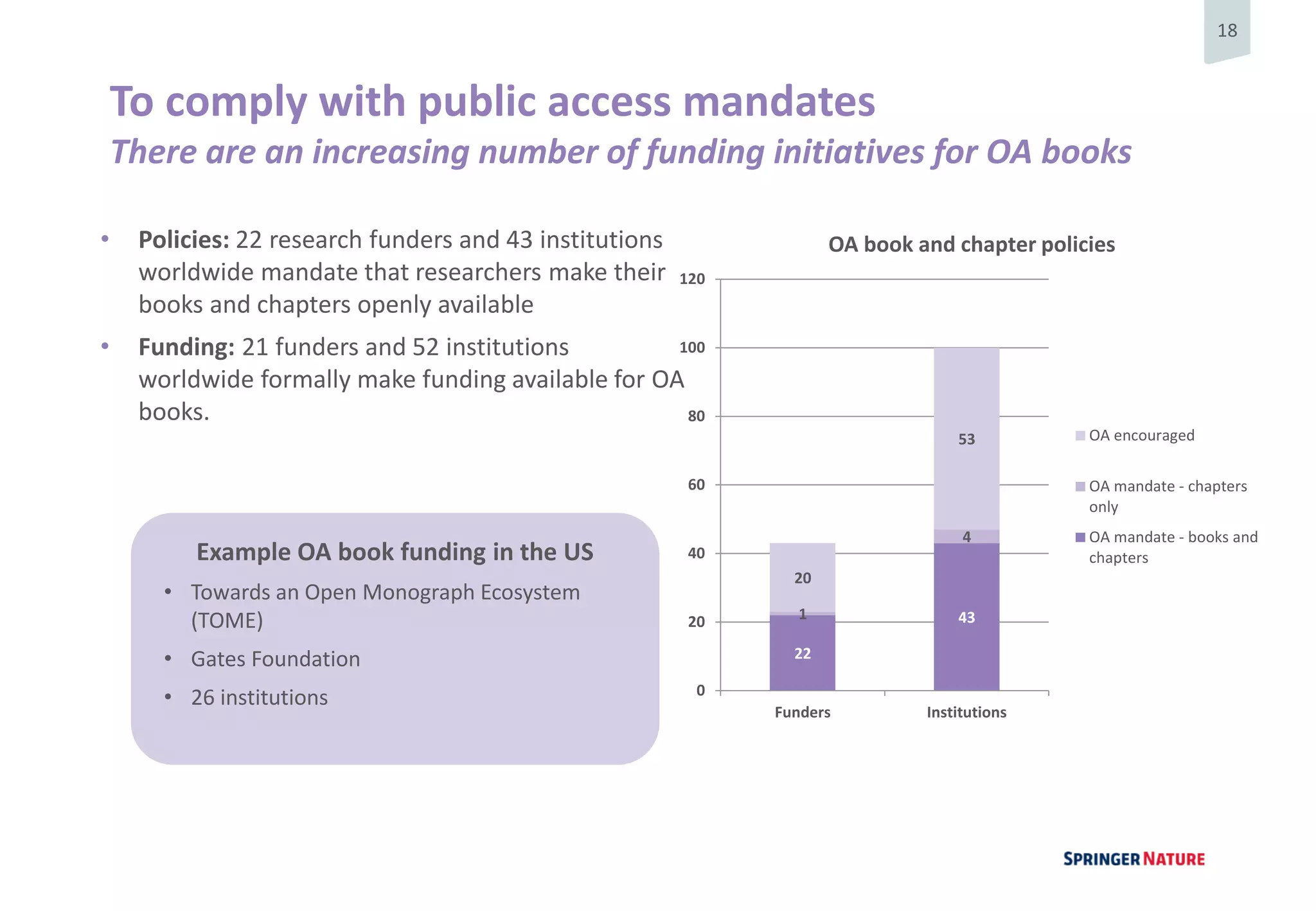
• Policies: 22 research funders and 43 institutions
worldwide mandate that researchers make their
books and chapters openly available
• Funding: 21 funders and 52 institutions
worldwide formally make funding available for OA
books.
Example OA book funding in the US
• Towards an Open Monograph Ecosystem
(TOME)
• Gates Foundation
• 26 institutions
22
431
4
20
53
0
20
40
60
80
100
120
Funders Institutions
OA book and chapter policies
OA encouraged
OA mandate - chapters
only
OA mandate - books and
chapters
19
#exploreOAbooks
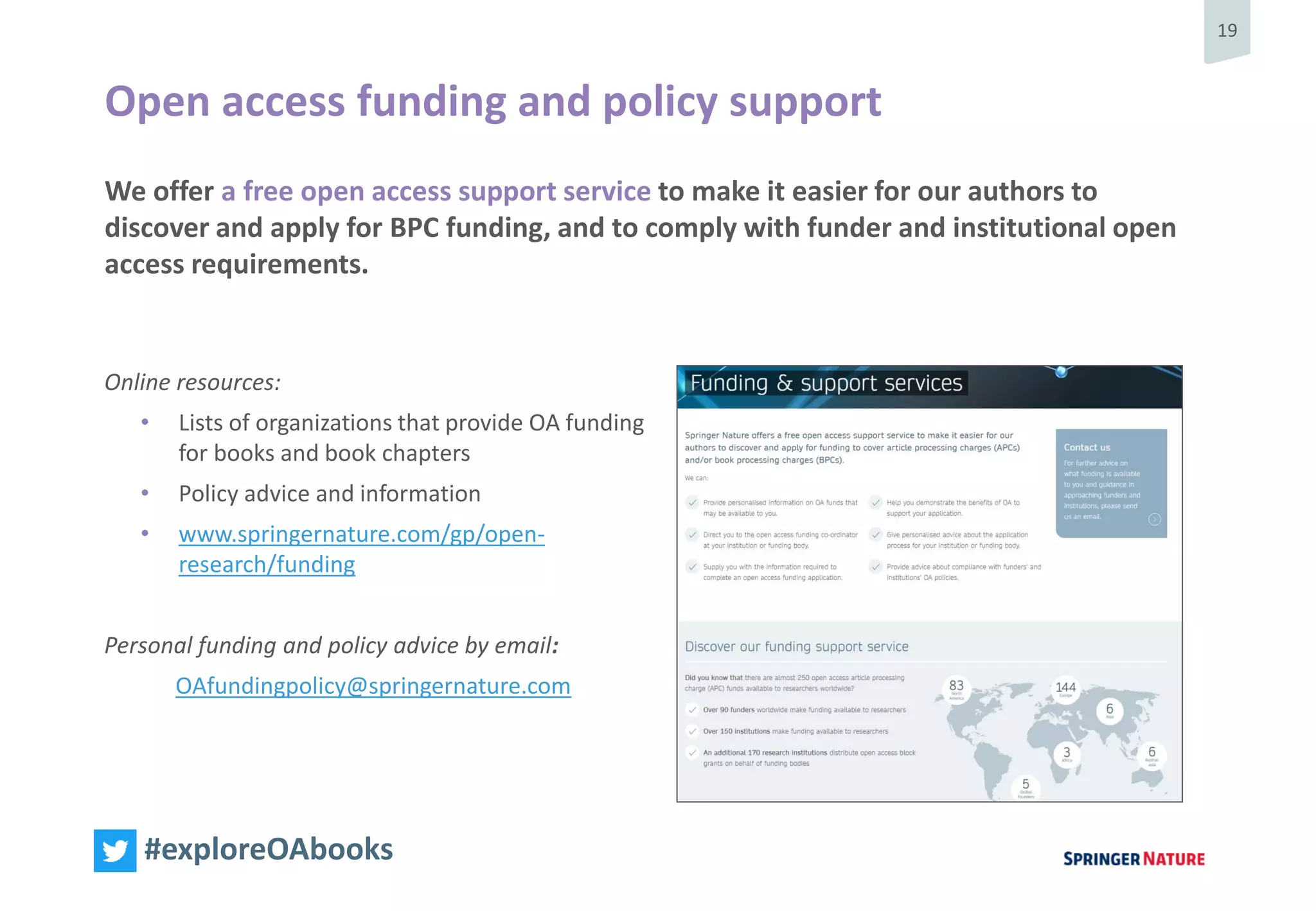
We offer a free open access support service to make it easier for our authors to
discover and apply for BPC funding, and to comply with funder and institutional open
access requirements.
Open access funding and policy support
Online resources:
• Lists of organizations that provide OA funding
for books and book chapters
• Policy advice and information
• www.springernature.com/gp/open-
research/funding
Personal funding and policy advice by email:
OAfundingpolicy@springernature.com
20
Why should I publish my book open access?
• Immediate online access
• Increased readership
• Reach a globally more diverse audience
• Reach beyond academia
• Support reproducibility
• Meet public access requirements
2121
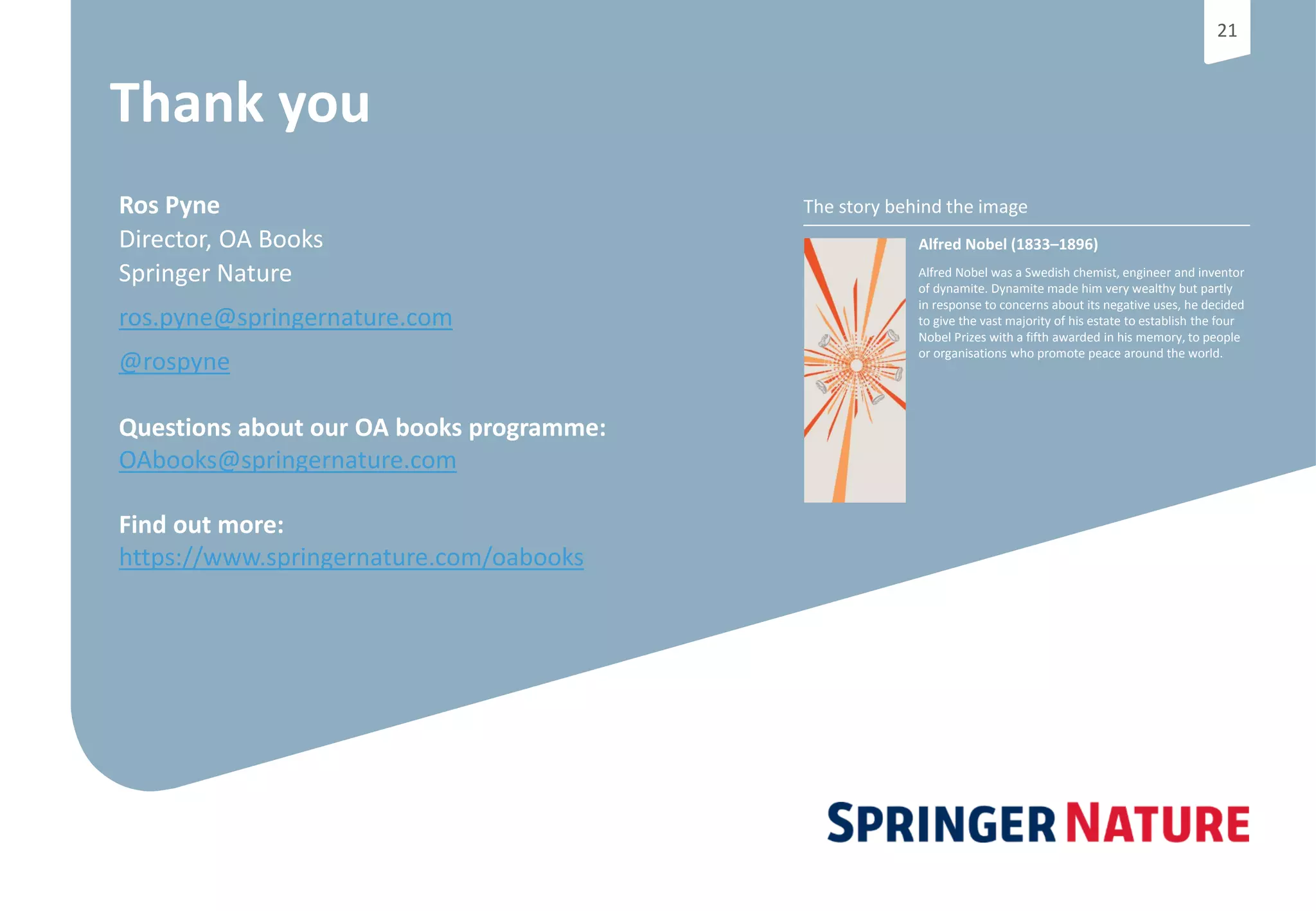
The story behind the image
Alfred Nobel (1833–1896)
Alfred Nobel was a Swedish chemist, engineer and inventor
of dynamite. Dynamite made him very wealthy but partly
in response to concerns about its negative uses, he decided
to give the vast majority of his estate to establish the four
Nobel Prizes with a fifth awarded in his memory, to people
or organisations who promote peace around the world.
Thank you
Ros Pyne
Director, OA Books
Springer Nature
ros.pyne@springernature.com
@rospyne
Questions about our OA books programme:
OAbooks@springernature.com
Find out more:
https://www.springernature.com/oabooks
2222
3.0
A funder’s perspective of open access books
Leslie Rutkowski
The International Association for the Evaluation of
Educational Achievement (IEA)
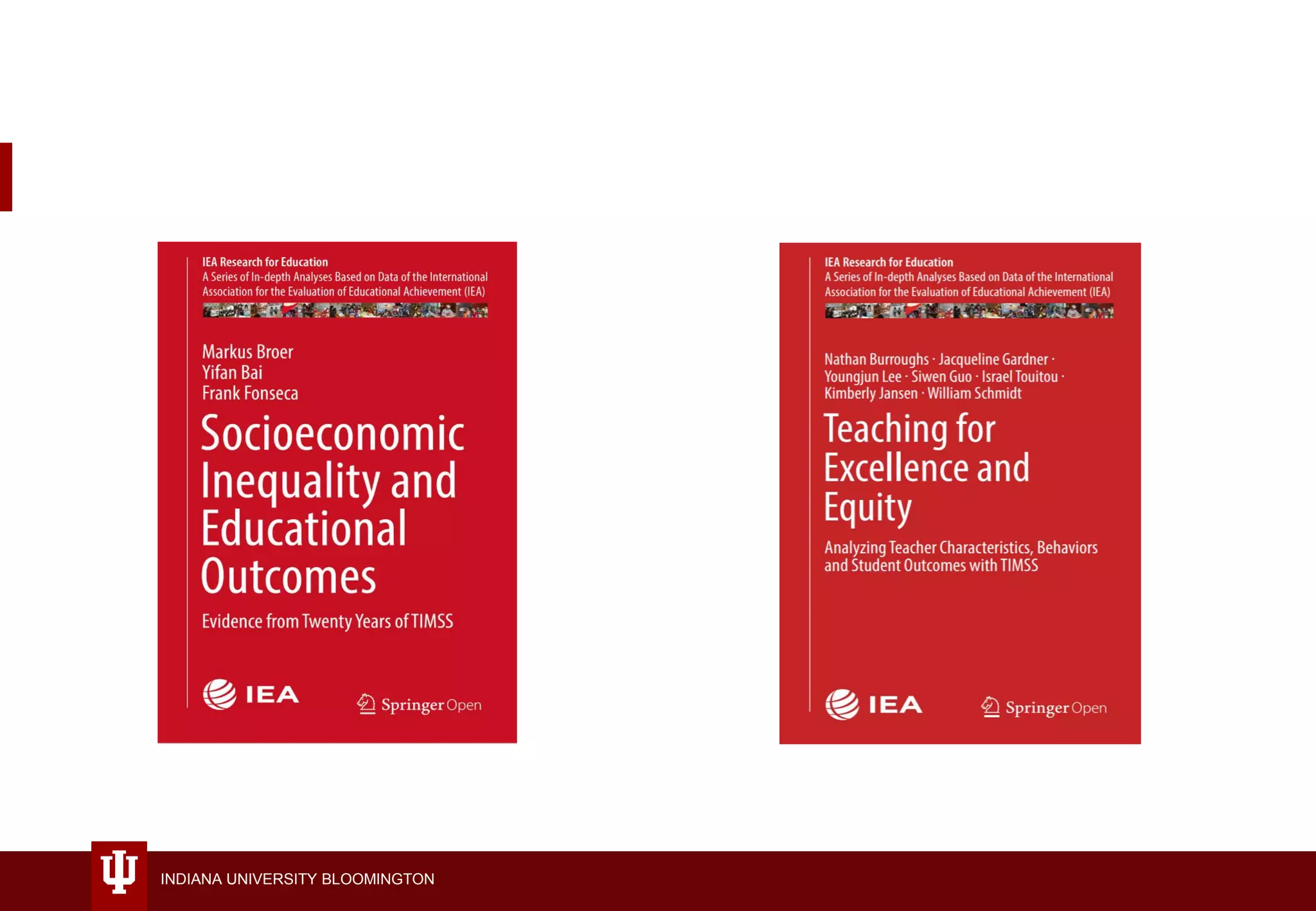
Research for Education Book Series
Leslie Rutkowski, PhD
Springer OA Book Event
New York, NY
2019
Who Am I?
A Funder’s Perspective
INDIANA UNIVERSITY BLOOMINGTON
About Me
• Associate Professor of Inquiry Methodology
• PhD from U of Illinois (2007)
• My research area: Quantitative methods/Psychometrics
• Latent variable models
• Especially as they are used for measuring cross-culturally
• Co-Editor of IEA Research for Education series (since 2017)
• Hobby ultrarunner
• Former EOD tech (have you seen Hurt Locker?)
Who is the IEA?
A Funder’s Perspective
INDIANA UNIVERSITY BLOOMINGTON
The IEA
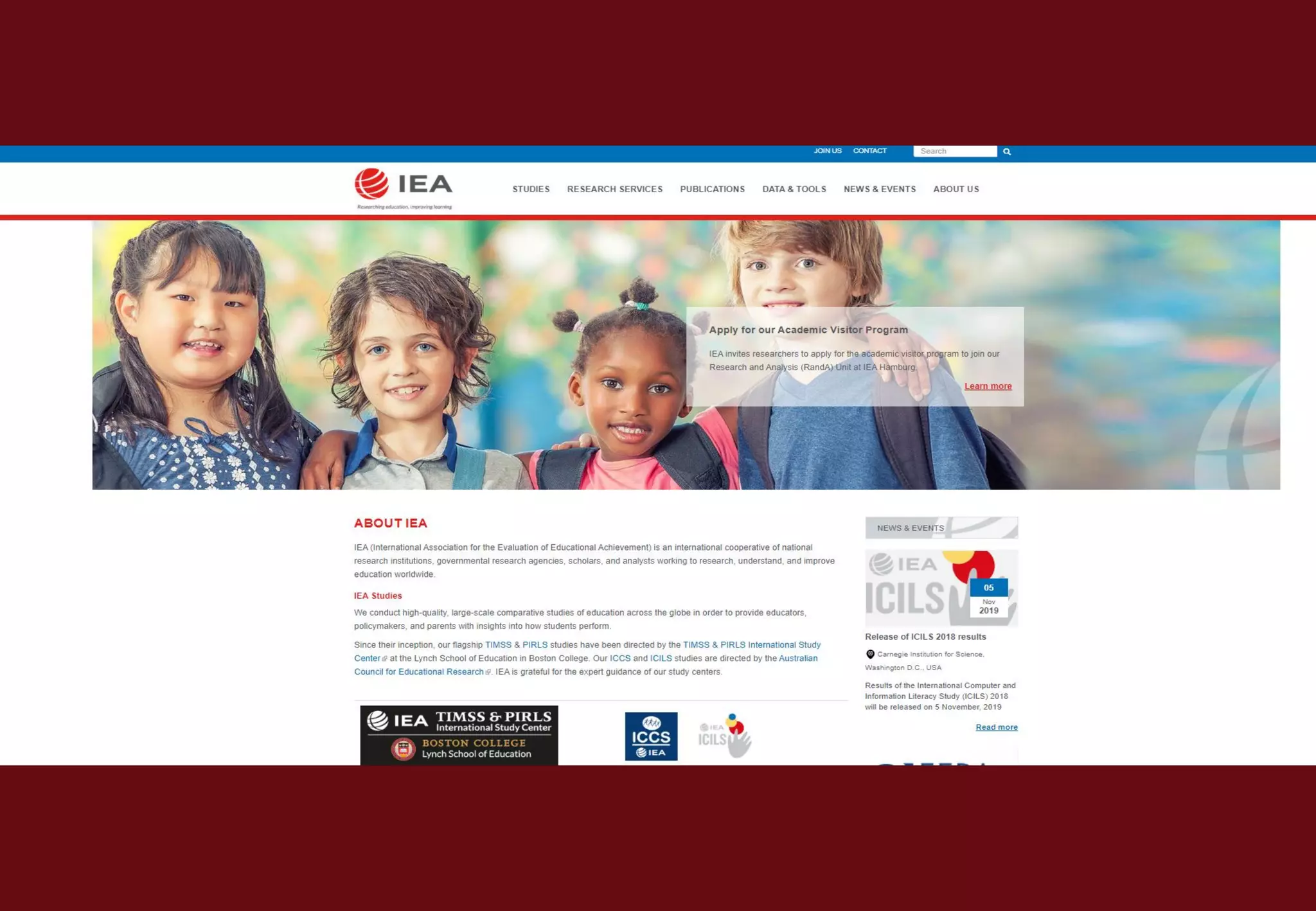
The International Association for the Evaluation of Educational Achievement (IEA) is
an independent nongovernmental nonprofit cooperative of national research
institutions and governmental research agencies that originated in Hamburg,
Germany in 1958. For over 60 years, IEA has developed and conducted high-
quality, large-scale comparative studies in education to support countries’ efforts to
engage in national strategies for educational monitoring and improvement.
www.iea.nl – check it out!
INDIANA UNIVERSITY BLOOMINGTON
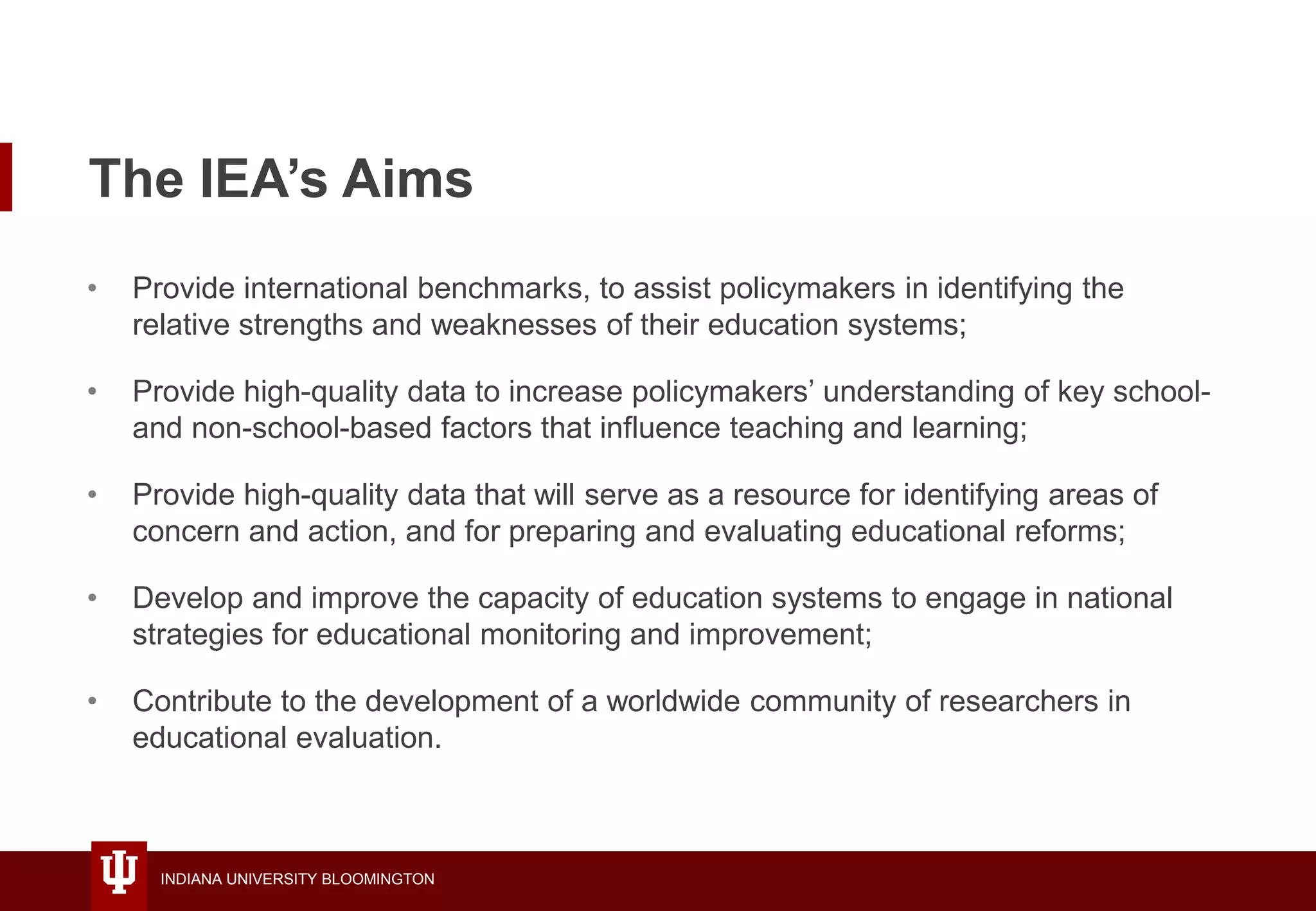
The IEA’s Aims
• Provide international benchmarks, to assist policymakers in identifying the
relative strengths and weaknesses of their education systems;
• Provide high-quality data to increase policymakers’ understanding of key school-
and non-school-based factors that influence teaching and learning;
• Provide high-quality data that will serve as a resource for identifying areas of
concern and action, and for preparing and evaluating educational reforms;
• Develop and improve the capacity of education systems to engage in national
strategies for educational monitoring and improvement;
• Contribute to the development of a worldwide community of researchers in
educational evaluation.
INDIANA UNIVERSITY BLOOMINGTON
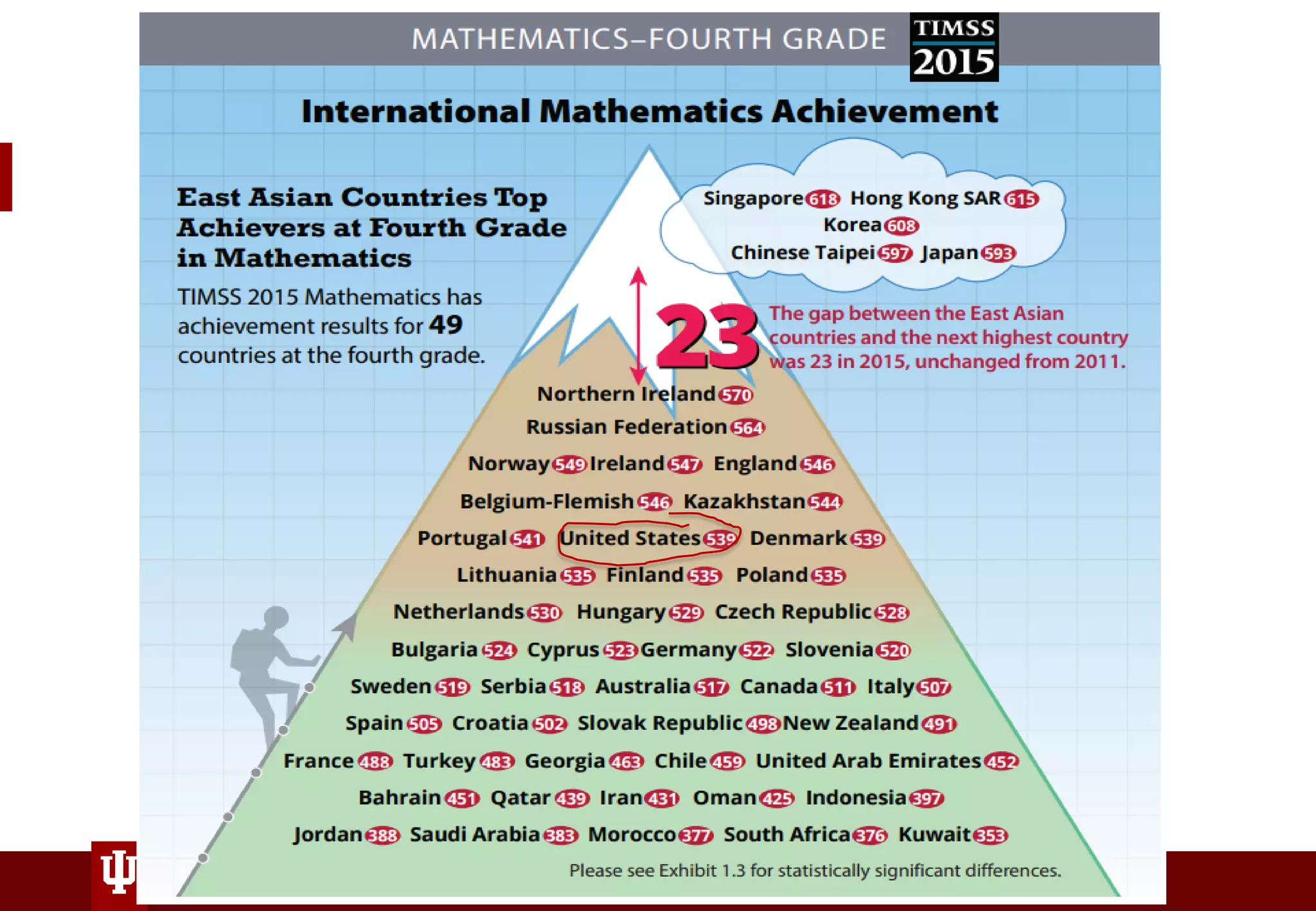
IEA Products
• Trends in International Mathematics and Science Study (TIMSS)
• International assessment of math and science at 4th and 8th grade
• Questionnaires from:
• Principals
• Teachers
• Students
• Provides an international snapshot of educational achievement and correlates
INDIANA UNIVERSITY BLOOMINGTON
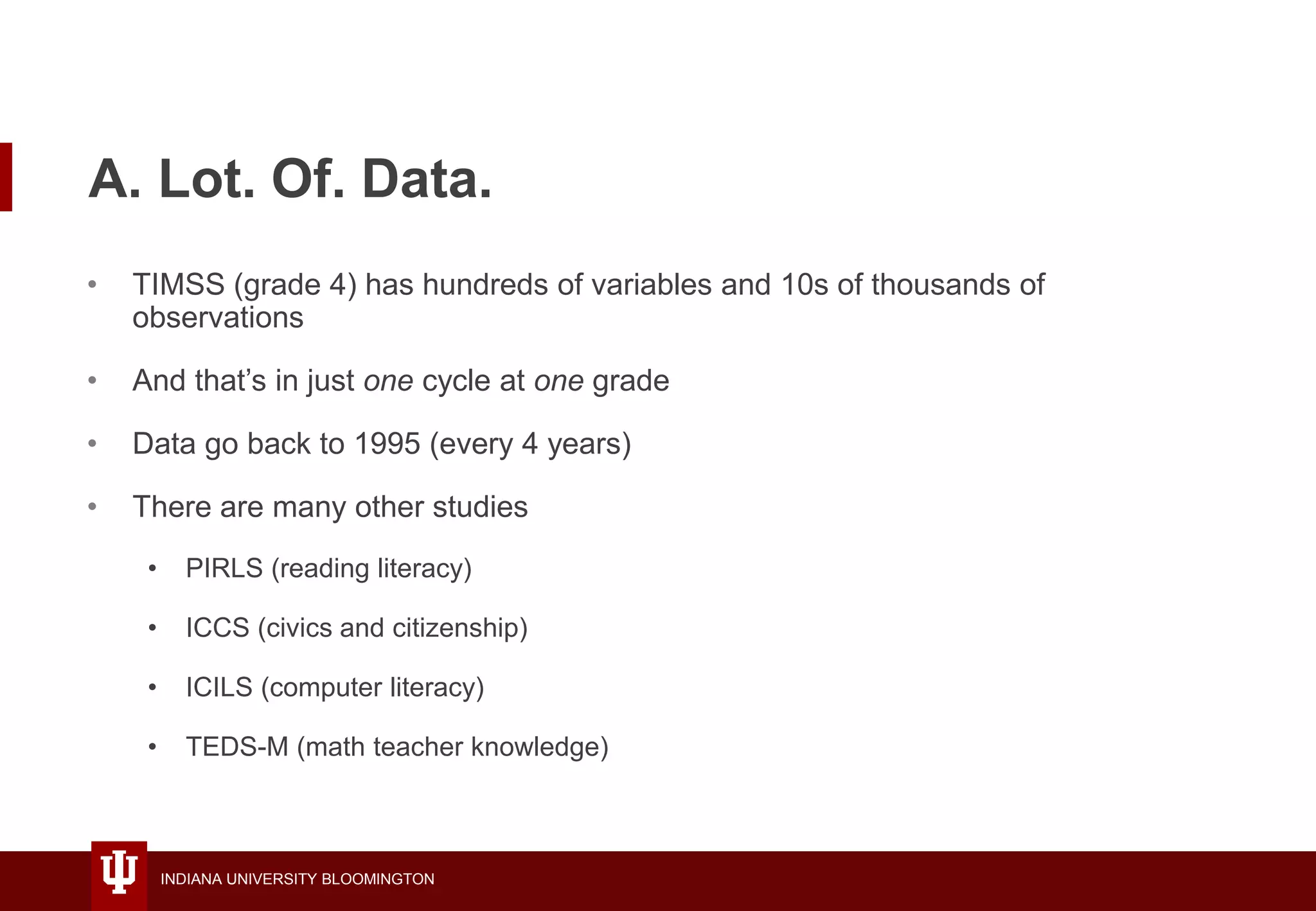
A. Lot. Of. Data.
• TIMSS (grade 4) has hundreds of variables and 10s of thousands of
observations
• And that’s in just one cycle at one grade
• Data go back to 1995 (every 4 years)
• There are many other studies
• PIRLS (reading literacy)
• ICCS (civics and citizenship)
• ICILS (computer literacy)
• TEDS-M (math teacher knowledge)
INDIANA UNIVERSITY BLOOMINGTON
Publications
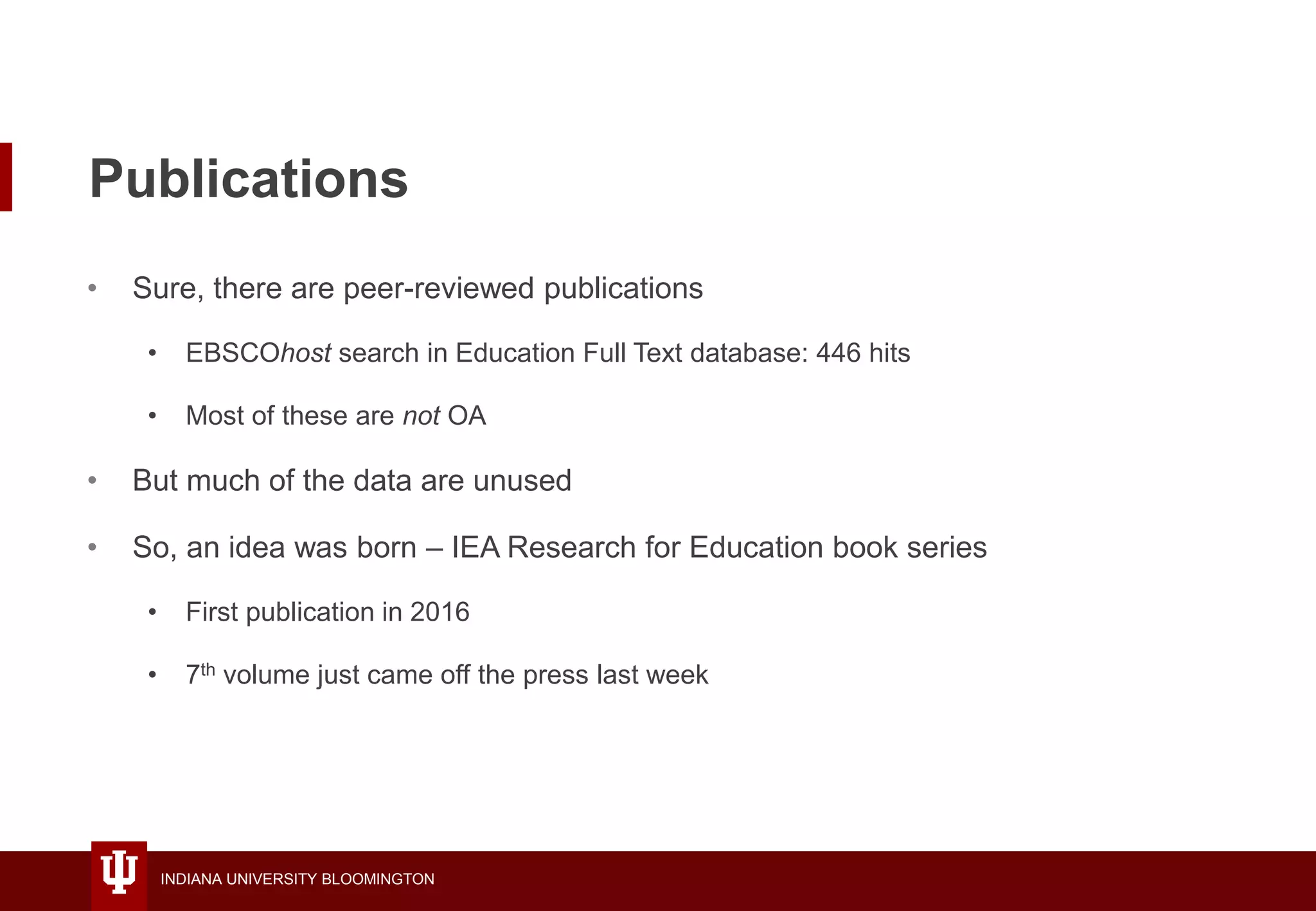
• Sure, there are peer-reviewed publications
• EBSCOhost search in Education Full Text database: 446 hits
• Most of these are not OA
• But much of the data are unused
• So, an idea was born – IEA Research for Education book series
• First publication in 2016
• 7th volume just came off the press last week
IEA Research for
Education
A Funder’s Perspective
INDIANA UNIVERSITY BLOOMINGTON
What it is
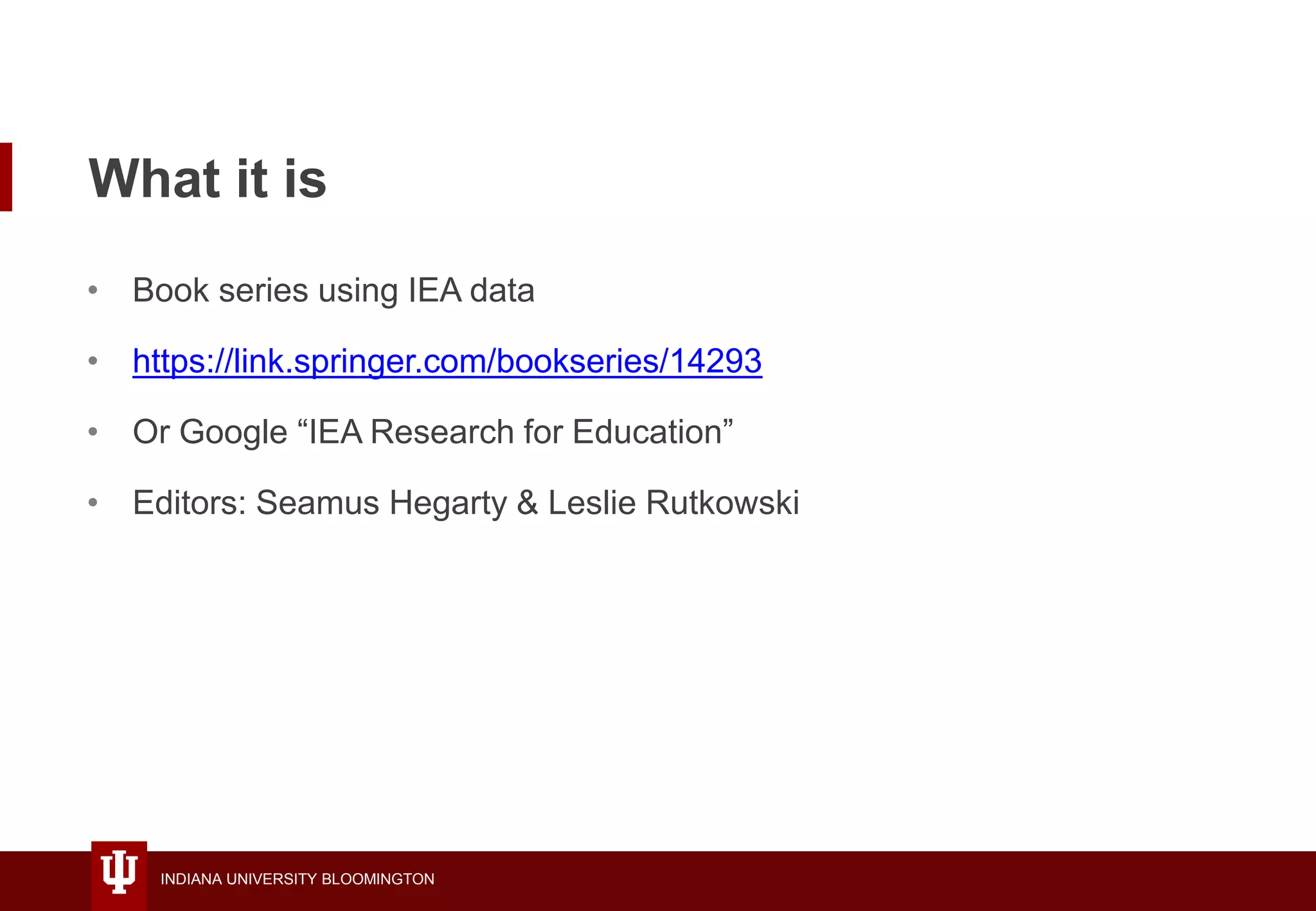
• Book series using IEA data
• https://link.springer.com/bookseries/14293
• Or Google “IEA Research for Education”
• Editors: Seamus Hegarty & Leslie Rutkowski
INDIANA UNIVERSITY BLOOMINGTON
What it is
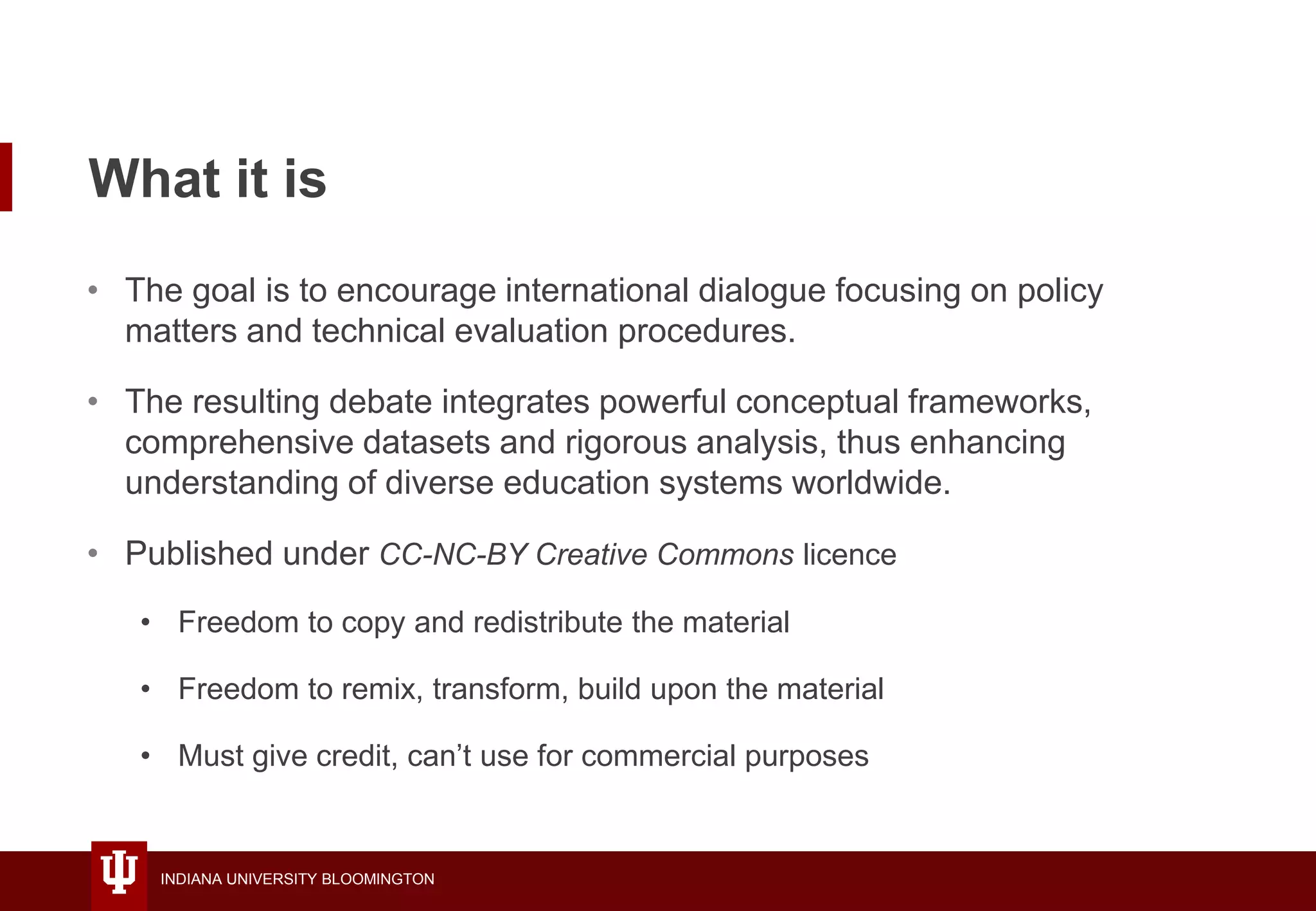
• The goal is to encourage international dialogue focusing on policy
matters and technical evaluation procedures.
• The resulting debate integrates powerful conceptual frameworks,
comprehensive datasets and rigorous analysis, thus enhancing
understanding of diverse education systems worldwide.
• Published under CC-NC-BY Creative Commons licence
• Freedom to copy and redistribute the material
• Freedom to remix, transform, build upon the material
• Must give credit, can’t use for commercial purposes
INDIANA UNIVERSITY BLOOMINGTON
Why Open Access?
1. A critical aspect of IEA’s vision
2. Inline with UN’s SGD4 Quality Education for All and IEA’s work with UNESCO.
3. IEA has a big international audience:
– Researchers and students
– NGOs/IGOs
– Policy makers
– Parents
– Educators
– Journalists
4. Many are from economically developing countries.
INDIANA UNIVERSITY BLOOMINGTON
A History of OA/OS and IEA
• Large-scale Assessments in Education – Springer journal
• IEA Compass – policy brief series, published in-house
• IDB Analyzer – free plug-in for analyzing IEA (and other similar) data
How to Get OA Funding
A Funder’s Perspective
INDIANA UNIVERSITY BLOOMINGTON
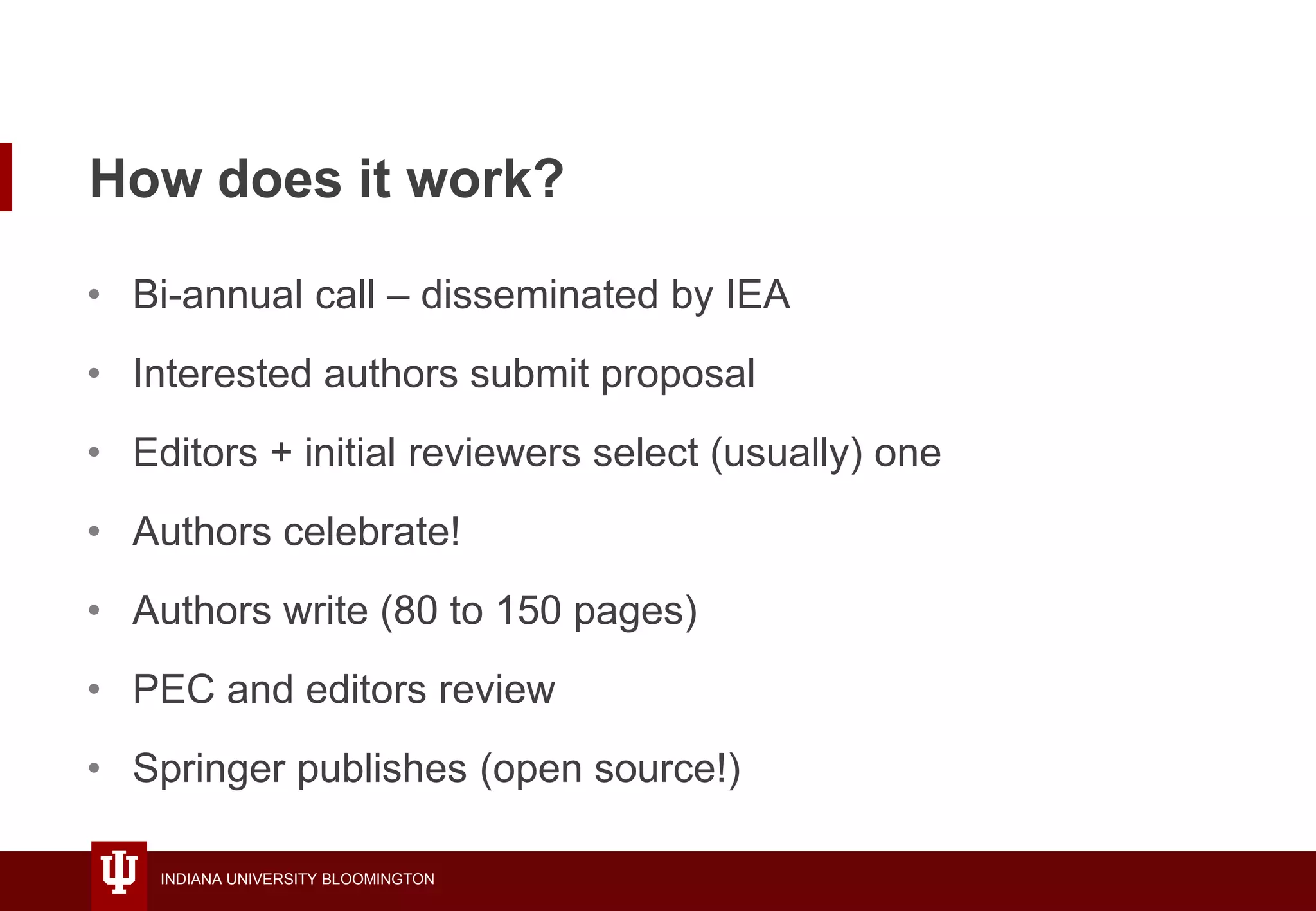
How does it work?
• Bi-annual call – disseminated by IEA
• Interested authors submit proposal
• Editors + initial reviewers select (usually) one
• Authors celebrate!
• Authors write (80 to 150 pages)
• PEC and editors review
• Springer publishes (open source!)
INDIANA UNIVERSITY BLOOMINGTON
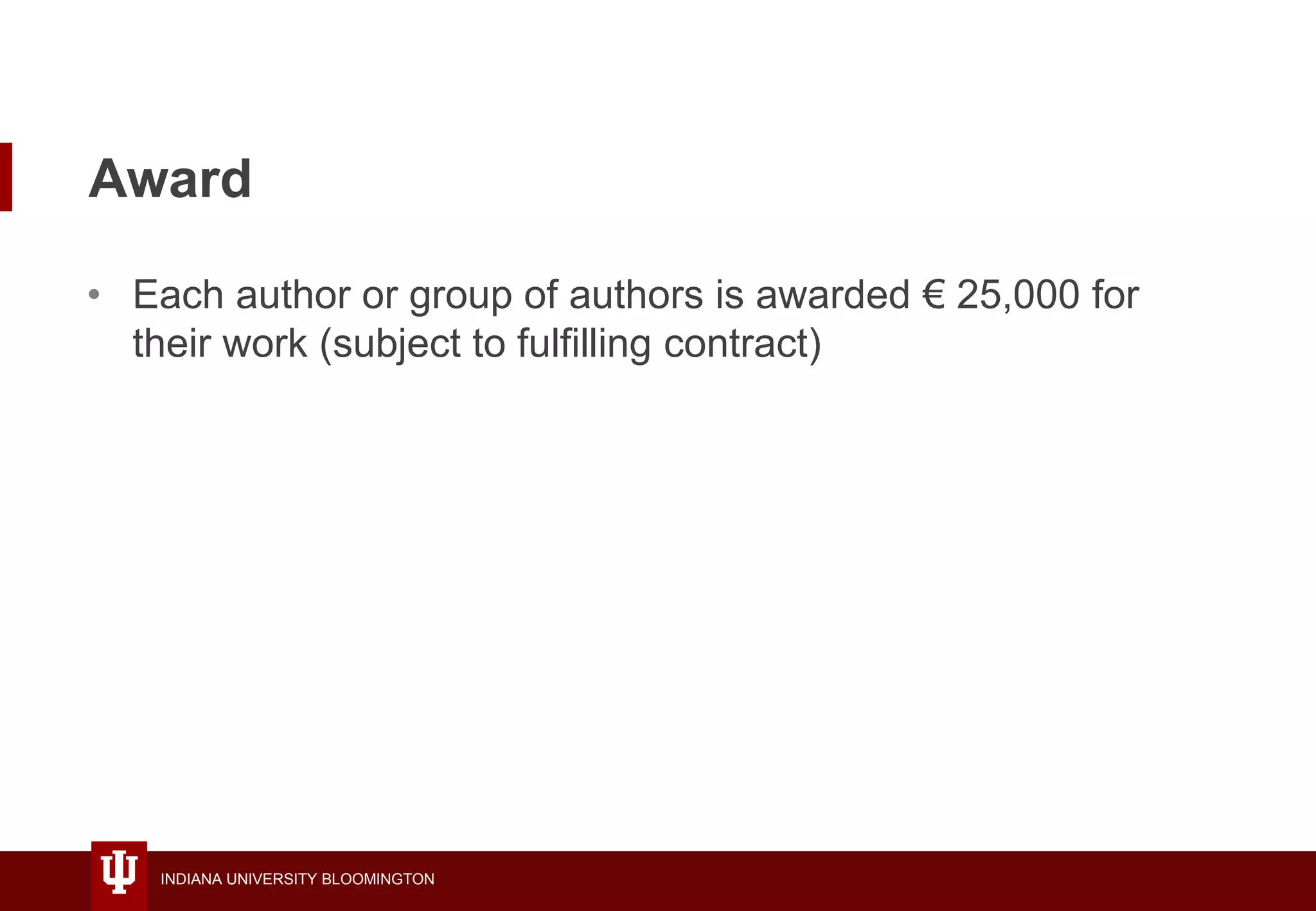
Award
• Each author or group of authors is awarded € 25,000 for
their work (subject to fulfilling contract)
INDIANA UNIVERSITY BLOOMINGTON
Unsolicited applications
• We also consider unsolicited applications
• Process is the same
• Proposal
• Review
• (Maybe) award
• Write
• Review
• Publish
Future of Funding
A Funder’s Perspective
INDIANA UNIVERSITY BLOOMINGTON
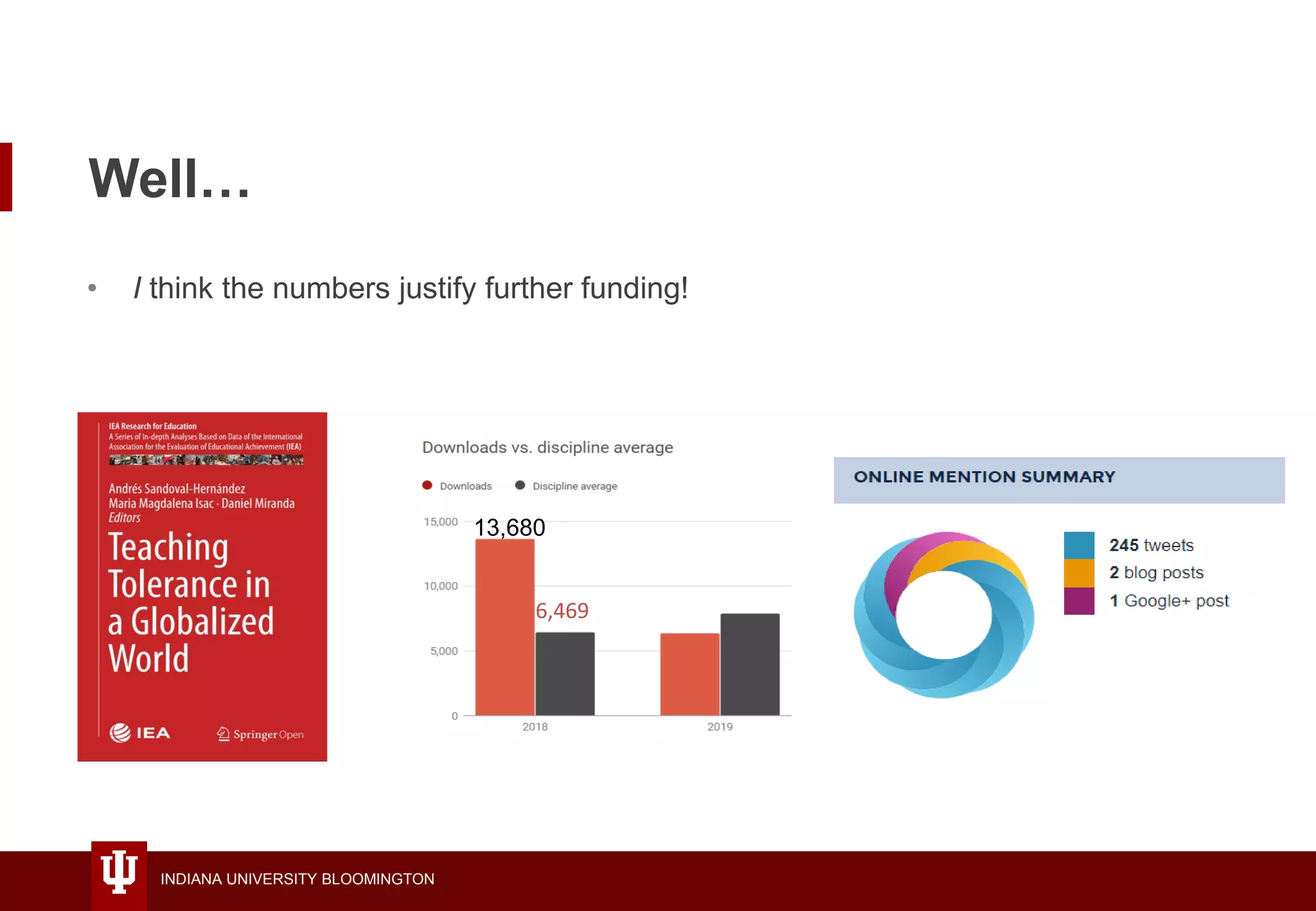
Well…
• I think the numbers justify further funding!
13,680
6,469
INDIANA UNIVERSITY BLOOMINGTON
For the foreseeable future
• We plan to continue to release RFPs
• And to keep the door open to unsolicited calls
Summary from an Editor’s
Perspective
INDIANA UNIVERSITY BLOOMINGTON
My Two Cents
• This has been a successful endeavor for me, the IEA, and (I hope) the authors
• We’ve had representation from Europe, S. America, and N. America
• It’s been a great way to get the data used and results disseminated as broadly
as possible – there’s no barrier, other than an internet connection.
5151
4.0
Tracking impact for open access authors:
Author services & tools
Christina Emery
Open access books Marketing Manager, Springer Nature
52
#exploreOAbooks
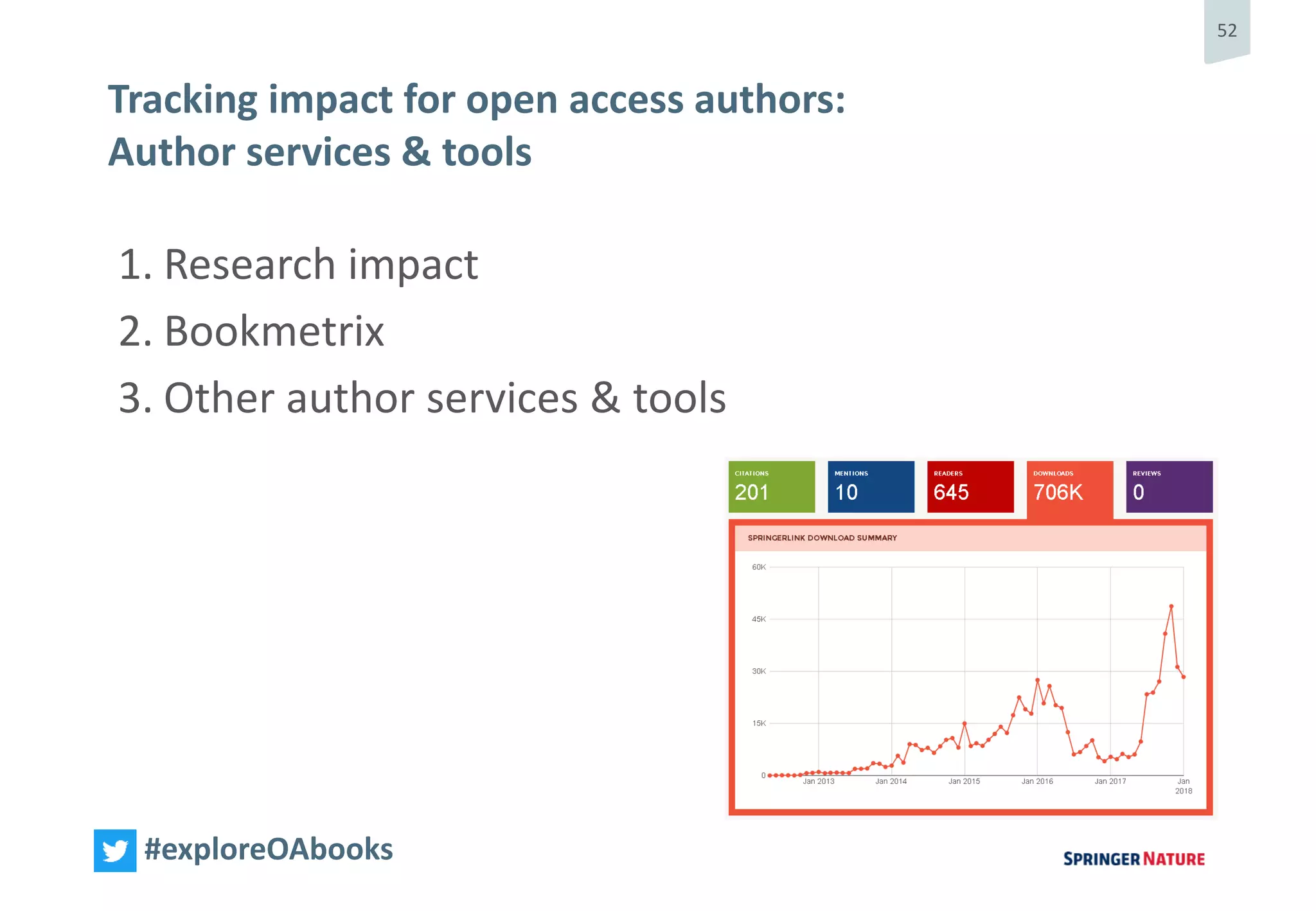
Tracking impact for open access authors:
Author services & tools
1. Research impact
2. Bookmetrix
3. Other author services & tools
53
#exploreOAbooks
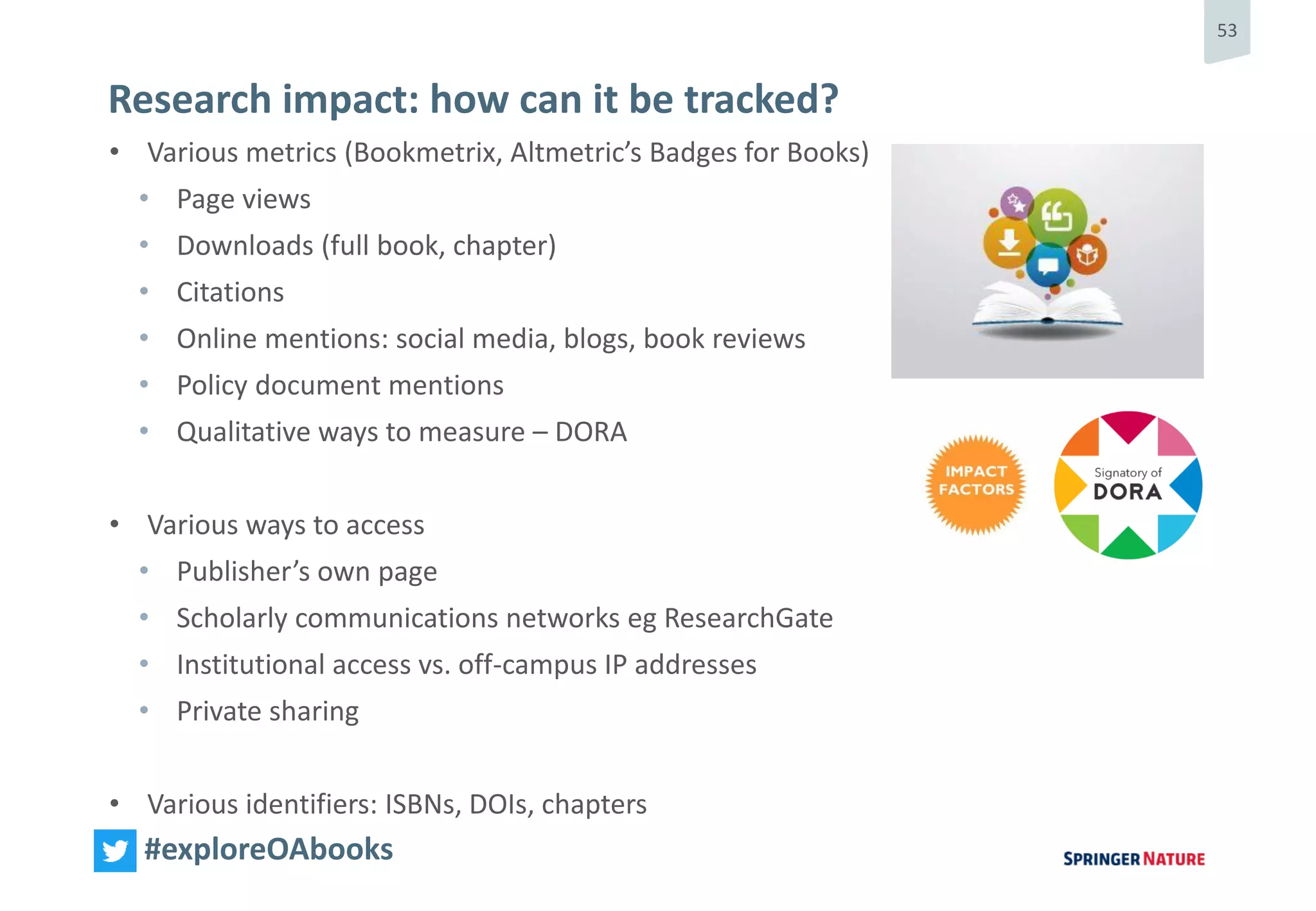
Research impact: how can it be tracked?
• Various metrics (Bookmetrix, Altmetric’s Badges for Books)
• Page views
• Downloads (full book, chapter)
• Citations
• Online mentions: social media, blogs, book reviews
• Policy document mentions
• Qualitative ways to measure – DORA
• Various ways to access
• Publisher’s own page
• Scholarly communications networks eg ResearchGate
• Institutional access vs. off-campus IP addresses
• Private sharing
• Various identifiers: ISBNs, DOIs, chapters
54
#exploreOAbooks
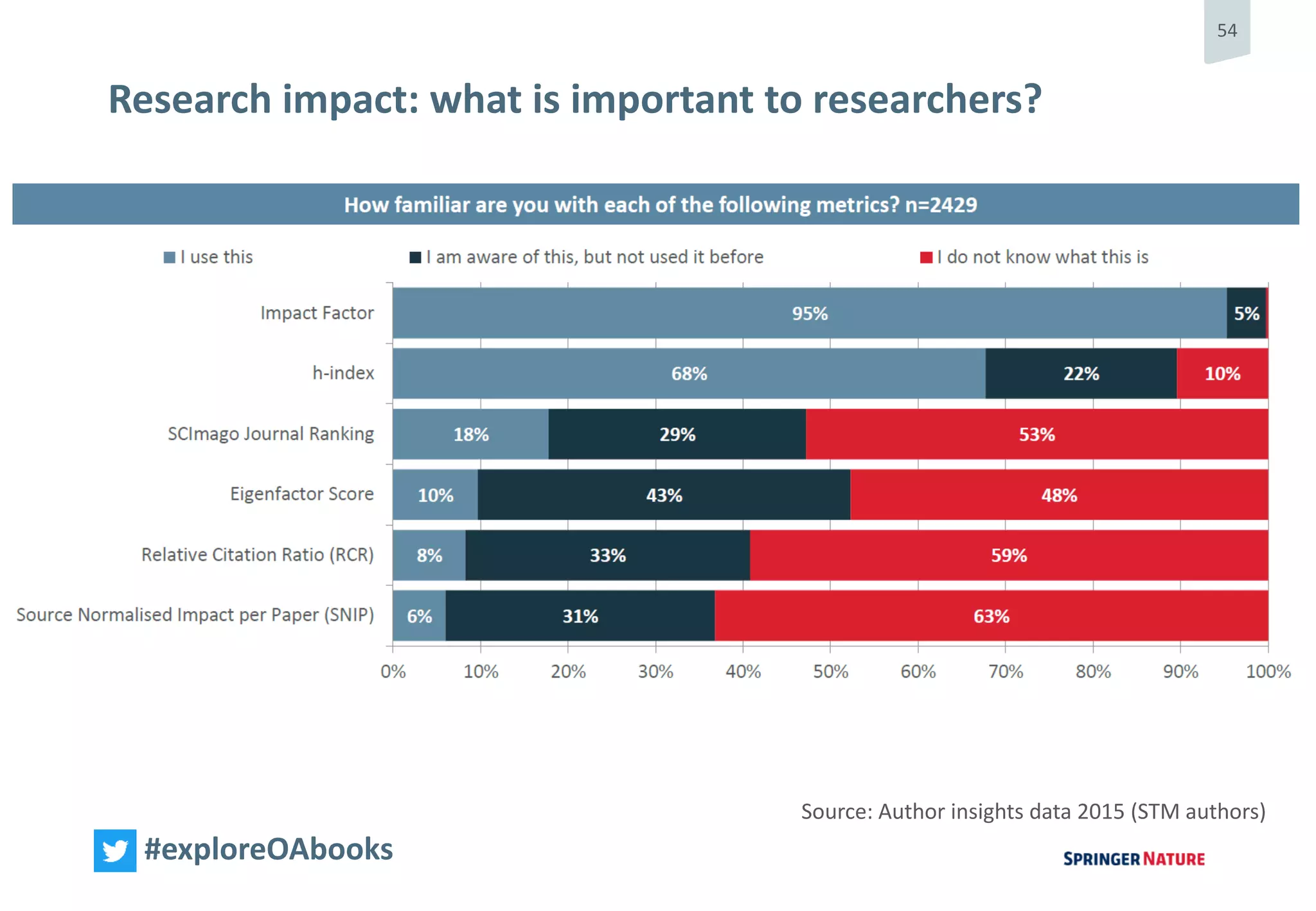
Research impact: what is important to researchers?
Source: Author insights data 2015 (STM authors)
55
#exploreOAbooks
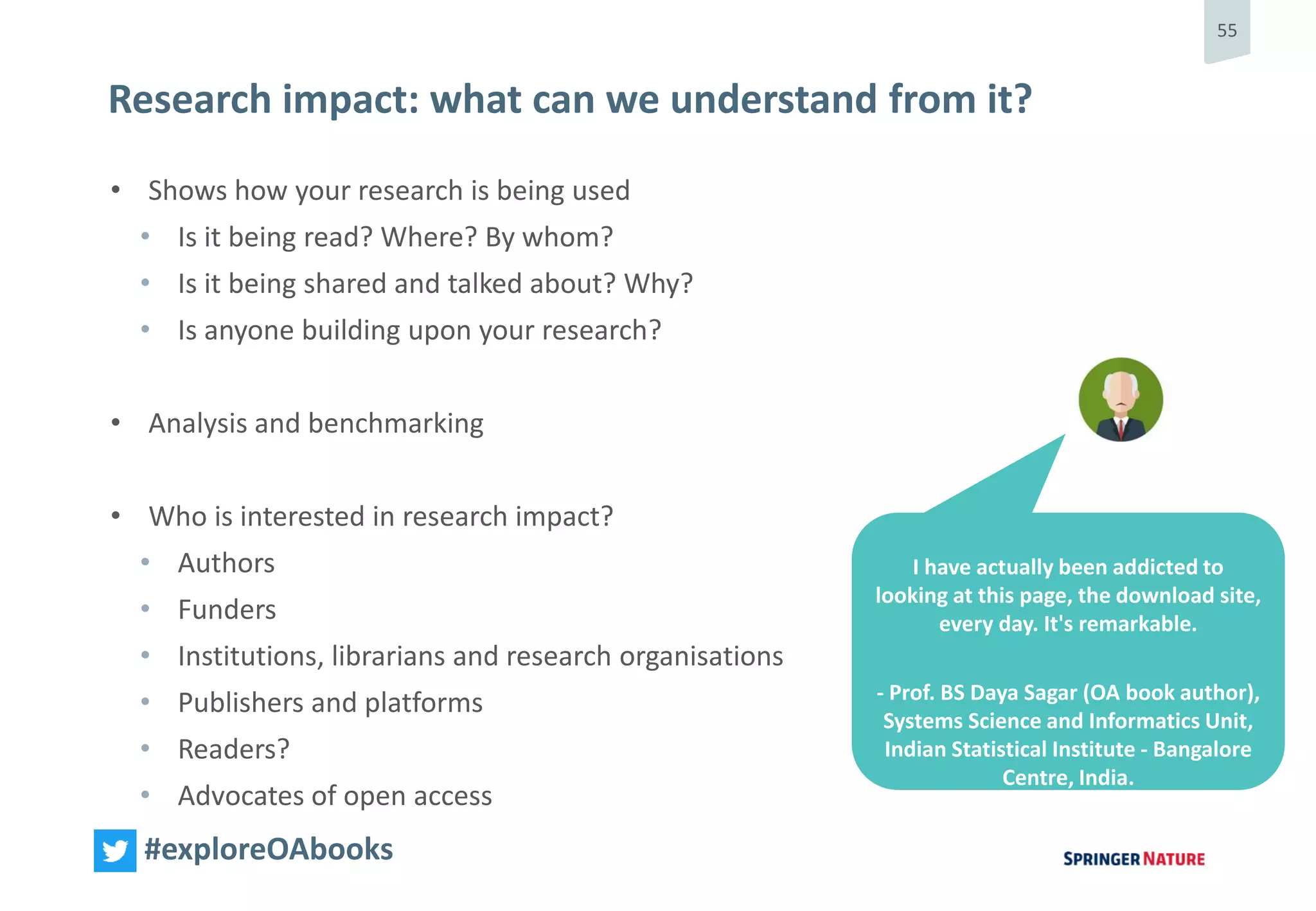
Research impact: what can we understand from it?
• Shows how your research is being used
• Is it being read? Where? By whom?
• Is it being shared and talked about? Why?
• Is anyone building upon your research?
• Analysis and benchmarking
• Who is interested in research impact?
• Authors
• Funders
• Institutions, librarians and research organisations
• Publishers and platforms
• Readers?
• Advocates of open access
I have actually been addicted to
looking at this page, the download site,
every day. It's remarkable.
- Prof. BS Daya Sagar (OA book author),
Systems Science and Informatics Unit,
Indian Statistical Institute - Bangalore
Centre, India.
56
#exploreOAbooks
Research impact: OA books
The OA Effect: How does open access affect the usage of scholarly books?
springernature.com/the-oa-effect
57
#exploreOAbooks
Professor of Social History at
the University of Hertfordshire, UK
https://link.springer.com/book/10.1007%2F978-3-319-59519-1
“Publishing is about communication beyond academia.”
– Prof. Owen Davies
58
#exploreOAbooks
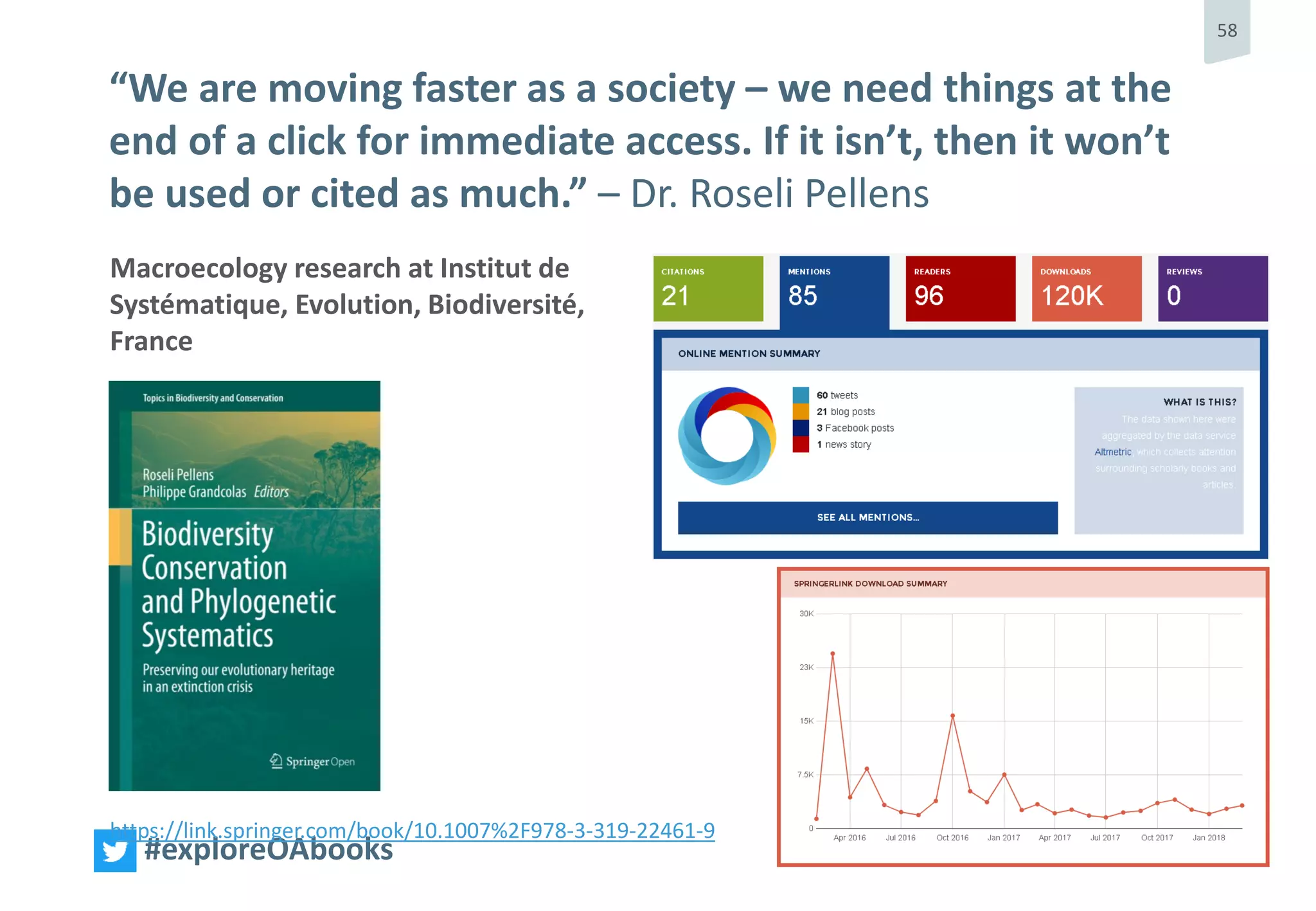
Macroecology research at Institut de
Systématique, Evolution, Biodiversité,
France
https://link.springer.com/book/10.1007%2F978-3-319-22461-9
“We are moving faster as a society – we need things at the
end of a click for immediate access. If it isn’t, then it won’t
be used or cited as much.” – Dr. Roseli Pellens
59
#exploreOAbooks
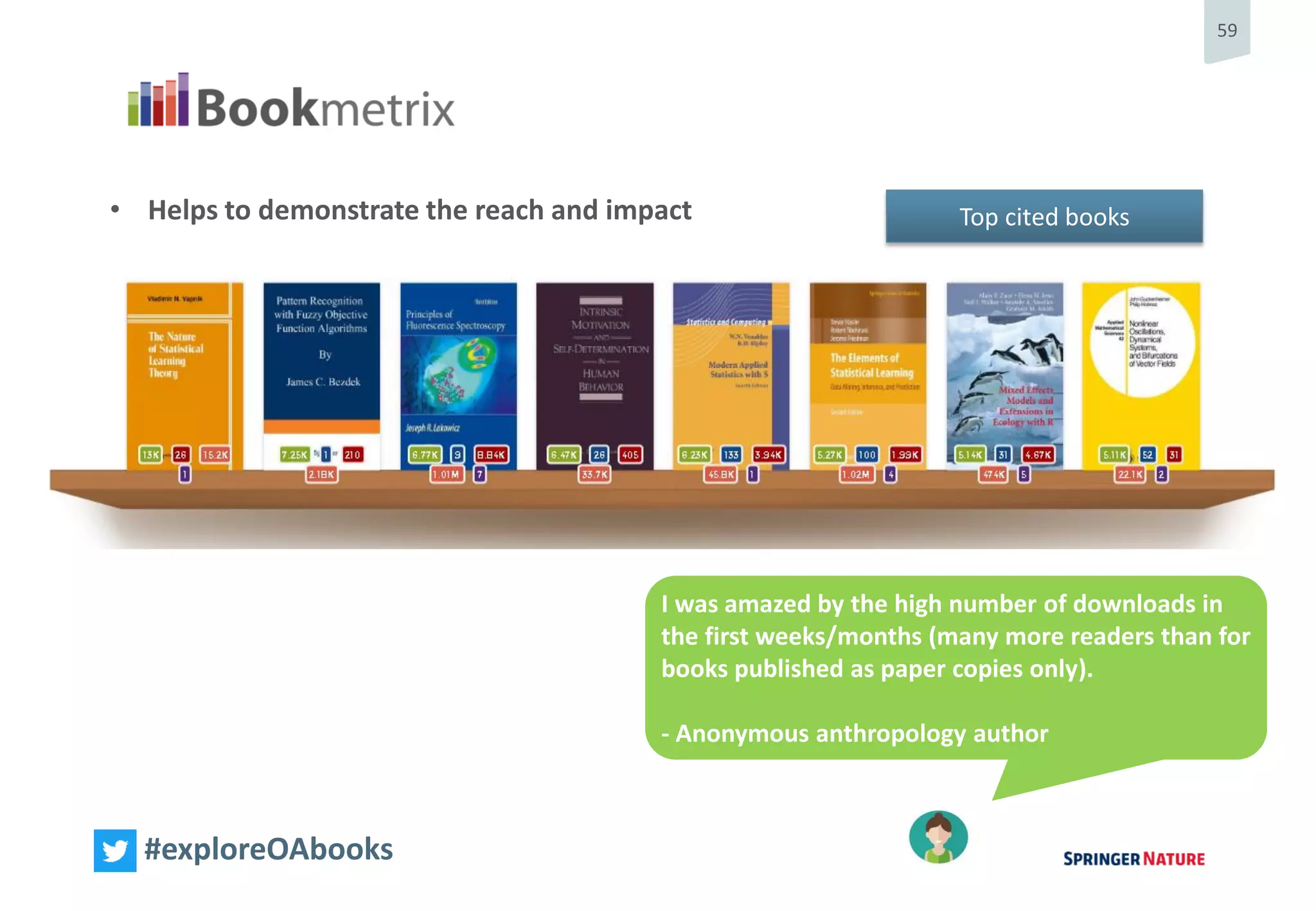
• Helps to demonstrate the reach and impact
I was amazed by the high number of downloads in
the first weeks/months (many more readers than for
books published as paper copies only).
- Anonymous anthropology author
Top cited books
60
#exploreOAbooks
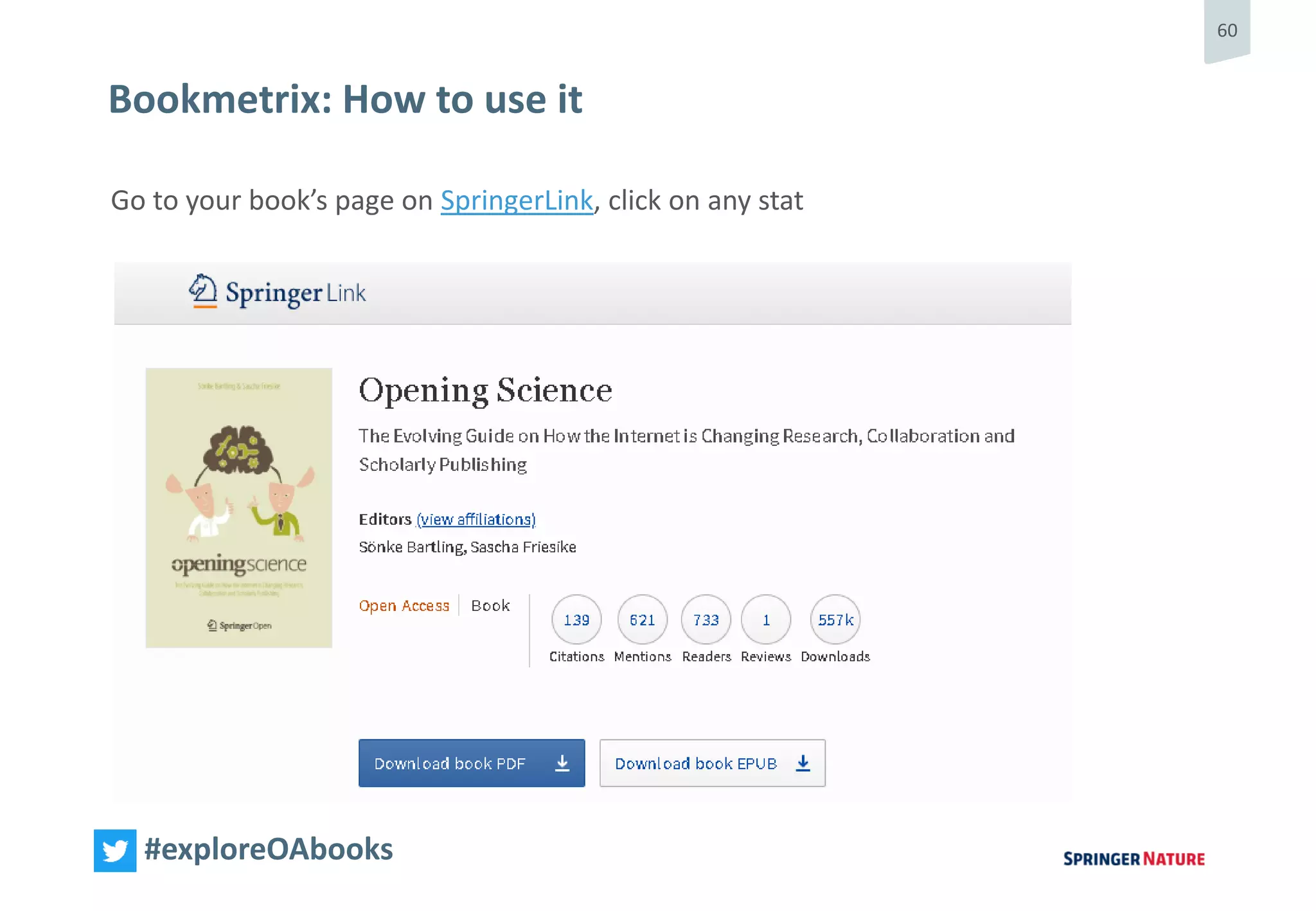
Bookmetrix: How to use it
Go to your book’s page on SpringerLink, click on any stat
61
#exploreOAbooks
Bookmetrix: How to use it
Click again on the stat
you are interested in,
for further drill down
Check comparison to
discipline average
62
#exploreOAbooks
Bookmetrix: How to use it
Look at full book or chapter-by-chapter metrics
63
#exploreOAbooks
Other services & tools
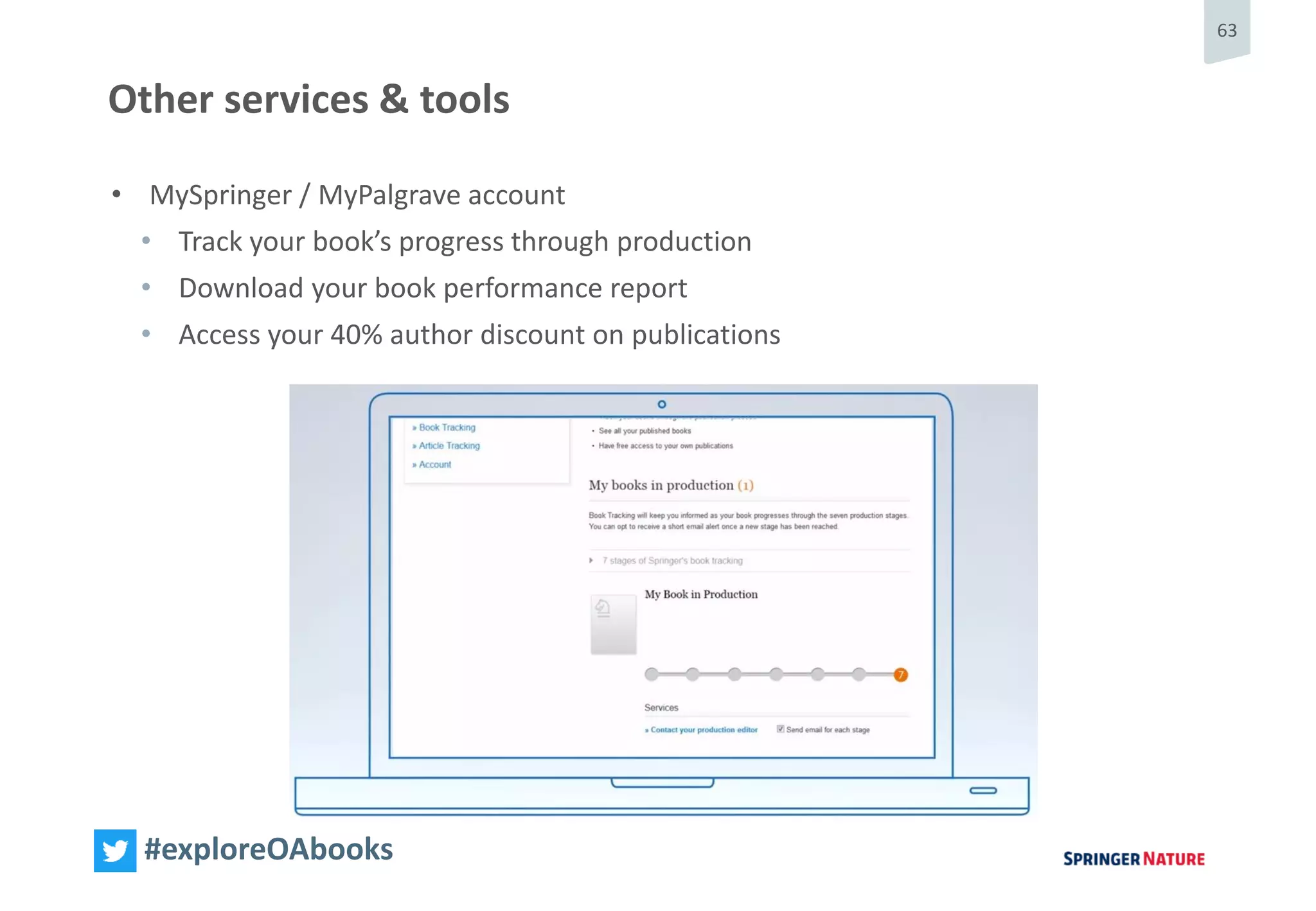
• MySpringer / MyPalgrave account
• Track your book’s progress through production
• Download your book performance report
• Access your 40% author discount on publications
64
#exploreOAbooks
Other services & tools
• Your own dedicated book page
• Link to shop and free download
• Snapshot of book’s stats
• Download flyer and high res image
• Author badge
• Promote your book
65
#exploreOAbooks
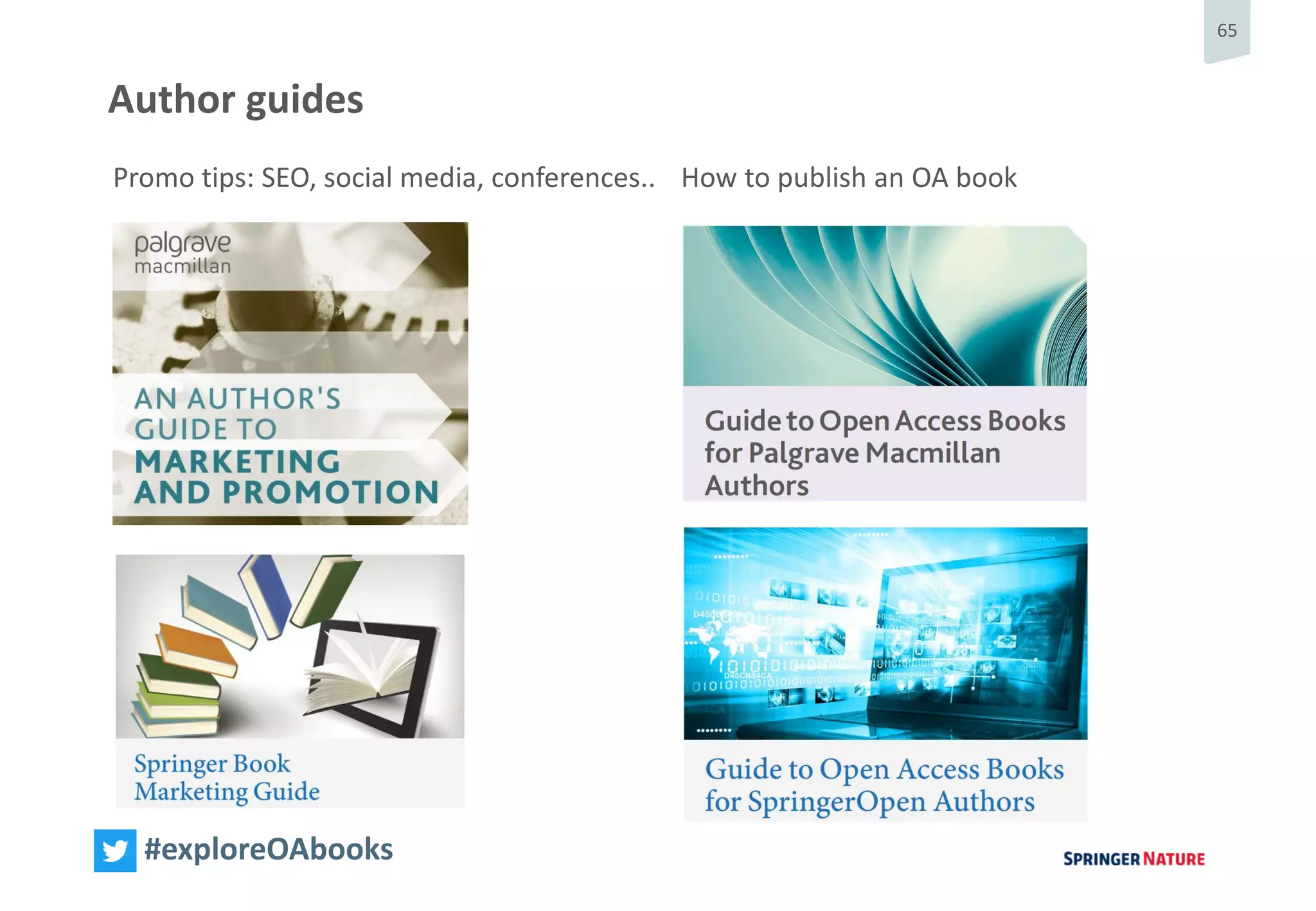
Author guides
Promo tips: SEO, social media, conferences.. How to publish an OA book
66
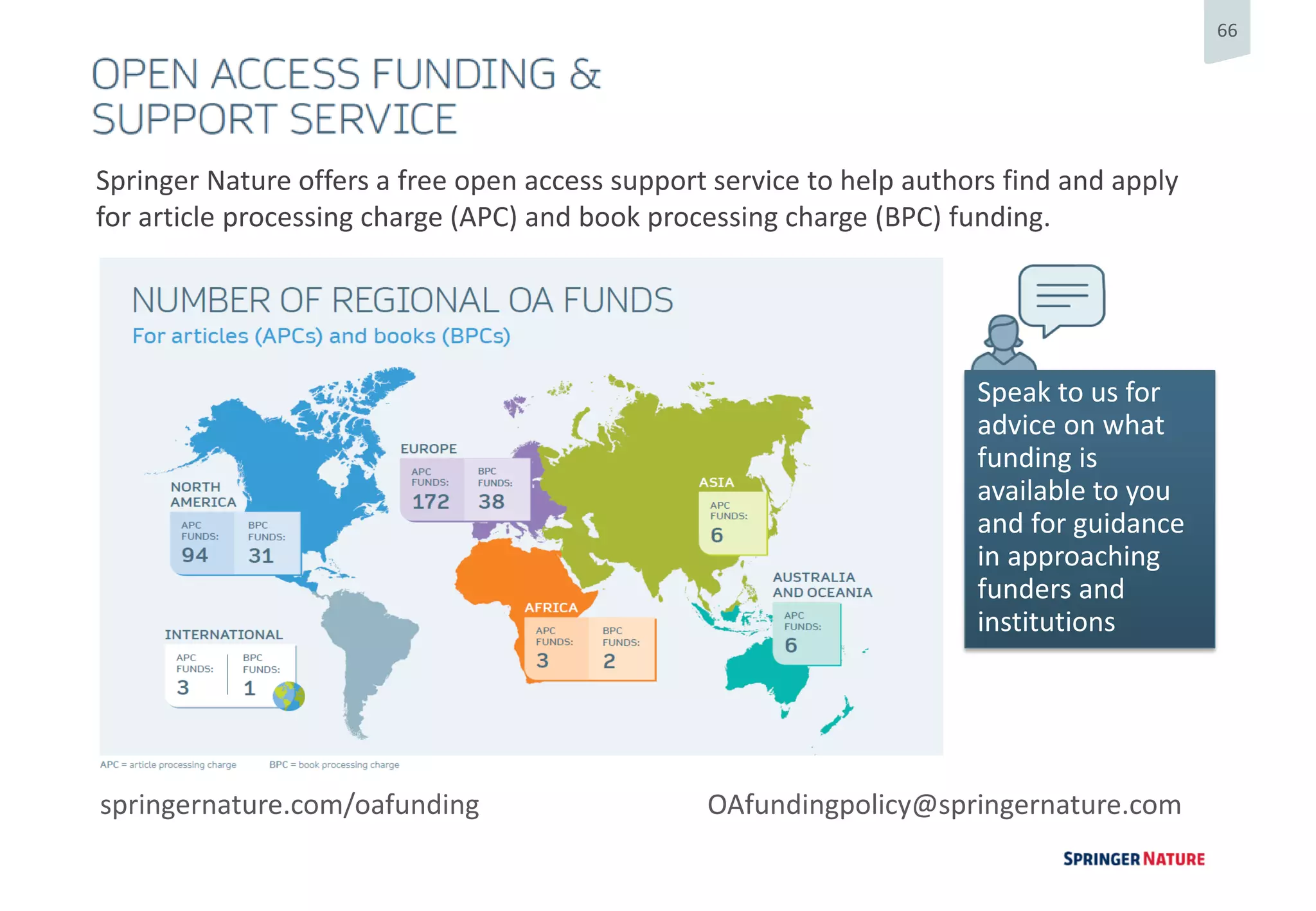
Springer Nature offers a free open access support service to help authors find and apply
for article processing charge (APC) and book processing charge (BPC) funding.
springernature.com/oafunding OAfundingpolicy@springernature.com
Speak to us for
advice on what
funding is
available to you
and for guidance
in approaching
funders and
institutions
67
#exploreOAbooks
Further information
Online resources
www.springernature.com/oabooks
www.springeropen.com/books
www.palgrave.com/open
Social media
@SN_OAbooks @SpringerNature @SpringerNature
linkedin.com/company/springer-nature/
Questions about our OA books programme:
OAbooks@springernature.com
6868
christina.emery@springernature.com
@_ChristinaEmery
0000-0003-3903-6724
Contact
6969
5.0
Author panel: Perspectives on publishing an open access
book
Chair: Philip Getz, Senior Commissioning Editor, Palgrave
Religion & Philosophy
Daniel Hess (University at Buffalo)
Juha Uitto (Global Environment Facility)
Sophie Mitra (Fordham University)
70
#exploreOAbooks
Professor and Chairperson of the
Department of Urban and Regional
Planning at the University at Buffalo
https://link.springer.com/book/10.1007/978-3-319-92813-5
Daniel Hess
71
#exploreOAbooks
Director of the Independent Evaluation
Office of the Global Environment Facility
https://link.springer.com/book/10.1007/978-3-319-43702-6
Juha Uitto
72
#exploreOAbooks
Professor in the Department
of Economics at Fordham University
https://link.springer.com/book/10.1057/978-1-137-53638-9
Sophie Mitra
7373
6.0
Panel: Discussing the learnings of the day incl. audience Q&A
Chair: Bill Tucker, Springer Nature
With all presenters and panellists, and audience participation
7474
The story behind the image
Marie Curie (1867–1934)
In a scientific world still dominated by men, Marie Curie
shone not only as an extraordinary pioneer in the field of
radioactivity, but also as a trailblazing female scientist. A
French-Polish chemist and physicist, Curie discovered two
new elements, polonium and radium, and revolutionised
our understanding of radioactivity, the process by which
unstable atoms decay by emitting energy in the form of
radiation. The first person of either gender to win or share
two Nobel Prizes, Curie is one of the most renowned
scientists of a generation, whose influences can be seen
throughout many areas of modern science, from particle
physics to medicine.
Thank you
Don’t forget to…
 complete our post-event survey
 follow us on Twitter @SN_OAbooks
 send your open access book proposal and
questions to OAbooks@springernature.com

Explore open access books - Springer Nature event in New York (2019-09)

  • 1.
    Explore open accessbooks #exploreOAbooks @SN_OAbooks IllustrationinspiredbytheworkofMarieCurie Wifi network: Springer Nature-Guest Password: spr%wm3n$
  • 2.
    1 #exploreOAbooks Programme 13:00 Welcome BillTucker, VP, Books, Medicine & Life Sciences, Springer Nature 13:10 Why publish your book open access? Rosalind Pyne, Director OA Books, Springer Nature 13:40 A funder’s perspective of open access books Leslie Rutkowski, The International Association for the Evaluation of Educational Achievement (IEA) 14:25 Tracking impact for open access authors: author services & tools Christina Emery, Open access books Marketing Manager, Springer Nature 14:55 Comfort break 15:05 Author panel: Perspectives on publishing an open access book Chair: Philip Getz, Senior Commissioning Editor, Palgrave Religion & Philosophy Open access book authors: Daniel Hess (University at Buffalo) Juha Uitto (Global Environment Facility) Sophie Mitra (Fordham University) 15:50 Panel: Discussing the learnings of the day incl. audience Q&A Chair: Bill Tucker, Springer Nature With all presenters and panellists, and audience participation 16:30 Wrap up Bill Tucker, Springer Nature 16:35 – 17:30 Networking drinks reception (same room) – including editorial representation
  • 3.
    22 1.0 Welcome Bill Tucker VP, Books,Medicine & Life Sciences, Springer Nature
  • 4.
    3 #exploreOAbooks • About SpringerNature and Open Research • Why we wanted to host this event • Themes of the day Wifi network: Springer Nature-Guest Password: spr%wm3n$ Welcome Don’t forget to…  fill in a Post-it on our question board  check out our information stand  live Tweet using #exploreOAbooks
  • 5.
    44 2.0 Why publish yourbook open access? Ros Pyne Director OA Books, Springer Nature
  • 6.
    5 What do wemean by open access? How does it work in practice?
  • 7.
    6 #exploreOAbooks • Free toread and download, with no restrictions, immediately on publication. • Version of record: The version that is free is the publisher‘s final typeset version (PDF, ePub, HTML, MOBI formats). • Licensed for re-use and sharing: Creative Commons licence means readers may freely use and share the work. • Highly visible and discoverable: Book is available from publisher platforms and many third-party sites • Print: OA books are also available in print. • High quality: The same rigorous peer-review process, copyediting and proofreading services as non-OA books • OA fee: An open access fee covers the costs of making the work OA. What is an open access book? Free to read and share; highly visible & discoverable; high quality
  • 8.
    7 #exploreOAbooks • Programme launchedin 2012. • Wide range of subject areas accepted • Monographs, edited collections, proceedings, short-form books, OA chapters • More than 800 OA books published so far OA books at Springer Nature
  • 9.
    8 #exploreOAbooks Publishing an OAbook with Springer Nature You can also choose to ‘flip’ to OA later on We apply the same rigorous peer review as for non-OA books Fees depend on format and length CC BY allows for maximum re-use All e versions are made OA; reduced price for print copies Visibility via multiple platforms and marketing support
  • 10.
    9 So, why publishyour book open access…?
  • 11.
    10 For increased readership OAbrings increased visibility and readership of research Source: Emery et al. Springer Nature. 2017. The OA effect: How does open access affect the usage of scholarly books? -- Postdoctoral Scholar in Management Science and Engineering, USA “it is really about bringing the content to people who shall be reading it.“
  • 12.
    11 For increased readership OAbooks are freely available from multiple platforms Source: Emery et al. Springer Nature. 2017. The OA effect: How does open access affect the usage of scholarly books?
  • 13.
    12 #exploreOAbooks For increased readership OAbooks have higher downloads, citations, and online mentions Download the full report http://www.springernature.com/the-oa-effect
  • 14.
    13 To reach awider global audience There is an ethical argument for OA “For me publishing a book that wasn’t OA on the impact of international development would be quite unethical, because I know that people in Uganda would not be able to read the book. For me [OA] was an absolute critical component to the ethics of publishing.” --- Helen Louise Ackers, Chair in Global Social Science, University of Salford Source: Emery et al. Springer Nature. 2017. The OA effect: How does open access affect the usage of scholarly books?
  • 15.
    14 #exploreOAbooks To reach awider global audience OA brings greater understanding of research globally and outside the academic community
  • 16.
    15 To reach awider global audience Countries in the global south have high total views and downloads of OA books per institution Source: Montgomery et al. Knowledge Unlatched Research. 2017. Exploring usage of open access books via the JSTOR platform.
  • 17.
    16 To support reproducibility OAhelps verification of results, speeds up scholarly exchange “with open science, it helps that research results can be replicated, verified, falsified, and reused for scholarly as well as practical applications.” -- Falk Reckling, PhD, Head of Department, Strategy – Policy, Evaluation, Analysis, Austrian Science Fund (FWF) Source: Emery et al. Springer Nature. 2017. The OA effect: How does open access affect the usage of scholarly books?
  • 18.
    17 To comply withpublic access mandates OA is being adopted by major funders and institutions worldwide “There is a political drive in Norway towards open access to research […] OA publishing is one way to help meet this political agenda.” -- Professor Aslak Tveito, CEO, Simula Research Laboratory “If it is publicly-funded research [...] then I think the public has the right to access these results.” --- Philosophy Professor, Germany
  • 19.
    18 To comply withpublic access mandates There are an increasing number of funding initiatives for OA books • Policies: 22 research funders and 43 institutions worldwide mandate that researchers make their books and chapters openly available • Funding: 21 funders and 52 institutions worldwide formally make funding available for OA books. Example OA book funding in the US • Towards an Open Monograph Ecosystem (TOME) • Gates Foundation • 26 institutions 22 431 4 20 53 0 20 40 60 80 100 120 Funders Institutions OA book and chapter policies OA encouraged OA mandate - chapters only OA mandate - books and chapters
  • 20.
    19 #exploreOAbooks We offer afree open access support service to make it easier for our authors to discover and apply for BPC funding, and to comply with funder and institutional open access requirements. Open access funding and policy support Online resources: • Lists of organizations that provide OA funding for books and book chapters • Policy advice and information • www.springernature.com/gp/open- research/funding Personal funding and policy advice by email: OAfundingpolicy@springernature.com
  • 21.
    20 Why should Ipublish my book open access? • Immediate online access • Increased readership • Reach a globally more diverse audience • Reach beyond academia • Support reproducibility • Meet public access requirements
  • 22.
    2121 The story behindthe image Alfred Nobel (1833–1896) Alfred Nobel was a Swedish chemist, engineer and inventor of dynamite. Dynamite made him very wealthy but partly in response to concerns about its negative uses, he decided to give the vast majority of his estate to establish the four Nobel Prizes with a fifth awarded in his memory, to people or organisations who promote peace around the world. Thank you Ros Pyne Director, OA Books Springer Nature ros.pyne@springernature.com @rospyne Questions about our OA books programme: OAbooks@springernature.com Find out more: https://www.springernature.com/oabooks
  • 23.
    2222 3.0 A funder’s perspectiveof open access books Leslie Rutkowski The International Association for the Evaluation of Educational Achievement (IEA)
  • 24.
    Research for EducationBook Series Leslie Rutkowski, PhD Springer OA Book Event New York, NY 2019
  • 25.
    Who Am I? AFunder’s Perspective
  • 26.
    INDIANA UNIVERSITY BLOOMINGTON AboutMe • Associate Professor of Inquiry Methodology • PhD from U of Illinois (2007) • My research area: Quantitative methods/Psychometrics • Latent variable models • Especially as they are used for measuring cross-culturally • Co-Editor of IEA Research for Education series (since 2017) • Hobby ultrarunner • Former EOD tech (have you seen Hurt Locker?)
  • 27.
    Who is theIEA? A Funder’s Perspective
  • 29.
    INDIANA UNIVERSITY BLOOMINGTON TheIEA The International Association for the Evaluation of Educational Achievement (IEA) is an independent nongovernmental nonprofit cooperative of national research institutions and governmental research agencies that originated in Hamburg, Germany in 1958. For over 60 years, IEA has developed and conducted high- quality, large-scale comparative studies in education to support countries’ efforts to engage in national strategies for educational monitoring and improvement. www.iea.nl – check it out!
  • 30.
    INDIANA UNIVERSITY BLOOMINGTON TheIEA’s Aims • Provide international benchmarks, to assist policymakers in identifying the relative strengths and weaknesses of their education systems; • Provide high-quality data to increase policymakers’ understanding of key school- and non-school-based factors that influence teaching and learning; • Provide high-quality data that will serve as a resource for identifying areas of concern and action, and for preparing and evaluating educational reforms; • Develop and improve the capacity of education systems to engage in national strategies for educational monitoring and improvement; • Contribute to the development of a worldwide community of researchers in educational evaluation.
  • 31.
    INDIANA UNIVERSITY BLOOMINGTON IEAProducts • Trends in International Mathematics and Science Study (TIMSS) • International assessment of math and science at 4th and 8th grade • Questionnaires from: • Principals • Teachers • Students • Provides an international snapshot of educational achievement and correlates
  • 32.
  • 33.
  • 34.
  • 35.
    INDIANA UNIVERSITY BLOOMINGTON A.Lot. Of. Data. • TIMSS (grade 4) has hundreds of variables and 10s of thousands of observations • And that’s in just one cycle at one grade • Data go back to 1995 (every 4 years) • There are many other studies • PIRLS (reading literacy) • ICCS (civics and citizenship) • ICILS (computer literacy) • TEDS-M (math teacher knowledge)
  • 36.
    INDIANA UNIVERSITY BLOOMINGTON Publications •Sure, there are peer-reviewed publications • EBSCOhost search in Education Full Text database: 446 hits • Most of these are not OA • But much of the data are unused • So, an idea was born – IEA Research for Education book series • First publication in 2016 • 7th volume just came off the press last week
  • 37.
    IEA Research for Education AFunder’s Perspective
  • 38.
    INDIANA UNIVERSITY BLOOMINGTON Whatit is • Book series using IEA data • https://link.springer.com/bookseries/14293 • Or Google “IEA Research for Education” • Editors: Seamus Hegarty & Leslie Rutkowski
  • 39.
    INDIANA UNIVERSITY BLOOMINGTON Whatit is • The goal is to encourage international dialogue focusing on policy matters and technical evaluation procedures. • The resulting debate integrates powerful conceptual frameworks, comprehensive datasets and rigorous analysis, thus enhancing understanding of diverse education systems worldwide. • Published under CC-NC-BY Creative Commons licence • Freedom to copy and redistribute the material • Freedom to remix, transform, build upon the material • Must give credit, can’t use for commercial purposes
  • 40.
  • 41.
    INDIANA UNIVERSITY BLOOMINGTON WhyOpen Access? 1. A critical aspect of IEA’s vision 2. Inline with UN’s SGD4 Quality Education for All and IEA’s work with UNESCO. 3. IEA has a big international audience: – Researchers and students – NGOs/IGOs – Policy makers – Parents – Educators – Journalists 4. Many are from economically developing countries.
  • 42.
    INDIANA UNIVERSITY BLOOMINGTON AHistory of OA/OS and IEA • Large-scale Assessments in Education – Springer journal • IEA Compass – policy brief series, published in-house • IDB Analyzer – free plug-in for analyzing IEA (and other similar) data
  • 43.
    How to GetOA Funding A Funder’s Perspective
  • 44.
    INDIANA UNIVERSITY BLOOMINGTON Howdoes it work? • Bi-annual call – disseminated by IEA • Interested authors submit proposal • Editors + initial reviewers select (usually) one • Authors celebrate! • Authors write (80 to 150 pages) • PEC and editors review • Springer publishes (open source!)
  • 45.
    INDIANA UNIVERSITY BLOOMINGTON Award •Each author or group of authors is awarded € 25,000 for their work (subject to fulfilling contract)
  • 46.
    INDIANA UNIVERSITY BLOOMINGTON Unsolicitedapplications • We also consider unsolicited applications • Process is the same • Proposal • Review • (Maybe) award • Write • Review • Publish
  • 47.
    Future of Funding AFunder’s Perspective
  • 48.
    INDIANA UNIVERSITY BLOOMINGTON Well… •I think the numbers justify further funding! 13,680 6,469
  • 49.
    INDIANA UNIVERSITY BLOOMINGTON Forthe foreseeable future • We plan to continue to release RFPs • And to keep the door open to unsolicited calls
  • 50.
    Summary from anEditor’s Perspective
  • 51.
    INDIANA UNIVERSITY BLOOMINGTON MyTwo Cents • This has been a successful endeavor for me, the IEA, and (I hope) the authors • We’ve had representation from Europe, S. America, and N. America • It’s been a great way to get the data used and results disseminated as broadly as possible – there’s no barrier, other than an internet connection.
  • 52.
    5151 4.0 Tracking impact foropen access authors: Author services & tools Christina Emery Open access books Marketing Manager, Springer Nature
  • 53.
    52 #exploreOAbooks Tracking impact foropen access authors: Author services & tools 1. Research impact 2. Bookmetrix 3. Other author services & tools
  • 54.
    53 #exploreOAbooks Research impact: howcan it be tracked? • Various metrics (Bookmetrix, Altmetric’s Badges for Books) • Page views • Downloads (full book, chapter) • Citations • Online mentions: social media, blogs, book reviews • Policy document mentions • Qualitative ways to measure – DORA • Various ways to access • Publisher’s own page • Scholarly communications networks eg ResearchGate • Institutional access vs. off-campus IP addresses • Private sharing • Various identifiers: ISBNs, DOIs, chapters
  • 55.
    54 #exploreOAbooks Research impact: whatis important to researchers? Source: Author insights data 2015 (STM authors)
  • 56.
    55 #exploreOAbooks Research impact: whatcan we understand from it? • Shows how your research is being used • Is it being read? Where? By whom? • Is it being shared and talked about? Why? • Is anyone building upon your research? • Analysis and benchmarking • Who is interested in research impact? • Authors • Funders • Institutions, librarians and research organisations • Publishers and platforms • Readers? • Advocates of open access I have actually been addicted to looking at this page, the download site, every day. It's remarkable. - Prof. BS Daya Sagar (OA book author), Systems Science and Informatics Unit, Indian Statistical Institute - Bangalore Centre, India.
  • 57.
    56 #exploreOAbooks Research impact: OAbooks The OA Effect: How does open access affect the usage of scholarly books? springernature.com/the-oa-effect
  • 58.
    57 #exploreOAbooks Professor of SocialHistory at the University of Hertfordshire, UK https://link.springer.com/book/10.1007%2F978-3-319-59519-1 “Publishing is about communication beyond academia.” – Prof. Owen Davies
  • 59.
    58 #exploreOAbooks Macroecology research atInstitut de Systématique, Evolution, Biodiversité, France https://link.springer.com/book/10.1007%2F978-3-319-22461-9 “We are moving faster as a society – we need things at the end of a click for immediate access. If it isn’t, then it won’t be used or cited as much.” – Dr. Roseli Pellens
  • 60.
    59 #exploreOAbooks • Helps todemonstrate the reach and impact I was amazed by the high number of downloads in the first weeks/months (many more readers than for books published as paper copies only). - Anonymous anthropology author Top cited books
  • 61.
    60 #exploreOAbooks Bookmetrix: How touse it Go to your book’s page on SpringerLink, click on any stat
  • 62.
    61 #exploreOAbooks Bookmetrix: How touse it Click again on the stat you are interested in, for further drill down Check comparison to discipline average
  • 63.
    62 #exploreOAbooks Bookmetrix: How touse it Look at full book or chapter-by-chapter metrics
  • 64.
    63 #exploreOAbooks Other services &tools • MySpringer / MyPalgrave account • Track your book’s progress through production • Download your book performance report • Access your 40% author discount on publications
  • 65.
    64 #exploreOAbooks Other services &tools • Your own dedicated book page • Link to shop and free download • Snapshot of book’s stats • Download flyer and high res image • Author badge • Promote your book
  • 66.
    65 #exploreOAbooks Author guides Promo tips:SEO, social media, conferences.. How to publish an OA book
  • 67.
    66 Springer Nature offersa free open access support service to help authors find and apply for article processing charge (APC) and book processing charge (BPC) funding. springernature.com/oafunding OAfundingpolicy@springernature.com Speak to us for advice on what funding is available to you and for guidance in approaching funders and institutions
  • 68.
    67 #exploreOAbooks Further information Online resources www.springernature.com/oabooks www.springeropen.com/books www.palgrave.com/open Socialmedia @SN_OAbooks @SpringerNature @SpringerNature linkedin.com/company/springer-nature/ Questions about our OA books programme: OAbooks@springernature.com
  • 69.
  • 70.
    6969 5.0 Author panel: Perspectiveson publishing an open access book Chair: Philip Getz, Senior Commissioning Editor, Palgrave Religion & Philosophy Daniel Hess (University at Buffalo) Juha Uitto (Global Environment Facility) Sophie Mitra (Fordham University)
  • 71.
    70 #exploreOAbooks Professor and Chairpersonof the Department of Urban and Regional Planning at the University at Buffalo https://link.springer.com/book/10.1007/978-3-319-92813-5 Daniel Hess
  • 72.
    71 #exploreOAbooks Director of theIndependent Evaluation Office of the Global Environment Facility https://link.springer.com/book/10.1007/978-3-319-43702-6 Juha Uitto
  • 73.
    72 #exploreOAbooks Professor in theDepartment of Economics at Fordham University https://link.springer.com/book/10.1057/978-1-137-53638-9 Sophie Mitra
  • 74.
    7373 6.0 Panel: Discussing thelearnings of the day incl. audience Q&A Chair: Bill Tucker, Springer Nature With all presenters and panellists, and audience participation
  • 75.
    7474 The story behindthe image Marie Curie (1867–1934) In a scientific world still dominated by men, Marie Curie shone not only as an extraordinary pioneer in the field of radioactivity, but also as a trailblazing female scientist. A French-Polish chemist and physicist, Curie discovered two new elements, polonium and radium, and revolutionised our understanding of radioactivity, the process by which unstable atoms decay by emitting energy in the form of radiation. The first person of either gender to win or share two Nobel Prizes, Curie is one of the most renowned scientists of a generation, whose influences can be seen throughout many areas of modern science, from particle physics to medicine. Thank you Don’t forget to…  complete our post-event survey  follow us on Twitter @SN_OAbooks  send your open access book proposal and questions to OAbooks@springernature.com