Humanities Roundtable
2021: The Monograph in
the Evolving Humanities
Ecosystem
NISO Virtual Conference
Wednesday, October 20, 11am - 4:00pm (Eastern)
Thinking About Usage in the
Humanities
Establishing the value
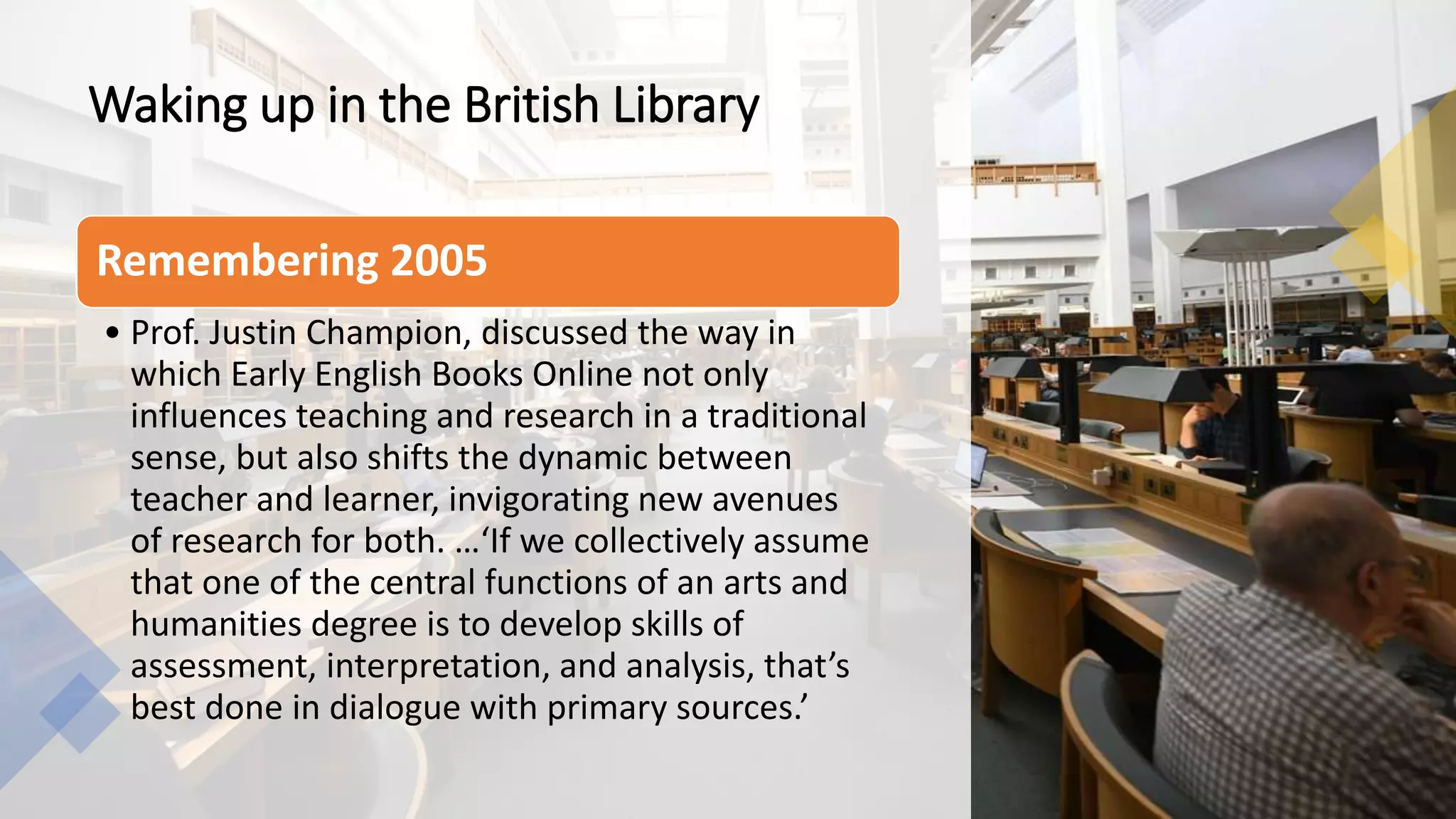
Waking up in the British Library
Remembering 2005
• Prof. Justin Champion, discussed the way in
which Early English Books Online not only
influences teaching and research in a traditional
sense, but also shifts the dynamic between
teacher and learner, invigorating new avenues
of research for both. …‘If we collectively assume
that one of the central functions of an arts and
humanities degree is to develop skills of
assessment, interpretation, and analysis, that’s
best done in dialogue with primary sources.’
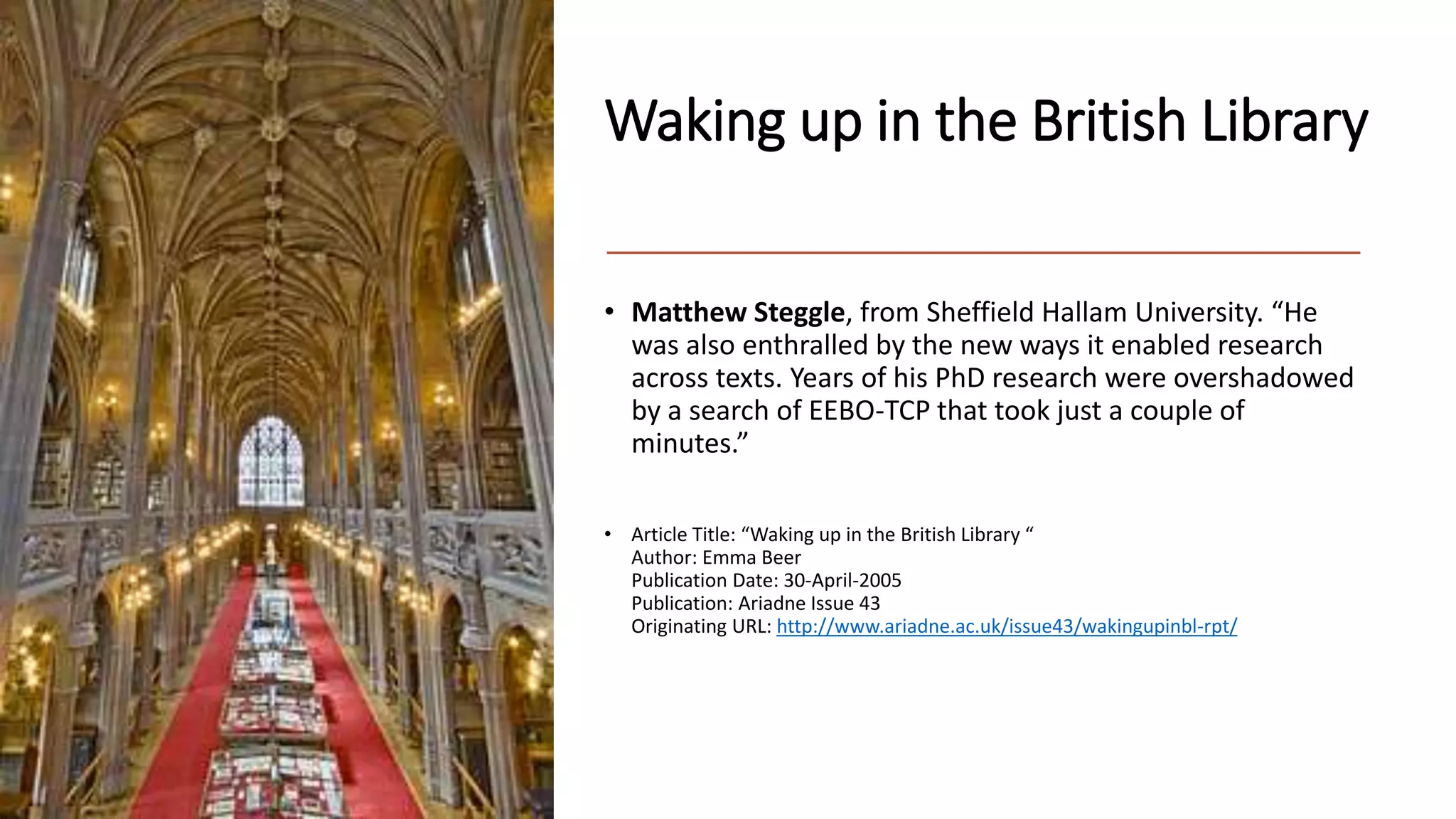
Waking up in the British Library
• Matthew Steggle, from Sheffield Hallam University. “He
was also enthralled by the new ways it enabled research
across texts. Years of his PhD research were overshadowed
by a search of EEBO-TCP that took just a couple of
minutes.”
• Article Title: “Waking up in the British Library “
Author: Emma Beer
Publication Date: 30-April-2005
Publication: Ariadne Issue 43
Originating URL: http://www.ariadne.ac.uk/issue43/wakingupinbl-rpt/
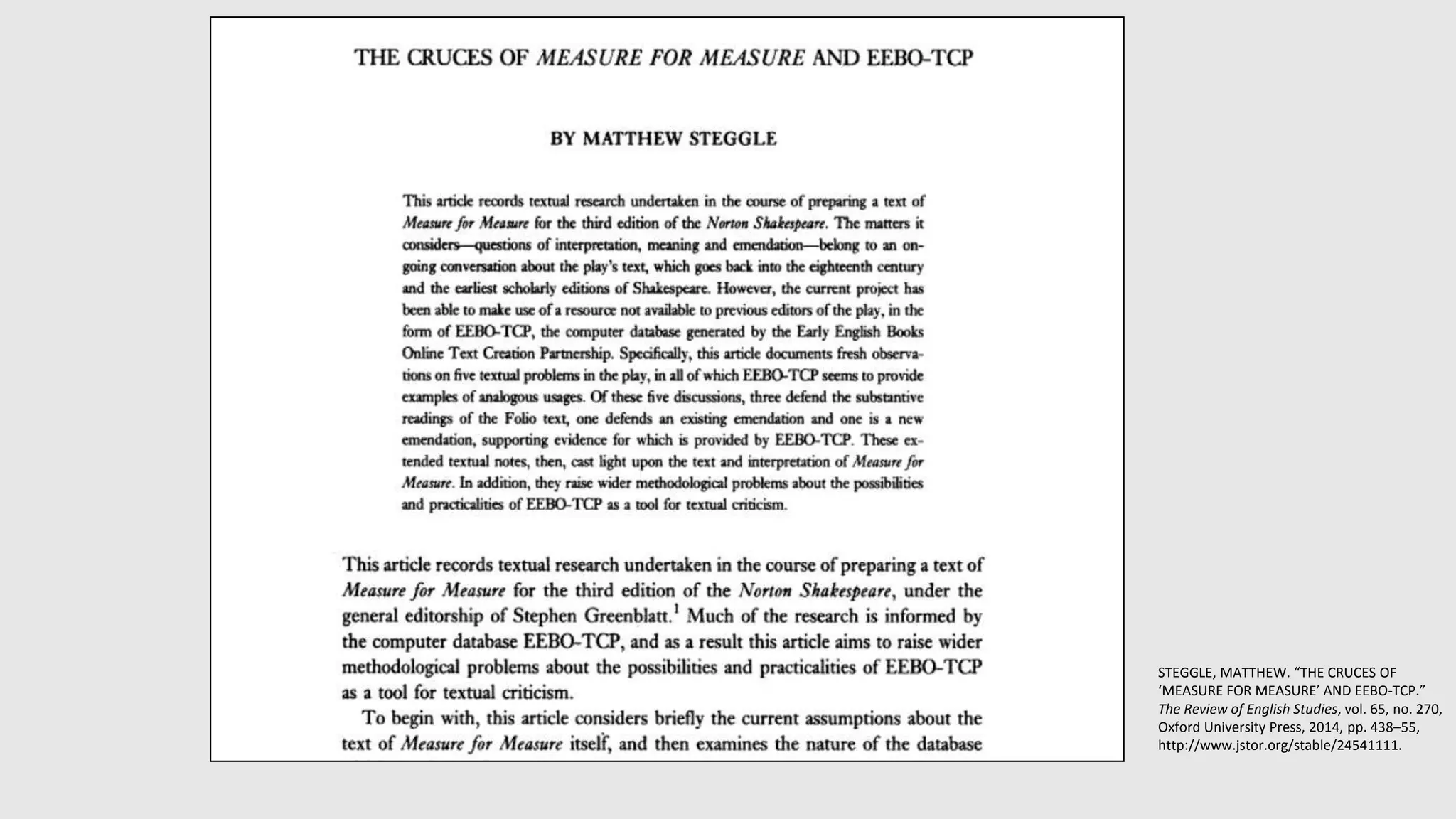
STEGGLE, MATTHEW. “THE CRUCES OF
‘MEASURE FOR MEASURE’ AND EEBO-TCP.”
The Review of English Studies, vol. 65, no. 270,
Oxford University Press, 2014, pp. 438–55,
http://www.jstor.org/stable/24541111.
Lisa Jardine
• British historian of the early modern
period.
• Democratization of access
Thinking About Usage in the
Humanities
The usage stats look less exciting
Challenges of
interpreting usage data
• Matthew Steggle found (I think) three physical
books in the British Library, and (I think) eight in
EBBO.
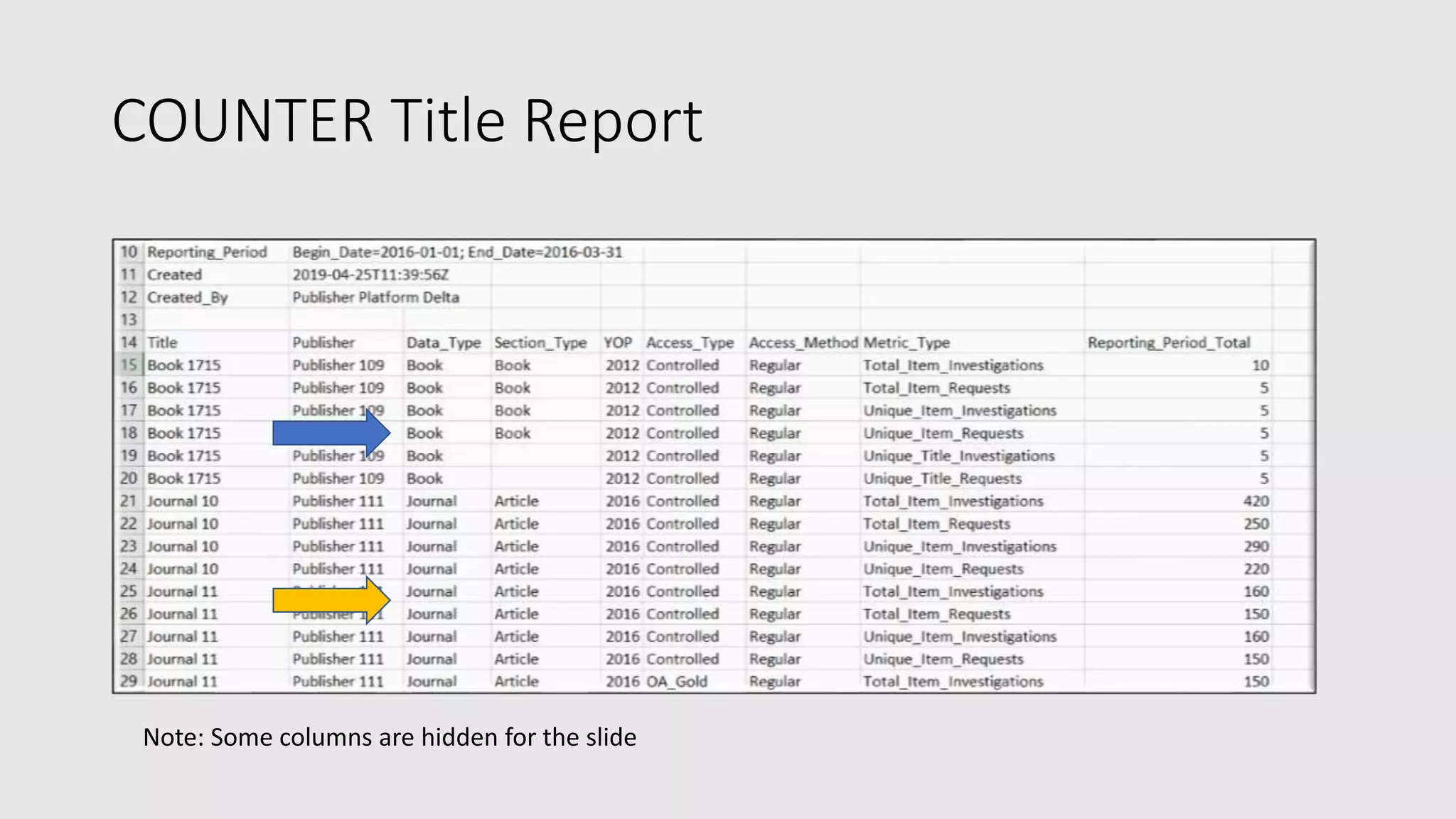
• In COUNTER reports that would be:
• Unique_Item_Requests= 8
• Unique_Title_Requests = 8
• 8 is not an impressive number but might inform
“years of his PhD research”
COUNTER Title Report
Note: Some columns are hidden for the slide
Thinking About Usage in the
Humanities
We have some work to do … librarians and publishers
Screen vs.
paper habits
“Habit and attitude appeared to be important, and a digitally
born textbook is by far the best alternative to a print
textbook when it comes to studying. But even those who
prefer to read on screens are originally native paper readers,
and as long as the existing application interfaces cannot
address the shortcomings of screens regarding spatial
landmarks, we will keep returning to paper under certain
circumstances.”
• Myrberg, Caroline, and Ninna Wiberg. 2015. “Screen Vs. Paper:
What Is the Difference for Reading and Learning?”. Insights 28 (2):
49–54. DOI: http://doi.org/10.1629/uksg.236
What the
students told us
2016
“The [print] book just isn’t always available in the library because ten people
have taken it already, so you have no choice but to use the e-book. Print books
are just easier on your eyes and tangible, whereas e-books? You just can’t feel
it in your hand and it’s just not really the same for me. A [print] book is an
asset that you’ve got, whereas e-books just feel like it’s something in the
background that you don’t really own.”
What the
students told
us
“I tend to use print books a lot more than I do e-books,
primarily probably for the reason that a lot of the books that I
have to read for my course are very long, hundreds and
hundreds of pages long. Maybe it’s a psychological thing, but
I like to know where I am in the chapter or in the book, I like
to keep flicking back to the end of the chapter to see how far
I’m going.”
What the
students told
us
“DRM (digital rights management) is Saleh Ahmed’s biggest
bugbear. ‘It feels pretty much like medieval armour or a
chastity belt. I want to be able to use e-books on different
devices and I do understand everything, but if you don’t treat
the users with respect, they will go somewhere else, or they
will try to remove it. ”
• Estelle, Lorraine. 2016. “What Students Told Us About Their Experiences and Expectations of Print
and E-books”. Insights 29 (1): 31–36. DOI: http://doi.org/10.1629/uksg.281
There are many nuances associated
with the use of ebooks and electronic
resources
• Usage statistics are useful, particularly for trends
across time, cost per use, but they are not a measure
impact.
• Low usage numbers may result in high impact e.g.,
three requests of a primary source material might
inform years of PhD research.
• We cannot compare usage of primary source
materials or of monographs with the use of journal
articles – particularly articles in the sciences.
• User habits and expectations … we haven’t solved
screen v. paper problem yet.
Thank you

Estelle "Thinking About Usage in the Humanities"

  • 1.
    Humanities Roundtable 2021: TheMonograph in the Evolving Humanities Ecosystem NISO Virtual Conference Wednesday, October 20, 11am - 4:00pm (Eastern)
  • 2.
    Thinking About Usagein the Humanities Establishing the value
  • 3.
    Waking up inthe British Library Remembering 2005 • Prof. Justin Champion, discussed the way in which Early English Books Online not only influences teaching and research in a traditional sense, but also shifts the dynamic between teacher and learner, invigorating new avenues of research for both. …‘If we collectively assume that one of the central functions of an arts and humanities degree is to develop skills of assessment, interpretation, and analysis, that’s best done in dialogue with primary sources.’
  • 4.
    Waking up inthe British Library • Matthew Steggle, from Sheffield Hallam University. “He was also enthralled by the new ways it enabled research across texts. Years of his PhD research were overshadowed by a search of EEBO-TCP that took just a couple of minutes.” • Article Title: “Waking up in the British Library “ Author: Emma Beer Publication Date: 30-April-2005 Publication: Ariadne Issue 43 Originating URL: http://www.ariadne.ac.uk/issue43/wakingupinbl-rpt/
  • 5.
    STEGGLE, MATTHEW. “THECRUCES OF ‘MEASURE FOR MEASURE’ AND EEBO-TCP.” The Review of English Studies, vol. 65, no. 270, Oxford University Press, 2014, pp. 438–55, http://www.jstor.org/stable/24541111.
  • 6.
    Lisa Jardine • Britishhistorian of the early modern period. • Democratization of access
  • 7.
    Thinking About Usagein the Humanities The usage stats look less exciting
  • 8.
    Challenges of interpreting usagedata • Matthew Steggle found (I think) three physical books in the British Library, and (I think) eight in EBBO. • In COUNTER reports that would be: • Unique_Item_Requests= 8 • Unique_Title_Requests = 8 • 8 is not an impressive number but might inform “years of his PhD research”
  • 9.
    COUNTER Title Report Note:Some columns are hidden for the slide
  • 10.
    Thinking About Usagein the Humanities We have some work to do … librarians and publishers
  • 11.
    Screen vs. paper habits “Habitand attitude appeared to be important, and a digitally born textbook is by far the best alternative to a print textbook when it comes to studying. But even those who prefer to read on screens are originally native paper readers, and as long as the existing application interfaces cannot address the shortcomings of screens regarding spatial landmarks, we will keep returning to paper under certain circumstances.” • Myrberg, Caroline, and Ninna Wiberg. 2015. “Screen Vs. Paper: What Is the Difference for Reading and Learning?”. Insights 28 (2): 49–54. DOI: http://doi.org/10.1629/uksg.236
  • 12.
    What the students toldus 2016 “The [print] book just isn’t always available in the library because ten people have taken it already, so you have no choice but to use the e-book. Print books are just easier on your eyes and tangible, whereas e-books? You just can’t feel it in your hand and it’s just not really the same for me. A [print] book is an asset that you’ve got, whereas e-books just feel like it’s something in the background that you don’t really own.”
  • 13.
    What the students told us “Itend to use print books a lot more than I do e-books, primarily probably for the reason that a lot of the books that I have to read for my course are very long, hundreds and hundreds of pages long. Maybe it’s a psychological thing, but I like to know where I am in the chapter or in the book, I like to keep flicking back to the end of the chapter to see how far I’m going.”
  • 14.
    What the students told us “DRM(digital rights management) is Saleh Ahmed’s biggest bugbear. ‘It feels pretty much like medieval armour or a chastity belt. I want to be able to use e-books on different devices and I do understand everything, but if you don’t treat the users with respect, they will go somewhere else, or they will try to remove it. ” • Estelle, Lorraine. 2016. “What Students Told Us About Their Experiences and Expectations of Print and E-books”. Insights 29 (1): 31–36. DOI: http://doi.org/10.1629/uksg.281
  • 15.
    There are manynuances associated with the use of ebooks and electronic resources • Usage statistics are useful, particularly for trends across time, cost per use, but they are not a measure impact. • Low usage numbers may result in high impact e.g., three requests of a primary source material might inform years of PhD research. • We cannot compare usage of primary source materials or of monographs with the use of journal articles – particularly articles in the sciences. • User habits and expectations … we haven’t solved screen v. paper problem yet.
  • 16.