An Leabharlann UCD
Moving from niche to mainstream:
the evolution of the UCD Digital
Library
1
Eugene Roche, Special Collections
Librarian
Julia Barrett,
Research Services Manager
UCD Library
Structure of the presentation:
Eugene
• Niche – the early days of
the DL and limitations.
• The criteria used for
selection of the first
projects
• Point of view of repository
stake holder
Julia
• Current “Drivers”
• Mainstreaming
• Managing expectations
• Summary of the journey
2
A note on structure and corporate entities
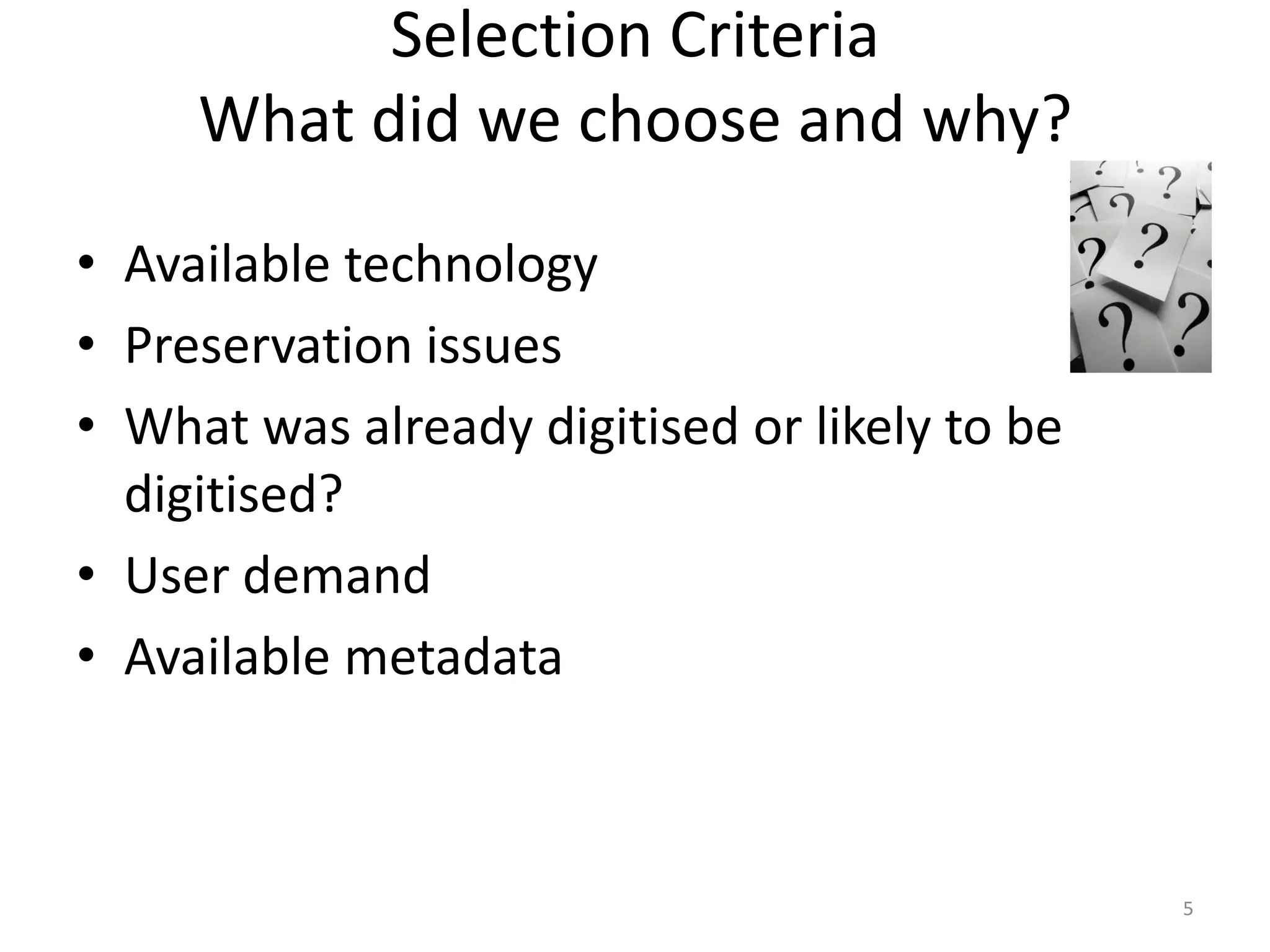
• The Irish Virtual Research Library and Archive (IVRLA) was a component of
the UCD Humanities Institute and was conceived as a five-year research
project which ran from January 2005 to December 2009, funded by the
Programme for Research in Third Level Institutions (PRTLI) Phase 3
• Evolved into what is now the UCD Digital Library
3
The Horseless Carriage
• Digitisation seen in simple terms like a early motor car was defined as a
carriage without horses – unaware of its potential
• Focus summed up in the word “surrogate” seen in simplistic terms as
providing a substitute for the hard copy
• “whether such efforts [digitisation projects] will be effective for more
than limited, well defined sub-sets of special collections is unclear”
(Bradshaw and Wagner, 2000)*
*Bradshaw, E. B., & Wagner, S. C. (2000). A common ground: communication and alliance between cataloguer and curator for
improved access to rare books and special collections. College & Research Libraries, 61(6), 525-534. 4
Selection Criteria
What did we choose and why?
• Available technology
• Preservation issues
• What was already digitised or likely to be
digitised?
• User demand
• Available metadata
5
Available Technology
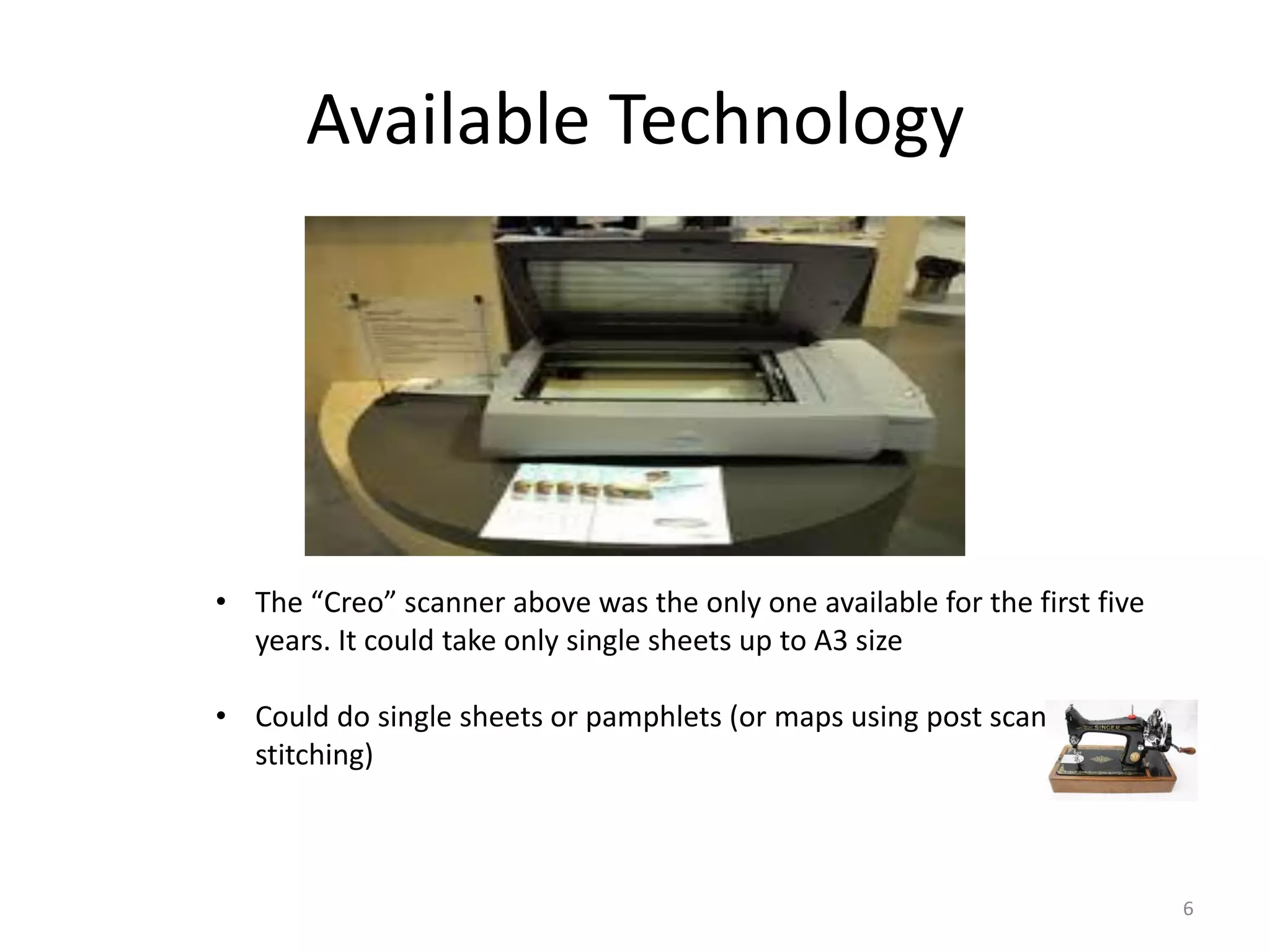
• The “Creo” scanner above was the only one available for the first five
years. It could take only single sheets up to A3 size
• Could do single sheets or pamphlets (or maps using post scan
stitching)
6
Preservation
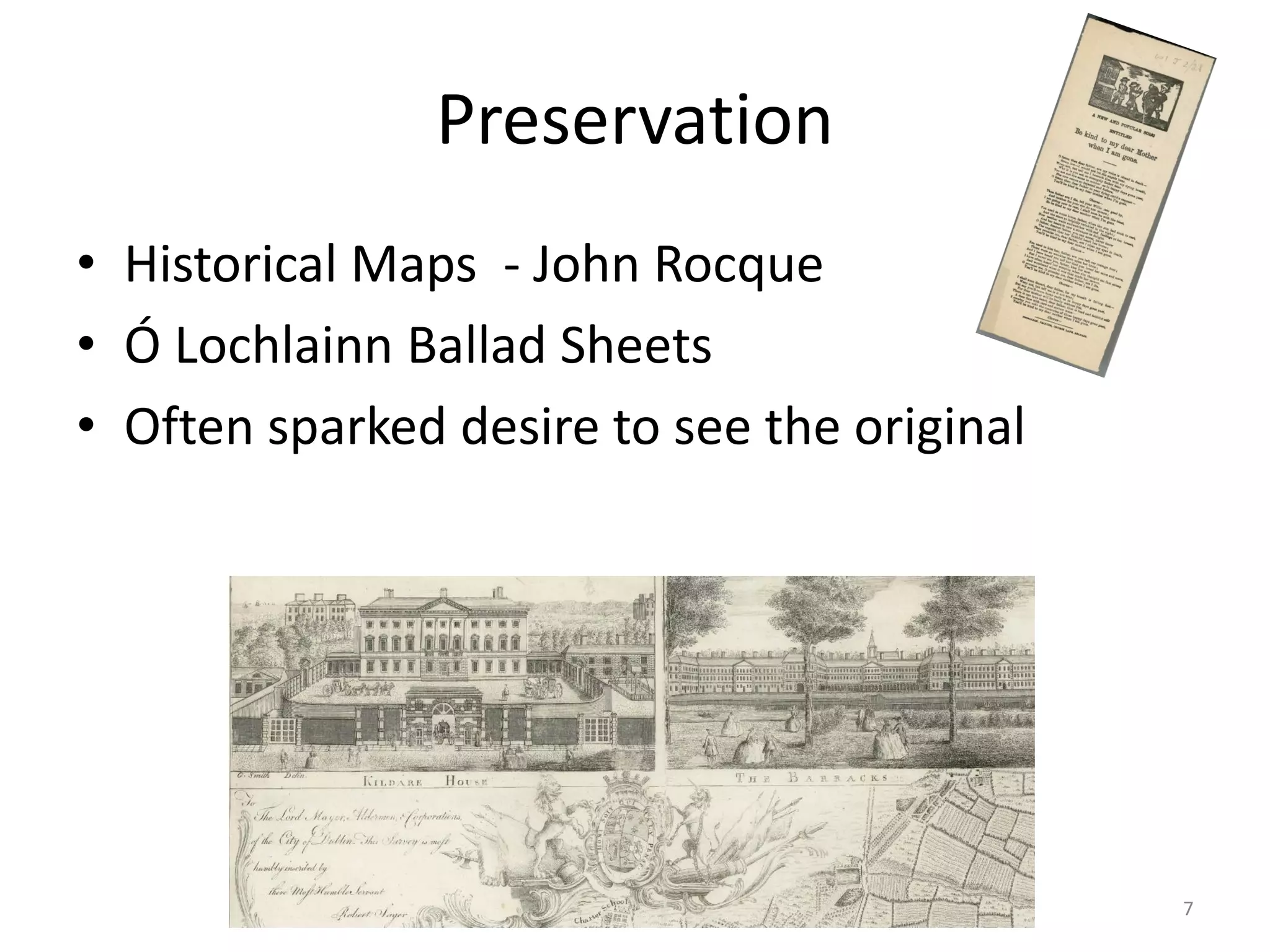
• Historical Maps - John Rocque
• Ó Lochlainn Ballad Sheets
• Often sparked desire to see the original
7
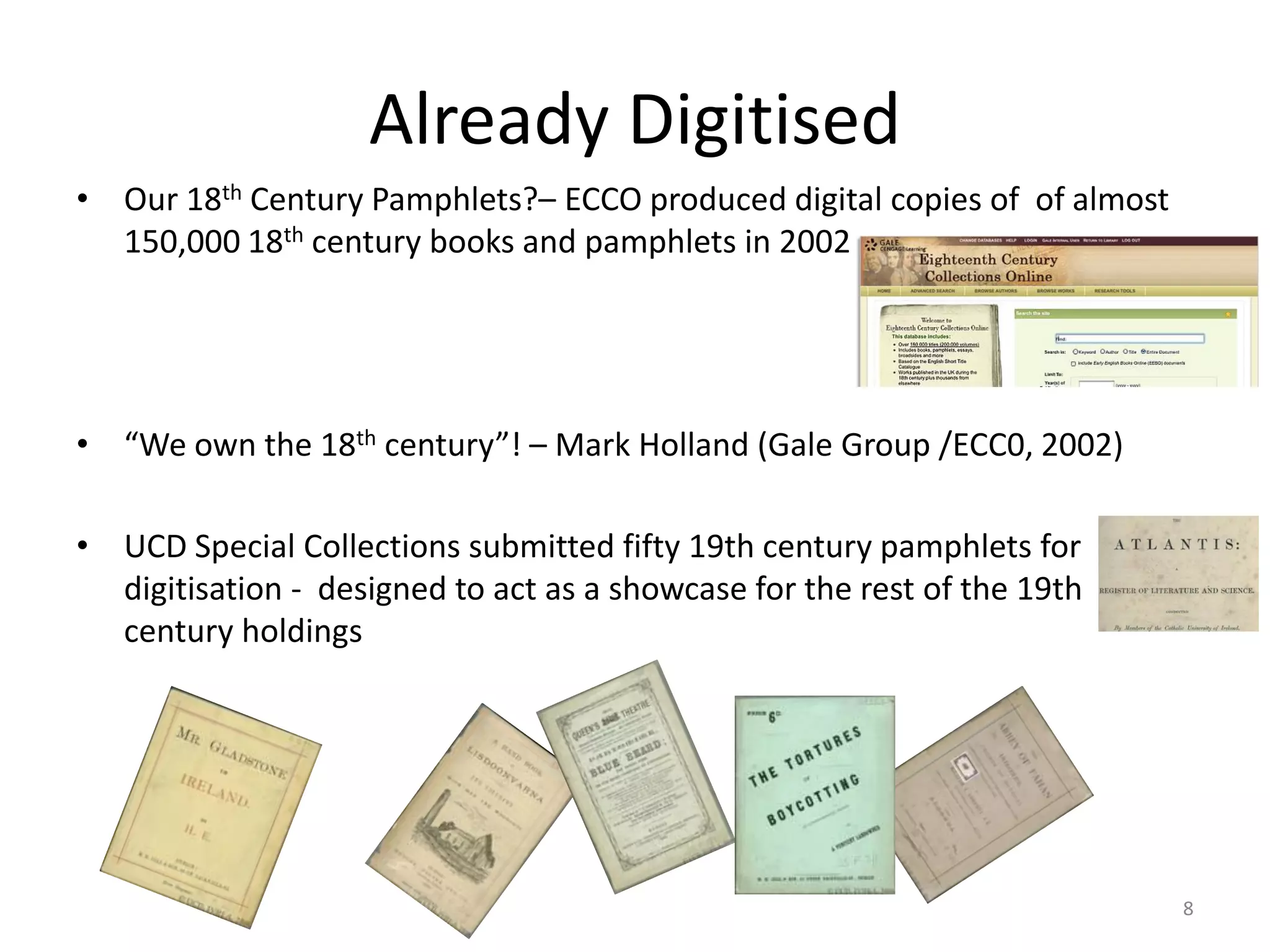
• Our 18th Century Pamphlets?– ECCO produced digital copies of of almost
150,000 18th century books and pamphlets in 2002
• “We own the 18th century”! – Mark Holland (Gale Group /ECC0, 2002)
• UCD Special Collections submitted fifty 19th century pamphlets for
digitisation - designed to act as a showcase for the rest of the 19th
century holdings
Already Digitised
8
User Demand
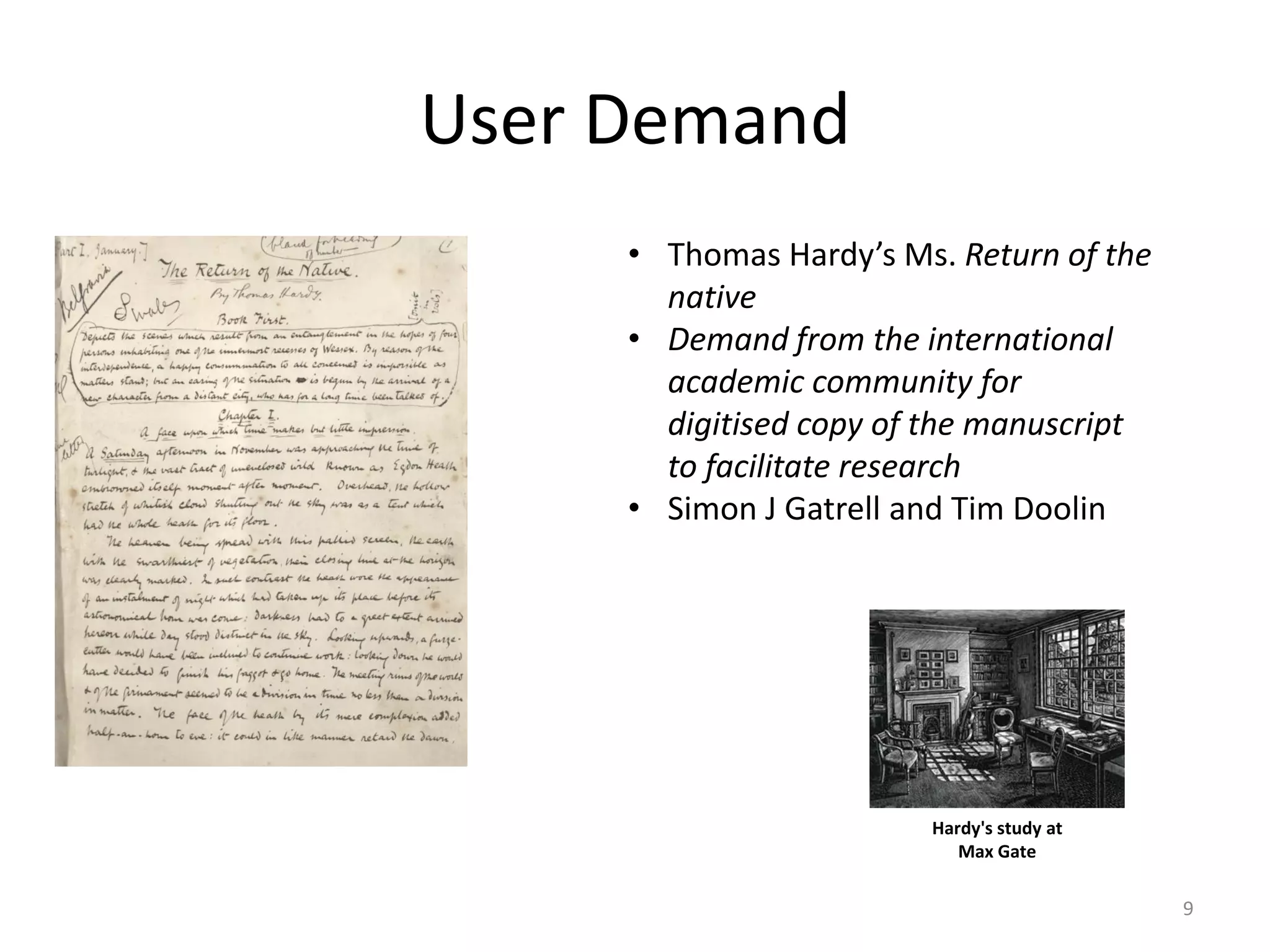
• Thomas Hardy’s Ms. Return of the
native
• Demand from the international
academic community for
digitised copy of the manuscript
to facilitate research
• Simon J Gatrell and Tim Doolin
Hardy's study at
Max Gate
9
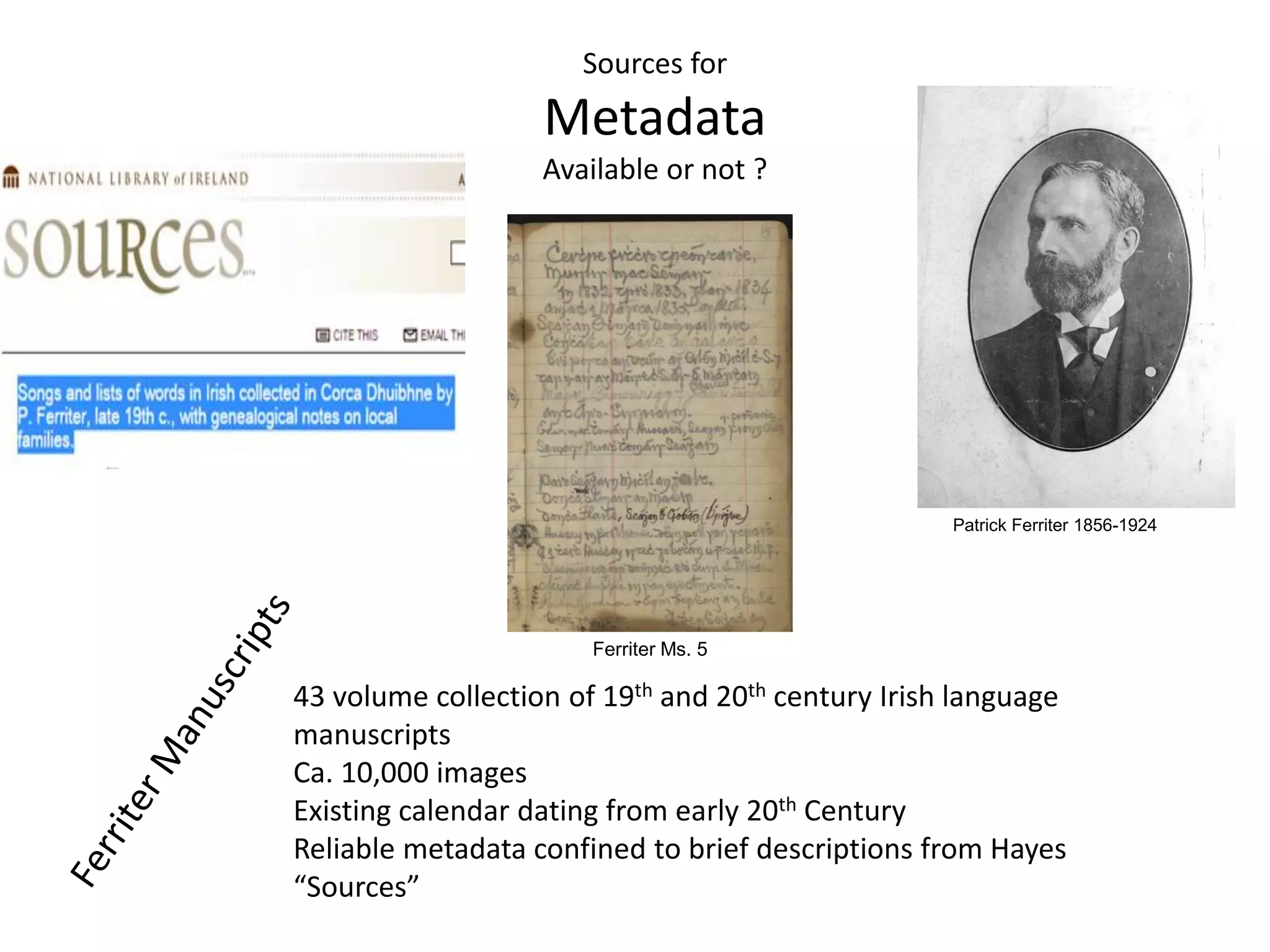
Sources for
Metadata
Available or not ?
43 volume collection of 19th and 20th century Irish language
manuscripts
Ca. 10,000 images
Existing calendar dating from early 20th Century
Reliable metadata confined to brief descriptions from Hayes
“Sources”
Patrick Ferriter 1856-1924
Ferriter Ms. 5
Drivers
• Decade of Anniversaries
• UCD’s strategic objectives
– Increase the quality, quantity and impact of our research,
scholarship and innovation
– Build our engagement locally, nationally and internationally
• Academic impact
• Public impact
• Increasing awareness of the use of digital technologies
to facilitate research insights and communication
• Internal re-organisation: UCD Archives and NFC
• Opportunity to build and strengthen relationships with
repositories, Schools, academics, etc.
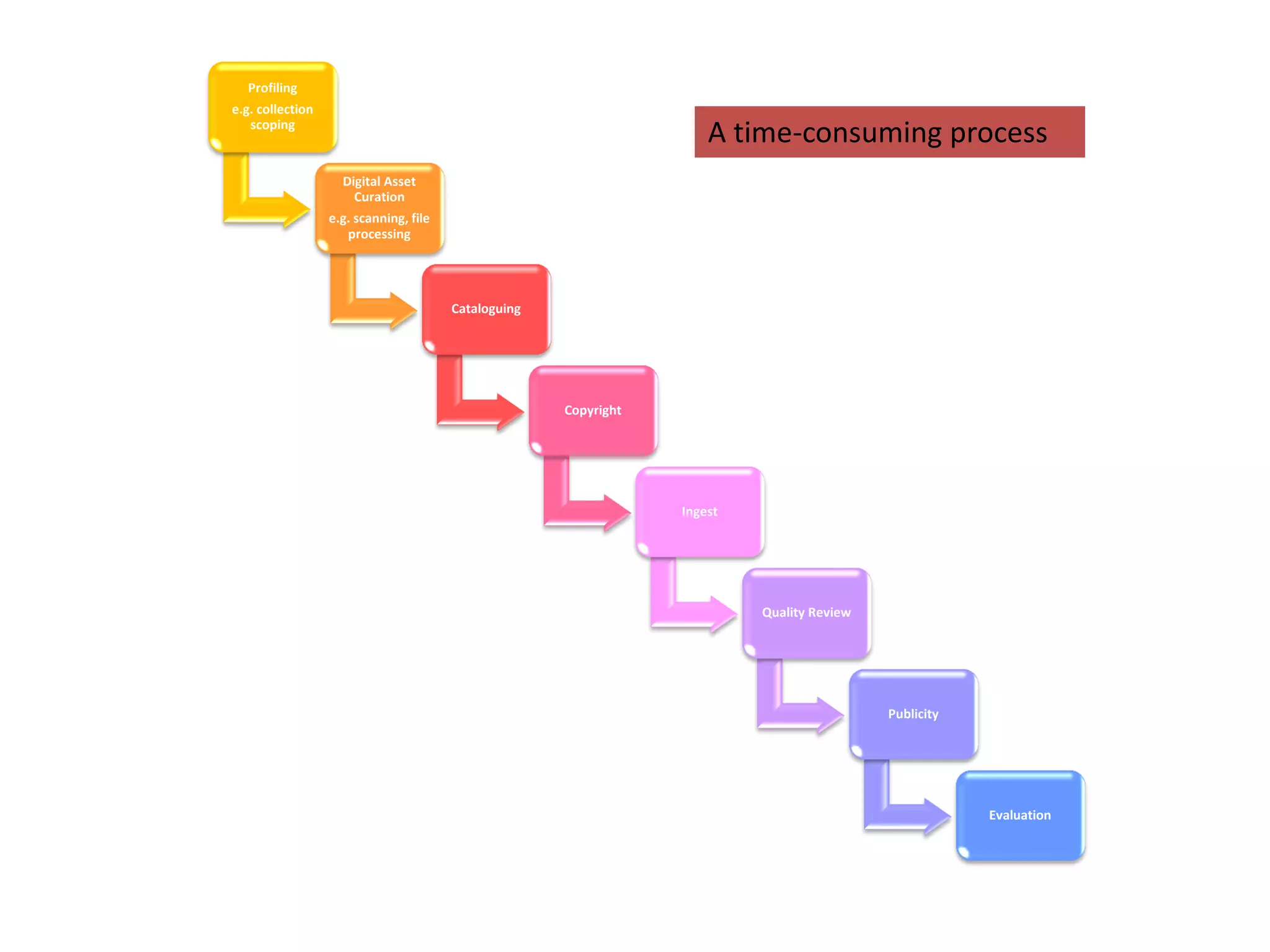
Profiling
e.g. collection
scoping
Digital Asset
Curation
e.g. scanning, file
processing
Cataloguing
Copyright
Ingest
Quality Review
Publicity
Evaluation
A time-consuming process
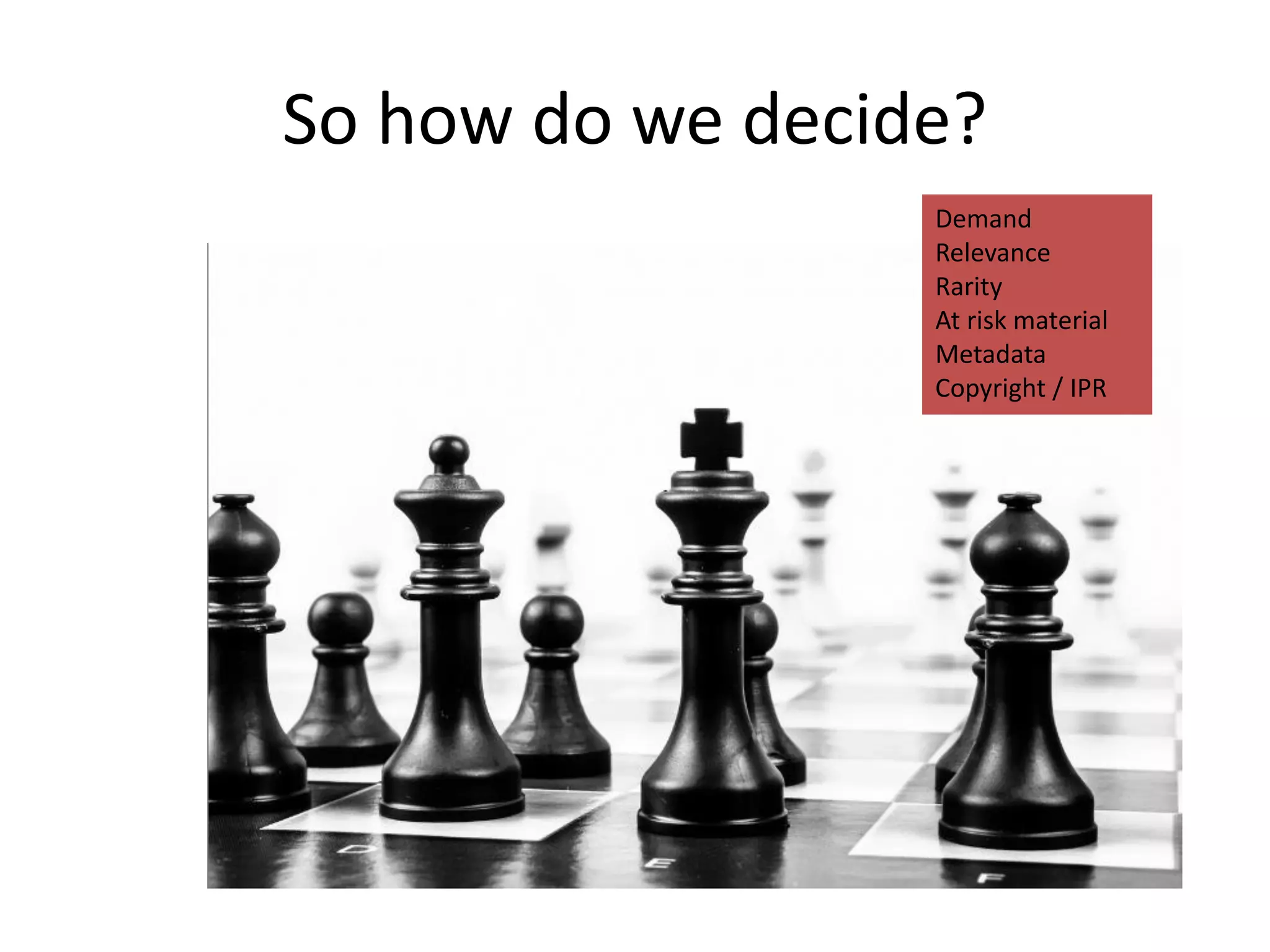
So how do we decide?
Demand
Relevance
Rarity
At risk material
Metadata
Copyright / IPR
Stakeholders
• Repositories
• Researchers
• Teachers
• UCD Schools and Research
Centres
• UCD
• Library
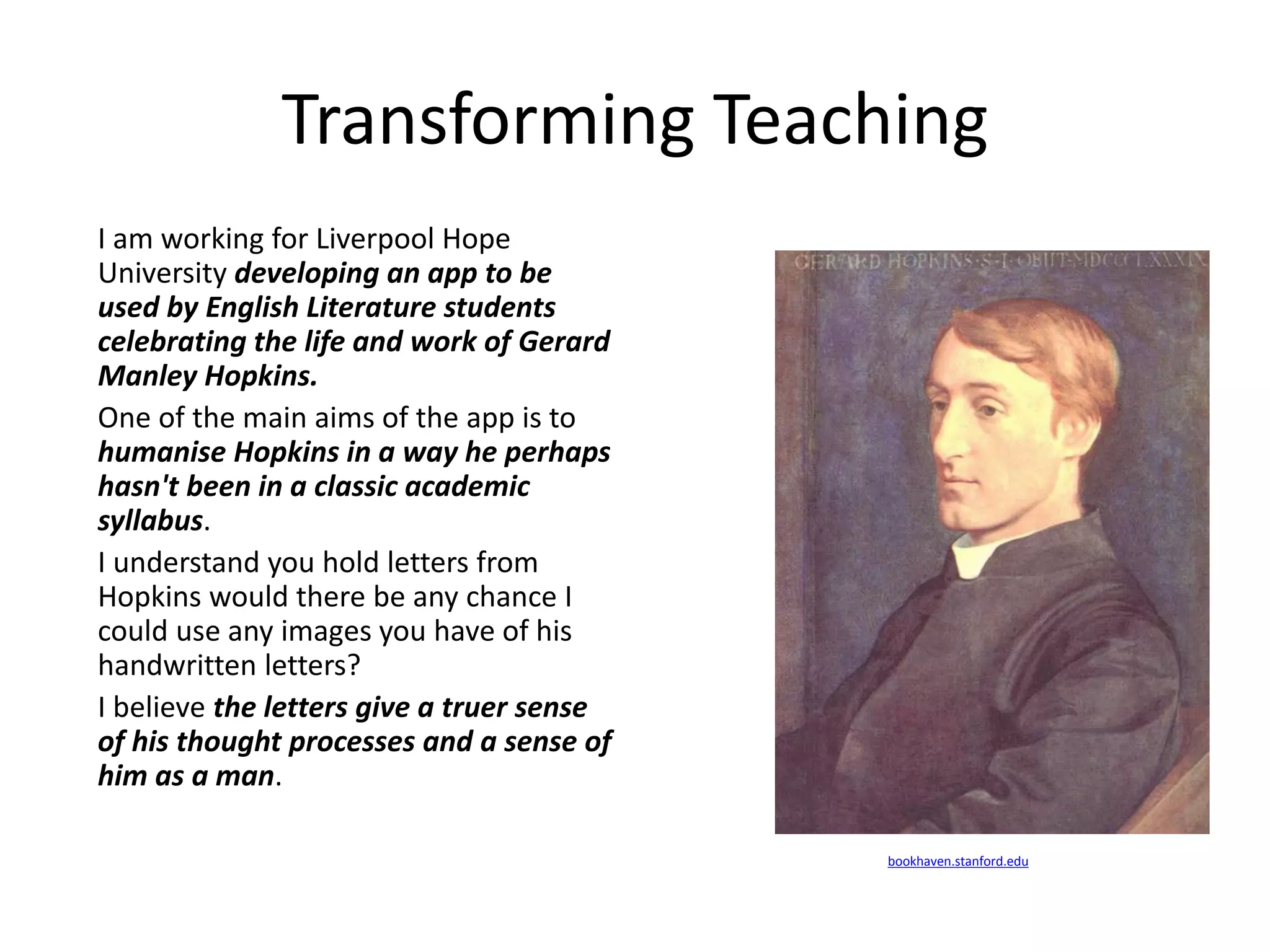
Transforming Teaching
I am working for Liverpool Hope
University developing an app to be
used by English Literature students
celebrating the life and work of Gerard
Manley Hopkins.
One of the main aims of the app is to
humanise Hopkins in a way he perhaps
hasn't been in a classic academic
syllabus.
I understand you hold letters from
Hopkins would there be any chance I
could use any images you have of his
handwritten letters?
I believe the letters give a truer sense
of his thought processes and a sense of
him as a man.
bookhaven.stanford.edu
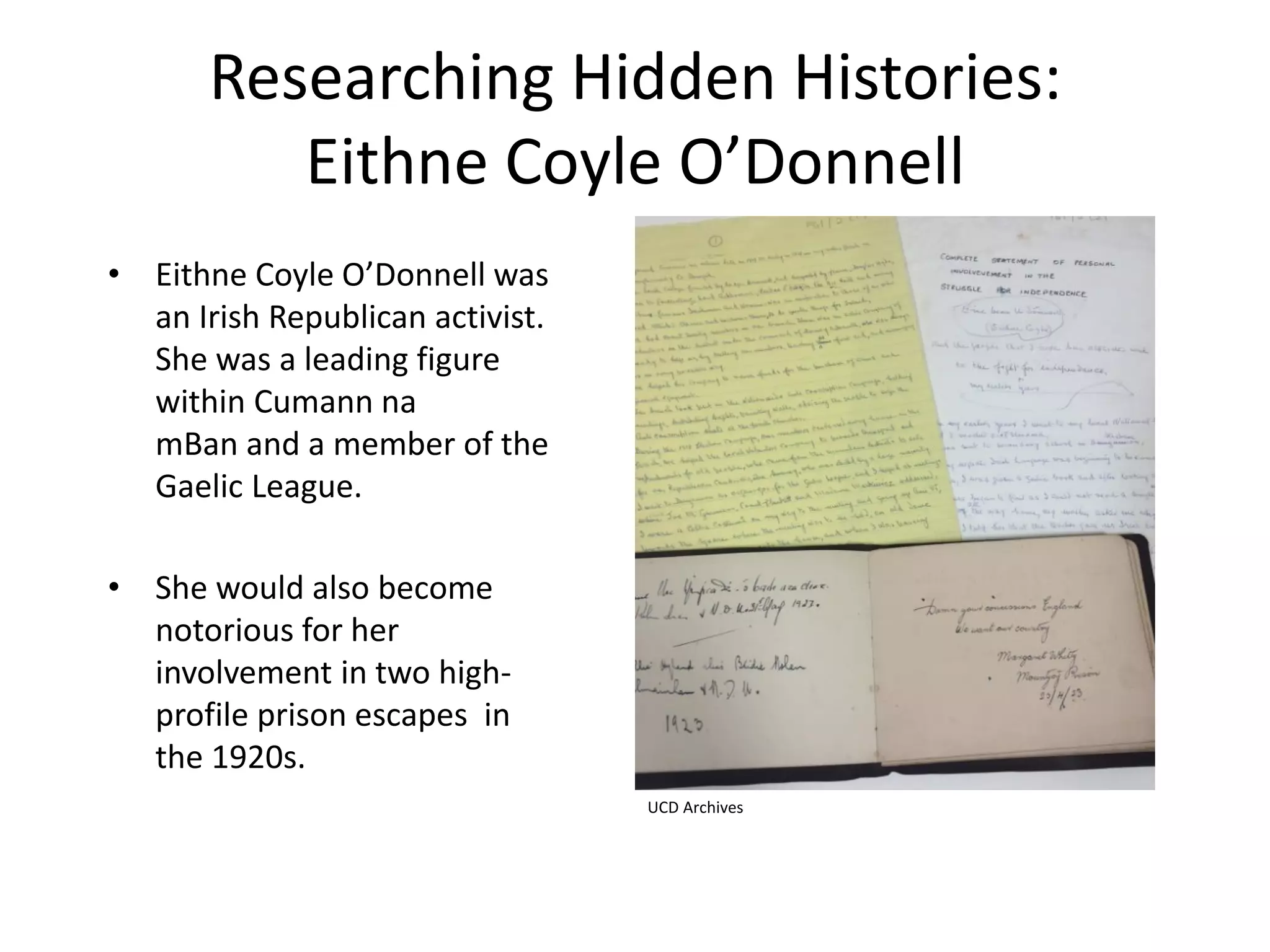
Researching Hidden Histories:
Eithne Coyle O’Donnell
• Eithne Coyle O’Donnell was
an Irish Republican activist.
She was a leading figure
within Cumann na
mBan and a member of the
Gaelic League.
• She would also become
notorious for her
involvement in two high-
profile prison escapes in
the 1920s.
UCD Archives
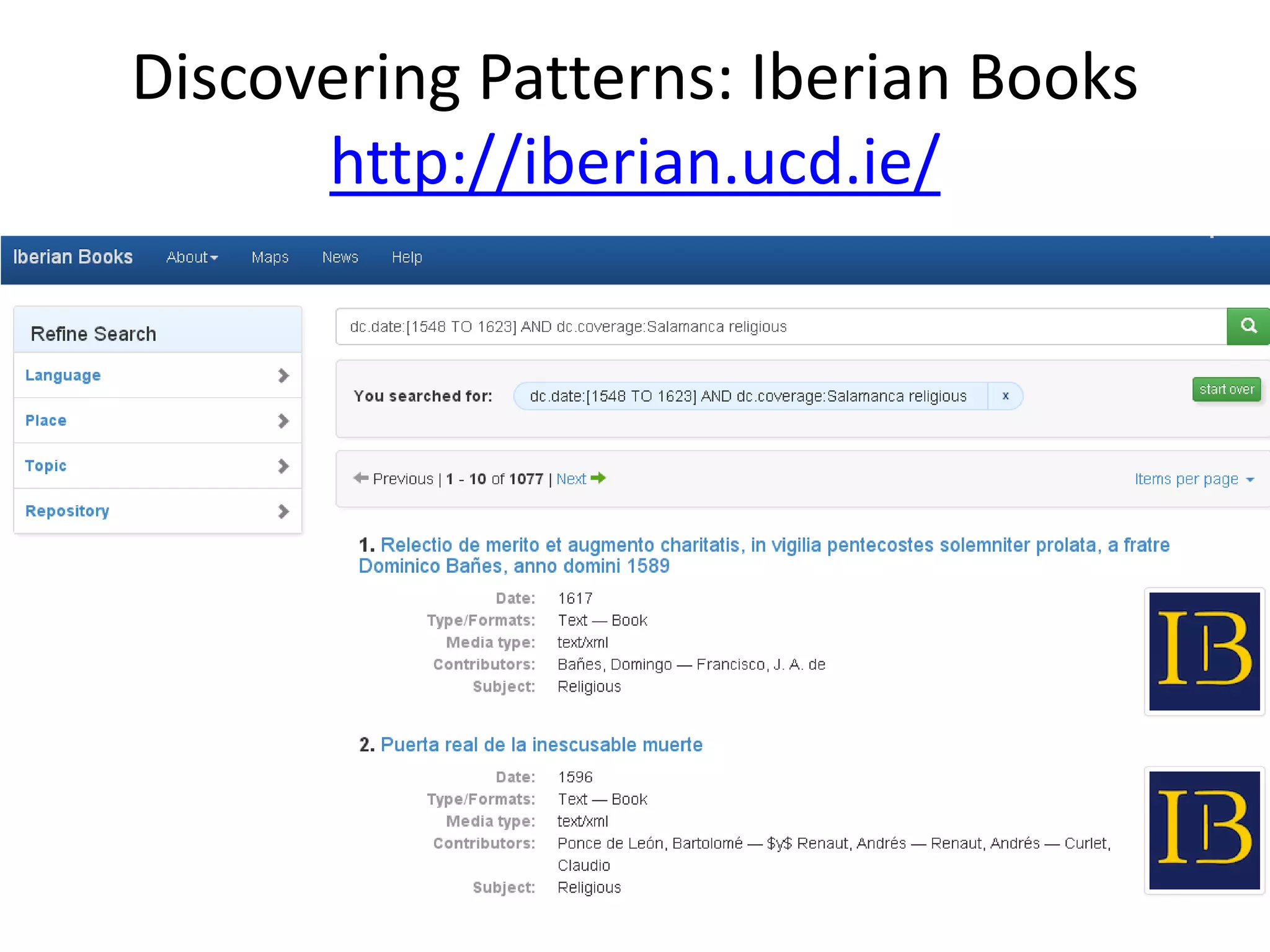
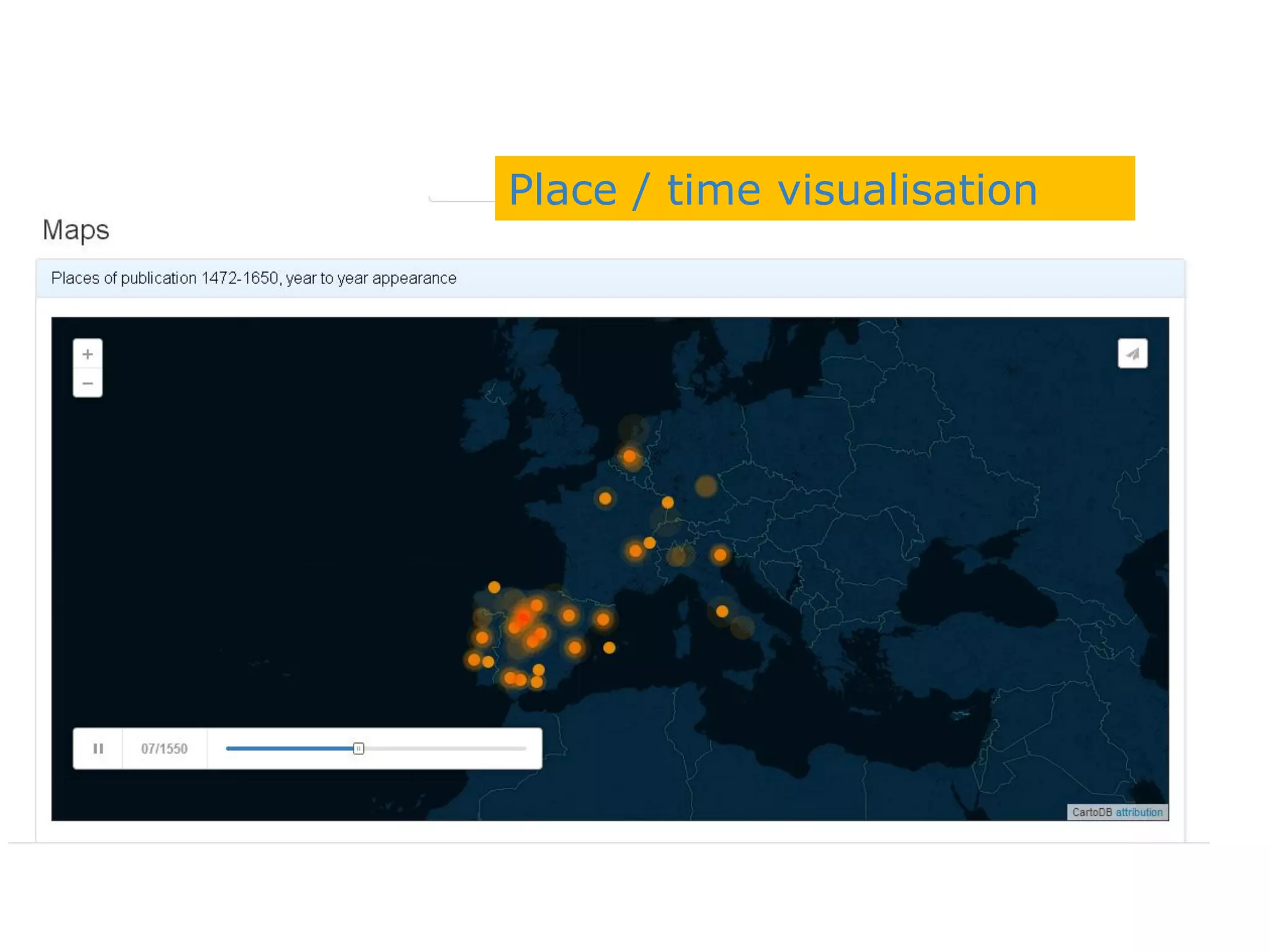
Discovering Patterns: Iberian Books
http://iberian.ucd.ie/
Place / time visualisation
School Funding Application:
Ryan Report
• The structure of the Ryan
Report makes institutional
comparisons difficult, thus
hiding how child abuse
emerged and became
systemic over time.
• It also obscures the pattern
of movement of staff and
victims between institutions
which must be important to
understanding the diffusion
of the culture of abuse
• “Dynamic Heat Map … The heat map will
bring together current digital arts
visualisation and digital mapping
techniques to create a geospatial heat
map of institutional expansion and
decline over the century 1899- 1999.
• This heat map will follow the lead of the
Iberian Books Project (UCD Centre for the
History of the Media; Mellon Foundation
Funded).
• This aspect of the project outcomes will
be done in collaboration with the UCD
Digital Library team.”
• “Long term
sustainability will be
ensured via digital
archiving through the
UCD Digital Library,
which is a certified
Trusted Digital
Repository.”
Successful School of
English, Drama & Film
and School of Computer
Science grant
application to IRC:
€213,958 awarded.
Managing Expectations
• Work with others;
communication; relationship-
building
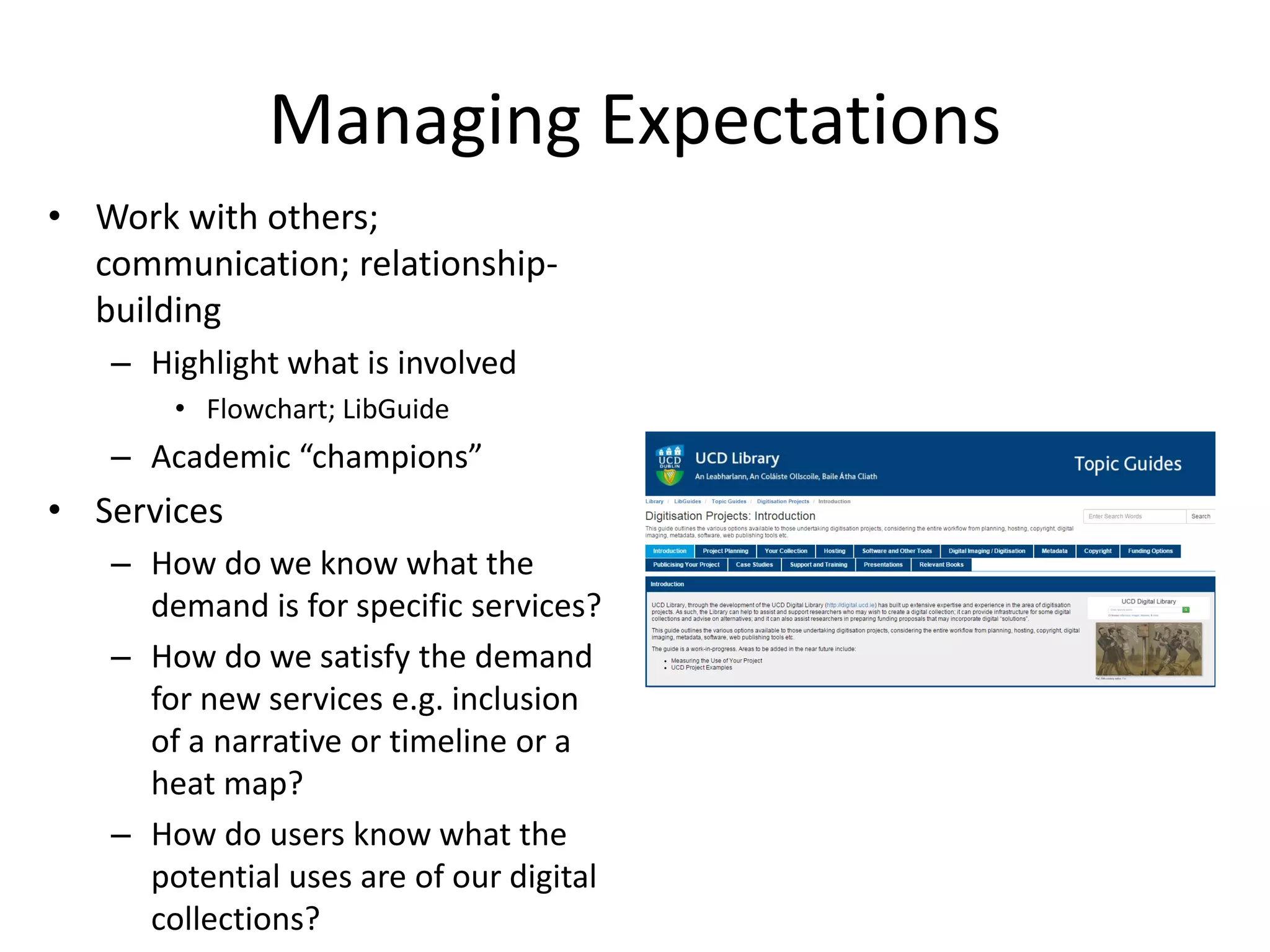
– Highlight what is involved
• Flowchart; LibGuide
– Academic “champions”
• Services
– How do we know what the
demand is for specific services?
– How do we satisfy the demand
for new services e.g. inclusion
of a narrative or timeline or a
heat map?
– How do users know what the
potential uses are of our digital
collections?
http://libguides.ucd.ie/digitisation
Managing Expectations
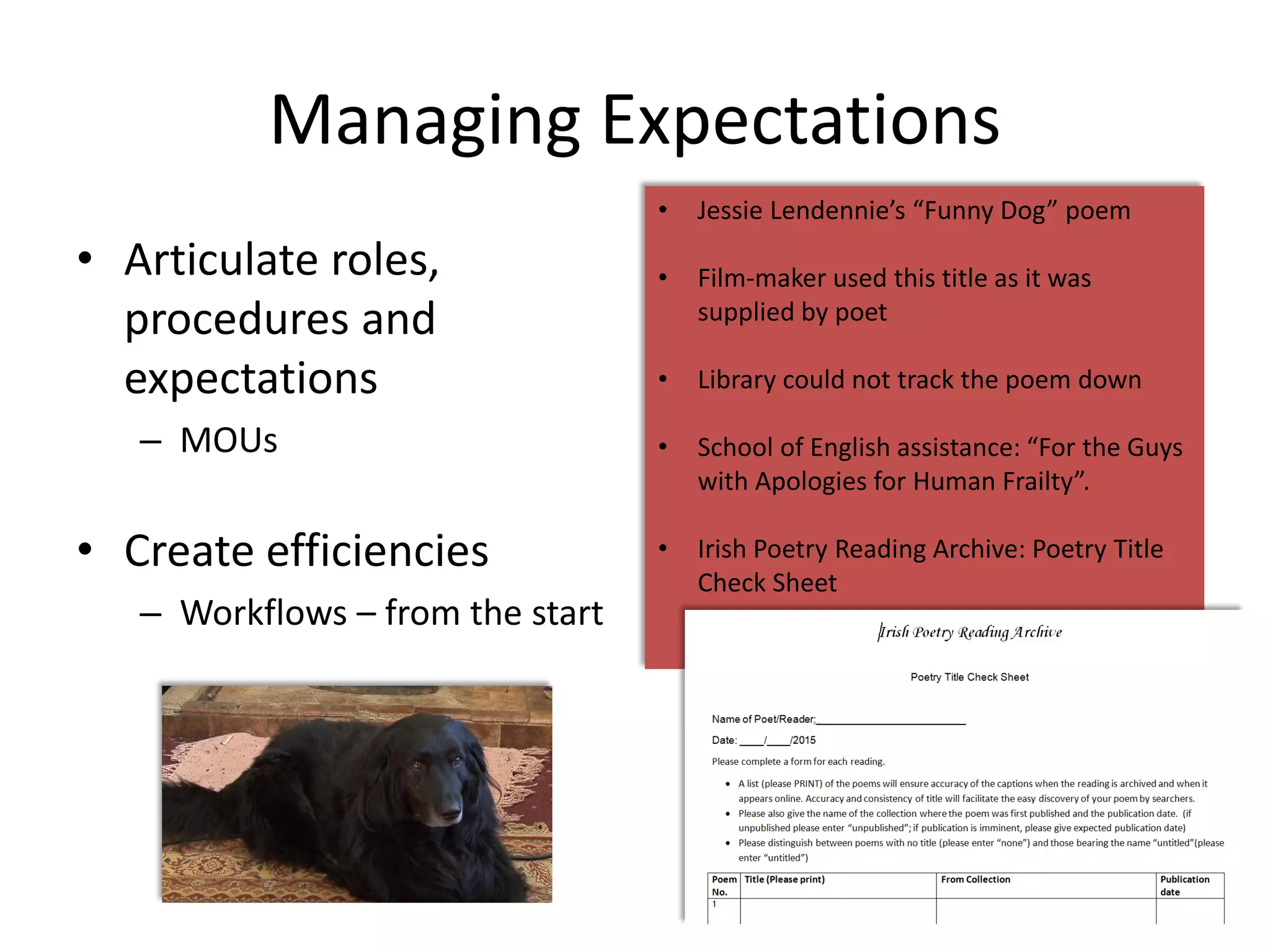
• Articulate roles,
procedures and
expectations
– MOUs
• Create efficiencies
– Workflows – from the start
22
• Jessie Lendennie’s “Funny Dog” poem
• Film-maker used this title as it was
supplied by poet
• Library could not track the poem down
• School of English assistance: “For the Guys
with Apologies for Human Frailty”.
• Irish Poetry Reading Archive: Poetry Title
Check Sheet
Summary
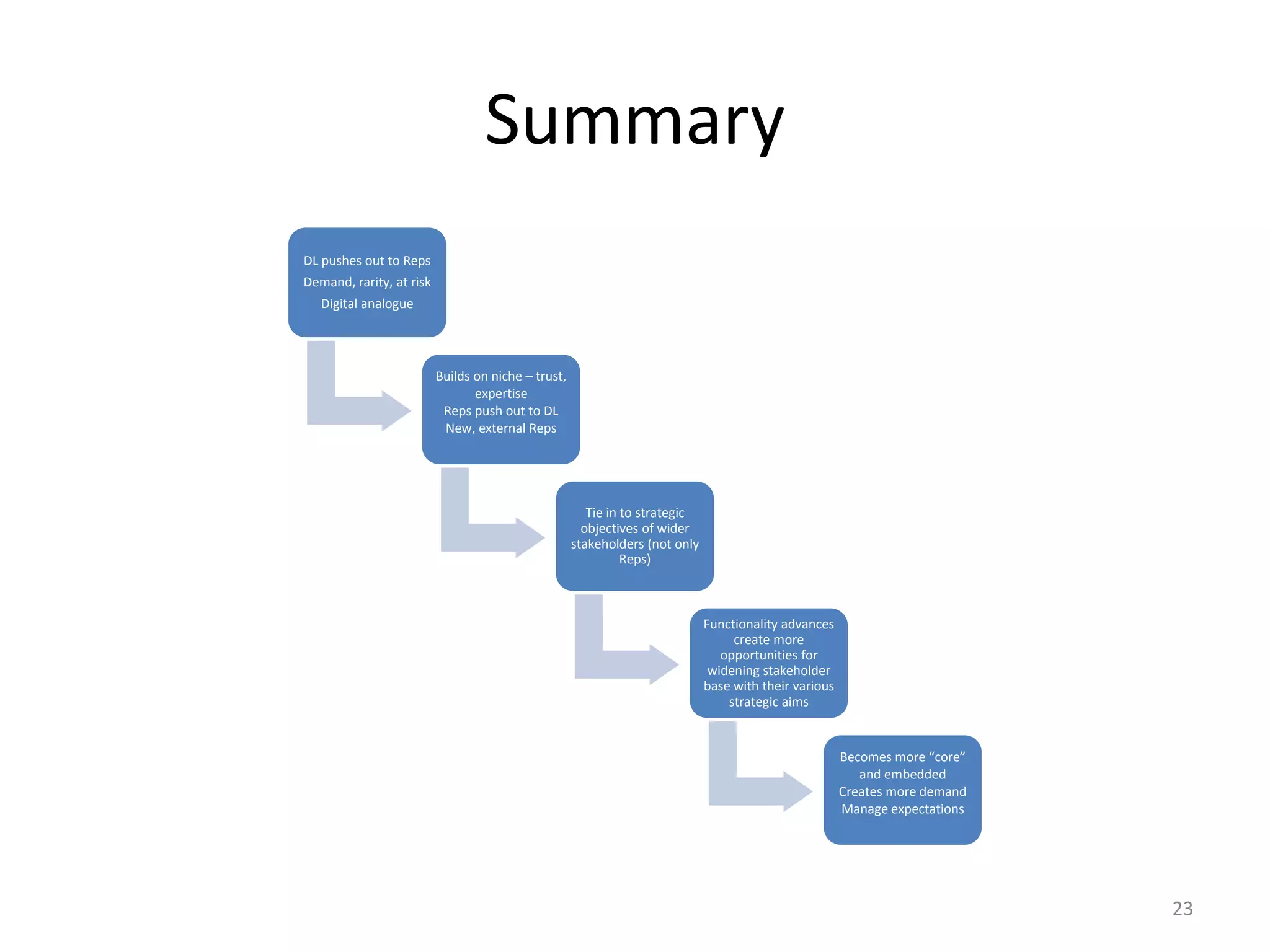
DL pushes out to Reps
Demand, rarity, at risk
Digital analogue
Builds on niche – trust,
expertise
Reps push out to DL
New, external Reps
Tie in to strategic
objectives of wider
stakeholders (not only
Reps)
Functionality advances
create more
opportunities for
widening stakeholder
base with their various
strategic aims
Becomes more “core”
and embedded
Creates more demand
Manage expectations
23

Moving from Niche to Mainstream: the Evolution of the UCD Digital Library

  • 1.
    An Leabharlann UCD Movingfrom niche to mainstream: the evolution of the UCD Digital Library 1 Eugene Roche, Special Collections Librarian Julia Barrett, Research Services Manager UCD Library
  • 2.
    Structure of thepresentation: Eugene • Niche – the early days of the DL and limitations. • The criteria used for selection of the first projects • Point of view of repository stake holder Julia • Current “Drivers” • Mainstreaming • Managing expectations • Summary of the journey 2
  • 3.
    A note onstructure and corporate entities • The Irish Virtual Research Library and Archive (IVRLA) was a component of the UCD Humanities Institute and was conceived as a five-year research project which ran from January 2005 to December 2009, funded by the Programme for Research in Third Level Institutions (PRTLI) Phase 3 • Evolved into what is now the UCD Digital Library 3
  • 4.
    The Horseless Carriage •Digitisation seen in simple terms like a early motor car was defined as a carriage without horses – unaware of its potential • Focus summed up in the word “surrogate” seen in simplistic terms as providing a substitute for the hard copy • “whether such efforts [digitisation projects] will be effective for more than limited, well defined sub-sets of special collections is unclear” (Bradshaw and Wagner, 2000)* *Bradshaw, E. B., & Wagner, S. C. (2000). A common ground: communication and alliance between cataloguer and curator for improved access to rare books and special collections. College & Research Libraries, 61(6), 525-534. 4
  • 5.
    Selection Criteria What didwe choose and why? • Available technology • Preservation issues • What was already digitised or likely to be digitised? • User demand • Available metadata 5
  • 6.
    Available Technology • The“Creo” scanner above was the only one available for the first five years. It could take only single sheets up to A3 size • Could do single sheets or pamphlets (or maps using post scan stitching) 6
  • 7.
    Preservation • Historical Maps- John Rocque • Ó Lochlainn Ballad Sheets • Often sparked desire to see the original 7
  • 8.
    • Our 18thCentury Pamphlets?– ECCO produced digital copies of of almost 150,000 18th century books and pamphlets in 2002 • “We own the 18th century”! – Mark Holland (Gale Group /ECC0, 2002) • UCD Special Collections submitted fifty 19th century pamphlets for digitisation - designed to act as a showcase for the rest of the 19th century holdings Already Digitised 8
  • 9.
    User Demand • ThomasHardy’s Ms. Return of the native • Demand from the international academic community for digitised copy of the manuscript to facilitate research • Simon J Gatrell and Tim Doolin Hardy's study at Max Gate 9
  • 10.
    Sources for Metadata Available ornot ? 43 volume collection of 19th and 20th century Irish language manuscripts Ca. 10,000 images Existing calendar dating from early 20th Century Reliable metadata confined to brief descriptions from Hayes “Sources” Patrick Ferriter 1856-1924 Ferriter Ms. 5
  • 11.
    Drivers • Decade ofAnniversaries • UCD’s strategic objectives – Increase the quality, quantity and impact of our research, scholarship and innovation – Build our engagement locally, nationally and internationally • Academic impact • Public impact • Increasing awareness of the use of digital technologies to facilitate research insights and communication • Internal re-organisation: UCD Archives and NFC • Opportunity to build and strengthen relationships with repositories, Schools, academics, etc.
  • 12.
    Profiling e.g. collection scoping Digital Asset Curation e.g.scanning, file processing Cataloguing Copyright Ingest Quality Review Publicity Evaluation A time-consuming process
  • 13.
    So how dowe decide? Demand Relevance Rarity At risk material Metadata Copyright / IPR
  • 14.
    Stakeholders • Repositories • Researchers •Teachers • UCD Schools and Research Centres • UCD • Library
  • 15.
    Transforming Teaching I amworking for Liverpool Hope University developing an app to be used by English Literature students celebrating the life and work of Gerard Manley Hopkins. One of the main aims of the app is to humanise Hopkins in a way he perhaps hasn't been in a classic academic syllabus. I understand you hold letters from Hopkins would there be any chance I could use any images you have of his handwritten letters? I believe the letters give a truer sense of his thought processes and a sense of him as a man. bookhaven.stanford.edu
  • 16.
    Researching Hidden Histories: EithneCoyle O’Donnell • Eithne Coyle O’Donnell was an Irish Republican activist. She was a leading figure within Cumann na mBan and a member of the Gaelic League. • She would also become notorious for her involvement in two high- profile prison escapes in the 1920s. UCD Archives
  • 17.
    Discovering Patterns: IberianBooks http://iberian.ucd.ie/
  • 18.
    Place / timevisualisation
  • 19.
    School Funding Application: RyanReport • The structure of the Ryan Report makes institutional comparisons difficult, thus hiding how child abuse emerged and became systemic over time. • It also obscures the pattern of movement of staff and victims between institutions which must be important to understanding the diffusion of the culture of abuse
  • 20.
    • “Dynamic HeatMap … The heat map will bring together current digital arts visualisation and digital mapping techniques to create a geospatial heat map of institutional expansion and decline over the century 1899- 1999. • This heat map will follow the lead of the Iberian Books Project (UCD Centre for the History of the Media; Mellon Foundation Funded). • This aspect of the project outcomes will be done in collaboration with the UCD Digital Library team.” • “Long term sustainability will be ensured via digital archiving through the UCD Digital Library, which is a certified Trusted Digital Repository.” Successful School of English, Drama & Film and School of Computer Science grant application to IRC: €213,958 awarded.
  • 21.
    Managing Expectations • Workwith others; communication; relationship- building – Highlight what is involved • Flowchart; LibGuide – Academic “champions” • Services – How do we know what the demand is for specific services? – How do we satisfy the demand for new services e.g. inclusion of a narrative or timeline or a heat map? – How do users know what the potential uses are of our digital collections? http://libguides.ucd.ie/digitisation
  • 22.
    Managing Expectations • Articulateroles, procedures and expectations – MOUs • Create efficiencies – Workflows – from the start 22 • Jessie Lendennie’s “Funny Dog” poem • Film-maker used this title as it was supplied by poet • Library could not track the poem down • School of English assistance: “For the Guys with Apologies for Human Frailty”. • Irish Poetry Reading Archive: Poetry Title Check Sheet
  • 23.
    Summary DL pushes outto Reps Demand, rarity, at risk Digital analogue Builds on niche – trust, expertise Reps push out to DL New, external Reps Tie in to strategic objectives of wider stakeholders (not only Reps) Functionality advances create more opportunities for widening stakeholder base with their various strategic aims Becomes more “core” and embedded Creates more demand Manage expectations 23