DAY 2 -
EXPERIMENTS
The Plan: Discuss
experimental
design and variables
WHAT IS
AN EXPERIMENT?
Experiment - a test under controlled ​conditions
that is made to show a certain principle or
to ​test a hypothesis.
To make sure that an experiment yields ​useful results, it must be
performed under ​controlled conditions. We refer to these controls as
experimental variables.
Variable - any factor that can be changed or controlled in a situation
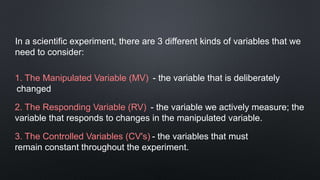
In a scientific experiment, there are 3 ​different kinds of variables that we
need ​to consider:
1. The Manipulated Variable (MV) - the variable that is deliberately
changed
2. The Responding Variable (RV) - the variable we actively measure; the
variable that responds to changes in the ​manipulated variable.
3. The Controlled Variables (CV's) - the variables that must
remain ​constant throughout the experiment.
LAB WRITE UP
LET'S PRACTICE IDENTIFYING VARIABLES
IN A FEW DIFFERENT SITUATIONS
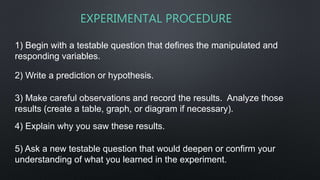
1) Begin with a testable question that defines the manipulated and
responding variables.
EXPERIMENTAL PROCEDURE
2) Write a prediction or hypothesis.
3) Make careful observations and record the results. Analyze those
results (create a table, graph, or diagram if necessary).
4) Explain why you saw these results.
5) Ask a new testable question that would deepen or confirm your
understanding of what you learned in the experiment.
A scientific control is an experiment or observation designed to minimize
the effects of variables other than the independent variable. This
increases the reliability of the results, often through a comparison
between control measurements and the other measurements.
CONTROL
FAIR TEST
It is important for an experiment to be a fair test. You conduct a fair test
by making sure that you change one factor at a time while keeping all
other conditions the same.
WHAT MAKES A
TEST FAIR?
The importance of a Fair test: how can you
possibly know the correct result if the test is not
fair?
FAIR TEST
For example, let's imagine that we want to measure which is the fastest
toy car to coast down a sloping ramp: how could we make this a fair
test?
Question: Which is faster, sound or light?
Problem statement: If I shine a flash light across a football field (at night) at the same time as I
blast an air horn, which will cross the field fastest: the sound or the light?
Hypothesis: I think that the sound will cross the field the fastest because the darkness will slow
the light down.
Observations/Results: The air horn sound arrived at the other side of the football field about 0.5
seconds after the light could be seen.
Interpretation: The light crossed the football field first because light is faster than sound.
Next Question: If I do the same experiment underwater, which will be faster: light or sound?
Can you identify: MV, RV, and fair test?
A sentence that identifies the possible relationship between the
manipulated and responding variable.
PROBLEM STATEMENT
How does the MV affect the RV?
A testable claim, often based on evidence and or reasoning.
HYPOTHESIS
Example: "Have you noticed that Howard can take any topic and use it to
remind you that he went to space?"
Detailed examination of something.
ANALYSIS
Explaining the meaning of something.
INTERPRETATION (INDUCTION)
The Plan: We will practice
identifying variables, write
problem statements,
practice hypothesizing.
A. Float or sink soda can
Choose your own examples
B. Elephants afraid of mice
C. Bull in a China Shop
D. Marshmallow test
E. Coca Cola & Milk
F. Burning money
G. Elephants and mice
I. Does Methane and CO2
actually make the air hotter?
H. Crowd wave time
J. Weaving in traffic
K. Swimming in syrup
L. Dropping potatoes
M. Big bang theory
N. Fizzy pop cans
O. Plant Growth
P. Curving bullet
Q. Gummy bears/rocket
fuel

Experimental Variables & Video Practice

  • 1.
  • 2.
  • 3.
    WHAT IS AN EXPERIMENT? Experiment- a test under controlled ​conditions that is made to show a certain principle or to ​test a hypothesis.
  • 4.
    To make surethat an experiment yields ​useful results, it must be performed under ​controlled conditions. We refer to these controls as experimental variables. Variable - any factor that can be changed or controlled in a situation
  • 5.
    In a scientificexperiment, there are 3 ​different kinds of variables that we need ​to consider: 1. The Manipulated Variable (MV) - the variable that is deliberately changed 2. The Responding Variable (RV) - the variable we actively measure; the variable that responds to changes in the ​manipulated variable. 3. The Controlled Variables (CV's) - the variables that must remain ​constant throughout the experiment.
  • 6.
  • 7.
    LET'S PRACTICE IDENTIFYINGVARIABLES IN A FEW DIFFERENT SITUATIONS
  • 12.
    1) Begin witha testable question that defines the manipulated and responding variables. EXPERIMENTAL PROCEDURE 2) Write a prediction or hypothesis. 3) Make careful observations and record the results. Analyze those results (create a table, graph, or diagram if necessary). 4) Explain why you saw these results. 5) Ask a new testable question that would deepen or confirm your understanding of what you learned in the experiment.
  • 13.
    A scientific controlis an experiment or observation designed to minimize the effects of variables other than the independent variable. This increases the reliability of the results, often through a comparison between control measurements and the other measurements. CONTROL FAIR TEST It is important for an experiment to be a fair test. You conduct a fair test by making sure that you change one factor at a time while keeping all other conditions the same.
  • 14.
    WHAT MAKES A TESTFAIR? The importance of a Fair test: how can you possibly know the correct result if the test is not fair?
  • 15.
    FAIR TEST For example,let's imagine that we want to measure which is the fastest toy car to coast down a sloping ramp: how could we make this a fair test?
  • 16.
    Question: Which isfaster, sound or light? Problem statement: If I shine a flash light across a football field (at night) at the same time as I blast an air horn, which will cross the field fastest: the sound or the light? Hypothesis: I think that the sound will cross the field the fastest because the darkness will slow the light down. Observations/Results: The air horn sound arrived at the other side of the football field about 0.5 seconds after the light could be seen. Interpretation: The light crossed the football field first because light is faster than sound. Next Question: If I do the same experiment underwater, which will be faster: light or sound? Can you identify: MV, RV, and fair test?
  • 17.
    A sentence thatidentifies the possible relationship between the manipulated and responding variable. PROBLEM STATEMENT How does the MV affect the RV?
  • 18.
    A testable claim,often based on evidence and or reasoning. HYPOTHESIS Example: "Have you noticed that Howard can take any topic and use it to remind you that he went to space?"
  • 19.
    Detailed examination ofsomething. ANALYSIS Explaining the meaning of something. INTERPRETATION (INDUCTION)
  • 21.
    The Plan: Wewill practice identifying variables, write problem statements, practice hypothesizing.
  • 23.
    A. Float orsink soda can Choose your own examples B. Elephants afraid of mice C. Bull in a China Shop D. Marshmallow test E. Coca Cola & Milk F. Burning money G. Elephants and mice I. Does Methane and CO2 actually make the air hotter? H. Crowd wave time J. Weaving in traffic K. Swimming in syrup L. Dropping potatoes M. Big bang theory N. Fizzy pop cans O. Plant Growth P. Curving bullet Q. Gummy bears/rocket fuel