1
2
CE-335L: Geotechnical Engineering-II (Lab)
Lecture 01
Experiment No. 01
Direct Shear Test
Dr. Muhammad Safdar, PhD. (Professional Geotechnical Engineer)
Assistant Professor, Earthquake Engineering Center,
Department of Civil Engineering,
UET Peshawar, KP, Pakistan.
E-mail: drsafdar@uetpeshawar.edu.pk
Lecture Contents
• Introduction to Shear Strength
• Introduction to Direct Shear Test
• Standard Reference
• Significance of the test
• Apparatus
• Test Procedure
• Analysis of Test Procedure
• Observations, Calculations and Results
• Advantages and Disadvantages
• Video
3
CE-335L-Geotechnical Engineering-II (Lab)
Course Instructor,
Dr. M. Safdar, EEC UET Peshawar.
Introduction to Shear Strength
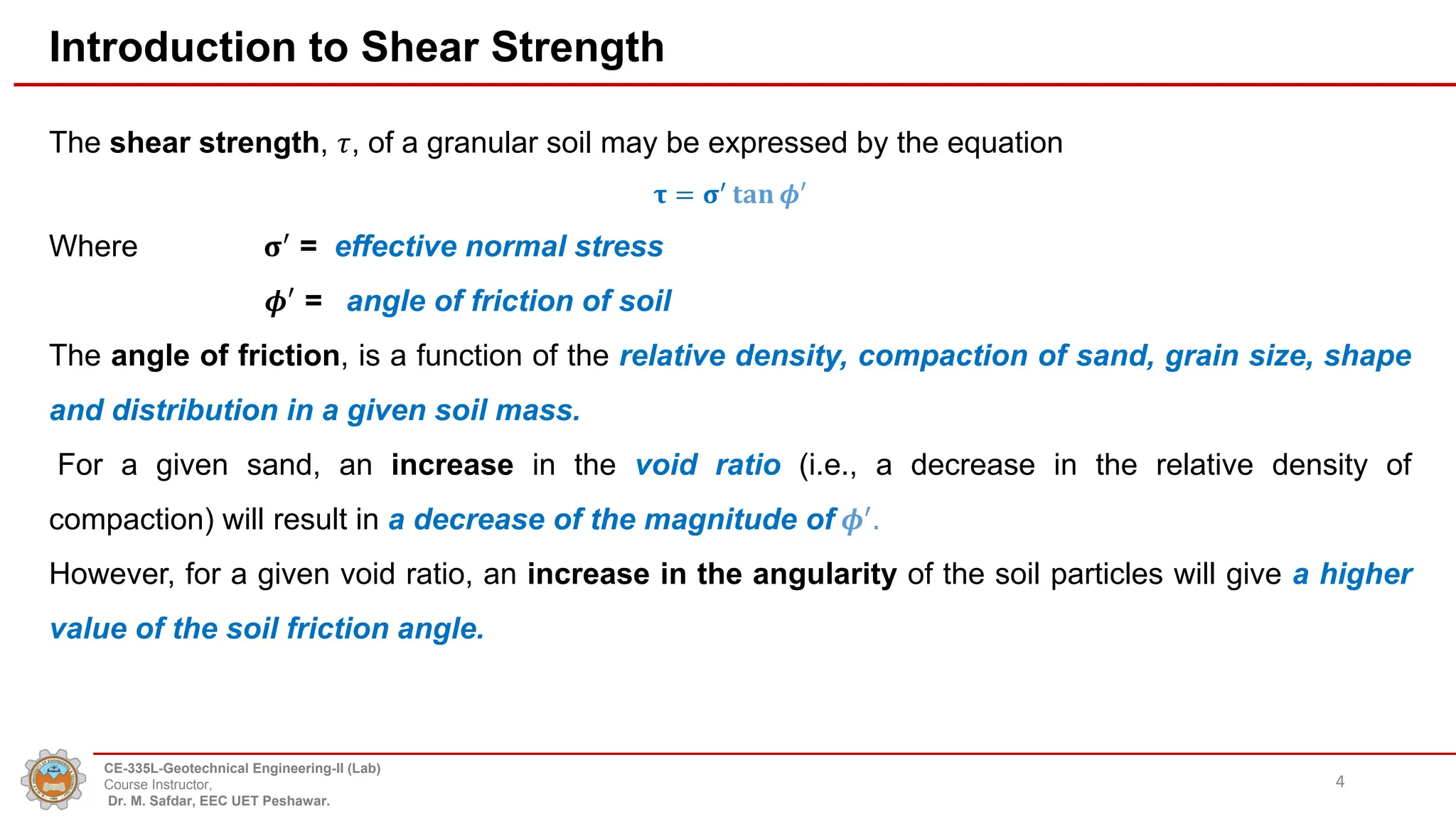
The shear strength, 𝜏, of a granular soil may be expressed by the equation
𝛕 = 𝛔′
𝐭𝐚𝐧 𝝓′
Where 𝛔′
= effective normal stress
𝝓′ = angle of friction of soil
The angle of friction, is a function of the relative density, compaction of sand, grain size, shape
and distribution in a given soil mass.
For a given sand, an increase in the void ratio (i.e., a decrease in the relative density of
compaction) will result in a decrease of the magnitude of 𝝓′
.
However, for a given void ratio, an increase in the angularity of the soil particles will give a higher
value of the soil friction angle.
4
CE-335L-Geotechnical Engineering-II (Lab)
Course Instructor,
Dr. M. Safdar, EEC UET Peshawar.
Introduction to Direct Shear Test
Direct shear test is performed to determine the consolidated-drained shear strength of a sandy
to silty soil.
The shear strength is one of the most important engineering properties of a soil, because it is
required whenever a structure is dependent on the soil’s shearing resistance.
The shear strength is needed for engineering situations such as determining the stability of slopes
or cuts, finding the bearing capacity for foundations, and calculating the pressure exerted by a
soil on a retaining wall.
5
CE-335L-Geotechnical Engineering-II (Lab)
Course Instructor,
Dr. M. Safdar, EEC UET Peshawar.
Standard Reference
ASTM D 3080 - Standard Test Method for Direct Shear Test of Soils Under Consolidated
Drained Conditions
6
CE-335L-Geotechnical Engineering-II (Lab)
Course Instructor,
Dr. M. Safdar, EEC UET Peshawar.
Significance of the Test
The direct shear test is one of the oldest shear strength test for soils.
The direct shear test is suited to the relatively rapid determination of consolidated drained shear
strength properties of soils.
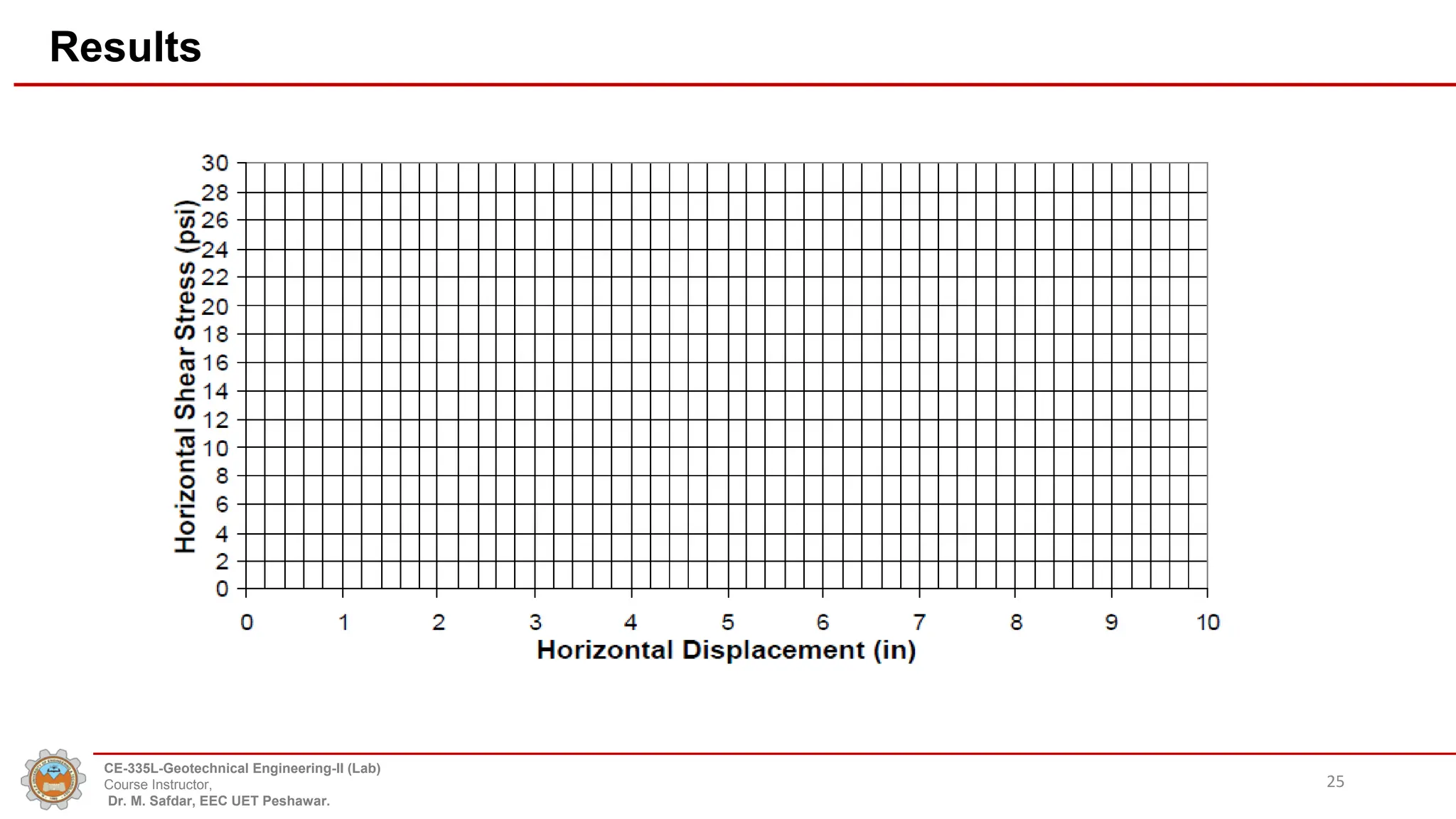
From the plot of the shear stress versus the horizontal displacement, the maximum shear stress
is obtained for a specific vertical confining stress.
After the experiment is performed several times for various vertical-confining stresses, a plot of the
maximum shear stresses versus the vertical (normal) confining stresses for each of the tests is
produced.
7
CE-335L-Geotechnical Engineering-II (Lab)
Course Instructor,
Dr. M. Safdar, EEC UET Peshawar.
Significance of the Test
From the plot, a straight-line approximation of the Mohr-Coulomb failure envelope can be drawn,
𝝓′ may be determined, and for cohesionless soils (c = 0), the shear strength can be computed from
the following equation:
8
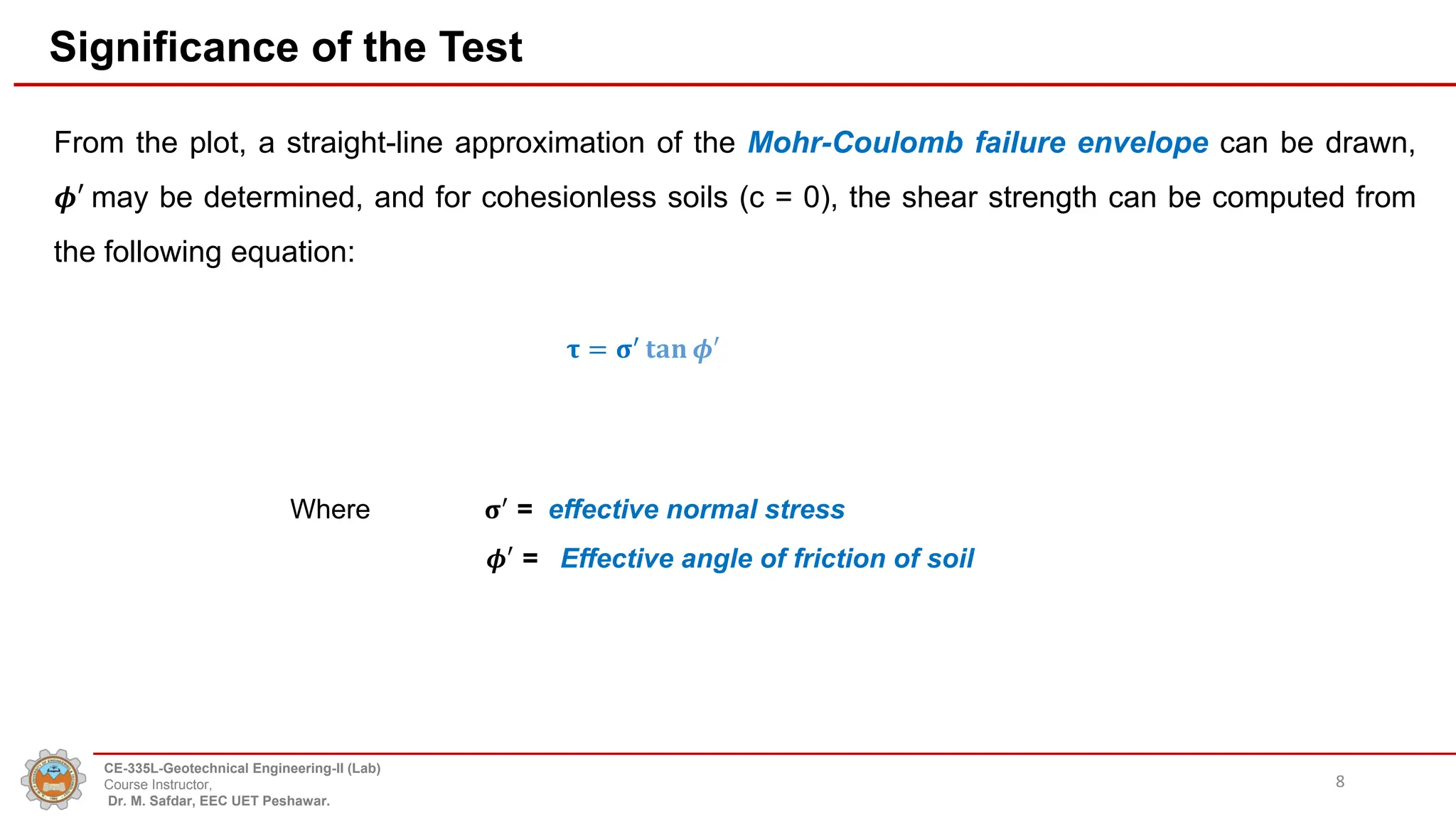
𝛕 = 𝛔′
𝐭𝐚𝐧 𝝓′
Where 𝛔′
= effective normal stress
𝝓′ = Effective angle of friction of soil
CE-335L-Geotechnical Engineering-II (Lab)
Course Instructor,
Dr. M. Safdar, EEC UET Peshawar.
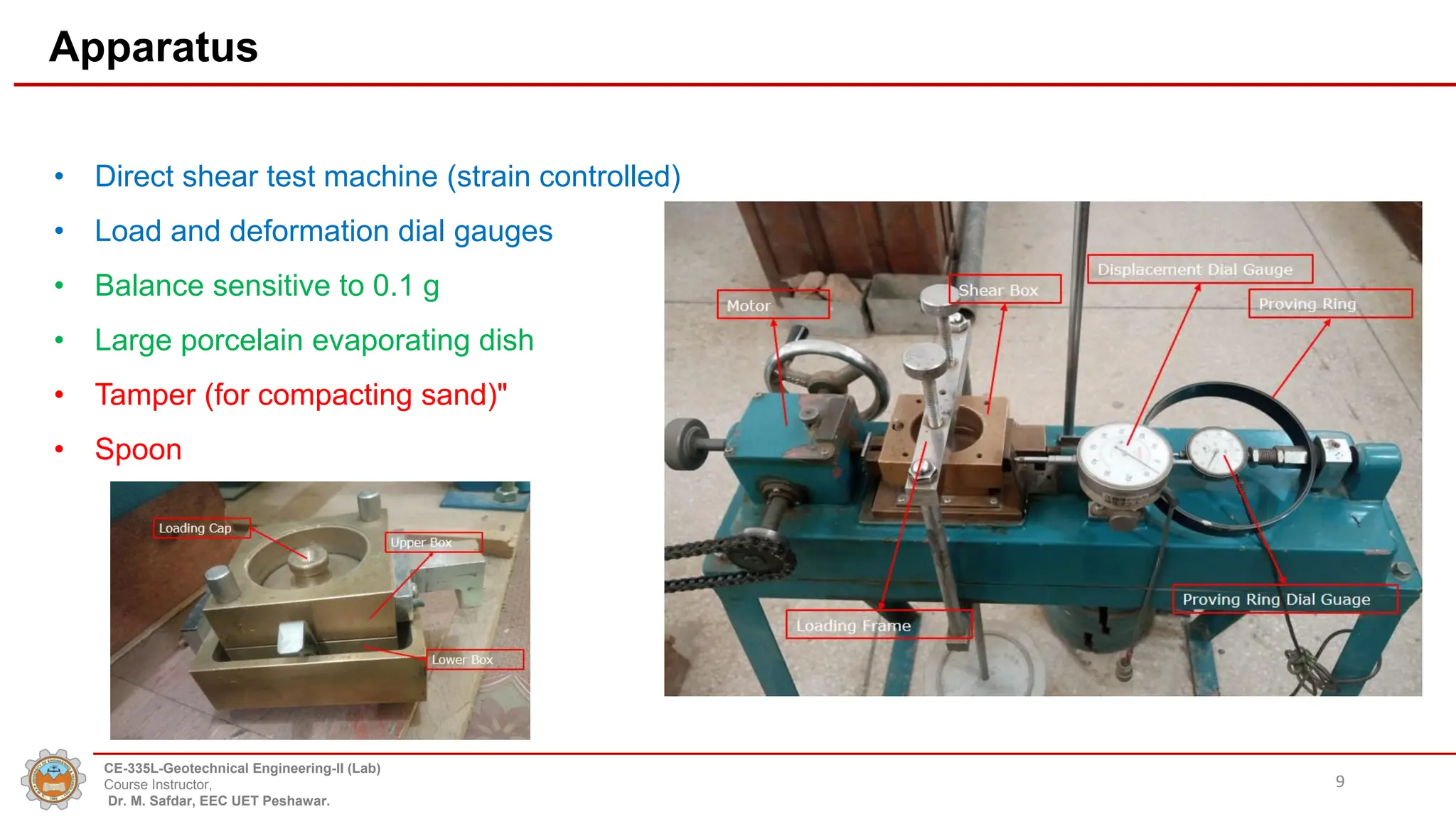
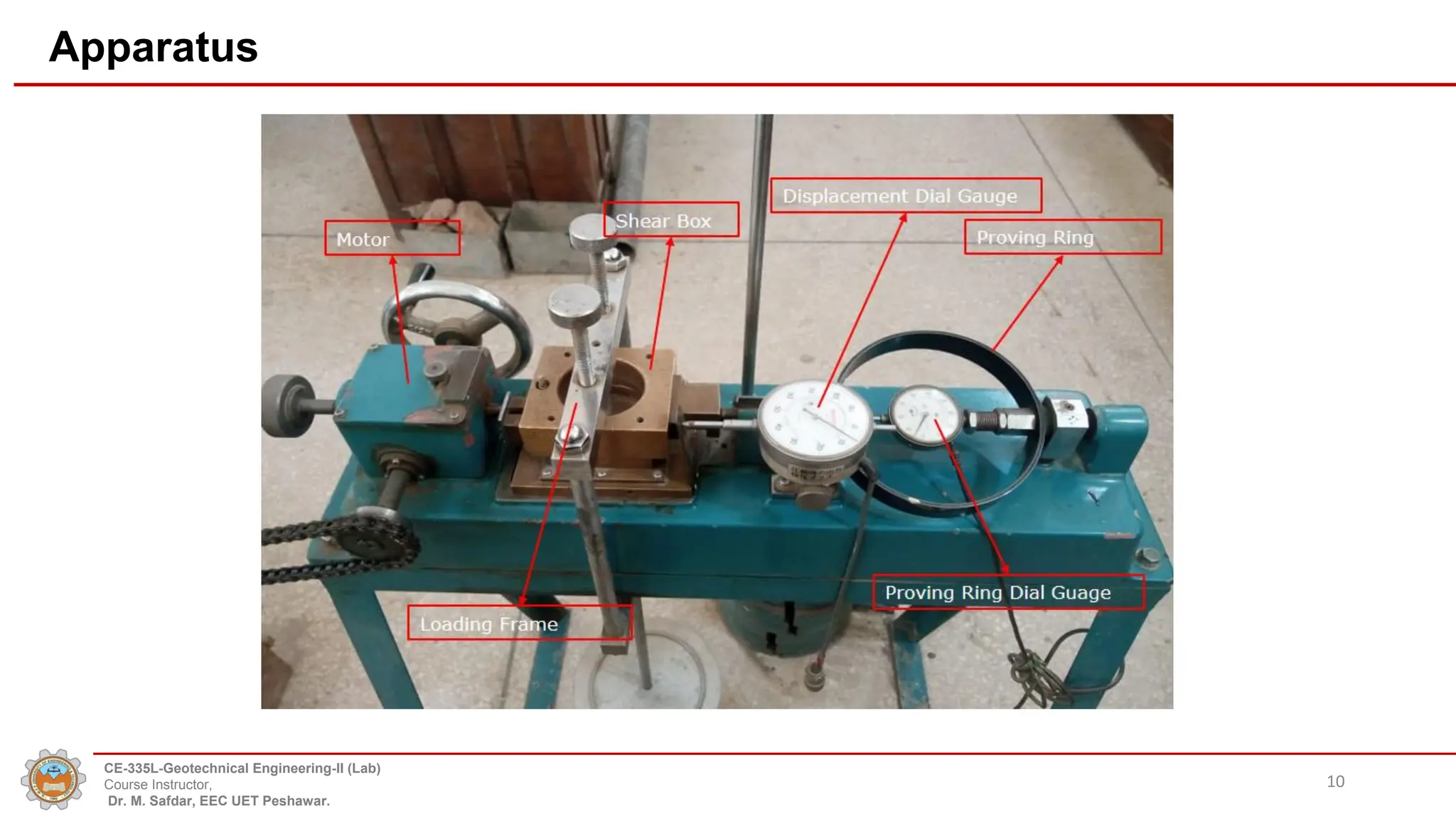
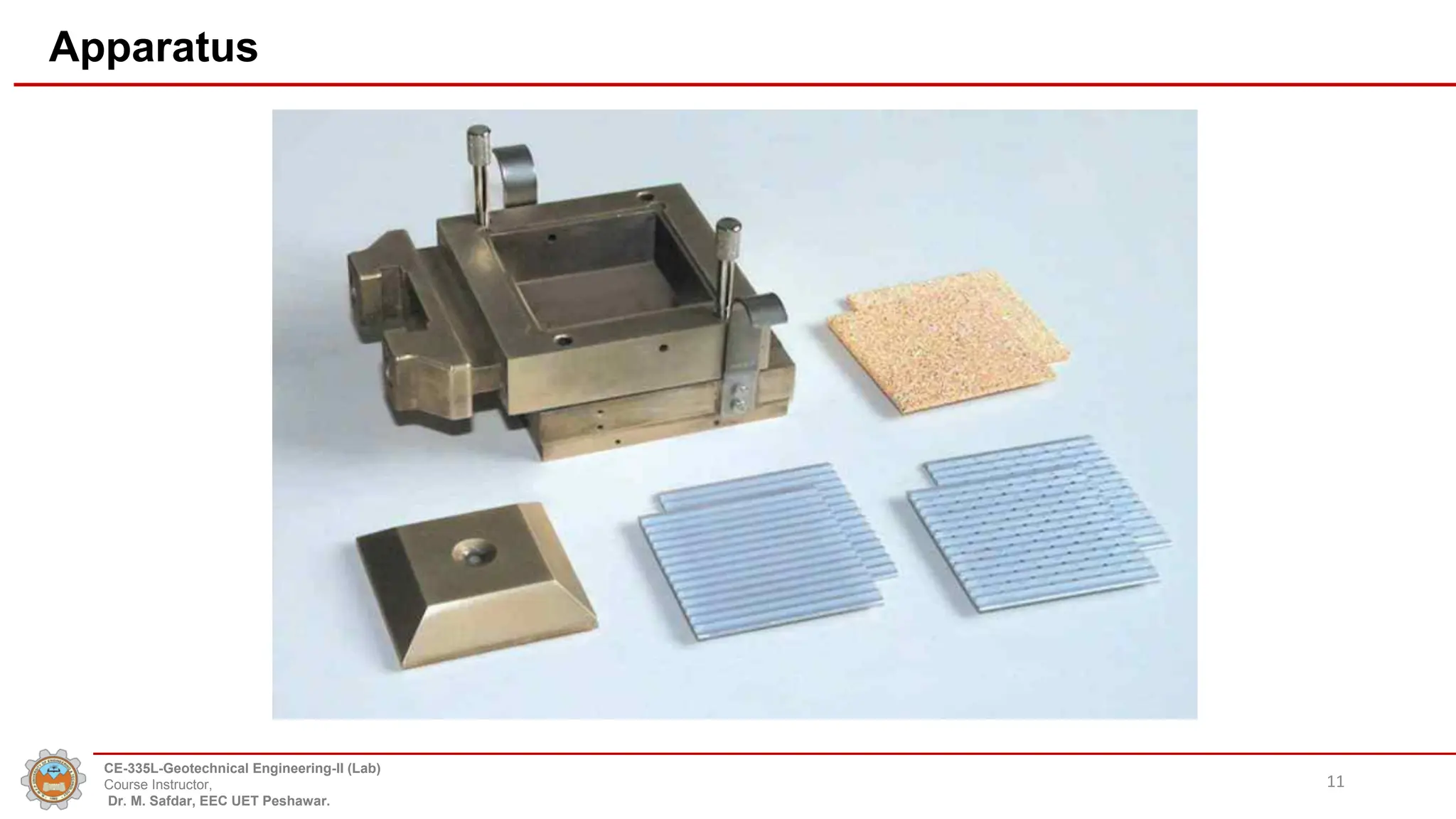
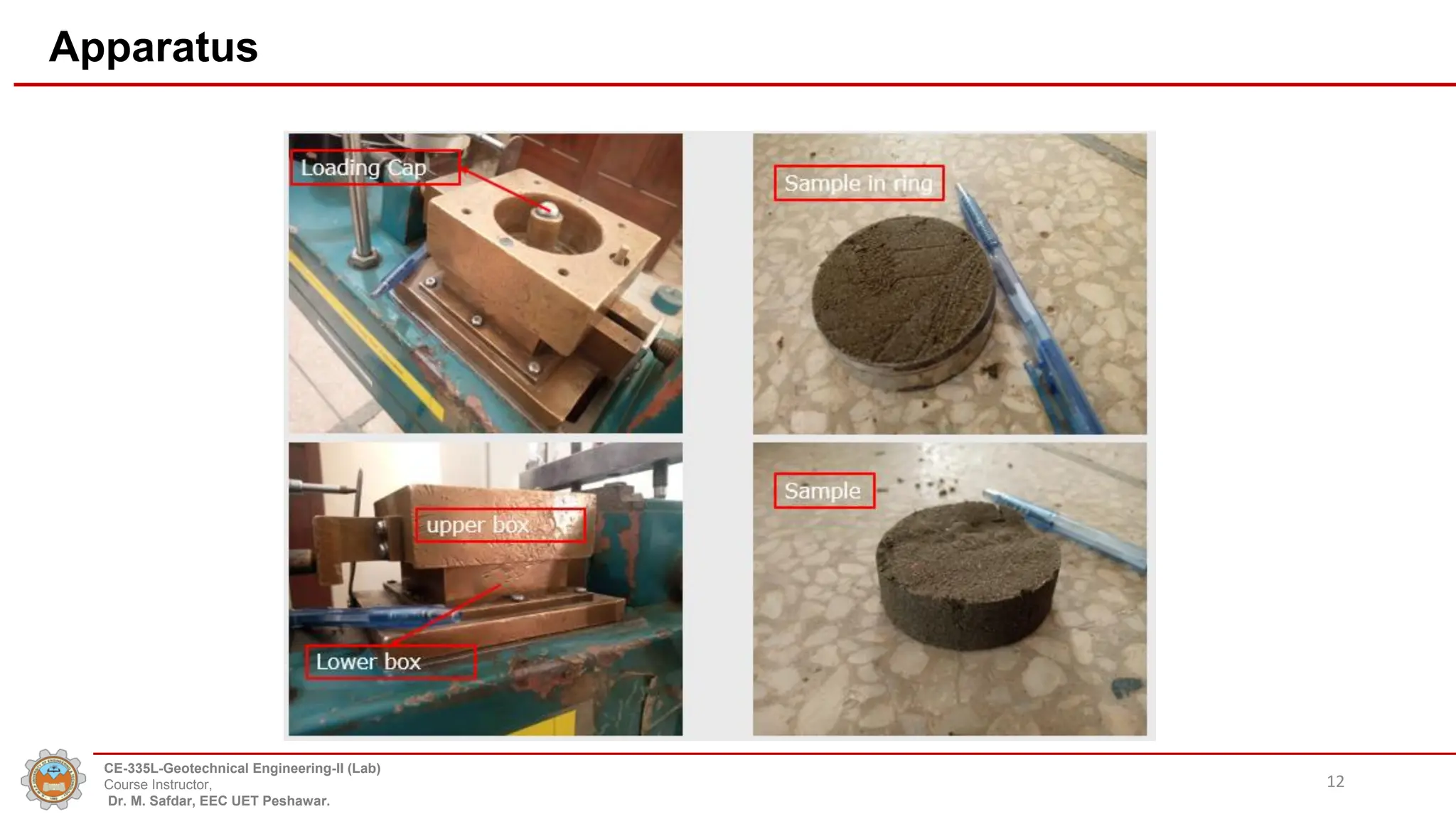
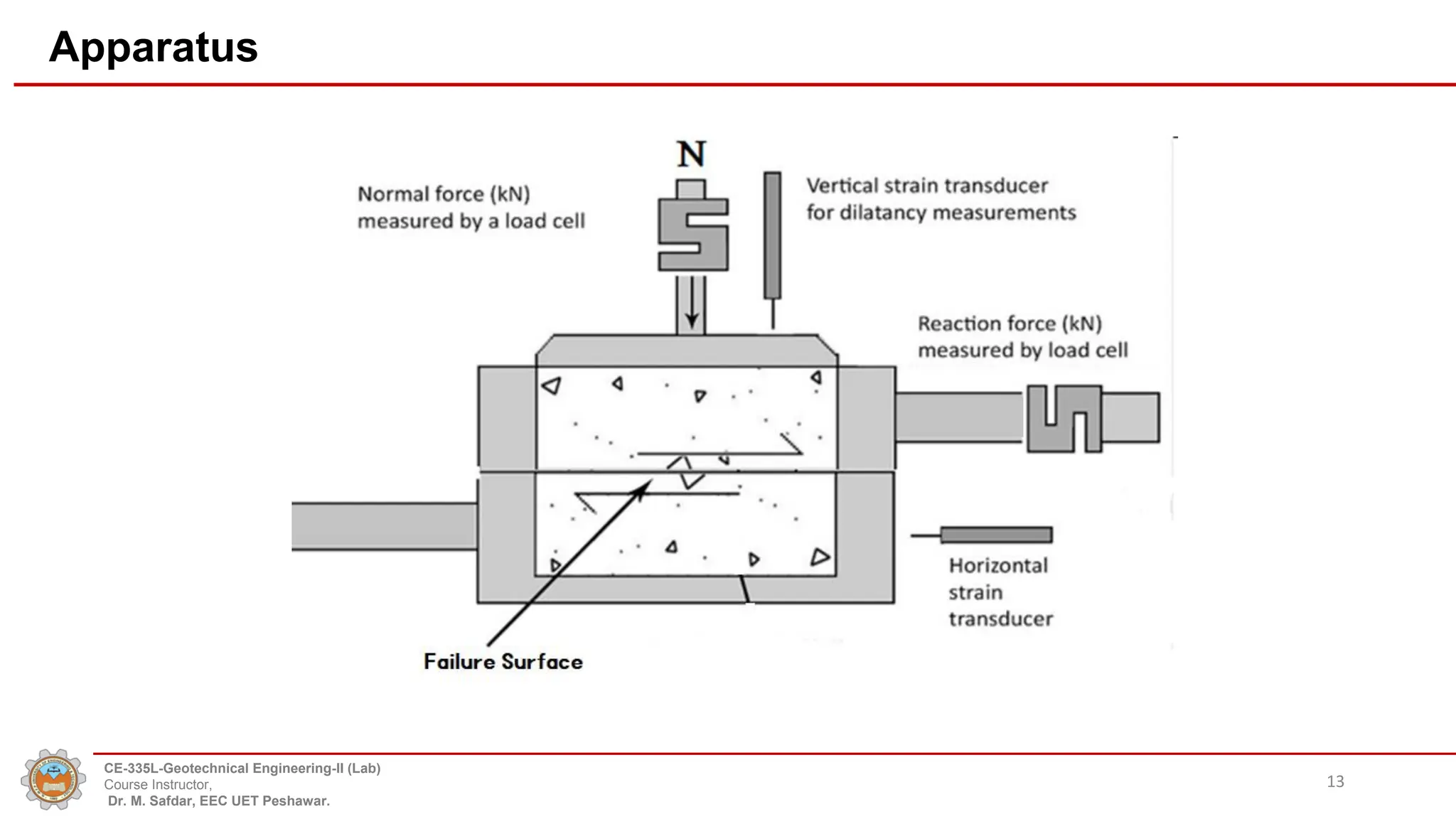
Apparatus
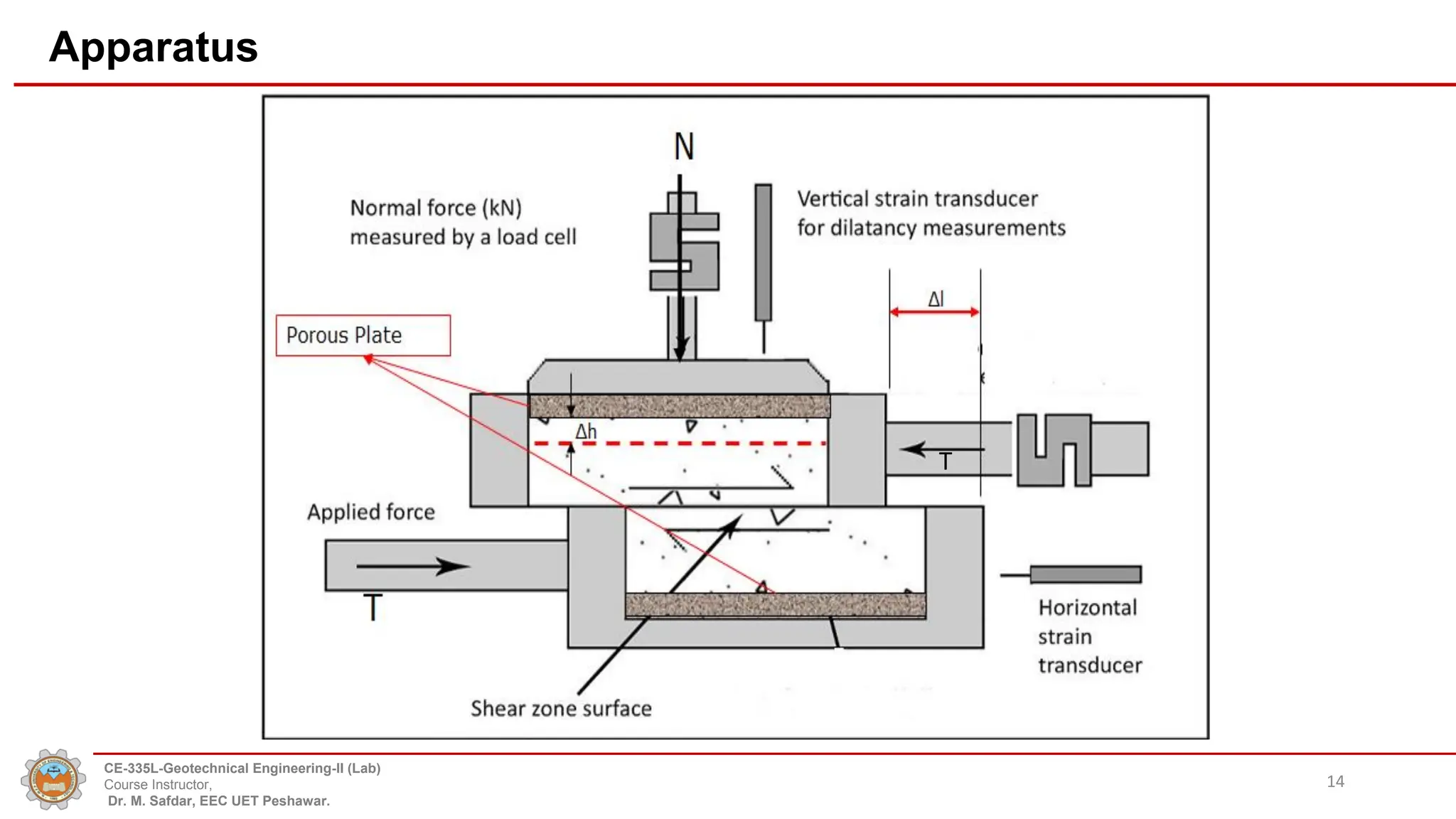
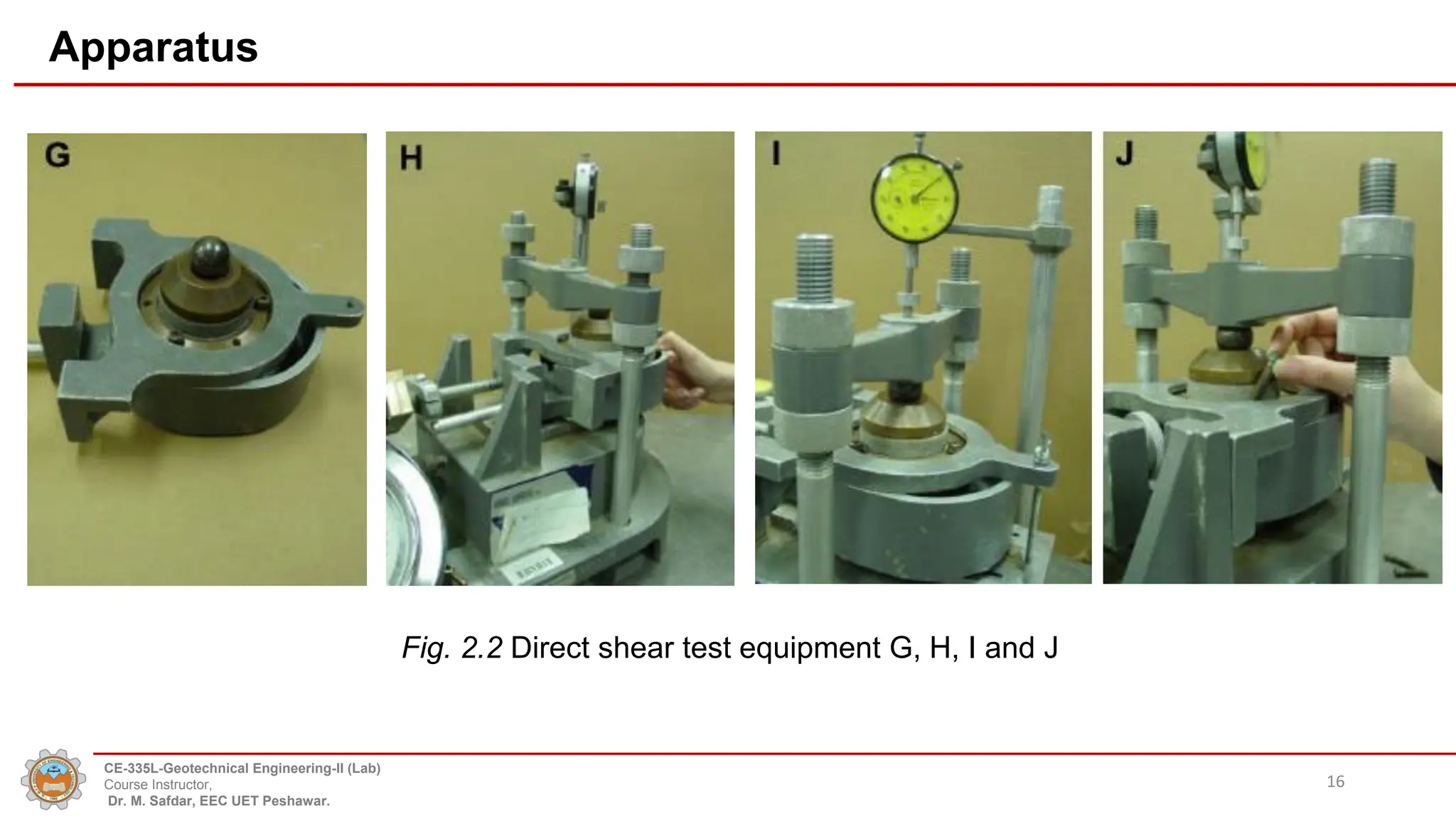
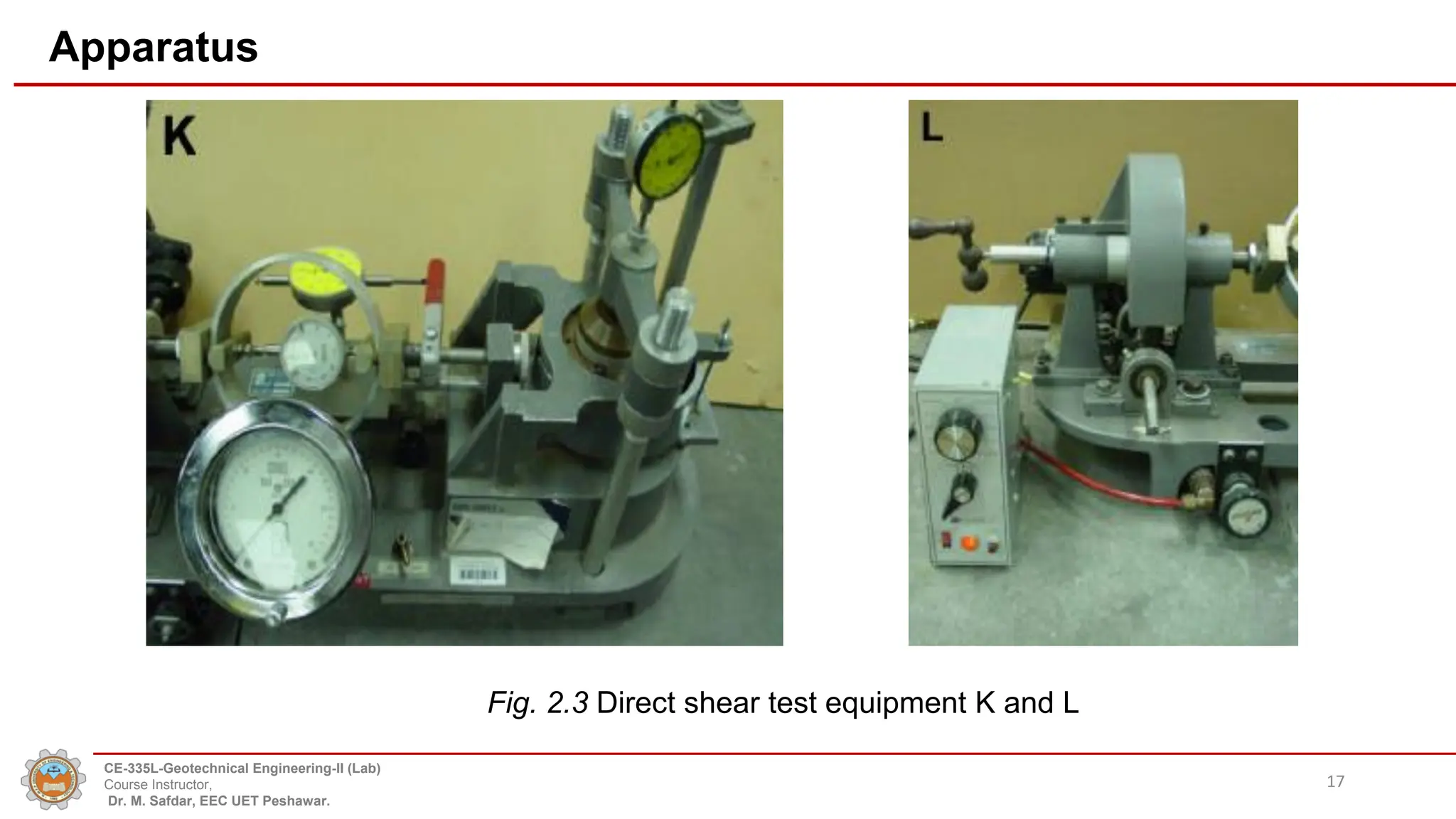
• Direct shear test machine (strain controlled)
• Load and deformation dial gauges
• Balance sensitive to 0.1 g
• Large porcelain evaporating dish
• Tamper (for compacting sand)"
• Spoon
9
CE-335L-Geotechnical Engineering-II (Lab)
Course Instructor,
Dr. M. Safdar, EEC UET Peshawar.
Apparatus
10
CE-335L-Geotechnical Engineering-II (Lab)
Course Instructor,
Dr. M. Safdar, EEC UET Peshawar.
Apparatus
11
CE-335L-Geotechnical Engineering-II (Lab)
Course Instructor,
Dr. M. Safdar, EEC UET Peshawar.
Apparatus
12
CE-335L-Geotechnical Engineering-II (Lab)
Course Instructor,
Dr. M. Safdar, EEC UET Peshawar.
Apparatus
13
CE-335L-Geotechnical Engineering-II (Lab)
Course Instructor,
Dr. M. Safdar, EEC UET Peshawar.
Apparatus
14
T
CE-335L-Geotechnical Engineering-II (Lab)
Course Instructor,
Dr. M. Safdar, EEC UET Peshawar.
Apparatus
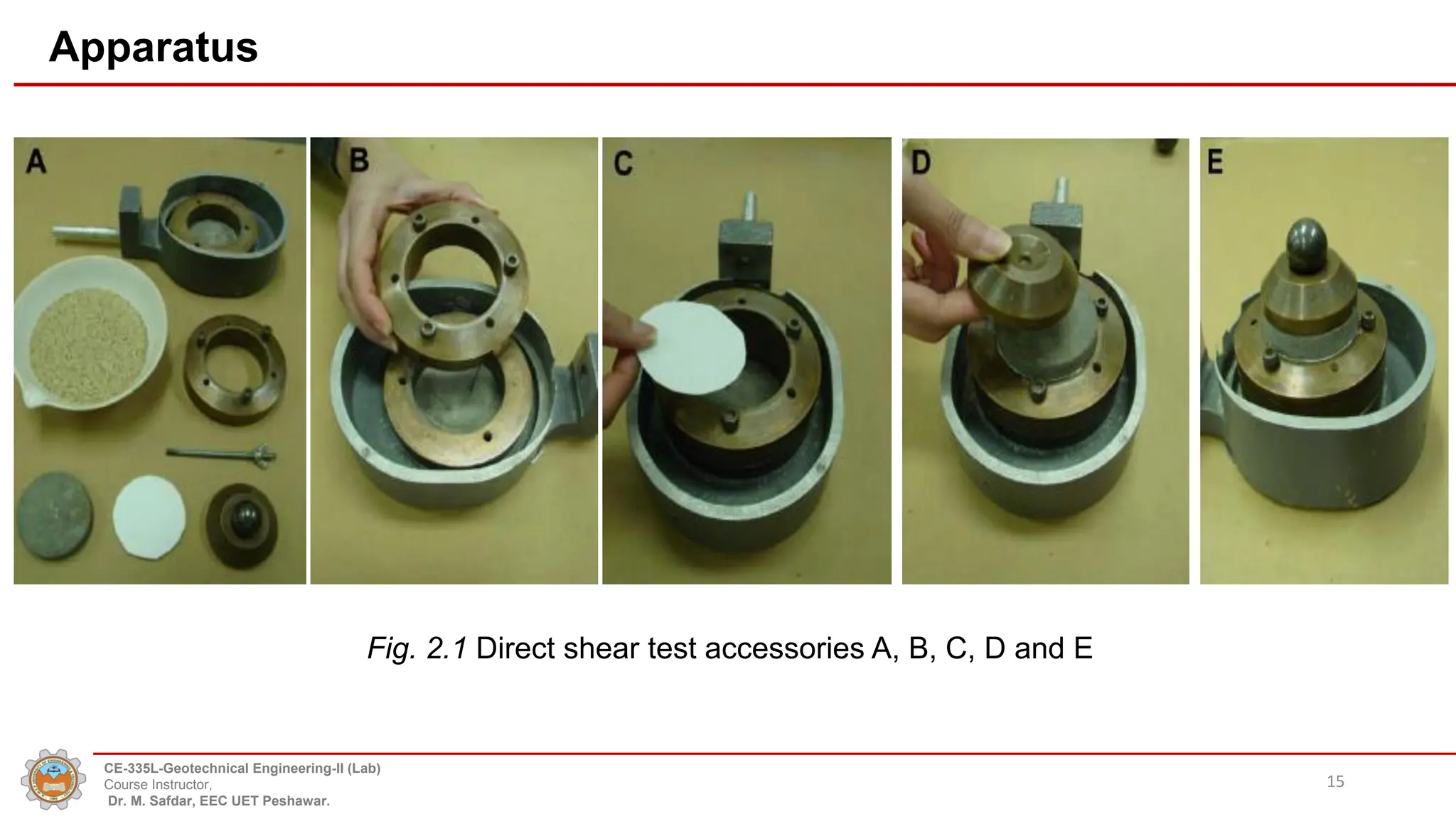
Fig. 2.1 Direct shear test accessories A, B, C, D and E
15
CE-335L-Geotechnical Engineering-II (Lab)
Course Instructor,
Dr. M. Safdar, EEC UET Peshawar.
Apparatus
Fig. 2.2 Direct shear test equipment G, H, I and J
16
CE-335L-Geotechnical Engineering-II (Lab)
Course Instructor,
Dr. M. Safdar, EEC UET Peshawar.
Apparatus
Fig. 2.3 Direct shear test equipment K and L
17
CE-335L-Geotechnical Engineering-II (Lab)
Course Instructor,
Dr. M. Safdar, EEC UET Peshawar.
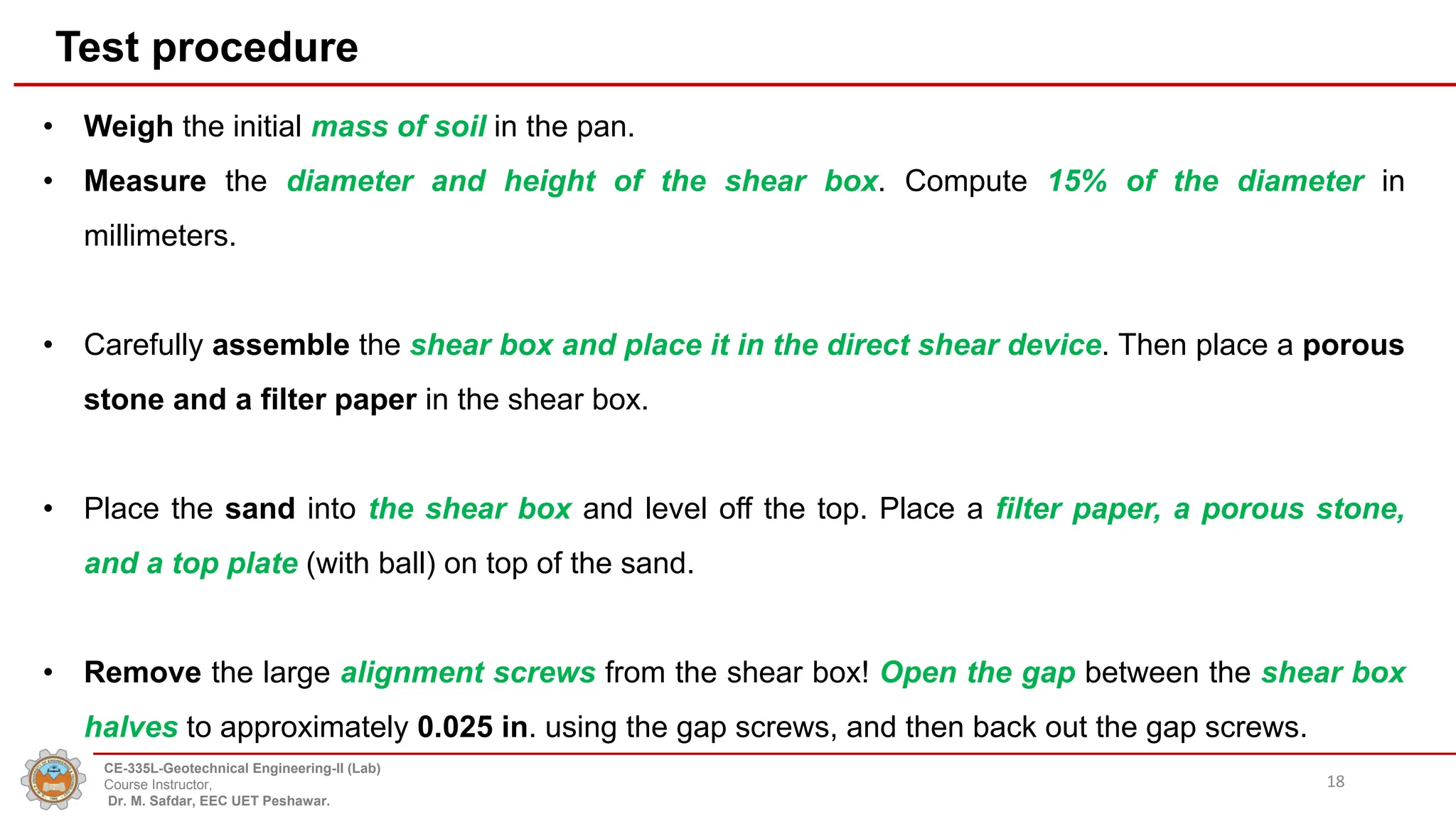
• Weigh the initial mass of soil in the pan.
• Measure the diameter and height of the shear box. Compute 15% of the diameter in
millimeters.
• Carefully assemble the shear box and place it in the direct shear device. Then place a porous
stone and a filter paper in the shear box.
• Place the sand into the shear box and level off the top. Place a filter paper, a porous stone,
and a top plate (with ball) on top of the sand.
• Remove the large alignment screws from the shear box! Open the gap between the shear box
halves to approximately 0.025 in. using the gap screws, and then back out the gap screws.
18
Test procedure
CE-335L-Geotechnical Engineering-II (Lab)
Course Instructor,
Dr. M. Safdar, EEC UET Peshawar.
Test procedure
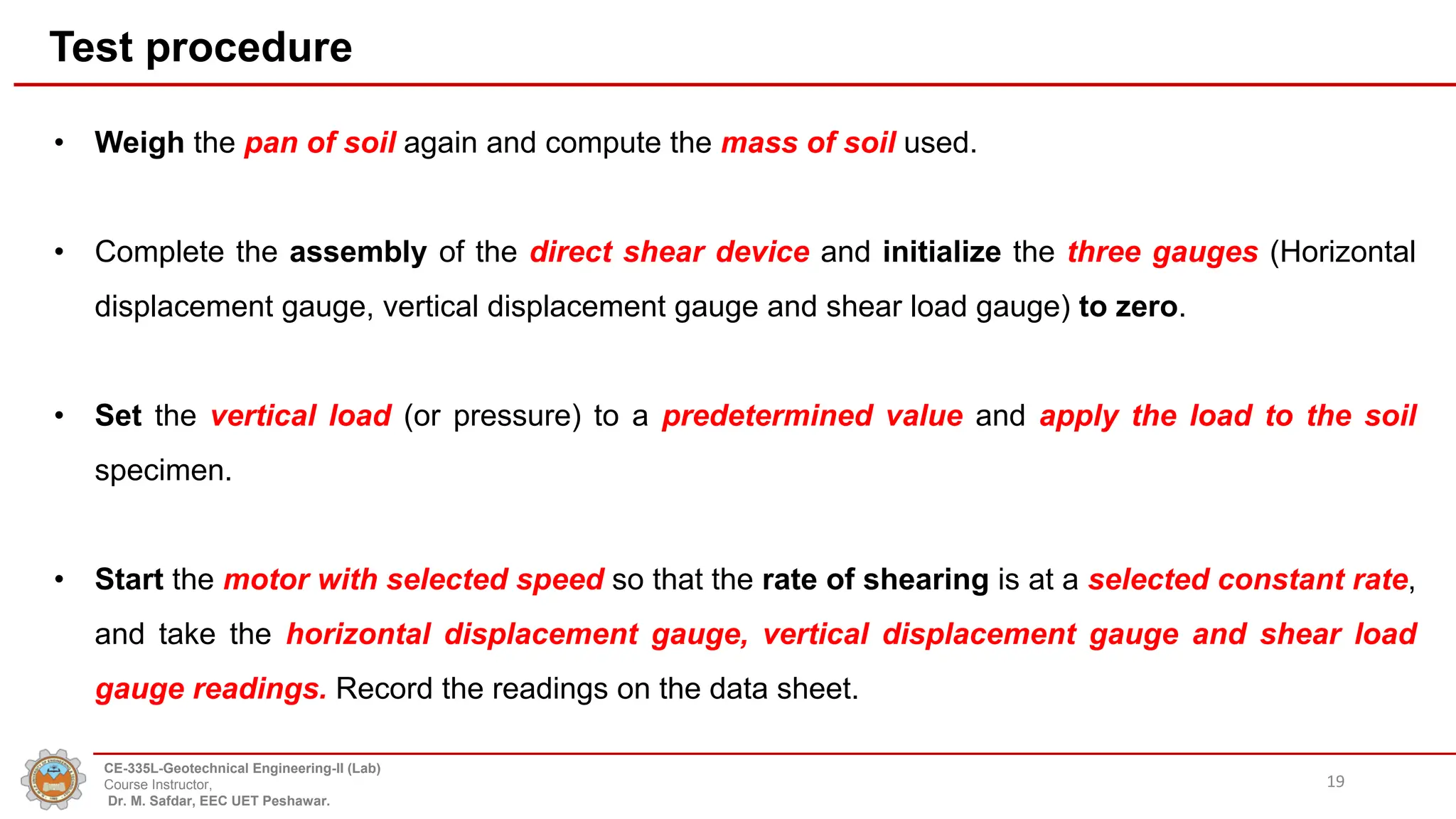
• Weigh the pan of soil again and compute the mass of soil used.
• Complete the assembly of the direct shear device and initialize the three gauges (Horizontal
displacement gauge, vertical displacement gauge and shear load gauge) to zero.
• Set the vertical load (or pressure) to a predetermined value and apply the load to the soil
specimen.
• Start the motor with selected speed so that the rate of shearing is at a selected constant rate,
and take the horizontal displacement gauge, vertical displacement gauge and shear load
gauge readings. Record the readings on the data sheet.
19
CE-335L-Geotechnical Engineering-II (Lab)
Course Instructor,
Dr. M. Safdar, EEC UET Peshawar.
Test procedure
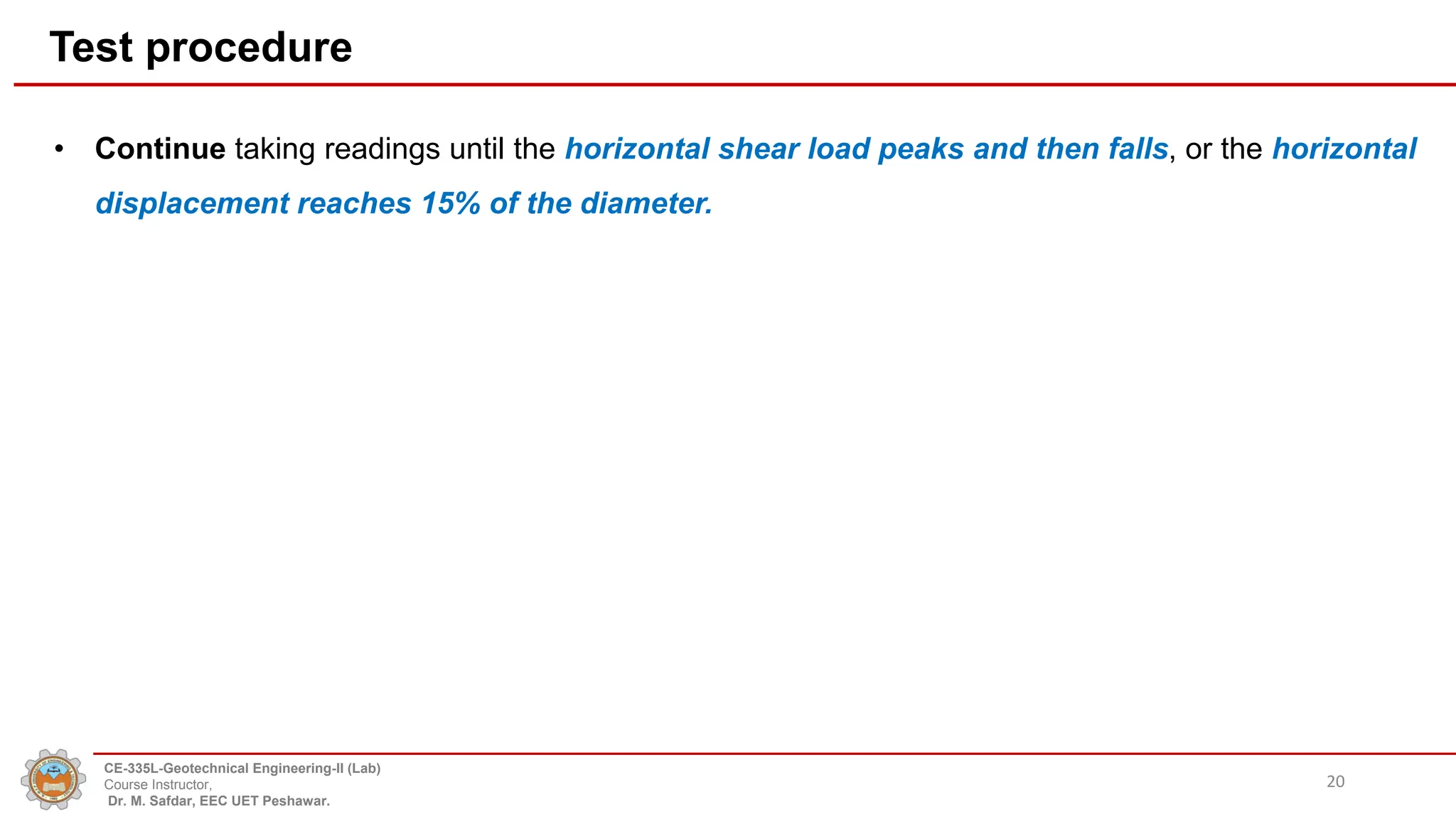
• Continue taking readings until the horizontal shear load peaks and then falls, or the horizontal
displacement reaches 15% of the diameter.
20
CE-335L-Geotechnical Engineering-II (Lab)
Course Instructor,
Dr. M. Safdar, EEC UET Peshawar.
Analysis of test procedure
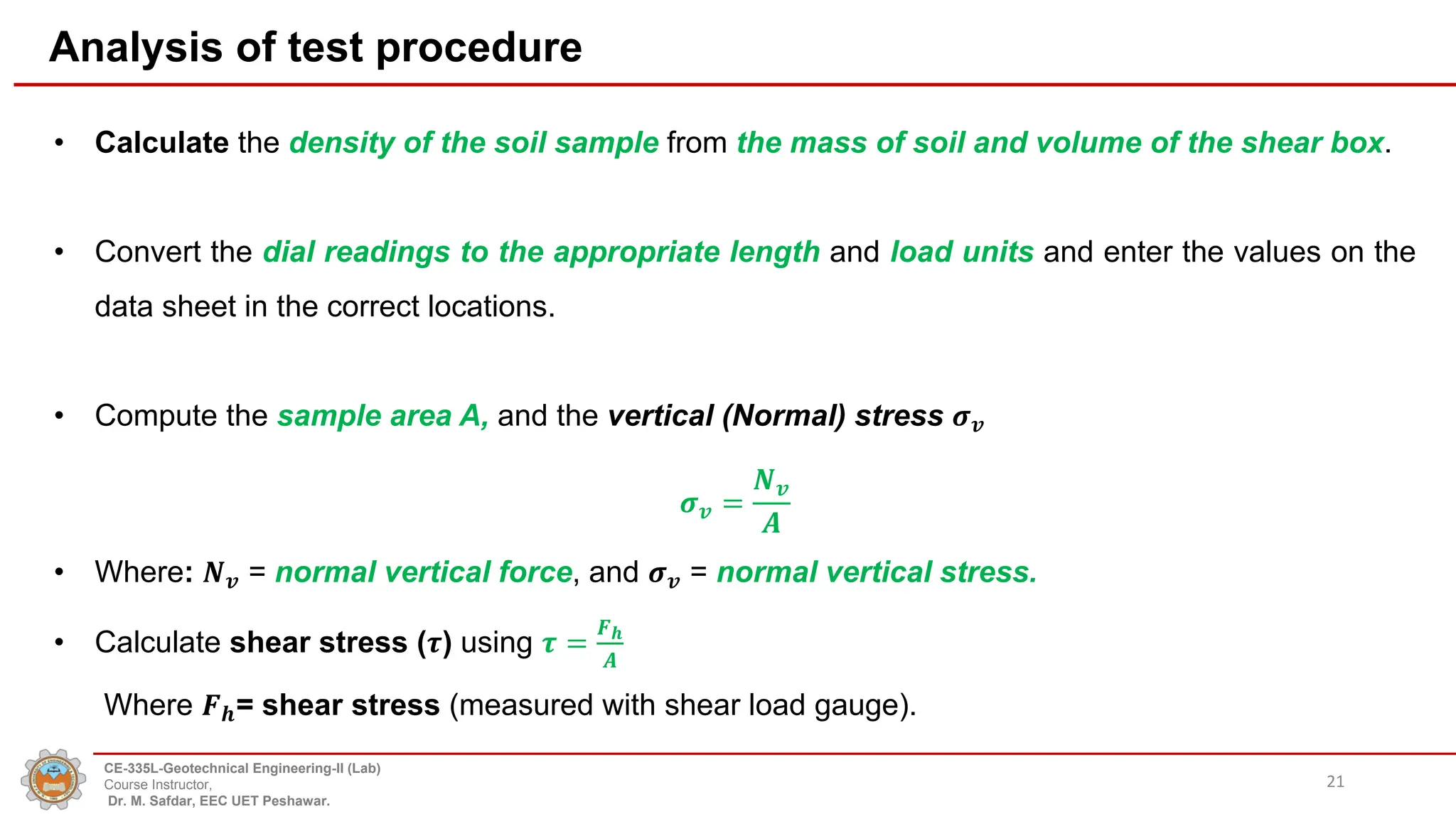
• Calculate the density of the soil sample from the mass of soil and volume of the shear box.
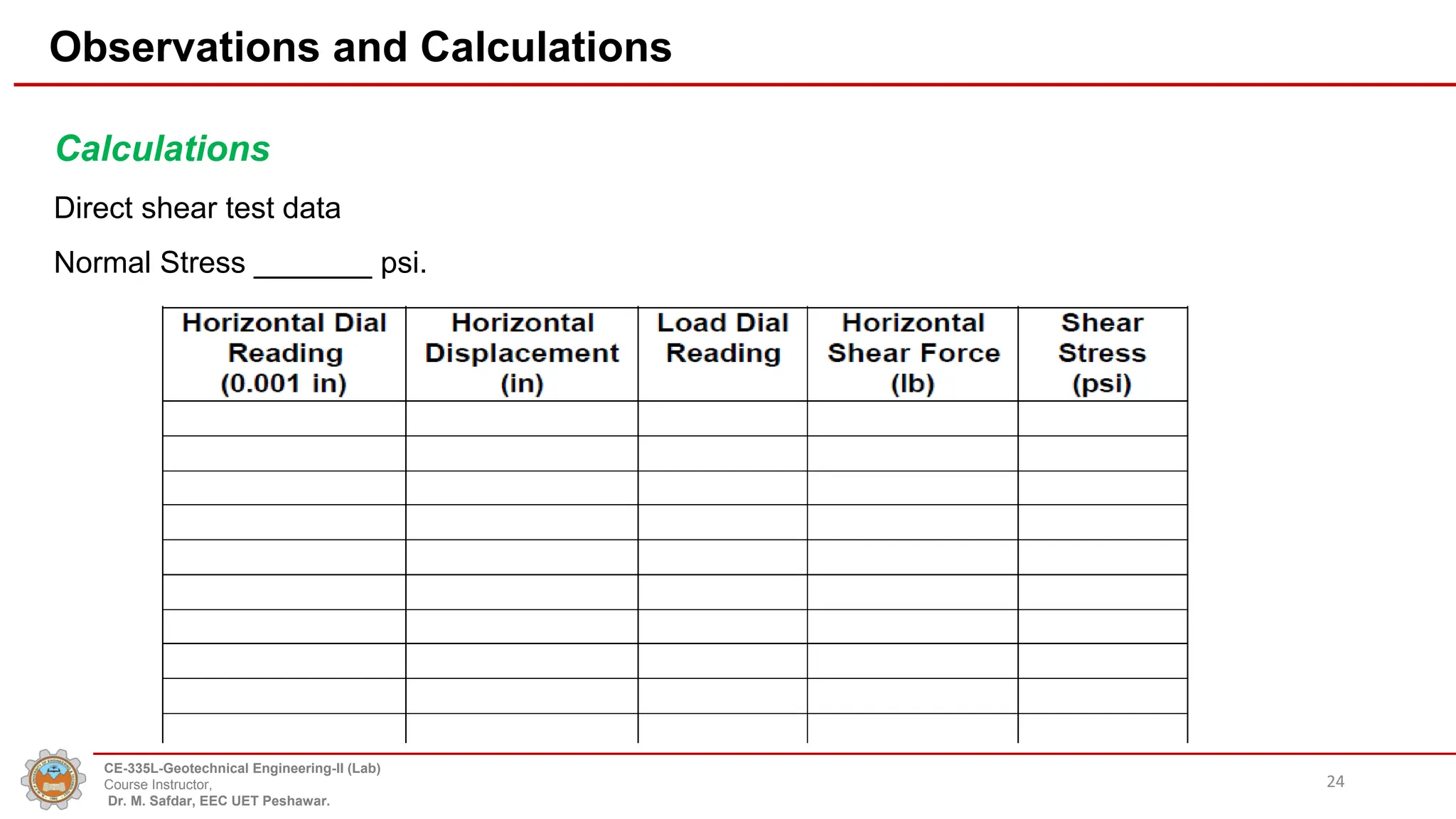
• Convert the dial readings to the appropriate length and load units and enter the values on the
data sheet in the correct locations.
• Compute the sample area A, and the vertical (Normal) stress 𝝈𝒗
𝝈𝒗 =
𝑵𝒗
𝑨
• Where: 𝑵𝒗 = normal vertical force, and 𝝈𝒗 = normal vertical stress.
• Calculate shear stress (𝝉) using 𝝉 =
𝑭𝒉
𝑨
Where 𝑭𝒉= shear stress (measured with shear load gauge).
21
CE-335L-Geotechnical Engineering-II (Lab)
Course Instructor,
Dr. M. Safdar, EEC UET Peshawar.
Analysis of test procedure
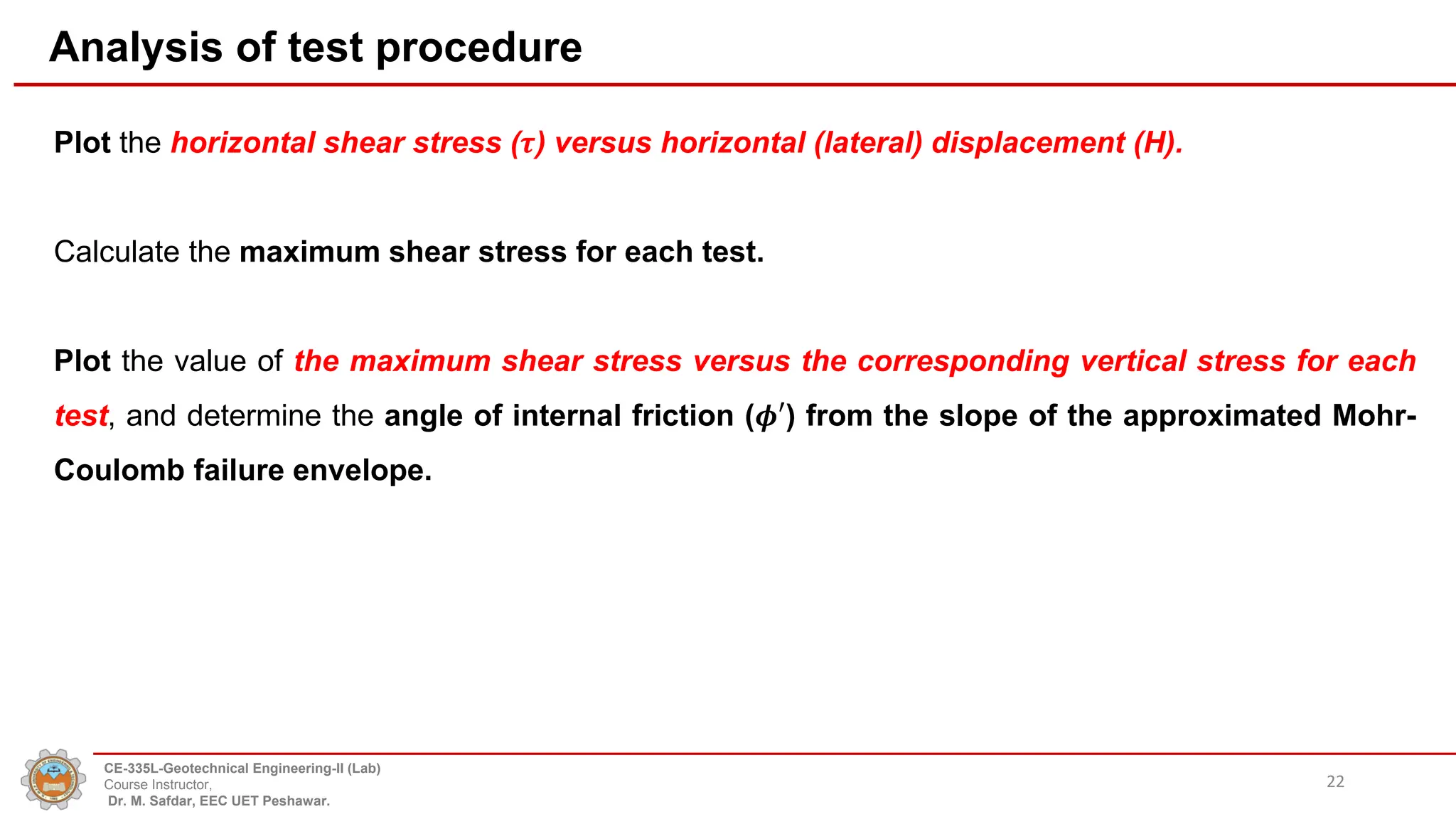
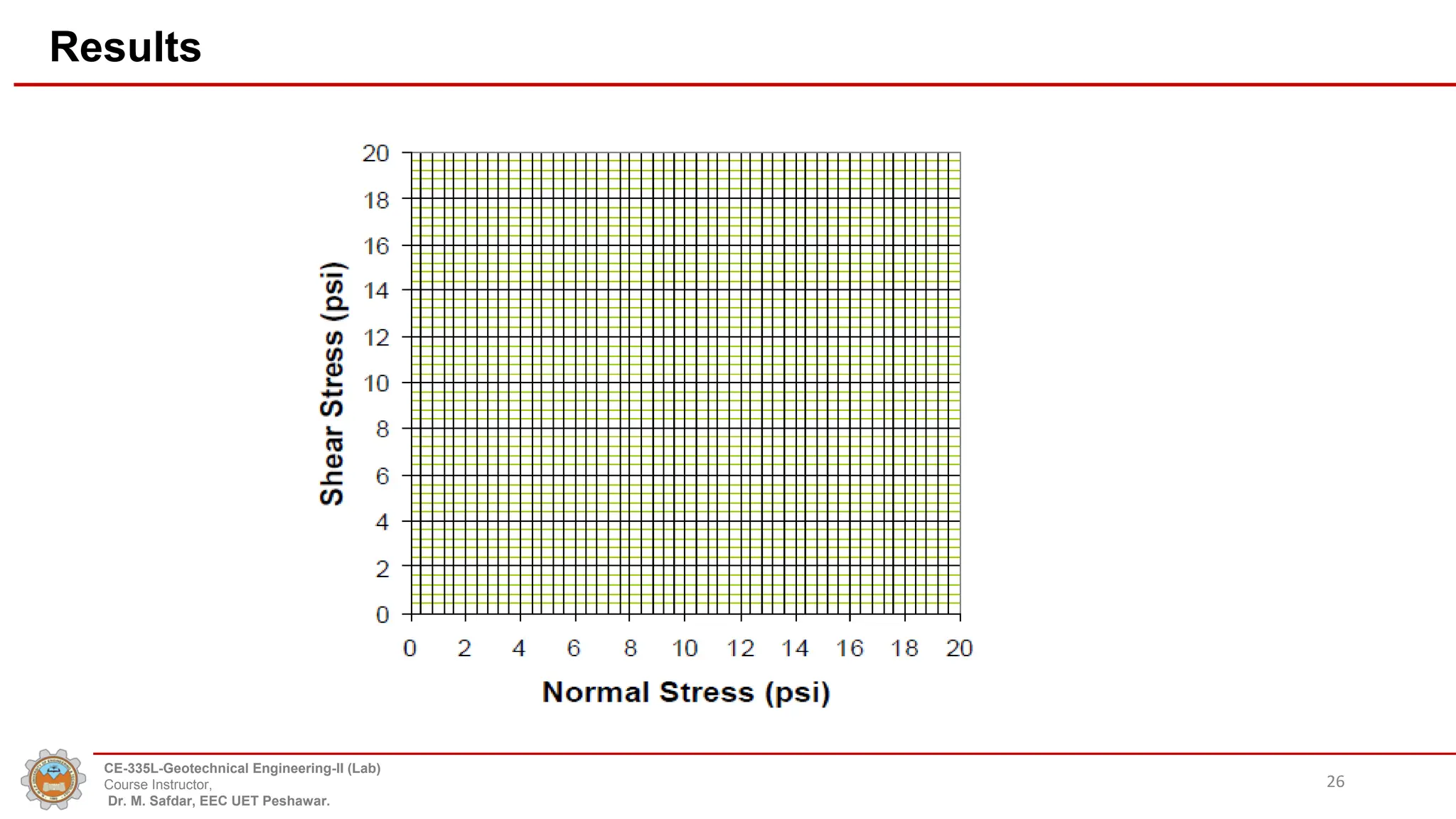
Plot the horizontal shear stress (𝝉) versus horizontal (lateral) displacement (H).
Calculate the maximum shear stress for each test.
Plot the value of the maximum shear stress versus the corresponding vertical stress for each
test, and determine the angle of internal friction (𝝓′) from the slope of the approximated Mohr-
Coulomb failure envelope.
22
CE-335L-Geotechnical Engineering-II (Lab)
Course Instructor,
Dr. M. Safdar, EEC UET Peshawar.
Observations and Calculations
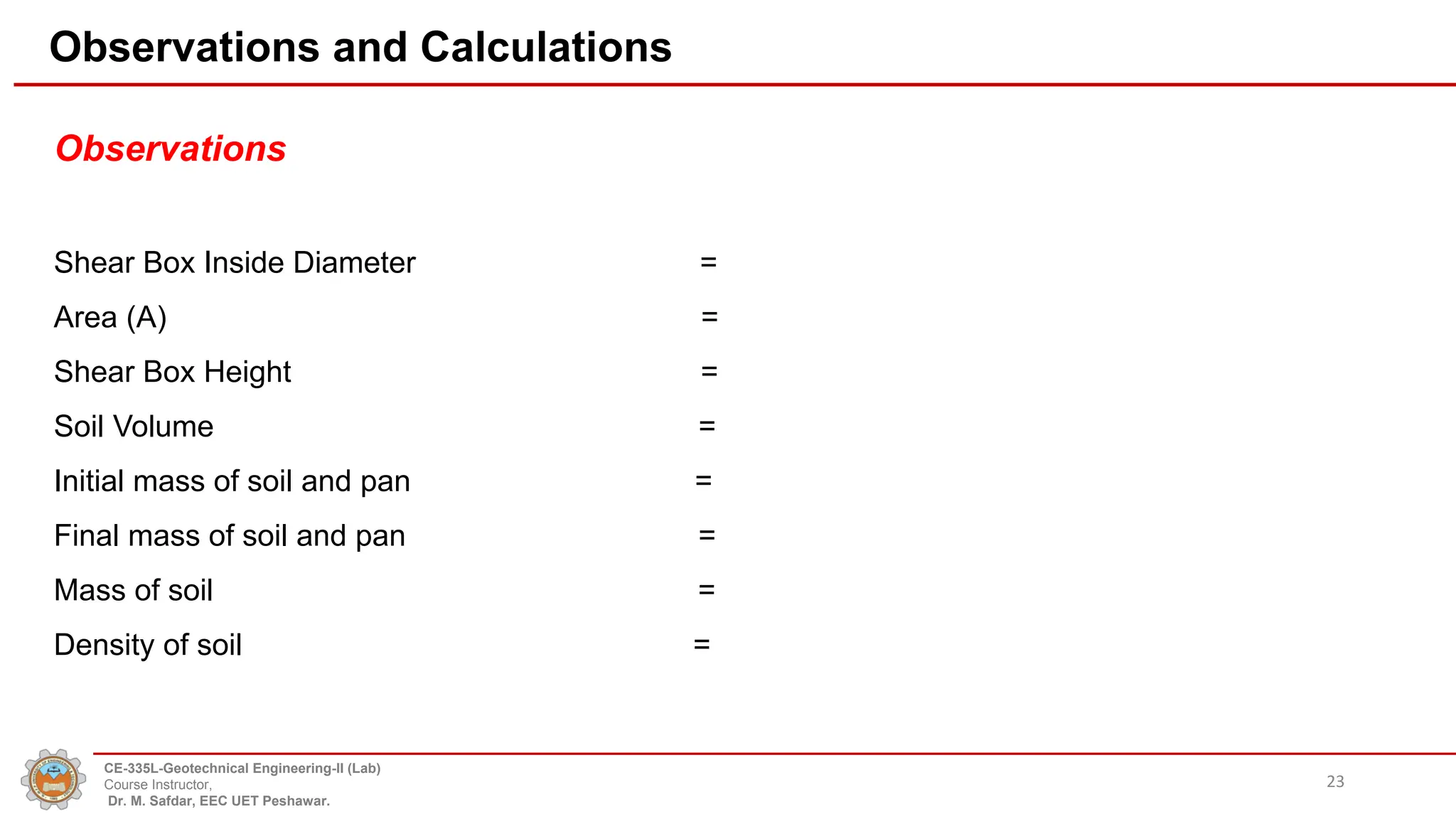
Observations
Shear Box Inside Diameter =
Area (A) =
Shear Box Height =
Soil Volume =
Initial mass of soil and pan =
Final mass of soil and pan =
Mass of soil =
Density of soil =
23
CE-335L-Geotechnical Engineering-II (Lab)
Course Instructor,
Dr. M. Safdar, EEC UET Peshawar.
Observations and Calculations
Calculations
Direct shear test data
Normal Stress _______ psi.
24
CE-335L-Geotechnical Engineering-II (Lab)
Course Instructor,
Dr. M. Safdar, EEC UET Peshawar.
Results
25
CE-335L-Geotechnical Engineering-II (Lab)
Course Instructor,
Dr. M. Safdar, EEC UET Peshawar.
Results
26
CE-335L-Geotechnical Engineering-II (Lab)
Course Instructor,
Dr. M. Safdar, EEC UET Peshawar.
Advantages and Disadvantages
27
CE-335L-Geotechnical Engineering-II (Lab)
Course Instructor,
Dr. M. Safdar, EEC UET Peshawar.
Video
28
CE-335L-Geotechnical Engineering-II (Lab)
Course Instructor,
Dr. M. Safdar, EEC UET Peshawar.
CE-335L-Geotechnical Engineering-II (Lab)
Course Instructor,
Dr. M. Safdar, EEC UET Peshawar.
Thank You
29

Experiment 1 Direct Shear Test.pdf(Geotechnical engineering)

  • 1.
  • 2.
    2 CE-335L: Geotechnical Engineering-II(Lab) Lecture 01 Experiment No. 01 Direct Shear Test Dr. Muhammad Safdar, PhD. (Professional Geotechnical Engineer) Assistant Professor, Earthquake Engineering Center, Department of Civil Engineering, UET Peshawar, KP, Pakistan. E-mail: drsafdar@uetpeshawar.edu.pk
  • 3.
    Lecture Contents • Introductionto Shear Strength • Introduction to Direct Shear Test • Standard Reference • Significance of the test • Apparatus • Test Procedure • Analysis of Test Procedure • Observations, Calculations and Results • Advantages and Disadvantages • Video 3 CE-335L-Geotechnical Engineering-II (Lab) Course Instructor, Dr. M. Safdar, EEC UET Peshawar.
  • 4.
    Introduction to ShearStrength The shear strength, 𝜏, of a granular soil may be expressed by the equation 𝛕 = 𝛔′ 𝐭𝐚𝐧 𝝓′ Where 𝛔′ = effective normal stress 𝝓′ = angle of friction of soil The angle of friction, is a function of the relative density, compaction of sand, grain size, shape and distribution in a given soil mass. For a given sand, an increase in the void ratio (i.e., a decrease in the relative density of compaction) will result in a decrease of the magnitude of 𝝓′ . However, for a given void ratio, an increase in the angularity of the soil particles will give a higher value of the soil friction angle. 4 CE-335L-Geotechnical Engineering-II (Lab) Course Instructor, Dr. M. Safdar, EEC UET Peshawar.
  • 5.
    Introduction to DirectShear Test Direct shear test is performed to determine the consolidated-drained shear strength of a sandy to silty soil. The shear strength is one of the most important engineering properties of a soil, because it is required whenever a structure is dependent on the soil’s shearing resistance. The shear strength is needed for engineering situations such as determining the stability of slopes or cuts, finding the bearing capacity for foundations, and calculating the pressure exerted by a soil on a retaining wall. 5 CE-335L-Geotechnical Engineering-II (Lab) Course Instructor, Dr. M. Safdar, EEC UET Peshawar.
  • 6.
    Standard Reference ASTM D3080 - Standard Test Method for Direct Shear Test of Soils Under Consolidated Drained Conditions 6 CE-335L-Geotechnical Engineering-II (Lab) Course Instructor, Dr. M. Safdar, EEC UET Peshawar.
  • 7.
    Significance of theTest The direct shear test is one of the oldest shear strength test for soils. The direct shear test is suited to the relatively rapid determination of consolidated drained shear strength properties of soils. From the plot of the shear stress versus the horizontal displacement, the maximum shear stress is obtained for a specific vertical confining stress. After the experiment is performed several times for various vertical-confining stresses, a plot of the maximum shear stresses versus the vertical (normal) confining stresses for each of the tests is produced. 7 CE-335L-Geotechnical Engineering-II (Lab) Course Instructor, Dr. M. Safdar, EEC UET Peshawar.
  • 8.
    Significance of theTest From the plot, a straight-line approximation of the Mohr-Coulomb failure envelope can be drawn, 𝝓′ may be determined, and for cohesionless soils (c = 0), the shear strength can be computed from the following equation: 8 𝛕 = 𝛔′ 𝐭𝐚𝐧 𝝓′ Where 𝛔′ = effective normal stress 𝝓′ = Effective angle of friction of soil CE-335L-Geotechnical Engineering-II (Lab) Course Instructor, Dr. M. Safdar, EEC UET Peshawar.
  • 9.
    Apparatus • Direct sheartest machine (strain controlled) • Load and deformation dial gauges • Balance sensitive to 0.1 g • Large porcelain evaporating dish • Tamper (for compacting sand)" • Spoon 9 CE-335L-Geotechnical Engineering-II (Lab) Course Instructor, Dr. M. Safdar, EEC UET Peshawar.
  • 10.
    Apparatus 10 CE-335L-Geotechnical Engineering-II (Lab) CourseInstructor, Dr. M. Safdar, EEC UET Peshawar.
  • 11.
    Apparatus 11 CE-335L-Geotechnical Engineering-II (Lab) CourseInstructor, Dr. M. Safdar, EEC UET Peshawar.
  • 12.
    Apparatus 12 CE-335L-Geotechnical Engineering-II (Lab) CourseInstructor, Dr. M. Safdar, EEC UET Peshawar.
  • 13.
    Apparatus 13 CE-335L-Geotechnical Engineering-II (Lab) CourseInstructor, Dr. M. Safdar, EEC UET Peshawar.
  • 14.
    Apparatus 14 T CE-335L-Geotechnical Engineering-II (Lab) CourseInstructor, Dr. M. Safdar, EEC UET Peshawar.
  • 15.
    Apparatus Fig. 2.1 Directshear test accessories A, B, C, D and E 15 CE-335L-Geotechnical Engineering-II (Lab) Course Instructor, Dr. M. Safdar, EEC UET Peshawar.
  • 16.
    Apparatus Fig. 2.2 Directshear test equipment G, H, I and J 16 CE-335L-Geotechnical Engineering-II (Lab) Course Instructor, Dr. M. Safdar, EEC UET Peshawar.
  • 17.
    Apparatus Fig. 2.3 Directshear test equipment K and L 17 CE-335L-Geotechnical Engineering-II (Lab) Course Instructor, Dr. M. Safdar, EEC UET Peshawar.
  • 18.
    • Weigh theinitial mass of soil in the pan. • Measure the diameter and height of the shear box. Compute 15% of the diameter in millimeters. • Carefully assemble the shear box and place it in the direct shear device. Then place a porous stone and a filter paper in the shear box. • Place the sand into the shear box and level off the top. Place a filter paper, a porous stone, and a top plate (with ball) on top of the sand. • Remove the large alignment screws from the shear box! Open the gap between the shear box halves to approximately 0.025 in. using the gap screws, and then back out the gap screws. 18 Test procedure CE-335L-Geotechnical Engineering-II (Lab) Course Instructor, Dr. M. Safdar, EEC UET Peshawar.
  • 19.
    Test procedure • Weighthe pan of soil again and compute the mass of soil used. • Complete the assembly of the direct shear device and initialize the three gauges (Horizontal displacement gauge, vertical displacement gauge and shear load gauge) to zero. • Set the vertical load (or pressure) to a predetermined value and apply the load to the soil specimen. • Start the motor with selected speed so that the rate of shearing is at a selected constant rate, and take the horizontal displacement gauge, vertical displacement gauge and shear load gauge readings. Record the readings on the data sheet. 19 CE-335L-Geotechnical Engineering-II (Lab) Course Instructor, Dr. M. Safdar, EEC UET Peshawar.
  • 20.
    Test procedure • Continuetaking readings until the horizontal shear load peaks and then falls, or the horizontal displacement reaches 15% of the diameter. 20 CE-335L-Geotechnical Engineering-II (Lab) Course Instructor, Dr. M. Safdar, EEC UET Peshawar.
  • 21.
    Analysis of testprocedure • Calculate the density of the soil sample from the mass of soil and volume of the shear box. • Convert the dial readings to the appropriate length and load units and enter the values on the data sheet in the correct locations. • Compute the sample area A, and the vertical (Normal) stress 𝝈𝒗 𝝈𝒗 = 𝑵𝒗 𝑨 • Where: 𝑵𝒗 = normal vertical force, and 𝝈𝒗 = normal vertical stress. • Calculate shear stress (𝝉) using 𝝉 = 𝑭𝒉 𝑨 Where 𝑭𝒉= shear stress (measured with shear load gauge). 21 CE-335L-Geotechnical Engineering-II (Lab) Course Instructor, Dr. M. Safdar, EEC UET Peshawar.
  • 22.
    Analysis of testprocedure Plot the horizontal shear stress (𝝉) versus horizontal (lateral) displacement (H). Calculate the maximum shear stress for each test. Plot the value of the maximum shear stress versus the corresponding vertical stress for each test, and determine the angle of internal friction (𝝓′) from the slope of the approximated Mohr- Coulomb failure envelope. 22 CE-335L-Geotechnical Engineering-II (Lab) Course Instructor, Dr. M. Safdar, EEC UET Peshawar.
  • 23.
    Observations and Calculations Observations ShearBox Inside Diameter = Area (A) = Shear Box Height = Soil Volume = Initial mass of soil and pan = Final mass of soil and pan = Mass of soil = Density of soil = 23 CE-335L-Geotechnical Engineering-II (Lab) Course Instructor, Dr. M. Safdar, EEC UET Peshawar.
  • 24.
    Observations and Calculations Calculations Directshear test data Normal Stress _______ psi. 24 CE-335L-Geotechnical Engineering-II (Lab) Course Instructor, Dr. M. Safdar, EEC UET Peshawar.
  • 25.
    Results 25 CE-335L-Geotechnical Engineering-II (Lab) CourseInstructor, Dr. M. Safdar, EEC UET Peshawar.
  • 26.
    Results 26 CE-335L-Geotechnical Engineering-II (Lab) CourseInstructor, Dr. M. Safdar, EEC UET Peshawar.
  • 27.
    Advantages and Disadvantages 27 CE-335L-GeotechnicalEngineering-II (Lab) Course Instructor, Dr. M. Safdar, EEC UET Peshawar.
  • 28.
    Video 28 CE-335L-Geotechnical Engineering-II (Lab) CourseInstructor, Dr. M. Safdar, EEC UET Peshawar.
  • 29.
    CE-335L-Geotechnical Engineering-II (Lab) CourseInstructor, Dr. M. Safdar, EEC UET Peshawar. Thank You 29