Experiences about aflatoxins in Serbia: what could
be relevant for Africa?
Prof Ferenc Bagi, PhD
University of Novi Sad, Faculty of Agriculture, Serbia
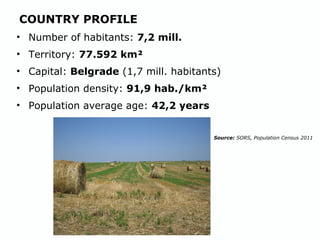
COUNTRY PROFILE
• Number of habitants: 7,2 mill.
• Territory: 77.592 km²
• Capital: Belgrade (1,7 mill. habitants)
• Population density: 91,9 hab./km²
• Population average age: 42,2 years
Source: SORS, Population Census 2011
AGRICULTURE IN SERBIA AT GLANCE*
• GDP (Gross Domestic Product (current prices): 29,6 bill. EUR
• GDP per capita (current prices): 4.112 EUR
• GVA (Gross Value Added) of agriculture, forestry, hunting and
fishing sector in total GVA: 9,7%
• Employment in agriculture: 21% in total
• Number of agricultural holdings: 631.552 (29,2% up to 1 ha)
• Family holdings: 99,5% in total
• Holders of family holdings: 17% are women
• Number of agricultural holdings in the Farm Register:
309.627**
• Rural population (population in non-town settlements): 40,6%
*Data refer to 2012 (Source: SORS) **Data refer to 31st
March 2014 (Source: MAEP)
FARM STRUCTURE
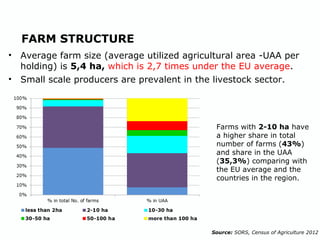
• Average farm size (average utilized agricultural area -UAA per
holding) is 5,4 ha, which is 2,7 times under the EU average.
• Small scale producers are prevalent in the livestock sector.
Farms with 2-10 ha have
a higher share in total
number of farms (43%)
and share in the UAA
(35,3%) comparing with
the EU average and the
countries in the region.
Source: SORS, Census of Agriculture 2012
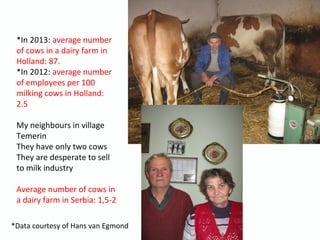
*In 2013: average number
of cows in a dairy farm in
Holland: 87.
*In 2012: average number
of employees per 100
milking cows in Holland:
2.5
My neighbours in village
Temerin
They have only two cows
They are desperate to sell
to milk industry
Average number of cows in
a dairy farm in Serbia: 1,5-2
*Data courtesy of Hans van Egmond
FARM STRUCTURE - LABOR
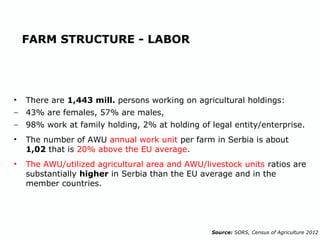
• There are 1,443 mill. persons working on agricultural holdings:
− 43% are females, 57% are males,
− 98% work at family holding, 2% at holding of legal entity/enterprise.
• The number of AWU annual work unit per farm in Serbia is about
1,02 that is 20% above the EU average.
• The AWU/utilized agricultural area and AWU/livestock units ratios are
substantially higher in Serbia than the EU average and in the
member countries.
Source: SORS, Census of Agriculture 2012
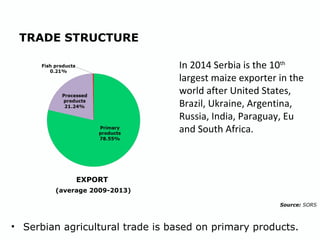
TRADE STRUCTURE
EXPORT
(average 2009-2013)
Source: SORS
• Serbian agricultural trade is based on primary products.
In 2014 Serbia is the 10th
largest maize exporter in the
world after United States,
Brazil, Ukraine, Argentina,
Russia, India, Paraguay, Eu
and South Africa.
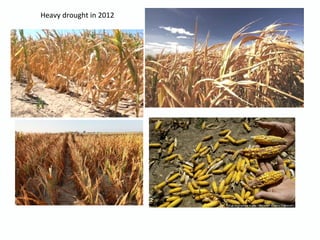
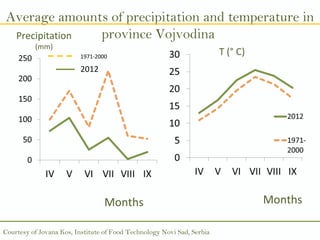
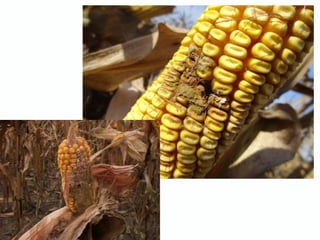
Heavy drought in 2012
Precipitation
(mm)
Months
Average amounts of precipitation and temperature in
province Vojvodina
2012
1971-2000
Courtesy of Jovana Kos, Institute of Food Technology Novi Sad, Serbia
T (° C)
Months
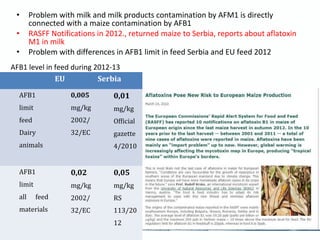
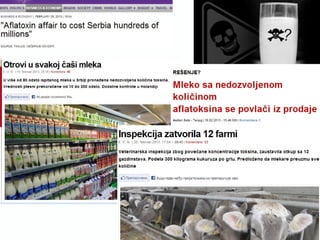
• Problem with milk and milk products contamination by AFM1 is directly
connected with a maize contamination by AFB1
• RASFF Notifications in 2012., returned maize to Serbia, reports about aflatoxin
M1 in milk
• Problem with differences in AFB1 limit in feed Serbia and EU feed 2012
AFB1 level in feed during 2012-13
EU Serbia
AFB1
limit
feed
Dairy
animals
0,005
mg/kg
2002/
32/EC
0,01
mg/kg
Official
gazette
4/2010
AFB1
limit
all feed
materials
0,02
mg/kg
2002/
32/EC
0,05
mg/kg
RS
113/20
12
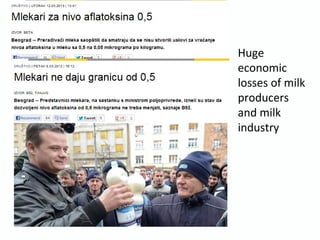
Huge
economic
losses of milk
producers
and milk
industry
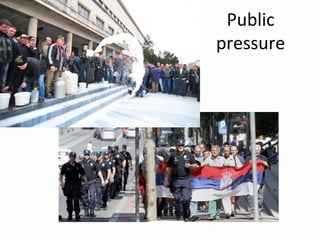
Public
pressure
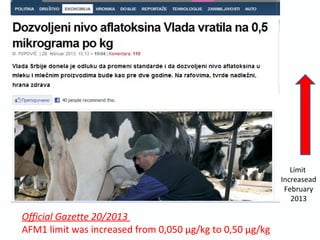
Official Gazette 20/2013
AFM1 limit was increased from 0,050 µg/kg to 0,50 µg/kg
Limit
Increasead
February
2013
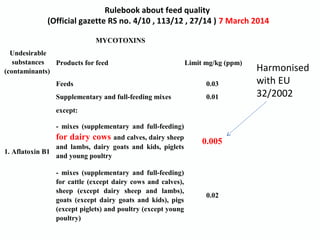
Rulebook about feed quality
(Official gazette RS no. 4/10 , 113/12 , 27/14 ) 7 March 2014
MYCOTOXINS
Undesirable
substances
(contaminants)
Products for feed Limit mg/kg (ppm)
1. Aflatoxin B1
Feeds 0.03
Supplementary and full-feeding mixes 0.01
except:
- mixes (supplementary and full-feeding)
for dairy cows and calves, dairy sheep
and lambs, dairy goats and kids, piglets
and young poultry
0.005
- mixes (supplementary and full-feeding)
for cattle (except dairy cows and calves),
sheep (except dairy sheep and lambs),
goats (except dairy goats and kids), pigs
(except piglets) and poultry (except young
poultry)
0.02
Harmonised
with EU
32/2002
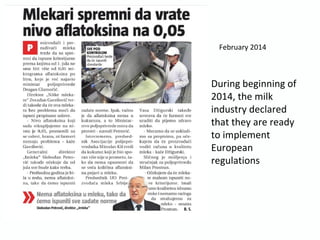
February 2014
During beginning of
2014, the milk
industry declared
that they are ready
to implement
European
regulations
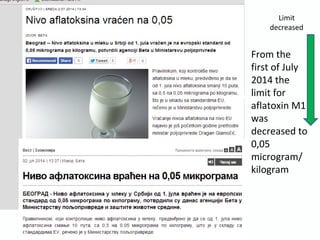
From the
first of July
2014 the
limit for
aflatoxin M1
was
decreased to
0,05
microgram/
kilogram
Limit
decreased
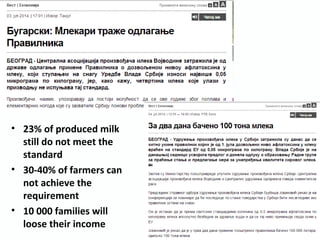
• 23% of produced milk
still do not meet the
standard
• 30-40% of farmers can
not achieve the
requirement
• 10 000 families will
loose their income
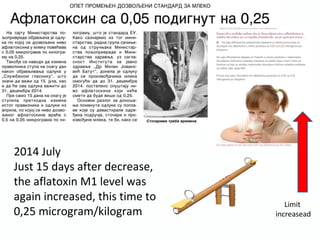
2014 July
Just 15 days after decrease,
the aflatoxin M1 level was
again increased, this time to
0,25 microgram/kilogram
Limit
increasead
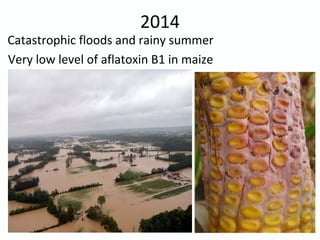
2014
Catastrophic floods and rainy summer
Very low level of aflatoxin B1 in maize
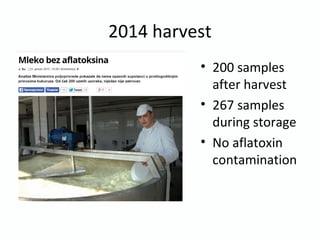
2014 harvest
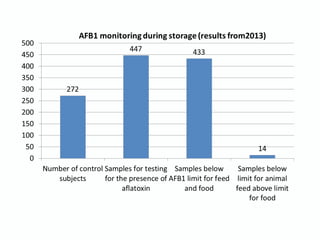
• 200 samples
after harvest
• 267 samples
during storage
• No aflatoxin
contamination
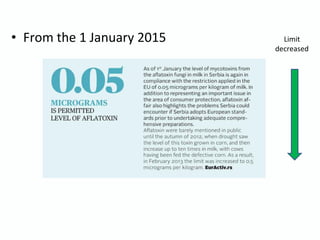
• From the 1 January 2015 Limit
decreased
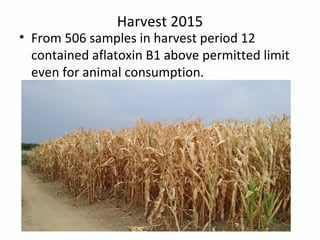
Harvest 2015
• From 506 samples in harvest period 12
contained aflatoxin B1 above permitted limit
even for animal consumption.
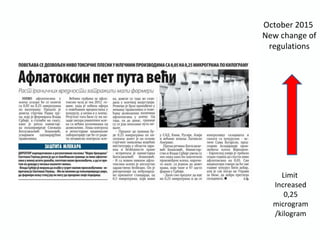
October 2015
New change of
regulations
Limit
Increased
0,25
microgram
/kilogram
Challenges /problems
• Lot of small producers without clustering
• It is difficult to control all the small producers by
phytosanitary and veterinary inspectors- huge
number of official controls and samples are needed,
high cost
• No precise data of remained corn quantities from
previous year-silos and private cribs
• Sampling from big storage facilities
• Need to increase storage hygiene
• Low number of inspectors
• According to food safety law every producer is
responsible for own product, but...the ministry alway
has a heavy responsibility to social component
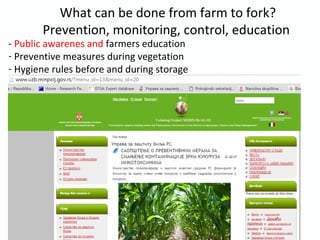
What can be done from farm to fork?
Prevention, monitoring, control, education
- Public awarenes and farmers education
- Preventive measures during vegetation
- Hygiene rules before and during storage
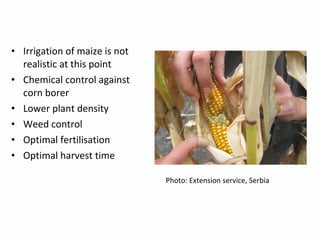
• Irrigation of maize is not
realistic at this point
• Chemical control against
corn borer
• Lower plant density
• Weed control
• Optimal fertilisation
• Optimal harvest time
Photo: Extension service, Serbia
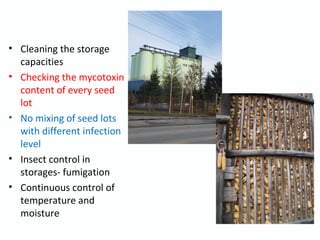
• Cleaning the storage
capacities
• Checking the mycotoxin
content of every seed
lot
• No mixing of seed lots
with different infection
level
• Insect control in
storages- fumigation
• Continuous control of
temperature and
moisture
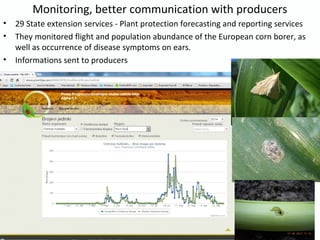
Monitoring, better communication with producers
• 29 State extension services - Plant protection forecasting and reporting services
• They monitored flight and population abundance of the European corn borer, as
well as occurrence of disease symptoms on ears.
• Informations sent to producers
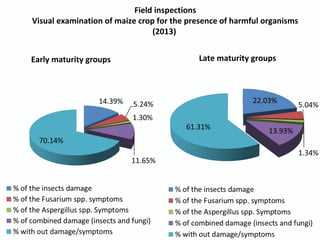
Field inspections
Visual examination of maize crop for the presence of harmful organisms
(2013)
Early maturity groups Late maturity groups
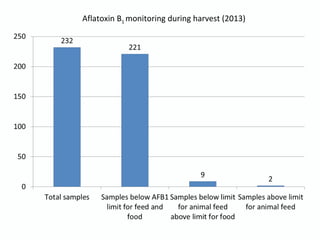
Aflatoxin B1 monitoring during harvest (2013)
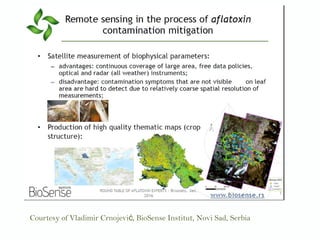
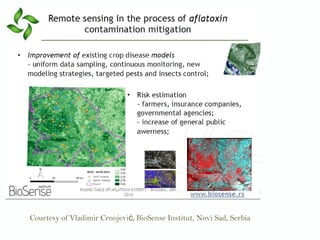
Courtesy of Vladimir Crnojevi , BioSense Institut,ć Novi Sad, Serbia
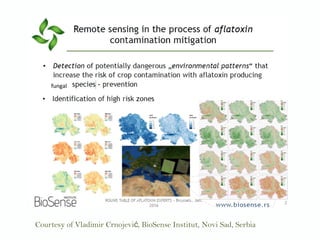
fungal
Courtesy of Vladimir Crnojevi , BioSense Institut,ć Novi Sad, Serbia
• No predicting models for aflatoxin validated in Serbia
• Predicting models for Africa?
• Not enough data for biological control in Serbia
• Field testing of resistance to aflatoxin accumulation
is time consuming because different climatic
conditions from year to year – testing in Africa?
• Differences in fungal population- in mycotoxigenic
potential
• About scientific research in Serbia
• With partners from Hungary during 2012 and 2013 University of Novi Sad
have implemented
• HUSRB/1002/1.2.2/062 Improvement of safety of corn-based feedstuffs
through using more resistant hybrids and management of corn processing
(Hungary-Serbia IPA Cross-border Co-operation Program), Reference
number of the Call for Proposals: HUSRB/1002/1.2.2/062 (2012-2013).
• We have found differences between commercial hybrids from Hungary
and Serbia in susceptibility to Aspergillus flavus and toxin accumulation.
ToxToxFreeFreeFeedFeed
Partner institutions: University of Szeged, Hungary; Cereal Research Institute, Szeged,
Hungary; University of Novi Sad, Serbia; Institut for Food Technology, Novi Sad, Serbia
40
SFS-13-2015 Biological contamination of crops and the food chain
Specific challenge: The occurrence of biological contamination in various crops is of major
concern as it has major implications for food and feed safety, food security and international trade.
Worldwide, it is estimated that mycotoxins are responsible for losses of up to 5-10% of crop
production. Integrated approaches rather than isolated solutions are required to effectively
control the incidence of mycotoxins in crops and reduce contamination throughout the feed
and food chains.
Scope: Proposals should aim at reducing the risk of mycotoxin contamination in crops and all
along the feed and food chains. They should bring about technical, management and
organisational solutions (including HACCP techniques) that are effective at the various stages of
production as well as at pre- and post-harvest levels and also deal with the safe use of
contaminated batches. Proposals should benefit conventional and organic supply chains and
fall under the concept of 'multi-actor approach' and allow for adequate involvement of the
farming sector in proposed activities. In line with the objectives of the EU strategy for international
cooperation in research and innovation and in particular with the implementation of the EU-
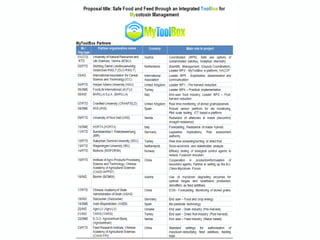
China dialogue, proposals are encouraged to include third country participants,
especially those established in China .
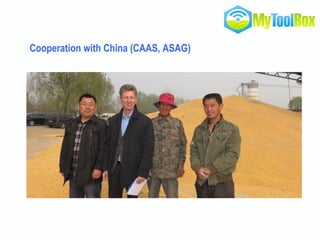
Cooperation with China (CAAS, ASAG)
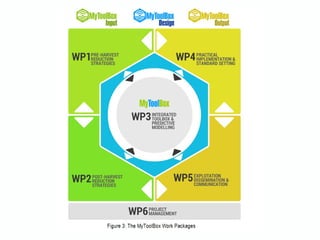
Mytoolbox
• University of Novi Sad is involved in Work
package Preharvest reduction strategies
• Main goals:
• Reduction of aflatoxins in maize through
genetics (drought resistance, early maturity)
• Biocontrol for aflatoxins in maize
• Thank you for your attention!