Machinelearningfortheenvironment: monitoring thepulseof
ourPlanetwithremotelysenseddata
Prof. Devis Tuia, EPFL
Thereweremanysensordata to
monitorEarth in2015
• 333 Earth Observation
satellites in orbit in 2015
[ucsusa.org].
• 10’000 recreational drones
registered in the U.S. by 2020
[FAA].
• 20 Pb of oblique photos in Google
Street View in 2015
[Google Maps].
• 198 millions of geolocated photos
on Flickr in Jan. 2013 [flickr.com].
AI4Copernicus
2023
D.
Tuia
/
May
2023
3
Thereare manysensordata to
monitorEarth in2015 2023
• 333 1’005 Earth Observation
satellites in orbit in 2023
[ucsusa.org].
• 10’000 1’100’000 recreational
drones registered in the U.S in
2023. [FAA].
• 170 billions of oblique photos in
Google Street View in 2020
[Google Maps].
• 198 millions of geolocated photos
on Flickr in Jan. 2013 [flickr.com].
AI4Copernicus
2023
D.
Tuia
/
May
2023
4
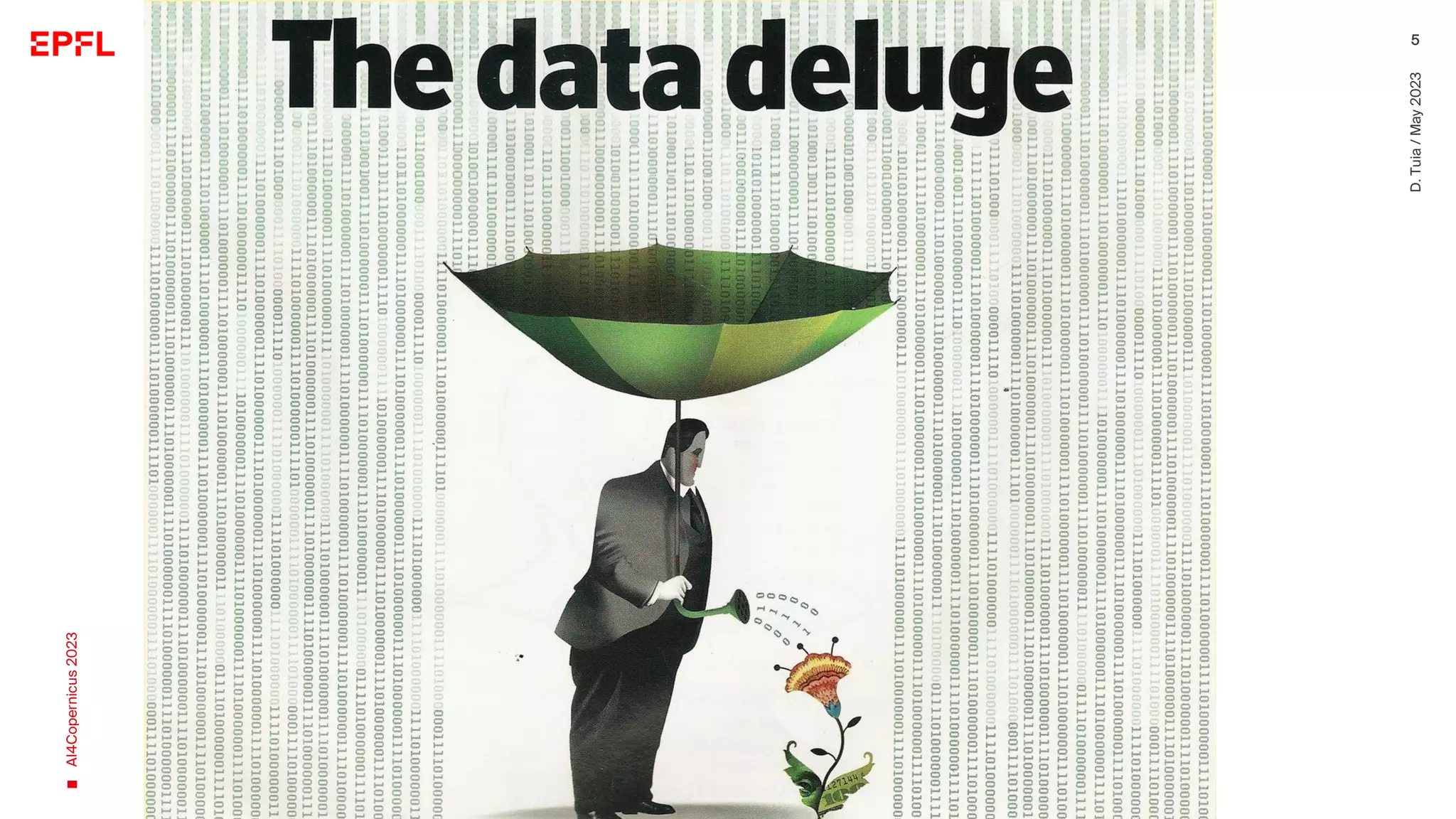
Thedatadeluge(Baraniuk,Science
(2011).Image:the Economist)
AI4Copernicus
2023
D.
Tuia
/
May
2023
5
MACHINE LEARNING
Machinelearningintwominutes
AI4Copernicus
2023
Animation by B. Kellenberger, 2021 © EPFL ECEO
D.
Tuia
/
May
2023
7
Whynow:statisticalandcomputational
modelsaregoodenough...
AI4Copernicus
2023
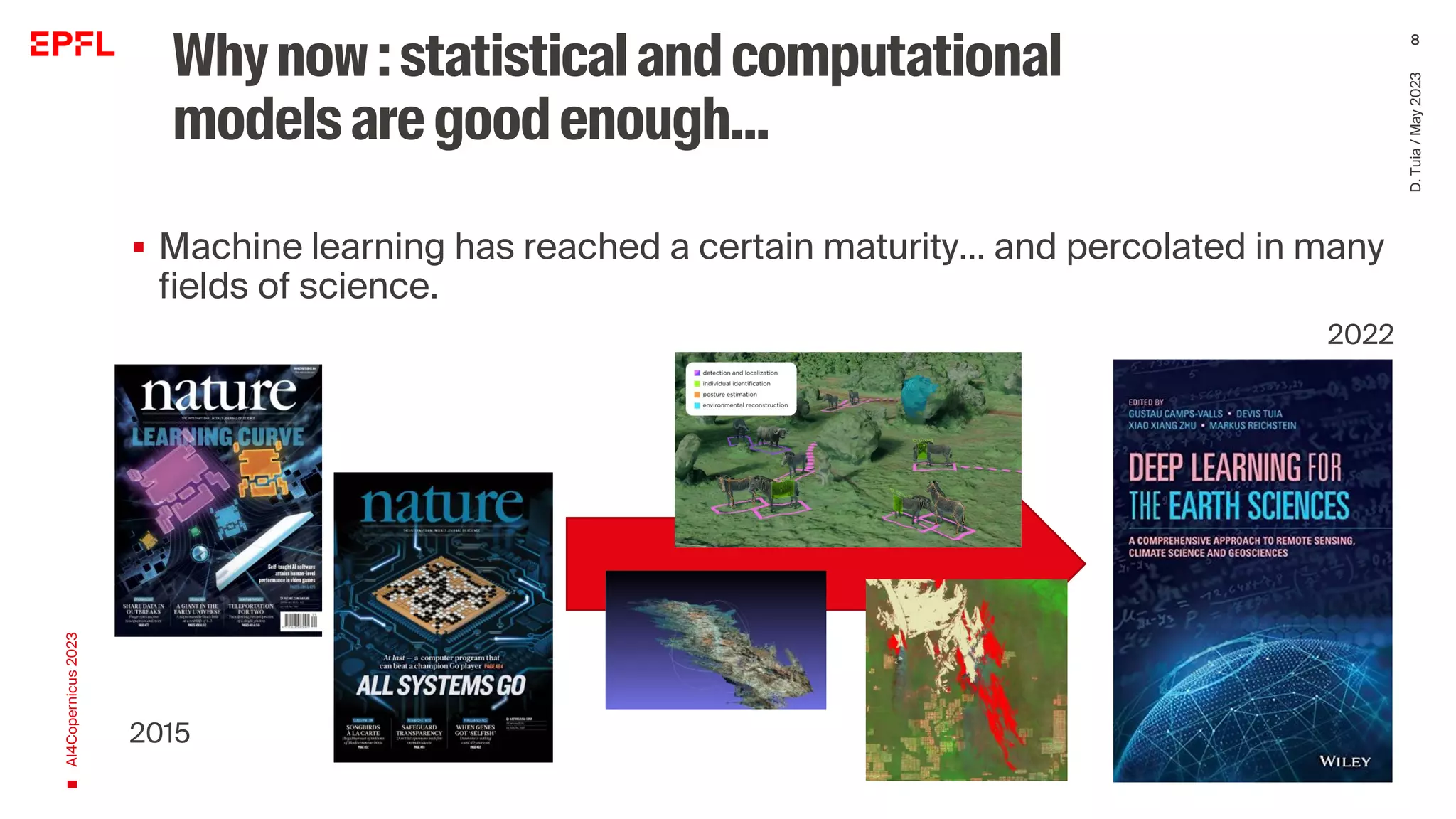
▪ Machine learning has reached a certain maturity… and percolated in many
fields of science.
2015
2022
D.
Tuia
/
May
2023
8
Buildingenvironmentaldeeplearning
models
AI4Copernicus
2023
D.
Tuia
/
May
2023
9
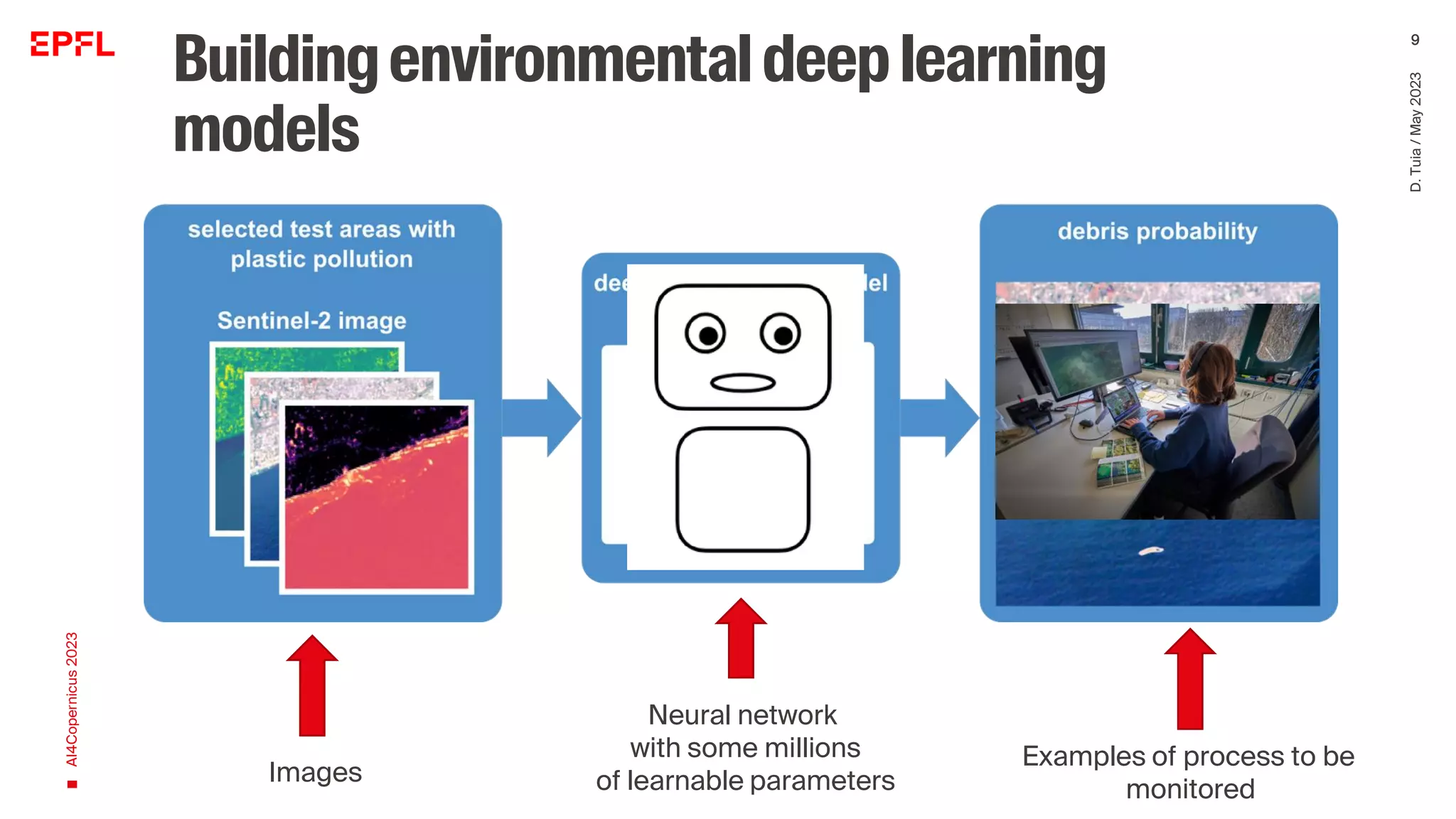
Images
Examples of process to be
monitored
Neural network
with some millions
of learnable parameters
Buildingenvironmentaldeeplearning
models
▪ We used debris events found in news and
social media, then hand labeled on
images by experts.
AI4Copernicus
2023
D.
Tuia
/
May
2023
10
[Mifdal et al., 2020]
Mifdal, J., Longépé, N., and Rußwurm, M.: Towards detecting floating objects on a global scale with spatial features
using Sentinel-2, ISPRS Ann. Photogramm. Remote Sens. Spatial Inf. Sci., V-3-2021, 285–293,
Buildingenvironmentaldeeplearning
modelsthat are accurate
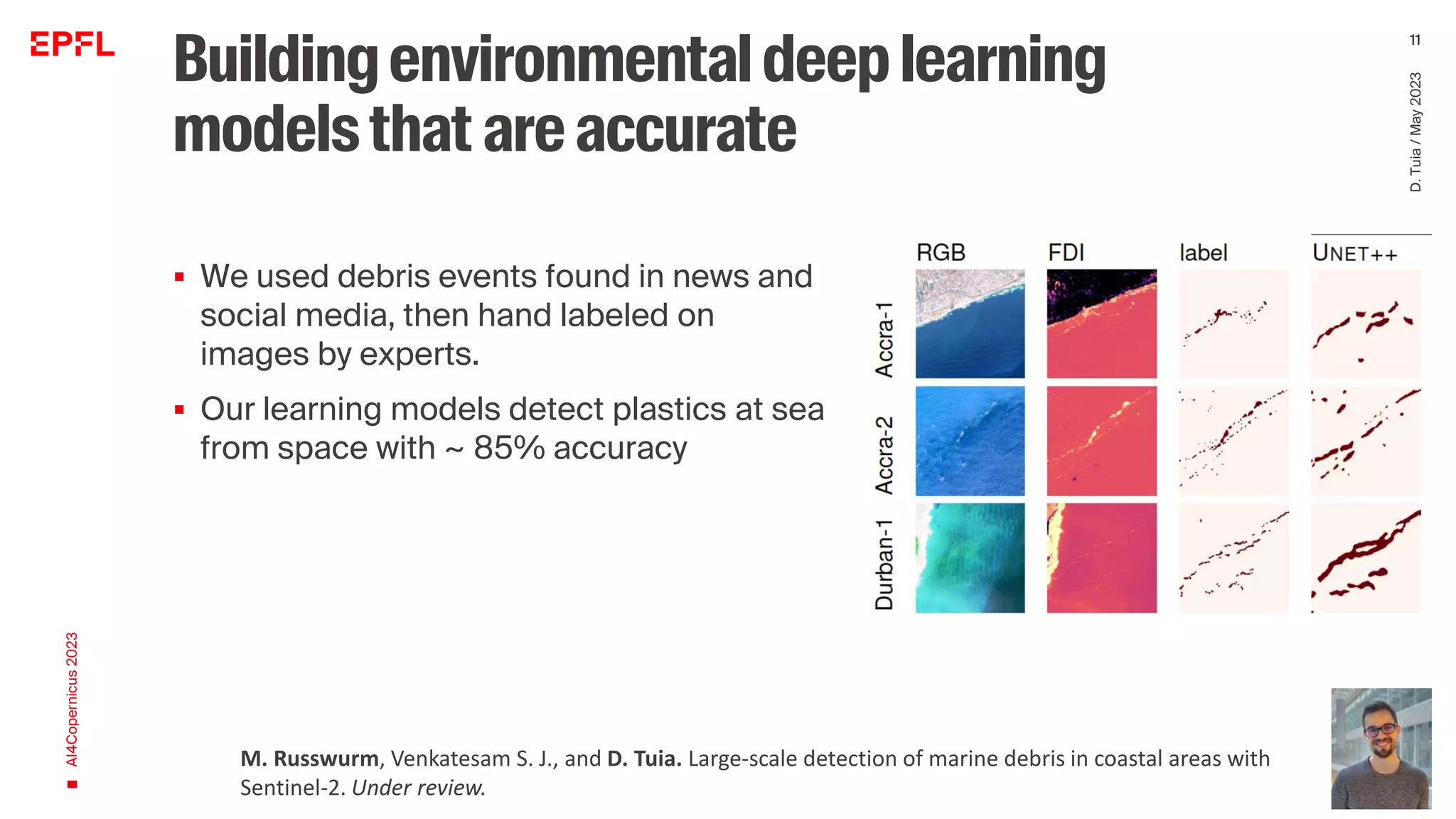
▪ We used debris events found in news and
social media, then hand labeled on
images by experts.
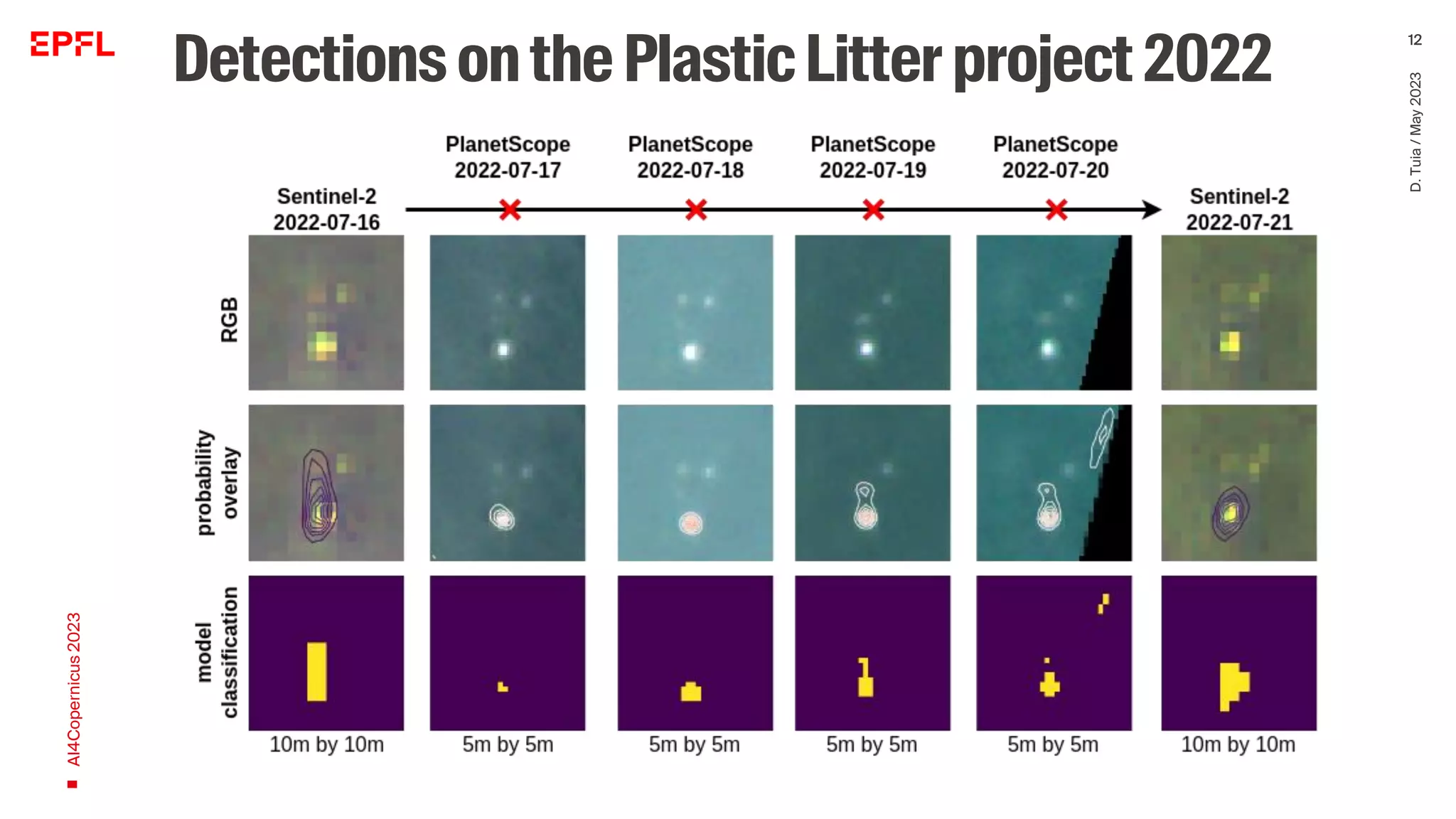
▪ Our learning models detect plastics at sea
from space with ~ 85% accuracy
AI4Copernicus
2023
D.
Tuia
/
May
2023
11
M. Russwurm, Venkatesam S. J., and D. Tuia. Large-scale detection of marine debris in coastal areas with
Sentinel-2. Under review.
Detectionsonthe PlasticLitter project2022
AI4Copernicus
2023
D.
Tuia
/
May
2023
12
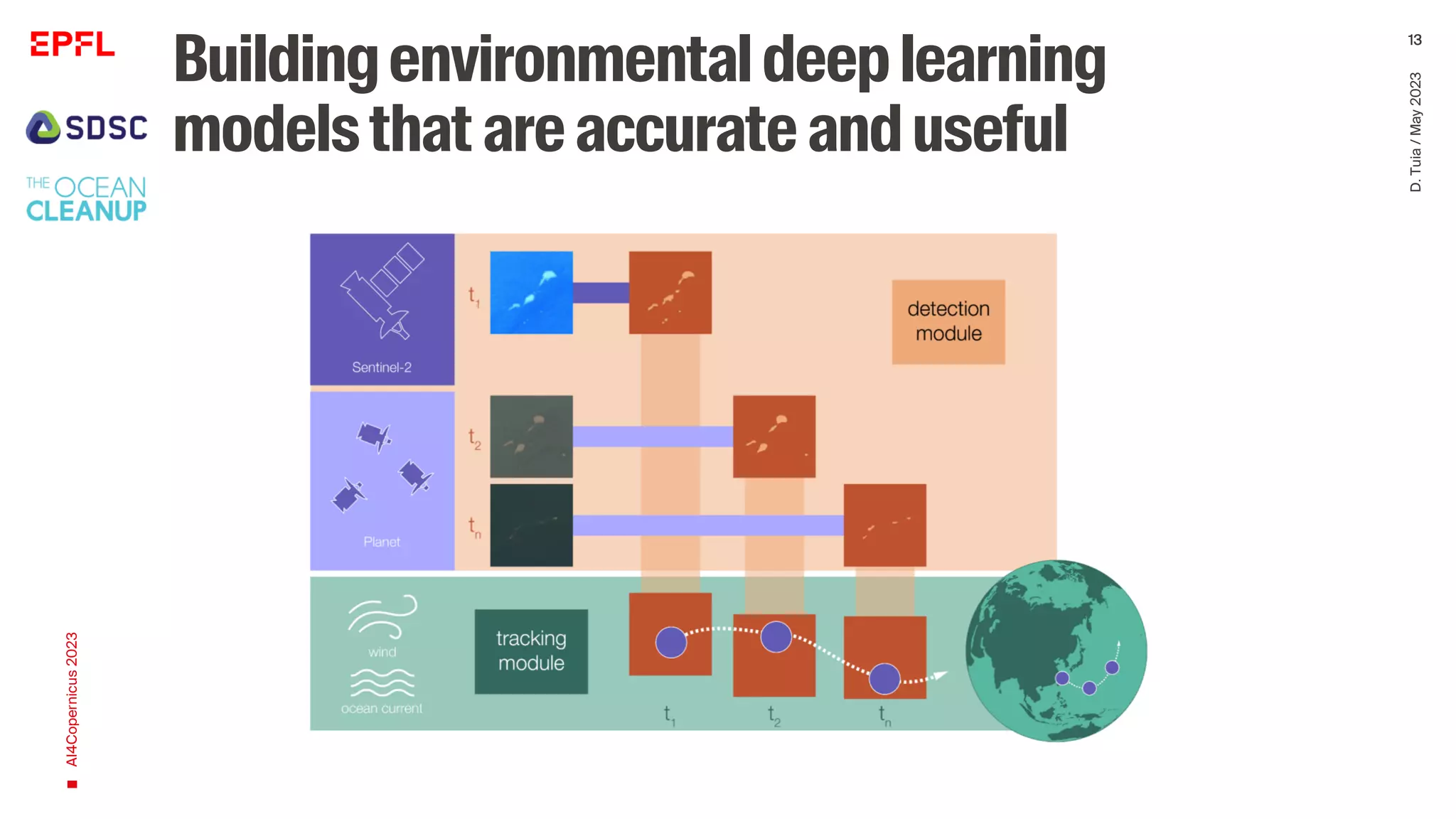
Buildingenvironmentaldeeplearning
modelsthat are accurate anduseful
AI4Copernicus
2023
D.
Tuia
/
May
2023
13
6/12/2023
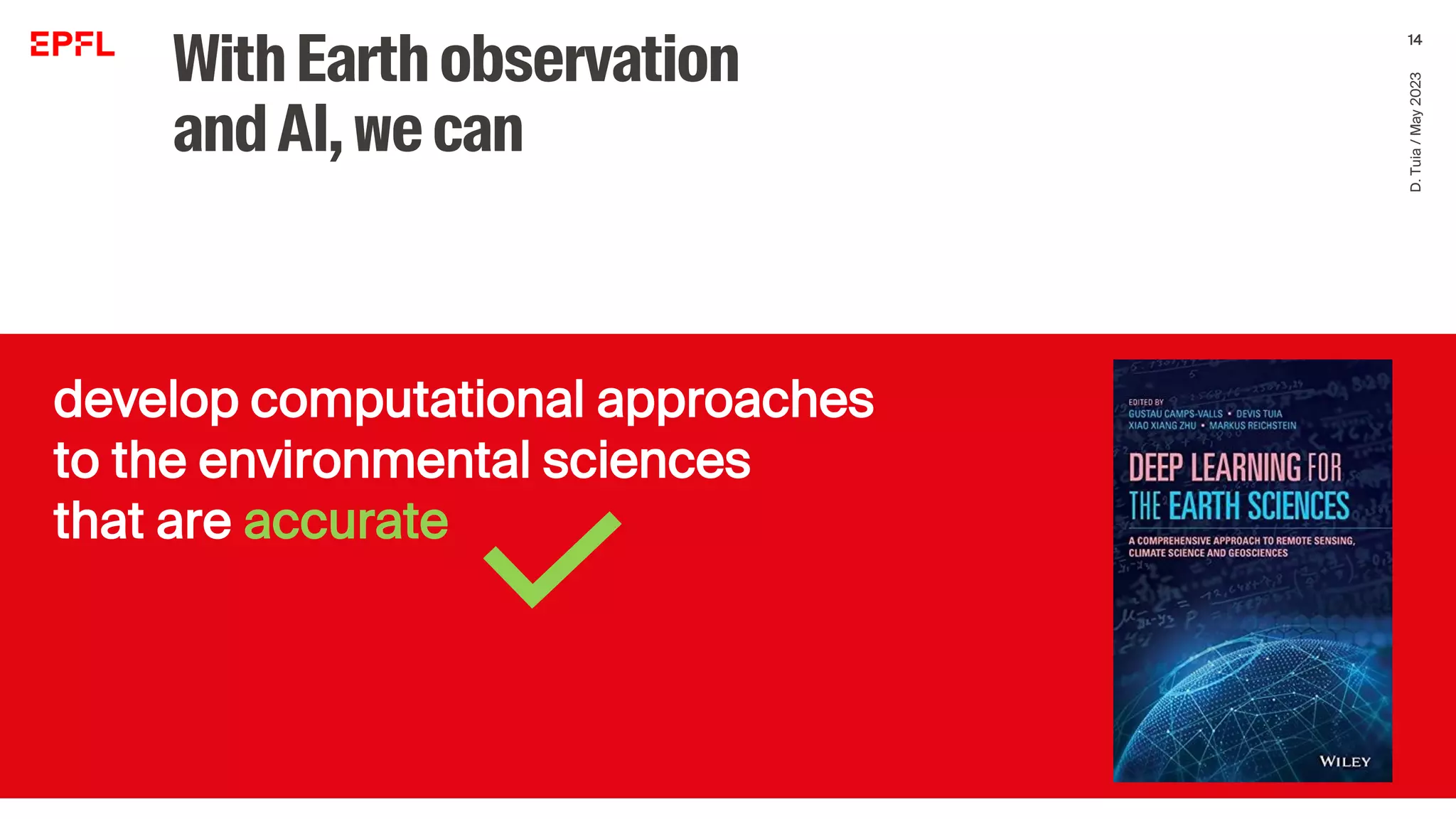
develop computational approaches
to the environmental sciences
that are accurate
D.
Tuia
/
May
2023
14
WithEarth observation
andAI,wecan
WithEarth observation
andAI,wecan
6/12/2023
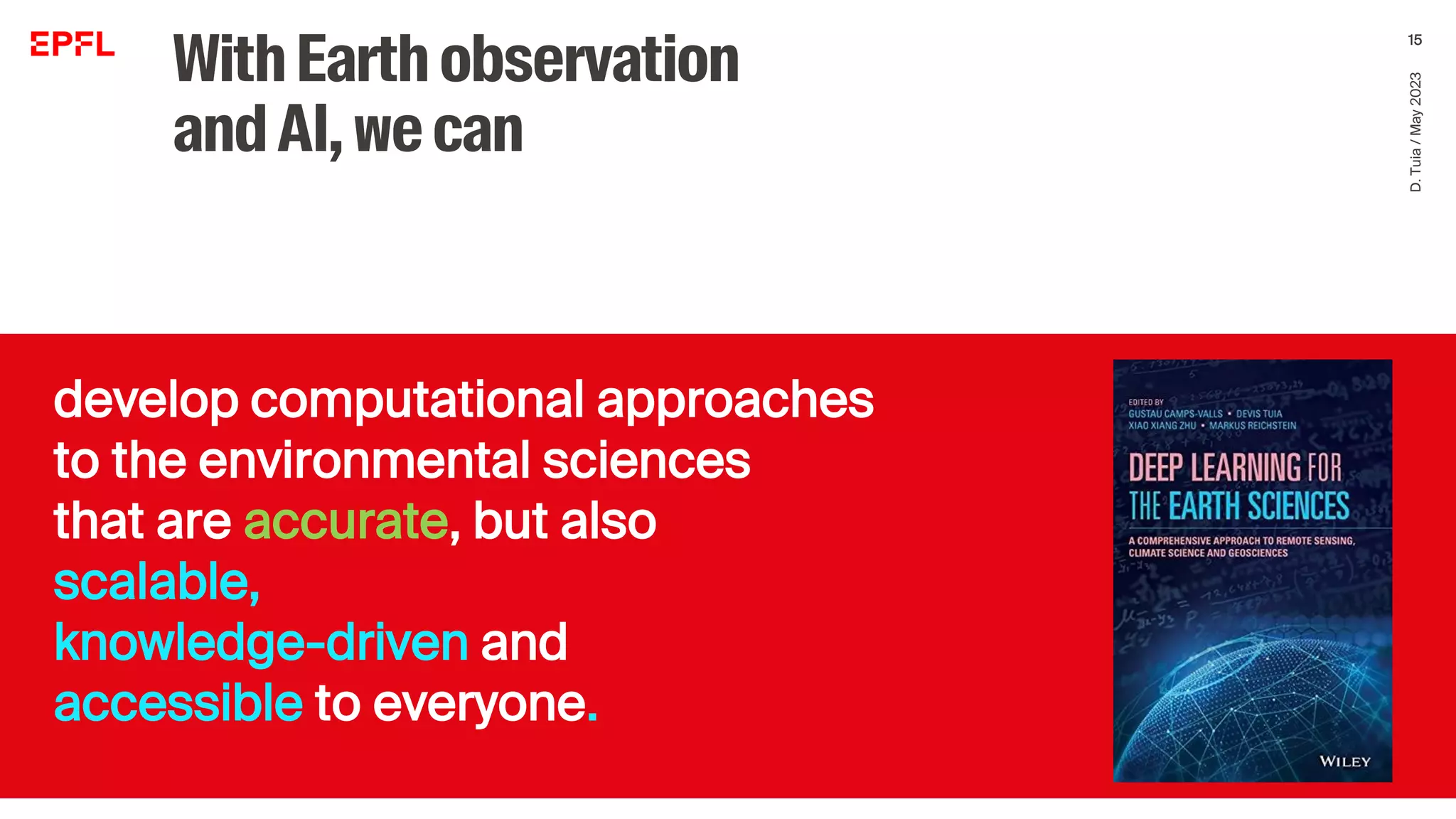
develop computational approaches
to the environmental sciences
that are accurate, but also
scalable,
knowledge-driven and
accessible to everyone.
D.
Tuia
/
May
2023
15
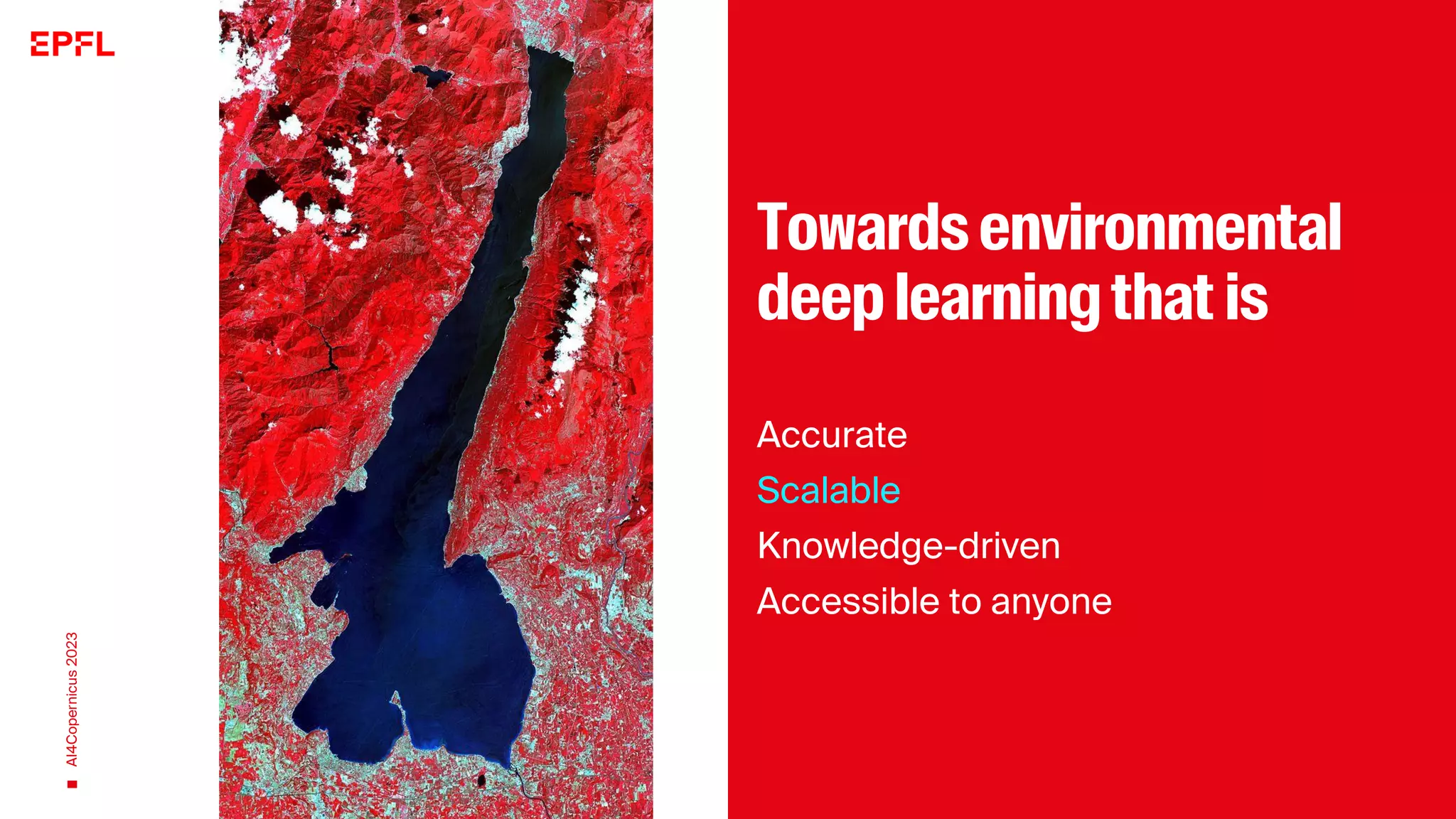
Towardsenvironmental
deeplearningthat is
Accurate
Scalable
Knowledge-driven
Accessible to anyone
AI4Copernicus
2023
Scalable
▪ No model should work only on
• one image
• one region of the world
• one task
AI4Copernicus
2023
D.
Tuia
/
May
2023
17
[Mifdal et al., 2020]
Mifdal, J., Longépé, N., and Rußwurm, M.: Towards detecting floating objects on a global scale with spatial features
using Sentinel-2, ISPRS Ann. Photogramm. Remote Sens. Spatial Inf. Sci., V-3-2021, 285–293,
Scalable
▪ No model should work only on
• one image
• one region of the world
• one task
AI4Copernicus
2023
D.
Tuia
/
May
2023
18
D. Tuia, B. Kellenberger, S. Beery, B. Costelloe, S. Zuffi, B. Risse, A. Mathis, M. W. Mathis, F. van Langevelde, T. Burghardt, R. Kays, H. Klinck, M.
Wikelski, I. D. Couzin, G. van Horn, M. C. Crofoot, C. V. Stewart, and T. Berger-Wolf. Perspectives in machine learning for wildlife conservation.
Nature Comm., 13(792), 2022.
[Mifdal et al., 2020]
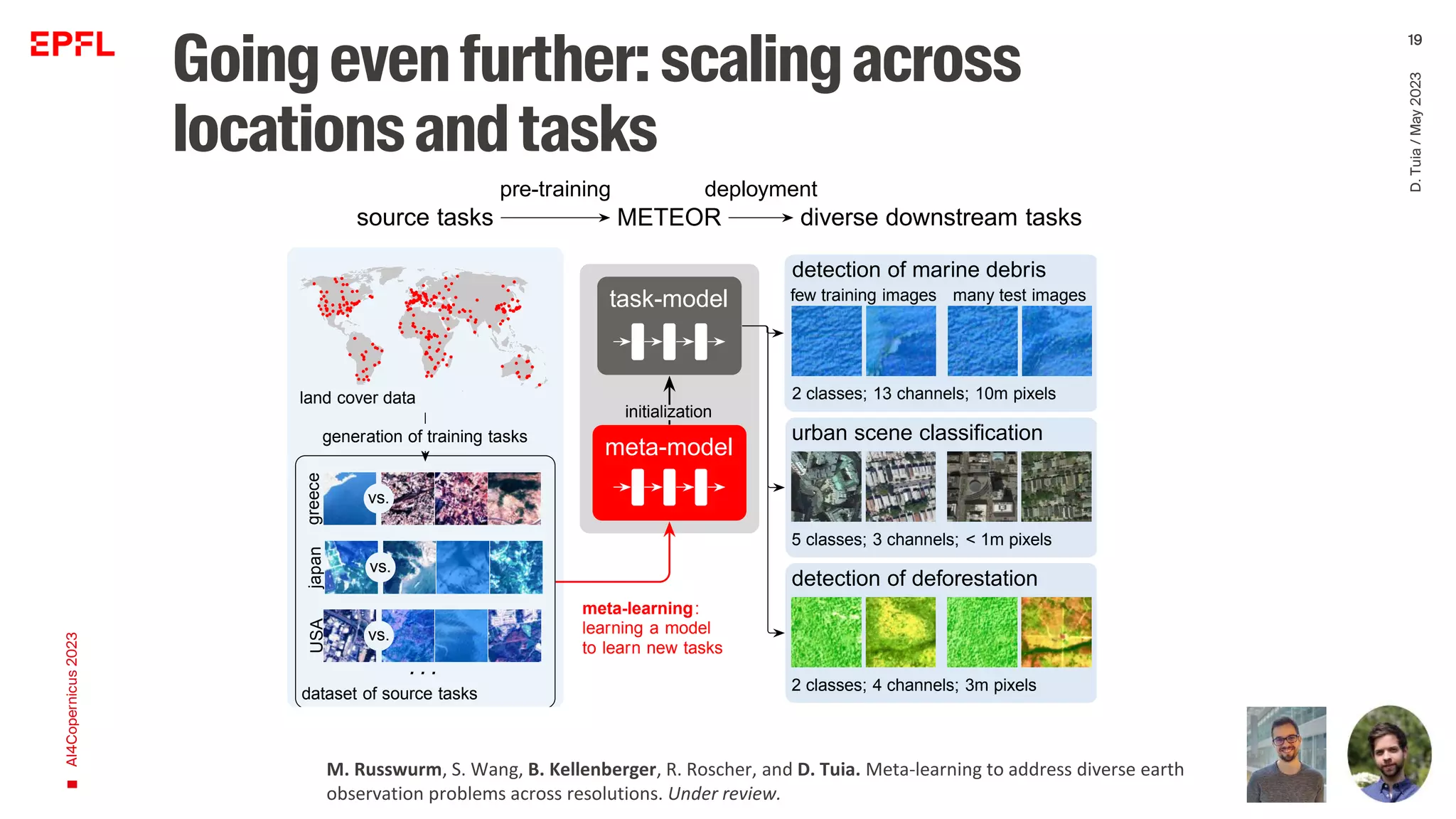
Goingevenfurther: scalingacross
locationsandtasks
meta-model
task-model
initialization
land cover data
vs.
greece
vs.
japan
vs.
USA
. . .
generation of training tasks
dataset of source tasks
meta-learning:
learning a model
to learn new tasks
detection of marine debris
2 classes; 13 channels; 10m pixels
few training images many test images
urban scene classification
5 classes; 3 channels; < 1m pixels
detection of deforestation
2 classes; 4 channels; 3m pixels
source tasks diverse downstream tasks
METEOR
pre-training deployment
AI4Copernicus
2023
D.
Tuia
/
May
2023
19
M. Russwurm, S. Wang, B. Kellenberger, R. Roscher, and D. Tuia. Meta-learning to address diverse earth
observation problems across resolutions. Under review.
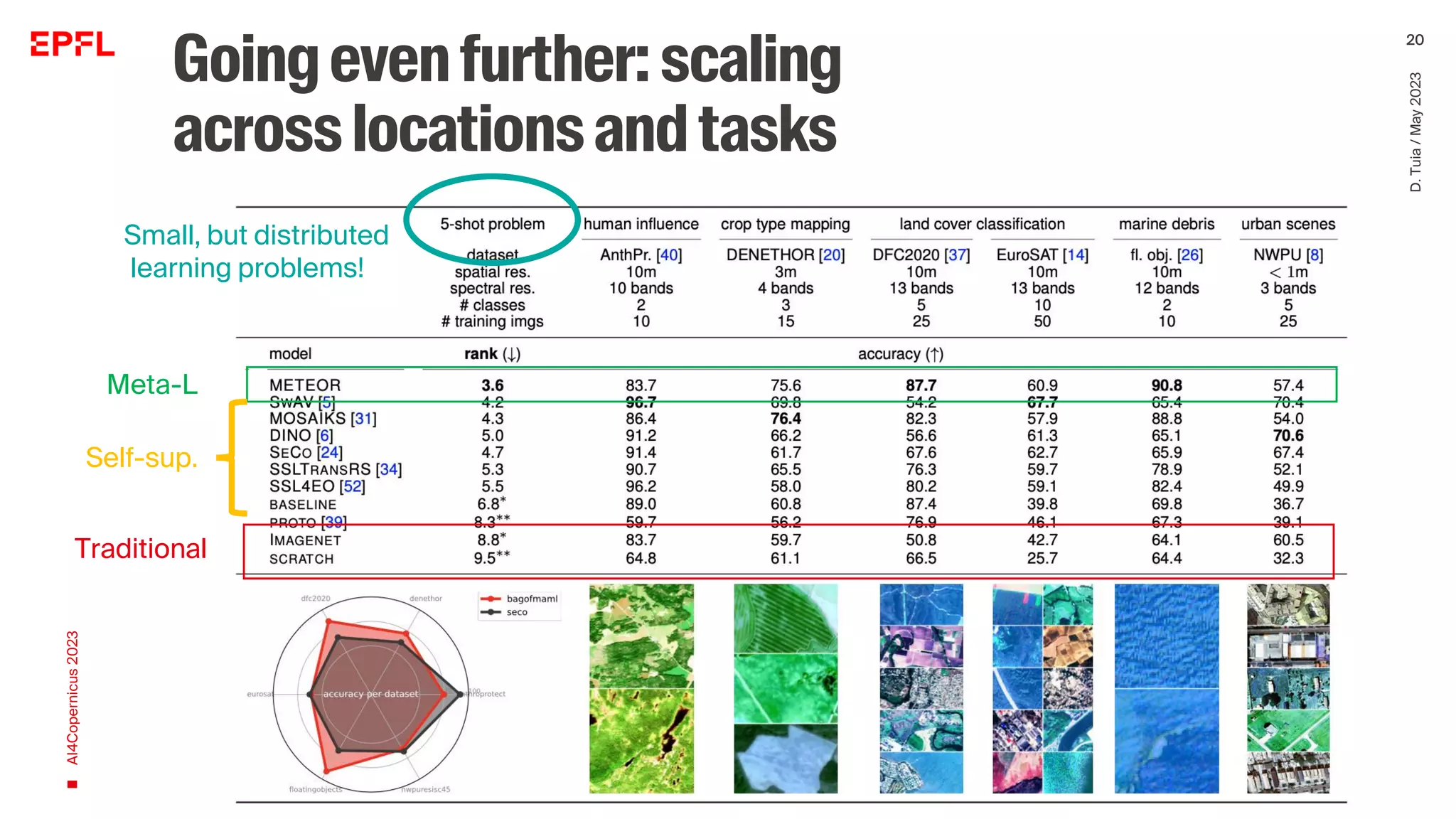
Goingevenfurther: scaling
acrosslocationsand tasks
AI4Copernicus
2023
D.
Tuia
/
May
2023
20
Traditional
Meta-L
Self-sup.
Small, but distributed
learning problems!
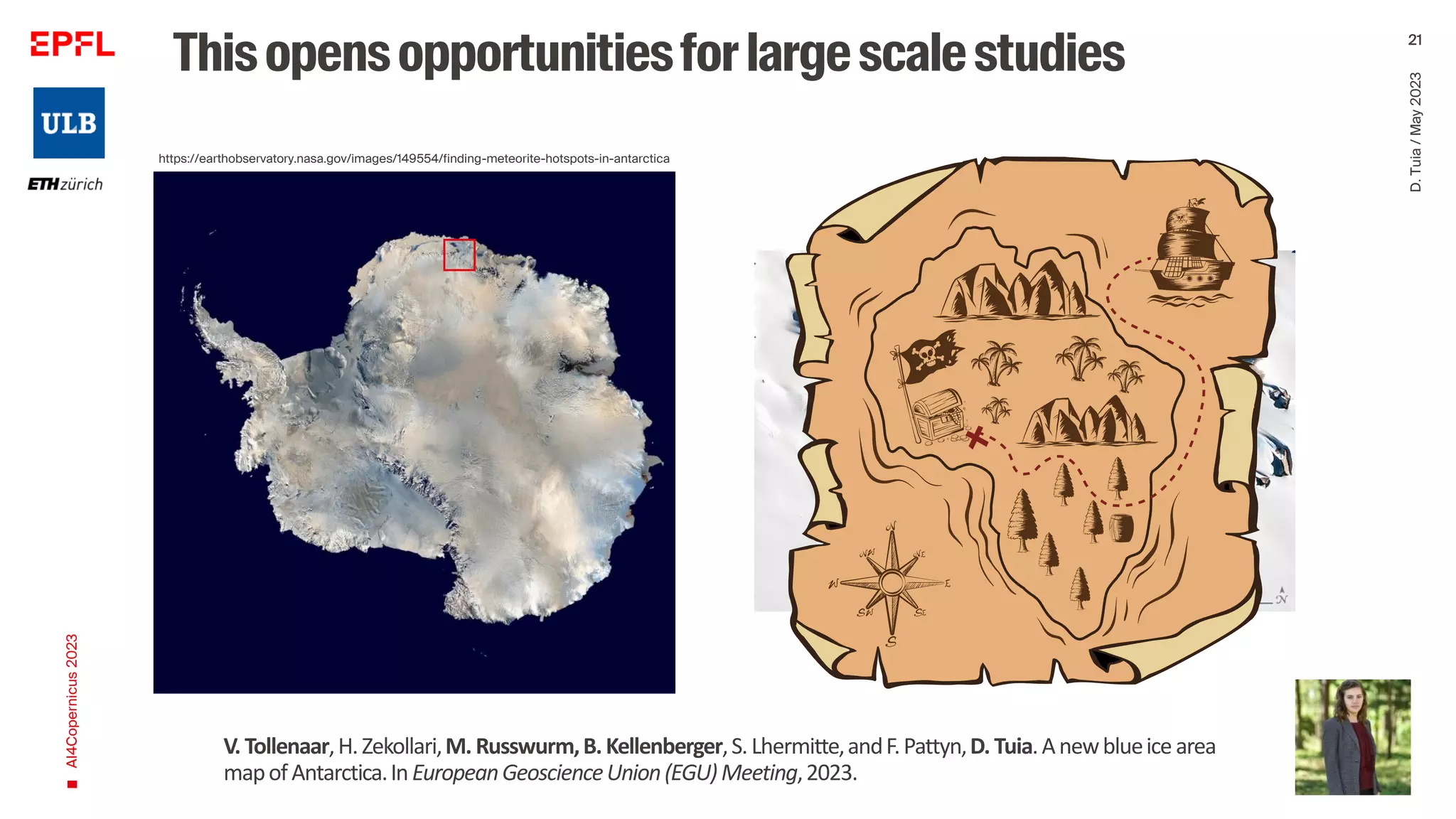
V. Tollenaar,H.Zekollari,M. Russwurm,B.Kellenberger,S.Lhermitte,andF.Pattyn,D. Tuia.Anewblueice area
mapofAntarctica.InEuropeanGeoscienceUnion(EGU)Meeting,2023.
AI4Copernicus
2023
D.
Tuia
/
May
2023
21
https://earthobservatory.nasa.gov/images/149554/finding-meteorite-hotspots-in-antarctica
Thisopensopportunitiesforlargescalestudies
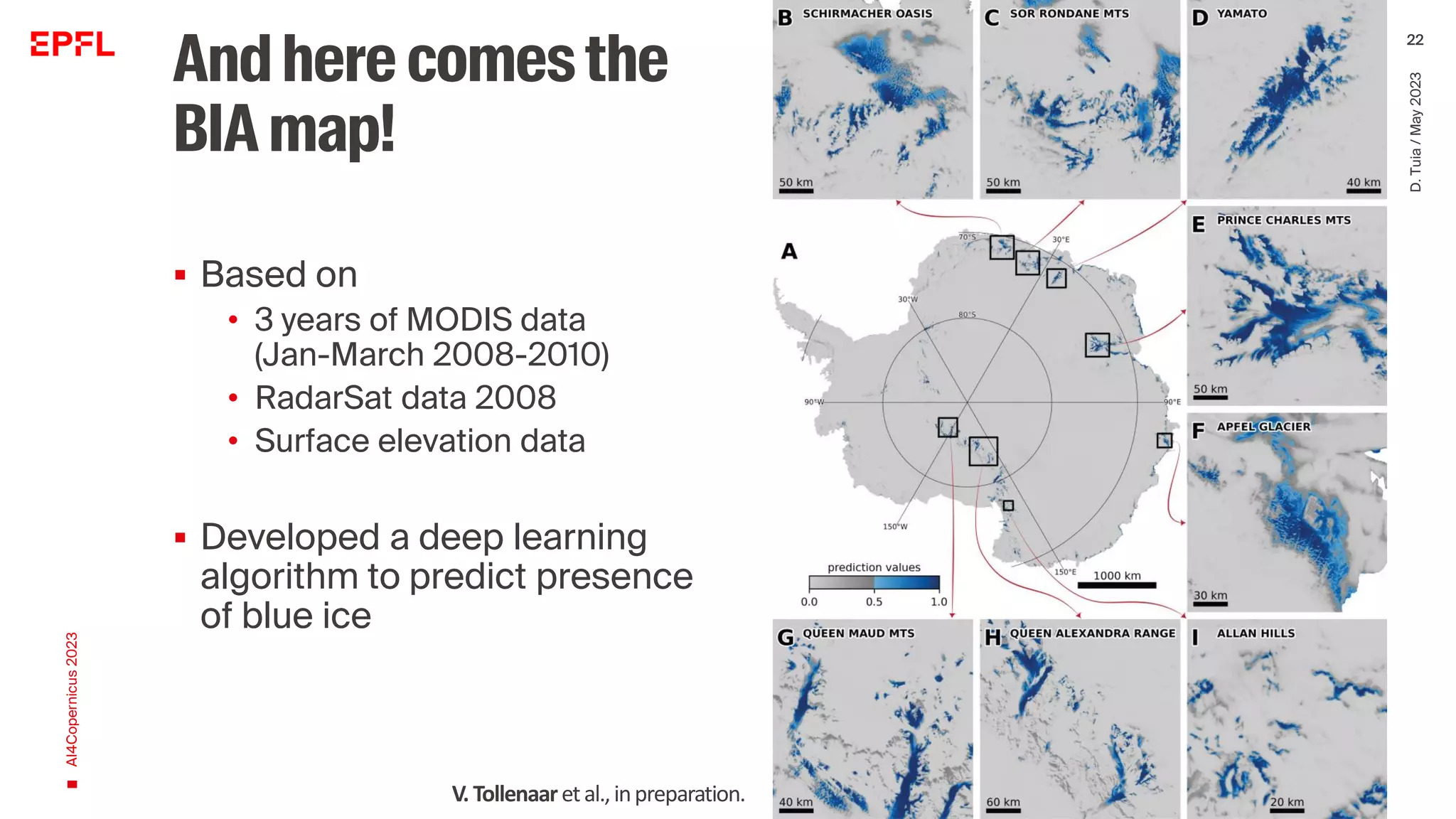
Andhere comesthe
BIAmap!
▪ Based on
• 3 years of MODIS data
(Jan-March 2008-2010)
• RadarSat data 2008
• Surface elevation data
▪ Developed a deep learning
algorithm to predict presence
of blue ice
AI4Copernicus
2023
D.
Tuia
/
May
2023
22
V. Tollenaaretal.,inpreparation.
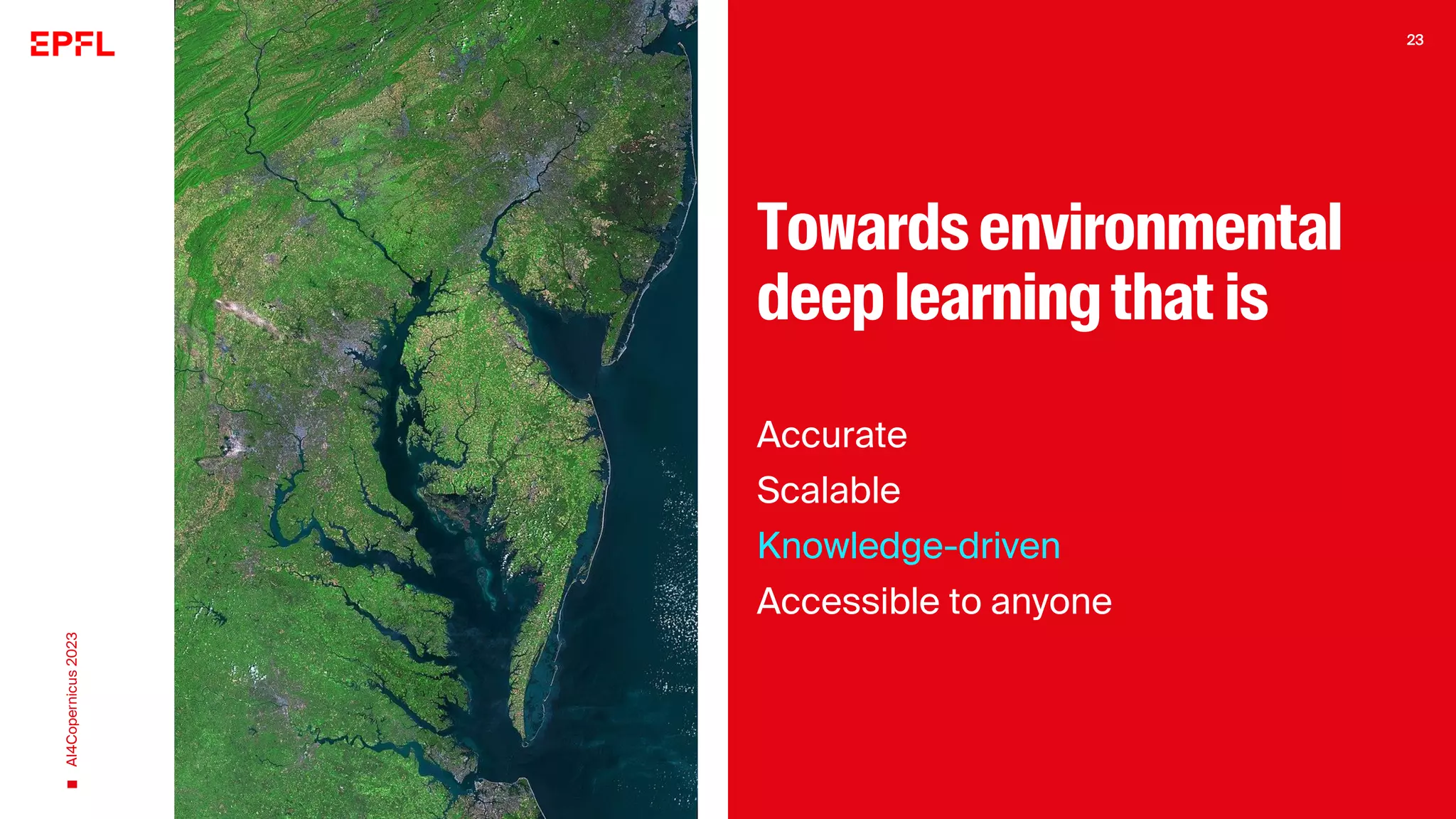
Towardsenvironmental
deeplearningthat is
Accurate
Scalable
Knowledge-driven
Accessible to anyone
AI4Copernicus
2023
23
Doweneedtoextractall
informationfromdata?
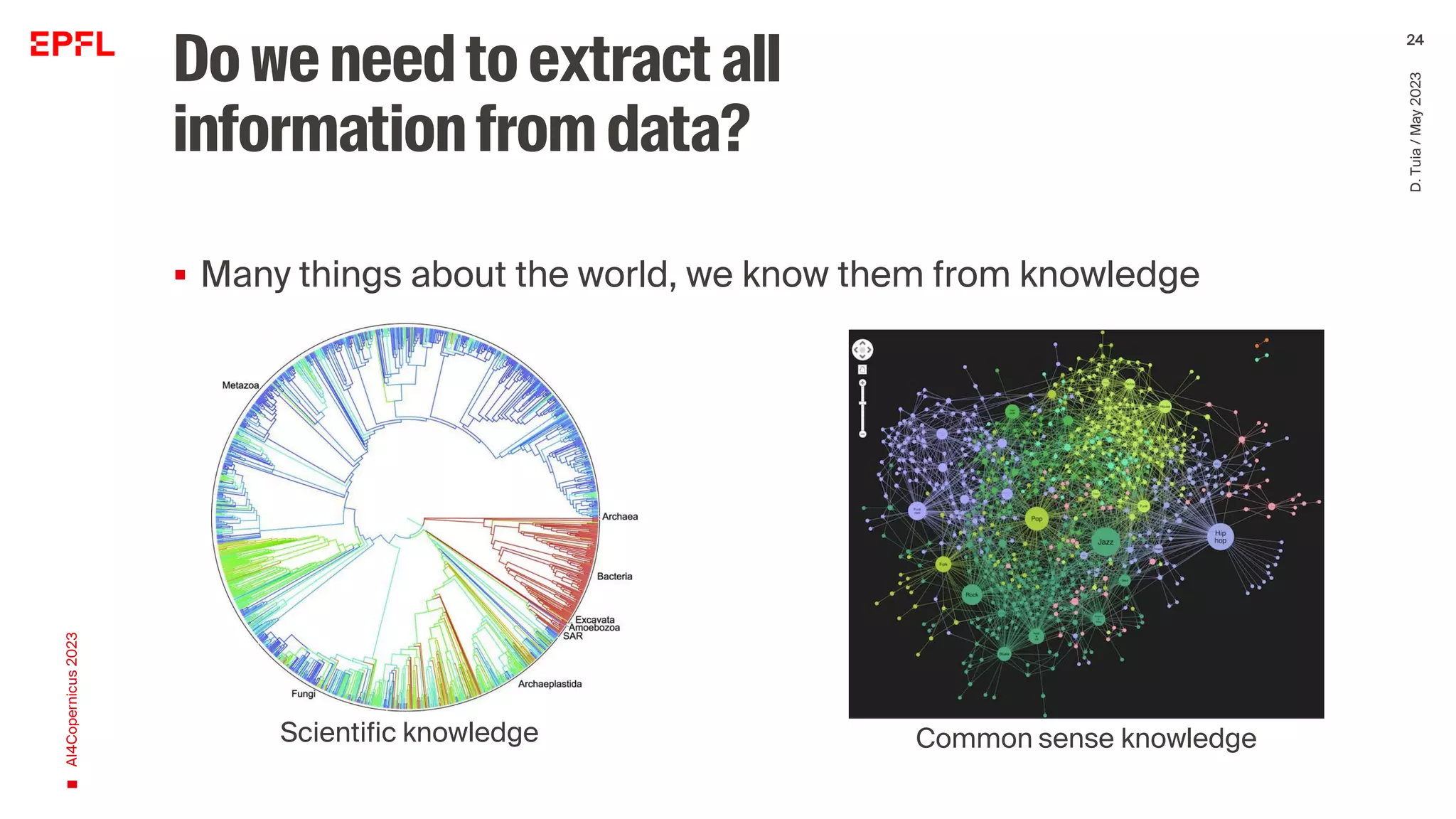
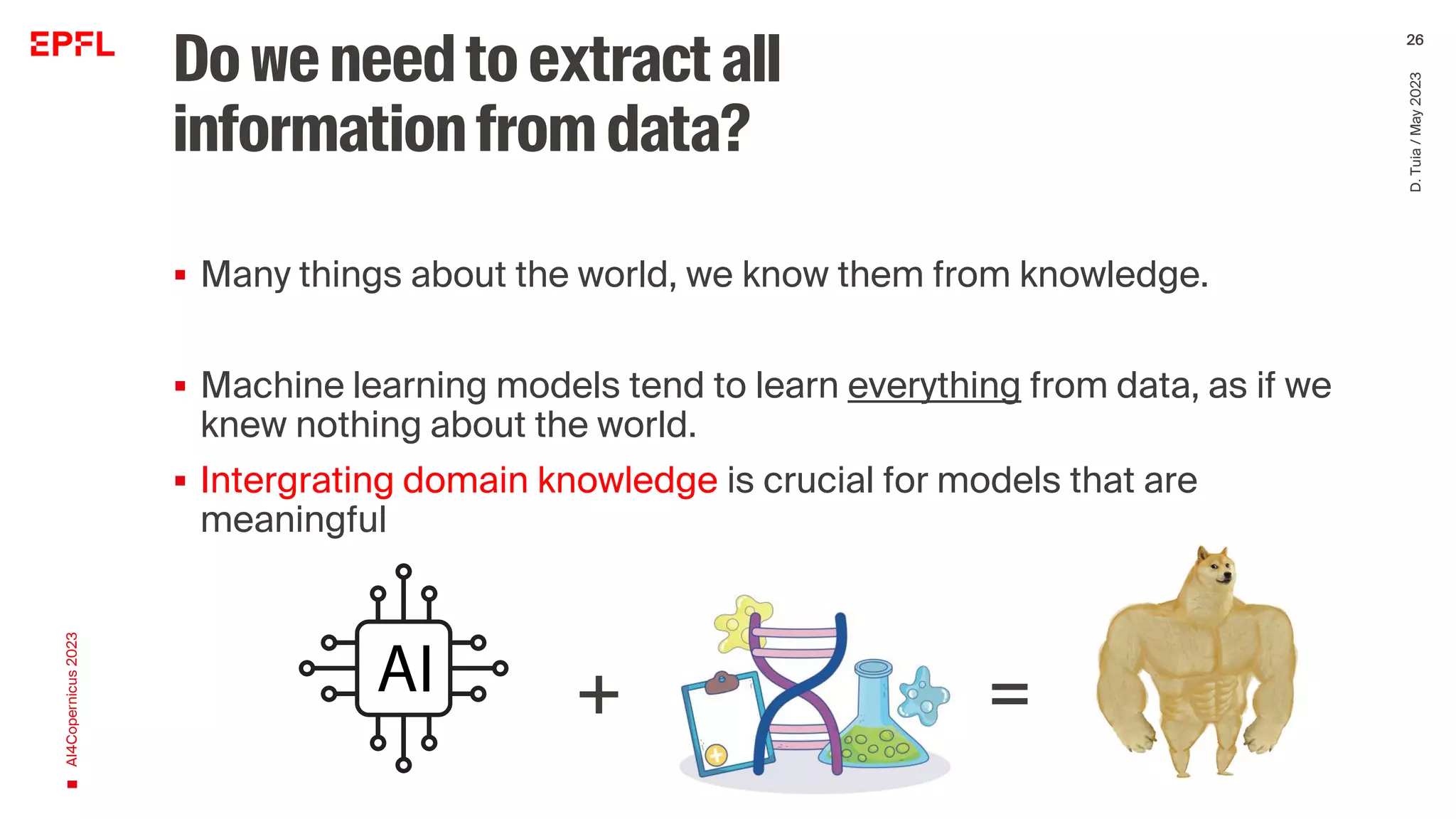
▪ Many things about the world, we know them from knowledge
AI4Copernicus
2023
D.
Tuia
/
May
2023
24
Scientific knowledge Common sense knowledge
Doweneedtoextractall
informationfromdata?
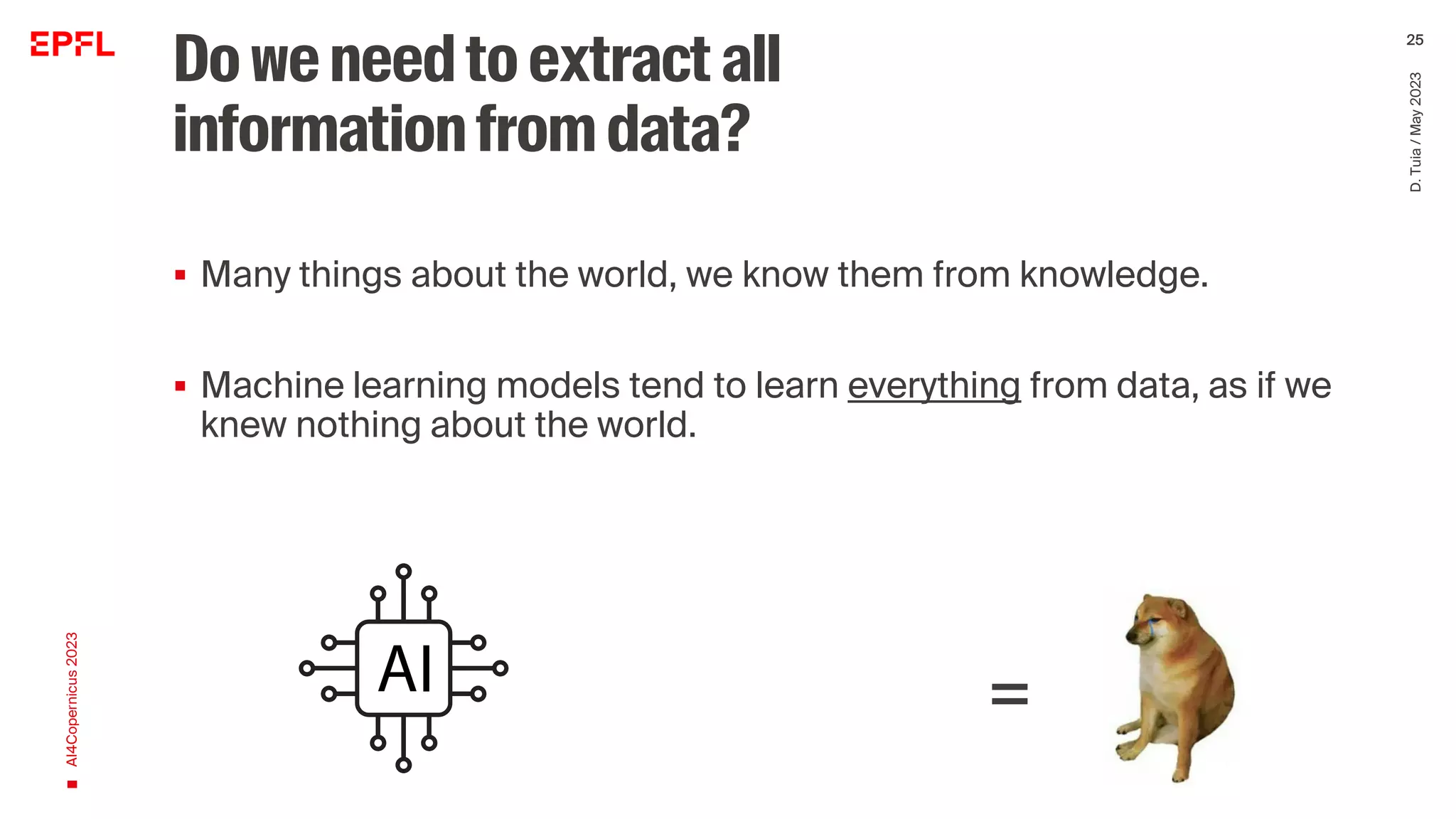
▪ Many things about the world, we know them from knowledge.
▪ Machine learning models tend to learn everything from data, as if we
knew nothing about the world.
Intergrating domain knowledge is crucial for models that are
meaningful
AI4Copernicus
2023
D.
Tuia
/
May
2023
25
=
Doweneedtoextractall
informationfromdata?
▪ Many things about the world, we know them from knowledge.
▪ Machine learning models tend to learn everything from data, as if we
knew nothing about the world.
▪ Intergrating domain knowledge is crucial for models that are
meaningful
AI4Copernicus
2023
D.
Tuia
/
May
2023
26
+ =
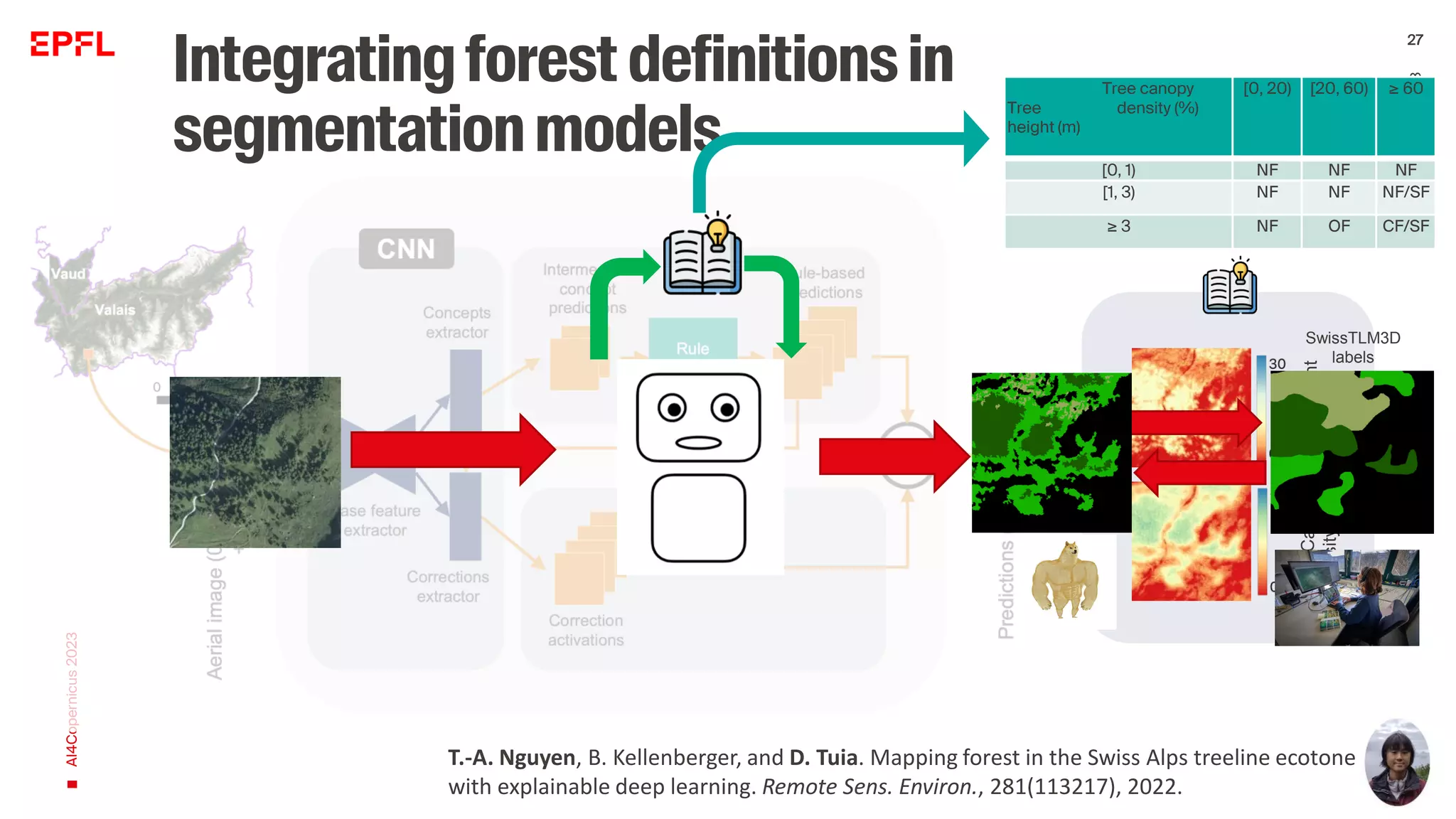
Integratingforestdefinitionsin
segmentationmodels
AI4Copernicus
2023
D.
Tuia
/
May
2023
27
T.-A. Nguyen, B. Kellenberger, and D. Tuia. Mapping forest in the Swiss Alps treeline ecotone
with explainable deep learning. Remote Sens. Environ., 281(113217), 2022.
Tree canopy
Tree density (%)
height (m)
[0, 20) [20, 60) ≥ 60
[0, 1) NF NF NF
[1, 3) NF NF NF/SF
≥ 3 NF OF CF/SF
Tree
Canopy
Density
(%)
Tree
Height
(m)
SwissTLM3D
labels
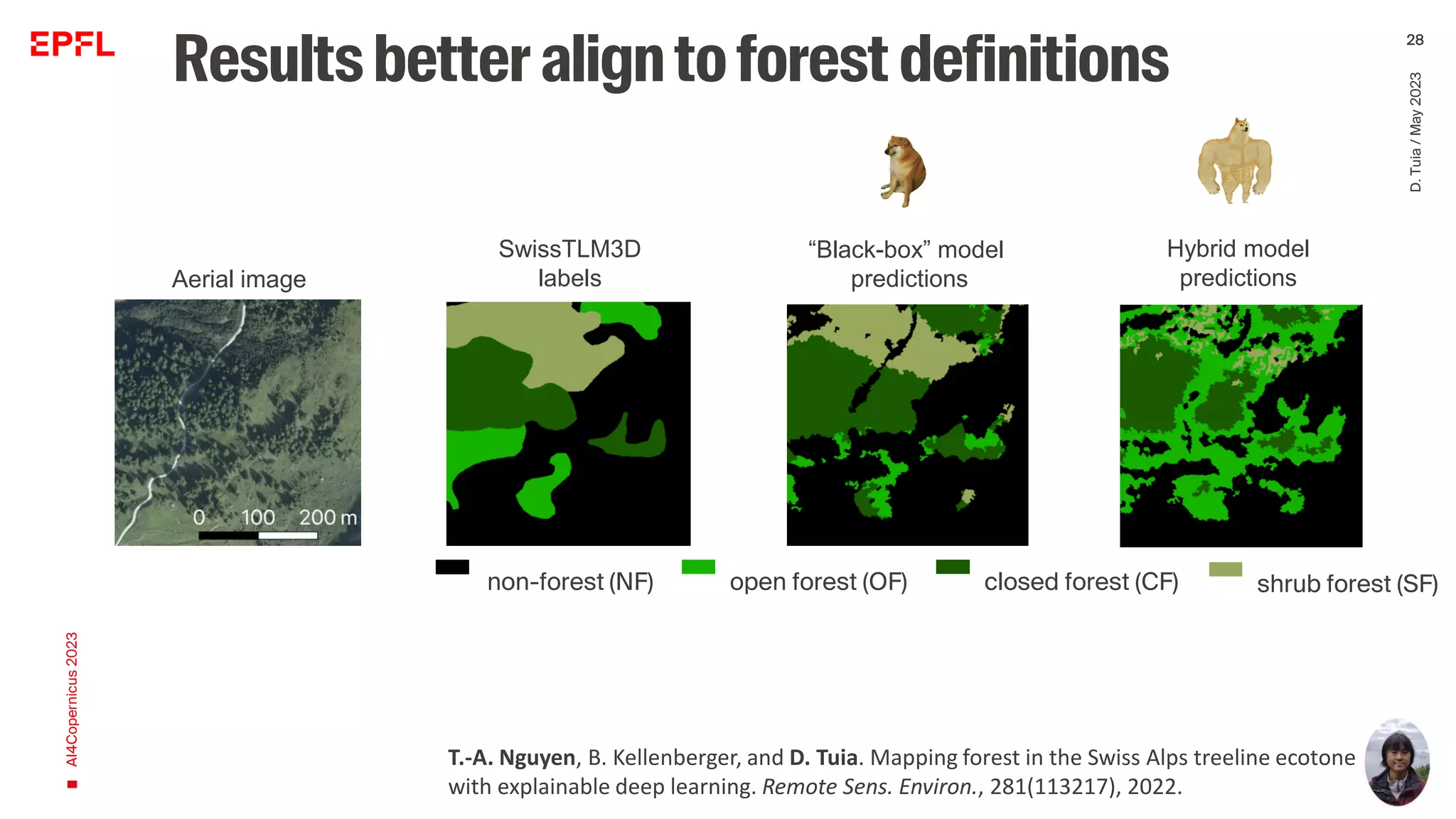
Resultsbetter aligntoforestdefinitions
AI4Copernicus
2023
D.
Tuia
/
May
2023
28
“Black-box” model
predictions
SwissTLM3D
labels
Hybrid model
predictions
Aerial image
non-forest (NF) open forest (OF) closed forest (CF) shrub forest (SF)
T.-A. Nguyen, B. Kellenberger, and D. Tuia. Mapping forest in the Swiss Alps treeline ecotone
with explainable deep learning. Remote Sens. Environ., 281(113217), 2022.
AI4Copernicus
2023
D.
Tuia
/
May
2023
29
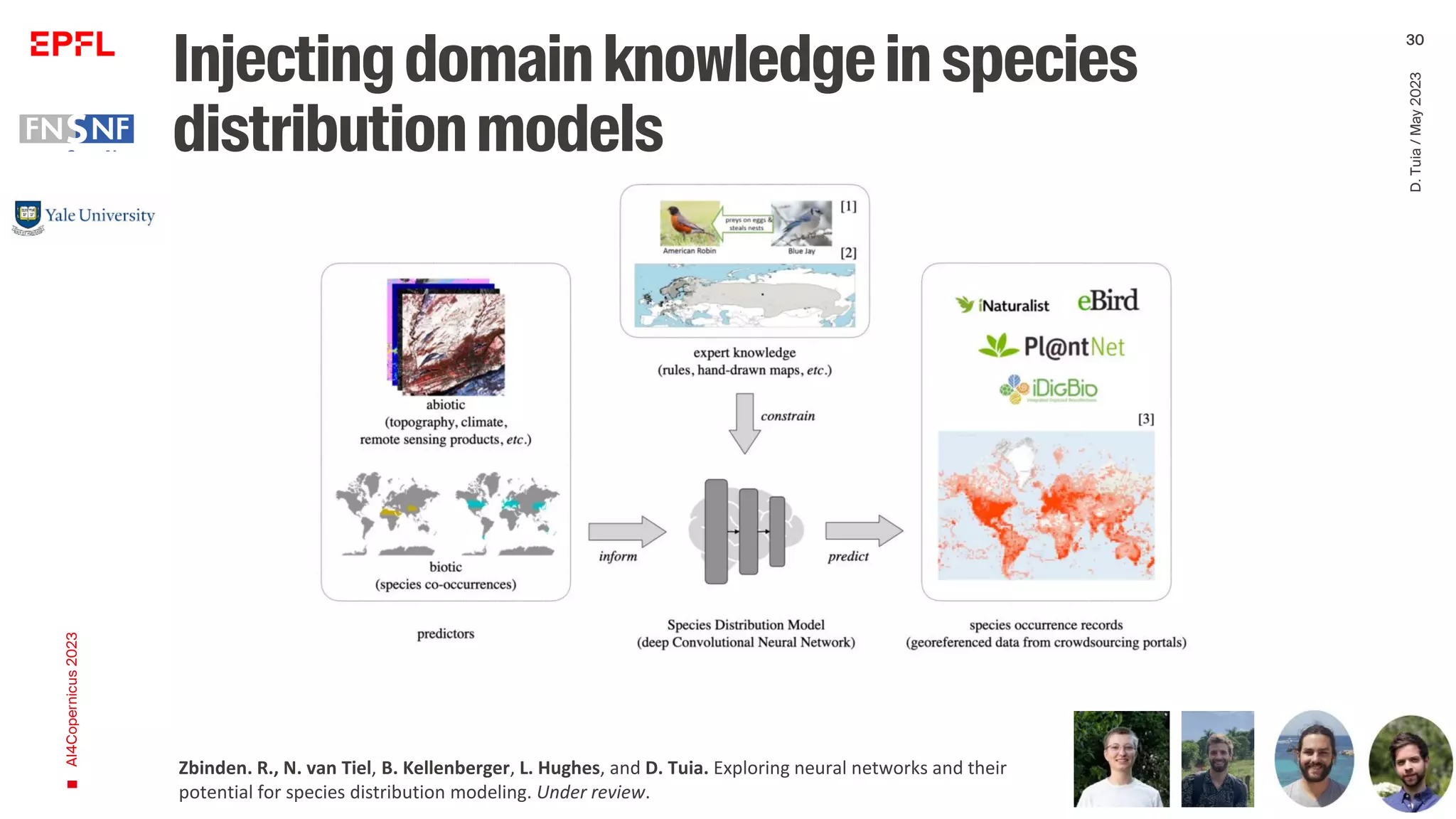
Injectingdomainknowledgeinspecies
distributionmodels
AI4Copernicus
2023
D.
Tuia
/
May
2023
30
Zbinden. R., N. van Tiel, B. Kellenberger, L. Hughes, and D. Tuia. Exploring neural networks and their
potential for species distribution modeling. Under review.
AI4Copernicus
2023
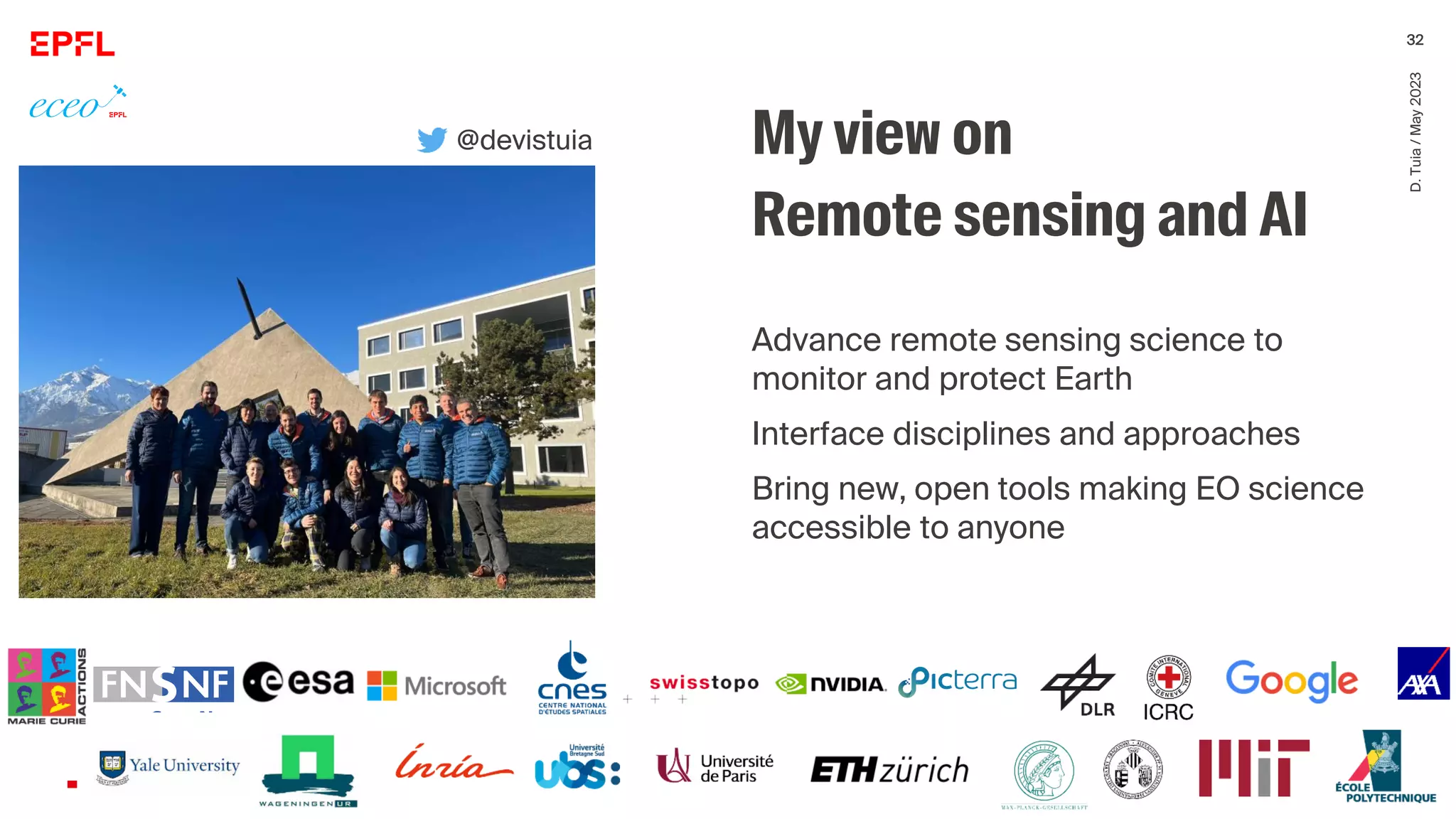
My view on
Remote sensing and AI
Advance remote sensing science to
monitor and protect Earth
Interface disciplines and approaches
Bring new, open tools making EO science
accessible to anyone
D.
Tuia
/
May
2023
32
My view on
Remote sensing and AI
Advance remote sensing science to
monitor and protect Earth
Interface disciplines and approaches
Bring new, open tools making EO science
accessible to anyone
@devistuia

Machine learning for the environment: monitoring the pulse of our Planet with remotely sensed data