Horizon 2020
Societal Challenge 2
Work Programme 2016-2017
Call "Sustainable Food Security (SFS)"
Topics under sub-areas "EU-Africa
Partnership" and "EU China FAB
Flagship Initiative"
European Commission
Annette Schneegans, DG AGRI
Miroslav Bozic, DG AGRI
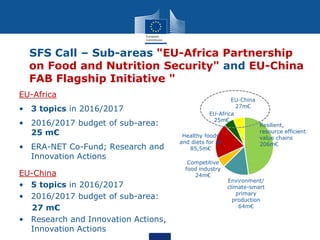
SFS Call – Sub-areas "EU-Africa Partnership
on Food and Nutrition Security" and EU-China
FAB Flagship Initiative "
EU-Africa
• 3 topics in 2016/2017
• 2016/2017 budget of sub-area:
25 m€
• ERA-NET Co-Fund; Research and
Innovation Actions
EU-China
• 5 topics in 2016/2017
• 2016/2017 budget of sub-area:
27 m€
• Research and Innovation Actions,
Innovation Actions
Environment/
climate-smart
primary
production
64m€
Competitive
food industry
24m€
Healthy foods
and diets for all
85,5m€
EU-Africa
25m€
EU-Africa Cooperation
• SFS-41-2016: ERA-Net Cofund
EU-Africa Research and Innovation partnership on food
and nutrition security and sustainable agriculture
• max EC contrib.: EUR 10 million, deadline 17/02/2016
• Questions: What does ERA-NET Cofund imply? Is this a call
researchers can apply to? NGOs part of the
consortium/coordinator?
• Answers: The ERA-NET cofund project will launch a joint call for
research and innovation proposals to which researchers can apply.
• Implemented jointly by European and African countries (Ministries,
government agencies) in addition other national or international
funders such as foundations and non-governmental organisations
4
Scope:
• Strategy for fostering innovation and enhancing the impact of the EU-Africa
Research and Innovation Partnership on FNSSA
• review the various approaches towards innovation promoted and implemented in
past and present activities in Africa or other regions
• look at the involvement of various categories of stakeholders in all stages of the
research process
• develop and test relevant approaches scaling out of results achieved through EU-
Africa cooperation on R&I.
• Mapping national EASs in African countries (typology and capacity to facilitate
appropriate links between researchers and other actors in innovation systems).
• Covering various farming approaches (organic sector included)
• Governance mechanisms (particularly in terms of farmers' involvement in
orientation and programming) and funding
SFS-42-2016: Promoting Food and Nutrition Security
and Sustainable Agriculture in Africa: the role of
innovation
5
Expected impact
Short-term:
• Fostering innovation in FNSSA in Africa and achieving widespread local impact by
delivering on relevant activities, schemes, approaches and strategies;
• Support development of a long-term EU-Africa Research and Innovation Partnership
on FNSSA;
• Policy recommendations in support of innovation processes (AKIS and cooperation),
in particular as regards linking local innovation needs to a research agenda and the
role of knowledge brokers such as EAS.
Type of action: Research and innovation action
Indicative budget range: 5 M€
Question: NGOs part of the consortium/coordinator?
• NGOs could be part of the consortium, also coordinator, however, at the end the
external evaluators have to be convinced
SFS-42-2016: Promoting Food and Nutrition Security
and Sustainable Agriculture in Africa: the role of
innovation
• EU-China FAB Flagship
• initiative
SFS-44-2016: A joint plant breeding programme
to decrease the EU's and China's dependency on
protein imports (proposals up to 5m€)
Scope
• Develop long-term breeding strategies for legume crops
• Broaden the genetic base of legume crops for breeding purposes
• Analyse genetic material and identify resistance to combinations
of biotic and abiotic stresses
• Test plant performance (phenotyping) of a wide range of legume
species/varieties in various geographic and environmental
situations in EU and China, considering climate-change
scenarios
• Explore scope for increased exchanges between the EU and
China via mutual access to gene banks through open databases.
SFS-44-2016: A joint plant breeding programme
to decrease the EU's and China's dependency on
protein imports (cont.)
Impact
• Reduce overall long-term dependence of Europe and China on
protein imports
 Enlarged range of genetic resources of legume crops for breeding
programmes
 Common methods, tools and technologies for characterisation and
evaluation of genetic resources
 Increased mutual access to genetic resources
 New varieties adapted to local conditions in order to increase the
overall productivity and quality of legume crops that should benefit
both conventional and organic agriculture
 New varieties adapted to climate related biotic and biotic stresses
9
Scope:
• Development of food-safety management systems for processed agro-food products
-> enhancing the overall transparency of the food chain.
• complex issue of the supply chain for packaging
• Traceability: preventing the spread of food safety risk, GI importance)
• Systems to be implemented (eventually by agro-food manufacturers and agro-food
operators) in Europe and China.
• Good-practice guide supporting better food safety management systems and
implement demonstration and pilot activities in key sectors (greatest impact in
terms of potential risks and commercial value)
• Exchange and convergence of best practices between the EU and China (e.g.
training of experts and cooperation between laboratories to ensure equal
performance) to facilitate the harmonisation of food safety standards
• Feasibility studies for a sustainable EU-China joint laboratory to ensure
compliance with the harmonised standards
SFS-45-2016: Increase overall transparency of
processed agro-food products
10
Expected impact:
• Common EU-China vision of global food safety issues-> trade increase and improve
trade predictability in key production areas
• Improve the transparency of the food chain and manufacturers' sense of
responsibility
• Improve traceability tools along the food and feed chains
• reduce human health risks linked to food processing and packaging
• increase consumers' confidence in processed agro-food products traded between the
EU and China and in domestic markets
• Increase EU-China cooperation at technical and scientific levels
Type of action: Research and innovation action
Indicative budget range: 5 M€ (funding of CN participants not included)
SFS-45-2016: Increase overall transparency of
processed agro-food products
Additional information
Involving CN partners
• Which ones?
• Depends on the objectives of the proposal
• Not only CAAS institutions
• Funding?
• EU-China Co-Funding Mechanism for Research and Innovation projects
under development
• More info on matching funds for international partners:
participants portal
HORIZON 2020
Thank you
for your attention!
Useful links:
Horizon 2020 and draft WPs: www.ec.europa/research/horizon2020
Participant Portal and final WPs: https://ec.europa.eu/research/participants/portal
Bioeconomy Portal and Info Day: http://ec.europa.eu/research/bioeconomy/
The presentation shall neither be binding nor construed as constituting commitment by the European Commission

Horizon 2020 Info Day

  • 1.
    Horizon 2020 Societal Challenge2 Work Programme 2016-2017 Call "Sustainable Food Security (SFS)" Topics under sub-areas "EU-Africa Partnership" and "EU China FAB Flagship Initiative" European Commission Annette Schneegans, DG AGRI Miroslav Bozic, DG AGRI
  • 2.
    SFS Call –Sub-areas "EU-Africa Partnership on Food and Nutrition Security" and EU-China FAB Flagship Initiative " EU-Africa • 3 topics in 2016/2017 • 2016/2017 budget of sub-area: 25 m€ • ERA-NET Co-Fund; Research and Innovation Actions EU-China • 5 topics in 2016/2017 • 2016/2017 budget of sub-area: 27 m€ • Research and Innovation Actions, Innovation Actions Environment/ climate-smart primary production 64m€ Competitive food industry 24m€ Healthy foods and diets for all 85,5m€ EU-Africa 25m€
  • 3.
    EU-Africa Cooperation • SFS-41-2016:ERA-Net Cofund EU-Africa Research and Innovation partnership on food and nutrition security and sustainable agriculture • max EC contrib.: EUR 10 million, deadline 17/02/2016 • Questions: What does ERA-NET Cofund imply? Is this a call researchers can apply to? NGOs part of the consortium/coordinator? • Answers: The ERA-NET cofund project will launch a joint call for research and innovation proposals to which researchers can apply. • Implemented jointly by European and African countries (Ministries, government agencies) in addition other national or international funders such as foundations and non-governmental organisations
  • 4.
    4 Scope: • Strategy forfostering innovation and enhancing the impact of the EU-Africa Research and Innovation Partnership on FNSSA • review the various approaches towards innovation promoted and implemented in past and present activities in Africa or other regions • look at the involvement of various categories of stakeholders in all stages of the research process • develop and test relevant approaches scaling out of results achieved through EU- Africa cooperation on R&I. • Mapping national EASs in African countries (typology and capacity to facilitate appropriate links between researchers and other actors in innovation systems). • Covering various farming approaches (organic sector included) • Governance mechanisms (particularly in terms of farmers' involvement in orientation and programming) and funding SFS-42-2016: Promoting Food and Nutrition Security and Sustainable Agriculture in Africa: the role of innovation
  • 5.
    5 Expected impact Short-term: • Fosteringinnovation in FNSSA in Africa and achieving widespread local impact by delivering on relevant activities, schemes, approaches and strategies; • Support development of a long-term EU-Africa Research and Innovation Partnership on FNSSA; • Policy recommendations in support of innovation processes (AKIS and cooperation), in particular as regards linking local innovation needs to a research agenda and the role of knowledge brokers such as EAS. Type of action: Research and innovation action Indicative budget range: 5 M€ Question: NGOs part of the consortium/coordinator? • NGOs could be part of the consortium, also coordinator, however, at the end the external evaluators have to be convinced SFS-42-2016: Promoting Food and Nutrition Security and Sustainable Agriculture in Africa: the role of innovation
  • 6.
    • EU-China FABFlagship • initiative
  • 7.
    SFS-44-2016: A jointplant breeding programme to decrease the EU's and China's dependency on protein imports (proposals up to 5m€) Scope • Develop long-term breeding strategies for legume crops • Broaden the genetic base of legume crops for breeding purposes • Analyse genetic material and identify resistance to combinations of biotic and abiotic stresses • Test plant performance (phenotyping) of a wide range of legume species/varieties in various geographic and environmental situations in EU and China, considering climate-change scenarios • Explore scope for increased exchanges between the EU and China via mutual access to gene banks through open databases.
  • 8.
    SFS-44-2016: A jointplant breeding programme to decrease the EU's and China's dependency on protein imports (cont.) Impact • Reduce overall long-term dependence of Europe and China on protein imports  Enlarged range of genetic resources of legume crops for breeding programmes  Common methods, tools and technologies for characterisation and evaluation of genetic resources  Increased mutual access to genetic resources  New varieties adapted to local conditions in order to increase the overall productivity and quality of legume crops that should benefit both conventional and organic agriculture  New varieties adapted to climate related biotic and biotic stresses
  • 9.
    9 Scope: • Development offood-safety management systems for processed agro-food products -> enhancing the overall transparency of the food chain. • complex issue of the supply chain for packaging • Traceability: preventing the spread of food safety risk, GI importance) • Systems to be implemented (eventually by agro-food manufacturers and agro-food operators) in Europe and China. • Good-practice guide supporting better food safety management systems and implement demonstration and pilot activities in key sectors (greatest impact in terms of potential risks and commercial value) • Exchange and convergence of best practices between the EU and China (e.g. training of experts and cooperation between laboratories to ensure equal performance) to facilitate the harmonisation of food safety standards • Feasibility studies for a sustainable EU-China joint laboratory to ensure compliance with the harmonised standards SFS-45-2016: Increase overall transparency of processed agro-food products
  • 10.
    10 Expected impact: • CommonEU-China vision of global food safety issues-> trade increase and improve trade predictability in key production areas • Improve the transparency of the food chain and manufacturers' sense of responsibility • Improve traceability tools along the food and feed chains • reduce human health risks linked to food processing and packaging • increase consumers' confidence in processed agro-food products traded between the EU and China and in domestic markets • Increase EU-China cooperation at technical and scientific levels Type of action: Research and innovation action Indicative budget range: 5 M€ (funding of CN participants not included) SFS-45-2016: Increase overall transparency of processed agro-food products
  • 11.
    Additional information Involving CNpartners • Which ones? • Depends on the objectives of the proposal • Not only CAAS institutions • Funding? • EU-China Co-Funding Mechanism for Research and Innovation projects under development • More info on matching funds for international partners: participants portal
  • 12.
    HORIZON 2020 Thank you foryour attention! Useful links: Horizon 2020 and draft WPs: www.ec.europa/research/horizon2020 Participant Portal and final WPs: https://ec.europa.eu/research/participants/portal Bioeconomy Portal and Info Day: http://ec.europa.eu/research/bioeconomy/ The presentation shall neither be binding nor construed as constituting commitment by the European Commission