Page 121/01/2016
Implemented by
Rapid Loss Appraisal Tool (RLAT)
for agribusiness value chains
Bruno Schuler, Tanja Pickardt, GIZ Sector Project Sustainable Agriculture
Heike Ostermann, Margret Will, Kerstin Hell
Page 2
Practical challenges on the ground
21/01/2016
• GIZ implements a large number of projects on value
chain (VC) support worldwide; strong focus on food crops
linked to the Special Initiative ONEWORLD no hunger
(Green Innovation Centers) > experience:
• Food losses (including aflatoxin contamination) are not
adequately (or even not at all) addressed so far
• 1st step: Create awareness on the neccessity to reduce
food losses
 Need for a rapid and cost-effective approach to identify
the most important loss points within a VC and get a first
idea about the extent (without quantifying / measuring)
Page 321/01/2016
Rapid Loss Appraisal Tool (RLAT)
Limitations:
The Rapid Loss Appraisal Tool alone does not intend to provide sufficient data for
evidence-based policy or enterprise decision making
Objectives:
 pre-screening of quantitative and qualitative losses along specific VCs
 finding leverage points for reducing losses along VCs with sufficient evidence for
initiating further interventions
 identification of information gaps to support planning of further detailed studies
on losses and loss reduction measures
 create willingness to address food losses
Target group:
National programmes, development organisations and NGOs supporting VC
development
Page 421/01/2016
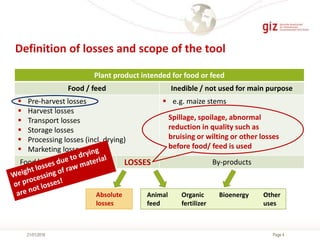
Definition of losses and scope of the tool
Plant product intended for food or feed
Food / feed Inedible / not used for main purpose
 Pre-harvest losses
 Harvest losses
 Transport losses
 Storage losses
 Processing losses (incl. drying)
 Marketing losses
 e.g. maize stems
Food/ feed for consumption By-products
Absolute
losses
Animal Organic Bioenergy Other
feed fertilizer uses
Spillage, spoilage, abnormal
reduction in quality such as
bruising or wilting or other losses
before food/ feed is used
LOSSES
Page 5
Process Steps of RLAT > see User Guide
XXX21/01/2016
Preparation (up to 12 days)
Process step 1: scheduling the rapid appraisal
Process step 2: training of RLAT users and facilitators
Process step 3: desktop study
Field-research phase (up to 24 days)
Process step 4: key expert roundtable
Process step 5: stakeholder workshop
Process step 6: focus group meetings and processor meetings
Process step 7: key informant meetings
Follow-up phase (up to 12 days)
Process step 8: assessment of results
Process step 9: conclusions and recommendations
Process step 10: reporting
Page 6
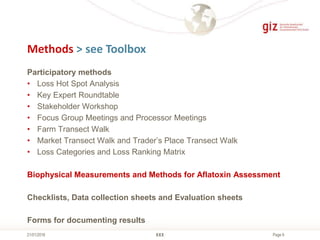
Methods > see Toolbox
XXX21/01/2016
Participatory methods
• Loss Hot Spot Analysis
• Key Expert Roundtable
• Stakeholder Workshop
• Focus Group Meetings and Processor Meetings
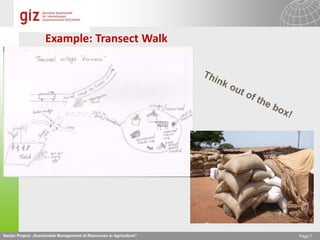
• Farm Transect Walk
• Market Transect Walk and Trader’s Place Transect Walk
• Loss Categories and Loss Ranking Matrix
Biophysical Measurements and Methods for Aflatoxin Assessment
Checklists, Data collection sheets and Evaluation sheets
Forms for documenting results
Sector Project „Sustainable Management of Resources in Agriculture" Page 7
Example: Transect Walk
Page 8
XXX21/01/2016 SNRD Conference Addis Ababa, Ethiopia, March 15-20 2015WG AGRIBUSINESS & FOOD SECURITY
Sector Network Rural Development, Africa
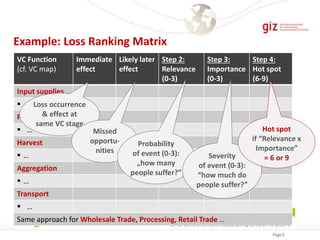
Example: Loss Ranking Matrix
VC Function
(cf. VC map)
Immediate
effect
Likely later
effect
Step 2:
Relevance
(0-3)
Step 3:
Importance
(0-3)
Step 4:
Hot spot
(6-9)
Input supplies
 …
Pre-harvest
 …
Harvest
 …
Aggregation
 …
Transport
 …
Same approach for Wholesale Trade, Processing, Retail Trade …
Loss occurrence
& effect at
same VC stage
Missed
opportu-
nities
Probability
of event (0-3):
„how many
people suffer?”
Severity
of event (0-3):
“how much do
people suffer?”
Hot spot
if “Relevance x
Importance”
= 6 or 9
Page 921/01/2016
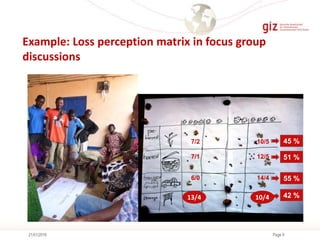
Example: Loss perception matrix in focus group
discussions
10/57/2
13/4 10/4
14/4 55 %
45 %
6/0
51 %7/1 12/5
42 %13/4 10/4
Sector Project „Sustainable Management of Resources in Agriculture" Page 10
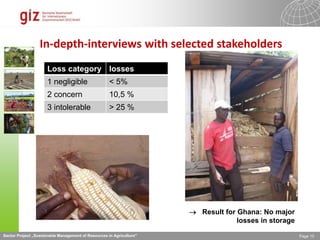
In-depth-interviews with selected stakeholders
Loss category losses
1 negligible < 5%
2 concern 10,5 %
3 intolerable > 25 %
 Result for Ghana: No major
losses in storage
Sector Project „Sustainable Management of Resources in Agriculture" Page 11
Integrating the Aflatoxin risk into the Rapid Loss
Appraisal Tool
Aflatoxin checklist:
 Points of increased risk for aflatoxin contamination along the production
to consumption chain
 Risk evaluated as percentage of positive responses
 List has to be specifically conceived for every commodity
Bio-physical measurements:
 Indication of aflatoxin risk via number of discoloured grains (which has no
direct relationship with aflatoxin, but indicates a higher risk)
 Use of blue-light as aflatoxin indicator not successful – high rate of
instrumentation needed in the field, including access to POWER
 Laboratory testing is too lengthy and complicated (sampling !) for RLAT,
but should be recommended as a follow up if a high risk has
been detected by the number of discoloured grains
Sector Project „Sustainable Management of Resources in Agriculture" Page 12
Lessons learnt so far
 Narrowing the scope to PHL is not useful for VC actors
 Include pre-harvest losses and lost opportunities (i.e. choice of
inappropriate seed). This is also a result of previous case studies on
rice in Nigeria and potatoes in Kenya !
 Temporal variability of food losses
 Carefully determine and plan the schedule
 Spatial and process-related variability of food losses
 A reasonable scale is crucial, i.e. a specific value chain
 The integration of an Aflatoxin risk assessment is essential
 In this context, the definition of “loss” has to be rethought, as
contaminated grains continue to be consumed, with very negative
effects on human health (and the related costs)
Page 13
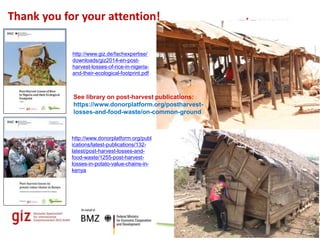
Thank you for your attention!
Sector Project "Sustainable Agriculture"
http://www.donorplatform.org/publ
ications/latest-publications/132-
latest/post-harvest-losses-and-
food-waste/1255-post-harvest-
losses-in-potato-value-chains-in-
kenya
http://www.giz.de/fachexpertise/
downloads/giz2014-en-post-
harvest-losses-of-rice-in-nigeria-
and-their-ecological-footprint.pdf
See library on post-harvest publications:
https://www.donorplatform.org/postharvest-
losses-and-food-waste/on-common-ground