How to Efficiently and Effectively Balance Central
Monitoring with On-Site Monitoring
Experience from Phase 3 Study Using Risk-
Based Monitoring and eSource
Methodologies
December 2013
For information contact:
Jules T. Mitchel, MBA, PhD
212-681-2100
JulesMitchel@targethealth.com
©Copyright Target Health 2013
A Touch of Philosophy
Every truth passes through three stages
before it is recognized:
In the first it is ridiculed
In the second it is opposed
In the third it is regarded as self-evident
(Arthur Schopenhauer)
2
A Touch of Philosophy
What a person hears he/she may doubt
What he/she sees, he/she may possibly
doubt
But what he/she does, cannot be doubted
(Adapted from Seaman Knapp: American Agriculturist and Educator)
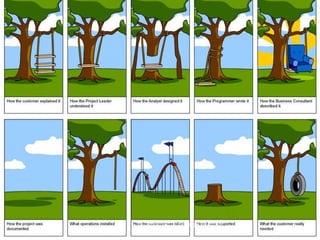
The Problem
© Copyright 2011 by Target Health Inc. 4
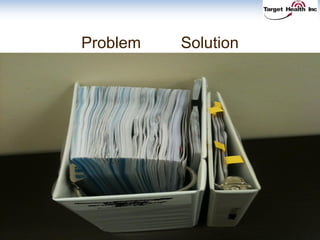
Problem Solution
5
Quality Redefined
Quality in clinical trials = the absence
of errors that matter
Are the data fit for use/purpose
6
What are “Errors that Matter”?
Errors that have a meaningful impact on
Patient safety or
Interpretation of trial results
7
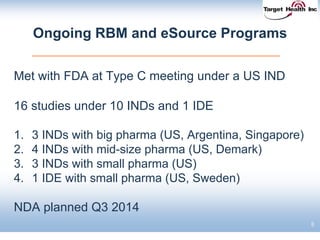
Ongoing RBM and eSource Programs
Met with FDA at Type C meeting under a US IND
16 studies under 10 INDs and 1 IDE
1. 3 INDs with big pharma (US, Argentina, Singapore)
2. 4 INDs with mid-size pharma (US, Demark)
3. 3 INDs with small pharma (US)
4. 1 IDE with small pharma (US, Sweden)
NDA planned Q3 2014
8
9
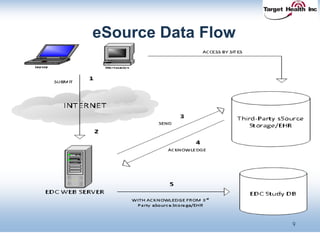
eSource Data Flow
IT IS ALL ABOUT THE DATA
10
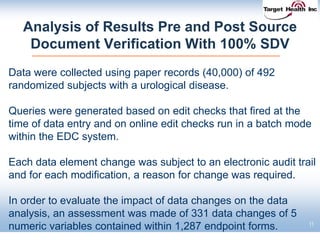
Analysis of Results Pre and Post Source
Document Verification With 100% SDV
11
Data were collected using paper records (40,000) of 492
randomized subjects with a urological disease.
Queries were generated based on edit checks that fired at the
time of data entry and on online edit checks run in a batch mode
within the EDC system.
Each data element change was subject to an electronic audit trail
and for each modification, a reason for change was required.
In order to evaluate the impact of data changes on the data
analysis, an assessment was made of 331 data changes of 5
numeric variables contained within 1,287 endpoint forms.
12
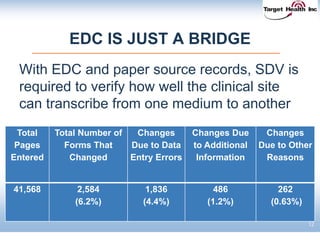
EDC IS JUST A BRIDGE
With EDC and paper source records, SDV is
required to verify how well the clinical site
can transcribe from one medium to another
Total
Pages
Entered
Total Number of
Forms That
Changed
Changes
Due to Data
Entry Errors
Changes Due
to Additional
Information
Changes
Due to Other
Reasons
41,568 2,584
(6.2%)
1,836
(4.4%)
486
(1.2%)
262
(0.63%)
13
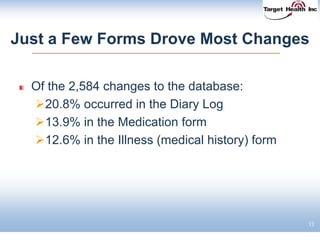
Just a Few Forms Drove Most Changes
Of the 2,584 changes to the database:
20.8% occurred in the Diary Log
13.9% in the Medication form
12.6% in the Illness (medical history) form
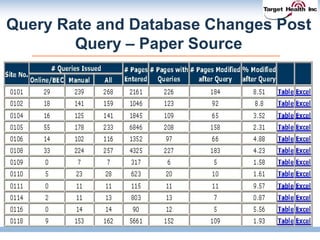
Query Rate and Database Changes Post
Query – Paper Source
14
15
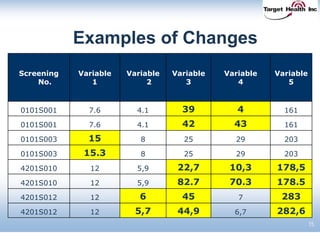
Examples of Changes
Screening
No.
Variable
1
Variable
2
Variable
3
Variable
4
Variable
5
0101S001 7.6 4.1 39 4 161
0101S001 7.6 4.1 42 43 161
0101S003 15 8 25 29 203
0101S003 15.3 8 25 29 203
4201S010 12 5,9 22,7 10,3 178,5
4201S010 12 5,9 82.7 70.3 178.5
4201S012 12 6 45 7 283
4201S012 12 5,7 44,9 6,7 282,6
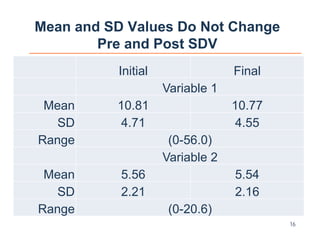
Mean and SD Values Do Not Change
Pre and Post SDV
16
Initial Final
Variable 1
Mean 10.81 10.77
SD 4.71 4.55
Range (0-56.0)
Variable 2
Mean 5.56 5.54
SD 2.21 2.16
Range (0-20.6)
17
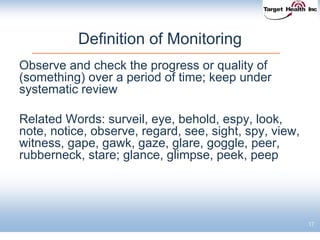
Definition of Monitoring
Observe and check the progress or quality of
(something) over a period of time; keep under
systematic review
Related Words: surveil, eye, behold, espy, look,
note, notice, observe, regard, see, sight, spy, view,
witness, gape, gawk, gaze, glare, goggle, peer,
rubberneck, stare; glance, glimpse, peek, peep
18
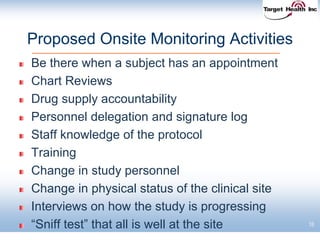
Proposed Onsite Monitoring Activities
Be there when a subject has an appointment
Chart Reviews
Drug supply accountability
Personnel delegation and signature log
Staff knowledge of the protocol
Training
Change in study personnel
Change in physical status of the clinical site
Interviews on how the study is progressing
“Sniff test” that all is well at the site
19
Current Onsite Monitoring Activities That May be
Able to be Performed Centrally
Study conduct and protocol adherence
Review of Informed Consent forms
Subject Eligibility
Evaluation of medications associated with
adverse events
Drug supply accountability
Protocol deviations and violations
20
Central Monitoring Activities
Evaluate, by site and across sites:
Enrollment and dropout status
Number of forms entered and reviewed
Edit checks and queries by form and variable
Numbers and reasons for database changes
Adverse events and medications
Protocol deviations and violations
21
Tips on Centralized Monitoring
1.Make sure the data are available rapidly from the
time of the clinic visit
2.Review data at least once-a-day
3.Review online quality checks every day
4.Meet periodically to review findings of central
monitoring
5.Communicate findings to the monitors, sites and
other interested parties
6.Maintain meeting minutes with findings and
corrective actions
22
METRICS
Phase 3 Study
18 Sites
180 Completed Subjects
23
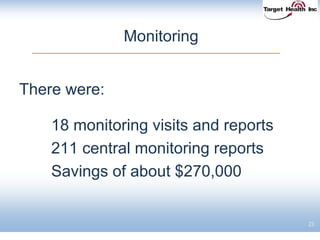
Monitoring
There were:
18 monitoring visits and reports
211 central monitoring reports
Savings of about $270,000
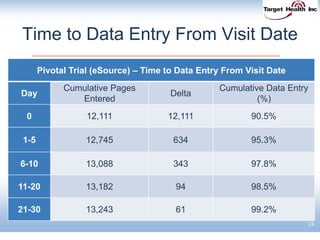
Time to Data Entry From Visit Date
24
Pivotal Trial (eSource) – Time to Data Entry From Visit Date
Day
Cumulative Pages
Entered
Delta
Cumulative Data Entry
(%)
0 12,111 12,111 90.5%
1-5 12,745 634 95.3%
6-10 13,088 343 97.8%
11-20 13,182 94 98.5%
21-30 13,243 61 99.2%
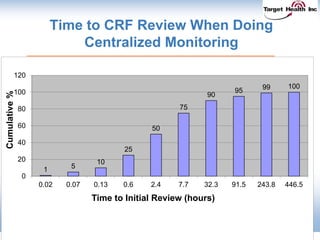
Time to CRF Review When Doing
Centralized Monitoring
1 5
10
25
50
75
90
95 99 100
0
20
40
60
80
100
120
0.02 0.07 0.13 0.6 2.4 7.7 32.3 91.5 243.8 446.5
Cumulative%
Time to Initial Review (hours)
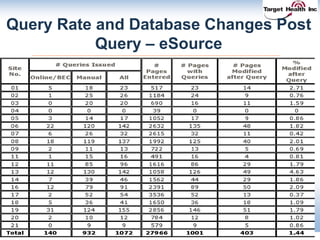
Query Rate and Database Changes Post
Query – eSource
26
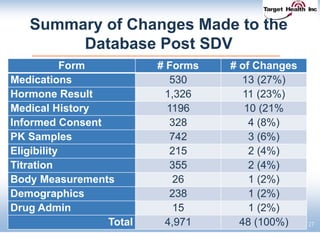
Summary of Changes Made to the
Database Post SDV
27
Form # Forms # of Changes
Medications 530 13 (27%)
Hormone Result 1,326 11 (23%)
Medical History 1196 10 (21%
Informed Consent 328 4 (8%)
PK Samples 742 3 (6%)
Eligibility 215 2 (4%)
Titration 355 2 (4%)
Body Measurements 26 1 (2%)
Demographics 238 1 (2%)
Drug Admin 15 1 (2%)
Total 4,971 48 (100%)
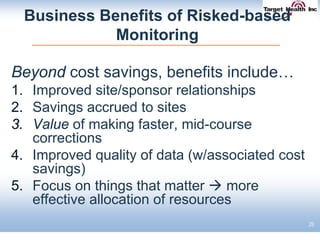
Business Benefits of Risked-based
Monitoring
Beyond cost savings, benefits include…
1. Improved site/sponsor relationships
2. Savings accrued to sites
3. Value of making faster, mid-course
corrections
4. Improved quality of data (w/associated cost
savings)
5. Focus on things that matter  more
effective allocation of resources
28
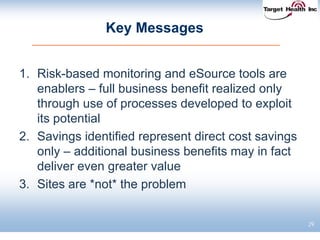
Key Messages
1. Risk-based monitoring and eSource tools are
enablers – full business benefit realized only
through use of processes developed to exploit
its potential
2. Savings identified represent direct cost savings
only – additional business benefits may in fact
deliver even greater value
3. Sites are *not* the problem
29
Thank You
Jules T. Mitchel, MBA, Ph.D., President
Target Health Inc.
261 Madison Avenue, 24th Floor, New York, NY 10016
JulesMitchel@targethealth.com
www.targethealth.com
TARGET HEALTH INC., founded in 1993, is a private, New
York City-based, full-service eCRO, engaged in all aspects of
Drug and Device Development, including Regulatory Affairs
Strategic Planning, Clinical Research, Data Management,
Biostatistics, Medical Writing and the paperless clinical trial.
30

Experience from Phase 3 Study Using Risk- Based Monitoring and eSource Methodologies

  • 1.
    How to Efficientlyand Effectively Balance Central Monitoring with On-Site Monitoring Experience from Phase 3 Study Using Risk- Based Monitoring and eSource Methodologies December 2013 For information contact: Jules T. Mitchel, MBA, PhD 212-681-2100 JulesMitchel@targethealth.com ©Copyright Target Health 2013
  • 2.
    A Touch ofPhilosophy Every truth passes through three stages before it is recognized: In the first it is ridiculed In the second it is opposed In the third it is regarded as self-evident (Arthur Schopenhauer) 2
  • 3.
    A Touch ofPhilosophy What a person hears he/she may doubt What he/she sees, he/she may possibly doubt But what he/she does, cannot be doubted (Adapted from Seaman Knapp: American Agriculturist and Educator)
  • 4.
    The Problem © Copyright2011 by Target Health Inc. 4
  • 5.
  • 6.
    Quality Redefined Quality inclinical trials = the absence of errors that matter Are the data fit for use/purpose 6
  • 7.
    What are “Errorsthat Matter”? Errors that have a meaningful impact on Patient safety or Interpretation of trial results 7
  • 8.
    Ongoing RBM andeSource Programs Met with FDA at Type C meeting under a US IND 16 studies under 10 INDs and 1 IDE 1. 3 INDs with big pharma (US, Argentina, Singapore) 2. 4 INDs with mid-size pharma (US, Demark) 3. 3 INDs with small pharma (US) 4. 1 IDE with small pharma (US, Sweden) NDA planned Q3 2014 8
  • 9.
  • 10.
    IT IS ALLABOUT THE DATA 10
  • 11.
    Analysis of ResultsPre and Post Source Document Verification With 100% SDV 11 Data were collected using paper records (40,000) of 492 randomized subjects with a urological disease. Queries were generated based on edit checks that fired at the time of data entry and on online edit checks run in a batch mode within the EDC system. Each data element change was subject to an electronic audit trail and for each modification, a reason for change was required. In order to evaluate the impact of data changes on the data analysis, an assessment was made of 331 data changes of 5 numeric variables contained within 1,287 endpoint forms.
  • 12.
    12 EDC IS JUSTA BRIDGE With EDC and paper source records, SDV is required to verify how well the clinical site can transcribe from one medium to another Total Pages Entered Total Number of Forms That Changed Changes Due to Data Entry Errors Changes Due to Additional Information Changes Due to Other Reasons 41,568 2,584 (6.2%) 1,836 (4.4%) 486 (1.2%) 262 (0.63%)
  • 13.
    13 Just a FewForms Drove Most Changes Of the 2,584 changes to the database: 20.8% occurred in the Diary Log 13.9% in the Medication form 12.6% in the Illness (medical history) form
  • 14.
    Query Rate andDatabase Changes Post Query – Paper Source 14
  • 15.
    15 Examples of Changes Screening No. Variable 1 Variable 2 Variable 3 Variable 4 Variable 5 0101S0017.6 4.1 39 4 161 0101S001 7.6 4.1 42 43 161 0101S003 15 8 25 29 203 0101S003 15.3 8 25 29 203 4201S010 12 5,9 22,7 10,3 178,5 4201S010 12 5,9 82.7 70.3 178.5 4201S012 12 6 45 7 283 4201S012 12 5,7 44,9 6,7 282,6
  • 16.
    Mean and SDValues Do Not Change Pre and Post SDV 16 Initial Final Variable 1 Mean 10.81 10.77 SD 4.71 4.55 Range (0-56.0) Variable 2 Mean 5.56 5.54 SD 2.21 2.16 Range (0-20.6)
  • 17.
    17 Definition of Monitoring Observeand check the progress or quality of (something) over a period of time; keep under systematic review Related Words: surveil, eye, behold, espy, look, note, notice, observe, regard, see, sight, spy, view, witness, gape, gawk, gaze, glare, goggle, peer, rubberneck, stare; glance, glimpse, peek, peep
  • 18.
    18 Proposed Onsite MonitoringActivities Be there when a subject has an appointment Chart Reviews Drug supply accountability Personnel delegation and signature log Staff knowledge of the protocol Training Change in study personnel Change in physical status of the clinical site Interviews on how the study is progressing “Sniff test” that all is well at the site
  • 19.
    19 Current Onsite MonitoringActivities That May be Able to be Performed Centrally Study conduct and protocol adherence Review of Informed Consent forms Subject Eligibility Evaluation of medications associated with adverse events Drug supply accountability Protocol deviations and violations
  • 20.
    20 Central Monitoring Activities Evaluate,by site and across sites: Enrollment and dropout status Number of forms entered and reviewed Edit checks and queries by form and variable Numbers and reasons for database changes Adverse events and medications Protocol deviations and violations
  • 21.
    21 Tips on CentralizedMonitoring 1.Make sure the data are available rapidly from the time of the clinic visit 2.Review data at least once-a-day 3.Review online quality checks every day 4.Meet periodically to review findings of central monitoring 5.Communicate findings to the monitors, sites and other interested parties 6.Maintain meeting minutes with findings and corrective actions
  • 22.
    22 METRICS Phase 3 Study 18Sites 180 Completed Subjects
  • 23.
    23 Monitoring There were: 18 monitoringvisits and reports 211 central monitoring reports Savings of about $270,000
  • 24.
    Time to DataEntry From Visit Date 24 Pivotal Trial (eSource) – Time to Data Entry From Visit Date Day Cumulative Pages Entered Delta Cumulative Data Entry (%) 0 12,111 12,111 90.5% 1-5 12,745 634 95.3% 6-10 13,088 343 97.8% 11-20 13,182 94 98.5% 21-30 13,243 61 99.2%
  • 25.
    Time to CRFReview When Doing Centralized Monitoring 1 5 10 25 50 75 90 95 99 100 0 20 40 60 80 100 120 0.02 0.07 0.13 0.6 2.4 7.7 32.3 91.5 243.8 446.5 Cumulative% Time to Initial Review (hours)
  • 26.
    Query Rate andDatabase Changes Post Query – eSource 26
  • 27.
    Summary of ChangesMade to the Database Post SDV 27 Form # Forms # of Changes Medications 530 13 (27%) Hormone Result 1,326 11 (23%) Medical History 1196 10 (21% Informed Consent 328 4 (8%) PK Samples 742 3 (6%) Eligibility 215 2 (4%) Titration 355 2 (4%) Body Measurements 26 1 (2%) Demographics 238 1 (2%) Drug Admin 15 1 (2%) Total 4,971 48 (100%)
  • 28.
    Business Benefits ofRisked-based Monitoring Beyond cost savings, benefits include… 1. Improved site/sponsor relationships 2. Savings accrued to sites 3. Value of making faster, mid-course corrections 4. Improved quality of data (w/associated cost savings) 5. Focus on things that matter  more effective allocation of resources 28
  • 29.
    Key Messages 1. Risk-basedmonitoring and eSource tools are enablers – full business benefit realized only through use of processes developed to exploit its potential 2. Savings identified represent direct cost savings only – additional business benefits may in fact deliver even greater value 3. Sites are *not* the problem 29
  • 30.
    Thank You Jules T.Mitchel, MBA, Ph.D., President Target Health Inc. 261 Madison Avenue, 24th Floor, New York, NY 10016 JulesMitchel@targethealth.com www.targethealth.com TARGET HEALTH INC., founded in 1993, is a private, New York City-based, full-service eCRO, engaged in all aspects of Drug and Device Development, including Regulatory Affairs Strategic Planning, Clinical Research, Data Management, Biostatistics, Medical Writing and the paperless clinical trial. 30