Regulatory Concerns When Running Virtual/Paperless
Clinical Trials
EMA: Effective and Material Authentication
FDA: Fastidious Digital Authentication
PMDA: Preferred Methods for Digital Authentication
of Data from a Virtual Clinical Trial (VCT)
What is Expected and How will it be Inspected
1
Learning Objectives
Upon completion of this webinar you will be able to
A. Understand the future landscape of paperless clinical trials
B. Understand regulatory concerns when running paperless clinical trials
C. How to “separate toys from tools” when choosing mobile and related
devices
2
A Little History
June 7, 2011: NEW YORK---Pfizer Inc. announced today that it is
conducting the first-ever randomized clinical trial under an investigational
new drug (IND) application that manages study participation entirely
using electronic tools and allows patients to participate in the clinical trial
regardless of their proximity to clinical sites. The pilot project, initiated
following review from the U.S. Food and Drug Administration (FDA), uses
mobile phone and web-based technology to collect necessary data for the
trial without clinic visits
3
Some Initial Questions to Think About
• Which area/part of paperless clinical trials do you think paperless is
already preferred by governing bodies? Which ones do you think will
come next or maybe never?
• A thought experiment: two identical drugs have been tested in
comparable sites and patient populations, one with electronic data
capturing and one with paper. Which ones do you think would the
governing bodies prefer (if any)?
4
Some Initial Questions to Think About
How to handle data gathered on paper outside of the eCOA system,
thoughts on recall periods?
how are eCOA data changes handled? What types of changes, who from
the sponsor manages the process?
Using BYOD to collect patient reported outcomes in clinical trials.
5
Some Initial Questions to Think About
• How does software vendors help this transition for the sponsors and
sites?
• Will the end users or CRA/CRC would have any specific requirements to
smoothen this transition?
• What kind of regulations that are applicable that are not in scope for
paper studies other than 21 CRF Part 11?
• Do we have any country specific regulations that we need to consider for
this transition for major markets like UK, Europe and Japan?
6
Some Initial Questions to Think About
• What are some best practices to ensure paperless investigator site
files/regulatory are 21 CFR Part 11 compliant?
• Would AI technology be associated with e-Clinical trial?
7
Some Initial Questions to Think About
• I'm interested in how e-trials can help to cut down data entry errors by
gathering information at source.
• Also, how to move towards use of mobile phones in clinical trials (BYOD,
etc.) and even conducting remote trials?
8
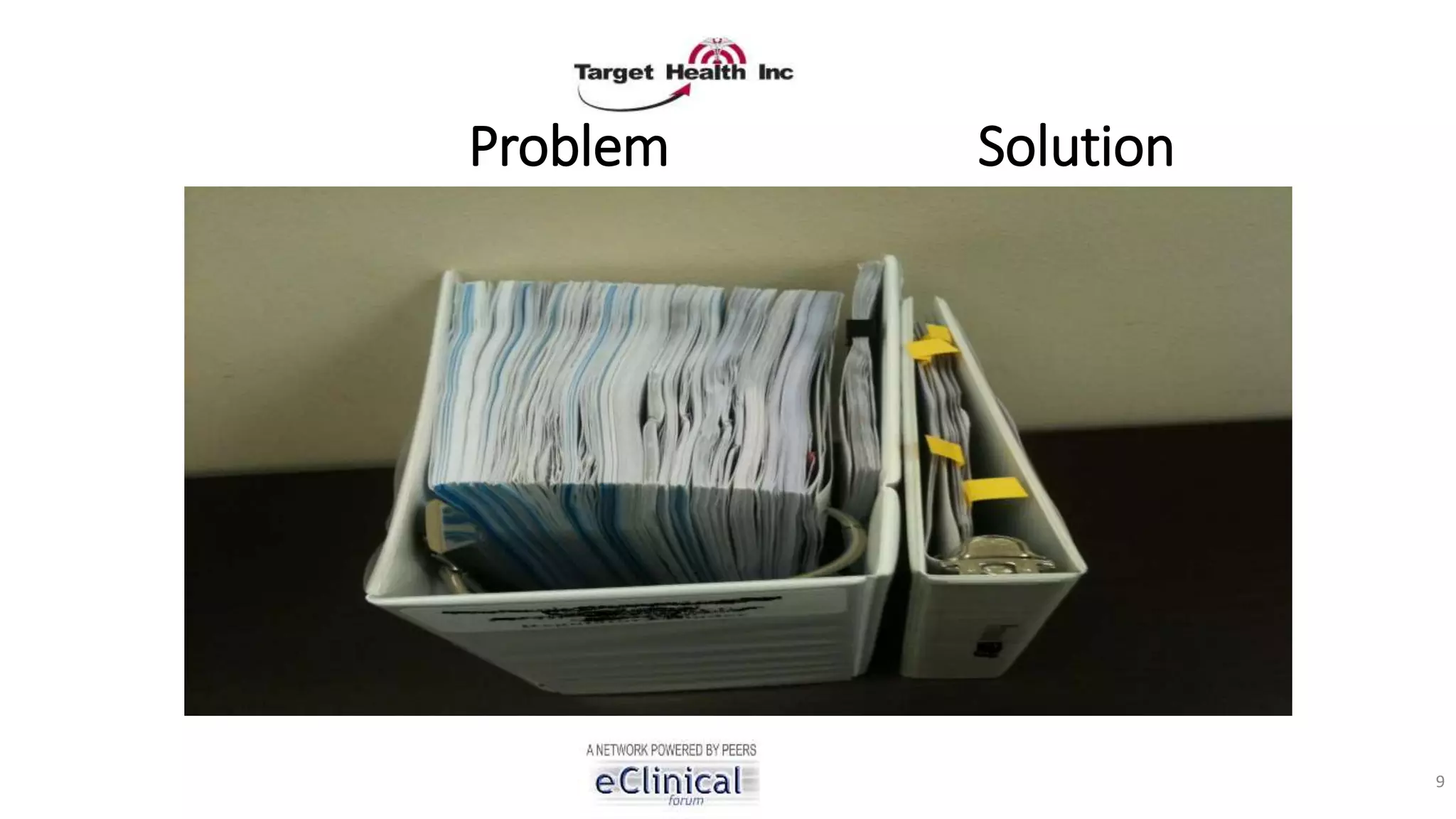
Problem Solution
9
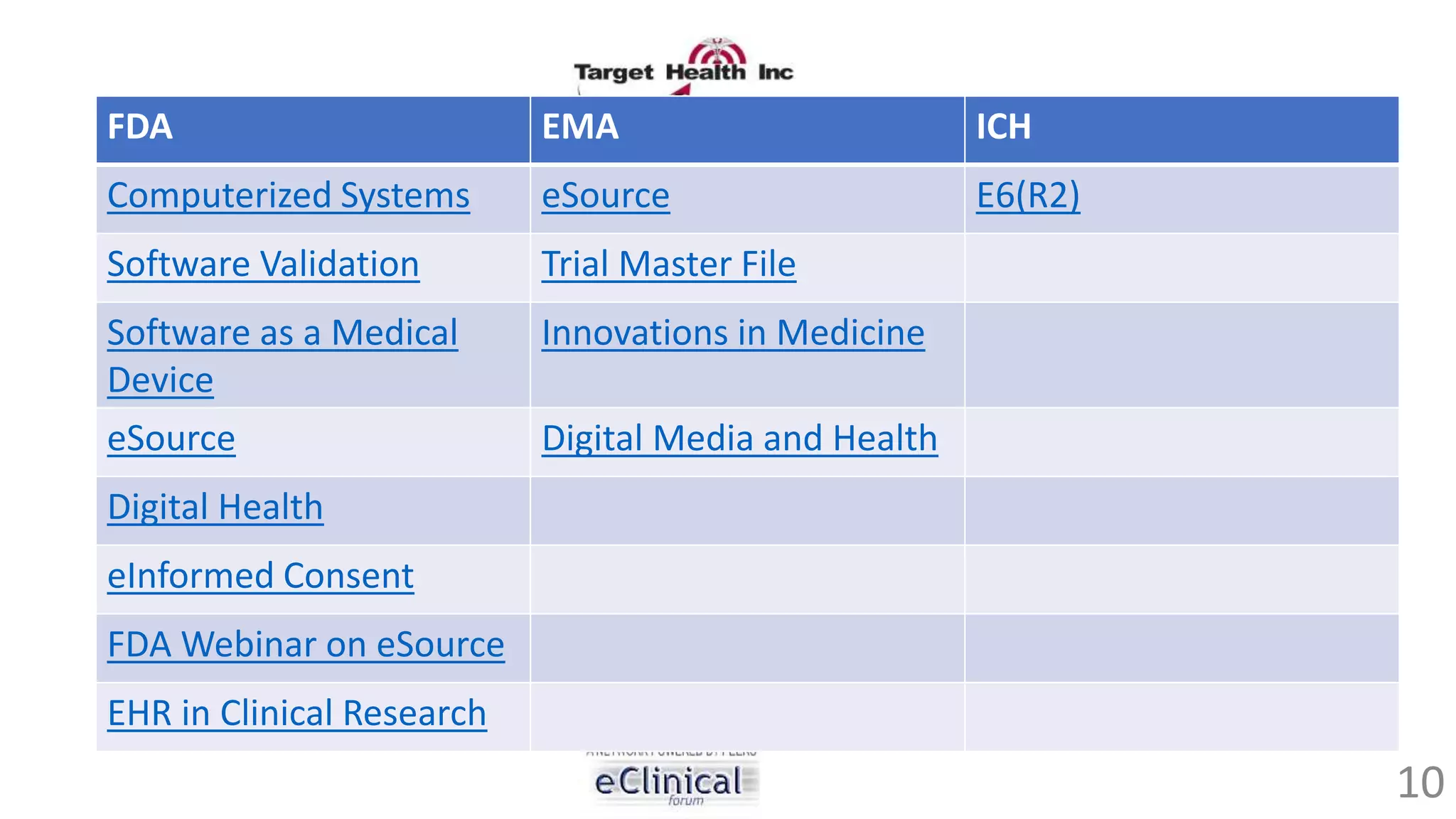
FDA EMA ICH
Computerized Systems eSource E6(R2)
Software Validation Trial Master File
Software as a Medical
Device
Innovations in Medicine
eSource Digital Media and Health
Digital Health
eInformed Consent
FDA Webinar on eSource
EHR in Clinical Research
10
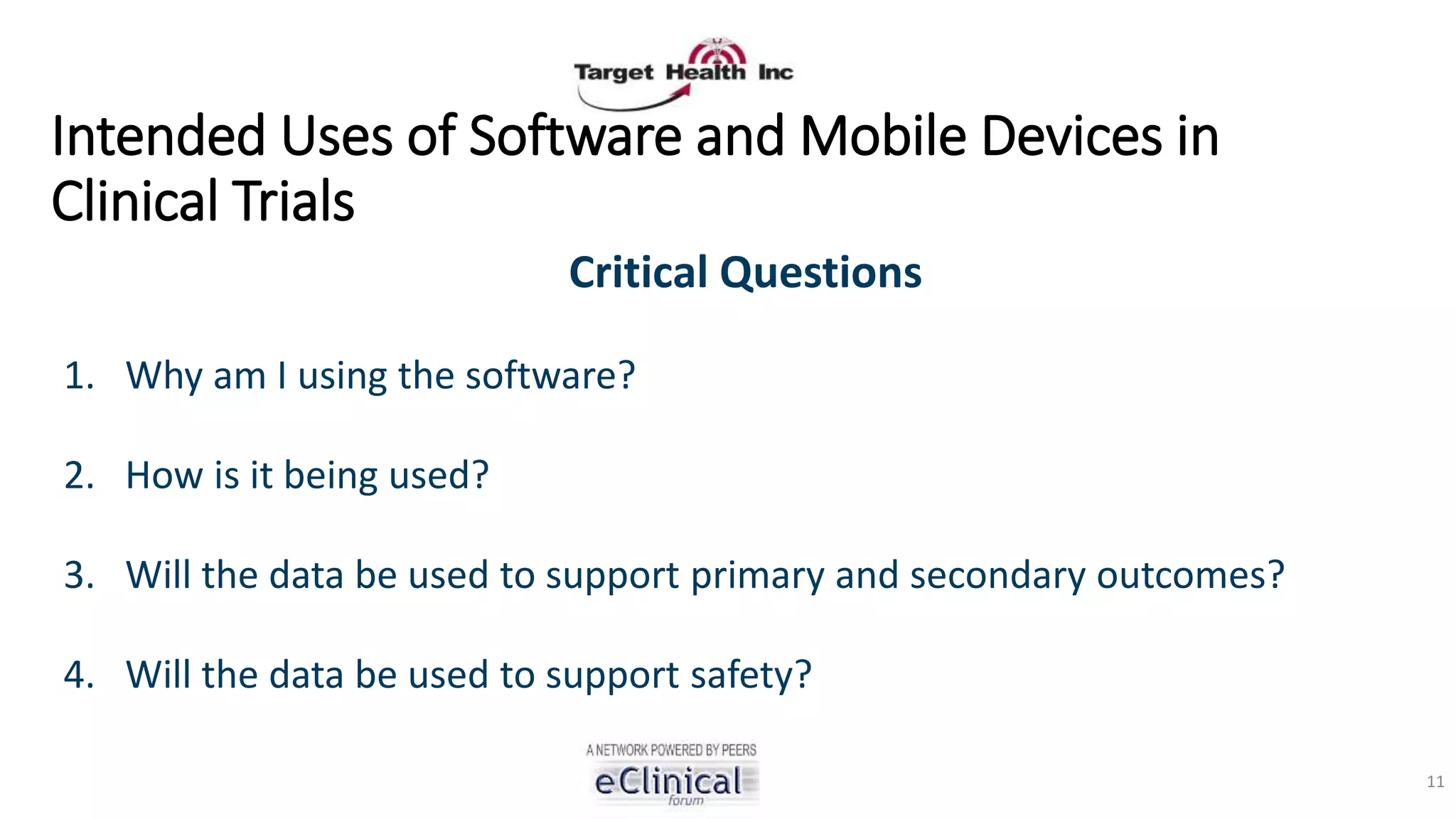
Intended Uses of Software and Mobile Devices in
Clinical Trials
Critical Questions
1. Why am I using the software?
2. How is it being used?
3. Will the data be used to support primary and secondary outcomes?
4. Will the data be used to support safety?
11
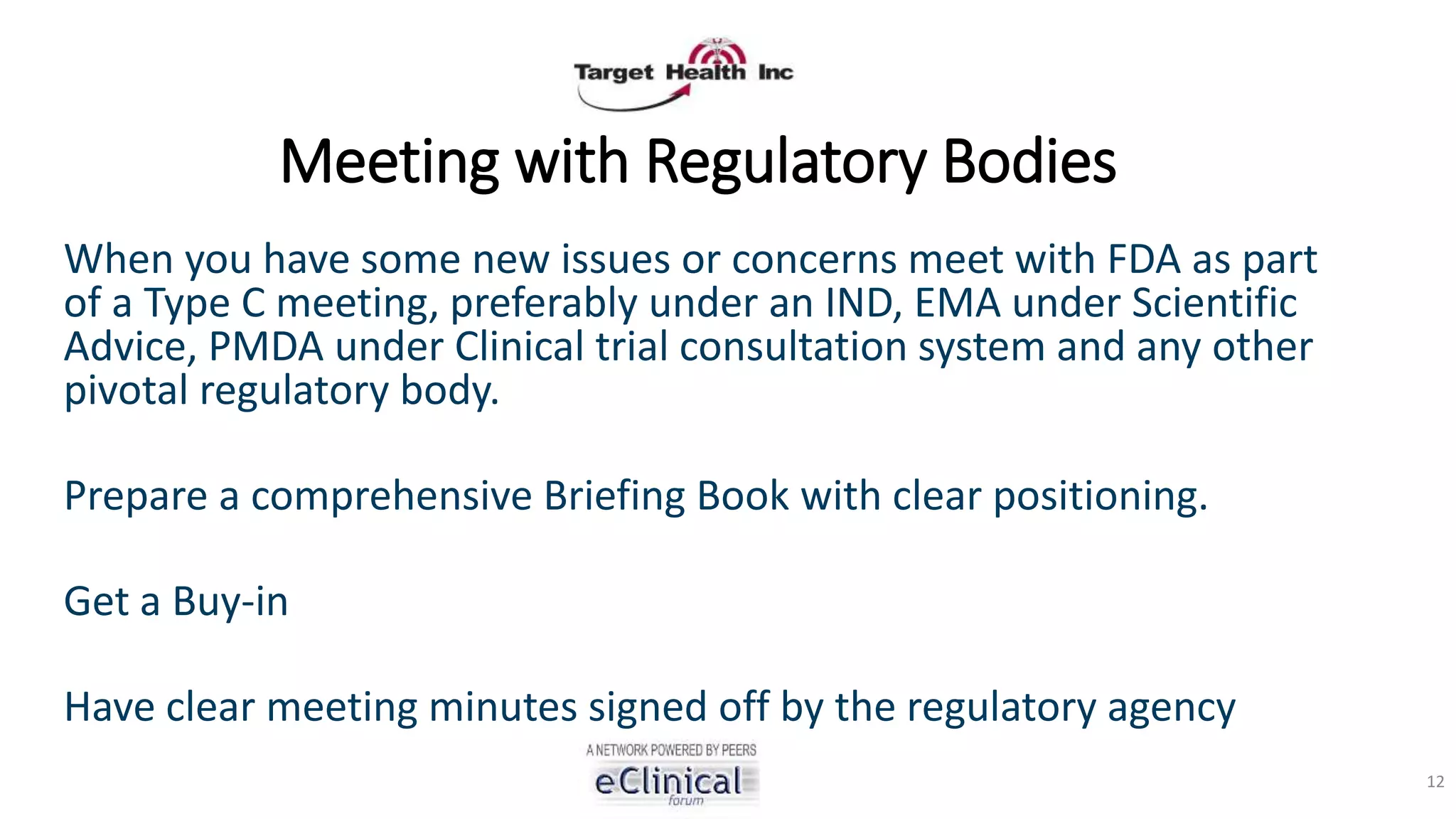
Meeting with Regulatory Bodies
When you have some new issues or concerns meet with FDA as part
of a Type C meeting, preferably under an IND, EMA under Scientific
Advice, PMDA under Clinical trial consultation system and any other
pivotal regulatory body.
Prepare a comprehensive Briefing Book with clear positioning.
Get a Buy-in
Have clear meeting minutes signed off by the regulatory agency
12
Are the Data Reliable and Fit For Purpose
1. Are the subjects real?
2. How are users authenticated and controlled?
3. Is this off the shelf software or a new app?
4. How was the vendor assessed?
5. How was software validation assessed?
6. How was the software tested by Sponsor?
7. How were the data transferred?
8. How is access to the original data controlled?
9. Are there date and time stamps?
10. Are there audit trails that can’t be overwritten?
13
Risk Assessment
1. Assign a value to risk to study subject
2. Assign a value to risk to the study
3. Assign severity scores if it happens
4. Assign a likelihood of detection score
5. Then create a risk-mitigation strategy as part of your Quality by Design
Methodology
14
The Protocol
In order to make sure the protocol is being followed and compliance can
confirmed by inspectors:
The protocol must explicitly describe:
a. all electronic systems used
b. the reason for their use
c. how systems will be used
d. how devices and software will be controlled
e. that there will be a risk assessment and risk mitigation strategies
f. data flow (i.e.-ownership and access controls)
g. other relevant issues
15
What is Validation?
A validated computerized system “Acts As Intended.”
Supporting Life Cycle Management Documentation in “English” or the language
of your choice should contain:
1. The Concept behind the software – “Why do I need this”
2. Requirements - “What the Software Intends To Do”
3. Functional Specifications - “How it will be done”
4. Test Plan and Scripts – “How will I test it”
5. Test Results – “errors, bugs and fixes”
6. Release – “Signoff by those responsible”
7. Change Management – “Change the software as needed”
16
Regulated Software for Virtual Clinical Trials
1. Electronic Data Capture Systems
2. Non-EHR eSource Systems
3. Electronic Informed Consent
4. Mobile medical apps are medical devices and whose functionality
could pose a risk to a patient’s safety if the mobile app were to
not function as intended.
17
Non-Regulated Software for Virtual Clinical Trials
1. Mobile medical apps solely for use in research, teaching, or
analysis and do not introduce such devices into commercial
distribution (outside of the virtual trial)
2. Electronic Health Records
18
What Matters Most to Inspectors
1. Informed Consent
2. Data integrity
3. Was the protocol followed
4. Patient safety by assuring that all safety events were
accurately reported
5. Drug/Device accountability
19
Assessing the Electronic Informed Consent
1. Electronic Informed Consent Form (eICF)
a. SOP’s present
b. Did site follow SOPs
c. Risk assessment of using paper ICF vs. eICF
d. Verification process for authenticating subject identity
e. Process for subject registration
f. Process for electronic signing of the ICF
g. Date of signing related to date of initiating study procedures
h. Secure location of eICF
i. Control of access to eICF
20
Mobile Apps
1. Mobile apps are software programs that run on smartphones and
other mobile communication devices. They can also be accessories
that attach to a smartphone or other mobile communication devices,
or a combination of accessories and software.
2. Mobile medical apps are medical devices that are mobile apps, meet
the definition of a medical device and are an accessory to a regulated
medical device or transform a mobile platform into a regulated
medical device.
21
How Will Mobile Medical Apps be Regulated?
The regulators will apply the same risk-based approach the agency
uses to assure safety and effectiveness for other medical devices.
22
How Will Commercial Mobile Device Manufacturers
be Regulated?
Currently, the FDA, for example, does not regulate the sale or general
consumer use of smartphones or tablets and does not consider entities
that exclusively distribute mobile apps, such as the owners and operators
of the “iTunes App store” or the “Google Play store,” to be medical device
manufacturers.
Also, FDA does not consider mobile platform manufacturers to be
medical device manufacturers just because their mobile platform could
be used to run a mobile medical app regulated by FDA.
23
Tuesday Morning and an Inspector Has Arrived
1. You will be asked for:
a. A list the relevant organizational chart
b. Copies of relevant contracts/agreements
c. Documents supporting vendor qualifications
d. Documents supporting software validation/testing
e. Data management plan
f. Risk mitigation plan
g. Monitoring plan and monitoring reports
h. Minutes from quality by design/project meetings and action items taken,
reasons for actions taken and results
24
Conclusions
CLEARLY WE LIVE IN A WORLD FULL OF TECHNOLOGY SO WHY NOT JUST DO IT
WHILE THERE WE BE DOUBTERS AND OBSTRUCTIONISTS, WHEN
IMPLEMENTING CHANGE:
1. What a person hears he/she may doubt
2. What he/she sees, he/she may possibly doubt
3. But what he/she does, cannot be doubted
(Adapted from Seaman Knapp: American Agriculturist and Educator)
25
THANK YOU
Jules T. Mitchel, MBA, Ph.D., President
Target Health Inc.
261 Madison Avenue, 24th Floor, New York, NY 10016
jmitchel@targethealth.com
www.targethealth.com
Target Health Inc., established in 1993, is a full service, technology driven CRO with staff dedicated
to all aspects of drug, device and diagnostic development. This includes Strategic Planning,
Chemistry Manufacturing and Controls, Clinical Research, Biostatistics, Data Management and
Medical Writing.
Target champions the Paperless Clinical Trial.
26

Regulatory Concerns When Running Virtual/Paperless Clinical Trials

  • 1.
    Regulatory Concerns WhenRunning Virtual/Paperless Clinical Trials EMA: Effective and Material Authentication FDA: Fastidious Digital Authentication PMDA: Preferred Methods for Digital Authentication of Data from a Virtual Clinical Trial (VCT) What is Expected and How will it be Inspected 1
  • 2.
    Learning Objectives Upon completionof this webinar you will be able to A. Understand the future landscape of paperless clinical trials B. Understand regulatory concerns when running paperless clinical trials C. How to “separate toys from tools” when choosing mobile and related devices 2
  • 3.
    A Little History June7, 2011: NEW YORK---Pfizer Inc. announced today that it is conducting the first-ever randomized clinical trial under an investigational new drug (IND) application that manages study participation entirely using electronic tools and allows patients to participate in the clinical trial regardless of their proximity to clinical sites. The pilot project, initiated following review from the U.S. Food and Drug Administration (FDA), uses mobile phone and web-based technology to collect necessary data for the trial without clinic visits 3
  • 4.
    Some Initial Questionsto Think About • Which area/part of paperless clinical trials do you think paperless is already preferred by governing bodies? Which ones do you think will come next or maybe never? • A thought experiment: two identical drugs have been tested in comparable sites and patient populations, one with electronic data capturing and one with paper. Which ones do you think would the governing bodies prefer (if any)? 4
  • 5.
    Some Initial Questionsto Think About How to handle data gathered on paper outside of the eCOA system, thoughts on recall periods? how are eCOA data changes handled? What types of changes, who from the sponsor manages the process? Using BYOD to collect patient reported outcomes in clinical trials. 5
  • 6.
    Some Initial Questionsto Think About • How does software vendors help this transition for the sponsors and sites? • Will the end users or CRA/CRC would have any specific requirements to smoothen this transition? • What kind of regulations that are applicable that are not in scope for paper studies other than 21 CRF Part 11? • Do we have any country specific regulations that we need to consider for this transition for major markets like UK, Europe and Japan? 6
  • 7.
    Some Initial Questionsto Think About • What are some best practices to ensure paperless investigator site files/regulatory are 21 CFR Part 11 compliant? • Would AI technology be associated with e-Clinical trial? 7
  • 8.
    Some Initial Questionsto Think About • I'm interested in how e-trials can help to cut down data entry errors by gathering information at source. • Also, how to move towards use of mobile phones in clinical trials (BYOD, etc.) and even conducting remote trials? 8
  • 9.
  • 10.
    FDA EMA ICH ComputerizedSystems eSource E6(R2) Software Validation Trial Master File Software as a Medical Device Innovations in Medicine eSource Digital Media and Health Digital Health eInformed Consent FDA Webinar on eSource EHR in Clinical Research 10
  • 11.
    Intended Uses ofSoftware and Mobile Devices in Clinical Trials Critical Questions 1. Why am I using the software? 2. How is it being used? 3. Will the data be used to support primary and secondary outcomes? 4. Will the data be used to support safety? 11
  • 12.
    Meeting with RegulatoryBodies When you have some new issues or concerns meet with FDA as part of a Type C meeting, preferably under an IND, EMA under Scientific Advice, PMDA under Clinical trial consultation system and any other pivotal regulatory body. Prepare a comprehensive Briefing Book with clear positioning. Get a Buy-in Have clear meeting minutes signed off by the regulatory agency 12
  • 13.
    Are the DataReliable and Fit For Purpose 1. Are the subjects real? 2. How are users authenticated and controlled? 3. Is this off the shelf software or a new app? 4. How was the vendor assessed? 5. How was software validation assessed? 6. How was the software tested by Sponsor? 7. How were the data transferred? 8. How is access to the original data controlled? 9. Are there date and time stamps? 10. Are there audit trails that can’t be overwritten? 13
  • 14.
    Risk Assessment 1. Assigna value to risk to study subject 2. Assign a value to risk to the study 3. Assign severity scores if it happens 4. Assign a likelihood of detection score 5. Then create a risk-mitigation strategy as part of your Quality by Design Methodology 14
  • 15.
    The Protocol In orderto make sure the protocol is being followed and compliance can confirmed by inspectors: The protocol must explicitly describe: a. all electronic systems used b. the reason for their use c. how systems will be used d. how devices and software will be controlled e. that there will be a risk assessment and risk mitigation strategies f. data flow (i.e.-ownership and access controls) g. other relevant issues 15
  • 16.
    What is Validation? Avalidated computerized system “Acts As Intended.” Supporting Life Cycle Management Documentation in “English” or the language of your choice should contain: 1. The Concept behind the software – “Why do I need this” 2. Requirements - “What the Software Intends To Do” 3. Functional Specifications - “How it will be done” 4. Test Plan and Scripts – “How will I test it” 5. Test Results – “errors, bugs and fixes” 6. Release – “Signoff by those responsible” 7. Change Management – “Change the software as needed” 16
  • 17.
    Regulated Software forVirtual Clinical Trials 1. Electronic Data Capture Systems 2. Non-EHR eSource Systems 3. Electronic Informed Consent 4. Mobile medical apps are medical devices and whose functionality could pose a risk to a patient’s safety if the mobile app were to not function as intended. 17
  • 18.
    Non-Regulated Software forVirtual Clinical Trials 1. Mobile medical apps solely for use in research, teaching, or analysis and do not introduce such devices into commercial distribution (outside of the virtual trial) 2. Electronic Health Records 18
  • 19.
    What Matters Mostto Inspectors 1. Informed Consent 2. Data integrity 3. Was the protocol followed 4. Patient safety by assuring that all safety events were accurately reported 5. Drug/Device accountability 19
  • 20.
    Assessing the ElectronicInformed Consent 1. Electronic Informed Consent Form (eICF) a. SOP’s present b. Did site follow SOPs c. Risk assessment of using paper ICF vs. eICF d. Verification process for authenticating subject identity e. Process for subject registration f. Process for electronic signing of the ICF g. Date of signing related to date of initiating study procedures h. Secure location of eICF i. Control of access to eICF 20
  • 21.
    Mobile Apps 1. Mobileapps are software programs that run on smartphones and other mobile communication devices. They can also be accessories that attach to a smartphone or other mobile communication devices, or a combination of accessories and software. 2. Mobile medical apps are medical devices that are mobile apps, meet the definition of a medical device and are an accessory to a regulated medical device or transform a mobile platform into a regulated medical device. 21
  • 22.
    How Will MobileMedical Apps be Regulated? The regulators will apply the same risk-based approach the agency uses to assure safety and effectiveness for other medical devices. 22
  • 23.
    How Will CommercialMobile Device Manufacturers be Regulated? Currently, the FDA, for example, does not regulate the sale or general consumer use of smartphones or tablets and does not consider entities that exclusively distribute mobile apps, such as the owners and operators of the “iTunes App store” or the “Google Play store,” to be medical device manufacturers. Also, FDA does not consider mobile platform manufacturers to be medical device manufacturers just because their mobile platform could be used to run a mobile medical app regulated by FDA. 23
  • 24.
    Tuesday Morning andan Inspector Has Arrived 1. You will be asked for: a. A list the relevant organizational chart b. Copies of relevant contracts/agreements c. Documents supporting vendor qualifications d. Documents supporting software validation/testing e. Data management plan f. Risk mitigation plan g. Monitoring plan and monitoring reports h. Minutes from quality by design/project meetings and action items taken, reasons for actions taken and results 24
  • 25.
    Conclusions CLEARLY WE LIVEIN A WORLD FULL OF TECHNOLOGY SO WHY NOT JUST DO IT WHILE THERE WE BE DOUBTERS AND OBSTRUCTIONISTS, WHEN IMPLEMENTING CHANGE: 1. What a person hears he/she may doubt 2. What he/she sees, he/she may possibly doubt 3. But what he/she does, cannot be doubted (Adapted from Seaman Knapp: American Agriculturist and Educator) 25
  • 26.
    THANK YOU Jules T.Mitchel, MBA, Ph.D., President Target Health Inc. 261 Madison Avenue, 24th Floor, New York, NY 10016 jmitchel@targethealth.com www.targethealth.com Target Health Inc., established in 1993, is a full service, technology driven CRO with staff dedicated to all aspects of drug, device and diagnostic development. This includes Strategic Planning, Chemistry Manufacturing and Controls, Clinical Research, Biostatistics, Data Management and Medical Writing. Target champions the Paperless Clinical Trial. 26